Cryptocarya kaengkrachanensis
, a new species of
Lauraceae from Kaeng Krachan National Park,
southwest Thailand
Meng Zhang1, Tetsukazu Yahara1, Shuichiro Tagane1,2, Sukid Rueangruea3, Somran Suddee3, Etsuko Moritsuka1, Yoshihisa Suyama4
1 Department of Biology, Kyushu University, 744 Motooka, Fukuoka, 819-0395, Japan 2 The Kagoshima University Museum, Kagoshima University, 1-21-30 Korimoto, Kagoshima, 890-0065, Japan 3 Forest Herba-rium, Department of National Parks, Wildlife and Plant Conservation, Chatuchak, Bangkok, 10900, Thai-land 4 Kawatabi Field Science Center, Graduate School of Agricultural Science, Tohoku University, 232-3 Yomogida, Naruko-onsen, Osaki, Miyagi 989-6711, Japan
Corresponding author:Meng Zhang ([email protected])
Academic editor:Clifford Morden | Received 18 March 2019 | Accepted 8 October 2019 | Published 4 March 2020
Citation: Zhang M, Yahara T, Tagane S, Rueangruea S, Suddee S, Moritsuka E, Suyama Y (2020) Cryptocarya kaengkrachanensis, a new species of Lauraceae from Kaeng Krachan National Park, southwest Thailand. PhytoKeys 140: 139–157. https://doi.org/10.3897/phytokeys.140.34574
Abstract
A new species of Lauraceae, Cryptocarya kaengkrachanensis M.Z.Zhang, Yahara & Tagane, from Kaeng Krachan National Park, Phetchaburi Province, southwestern Thailand, is described and illustrated. This species is morphologically most similar to C. amygdalina in that its leaves are pinnately veined, leathery, and apparently glabrous (but microscopically hairy) abaxially, twigs are yellowish brown hairy, and fruits are 1.36 to 1.85 times longer than width. However, C. kaengkrachanensis is distinguished from C. amygda-lina in having the leaves of ovate and elliptic (vs. oblong-lanceolate) with leaf aspect ratio (length:width) from 1.38 to 2.28 (vs. 2.46–3.43), and ovoid fruits (vs. ellipsoid) with stalk distinctly swollen (vs. not or only slightly swollen). In addition, phylogenetic trees constructed based on internal transcribed spacer sequences (ITS) and genome-wide SNPs using MIG-seq showed that C. kaengkrachanensis is not sister to C. amygdalina and is distinct from all the other Cryptocarya species hitherto recognized in Thailand. Analysis including other species demonstrates that C. floribunda should be a synonym of C. amygdalina, but we recognize C. scortechinii as a distinct species.
Keywords
Cryptocarya, flora, Laurales, Lauraceae, new species, taxonomy, Thailand
http://phytokeys.pensoft.net
Copyright Meng Zhang et al. This is an open access article distributed under the terms of the Creative Commons Attribution License (CC BY 4.0), which permits unrestricted use, distribution, and reproduction in any medium, provided the original author and source are credited.
Introduction
Lauraceae, a plant family widely distributed across the world, contain an estimated 2500–3500 species in about 50 genera, and its highest species richness is found in the tropical forests of Southeast Asia and the Americas (Rohwer 1993, Li et al. 2008, Rohwer et al. 2014, Yahara et al. 2016). In Southeast Asia, trees of Lauraceae occur widely from lowlands to high elevations (van der Werff 2001, Ngernsaengsaruay et al. 2011, Wuu-Kuang 2011, de Kok 2015, 2016a, 2016b, Yahara et al. 2016), and are of-ten among the most dominant components of the canopy in montane forests (Ohsawa 1991, Tagawa 1995, Sri-Ngernyuang et al. 2003). Reflecting their species diversity and dominance, many taxonomic studies have been published for Lauraceae of South-east Asia, including a classic monograph by Liou (1934), a series of publications by Kostermans (1968, 1969, 1970, 1974, 1988), floristic treatments of Lecomte (1914), Kochummen (1989), and Hô (1999), and more recent publications of new species by various authors (Nishida 2008, Liu et al. 2013, Tagane et al. 2015, de Kok 2016a, 2016b, Yahara et al. 2016, Mitsuyuki et al. 2018). In spite of all these studies, the species-level taxonomy of Lauraceae is still in need of critical scrutiny in many parts of Southeast Asia (Yahara et al. 2016).
Among Southeast Asian genera of Lauraceae, the genus Cryptocarya is particularly well studied. de Kok (2015) revised the taxonomy of Cryptocarya of Indochina and Thailand and enumerated 16 species, among which six species are endemic to Indochi-na and Thailand. Subsequently, de Kok (2016a) revised Cryptocarya of Peninsular Ma-laysia and recognized 17 species, among which three species are endemic to Peninsular Malaysia. However, during our field surveys in Cambodia, Laos, Vietnam, Thailand, Myanmar, Malaysia and Indonesia, we collected specimens of Cryptocarya that are difficult to identify using the classifications of de Kok (2015, 2016a). By combining molecular phylogenetic evidence, comparative morphological studies, and field obser-vations on sympatric occurrences of different entities, we concluded that some of these represent new species. In this paper, we document three species of Cryptocarya as oc-curring in Kaeng Krachan National Park, Phetchaburi Province, southwest Thailand, namely C. amygdalina Nees, C. pustulata Kosterm. and a new species, described below.
show that the two species from Kaeng Krachan National Park identified as “C. amyg-dalina” are not sister to each other in a phylogenetic tree constructed by ITS sequences and genome-wide SNPs of MIG-seq (Suyama and Matsuki 2015). By combining the molecular evidence with morphological and field observations, we revise the broader concept of “C. amygdalina” of de Kok (2015, 2016a) by recognizing three species, C. amygdalina s. str., C. scortechinii, and a taxon from Kaeng Krachen National Park.
Materials and methods
Field observations
In Kaeng Krachan National Park (Fig. 1), we established five 100 m × 5 m plots at elevations of 360 m (12°48'11.4"N, 99°26'31.6"E, surveyed on 5 Oct. 2012), 540 m (12°48'18.48"N, 99°25'07.12"E, surveyed on 27 May 2014), 680 m (12°48'25.6"N, 99°24'24.0"E, surveyed on 25 Oct. 2013), 850 m (12°49'03.5"N, 99°22'53.5"E, sur-veyed on 28 Oct. 2013), and 960 m (12°49'19.7"N, 99°21'57.7"E, sursur-veyed on 21 Oct. 2013). All vascular plants were recorded in each plot. For trees 4 m or taller, we recorded girth and height of trunks. For trees lower than 4 m and herbs, we recorded presence/absence in each of ten 10 m × 5 m sections. For all the species distinguished in the field, we collected voucher specimens and sampled some pieces of leaves for DNA isolation (vouchers were deposited at BKF and FU). Each sample collected for DNA isolation was dried with silica gel in a zipper storage bag. In addition to plants recorded in the five plots, we also collected additional specimens with flowers or fruits from outside the plots.
Figure 1. Study area A location of Kaeng Krachan National Park B topographical map of Kaeng Krachan National Park; solid square indicates the type locality (elevation, 960 m) of Cryptocarya kaengkrachanensis
Morphological observation
We scanned dried herbarium specimens and specimen images were measured for leaf length, leaf width, aspect ratio and circularity using ImageJ (Schneider et al. 2012); aspect ratio and circularity are defined as leaf length/leaf width and 4π × (area/perimeter squared), respectively. To identify species, we examined images of type specimens using JSTOR Global Plants (https://plants.jstor.org/). We also ex-amined specimens kept at the herbaria BKF, BO, FOF, FU, KAG, KYO, RUPP, SAR, SNP and VNM, and reviewed taxonomic literature of Cryptocarya in South-east Asia (Lecomte 1914, Liou 1934, Kostermans 1988, Kochummen 1989, Hô 1999, Dy Phon 2000, Newman et al. 2007, Li et al. 2008, de Kok 2015, 2016a, Liu et al. 2017).
DNA barcoding
For DNA extraction, we milled the dried leaf material into fine powder by QIAGEN TissueLyser and the powder was washed three times with 1 ml buffer solution (in-cluding 0.1 M HEPES, pH 8.0; 2% Mercaptoethanol; 1% PVP; 0.05 M Ascorbic acid) (Toyama et al. 2015). DNA was then isolated from the washed powder by us-ing the CTAB method (Doyle and Doyle 1987) with a slight modification (Toyama et al. 2015).
We determined partial sequences of the internal transcribed spacer (ITS region) of ribosomal DNA using the following primer sets of Rohwer et al. (2009): ITS18-F (5’-GTCCACTGAACCTTATCATTTAGAGG-3’) and ITS26-R (5’-GCCGT-TACTAAGGGAATCCTTGTTAG-3’) and Tks Gflex DNA Polymerase (Takara Bio, Kusatsu, Japan) (Binh et al. 2018). The PCR reaction was carried out following the published protocols of Kress et al. (2009) with some modification by setting PCR cy-cling conditions as [95 °C 4 min (94 °C 30 sec, 55 °C 1 min, 72 °C 1 min) 25 cycles, 72 °C 10 min]. The PCR products were purified by a diluted mixture of ExoSap-IT (GE Healthcare, Little Chalfont, UK). Using the purified PCR products, forward and reverse sequencing was carried out separately by adding BigDye terminator sequencing mixture (BigDye Terminator v3.1; Applied Biosystems) and setting cycling conditions as [96 °C 1 min (96 °C 30 sec, 50 °C 30 sec, 60 °C 4 min) 25 cycles]. The BigDye reaction products were finally read with ABI 3730 automated sequencer (Applied Bio-systems, Foster City, CA, USA).
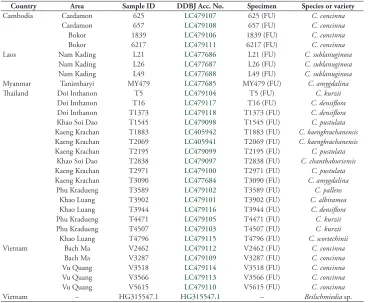
Table 1. Sample lists for genotyping.
Country Area Sample ID DDBJ Acc. No. Specimen Species or variety
Cambodia Cardamon 625 LC479107 625 (FU) C. concinna
Cardamon 657 LC479108 657 (FU) C. concinna
Bokor 1839 LC479106 1839 (FU) C. concinna
Bokor 6217 LC479111 6217 (FU) C. concinna
Laos Nam Kading L21 LC477686 L21 (FU) C. sublanuginosa
Nam Kading L26 LC477687 L26 (FU) C. sublanuginosa
Nam Kading L49 LC477688 L49 (FU) C. sublanuginosa
Myanmar Tanintharyi MY479 LC477685 MY479 (FU) C. amygdalina
Thailand Doi Inthanon T5 LC479104 T5 (FU) C. kurzii
Doi Inthanon T16 LC479117 T16 (FU) C. densiflora
Doi Inthanon T1373 LC479118 T1373 (FU) C. densiflora
Khao Soi Dao T1545 LC479098 T1545 (FU) C. pustulata
Kaeng Krachan T1883 LC405942 T1883 (FU) C. kaengkrachanensis
Kaeng Krachan T2069 LC405941 T2069 (FU) C. kaengkrachanensis
Kaeng Krachan T2195 LC479099 T2195 (FU) C. pustulata
Khao Soi Dao T2838 LC479097 T2838 (FU) C. chanthaburiensis
Kaeng Krachan T2971 LC479100 T2971 (FU) C. pustulata
Kaeng Krachan T3090 LC477684 T3090 (FU) C. amygdalina
Phu Kradueng T3589 LC479102 T3589 (FU) C. pallens
Khao Luang T3902 LC479101 T3902 (FU) C. albiramea
Khao Luang T3944 LC479116 T3944 (FU) C. densiflora
Phu Kradueng T4471 LC479105 T4471 (FU) C. kurzii
Phu Kradueng T4507 LC479103 T4507 (FU) C. kurzii
Khao Luang T4796 LC479115 T4796 (FU) C. scortechinii
Vietnam Bach Ma V2462 LC479112 V2462 (FU) C. concinna
Bach Ma V3287 LC479109 V3287 (FU) C. concinna
Vu Quang V3518 LC479114 V3518 (FU) C. concinna
Vu Quang V3566 LC479113 V3566 (FU) C. concinna
Vu Quang V5615 LC479110 V5615 (FU) C. concinna
Vietnam – HG315547.1 HG315547.1 – Beilschmiedia sp.
Next generation DNA sequencing – MIG-seq
Phylogenetic tree reconstruction
For DNA barcoding analysis, MEGA X (Kumar et al. 2018, http://www.megasoft-ware.net/) was used to assemble the ITS sequences of 30 samples including 29 of Cryptocarya spp. and an additional sample of Beilschmiedia sp.; MAFFT ver. 7 (http:// mafft.cbrc.jp) was used to align ITS sequences. We reconstructed a phylogenetic tree by the maximum likelihood method with Tamura 3-parameter model using MEGA X with a bootstrap test of 1500 replicates. In addition, we drew a TCS haplotype net-work (Clement et al. 2000) among 29 samples of Cryptocarya using POPART ver.1.7 (Leigh and Bryant 2015).
For MIG-seq, we pretreated the raw data of Cryptocarya samples following the quality control protocol of Suyama and Matsuki (2015) and Binh et al. (2018). We then assembled homologous sequences (designated as loci below) with the de novo map pipelines (ustacks, cstacks, sstacks) using Stacks ver. 1.48 (Catchen et al. 2011). First, we assembled loci by ustacks with the following settings: m = 3, M = 3, N = 2, and maximum gaps = 2 (where “m” is the minimum depth of coverage, “M” is maximum distance allowed between stacks, and “N” is the maximum distance al-lowed to align secondary reads to primary stacks). We then used cstacks to build a catalogue of consensus loci by assembling loci from ustacks, by setting the parameter of “number of allowed mismatches between sample (n)” as 2. Second, by using the sstacks, we associated all stacks created by ustacks with the catalog produced by cstacks. Third, we got an output vcf file containing genotypes of individuals at each locus. Subsequently, we used the vcf2phylip program (Ortiz 2019) to convert the vcf file to a phylip type file. Finally, we constructed a maximum likelihood tree with RAxML ver. 8.2 (Stamatakis 2014) and examined its reliability by bootstrapping using 1500 replicates.
Results
Field observation
which were lower than 4 m. However, we could not identify these trees and vouchers were not collected. In the plot at 960 m (Fig. 1), we recorded girth × height for two trees of the Kaeng Krachan taxon as 24.3 cm × 5 m and 15.7 × 4.5 m, respectively. In addition, in the vicinity of the plot, a fruiting specimen (T2069) was collected from a tree 12 m tall on 23 Oct. 2013. Young trees of the Kaeng Krachan taxon lower than 4 m were found in all ten sections of 10 m × 5 m in the 100 m × 5 m plot at the elevation of 960 m.
Morphological observation
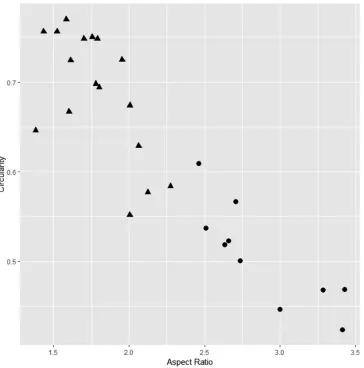
In fruiting specimens, the Kaeng Krachan taxon (T2069; Fig. 2) has relatively shorter and broader leaves than C. amygdalina (T3090; Fig. 3), but the ranges are largely overlapping: the range (and average±SD) of leaf length (cm) is 2.6–10.3 (7.2±2.5) in the Kaeng Krachan taxon (n=17) vs. 9.4–14.1 (11.6±1.4) in C. amyg-dalina (n=10); the range of leaf width (cm) is 1.5–6.4 (4.2±0.6, n=17) vs. 3.5–5.2 (4.1±1.2, n=10). On the other hand, the two species are distinct in aspect ratio: 1.38–2.28 (1.79±0.25) in the Kaeng Krachan taxon vs. 2.46–3.43 (2.88±0.37) in C. amygdalina. The two taxa were also different in circularity, but with overlapping values: 0.55–0.77 (0.69±0.07) vs. 0.42–0.61 (0.51±0.06). Figure 4 shows that the Kaeng Krachan taxon is distinguishable from C. amygdalina by having a lower aspect ratio and larger circularity.
The abaxial leaf blade surface of the Kaeng Krachan taxon is sparsely covered with minute hairs that are almost invisible to the naked eye or hand lens (10 ×), but visible under a microscope (25 ×). Similarly, the lower leaf surface of C. amygdalina (T3090) is sparsely covered with minute hairs that are visible only under a microscope (25 ×). Both C. amygdalina and the Kaeng Krachan taxon have scalariform to scalariform-reticulate tertiary veins and it is difficult to distinguish between the two species by their venation.
Figure 3. Cryptocarya amygdalina A leafy branchlet B lower leaf surface C specimen Tagane et al. T3090
Figure 4. Scatter plot of leaf aspect ratio (horizontal axis) and circularity (vertical axis). Solid circles:
Cryptocarya amygdalina, solid triangles: C. kaengkrachanensis.
Phylogenetic analysis
Figure 5. Maximum likelihood tree of Cryptocarya species from Thailand reconstructed from ITS se-quences. Numbers: bootstrap values; Scale bar: mean number of nucleotide substitutions per site; solid triangle and square bracket: clade of 95% bootstrap value.
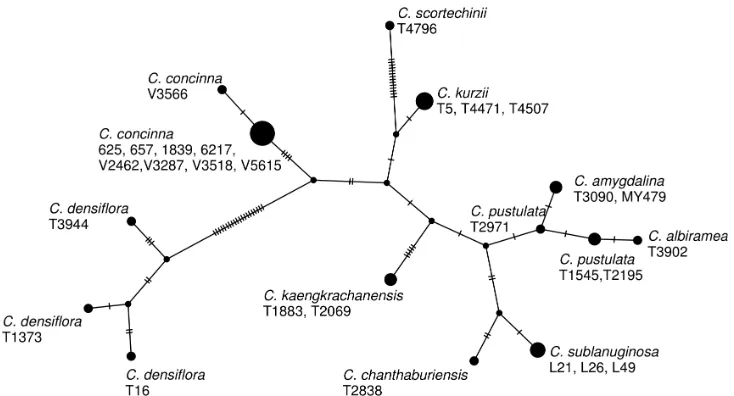
the plants of the Kaeng Krachan taxon sister to this clade, differing by 10 base pairs in the ITS sequences (Fig. 6) and are distinct from each other in the ITS haplotype network (Fig. 6).
Figure 6. A haplotype network of Cryptocarya species from Thailand constructed from the ITS sequences.
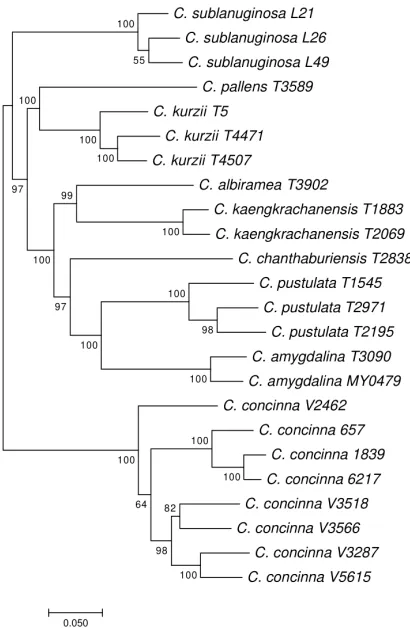
7). While C. amygdalina and C. pustulata were sister to each other, the Kaeng Krachan taxon was not sister to either of these species, but instead to C. albiramea (Fig. 7), with 99% bootstrap (BS).
Based on the evidence of morphology and phylogenetic analysis presented above, the two samples (T1883 and T2069) collected from Kaeng Krachan national park clear-ly represent a distinct and new species, which is named as Cryptocarya kaengkrachanensis.
Taxonomy
Cryptocarya kaengkrachanensis M.Z.Zhang, Yahara & Tagane, sp. nov. urn:lsid:ipni.org:names:77206953-1
Fig. 2
Figure 7. A maximum likelihood tree of Cryptocarya species from Thailand. reconstructed using MIG-seq data. Numbers: bootstrap values; Scale bar: mean number of nucleotide substitutions per site;
Type. THAILAND. Phetchaburi Province: Kaeng Krachan National Park, 960 m elev., 12°49'19.7"N, 99°21'57.7"E, 23 Oct. 2013, Tagane S., Nagamasu H., Naiki A., Rueangruea S., Suddee S., Fuse K., Keiwbang W., Pansamrong P. T2069 [fr.] (holotype KYO!, isotypes BKF!, FU!, KAG!).
above, raised below; the range (and average±SD) of petiole length (cm) is 0.7–1.5 long (1.1±0.22, n=10), flat above, rounded below, dark brown when dry, covered with short yellowish hairs. Inflorescences and flowers not seen. Infructescence axillary, 4–17 cm long (8.4±3.4, n=16) (the range, average±SD), rachis hairy, lenticellate; bracteoles not seen. Immature fruits ovoid, 9.9–13.8 mm long (11.49±1.28, n=14), 5.8–9.7 mm wide (7.53±2.36, n=14) with aspect ratio 1.36–1.85 (1.54±0.14, n=14). yellow green when fresh, dark brown when dry, shortly hairy. Fruiting stalk slightly swollen, rough, light brown when fresh, dark brown when dry. Mature fruits not seen.
Other specimens of C. kaengkrachanensis examined. THAILAND. Phrae Prov-ince: between Ban Nam Krai and Pha Tuem, 16 Apr 1970, Smitinand T., Cheke A.S. 10817 [BKF 46511!]. Phetchaburi Province: Kaeng Krachan National Park, 960 m elev., 12°49'19.7"N, 99°21'57.7"E, 23 Oct. 2013, Tagane S., Nagamasu H., Naiki A., Rueangruea S., Suddee S., Fuse K., Keiwbang W., Pansamrong P. T1883 (BKF!, FU!). Kanchanaburi Province: Thong Pha Phum District, Pilok, at the Thai-Burmanese bor-der. C. 900 m. 14 41.0'N, 98 21.8'E, tree 12m, 25 January 2009 [fr.], Middleton D.J., Karaket P., Lindsay S., Suddee S. 4785 [BKF 182421!].
Distribution. Endemic to Thailand. The new species is currently only known in a few protected areas of Phrae, Phetchaburi and Kanchanaburi Provinces including Kaeng Krachan National Park.
Etymology. The specific epithet kaengkrachanensis is derived from the name of the national park from which the species has first been recorded.
Conservation status. Least Concern (IUCN 2012, 2017). This species occurs in hill evergreen forests of some protected areas including Kaeng Krachan National Park and there is no sign of declining trends.
Discussion
In Kaeng Krachan National Park, we found three species of Cryptocarya that grew at different elevations. While C. pustulata was collected at lower elevations, 360 m, 550 m and 680 m, C. amygdalina and C. kaengkrachanensis were collected at higher elevations, 709 m and 960 m. Cryptocarya pustulata is a canopy tree constituent and at-tains a height of 25 m and we were unable to collect fertile material of this species. On the other hand, C. kaengkrachanensis is a subcanopy tree and we collected fruits from a tree 12 m tall. This species was common in the hill evergreen forest at an elevation of 960 m. Cryptocarya amygdalina and C. kaengkrachanensis are suspected to flower in different seasons because we collected a fruiting specimen of C. amygdalina (T3090) on 30 May 2014, and a fruiting specimen of C. kaengkrachanensis (T2069) on 23 Oct. 2013. The above observations in the field supported our hypothesis that there are three ecologically distinct species of Cryptocarya in Kaeng Krachan National Park.
of the ITS sequences and are placed in distant positions on both the ITS and MIG-seq trees. While C. kaengkrachanensis was sister to C. albiramea in MIG-seq tree, C. kaeng-krachanensis is distinguished from C. albiramea by having elliptic leaves with leaf aspect ratio less than 2.5 (vs. oblong-lanceolate leaves with leaf aspect ratio more than 2.5).
To apply names to the species of Cryptocarya in Kaeng Krachan National Park, we examined the images of the lectotype and isolectotype of C. amygdalina and noticed that the description of the fruit morphology of C. amygdalina by de Kok (2015) does seem to not agree with the type material of C. amygdalina. While de Kok (2015) de-scribed the fruit stalk of C. amygdalina as “red, strongly swollen when mature” and used this state to distinguish C. amygdalina from morphologically similar species in the key, the type of C. amygdalina has fruit stalks not or only slightly swollen, as in our collec-tion T3090. On the other hand, the fruit stalks of C. kaengkrachanensis are somewhat swollen, and brownish rather than red. The fruit stalks of C. scortechinii Gamble in Malay Peninsula are red and strongly swollen (e.g. G. Kedah, T. Witmore FRI 4683, KEP!). We suggest that the concept of C. amygdalina adopted by de Kok (2015) is a heterogeneous one that includes C. amygdalina s. str., C. scortechinii (see below) and C. kaengkrachanensis. In fact, the following specimen cited under C. amygdalina by de Kok (2015) is identical to C. kaengkrachanensis in leaf morphology; Phrae: between Ban Nam Krai and Pha Tuem, 16 Apr 1970, Smitinand T, Cheke A.S. 10817 [BKF 46511]).
Before concluding that T2069 was an undescribed species, we needed to compare it with the type material of C. floribunda Nees and C. scortechinii Gamble, two names that were treated as synonyms of C. amygdalina by de Kok (2015). The type specimens of C. floribunda [Wallich Cat. n. 2593, BM000880687, K000768399, MEL2390468, MEL2390469, MEL2390467, MNHN-P-P02010447] have only flowers and we cannot verify the fruit characters. However, these specimens are most similar to the lectotype and isolectotype of C. amygdalina in floral and vegetative morphology. Thus, we agree with the earlier treatment of de Kok (2015, 2016a) that C. floribunda is a synonym of C. amygdalina. We collected a specimen (T4796) morphologically similar to the type specimens of C. scortechinii [King’s collector 6297, L0036248-lectotype, MEL2386583-isolectotype] at the elevation of 322 m at Khao Luang, peninsular Thailand. Although our collection is sterile, it is identified as C. scortechinii based on its leaf size, shape, and venation as well as its distribution in peninsular Thailand. As is shown in Fig. 5 and 6, C. scortechinii was placed in a distant position from C. amygdalina. Thus, our evidence does not support the treatment of de Kok (2015, 2016a) that C. scortechinii is a synonym of C. amygdalina. Cryptocarya kaengkrachanensis is easily distinguished from C. scortechinii by its elliptic leaves (aspect ratio lower than 2.5) that are obtuse at the apex and not lustrous above. Based on the evidence provided above, we here concluded that C. kaengkrachanensis is an undescribed species.
Be-cause most species of Cryptocarya are more or less hairy on the lower blade surface and hairiness of leaves is very variable, we do not use the hairiness trait in the following key.
In his key, de Kok (2015) characterized C. amygdalina as “Tertiary veins scalari-form” and other species as “Tertiary veins reticulate to scalariscalari-form”, but the specimen T3090 of C. amygdalina has undulate scalariform veins that are connected by finer reticulate veins. Among Thai species of Cryptocarya, C. chanthaburiensis Kosterm., C. concinna Hance and C. densiflora Blume are characterized by reticulate tertiary veins, but other species including C. amygdalina and C. kaengkrachanensis have more or less scalariform tertiary veins connected with finer reticulate veins. Thus, we used only two categories of venations, reticulate and scalariform, in the key that follows. In de Kok (2015), C. diversifolia Blume, C. ferrea Blume, C. laotica (Gagnep.) Kosterm., C. nitens (Blume) Koord. & Valeton, and C. rugulosa Hook.f. from Thailand, but these species are not included in the following key because we could not confirm the distribution of these species in Thailand.
Identification Key to the species of Cryptocarya in Thailand
1 Leaf aspect ratio less than 2.5 ...2 – Leaf aspect ratio more than 2.5 ...3 2 Basal lateral veins attaining to 1/3 to 1/2 of leaf blade; tertiary veins reticulate;
fruits globose ...C. densiflora
– Basal lateral veins attaining less than 1/4 of leaf blade; tertiary veins scalariform; fruits ovoid...C. kaengkrachanensis
3 Leaves (dried) distinctly glaucous below ...4 – Leaves (dried) not or only slightly glaucous below ...5 4 Leaves lustrous above when fresh, distinctly foveolate above when dried ...
...C. albiramea
– Leaves not lustrous above when fresh, not foveolate above when dried ....C. kurzii
5 Tertiary veins mostly reticulate ...6 – Tertiary veins scalariform ...7 6 Leaves (thinly) leathery; lamina oblong, oblong-lanceolate, (5.5–)10–19 × (2.6–)
3–4.6 cm; petiole 0.8–1.5 cm long ...C. chanthaburiensis
– Leaves papery; lamina elliptic to elliptic-oblong, (3–)5–10(–13) × (1.5–)2–3(–6) cm; petiole 0.4–0.8(–1) cm long ...C. concinna
7 Inflorescences longer than leaves; fruits ellipsoid ...8 – Inflorescences shorter than leaves; fruits globose or unknown (for C. pustulata) 9 8 Leaves lustrous above when fresh; fruit stalks thickly swollen ...C. scortechinii
– Leaves not lustrous above; fruit stalks not or slightly swollen ...C. amygdalina
9 Leaves waxy below, light brown when dried ...C. pallens
– Leaves not waxy below, dark brown when dried ...10 10 Finely reticulate veins raised on the upper surface of dried leaves ....C. pustulata
Acknowledgements
We thank the director and staff of Kaeng Krachan National Park for their help dur-ing the field survey, and the curators of BKF, BO, FOF, FU, KAG, KYO, RUPP, SAR and VNM for allowing us to examine herbarium specimens. This study was supported by the Environment Research and Technology Development Fund (S9 & 4-1601) of the Ministry of the Environment, Japan, and MEXT/JSPS KAKENHI (Grant Number JP15H02640).
References
Binh HT, Ngoc NV, Tagane S, Toyama H, Mase K, Mitsuyuki C, Strijk JS, Suyama Y, Yahara T (2018) A taxonomic study of Quercus langbianensis complex based on morphology and DNA barcodes of classic and next generation sequences. PhytoKeys 95: 37–70. https://doi. org/10.3897/phytokeys.95.21126
Catchen JM, Amores A, Hohenlohe P, Cresko W, Postlethwait JH (2011) Stacks: Building and gen-otyping loci de novo from short-read sequences. G3: Genes, Genomes, Genetics 1(3): 171–182. Clement M, Posada D, Crandall K (2000) TCS: A computer program to estimate gene
ge-nealogies. Molecular Ecology 9(10): 1657–1660.
https://doi.org/10.1046/j.1365-294x.2000.01020.x
de Kok RPJ (2015) A revision of Cryptocarya (Lauraceae) from Thailand and Indochina. Gar-dens’ Bulletin (Singapore) 67(2): 309–350. https://doi.org/10.3850/S2382581215000277 de Kok RPJ (2016a) A revision of Cryptocarya R. Br. (Lauraceae) of Peninsular Malaysia. Kew
Bulletin 71(1): 1–26. https://doi.org/10.1007/s12225-016-9613-1
de Kok RPJ (2016b) A revision of Beilschmiedia (Lauraceae) of Peninsular Malaysia. Blumea 61(2): 147–164. https://doi.org/10.3767/000651916X693004
Doyle JJ, Doyle JL (1987) A rapid DNA isolation procedure for small quantities of fresh leaf tissue. Phytochemical Bulletin 19: 11–15.
Dy Phon P (2000) Dictionary of Plants used in Cambodia. Imprimerie Olympic, Phnom Penh. Hô PH (1999) An Illustrated flora of Vietnam (Vol. 1). Young Publishing House, Ho Chi
Minh City, 951 pp.
IUCN (2012) IUCN Red List Categories and Criteria, Version 3.1. (2nd edn). IUCN, Gland and Cambridge, 32 pp.
IUCN (2017) Guidelines for Using the IUCN Red List Categories and Criteria. Version 13. Prepared by the Standards and Petitions Subcommittee.
Kochummen KM (1989) Lauraceae. In: Ng FSP (Ed.) Tree Flora of Malaya: A manual for foresters (vol. 4). Longman, Kuala Lumpur, 98–178.
Kress WJ, Erickson DL, Jones FA, Swenson NG, Perez R, Sanjur O, Bermingham E (2009) Plant DNA barcodes and a community phylogeny of a tropical forest dynamics plot in Panama. Proceedings of the National Academy of Sciences of the United States of America 106(44): 18621–18626. https://doi.org/10.1073/pnas.0909820106
Kumar S, Stecher G, Li M, Knyaz C, Tamura K (2018) MEGA X: Molecular Evolutionary Genetics Analysis across computing platforms. Molecular Biology and Evolution 35(6): 1547–1549. https://doi.org/10.1093/molbev/msy096
Lecomte H (1914) Lauracées. In: Lecomte PH, Gagnepain F (Eds) Flore générale de l’Indo-Chine 5. Masson Paris, 107–158.
Leigh JW, Bryant D (2015) PopART: Full-feature software for haplotype network construc-tion. Methods in Ecology and Evolution 6(9): 1110–1116. https://doi.org/10.1111/2041-210X.12410
Li XW, Li J, van der Werff H (2008) Cryptocarya. In: Wu ZY, Raven, PH Hong DY (Eds) Flora of China 7: 102–254. http://www.efloras.org
Liou H (1934) Lauracées de Chine et d’Indochine. Hermann Cie, Paris, 220 pp.
Liu B, Yang Y, Xie L, Zeng G, Ma K (2013) Beilschmiedia turbinata: A newly recognized but dying species of Lauraceae from tropical Asia based on morphological and molecular data. PLoS One 8(6): e67636. https://doi.org/10.1371/journal.pone.0067636
Liu ZF, Ci Q, Li L, Li HW, Conran JG, Li J (2017) DNA barcoding evaluation and implica-tions for phylogenetic relaimplica-tionships in Lauraceae from China. PLoS ONE 12(4): 1–20. https://doi.org/10.1371/journal.pone.0175788
Mitsuyuki C, Tagane S, Ngoc NV, Binh HT, Suddee S, Ruangruea S, Toyama H, Mase K, Yang CJ, Naiki A, Yahara T (2018) Two new species of Neolitsea (Lauraceae), N. kraduengensis from Thailand and N. vuquangensis from Vietnam and an analysis of their phylogenetic positions using ITS sequences. Acta Phytotaxonomica et Geobotanica 69(3): 161–173. https://doi.org/10.18942/apg.201810
Newman M, Ketphanh S, Svengsuksa B, Thomas P, Sengdala K, Lamxay V, Armstrong K (2007) A Checklist of the Vascular Plants of Lao PDR. Royal Botanic Garden Edinburgh, Edinburgh, 394 pp.
Ngernsaengsaruay C, Middleton DJ, Chayamarit K (2011) A revision of the genus Litsea Lam. (Lauraceae) in Thailand. Thai Forest Bulletin (Botany) 39: 40–119.
Nishida S (2008) Taxonomic revision of Beilschmiedia (Lauraceae) in Borneo. Blumea 53(2): 345–383. https://doi.org/10.3767/000651908X608007
Ohsawa M (1991) Structural comparison of tropical montane rain forests along latitudinal and altitudinal gradients in south and east Asia. Vegetatio 97: 1–10.
Ortiz EM (2019) vcf2phylip v2.0: convert a VCF matrix into several matrix formats for phylo-genetic analysis. http://doi.org/10.5281/zenodo.2540861
Rohwer JG (1993) Lauraceae. In: Kubitzki K, Rohwer JG, Bittrich V (Eds) The Fami-lies and Genera of Vascular Plants II. Springer Verlag, Berlin, 366–391. https://doi. org/10.1007/978-3-662-02899-5_46
Rohwer JG, De Moraes PLR, Rudolph B, Van Der Werff H (2014) A phylogenetic analysis of the Cryptocarya group (Lauraceae), and relationships of Dahlgrenodendron, Sinopora, Triadodaph-ne, and Yasunia. Phytotaxa 158(2): 111–132. https://doi.org/10.11646/phytotaxa.158.2.1 Schneider CA, Rasband WS, Eliceiri KW (2012) NIH Image to ImageJ: 25 years of image
analysis. Nature Methods 9(7): 671–675. https://doi.org/10.1038/nmeth.2089
Sri-Ngernyuang K, Kanzaki M, Mizuno T, Noguchi H, Teejuntuk S, Sungpalee C, Hara M, Yamakura T, Sanhunal P, Dhanmanonda P, Bunyavejchewin A (2003) Habitat differentia-tion of Lauraceae species in a tropical lower montane forest in northern Thailand. Ecologi-cal Research 18(1): 1–14. https://doi.org/10.1046/j.1440-1703.2003.00539.x
Stamatakis A (2014) RAxML Version 8: A tool for phylogenetic analysis and post-analysis of large phylogenies. Bioinformatics 30(9): 1312–1313. https://doi.org/10.1093/bioinfor-matics/btu033
Suyama Y, Matsuki Y (2015) MIG-seq: An effective PCR-based method for genome-wide sin-gle-nucleotide polymorphism genotyping using the next-generation sequencing platform. Scientific Reports 5(1): 16963. https://doi.org/10.1038/srep16963
Tagane S, Toyama H, Chhang P, Nagamasu H, Yahara T (2015) Flora of Bokor National Park, Cambodia I: Thirteen new species and one change in Status. Acta Phytotaxonomica et Geobotanica 66: 95–135. https://doi.org/10.18942/apg.KJ00010001424
Tagawa H (1995) Distribution of lucidophyll oak-laurel forest formation in Asia and other areas. Tropics 5(1/2): 1–40. https://doi.org/10.3759/tropics.5.1
Toyama H, Kajisa T, Tagane S, Mase K, Chhang P, Samreth V, Ma V, Sokh H, Ichihashi R, Onoda Y, Mizoue N, Yahara T (2015) Effects of logging and recruitment on community phylogenetic structure in 32 permanent forest plots of Kampong Thom, Cambodia. Philo-sophical Transactions of the Royal Society B: Biological Sciences 370(1662): 20140008– 20140008. https://doi.org/10.1098/rstb.2014.0008
van der Werff H (2001) An annotated key to the genera of Lauraceae in the Flora Malesiana Region. Blumea 46: 125–140.
Wuu-Kuang S (2011) Taxonomic revision of Cinnamomum (Lauraceae) in Borneo. Blumea
56(3): 241–264. https://doi.org/10.3767/000651911X615168