Reviewable v1 Policy Brief
Summary report and strategy recommendations for
EU citizen science gateway for biodiversity data
Veljo Runnel, Florian Tobias Wetzel, Quentin John Groom, Wouter Koch, Israel Pe’er, Nils Valland
, Emmanouela Panteri, Urmas Kõljalg
‡ University of Tartu, Tartu, Estonia
§ Museum für Naturkunde Berlin, Leibniz Institute for Evolution and Biodiversity Science, Berlin, Germany | Agentschap Plantentuin Meise, Meise, Belgium
¶ Norwegian Biodiversity Information Centre, Trondheim, Norway # GlueCAD, Haifa, Israel
¤ Hellenic Centre for Marine Research (HCMR), Heraklion, Greece
Corresponding author: Veljo Runnel ([email protected]) Received: 20 Dec 2016 | Published: 22 Dec 2016
Citation: Runnel V, Wetzel F, Groom Q, Koch W, Pe’er I, Valland N, Panteri E, Kõljalg U (2016) Summary report and strategy recommendations for EU citizen science gateway for biodiversity data. Research Ideas and Outcomes 2: e11563. https://doi.org/10.3897/rio.2.e11563
Abstract
Citizen science is an approach of public participation in scientific research which has gained significant momentum in recent years. This is particularly evident in biology and environmental sciences where input from citizen scientists has greatly increased the number of publicly available observation data. However, there are still challenges in effective networking, data sharing and securing data quality. EU BON project has analyzed the citizen science landscape in Europe with regards to biodiversity research and proposes several policy recommendations. One of the recommendations is a Pan-European citizen science gateway for biodiversity data with dedicated tools for data collection and management. The prototypes of the gateway components are part of the EU BON biodiversity portal and described in current report.
‡ § | ¶ #
¶ ¤ ‡
Keywords
citizen science, biodiversity observations, volunteering, motivation, data, data sharing, policy
Introduction
This report reviews biodiversity related citizen science in Europe, specifically the data mobilization aspect and gives an overview of citizen science related activities in the project EU BON, the European Biodiversity Observation Network. In addition, recommendations for a Pan-European citizen science gateway and data mobilization efforts will be given, with the aim of filling in existing biodiversity data gaps. Also the EU BON citizen science gateway is described, which is a part of the European Biodiversity Portal (http:// biodiversity.eubon.eu) with citizen science related products. The citizen science gateway gives an overview of existing citizen science tools, initiatives and products, information about best practice examples, guidance for uploading and curating data and also make it openly accessible (e.g. via transferring the data to data publishers as GBIF).
Citizen science (CS) is a term which has been used to describe volunteer participation in research or activities which have scientific meaning. The exact meaning and context of the term can vary and sometimes it is used as general notion to describe interactions between science and society. “Public participation in scientific research” (PPSR), “crowdsourcing”, “participatory monitoring” and “citizen observatories” are examples of the terms which are
used sometimes as synonyms and some other times covering specific aspects of the
broader term “citizen science”. A definition which suits the scope of EU BON project regarding citizen science is offered by Roy et al (Roy et al. 2012): "Volunteer collection of biodiversity and environmental data which contributes to expanding our knowledge of the natural environment, including biological monitoring and the collection or interpretation of environmental observations”. We will use in turn this definition and particularly focus on biodiversity observation data.
Biodiversity and citizen science
of citizen science in biodiversity monitoring volunteering is an important aspect (Roy et al. 2012). In research which employs citizen science methods the largest body of articles is in biology and conservation, followed by geographical research, social sciences and health (Kullenberg and Kasperowski 2016). Four types of participatory networks were identified for biodiversity monitoring which rely on volunteering: participating in environmental tourism; virtual network organisations; national NGOs and local associations (Bell et al. 2007). Some of those networks have been active for more than 100 years, but virtual network organisations and information sharing using the internet are relatively new concepts and practices which have quickly advanced. With the rise of online nature observation portals the number of opportunistic observations that are publicly available has also been increasing.
Europe and citizen science
Europe has an active and vibrant community of citizen scientists and their organizations. CS encompasses a wide range of scientific studies, including astronomy, biology and the environmental sciences. However, research related to biodiversity monitoring is one of the most active. The EC-funded project EuMon studied EU-wide biodiversity monitoring methods and systems in 2004-2008. EuMon compiled a database (DaEuMon) of European biodiversity monitoring schemes (at the moment it counts 656 schemes) to draw a first image of biodiversity monitoring in Europe. Among other aspects the project also focused on volunteer participation (Schmeller et al. 2012, Schmeller et al. 2009). They found that of 327 participatory monitoring networks in Europe, 80% relied on volunteer help (EuMon 2016). There are several important organizations guiding and connecting CS schemes in Europe including OPAL (Open Air Laboratories, https://www.opalexplorenature.org/) from London's Imperial College, which is a well known initiative in UK. Another important network is the ECSA (European Citizen Science Association, http://ecsa.citizen-science.net/) which was launched in 2013 as an informal network of researchers and communicators and as of 2016 is a NGO under German law. ECSA has more than 150 individual and organizational members from 28 countries (ECSA 2016). ECSA is also collaborating with other major citizen science organizations - CSA (Citizen Science Association, http://citizenscience.org/) in USA and ACSA (Australian Citizen Science Association, http://csna.gaiaresources.com.au/wordpress/). Although there are efforts to guide and manage citizen science initiatives, an enormous number of organizations involved in this field in Europe are still fragmented by country, region, language, taxonomic interest and methodology. The European Seventh Framework Programme project Socientize (http://www.socientize.eu/?q=eu) identified the challenges and solutions for citizen science in Europe and published a white paper on the subject (Socientize consortium 2014).
researchers. A report carried out on behalf of the UKEOF (UK Environmental Observation Framework) outlines the motivations, benefits and barriers in citizen science and suggests that there is “a need to understand how motivations differ in/between developed and developing nations” and summarises what encourages and discourages participation (Geoghegan et al. 2016). Based on this current heterogeneities in the citizen science landscape, the approach in EU BON was to help the citizen science community in streamlining efforts, collecting best-practice examples and in finding ways to standardize data that was collected with the help of volunteers.
EU BON, biodiversity and citizen science
The EU-funded project EU BON (European Biodiversity Observation Network, cf. Hoffmann et al. 2014) addresses the existing barriers to improve the biodiversity data landscape by integrating, harmonizing and standardizing biodiversity information from on-ground to remote sensing data. The global framework is set by GEO, the Group on Earth Observations and its biodiversity section, the Biodiversity Observation Network of GEO (GEO BON). Europe’s support for this initiative is currently EU BON, an EU-funded project which builds on existing biodiversity information systems and infrastructures (e.g. the Global Biodiversity Information Facility, LifeWatch, LTER) thereby aims to provide improved access to integrated data from various fields .
One of the central tasks is the development of a new open access platform (called the European Biodiversity Portal, http://biodiversity.eubon.eu) for sharing biodiversity data and tools, as well as results from current analyses. A part of the European Biodiversity Portal is dedicated to citizen science and serves as the major entry point for accessing the EU BON work on the citizen science gateway.
In general, there are a number of contributions of Biodiversity Observation Networks (BONs) towards mobilizing biodiversity information for use by policy development and decision-makers (Wetzel et al. 2015). Data leveraged from various sources are standardised and integrated by BONs (e.g. application of standards, creation of data and knowledge products, modelling), whilst ensuring alignment with policy needs hence making biodiversity data discoverable, accessible and processable.
main goals of a common EU citizen science Gateway is to integrate CS data for European biodiversity research. EU BON also seeks to develop a strategy for achieving this goal and encourages educational aspects of citizen science through networking and the development of tools.
EU citizen science gateway for biodiversity data
With the growing interest of citizens to contribute and participate in scientific research a huge variety and number of CS initiatives emerged. In parallel, the mobilization of citizens to participate in scientific research creates a growing need for systematized, standardized creation of workflows for citizen science data in order to generate scientific knowledge.
A range of CS projects are already active or just recently started its activities and many of them want to learn from existing knowledge, experiences and best practices already gained in former projects (see an EU BON analysis of the current biodiversity data and project landscape in Suppl. material 1).
EU BON has identified the need for a action plan for a pan-European citizen science gateway. The EU citizen science gateway for biodiversity data is in essence a CS network for biodiversity information. It offers information for CS project leaders, project members and citizen science stakeholders (environmental agencies, municipalities, educational institutions, NGOs etc) in Europe. The EU BON proposed CS gateway includes a wealth of information on CS project designs, standards in use, directories of projects and SC data providers (Suppl. material 1) as well as guidelines with an option for project leaders to improve their own projects, data and workflows.
Although the EU BON citizen science gateway builds on many extant initiatives and networks, it should also provide an overview of them and aim to provide additional important support for overcoming the problems caused by the limitations existing with current portals. One of the main data providers for biodiversity data is the Global Biodiversity Information Facility (GBIF) that also offers a quite significant amount of CS data. To make publishing in GBIF easier, EU BON offers centralized entry points for data holders - as an instance of Integrated Publishing Toolkit and PlutoF biodiversity data platform.
Agency website (European Environmental Agency 2013) which use CS methods but also this list shows some significant limitations.
Hence, EU BON promotes (cf. EU BON citizen science gateway) and recommends some tools and platforms for data curation and upload in order to overcome existing limitations.
In this paper we will present some of the major work and achievements of EU BON related to citizen science:
(a) experiences in linking networks and main actors of citizen science on a European scale,
(b) work on data governance and requirements: data standards, quality and intellectual property rights,
(c) EU BON citizen science gateway as a model for improving the European CS data landscape in Europe,
(d) and finally the conclusions and recommendations to the European Commission.
Experiences in linking networks and main actors of citizen
science on European scale
Challenges for European citizen science networks
An important task of the citizen science gateway is, in addition to providing tools and the technical infrastructure, to establish a close cooperation between the main actors of CS on European scale. There are many projects, initiatives and networks that focus on citizen science or that involve citizen scientists, for example in data collection and monitoring of species. Best practices, experiences and tools should be shared, discussed and further developed and common approaches are needed in order to avoid duplicating efforts. Other challenges, specifically for citizen science data exist and common solutions need to be established that could be only found by a close cooperation of networks, projects and individual researchers and citizen scientists.
In a EU BON workshop it was shown that lots of data generated by citizen science projects cannot be used due to data usage restrictions. As an analysis of Nils Valland shows, of the around 570 million records of species occurrence data that were collected with the help of citizen scientists, only 100 million records are available via GBIF, which means only around 18% (see Fig. 1, Suppl. material 1 for a more detailed overview). There are many voluteers involved in gathering this data - for example in the species observation system Artsdatabanken around 20,000 rapporteurs contributed data in Sweden and 12,000 rapporteurs in Norway. The finding that only a small percentage of the data is shared is also supported by a recent study showing that only 12% of the citizen science projects provide evidence that data are used in scientific research (Theobald et al. 2015). Even when those data are shared they tend to be licenced with more restrictive terms (Groom et al. 2016).
These cases illustrate that considerably more data could be made available with the help of projects such as EU BON. To achieve this, good communication and exchange of ideas within CS networks and with other initiatives and projects are needed. The individual researchers need appropriate tools for data mobilization; they need databases where the data can be hosted and curated and where quality control can take place; finally they need help in making the data openly available, for example to GBIF or to open repositories such as Dryad or others to ensure that data will become discoverable in the GEOSS data portal (www.geoportal.org). A central aspect of the networking is to spread the word on data standards and enhancing open access, so knowledge about existing approaches for open data were disseminated. For example information on the GEOSS data sharing principles that demand that data, metadata and products are shared openly, made available with a minimum time delay and that data is free of charge or no more than the cost of reproduction.
Figure 1.
Data mobilization is also important as many data gaps exist on a European scale with regards to biodiversity information. An EU BON analysis of data mediated by the Global Biodiversity Information Facility (GBIF), one of the most important European and global mediators for biodiversity data, shows that data are still biased, for example, there are spatial gaps in Eastern European countries (Wetzel 2015). These gaps, along with taxonomic and temporal gaps, need to be filled in and citizen science projects could tremendously help to this end. A first step could be the mining of existing CS projects for their observation data. Good starting point is EuMon database of biodiversity monitoring schemes which provides rich metadata for projects. One of the discussed topics was to generate an overview of existing citizen monitoring initiatives. This task was later followed in the course of designing the citizen science part of the biodiversity portal, e.g. by listing major citizen science data providers in Europe. Another open task is also to find strategies to leverage additional data, e.g. to fill the existing large gaps in genetic datasets (Geijzendorffer et al. 2015). So data mobilization remains an important topic, also to fulfill national, regional and international reporting obligations, for example for monitoring progress on the Aichi biodiversity targets of the Convention on Biological Diversity (CBD 2014).
Data quality is another important topic that needs to be focused on when dealing with citizen science projects. Generally it was shown that CS initiatives can provide an important data source for research, eBird data for example has been used in at least 90 peer-reviewed scientific articles on climate change, ecology and other types of research (Bonney et al. 2014). However, data quality filtering mechanisms are needed as particularly unstructured citizen science data is often not suitable for analysing species state and trends or is generating mismatching trends (Kamp et al. 2016). Solutions for this are available and await to be adopted by portals and the CS community, e.g. by promoting data curation platforms and mechanisms ensuring a high data quality (e.g. by expert validation as conducted e.g. on the Norwegian Species Observation System, NBIC 2016).
Linking CS related data, projects, stakeholders and networks in EU BON
Many initiatives, projects and networks in Europe are already collecting, integrating and engaging citizen science based biodiversity data and activities. One group of stakeholders are end-users of the generated data (e.g. researchers, governments and political administration), another one are volunteers and citizen scientists and both groups have their own interests, intentions and aims they follow (Pocock et al. 2015).
researchers in particular in that regard, EU BON conducted a survey in 2014 (Suppl. material 2).
As mentioned before, the European Citizen Science Association (ECSA) is an important player in CS networking, a non-profit organization to foster citizen science activities on a European scale. Over 150 individual and organizational members from 28 countries participate in the report with the main aim to link citizens and science (European Citizen Science Association 2016). In ECSA there are several thematic working groups focusing on different aspects, for example a ‘Sharing Best Practice and Building Capacity’ Committee , a ‘Citizen Science and Responsible Research and Innovation’ Committee or a ‘Projects, Data, Tools, and Technology’ Committee . The latter focuses primarily on issues that are connected to the data collected by citizen science initiatives and hence central aspects of the work are on data interoperability, reliability and intellectual property rights.This working group shares many topics that are also relevant for the EU BON CS Gateway and a particularly tight collaboration and exchange was foreseen and carried out with this working group.
Abovementioned GBIF became a major player and leading facilitator in providing open access to data on global scale. GBIF promotes open standards and free tools for biodiversity data management and exchange (see more for example on the GBIF Integrated Publishing Toolkit (IPT) in chapter Data governance). Among sources of GBIF-mediated citizen science data are networks and tools such as eBird (more than 150 million observations worldwide), iNaturalist and others (e.g. anymals+plants, Diveboard, Scandinavian networks).
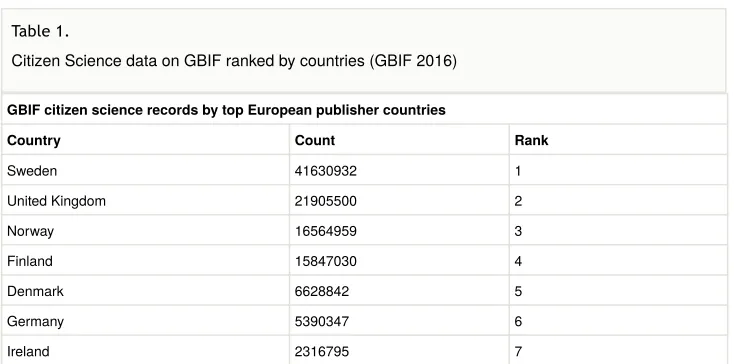
Many European countries provide considerable amounts of citizen science-based data in GBIF (Table 1). However, the top five countries (Sweden, United Kingdom, Norway, Finland, Denmark) alone provide 89% of the data and there are several countries where more efforts are needed to make their citizen science data openly accessible, for example France, Spain, Portugal, Switzerland and Austria.
GBIF citizen science records by top European publisher countries
Country Count Rank
Sweden 41630932 1
United Kingdom 21905500 2
Norway 16564959 3
Finland 15847030 4
Denmark 6628842 5
Germany 5390347 6
Ireland 2316795 7
Table 1.
Belgium 1625973 8
Netherlands 1386167 9
Estonia 921998 10
France 578567 11
Spain 561098 12
Portugal 257531 13
Switzerland 151680 14
Austria 16469 15
One of the tasks in the data workflow is also to make data that was mobilized by EU BON available in GBIF, hence a close collaboration is key. One of the achievements of the project is the development of a spatial dataset browser and a species trends visualization tools that are part of the work of the European biodiversity portal. These tools help to visualize CS-derived observation records and also increase the discoverability of data.
Many European projects are contributing biodiversity data by involving volunteers that help in data collection and processing. Also there are sometimes similar efforts to integrate data and develop tools. A close link to ongoing projects in the field of CS is needed to avoid duplication of efforts and to find synergies among the projects. There have been specific EU-funded projects with similar intentions on building networks and harmonizing data. For example citizen science observatories - community-based environmental monitoring and information systems, in order to stimulate novel Earth observation technologies, exploiting capabilities of portable devices and collective intelligence and to enable participation of citizens in local stewardship. A closer exchange was conducted with three of the five observatory projects, moreover a more formalized cooperation was initiated with the project Socientize by signing a Memorandum of Understanding. The project Socientize had an open and collaborative approach by coordinating and linking participatory projects and actively engaging scientists and citizens that contribute with their knowledge and resources. Several projects were conducted, e.g. on urban bees, and by drafting policy recommendations based on the projects experience. Another project with a closer linkage was a Citclops (http://www.citclops.eu/), a project on water monitoring and participatory science. In this project, citizens participated in the collection of environmental data, i.e. water color, transparency and fluorescence, by using smartphones and low-cost sensors in coastal and oceanic areas. Aim was to improve governmental environmental observation systems in order to improve current (political) decision making. Another project was COBWEB, the Citizen OBservatory WEB, (http://cobwebproject.net/about) for crowd sourced environmental data that was collected by citizen scientists with mobile devices in UNESCO biosphere reserves. These projects were all programmes funded under the 7th research framework and discussion took place on technological and data workflow issues.
2016). Also open access is still an issue, as 26% of the respondents answered that the data from their projects is not available for re-use, however, also sustainable storage and access to data is an issue as 42% of the project respondents replied that access will only be guaranteed within the project’s lifetime and in most cases the Citizen Science data is stored on a remote server that is hosted by a project member (Schade and Tsinaraki 2016).
An important way to facilitate exchanges between main actors and interest groups in EU BON were the Stakeholder Roundtables, a series of four meetings that aimed to enable discussions among relevant stakeholders (Fig. 2).
For the citizen science related-tasks, such meetings and roundtables are needed for:
• generally for connecting EU CS initiatives and networks and to allow feedback on the different approaches and exchange of ideas and strategies,
• finding solutions for existing problems (filling data gaps, workflows from data collection to analysis and dissemination, development of tools for data collection and curation),
• derive success factors of citizen science projects (lessons learnt, guidelines and methods to obtain adequate and high quality data),
• share best-practice examples from existing projects in different levels (from the project level to policy recommendations),
• facilitating new (technological) developments of portals, tools and databases by joining forces.
During the roundtables, citizen science subjects were discussed in many working groups, world cafe sessions and are part of products of EU BON, e.g. in the European Biodiversity Portal.
Figure 2.
One of the roundtables particularly addressed this topic, i.e. the 2nd EU BON Stakeholder Roundtable that took place in Berlin in November 2014 with the title “How can a European biodiversity network support citizen science?”.
At the roundtable, various stakeholders from the field of citizen science were invited to discuss possibilities of interactions and the role of EU BON for supporting citizen science on a European scale. Addressed stakeholders were different citizen science projects, researchers and biodiversity networks.The aim of the roundtable on citizen science was to explore how and with which means EU BON can support citizen science activities and to connect the projects of EU BON consortium partners with other European initiatives. The project may act as data portal to find the right data base for the data, EU BON may provide tools to visualize and interpret data, EU BON may provide tool to assess the quality of data and link it to broader information pools such remote sensing data or modeling information. However, also the citizen science community was asked what it expects from EU BON.
The discussions and linkages at the roundtable were an important kick-off for the further work with other networks, such as ECSA and connections to other projects. In the course of the project, some important recommendations were drafted and experiences shared that helped to improve the citizen gateway approach. There are also some critical success factors for citizen science projects that aim to gather data for observation records, for example:
• Data quality (Effective user interface and rich user services needed, relevance, e.g. environmental impact, cooperation of governmental institutions and NGOs), • Data quantity (Not anonymous, visibility: report first - quality control second,
informal voluntarily community, quality control, validation on priority species, cooperation of governmental institutions and NGOs),
• Accessability (effective data distribution, open data and clear license information).
Overall, a tight exchange with stakeholders, e.g. citizen science projects, networks and initiatives is needed in order to include feedback mechanisms to adapt the original plans that were foreseen when writing project proposals. However, particularly in the rapidly evolving field of citizen science, European projects and web-based technology, such as smartphone applications it is important to conduct such feedback loops for adaptive management and reducing the duplications of efforts with regards to theoretic frameworks, infrastructure and technology.
Citizen science networking recommendations for Eastern and Central Europe
restraints still need to be examined. In addition to technical or infrastructure hindrances for data sharing there can also be problems with volunteer motivation. Volunteering for biodiversity monitoring in Eastern and Central Europe has in some cases been influenced by socio-political background of these countries (Bell et al. 2011).
To draw focus on the potential of CS for biodiversity data mobilization, EU BON project organized a workshop specifically aimed at Eastern and Central European countries. During the citizen science workshop in Tartu (Estonia) that took place from 27-28 June in 2016, the participants analyzed how people and institutions that work on citizen science could more effectively collaborate, how they could share their data efficiently and what useful best practices exist. Participants identified solutions for better networking. For effective collaboration there is a need for improving the knowledge base. In order to achieve this goal, it was proposed to develop a special training program that could be organized by recognized expert organizations or institutions (like the European Citizen
Figure 3.
Peacock Butterfly Aglais io (Linnaeus, 1758) occurrences visualized in GBIF portal (A), distribution map in Fauna Europaea (B) and occurrences in Latvian national observation portal dabastati.lv (C).
Figure 4.
Science Association). For local counseling a solution could be to appoint a “community manager” or middleman (facilitator) who can advise both researchers and project managers how to communicate with volunteers (participants) in the best way, and to advise which methodology and standards should be used for data handling. Training of such community managers could be supported by European central institutions and ECSA could also be involved. Although bottom-up initiatives should be encouraged and are crucial for a long-term sustainability of citizen science, the countries with only little history of community-based research initiatives would benefit from top-down approach for building up the knowledge base and assistance network for citizen science. The existing networks of knowledge like schools would be a possible solution for citizen science community hubs. Data sharing is an important part of keeping citizen science approaches sustainable to ensure a long-term availability of data and in order to close temporal gaps of data. In order to reuse and harmonize data, it will be crucial that CS projects apply standards to enable data integration and interoperability. However, the ultimate challenge for any initiative is securing the funding. Clear funding mechanisms for citizen science can help to start new projects with strong predisposition for success so there is an urgent need for enhanced funding mechanisms from national governments and the EU. The most important players in the CS network that were, identified at the workshop are policy makers, key scientists, NGOs and opinion leaders - all these need to be involved for establishing successful CS initiatives in Eastern and Central European countries.
Data governance and requirements: data standards, quality and
intellectual property rights
Data governance
Data standards
An important aspect of data standards relates to the question of how citizens collect data and how reliable and repeatable they are. Sporadic reports of one species or another may be valuable, but any form of comprehensiveness and repeatability increases the quality of the data collected. Systematic monitoring schemes put particular effort into harvesting repeated observations, with known (or set) sampling effort, of all species at a given site. Data are much more scientifically valuable if they come from the same sites, multiple times within the year and over multiple years. Furthermore, such data can be improved with reports that include all species, preferably with an indication of abundance, because this open the route for key ecological analyses including population trends, changes in community structure and other metrics related to of populations, species and communities that form key EBVs (Essential Biodiversity Variables). Such data are illustrated in the examples of systematic monitoring of birds and butterflies.
Biodiversity data are highly heterogeneous due to the high diversity of observed taxonomic groups, the observation methods used and the different data types. Ensuring data interoperability was also one of the central aims of the EU BON citizen science gateway. There is an urget need for data standardization, and the standardization and data aggregation has to be done in such a way that it is both human and machine readable.
In the biodiversity research community the need for a common ground in terminology has created a well-known and broadly accepted standard called Darwin Core (DwC) with a set of terms with clearly defined semantics (Wieczorek et al. 2012). The DwC standard was developed and formalised by the Biodiversity Information Standards group (TDWG) and ratified in 2009. At first it mainly addressed the needs of natural history collections but later the scope was extended to documenting species occurrences in general. In March 2015,
Figure 5.
TDWG ratified changes to DwC standard that enabled it to express sampling-event datasets. These data derive from environmental, ecological and natural resource investigations that follow standardized protocols for measuring and observing biodiversity
(http://links.gbif.org/ipt-sample-data-primer). The DwC standard not only facilitates the interpretation of data in a unified way but also to publish it.
The Global Biodiversity Information Facility (GBIF) Integrated Publishing Toolkit (IPT)
(http://www.gbif.org/ipt) is a free open source software tool that can be used to publish and share biodiversity data (Robertson et al. 2014). In September 2015 GBIF released a new version of the IPT (v2.3) allowing publication of sampling event datasets (http:// www.gbif.org/ipt/releases). The IPT publishes datasets in Darwin Core Archive (DwC-A) format, which is a compressed set of files based on the Darwin Core terms, and the GBIF metadata profile built using the Ecological Metadata Language (EML). Many citizen science biodiversity projects and initiatives also manage data in compliance with DwC. The well known international citizen science initiative eBird publishes their datasets regularly to GBIF using the IPT. iNaturalist also publishes their dataset to GBIF in DwC-A format, however, they use their own software to do this. Certainly for small CS projects it could be technically more challenging to manage standardized data publishing on their own. Using existing tools such as the IPT, biodiversity monitoring applications or building applications that rely on well-established biodiversity databases via an application programming interface (API) can ease the pressure on data interoperability management. EU BON promoted also with regards to its CS activities the use of DwC and the provision of data to GBIF and training events were held to teach participants in the use of the GBIF IPT tool and in uploading standardized data.
There are also other biodiversity data standards which are relevant for citizen science, for example Access to Biological Collections Data (ABCD).
Standardized metadata are another important aspect to achieve interoperability and to enhance the usefulness of data. The Ecological Metadata Language (EML) is a widely used metadata standard for biodiversity data. Metadata describes the underlying basic features of a dataset for its identification and helps to increase data discovery, e.g. by providing information on when data was collected, where it was collected and by whom etc.
projects. Currently, the list of proposed metadata fields is focused on CS project definitions, statuses, participants, training etc. This is a first start for a proper CS project description. However, additional standards are needed, for example on CS data quality and validation methods.
Data Quality and Validation in citizen science
Public participation in scientific research and the use of volunteers helps to collect an extensive amount of data across large areas and over a long time span. However, data quality remains a primary concern for the research community as the data come from a large and often unknown population of volunteers with different levels of expertise (Conrad and Hilchey 2010).
A plethora of different methods, models and mechanisms exist that aim to enhance the reliability and thereby quality of community-generated data in citizen science. Most projects that have high quality standards employ multiple mechanisms to ensure data quality and appropriate levels of validation. If data collection is following standards, it is possible to apply big data methods for building species distribution models from citizen science data (Kelling et al. 2015). An approach of the data mobilisation in EU BON is also to improve data quality in CS data, so basic error sources of the biodiversity data were analysed and improvements and recommendations in order to enhance data quality were collected:
There are several error sources that negatively affect CS data quality, such error sources are for example:
• Errors in the identification of species, i.e. a misidentification of many species by the data collectors,
• Inaccurate measurements in the field (e.g. geolocation of observations, environmental conditions),
• Inadequate sampling design.
In addition to the pure methodological errors, often there are biases in data collection, especially for sporadic data, with a well-known tendency of observers to report on rare rather than common species, and especially to report unique observations - i.e., when species are observed out of their distribution area or period of occurrence. These create “conceptual errors” that require consideration by data users.
There are also different means to improve data quality that could be categorized by measures that take place before, during and after data submission.
The non-exhaustive list of measures to increase data quality includes:
• standardize sighting and monitoring protocols, designed by professionals: this is one of the key means to ensure highest data quality, and one which requires highest attention - as with good (and known) standards one can use even the simplest data,
• providing introductions and educational materials in order to improve the skills of the participants,
• regular monitoring of the performance to ensure that training and sampling design remain adequate,
• employing online data entry forms with automated error checking capabilities, • screening and validation of potentially erroneous observations,
• developing smart filters to identify potentially erroneous observations, • employing a confirmation process by expert reviewers,
• deploying query based algorithms on historical data to flag species that are reported out of its usual distribution range,
• using mobile applications that allow automated entries such as of geolocated specimens associated with a species sighting.
Citizen-science projects must apply standards for all phases of the data workflow. Standards must become widely accepted as a valuable research tool also for volunteer-generated data where a large number of people participate that have a varying level of expertise. Within the context of biodiversity-related projects, standardization is needed for the taxonomic identification, for monitoring and sampling protocols, for confirmation protocols as well as data fields and formats (e.g. date, time, units) and geolocation. For a validated, confirmed dataset which is targeted for data publication, the next step of standardization would be to qualify it for publishing with a standard biodiversity publishing tool, such as the GBIF IPT. This process involves the mapping of data-fields to comply with standards such as Darwin Core (DwC) or EML. The result is the provision of interoperable data, see also the GBIF manual and guide (http://www.gbif.org/resource/80509).
Data access and intellectual property rights
Factual data, such as collected by citizen science projects, is not subject to intellectual property rights (IPR) regulation as such, since it is not a ‘creation of the intellect’. Reuse would however still require an examination of the data to ensure it does not contain copyrightable work, and a database as a whole may be assigned sui generis rights. A license (or waiver, in the case of no imposed restrictions) serves to signal any potential end user the terms under which the data may be reused indefinitely. This enables especially the use of large, compound "big data" datasets but requires the permission from the citizen scientist as the data provider. It is therefore advisable to implement a licensing policy, taking into account the purpose of the data that is to be collected.
required to assign to all datasets one of the following three standardized licenses or waivers:
• CC0 1.0, under which data are made available for any use without restriction or
particular requirements on the part of users
• CC BY 4.0, under which data are made available for any use provided that attribution is appropriately given for the sources of data used
• CC BY-NC 4.0, under which data are made available for any use provided that
attribution is appropriately given and provided the use is not for commercial purposes.
As of August 2016, datasets that were not assigned one of these licenses were no longer distributed through GBIF. This caused a decline in GBIF mediated data of 48.7 million records (7.5 per cent of the total number of records), because several data publishers did not select one of these licenses for their data before the deadline expired (GBIF 2016).
The GBIF case illustrates the trade-off between larger amounts of data due to a liberal licensing policy towards the data provider in which usage restrictions can be applied freely, and a policy limiting the restrictions a data provider can place on the data in order to accommodate reuse of especially larger datasets. At the same time it illustrates the difficulty of altering licensing policies at a later stage, as this requires data providers to reconsider the limits they wish to impose on usage by others and communicate their choice. It is advisable to specify the objective of the citizen science project and implement a licensing policy in line with this objective from the onset of the project. Within the scope of the EU BON project the emphasis lies on making reuse of biodiversity data both easy and legal, resulting in the recommendation of the CC0 waiver and the CC BY license (Penev et al. 2016).
The EU BON citizen science gateway - A model for improving the
European CS project landscape in Europe
CS data providers and the role of the EU BON CS gateway
Biodiversity data that was collected with the help of citizen scientists come from many different initiatives and projects. To give an overview of potential CS data sources, EU BON developed an overview of CS-based datasets that not only lists valuable CS data, but also gives additional information on the data providers itself. The list of data providers include leading CS-based biodiversity observation data providers and gives information, e.g. on the origin of the data (e.g. management, collections), type of taxa included, number of records, number of rapporteurs.
The source list of the data providers is managed via the PlutoF platform (https:// plutof.ut.ee/#/reference/view/4533; registration needed first) and the list is accessible via the EU BON portal citizen science gateway. The last-updated time of each item in the list is displayed as well as a link to provider's site and email. To ensure the further sustainability of this list, the information on the CS providers is kept in the PlutoF database. There is an option for a multiple user access and data management via the PlutoF workbench, so the workload can be divided and additional collaborators can be invited. PlutoF is used as a workbench and a repository for the data. It is part of the science infrastructure for Estonian research institutions and is being developed and maintained by the University of Tartu Natural History Museum. PlutoF also provides a data endpoint for the EU BON portal to publicly display the list of CS data providers. Maintaining the list is an ongoing task in the EU BON project, needs a dedicated data manager to update current information on providers and data availability. Data integration with PlutoF and EU BON portal will also require technical assistance to periodically check for possible issues and to resolve them.
Mobile apps empower citizen science
A key task of EU BON was the development of mobile phone applications (“apps”) for the citizen science data collection, for example “I saw a butterfly” for sporadic data collection or the 'BMSapp' (“Biodiversity Monitoring Schemes”) apps for systematic monitoring of any transect-based list of taxa, e.g. butterfly of an amphibians. “I saw a butterfly” is communicates with the PlutoF-API to store observations.
There are several reasons that stress the need for the development of mobile phone
applications. A survey among the Butterfly Monitoring Scheme (BMS) members reveals
• GPS is constantly activated and provides information on the spatial location (coordinates) as well as on altitude, spatial accuracy, exact date and time for every reported specimen,
• Activation of camera enables adding documented records, improves validation capacity and may further contribute to learning about host plants and habitat,
• Weather data can be extracted both directly by the application and indirectly by
linking to weather models or nearby meteorological stations,
• Speed of advancement on terrain can provide a measure of sampling-effort (e.g. for transect monitoring),
• Using a standard species list as a reference, resolves typing errors and taxon
mismatch,
• Enabling profiled-based species list, e.g. by country, region, season or ranking of species according to “most observed”, eases the typing and enables on-the-ground validation (e.g., feedback to observer if reporting a species out of its season or distribution range),
• A simple guide (pictures, basic info) can aid identification (may also enhance the interest of volunteers in the application, and useful for learning and self-validation), • For species not easily identified by sight, the guide may include audio files (and
consequently the app should allow for audio recording of the subject) or images of the spoor or other relevant information.
There are some recommended design consideration for mobile applications, that were also implemented in the EU BON CS applications (for a list of the recommended design considerations, see Table 2).
Directory of citizen science tools
Basically there would be two different schemes for the app, one for sporadic recording and the other for systematic monitoring.
Following is a (non-exhaustive) summary of proposed topics and requirements to be considered for the design and handling of data-flow between apps and the EU BON citizen science portal:
Minimum support of platforms: • Android, iOS User management/assistant:
• Observer receives User-ID upon registration plus limited access-writes to edit his/her own data.
• Provide users with common-names (Nomenclatural) to select from in addition to scientific names
• Multilanguage support Quality Management (App side):
• Basic data validations (e.g. numeric values)
• predefined set of required fields according with a selected protocol, • minimum typing (e.g. select from list of specimens).
• use standard taxonomy lists (e.g PlutoF taxonomy backbone) • profile based lists e.g. by country, season etc.
• allow taking pictures for documentation Communications (App to Server/Database):
• Http-based/post (preferred) , data export per sight (no batch mode)
• Employ server's API for data validation, writing to database, import and save pictures • network links, to be serviced by the EU BON citizen science portal (e.g. to GBIF) • enable offline recording (Autosave data locally on device memory if communication fails) Database (server side):
• database platform - MySQL, PostgreSQL , MS-SQL, etc • taxonomy standards of species lists - ITIS, IOC etc
• configuration/scheme to support publishing to GBIF (DwC metadata field names) • honor licenses (data and multimedia ownership, sharing etc)
Server application (optional):
• User interface – enable observers to edit their own data • Sighting approvals - by expert, with feedback to observer
• Quality Management - alert sightings which are out of distribution range, season etc. We note that it is important to allow volunteers in systematic monitoring to report also “no butterflies observed”, in order to ensure that a visit to a site is recorded.
A guide for citizen science project management
As an EU BON survey on volunteer involvement shows, there is a huge potential for citizen science participation in many research projects. However, there are still many barriers that prevent project managers and scientists from involving citizen scientists and many projects
Table 2.
need guidance in recruiting and training volunteers and generally in setting-up projects that enable a sound citizen participation. To make the CS project managing easier, EU BON provides a step-by-step guide on the proper design and management of citizen science projects that focus on biodiversity monitoring. With the help of this guide, users such as citizen science project leaders are pointed to a suitable PlutoF module. The guidelines will be further developed and improved until the end of EU BON project. Working with the guidelines is part of information management via the EU BON portal CMS. It is advisable to merge this job with other information services on CS gateway.
PlutoF citizen science module
This module (see the chapter 'Best practice cases') which operates as a workbench provides users with tools and services to create, manage and share their biodiversity observation projects. However, its database is also used as the source for some content that is available on the EU BON portal. Furthermore, PlutoF is also linked with citizen science mobile telephone applications, such as the butterfly sighting app by GlueCAD and animal sound recording app by the University of Tartu).
PlutoF is a part of science infrastructure for Estonian research institutions and is being developed and maintained by the University of Tartu Natural History Museum. PlutoF workbench is open for all users worldwide. PlutoF also encourages its users to keep data open. Development to enable integration of biodiversity systematic monitoring data from mobile app (e.g. the new BMSapp from GlueCAD) is possible with PlutoF API.
Best practices cases
To help citizen science initiatives manage bidoversity monitoring related aspects of project
management, EU BON provides different best practices case descriptions on webpage.
Some of these examples are presented in supplementary file (Suppl. material 3).
Conclusions and recommendations for European Policy &
Research
Introduction
links to resources, to providers of data and to projects-hostings which can facilitate mobilizing biodiversity data. The EU BON survey showed that CS inputs are increasingly receiving acclaim from the scientific community while measures to enhance data quality get more attention.
Policy
In 2014 the EU project Socientize published a white paper with policy recommendations for CS in general and more particularly in Europe. The work behind the white paper is thorough and results are also relevant for biodiversity research. Its main action points for European policy: integrating CS into existing funding schemes and designing new programmes specifically for CS. From the proposed support measures the data policy will greatly affect the CS gateway. Quality, interoperability and data IPR issues are aspects to consider when reviewing the policy. Open data is a recommended first choice of any CS biodiversity data. EU BON will support the proposed actions and measures of the white paper of Socientize. EU BON findings on regional biodiversity data gaps indicate the importance of supporting central and eastern European countries in their efforts to integrate citizen science in biodiversity research, monitoring and management so that data gaps in these countries could be filled in.
In addition to that, EU BON proposes the formation of a European-wide institution for CS data mobilization. EU BON has identified more than 80 current CS systems in Europe (see Suppl. material 1) which contain more than 500 million of unshared species records. When the EU BON project is completed, permanent institutions are recommended to further work on data rescue, data mobilization and facilitate implementation of efficient tools for citizen science contribution. A European-wide institution would be expedient and need to cooperate with GBIF to ensure an efficient data dissemination.
• This institution, together with GBIF, should have the task to approach and negotiate with current reluctant European system owners aiming to share data with open licenses (CC BY 4.0).
• The target data owners should be institutions and organizations with systems containing large amounts of data, starting with data owners with public funding.
• The geographical target areas should be countries or European regions with gaps
in data availability.
• The targets should cover both scientific institutions collaborating with naturalist NGOs and community based organizations with a potential for data sharing. • For identifying the targets it would be helpful to maintain the EU BON database of
current European CS systems and their metadata.
and system operation), scientific institutions (for quality control and validation) and naturalist NGOs (for community relevance and voluntary contribution).
Community and networking
Citizen science initiatives are a mix of bottom-up and top-down approaches without an official agreed-upon structure to represent every stakeholder in Europe. However, a relatively new NGO is gaining momentum - European Citizen Science Association (ECSA). It has links to nearly every major CS organisation or initiative and also a very strong cooperation with US and Australian counterparts. EU BON sees ECSA as a key organization in networking role in Europe and also for future development of CS gateway for biodiversity data. There is also the Citizen Science Alliance which hosts a collection of CS projects in its “Zooniverse”.
Data sharing
EU BON advocates supporting citizen science projects that follow acknowledged biodiversity data standards, open data principles and publishes the data through recognized data portals such as GBIF.
Citizen science metadata and standards for biodiversity observations
While the huge data flow of community-based observations is streaming in, active measures to develop and provide standards are the key for future developments and effective usage of these CS-generated data. Standardization will pave the way to process large amounts of CS data in order to use it for scientific research and analysis. Components of such standardization should include the promotion of repeated observations in fixed sites (within and among years), communicating with citizens the value of reporting full species’ lists, and the use of known observation methods through systematic and coordinated schemes. A frame of CS-standards for biodiversity research should include: Metadata fields for a list of topics to cover for projects definitions, volunteer skills, education and training frame, protocols, data validation methods, annotation and confirmation protocols.
Empowering communities to influence decision making
CS communities which actively take part and volunteer in systematic monitoring programs (e.g. on birds or butterflies) have a high awareness of their environment and are particularly interested in conservation-related questions. This has empowered them to try to influence local and regional decision makers and there are many examples where such activities have prevented or changed potentially environmentally damaging policies or projects.
top-down and bottom-up processes will likely be the best means to ensure that the two meet each other.
EU BON should consider how to encourage or even support CS initiatives, and should support the expansion of citizen engagement from “just” performing observations, to becoming partners in a broader range of activities along the process of scientific research -including study (co-)design, experimentation and joint learning - whereby the broader sense of citizen science can be achieved.
Funding
A major obstacle for almost all CS initiatives is the funding issue, partly due to the assumption that is often taken by policy-makers and other data users that “voluntary data are free”. In reality this is far from the truth: the activation, recruitment, training and coordination of CS activities; followed by data validation, extraction and analyses; all require expenses both for coordination and IT support, without which such initiatives fail to exists. In many cases, prudent collaboration with like-minded organizations, communities or governmental projects can provide a starting point, but recognition by leading institutes to the costs of operating CS activities, may serve an important step in capacity building. An EU based consultant group of advisors who are familiar with the funding application processes related to the topic could help these initiatives to come alive.
Acknowledgements
The authors would like to express their gratitude for the help on reviewing the document and giving advice on content to: Christos Arvanitidis, Kyle Braak, Anke Hoffmann, Patricia Mergen, Dirk Schmeller, Larissa Smirnova, Tim Vincent, Lauren Weatherdon.
Funding program
This paper was supported by the EU BON project which is a European Union’s Seventh Programme for research, technological development and demonstration under grant agreement No 308454.
Grant title
References
• Bell S, Reinert H, Cent J, Grodzińska-Jurczak M, Kobierska H, Podjed D, Vandzinskaite D (2011) Volunteers on the political anvil: citizenship and volunteer biodiversity
monitoring in three postcommunist countries. Environment and Planning C: Government and Policy 29 (1): 170‑185. https://doi.org/10.1068/c0872
• Bell S, Marzano M, Reinert H, Cent J, Kobierska H, Podjed D, Vandzinskaite D, Armaitiene A, Grodzińska-Jurczak M, Muršič R (2007) Cross-cultural recommendations for operational approaches in participatory monitoring networks to assess the 2010 target. http://eumon.ckff.si/deliverables_public/D24e.pdf
• Blaney RJ, Philippe AC, M.J.O. P, Jones GD (2016) Citizen Science and Environmental Monitoring: Towards a Methodology for Evaluating Opportunities, Costs and Benefits.
http://www.ukeof.org.uk/resources/citizen-science-resources/ Costbenefitcitizenscience.pdf. Accession date: 2016 8 23.
• Bonney R, Shirk JL, Phillips TB, Wiggins A, Ballard HL, Miller-Rushing AJ, Parrish JK (2014) Next Steps for Citizen Science. Science 343 (6178): 1436‑1437. https:// doi.org/10.1126/science.1251554
• CBD (2014) Global Biodiversity Outlook 4. Secretariat of the Convention on Biological Diversity, Montréal,, 155 pp. [ISBN 92-9225-539-8)]
• Citizen Science Association (2015) PPSR_CORE Metadata Standard. http://
citizenscience.org/2015/10/09/ppsr_core-metadata-standard/. Accession date: 2016 9 16.
• Colorado State University (2016) CitSci. http://citsci.org/. Accession date: 2016 9 06. • Conrad C, Hilchey K (2010) A review of citizen science and community-based
environmental monitoring: issues and opportunities. Environmental Monitoring and Assessment 176: 273‑291. https://doi.org/10.1007/s10661-010-1582-5
• ECSA (2016) Webpage of the European Citizen Science Association. http:// ecsa.citizen-science.net/about-us. Accession date: 2016 8 03.
• EU BON (2016) Directory of Citizen Science Data Providers. http://
beta.eubon.ebd.csic.es/web/citizen-science/directory-of-cs-data-providers. Accession date: 2016 9 12.
• EU BON consortium (2016) EU BON - Building the European Biodiversity Observation Network. http://eubon.eu/show/project_2731/. Accession date: 2016 9 19.
• EuMon (2016) Participatory Monitoring Networks in Europe. http://eumon.ckff.si/wp1/. Accession date: 2016 8 26.
• European Citizen Science Association (2016) European Citizen Science Association.
http://ecsa.citizen-science.net/
• European Environmental Agency (2013) Biodiversity observation schemes using citizen science. http://www.eea.europa.eu/data-and-maps/daviz/biodiversity-observation-schemes-using-citizen-science. Accession date: 2016 9 06.
• EU-wide monitoring methods and systems of surveillance for species and habitats of Community interest (2016) Participatory monitoring networks. http://eumon.ckff.si/wp1/. Accession date: 2016 9 01.
• Geijzendorffer I, Regan E, Pereira H, Brotons L, Brummitt N, Gavish Y, Haase P, Martin C, Mihoub J, Secades C, Schmeller D, Stoll S, Wetzel F, Walters M (2015) Bridging the gap between biodiversity data and policy reporting needs: An Essential Biodiversity Variables perspective. Journal of Applied Ecology 16: n/a‑n/a. https://
doi.org/10.1111/1365-2664.12417
• Geoghegan H, Dyke A, Pateman R, West S, Everett G (2016) Understanding
motivations for citizen science. Final report on behalf of UKEOF, University of Reading, Stockholm Environment Institute (University of York) and University of the West of England. UKEOF, 120 pp.
• Gollan J, de Bruyn LL, Reid N, Wilkie L (2012) Can Volunteers Collect Data that are Comparable to Professional Scientists? A Study of Variables Used in Monitoring the Outcomes of Ecosystem Rehabilitation. Environmental Management 50 (5): 969‑978.
https://doi.org/10.1007/s00267-012-9924-4
• Groom Q, Weatherdon L, Geijzendorffer I (2016) Is citizen science an open science in the case of biodiversity observations? Journal of Applied Ecology in press: 1. https:// doi.org/10.1111/1365-2664.12767
• Henle K, Bauch B, Auliya M, Külvik M, Pe‘er G, Schmeller D, Framstad E (2013) Priorities for biodiversity monitoring in Europe: A review of supranational policies and a novel scheme for integrative prioritization. Ecological Indicators 33: 5‑18. https:// doi.org/10.1016/j.ecolind.2013.03.028
• Hobbs S, White PL (2012) Motivations and barriers in relation to community
participation in biodiversity recording. Journal for Nature Conservation 20 (6): 364‑373.
https://doi.org/10.1016/j.jnc.2012.08.002
• Hoffmann A, Penner J, Vohland K, Cramer W, Doubleday R, Henle K, Kõljalg U, Kühn I, Kunin WE, Negro JJ, Penev L, Rodriguez C, Saarenmaa H, Schmeller DS, Stoev P, Sutherland WJ, Tuama EO, Wetzel FT, Häuser CL (2014) Improved access to
integrated biodiversity data for science, practice, and policy - the European Biodiversity Observation Network (EU BON). Nature Conservation 8: 49‑65. https://doi.org/10.3897/ natureconservation.6.6498
• Kamp J, Oppel S, Heldbjerg H, Nyegaard T, Donald P (2016) Unstructured citizen science data fail to detect long-term population declines of common birds in Denmark. Diversity and Distributions _: in press. https://doi.org/10.1111/ddi.12463
• Kelling S, Fink D, La Sorte FA, Johnston A, Bruns NE, Hochachka WM (2015) Taking a 'Big Data' approach to data quality in a citizen science project. Ambio 44: 601. https:// doi.org/10.1007/s13280-015-0710-4
• Kullenberg C, Kasperowski D (2016) What Is Citizen Science? – A Scientometric Meta-Analysis. PLOS ONE 11 (1): e0147152. https://doi.org/10.1371/journal.pone.0147152
• LLC SfC (2016) Scistarter. http://scistarter.com/. Accession date: 2016 9 06. • Meinard Y, Quetier F (2013) Experiencing Biodiversity as a Bridge over the
Science-Society Communication Gap. Conservation Biology 28: 705‑712. https:// doi.org/10.1111/cobi.12222
• NBIC (2016) Species Observation System. https://artsobservasjoner.no/. Accession date: 2016 9 16.
• Pocock MO, Newson S, Henderson I, Peyton J, Sutherland W, Noble D, Ball S, Beckmann B, Biggs J, Brereton T, Bullock D, Buckland S, Edwards M, Eaton M, Harvey M, Hill M, Horlock M, Hubble D, Julian A, Mackey E, Mann D, Marshall M, Medlock J, O'Mahony E, Pacheco M, Porter K, Prentice S, Procter D, Roy H, Southway S, Shortall C, Stewart AA, Wembridge D, Wright M, Roy D (2015) Developing and enhancing biodiversity monitoring programmes: a collaborative assessment of priorities. Journal of Applied Ecology 52 (3): 686‑695. https://doi.org/10.1111/1365-2664.12423
• Robertson T, Döring M, Guralnick R, Bloom D, Wieczorek J, Braak K, Otegui J, Russell L, Desmet P (2014) The GBIF Integrated Publishing Toolkit: Facilitating the Efficient Publishing of Biodiversity Data on the Internet. PLoS ONE 9 (8): e102623. https:// doi.org/10.1371/journal.pone.0102623
• Roy HE, Pocock MJ, Preston CD, Roy DB, Savage J, Tweddle JC, Robinson LD (2012) Understanding Citizen Science and Environmental Monitoring. Final Report on behalf of UK Environmental Observation Framework. https://www.ceh.ac.uk/sites/default/files/ citizensciencereview.pdf
• Schade S, Tsinaraki C (2016) Survey report: data management in Citizen Science projects. Publications Office of the European Union, Luxembourg, 56 pp. [ISBN 978-92-79-58387-2] https://doi.org/10.2788/539115
• Schmeller D, Henle K, Loyau A, Besnard A, Henry P (2012) Birdmonitoring in Europe -a first overview of practices, motivations and aims. Nature Conservation 2: 41‑57.
https://doi.org/10.3897/natureconservation.2.3644
• Schmeller DS, Henry PY, Julliard R, Gruber B, Clobert J, Dziock F, Lengyel S, Nowicki P, Deri E, Budrys E, Kull T, Tali K, Bauch B, Settele J, Van Swaay C, Kobler A, Babij V, Papastergiadou E, Henle K (2009) Advantages of Volunteer-Based Biodiversity Monitoring in Europe. Conservation Biology 23 (2): 307‑316. https://doi.org/10.1111/ j.1523-1739.2008.01125.x
• Snäll T, Kindvall O, Nilsson J, Pärt T (2011) Evaluating citizen-based presence data for bird monitoring. Biological Conservation 144 (2): 804‑810. https://doi.org/10.1016/ j.biocon.2010.11.010
• Socientize consortium (2014) White paper on Citizen Science for Europe. http:// www.socientize.eu/sites/default/files/white-paper_0.pdf. Accession date: 2016 9 02. • Theobald EJ, Ettinger AK, Burgess HK, DeBey LB, Schmidt NR, Froehlich HE, Wagner
C, HilleRisLambers J, Tewksbury J, Harsch MA, Parrish JK (2015) Global change and local solutions: Tapping the unrealized potential of citizen science for biodiversity research. Biological Conservation 181: 236‑244. https://doi.org/10.1016/ j.biocon.2014.10.021
• Tulloch AT, Possingham H, Joseph L, Szabo J, Martin T (2013) Realising the full potential of citizen science monitoring programs. Biological Conservation 165: 128‑138.
https://doi.org/10.1016/j.biocon.2013.05.025
• Vohland K, Häuser C, Hoffmann A, Underwood E, Weatherdon L, Bonet FJ, Wetzel F (2016) 3rd EU BON Stakeholder Roundtable (Granada, Spain): Biodiversity data workflow from data mobilization to practice. Research Ideas and Outcomes 2: e8622.
https://doi.org/10.3897/rio.2.e8622
• Wetzel F (2015) Gap analysis and priorities for filling identified gaps in data coverage and quality. Deliverable 1.1. p.162, EU BON, Berlin. http://eubon.eu/documents/1/
Biodiversity Observation Networks (BONs) in better tracking progress to 2020 biodiversity targets: a European case study. Biodiversity 16: 137‑149. https:// doi.org/10.1080/14888386.2015.1075902
• Wieczorek J, Bloom D, Guralnick R, Blum S, Doering M, de Giovanni R, Robertson T, Vieglais D (2012) Darwin Core: An evolving community-developed biodiversity data standard. PLoS ONE 7: 1.
Supplementary materials
Suppl. material 1: Citizen Science species occurrence data availability in Europe
Authors: Nils Valland
Data type: Database references
Brief description: Species occurrence data sources metadata
A list of data providers who collect, store and share SC taxon occurrence data. The list gives information on the names of institutions, contact emails, species groups, number of records, sharing availability, number of contributors etc.
Filename: Deliverable_1_2_Appendix
2_CS__SpeciesOccurence_DataAvailabilityEurope_022016.xlsx - Download file (28.86 kb)
Suppl. material 2: EU BON survey on citizen science data use among researchers in biological sciences
Authors: Veljo Runnel Data type: survey
Brief description: EU BON conducted a survey to assess how willing are researchers to recruit volunteers in their work, what are the main effects, motivators and hindrances.
Filename: Appendix 1_Citizen_Science_survey.docx - Download file (241.12 kb)
Suppl. material 3: Citizen science and biodiversity observations – EU BON best practice cases of initiatives, systems and tools.
Authors: Veljo Runnel, Israel Peer, Guy Peer, Wouter Koch, Christos Arvanitidis, Nils Valland Data type: list of best practice cases