O R I G I N A L A R T I C L E
Open Access
GD
3
: generalized discrete defect dynamics
Laurent Capolungo
1*and Vincent Taupin
2*Correspondence:[email protected] 1Materials Science and Technology Division, Los Alamos National Laboratory, Los Alamos NM87544, USA
Full list of author information is available at the end of the article
Abstract
A mesoscale model is introduced to study the dynamics of material defects lying at interface junctions. The proposed framework couples the dynamics of discrete dislocation and disclination lines. Disclinations are expected to be natural defects at interface junctions; their presence serving the purpose of accommodating
discontinuities in rotation fields at material interface junctions. Crystallography-based rules are proposed to describe the kinematics of disclination motion. A discrete-continuous couple-stress framework, in which discrete defect lines are introduced as plastic eigenstrains and eigencurvatures, is proposed to explicitly follow the dynamics of interfacial defects. The framework is then applied to study1012¯ twin transverse propagation and thickening in magnesium. Focusing first on the case of a twin domain, It is shown that a disclination based representation of twin domains allows for an appropriate mechanistic description of the kinematics of shear transformations. In what concerns twin thickening, the stability of defects at twin interfaces is further studied. To this end, a 3D crater lying on a twin interface is described as a dipole of disclination loops. Upon self-relaxation, it is found that out of plane motion of disclinations followed by the nucleation of twinning dislocations can be activated; thereby showing that conservative non-planar motion of disclinations can be thermodynamically favorable; mechanism that had been postulated some 50 years ago.
Keywords: Disclinations, Dislocations, Interfaces, Twinning, Magnesium
Introduction
In the context of multi-scale modeling, the current performance of discrete disloca-tion dynamics (DDD) codes allows for a linkage between unit processes associated with dislocation motion -as informed by atomistic simulations- and their collective effects on both hardening and slip (Arsenlis et al. 2007; Bulatov et al. 1998; Devin-cre and Kubin 1997; Fivel and Canova 1999; Ghoniem et al. 2000; Zbib et al. 1998). With this, one can validate, select and calibrate, crystal plasticity based constitutive laws. Examples of success include the quantification of: latent hardening effects result-ing from both short and long-range interactions between dislocations (Bertin et al. 2014; Bulatov et al. 2006; Devincre 2013; Franciosi et al. 1980; Madec et al. 2003; Kubin et al. 2008; Queyreau et al. 2009), the simultaneous effects of voids and self-interstitial loops induced by irradiation on strength (Sobie et al. 2017a, b), etc. These advances constitute critical steps towards the development of statistically representative, microstructure and chemistry sensitive constitutive models in the very spirit of seam-less multi-scale modeling as motivated in several seminal reviews in the field. Among the several roadblocks that remain, focus is placed here on the treatment of material
interfaces (Bilby 1955; Bollmann 1970; Frank1950; Priester 2013; Sutton and Baluffi 1995), and their effects on strength, hardening and eventually ductility (Capolungo et al.2007; Hoagland et al.2002; Mompiou et al. 2009; Wang and Ma2004; Bayerschen et al.2016; Spearot and Sangid2014). One notes that in the case of dislocations, albeit with limitations pertaining to the treatment of the system dynamics that disregards entropic effects, one can trace an explicit linkage between early static and two dimensional descrip-tions of dislocadescrip-tions (i.e. line tension, stress field, effect on diffraction line broadening), molecular statics and dynamics studies of dislocation core structures and their mobility -often aided by density functional theory and minimum energy pathway search methods - and discrete dislocation dynamics. However, such linkage remains lacking in the case of defects present at material interfaces. Indeed, early as well as more recent topological descriptions of admissible material defects provide for a two-dimensional registry of likely interfacial defects (ID) in terms of disconnection, disclination or dispiration content. Let us note that other ID based material interface representations have been proposed in the literature. Some of these account for the fine scale atomic structure of the interface while other such as those in the lineage of the Frank Bilby and Bollman’s Olattice theory -focus mostly on the material macroscopic interface degrees of freedom. These viewpoints have largely been enhanced by further considering the relationship between the proposed description of the interface and the resulting energy. Further, the appropriateness of these constructs can be validated against atomistic simulations. This was done for example in the case of hetero-interfaces which have been recently represented as networks of discrete dislocation lines (Vattré and Demkowicz2015).
Despite these advances, there is a clear disconnect between these interface con-structs and crystal plasticity constitutive models in which interface mediated plasticity is accounted for. To address these shortcomings and to depart from a simple treat-ment of material interfaces as impenetrable obstacles, different classes of DDD models with increasing level of complexity have been developed. A first class of models con-sists of introducing dislocation sources in both bulk and material interfaces, which allows modeling the decomposition of dislocations at grain boundaries and the asso-ciated plastic straining by glide (grain boundary sliding) and climb (diffusion), as well as slip transfer (Ahmed and Hartmaier 2011; Quek et al. 2014, 2016). A second class of models proposes to add slip transmission and re-emission criteria at material interfaces, which can invoke critical shear stress (Fan et al. 2015), interfacial energy (Li et al.2009; Hou et al.2009) -possibly as obtained from atomistic simulations (Zheng et al.2017)-, or line-tension (de Koning et al.2002,2003; Zhou and LeSar2012). A third class of models consists of explicitly modeling ID as well as their evolution and interac-tions with bulk dislocainterac-tions. Discrete dislocation networks were recently used to model the migration of low angle mixed grain boundaries (Lim et al.2012). Networks of mis-fit dislocations where used to study Ni-based superalloys (Gao et al. 2015). Discrete intrinsic dislocation networks were also used to simulate their complex interactions with extrinsic dislocations (Fan et al.2016; Liu et al.2011,2012; Yashiro et al.2006). Discrete dislocation networks can be built from coupled kinematic/energetic considerations (Vattré and Demkowicz2013,2015; Vattré et al.2014b; Vattré2017a,b), or they can be atomistically informed (Burbery et al.2017; Wang et al.2014).
(Hirth and Pond1996; Hirth and Pond2006,2016). Disconnections, consisting of a dislo-cation and a step (Hirth and Pond1996), were experimentally reported in several serrated interfaces. They were shown to play a key role in mediating the motion of interfaces. This is particularly true in the cases of twin boundaries and of interphase boundaries (Mom-piou et al.2009; Khater et al.2012; Rajabzadeh et al.2013; Hirth et al.2016). Atomistic simulations of the propagation of twins show that nucleation of serrations along the twin boundary occurs concomitantly with the motion of material interface junctions located at the twin tip (Xu et al.2013). A body of work has suggested that these interface junctions could be represented by disclination lines (Xu et al.2013).
Focusing now on the case of disclinations. These rotational type line defects have been found to be practical for describing material interfaces (Fressengeas et al.2011; Romanov and Kolesnikova 2009). This is the case for example of high-angle grain boundaries. Alternatively, as previously stated disclinations have also been identified as the most likely natural defects in specific regions of materials. This includes triple lines, twin tips, etc. (Beausir and Fressengeas2013; Bozhko et al.2014; Cordier et al.2014; Kolesnikova et al. 2016; Murayama et al.2002; Rösner et al.2011; Sun et al.2016). Overall, whether disclina-tions are a convenient mathematical object to describe material interfaces or are intrinsic interfacial defects (similarly to dislocations) remains debated. One notes that such ques-tion is complex as the diffracques-tion signature of disclinaques-tion fields cannot be uniquely identified and as extinction conditions for disclinations cannot be derived for transmis-sion electron microscopy. Further, while some have used disclinations as discrete static objects, the detailed crystallography of disclination lines has not yet been postulated. Thus far, networks of discrete wedge disclination lines were used to predict twin evolu-tion in NiMnGa alloys (Reinholz et al.2016).However a general and 3D consideration of disclination motion was not proposed. This question includes that of the natural habit planes of disclinations as well as of their out-of-plane motion. Remarkably, using a con-tinuous description of incompatibilies in the elastic strain and curvature fields associated with disclinations, it was shown that it can be kinematically admissible for a disclination to act as a source/sink of dislocation (deWit1970). However both the thermodynamics and crystallography of this kinematic requirement have not been studied.
long prismatic-basal and pyramidal-pyramidal interfaces/steps on twin thickening. While the existence of these large steps has been reported experimentally (Liu et al.2016), to date neither their stability nor their motion has been studied. In the context of a fully 3-dimensional configuration, these defects are represented as a crater on the twin interface which is formally described with a disclination dipole arrangement. As will be shown, the simulations suggest a new mechanism whereby large steps along the twin interface could decay by the emission of twinning dislocations. The results are qualitatively similar to those predicted in Xu et al. (2013) via atomistic simulations and prove that the aforemen-tioned dislocation source mechanism, proposed by DeWit (1970) is not only kinematically admissible but also thermodynamically possible.
Generalized discrete defect dynamics
Useful mathematical notations are provided in the appendix. A small strain setting is assumed. The material displacement field vectoruis single-valued and continuous at any point of the crystal. The distortion tensor, defined as the gradient of the displacement
U=grad u, is curl-free:
curl U=0. (1)
The strain tensoris the symmetric part ofU, the rotation tensorωits skew-symmetric part and the associated rotation vectorωis:
ω= −1
2ω:X= 1
2curl u. (2)
It is also a single-valued continuous field. The gradient of the rotation vector is the second order curvature tensorκ:
κ =gradω. (3)
The total curvature tensor is a compatible curl-free tensor, like the distortion tensor. The total distortion and curvature tensors are additively decomposed into elastic and plastic parts:
U = Ue+Up (4)
κ = κe+κp (5)
By decomposing the elastic and plastic distortion into strains and rotations, one also has the relations:
curle = κte−tr(κe)I (6)
curlp = κtp−tr(κp)I. (7) In the above two equations, the right part corresponds to the the curl of the elastic and plastic spin tensors, respectively.
Uijp⊥=
s
bsinsj⊥γs. (8)
The symmetric part of the plastic distortion is the plastic strain
p⊥ ij =
1 2
s
bsinsj⊥+bsjnsi⊥
γs, (9)
while the skew-symmetric part is the plastic spin
ωp⊥ ij =
1 2
s
bsinsj⊥−bsjnsi⊥
γs. (10)
In the above relations,bsandns⊥denote the unit Burgers vector and slip normal direc-tion of slip system s. The local plastic shearγs is obtained by multiplying the Burgers vector of the dislocation considered by the area is has sheared, normalized by the simula-tion volume. Importantly, Eq. (10) describes the crystal lattice rotation due to dislocation glide. Lattice rotations are therefore accounted for as they will impact the local elastic fields as a consequence of the elastic anisotropy of the crystal. Further, the evolution of lattice curvatures (the gradient of lattice rotations) due to dislocation glide will also affect the dynamics of disclinations.
We decompose the plastic curvature into disclination and dislocation parts:
κp=κp+κp⊥. (11)
The plastic curvature tensor due to dislocations is fully compatible as it is the gradient of the plastic rotation. It can be written as:
κp⊥ kl =eijkU
p⊥
ji,l. (12)
On the contrary, the plastic curvature due to disclinationsκpmust contain both an incompatible partκpiand a compatible partκpc. The compatible part will be defined later on.
The net plastic rotation jump due to the presence of a disclination is denoted with the Frank vector. Assuming known the planes on which disclinations can move, similarly to the case of dislocations, one can thus write the local incompatible plastic curvature field as follows:
κpi ij =
s s
insjκs, (13)
div T = 0 (14)
div M−T:X= 0, (15) where the stress tensor Tis generally non-symmetric. Thus, the rotated stress vector
T : Xbalances the divergence of the couple-stress tensorMwhenTis non-symmetric. Given a description of the specific free energy density function containing contributions from elastic strains and curvatures, one can introduce the constitutive relationship for the symmetric Cauchy stressTsymand deviatoric couple-stressMdev(Upadhyay et al.2013):
Tsym = C:e+D:κe (16)
Mdev = A:κe+B:e. (17) Plastic strains and curvatures due to defects appear in the above balance equations, through the additive decompositione=(−p)andκe= (κ−κp). Further note that tensorsA,BandDinvolve internal characteristic lengths that are the order of a fraction of the Burgers vector magnitude (Taupin et al.2014; Po et al.2014; Seif et al.2015).
Focus is now placed on the motion of discrete dislocation and disclination lines under the action of internal stress and couple-stress fields. At any point on the dislocation, the Peach-Koehler force is written as:
F⊥=Tt.b×t⊥, (18) wherebis the Burgers vector andt⊥denotes the line unit vector. Similarly, the Peach-Koehler-type force acting on a point lying on a disclination is expressed as follows:
F=Mt.×t, (19) whereis the Frank vector andtdenotes the line unit vector. It is a discrete version of the driving force defined in earlier work (Fressengeas et al.2011). Naturally, in the context of discrete defect dynamics, forces (18) and (19) should be integrated along a discretized segment in order to extract the forces acting on a node. From the known Peach-Koehler forces, the local velocity of points lying on the dislocation or disclination lines can be computed. In the present case, one assumes an overdamped equation of motion expressed as follows:
F⊥=B⊥V⊥, (20)
Finally, from the viewpoint of kinematics alone, one can introduce a generalized Burgers vector conservation law. It simply states that the flow of Burgers vector is a conserved quantity. This type of expression is typically used to solve the kinematics of junction formation and unzipping processes, i.e.bi =0. However, in the present case the equation of continuity is expressed dynamically and in the presence of disclinations, such that non-curl-free plastic curvature rates can lead to the generation of new dislo-cation lines. This was originally proposed by deWit (1970) and recently derived in the Field Dislocation and Disclination Mechanics model (Fressengeas et al.2011). In order to express this dislocation source/sink term, we first define the Nye dislocation density ten-sor componentαij = 1Snbitj⊥in the cartesian frame. The numbernof dislocation lines of Burgers vector componentbigives a total length of Burgers vector per unit resolution surfaceS. With this areal tensor, the evolution of dislocation densities writes:
˙
α= −curlU˙p, (22)
Further, recalling the decomposition of the plastic distortion into strains and spins, one has:
˙
α= −curl˙p+ ˙κpt−tr(κ˙p)I. (23) The plastic curvature rates include contributions from dislocation glide (the gradient of the plastic rotation) and from disclination motion, such thatκ˙p = ˙κp⊥+ ˙κp. The last contribution is the source/sink term for dislocations (Fressengeas et al.2011). Coming back to the discrete version, this source/sink term can be written in component form as:
˙
nbitj=S
˙
κp ji −tr
˙
κpδij. (24)
In the above discrete form,n˙is the number of generated dislocations. The vectorsbiand
tjare expressed in the reference coordinate system. As such, they have to be projected on possible crystallographic dislocation systems to nucleate discrete dislocations. A priori, there is no unique solution (nucleation of dislocation partials for instance) and we shall select the solution, based on energetic arguments such as dissipation, or on experimen-tal observations and atomistic simulations. A first application of this source/sink term is shown later on in this paper.
Numerical implementation, illustrations
Numerical implementation
In this section, we present the important numerical aspects related to the mesoscale model. The field equations will be solved by using Fast Fourier Transform (FFT) algo-rithms. First, we present the regularization method used to distribute the plastic fields induced by discrete dislocation and disclination lines (Bertin et al.2015) within the FFT grid. Second, we show how to uniquely calculate the plastic strains arising from plastic curvatures induced by disclinations (Fressengeas et al.2011). Third, we provide details on the spectral FFT code used to solve the balance equations.
We start with the calculation of plastic eigendistortionsUp⊥and plastic eigencurvatures
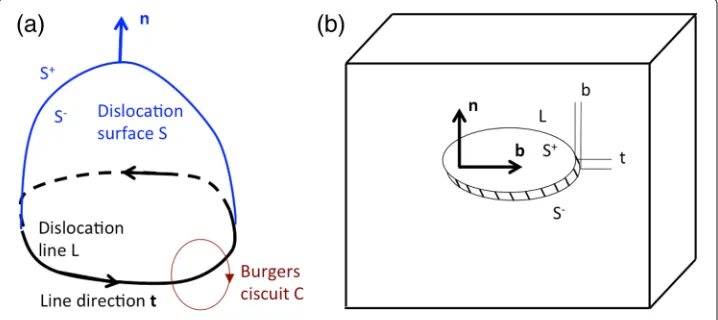
disclination lines. Nabarro showed that dislocations can be described as a set of coher-ent misfitting platelet inclusions (see for instance Mura (1987); Wang et al. (2001)). This representation of dislocations was recently used to develop the so-called Discrete Contin-uous Model (DCM) (Lemarchand et al.2001; Vattré et al.2014a). In this eigenstrain-based numerical formulation, the elastic fields of dislocations is obtained by introducing dis-locations as plate-like inclusions (see Fig.1), bearing the appropriate plastic strain, in a finite element solver. With this approach, a dislocation line – defined by its Burgers vector
band its defect surfaceSwith unit normaln– produces a plastic distortion:
Uijp(x)= −binj
δ(S−x) (25)
whereδ(S−x)denotes the three-dimensional Dirac delta function that is zero every-where except on surfaceS, and which accounts for the displacement discontinuity [u]=b
acrossS. The plastic distortionUp(x), directly resulting from the motion of dislocation lines, is numerically updated using the same regularization procedure. The increment of plastic distortion generated at voxelxd from the motion of dislocation segments on all slip systems is expressed as:
dUp(xd)=
s
bs⊗nsdγs(xd) (26)
where the summation is performed over all slip systemsswith Burgers vectorbsand unit normalns, and wheredγs(xd)denotes the plastic shear increment resulting from crys-tallographic slip on systems. Considering the motion of all dislocation segments across voxelxd, incrementdγs(xd)is expressed as:
dγs(xd)=
ij
dγ xd
ij (27)
wheredγ xd
ij denotes the shear produced by the glide of dislocation segmentijat voxel
xd, and where the summation is performed over all segmentsijgliding across voxelxd. As depicted in Fig.1, dislocations are represented as a plate-like inclusion of thickness
h=2L, withLdenoting the distance between voxels. With this, the shear produced by the motion of a dislocation can be determined as follows. It is considered that an elementary sheared areadS(x)centered inxswept by the glide of a portion of a dislocation segmentij
produces an elementary homogeneous plastic sheardγ (x)within an elementary spherical volumedφ(x)of radiush/2 (Vattré et al.2014a), such that:
dγ (x)= b dS(x)
dφ(x) =c(d)
6b
πh3dS(x) (28)
wherebdenotes the magnitude of the Burgers vector of the dislocation line.c(d)denotes a correction factor, as defined in Bertin et al. (2015), which ensures that the predicted stress fields remain correct regardless of the distancedbetween the segment and the center of the voxel. Following Eq.28, the plastic sheardγxd
ij in expression (27) produced by the glide of a dislocation segmentijis regularized at each grid pointxdas:
dγ xd
ij = 6b
πh3dS xd
ij =c(d)
b Ve
dSxd
ij (29)
whereVe = πh3/6 is the volume of the elementary spherical sheared volumedφ(xd)of radiush/2, and where quantitydSxd
ij corresponds to the intersection between the area
dAijswept by dislocation segmentijand the elementary sphere of volumeVecentered at voxelxd. Further details on this regularization procedure (e.g. choice for the regular-ization parameterh, numerical procedure to computedSxd
ij , numerical implementation, etc.) can be found in a recent paper (Bertin et al.2015). The same procedure applies for disclinations, the Frank vector substituting for the Burgers vector and using disclination slip systems.
From the known incompatible plastic curvature due to disclinationsκpi, one must quantify the associated incompatible plastic strainpand compatible plastic curvature
κpcfields. The reader is referred to the original paper introducing Field Disclination and Dislocation Mechanics for more details (Fressengeas et al.2011). Oncepis known, the total plastic strainp = p+p⊥is obtained and the balance equations can be finally solved. The plastic strainpsatisfies:
curlp=κpit+κpct−trκpiI−trκpcI, (30) The compatible curvatureκpcis the gradient of a continuous plastic rotation field. The latter rotation and the plastic strainpcompose the plastic distortionUp, such that the above incompatibility equation can be written as:
curl Up=κpit−trκpiI. (31) Note thatUpcannot contain any gradient part to ensure uniqueness of the solution (Acharya2001). As such, it must be divergence-free. Hence, by taking the curl of above equation,Upis solution of the higher-order equation:
div gradUp=Up= −curlκpit−trκpiI
Note in the above equation that the symbolin front of the plastic distortion indi-cates the Laplace operator applied to the plastic distortion. No boundary condition onUp applies here because of periodic boundary conditions in our FFT framework. Equation (32) is solved in the Fourier space by using FFT algorithms and special rules for evaluating spatial derivatives. The numerical method used is presented in a recent paper (Berbenni et al.2014). Finally, the plastic strainp can be derived as the sym-metric part ofUp. The compatible plastic curvature κpccan be calculated from the skew-symmetric part of the distortion.
Once the above plastic strains and curvatures are known, we can solve for the stress and couple-stress balance Eqs. (14,15). Recall that the elastic moduli tensorsA,BandD
involve internal characteristic lengths that are the order of a fraction of the Burgers vec-tor magnitude. Hence, at a resolution scale sufficiently larger than interatomic distances, which is the case in the proposed mesoscale model, the couple-stresses do not affect the balance of the stress field and the skew-symmetric stress is negligible as compared to the symmetric Cauchy stress. Hence, solving the above balance equations or simply
div(C:e)=0 yields exactly the same stress and couple-stress fields. Obviously, it is not true anymore when using a very small resolution scale to model the core elastic fields of defects (Taupin et al.2017). In the model, the elastic stiffness tensorCis heterogeneous because of crystal orientation and elastic anisotropy. We use the accelerated FFT spec-tral scheme formerly introduced by Eyre and Milton (Eyre and Milton1999; Michel et al. 2001) and recently used in the DCM-FFT-DDD code (Bertin et al.2015). The converged solution of the balance equations provides the total strain tensor.
The last step consists of deriving the total curvature tensorκ, such that the elastic, total minus plastic, curvature is known and the stresses and couple-stresses can be evaluated as per constitutive elastic laws (16,17). The strategy proposed to derive the curvature tensor in the Fourier space is as follows. The Cauchy stress field satisfies the balance equation:
div Tsym=0, (33)
which reads in component form
Tijsym,j =0. (34)
We now switch from the real space to the Fourier space. Letλˆdenote the Fourier trans-form of a functionλ andξ be the Fourier frequency vector with components ξi in a reference cartesian frame. The imaginary number is denoted byi. The balance Eq. (34) becomes
iξjTˆijsym=0. (35)
The heterogeneous elastic moduli tensor isC=C0+δC, whereC0is the stiffness tensor of a homogeneous reference medium andδCis the spatial fluctuation ofC. Expressing the Cauchy stress asTijsym=Cijkl
uk,l−klp
allows rewritting Eq. (35) in the well-known form
ξlξjCijkl0 uˆk=iξjτijˆ , (36)
whereτijˆ is the stress polarization tensor that includes both the fluctuationδCand the plastic strain. The above equations set an algebraic linear system of the form
ˆ
whereGˆ is associated with the homogeneous reference tensorC0, anduˆk is the material displacement. The latter is given by
ˆ
uk = ˆG−1ki fˆi. (38)
From the expression of the displacements, we now derive the curvature components. We first express the rotation vector as half of the curl of the displacement vector:
ˆ
ωi=i1
2eilkξluˆk =i 1 2eilkξlGˆ
−1
kmfˆm. (39)
The curvatures thus read:
ˆ
κij= −1
2eilkξjξluˆk = − 1
2eilkξjξlGˆ −1
kmˆfm. (40)
We finally cast the stress polarization tensor inˆf. Eq. (40) is transformed into :
ˆ
κij= −1
2eilkξjξlGˆ −1
kmiξnτmnˆ . (41)
By defining the following fourth-order tensor:
ˆ
ijmnκ = −
i
2eilkξjξlξnGˆ −1
km, (42)
The total curvature finally reads:
ˆ
κij= ˆκijmnτmnˆ . (43)
An inverse FFT can finally be used to obtain the curvature tensor in the real space. Finally, one obtains the elastic curvature tensor by subtracting the plastic part. Note that the material rotation vector is also known from Eq. (39), which allows calculating the elastic rotation by subtracting the plastic rotation.
Illustrations
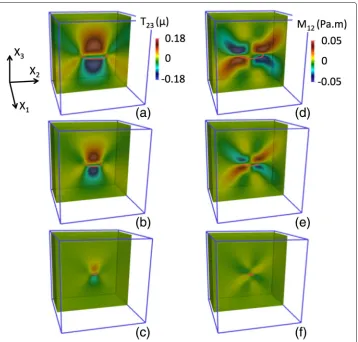
Fig. 2Self-annihilation of a disclination loop. The disclination loop (red line) is let to self-relax under its own elastic field. (a,b,c) Relaxation of the internal shear stress field. (d,e,f) Relaxation of the internal couple-stress field
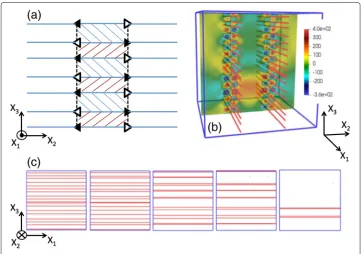
Fig. 3Self-relaxation of twin stacks. Initial twin stacks are let to self-relax by thickening/thinning of twins in the normal direction.a: sketch of the simulated twin stacks using wedge disclination lines.b: Colour-coded is shown the initial in plane shear stress field (MPa) due to disclination lines (red lines).cView in the(X1,X3)
plane showing the progressive growth and shrinkage of twins during self-relaxation until a defect-free matrix is obtained
Applications
Focus is now placed on the application of the disclination and dislocation dynamics framework to study the kinematics and thermodynamics of twin propagation in Mg, as well as twin thickening mediated by the motion of ledges and emission / propagation of twinning dislocations at twin interfaces. We consider1012¯ twins (Partridge1967). The twin plane normal is1012¯ and coincides with theX3axis, the shear direction is
1011¯ and coincides with theX2axis. The normal to shear direction in the twin plane is
1210¯ and coincides with theX1axis. The value of twinning shear iss = 0.131. Twinning dis-locations gliding in the twin plane have a Burgers vector in the shear direction1011¯ and the magnitude isb = 0.0446nm. The elementary step associated with disconnec-tions and separating adjacent twin planes ish = 0.378nm. In the reference coordinate system chosen, the shear transformationsleads to a distortionU23p =s. The plastic dis-tortion can therefore be decomposed into plastic strains,23p = 32p = s/2, and spins ωp
23= −ω p
32=s/2. In consequence the rotation vector is p
1= −s/2. Therefore, the mag-nitude of the Frank vector of the elementary disclinations used to build the twins and twin interface ledges is 0.0655rad=3.7°. The magnesium lattice parameters area=0.32nmand
c=0.52nm. Isotropic elasticity is reasonably assumed (Capolungo et al.2010), with shear modulusμ=17GPaand Poisson coefficientν=0.3.
evidence-we further postulate that disclinations can naturally glide on minimum energy inter-face planes. In the case of tensile twinning in magnesium, disclinations would therefore glide on the1012¯ twin plane. In addition, wedge disclinations which would bound the tip of a twin domain could also glide/climb on the basal/prismatic interface. The lat-ter was shown to be a minimum energy inlat-terface. In what concerns the ’dark side’ of the twin (Liu et al.2016), i.e. observing the twin domain along the twin shear direction, twist disclinations would then potentially ’cross-slip’ on pyramidal/pyramidal boundaries (i.e.2110¯ //21¯10¯ or potentially1010¯ //101¯1¯).
transverse propagation of the1012¯ twin
As stated in the above, disclination and their motion allow for an explicit description of lattice rotations. As such they appear as ideal defects/constructs to track the kinetics of propagation of twin domains. This is studied in the case of an isolated1012¯ twin domain which stability and transverse propagation is modeled as shown in Figs.4–6. A twin embryo is created simply by placing two disclination loops of opposite Frank vec-tor1 = e1 = −
p
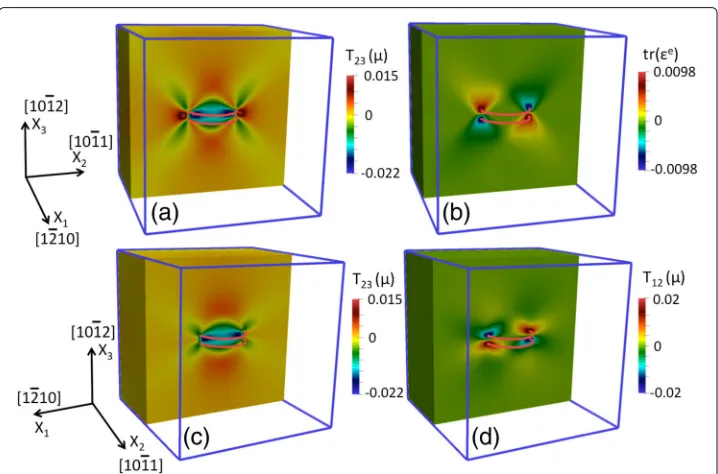
1 = ±s/2 above one another on parallel twin planes. The positive (resp. negative) loop is placed on the bottom (resp. top) of the dipole, such as to delimit a twin domain with negative plastic rotation−s/2 with respect to the matrix. Figure4 shows the elastic fields within the initial twin domain. In the top of the figure are shown the in plane shear stress fieldT23and the elastic dilatation/contraction in the plane par-allel to the twinning shear direction1011¯ . Disclination lines tangent to that plane are of pure wedge character. The location of elastic dilatations (resp. contractions) allows iden-tifying negative (resp. positive) wedge disclinations. The bottom of Fig.4shows the out of plane shear stress fields in the plane normal to the shear direction. The disclination lines
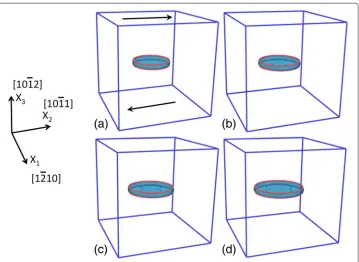
Fig. 5Self-shrinkage in the transverse direction of a(1012¯ )twin. The twin is modelled by a dipole of disclination loops (red solid lines). From (a) to (d): Progressive self-shrinkage of the twin. In blue colour is shown the plastic rotation aroundX1. Only plastic rotation values smaller than -0.06 rad are shown
Fig. 6Growth in the transverse direction of a(1012¯ )twin. The twin is modelled by a dipole of disclination loops (red solid lines) and gowth as per application of a shear strain23of 0.01. From (a) to (d): progressive
tangent to that plane are of pure twist character. One can see that the plastic eigenstrains and eigencurvatures resulting from the generation of the twin domain is compensated in the matrix phase such as to lead to the generation of large ’back stresses’ acting on the disclinations. Importantly, one can note an asymmetry of the shear stress fieldT23in planes parallel (Fig.4a) and normal (Fig.4c) to the twinning shear direction. Strong pos-itive stresses can be seen in front of the twin in the plane parallel to the shear direction, while they are much less significant in the other plane. Hence, from a purely elastostatic standpoint and considering only stresses, the latter suggest that twin propagation should be favored in the shear direction1011¯ as compared to the normal direction 1210¯ . However, from a dynamic point of view, disclination motion is driven by couple-stresses and the kinetics of propagation of the twin domain in shear and lateral directions depend on the mobility of disclinations. As such, introducing a segment-character dependent disclination drag will allow controlling the kinetics, together with internal elastic fields of the twin. This will be the object of further studies. Figure5shows the initial twin domain as well as the plastic rotation field (the matrix phase is taken as reference for comput-ing orientations). It then shows the evolution of the disclination loops and the associated rotation field during self-relaxation under the internal couple-stress field of the twin. The twin domain is consistently observed to shrink, together with the rotation field, such that one ends up with a single phase matrix. However and as expected, upon imposing a macroscopic shear strain to the system,23 = 0.01, it is found that the twin domain can now expand. This is shown in Fig.6. This applied shear strain yields a couple-stress as per non local elasticity tensorB(Taupin et al.2014,2017), which is in turn responsible for disclination loops expansion. Very importantly, not only the prediction of twin growth in the transverse direction can be predicted by our 3D model, but so does the evolution of the rotation field, as shown in Fig.6. We note that the shape of the twin domain remains almost perfectly circular during shrinking and growth.
Twin thickening
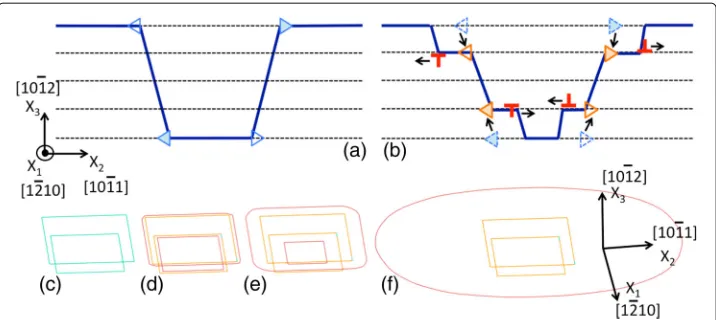
Thickening of a twin domain can be mediated by several processes which all lead to the generation of ID. Focus is placed on the generation of twinning dislocations from ledges present on a twin interface. For this first study, the intent is not to extract the kinetics and overall contributions of these mechanism but solely to assess the thermodynamics and kinematics of the mechanism. As shown in Fig.7, we consider a twin plane con-taining a ’crater’ in which the matrix phase locally penetrates into the twin domain. The boundaries of the crater can therefore be modeled as a disclination loop dipole with Frank vector corresponding to half of the twinning shear as in the previous case. For the sake of simplicity a square loop configuration is taken and the initial loop sizes are 200aand 100a. The crater height is 50a. The four interfaces connecting the two square disclination loops can be interpreted as Basal / Prismatic (BP) and Pyramidal/ Pyramidal (PP≈PP1 or PP2) interfaces. As in the previous case, disclination loops can glide in the
Fig. 7Simulation of a twin interface crater by using a dipole of disclination loops.a2D Sketch of the initial crater configuration (blue lines). Blue triangles denote wedge disclinations.b2D sketch of the dynamics of the crater. Dotted horizontal lines denote adjacent planes parallel to the twin plane and separated by elementary stepsh. Orange triangles show the new position of disclinations, leading to the nucleation of steps and edge dislocations, i.e. disconnections.cInitial dipole of square disclination loops forming the crater (blue lines). (d,e,f) Generation of dislocation loops (red lines) from the out of plane motion of disclination loops of opposite sign (orange lines). The lower dislocation loop shrinks while the upper one expands and reaches an equilibrium position
Upon self-relaxation, the couple-stress field induces an out of twin plane motion of the disclination loops crossing onto the BP and PP1 planes. The loops attract each other, such that the upper loop moves down while the lower loop moves up. Once both loops have moved by a distancehperpendicular to the twin plane, a dipolar arrangement of square twinning dislocation loops (red lines in the figure) is thus generated. As the mobility of dislocations is higher than that of disclinations, the upper and lower dislocation loops rapidly expand and shrink, respectively. Interestingly, the upper loop reaches an equilib-rium elliptical shape, as shown in Fig.7d, due to a balance between the repulsing stress field of the crater and the line tension of the elliptical dislocation loop. The loop is more elongated in the screw direction. As sketched in the Fig.7, we shall interpret the observed mechanism as the nucleation of disconnection loops from ledges in the twin interface. The generated disconnection loops are indeed composed of a step and of a dislocation, and they help propagating the twin interface. Such a mechanism is very similar to obser-vations in twin boundary interfaces in Mg as obtained from MD simulations, and can be invoked in other interfaces (Mompiou et al.2009; Khater et al.2012; Rajabzadeh et al. 2013; Hirth et al.2016).
Conclusions
boundary, Basal Prismatic boundary etc.) Third, we evidence the possibility for disclina-tions to change glide plane and emit dislocation in a fully conservative fashion. Applying the model to1012¯ twinning in magnesium, It is shown that twin domains can be appro-priately described by using dipoles of disclination loops. Further, both shrinking and propagation of twins can then be simulated. Importantly, the introduction of disclination loops as plastic eigencurvatures allows to conveniently track the evolution of rotations during twin propagation. The disclination based constructs of twins thus appears to be practical as internal stress fields, rotations and propagation can be rendered simultane-ously. Further, the model was used to study the stability of 3-dimensional defects, craters, along the twin interface. Simulations suggest that large ledges along the twin boundaries could decay by generating twinning dislocations; a phenomenon observed in atomistic simulations that insofar had not been mechanistically described or understood. The pre-diction of this mechanism is the sole consequence of the higher order kinematics and thermodynamic framework of the model. Naturally, the proposed framework pauses sev-eral interrogations pertaining to the mobility of disclinations, their rate of decay and the short range interactions with dislocations. These will be pursued in further studies.
Appendix: mathematical notations
A bold symbol denotes a tensor. When there may be ambiguity, an arrow is superposed to represent a vector: V. The symmetric part of tensor Ais denoted Asym. Its skew-symmetric and deviatoric parts areAskewandAdevrespectively. The transpose of a tensor
Ais denotedAt. The tensorA·B, with rectangular Cartesian componentsAikBkj, results from the dot product of tensorsAandB, andA⊗Bis their tensorial product, with com-ponentsAijBkl. The vectorA·V, with rectangular Cartesian componentsAijVj, results from the dot product of tensorAand vectorV. A : represents the trace inner product of the two second order tensorsA:B=AijBij, in rectangular Cartesian components, or the product of a higher order tensor with a second order tensor, e.g.,A : B= AijklBkl. The cross product of a second-order tensorAand a vectorV, thedivandcurloperations for second-order tensors are defined row by row, in analogy with the vectorial case. For any base vectoreiof the reference frame:
(A×V)t·ei =
At·ei
×V (44)
(div A)t·ei = div
At·ei
(45) (curl A)t·ei = curlAt·ei. (46)
In rectangular Cartesian components:
(A×V)ij = ejklAikVl (47)
(divA)i = Aij,j (48)
(curlA)ij = ejklAil,k. (49) whereejklis a component of the third-order alternating Levi-Civita tensorX. A vectorA is associated with tensorAby using its trace inner product with tensorX:
(A)k = −1
2(A:X)k = − 1
In the component representation, the spatial derivative with respect to a Cartesian coordinate is indicated by a comma followed by the component index. A superposed dot represents a material time derivative.
Abbreviations
BP: Basal/Pyramidal;DCM: Discrete continuous model;DDD: Discrete dislocation dynamics;FFT: Fast fourier transform;
FDDM: Field disclination and dislocation mechanics;GD3: Generalized discrete defect dynamics;ID: Interfacial defect;PP: Pyramidal/Pyramidal;PP1: Pyramidal/Pyramidal 1;PP2: Pyramidal/Pyramidal 2
Acknowledgements
This work was fully funded by the U.S. Department of Energy under Project FWP 06SCPE401 from the office of Basic Energy Sciences. The authors thank C.N. Tomé and D. Spearot for valuable discussions.
Availability of data and materials
All numerical data generated for this work can be access by contacting the corresponding author.
Authors’ contributions
LC and VT developed the model, ran/interpreted the simulations and wrote the manuscript. Both authors read and approved the final manuscript.
Competing interests
The authors declare no competing interests.
Publisher’s Note
Springer Nature remains neutral with regard to jurisdictional claims in published maps and institutional affiliations.
Author details
1Materials Science and Technology Division, Los Alamos National Laboratory, Los Alamos NM87544, USA.2Université de Lorraine, CNRS, Arts et Métiers ParisTech, LEM3, F-57000 Metz, France.
Received: 25 May 2018 Accepted: 6 December 2018
References
A. Acharya, A model of crystal plasticity based on the theory of continuously distributed dislocations. J. Mech. Phys. Solids.49, 761 (2001)
N. Ahmed, A. Hartmaier, Mechanisms of grain boundary softening and strain-rate sensitivity in deformation of ultrafine-grained metals at high temperatures. Acta Mater.59, 4323–4334 (2011)
A. Arsenlis, W. Cai, M. Tang, M. Rhee, T. Oppelstrup, G. Hommes, T. G. Pierce, V. V. Bulatiov, Enabling strain hardening simulations with dislocation dynamics. Modelling Simul. Mater. Sci. Eng.15, 553–95 (2007)
C. D. Barrett, H. El Kadiri, The roles of grain boundary dislocations and disclinations in the nucleation of 10¯12 twinning. Acta Mater.63, 1–15 (2014)
E. Bayerschen, A. T. McBride, B. D. Reddy, T. Böhlke, Review on slip transmission criteria in experiments and crystal plasticity models. J. Mater. Sci.51, 2243–2258 (2016)
B. Beausir, C. Fressengeas, Disclination densities from EBSD orientation mapping. Int. J. Solids. Structures.50, 137 (2013) S. Berbenni, V. Taupin, K. S. Djaka, C. Fressengeas, A numerical spectral approach for solving elasto-static field dislocation
and g-disclination mechanics. Int. J. Solids Structures.51, 4157 (2014)
N. Bertin, C. N. Tomé, I. J. Beyerlein, M. R. Barnett, L. Capolungo, On the strength of dislocation interactions and their effect on latent hardening in pure magnesium. Int. J. Plasticity.62, 72–92 (2014)
N. Bertin, M. V. Upadhyay, C. Pradalier, L. Capolungo, A FFT-based formulation for efficient mechanical fields computation in isotropic and anisotropic periodic discrete dislocation dynamics. Modelling Simul. Mater. Sci. Eng.23, 065009 (2015) B. A. Bilby, inBristol Conference Report on Defects in Crystalline Solids, Types of dislocation source (The Physical Society,
London, 1955), p. 124
E. Bitzek, P. Gumbsch, Atomistic study of drag, surface and inertial effects on edge dislocations in face-centered cubic metals. Mater. Sci. Eng., A.387-389, 11–15 (2004)
W. Bollmann,Crystal defects and crystalline interfaces. (Springer-Verlag, Berlin Heidelberg GmbH, 1970)
S. I. Bozhko, V. Taupin, M. Lebyodkin, C. Fressengeas, E. A. Levchenko, K. Radikan, O. Lübben, V. N. Semenov, I. V. Shvets, Disclinations in molecular layers on WO2/W(110) surfaces. Phys. Rev. B.90, 214106 (2014)
V. Bulatov, F. Abraham, F. Kubin, B. Devincre, S. Yip, Connecting atomistic and mesoscale simulations of crystal plasticity. Nature.391, 669–72 (1998)
V. V. Bulatov, L. L. Hsiung, M. Tang, A. Arsenlis, M. C. Bartelt, W. Cai, J. N. Florando, M. Hiratani, M. Rhee, G. Hommes, T. G. Pierce, T. Diaz de la Rubia, Dislocation multi-junctions and strain hardening. Nature.440, 1174–8 (2006) N. B. Burbery, G. Po, R. Das, N. Ghoniem, W. G. Ferguson, J. Micromech, Dislocation dynamics in polycrystals with
atomistic-informed mechanisms of dislocation-grain boundary interactions. Mol. Phys.02, 1750003 (2017)
L. Capolungo, D. E. Spearot, M. Cherkaoui, D. L. McDowell, J. Qu, K. I. Jacob, Dislocation nucleation from bicrystal interfaces and grain boundary ledges: Relationship to nanocrystalline deformation. J. Mech. Phys. Solids.55, 2300–2327 (2007) L. Capolungo, I. J. Beyerlein, Z. Qwang, The role of elastic anisotropy on plasticity in hcp metals: a three-dimensional
dislocation dynamics study. Modelling Simul. Mater. Sci. Eng.18, 085002 (2010)
P. Cordier, S. Demouchy, B. Beausir, V. Taupin, F. Barou, C. Fressengeas, Disclinations provide the missing mechanism for deforming olivine-rich rocks in the mantle. Nature.507, 51 (2014)
E. Cosserat, F. Cosserat,Théorie des corps déformables. (Hermann, Paris, 1909)
M. de Koning, R. Miller, V. V. Bulatov, F. F. Abraham, Modelling grain-boundary resistance in intergranular dislocation slip transmission. Philos Mag A Physics of Condensed Matter Structure Defects and Mechanical Properties.82, 2511–2527 (2002)
M. de Koning, R. J. Kurtz, V. V. Bulatov, C. H. Henager, R. G. Hoagland, W. Cai, M. Nomura, Modeling of dislocation-grain boundary interactions in FCC metals. J. Nucl. Mater.323, 281–289 (2003)
B. Devincre, L. P. Kubin, Mesoscopic simulations of dislocations and plasticity. Mater. Sci. Eng. Struct. Mater. Prop. Microstruct. Process.234, 8–14 (1997)
B. Devincre, Dislocation dynamics simulations of slip systems interactions and forest strengthening in ice crystals. Phil. Mag.93, 235–46 (2013)
R. deWit, inFundamental aspects of dislocation theory. ed. by J. A. Simmons, R. deWit, and R. Bullough, Linear theory of static disclinations. Nat. Bur. Stand. (US), Spec. Publ. 317, Vol. I, (1970), pp. 651–673
R. deWit, Theory of disclinations: IV. Straight disclinations. J Res Natl Bur Stand-A Phys Chem.77A, 607 (1973) D. J. Eyre, G. W. Milton, A fast numerical scheme for computing the response of composites using grid refinement. Eur
Phys J Appl Phys.6, 41–47 (1999)
H. Fan, S. Aubry, A. Arsenlis, J. A. El-Awady, Orientation influence on grain size effects in ultrafine-grained magnesium. Scripta Mater.97, 25–28 (2015)
Fan, H., S. Aubry, A. Arsenlis, J. A. El-Awady, Grain size effects on dislocation and twinning mediated plasticity in magnesium. Scripta Mater.112, 50–53 (2016)
M. C. Fivel, G. R. Canova, Developing rigorous boundary conditions to simulations of discrete dislocation dynamics. Modelling Simul. Mater. Sci. Eng.7, 753–68 (1999)
P. Franciosi, M. Berveiller, A. Zaoui, Latent hardening in copper and aluminium single crystals. Acta Metall.28, 273–283 (1980)
F. C. Frank, inSymposium on The Plastic Deformation of Crystalline Solids, The resultant content of dislocations in an arbitrary intercrystalline boundary (Mellon Institute, Pittsburgh, 1950), pp. (NAVEXOS-P-834), 150
C. Fressengeas, V. Taupin, L. Capolungo, An elasto-plastic theory of dislocation and disclination fields. Int. J. Solids Structures.48, 3499–3509 (2011)
S. Gao, M. Fivel, A. Ma, A. Hartmaier, Influence of misfit stresses on dislocation glide in single crystal superalloys: A three-dimensional discrete dislocation dynamics study. J. Mech. Phys. Solids.76, 276–290 (2015)
N. M. Ghoniem, S. H. Tong, L. Z. Sun, Parametric dislocation dynamics: A thermodynamics-based approach to investigations of mesoscopic plastic deformation. Phys. Rev. B.61, 913–27 (2000)
J. P. Hirth, R. C. Pond, Steps, dislocations and disconnections as interface defects relating to structure and phase transformations. Acta Mater.44, 4749 (1996)
J. P. Hirth, R. C. Pond, J. Lothe, Disconnections in tilt walls. Acta Mater.54, 4237 (2006)
J. P. Hirth, J. Wang, C. N. Tomé, Disconnections and other defects associated with twin interfaces. Progr. Mater. Sc.83, 417–471 (2016)
R. G. Hoagland, T. E. Mitchell, J. P. Hirth, H. Kung, On the strengthening effects of interfaces in multilayer fee metallic composites. Philos. Mag. a-Phys. Condens. Matter Struct. Defects Mech. Prop.82, 643–664 (2002)
C. Hou, Z. Li, M. Huang, C. Ouyang, Cyclic Hardening Behavior of Polycrystals with Penetrable Grain Boundaries: Two-Dimensional Discrete Dislocation Dynamics Simulation. Acta Mechanica Solida Sinica.22, 295 (2009) H. A. Khater, A. Serra, R. C. Pond, J. P. Hirth, The disconnection mechanism of coupled migration and shear at grain
boundaries. Acta Mater.60, 2007 (2012)
A. L. Kolesnikova, M. Y. Gutkin, A. V. Proskura, N. F. Morozov, A. E. Romanov, Elastic fields of straight wedge disclinations axially piercing bodies with spherical free surfaces. Int. J. Solids Structures.99, 82–96 (2016)
L. Kubin, B. Devincre, T. Hoc, Modeling dislocation storage rates and mean free paths in face-centered cubic crystals. Acta Mater.56, 6040–6049 (2008)
C. Lemarchand, B. Devincre, L. P. Kubin, Homogenization method for a discrete-continuum simulation of dislocation dynamics. J. Mech. Phys. Solids.49, 1969–82 (2001)
Z. Li, C. Hou, M. Huang, C. Ouyang, Strengthening mechanism in micro-polycrystals with penetrable grain boundaries by discrete dislocation dynamics simulation and Hall-Petch effect. Comput. Mater. Sci.46, 1124–1134 (2009)
A. T. Lim, M. Haataja, W. Cai, D. J. Srolovitz, Stress-driven migration of simple low-angle mixed grain boundaries. Acta Mater.60, 1395–1407 (2012)
B. Liu, D. Raabe, P. Eisenlohr, F. Roters, A. Arsenlis, G. Hommes, Dislocation interactions and low-angle grain boundary strengthening. Acta Mater.59, 7125–7134 (2011)
B. Liu, P. Eisenlohr, F. Roters, D. Raabe, Simulation of dislocation penetration through a general low-angle grain boundary. Acta Mater.60, 5380–5390 (2012)
Y. Liu, N. Li, S. Shao, M. Gong, J. Wang, R. J. McCabe, Y. Jiang, C. N. Tomé, Characterizing the boundary lateral to the shear direction of deformation twins in magnesium. Nat. Commun.7, 11577 (2016)
R. Madec, B. Devincre, L. Kubin, T. Hoc, D. Rodney, The role of collinear interaction in dislocation-induced hardening. Science.301, 1879–1882 (2003)
J. C. Michel, H. Moulinec, P. Suquet, A computational scheme for linear and non-linear composites with arbitrary phase contrast. Internat. J. Numer. Methods Engrg.52, 139–160 (2001)
F. Mompiou, D. Caillard, M. Legros, Grain boundary shear-migration coupling–I. In situ TEM straining experiments in Al polycrystals. Acta Materialia.57, 2198 (2009)
B. Muntifering, L. Kovarik, N. D. Browning, R. C. Pond, W. B. Knowlton, P. Müllner, Stress-assisted removal of conjugation boundaries in non-modulated Ni-Mn-Ga by coordinated secondary twinning. J. Mater. Sci.51, 457–466 (2016) T. Mura,Micromechanics of Defects in Solids. (Kluwer Academic Publishers, Dordrecht, 1987)
M. Murayama, J. M. Howe, H. Hidaka, S. Takaki, Atomic-level observation of disclination dipoles in mechanically milled, nanocrystalline Fe. Science.295, 2433 (2002)
G. Po, M. Lazar, D. Seif, N. Ghoniem, Singularity-free dislocation dynamics with strain gradient elasticity. J. Mech. Phys. Solids.68, 161–178 (2014)
L. Priester, Grain boundaries, from theory to engineering. Springer Ser. Mater. Sci.172(2013)
S. S. Quek, Z. Wu, Y. W. Zhang, D. J. Srolovitz, Polycrystal deformation in a discrete dislocation dynamics framework. Acta Mater.75, 92–105 (2014)
S. S. Quek, Z. H. Chooi, Z. Wu, Y. W. Zhang, D. J. Srolovitz, The inverse hall-petch relation in nanocrystalline metals: A discrete dislocation dynamics analysis. J. Mech. Phys. Solids.88, 252–266 (2016)
S. Queyreau, G. Monnet, B. Devincre, Slip systems interactions inα-iron determined by dislocation dynamics simulations. Int. J. Plasticity.25, 361–77 (2009)
A. Rajabzadeh, M. Legros, N. Combe, F. Mompiou, D. A. Molodov, Evidence of grain boundary dislocation step motion associated to shear-coupled grain boundary migration. Phil. Mag.93, 1299 (2013)
B. Reinholz, S. Brinckmann, A. Hartmaier, B. Muntifering, W. B. Knowlton, P. Müllner, Influence of the twin microstructure on the mechanical properties in magnetic shape memory alloys. Acta Mater.108, 197–206 (2016)
A. E. Romanov, A. L. Kolesnikova, Application of disclination concept to solid structures. Prog. Mat. Sci.54, 740 (2009) H. Rösner, C. Kübel, Y. Ivanisenko, L. Kurmanaeva, S. V. Divinski, M. Peterlechner, G. Wilde, Strain mapping of a triple
junction in nanocrystalline Pd. Acta Mater.59, 7380 (2011)
D. Seif, G. Po, M. Mrovec, M. Lazar, C. Elsässer, P. Gumbsch, Atomistically enabled nonsingular anisotropic elastic representation of near-core dislocation stress fields inα-iron. Phys. Rev. B.91, 184102 (2015)
C. Sobie, L. Capolungo, D. L. McDowell, E. Martinez, Thermal activation of dislocations in large scale obstacle bypass. J. Mech. Phys. Solids.105, 150–160 (2017a)
C. Sobie, L. Capolungo, D. L. McDowell, E. Martinez, Scale transition using dislocation dynamics and the nudged elastic band method. J. Mech. Phys. Solids.105, 161–178 (2017b)
D. E. Spearot, M. D. Sangid, Insights on slip transmission at grain boundaries from atomistic simulations. Curr. Opinion Solid State Mater. Sci.18, 188–195 (2014)
X.-Y. Sun, V. Taupin, C. Fressengeas, P. Cordier, Continuous description of the atomic structure of grain boundaries using dislocation and generalized-disclination density fields. Int. J. Plast.77, 75 (2016)
A. P. Sutton, R. W. Baluffi,Interfaces in crystalline materials. (Clarendon Press, Oxford, 1995)
V. Taupin, L. Capolungo, C. Fressengeas, A. Das, M. Upadhyay, Grain boundary modeling using an elasto-plastic theory of dislocation and disclination fields. J. Mech. Phys. Solids.61, 370 (2013)
V. Taupin, L. Capolungo, C. Fressengeas, Disclination mediated plasticity in shear-coupled boundary migration. Int. J. Plast.53, 179–192 (2014)
V. Taupin, K. Gbemou, C. Fressengeas, L. Capolungo, Nonlocal elasticity tensors in dislocation and disclination cores. J. Mech. Phys. Solids.100, 62–84 (2017)
M. Upadhyay, L. Capolungo, V. Taupin, C. Fressengeas, Elastic constitutive laws for incompatible crystalline media: the contributions of dislocations, disclinations and G-disclinations. Phil. Mag.93, 794 (2013)
A. J. Vattré, M. J. Demkowicz, Determining the Burgers vectors and elastic strain energies of interface dislocation arrays using anisotropic elasticity theory. Acta Mater.61, 5172 (2013)
A. J. Vattré, B. Devincre, F. Feyel, R. Gatti, S. Groh, O. Jamond, A. Roos, Modelling crystal plasticity by 3D dislocation dynamics and the finite element method: the discrete-continuous model revisited. J. Mech. Phys. Solids.63, 491–505 (2014a) A. J. Vattré, N. Abdolrahim, K. Kolluri, M. J. Demkowicz, Computational design of patterned interfaces using reduced order
models. Nature Sci. Reports.4, 1 (2014b)
A. J. Vattré, M. J. Demkowicz, Partitioning of elastic distortions at a semicoherent heterophase interface between anisotropic crystals. Acta Mater.82, 234 (2015)
A. J. Vattré, Elastic strain relaxation in interfacial dislocation patterns: I. A parametric energy-based framework. J. Mech. Phys. Solids.105, 254–282 (2017a)
A. J. Vattré, Elastic strain relaxation in interfacial dislocation patterns: II. From long- and short-range interactions to local reactions. J. Mech. Phys. Solids.105, 283–305 (2017b)
Y. U. Wang, Y. M. Jin, A. M. Cutino, A. G. Khachaturyan, Nanoscale phase field microelasticity theory of dislocations: model and 3D simulations. Acta Mater.49, 1847–1857 (2001)
Y. M. Wang, E. Ma, Strain hardening, strain rate sensitivity, and ductility of nanostructured metals. Mat. Sci. Eng. A. 375–377, 46–52 (2004)
J. Wang, C. Zhou, I. J. Beyerlein, S. Shao, Modeling interface-dominated mechanical behavior of nanolayered crystalline composites. J. Applied Mech.66, 102–113 (2014)
B. Xu, L. Capolungo, D. Rodney, On the importance of prismatic/basal interface in the growth of (1012) twins in hexagonal close packed crystals. Scripta Mater.68, 901–904 (2013)
K. Yashiro, F. Kurose, Y. Nakashima, K. Kubo, Y. Tomita, H. M. Zbib, Discrete dislocation dynamics simulation of cutting ofγ precipitate and interfacial dislocation network in Ni-based superalloys. Int. J. Plasticity.22, 713–723 (2006)
H. M. Zbib, M. Rhee, J. P. Hirth, On plastic deformation and the dynamics of 3D dislocations. Int. J. Mech. Sci.40, 113–27 (1998)
Z. Zheng, D. S. Balint, F. P. E. Dunne, Investigation of slip transfer across HCP grain boundaries with application to cold dwell facet fatigue. Acta Mater.127, 43–53 (2017)