R E V I E W
Open Access
Effect of classroom-based physical activity
interventions on academic and physical
activity outcomes: a systematic review and
meta-analysis
Amanda Watson, Anna Timperio, Helen Brown, Keren Best and Kylie D. Hesketh
*Abstract
Background:Physical activity is associated with many physical and mental health benefits, however many children do not meet the national physical activity guidelines. While schools provide an ideal setting to promote children’s physical activity, adding physical activity to the school day can be difficult given time constraints often imposed by competing key learning areas. Classroom-based physical activity may provide an opportunity to increase school-based physical activity while concurrently improving academic-related outcomes. The primary aim of this systematic review and meta-analysis was to evaluate the impact of classroom-based physical activity interventions on academic-related outcomes. A secondary aim was to evaluate the impact of these lessons on physical activity levels over the study duration.
Methods:A systematic search of electronic databases (PubMed, ERIC, SPORTDiscus, PsycINFO) was performed in January 2016 and updated in January 2017. Studies that investigated the association between classroom-based physical activity interventions and academic-related outcomes in primary (elementary) school-aged children were included. Meta-analyses were conducted in Review Manager, with effect sizes calculated separately for each outcome assessed.
Results: Thirty-nine articles met the inclusion criteria for the review, and 16 provided sufficient data and appropriate design for inclusion in the meta-analyses. Studies investigated a range of academic-related outcomes including classroom behaviour (e.g. on-task behaviour), cognitive functions (e.g. executive function), and academic achievement (e.g. standardised test scores). Results of the meta-analyses showed classroom-based physical activity had a positive effect on improving on-task and reducing off-task classroom behaviour (standardised mean difference = 0.60 (95% CI: 0.20,1.00)), and led to improvements in academic achievement when a progress monitoring tool was used (standardised mean difference = 1.03 (95% CI: 0.22,1.84)). However, no effect was found for cognitive functions (standardised mean difference = 0.33 (95% CI: -0.11,0.77)) or physical activity (standardised mean difference = 0.40 (95% CI: -1.15,0.95)).
Conclusions:Results suggest classroom-based physical activity may have a positive impact on academic-related outcomes. However, it is not possible to draw definitive conclusions due to the level of heterogeneity in intervention components and academic-related outcomes assessed. Future studies should consider the intervention period when selecting academic-related outcome measures, and use an objective measure of physical activity to determine intervention fidelity and effects on overall physical activity levels.
Keywords: Classroom, Physical activity, Academic performance, Children, Schools, Intervention, Systematic review, Meta-analysis
* Correspondence:[email protected]
Institute for Physical Activity and Nutrition (IPAN), School of Exercise and Nutrition Science, Deakin University, Geelong, Australia
Background
Multiple physical and mental health benefits can be attained when children participate in the recommended 60 min per day of moderate- to vigorous-intensity phys-ical activity [1, 2]. Despite these benefits, population based-studies have reported that over 50% of children in Australia and internationally are not meeting recom-mendations [3–6]. Schools are considered ideal settings for the promotion of children’s physical activity. There are multiple opportunities for children to be physically active over the course of the school week, including during break times, sport, Physical Education class and active travel to and from school. Studies have shown interventions targeting these discrete periods may be effective in increasing children’s physical ac-tivity levels [7, 8], with the potential to contribute to up to 50% of the physical activity required to meet physical activity guidelines [9]. However, with limited time available during these discrete periods, additional opportunities may be required in order for children to achieve the recommended levels of physical activ-ity. Classroom-based physical activity provides another way for children to be active at school. This involves classroom teachers incorporating physical activity into class time through either integrating physical activity into lessons (physically active lessons), or adding short bursts of physical activity, either with curricu-lum content (curricucurricu-lum focused active breaks) or without (active breaks).
There is increasing interest from researchers and
education professionals about the potential for
classroom-based physical activity to positively impact academic-related outcomes, including classroom beha-viour, cognitive function and academic achievement. While some teachers express concern that classroom-based physical activity may have an adverse effect on on-task classroom behaviour [10], emerging evidence from systematic reviews and meta-analyses suggest that overall physical activity may have a small positive effect on on-task classroom behaviour [11–17]. There is less evidence on classroom-based physical activity.
Narrative reviews [18–20], one systematic review [21] and two meta-analyses [22, 23] have explored the impact of classroom-based physical activity interventions on academic-related outcomes. However, these were narrow in scope, included few studies, and combined findings among primary and secondary school students, which may be problematic due to the difference in education settings.
A systematic review of 11 studies concluded that physically active lessons may have a positive effect, or no effect on academic-related outcomes [21]. However, that study did not consider other forms of classroom-based physical activity (e.g. active breaks), combined
findings among primary and secondary school students, and did not include a meta-analysis [21].
A meta-analysis of four intervention studies found that classroom-based physical activity had a positive effect on academic-related outcomes (M = 0.67; 95%CI:0.26,1.09) [23]. Similar results were reported in a meta-analysis of 24 intervention studies investigating the association between different types of physical activity (e.g., du-ring recess or lunch vs. active breaks vs. physically ac-tive lessons) and school engagement (behaviour at home and at school, and emotions, e.g. lesson enjoy-ment) [22]. In that meta-analysis, overall results showed physical activity had a significant positive ef-fect on school engagement (d = 0.28;95%CI:0.12,0.46) [22]. When broken down into type of physical acti-vity, active breaks (n = 4 studies) appeared to be the most effective type of intervention for improving school engagement (d = 0.55; 95%CI:0.02,1.06), com-pared with recess or lunch time physical activity (n = 3 studies; d = 0.26; 95%CI:-0.19,0.73) and physic-ally active lessons (n = 5 studies; d = 0.22; 95%CI: -0.21,0.66) [22]. However, results from those meta-analyses are limited by the small number of included studies [22, 23], the narrow range of potential academic-related outcomes assessed, the combination of findings among primary and secondary school stu-dents [22], and their recency [23].
The current paper aims to expand on findings from these reviews by conducting a systematic review and meta-analyses of the evidence of effect of classroom-based physical activity interventions (active breaks, curriculum-focused active breaks and physically active lessons) on a broad range of academic-related out-comes (classroom behavior, cognitive function and academic achievement), specifically among primary school-aged children. A secondary aim is to examine the effect of these interventions on children’s physical activity levels.
Methods Definitions
While there are no set definitions for classroom-based physical activity, the following definitions are provided in order to maintain consistency and clarity throughout the remainder of this systematic review.
Classroom-based physical activity: physical activity
carried out during regular class time, and can occur ei-ther inside or outside the classroom (e.g. hallway, play-ground), and is distinct from school recess/lunch break times. Classroom-based physical activity can take three forms:
Active breaks:short bouts of physical activity
Curriculum-focussed active breaks:short bouts of physical activity that include curriculum content [25,26].
Physically active lessons: the integration of physical activity into lessons in key learning areas other than physical education (e.g. mathematics) [27,28].
Academic-related outcomes: overarching term to
en-compass factors associated with academic performance at school. These can be grouped into three main categories:
Classroom behaviour:Observed behaviours that may promote or interfere with learning in the classroom, including on-task behaviour [29] (e.g. concentrating on tasks assigned by the teacher), and off-task be-haviour (e.g. not concentrating on tasks assigned by the teacher).
Cognitive function: Mental process (e.g. executive function) that may influence academic
performance [29].
Academic achievement:A child’s performance on school-related tasks; often reported via classroom grades, national standardised tests or progress moni-toring tools [29], as well as self-reported perceived academic competence [30].
Registration and protocol
This study followed the Preferred Reporting Items for
Systematic Reviews and Meta-Analyses (PRISMA)
recommendations for systematic review reporting, and was registered with the International Prospective Register of Systematic Reviews (PROSPERO) (record #CRD42016027294).
Search strategy
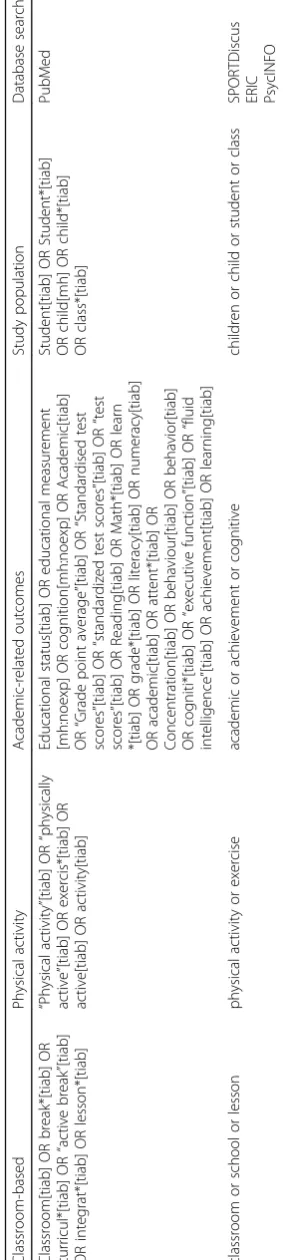
Studies were identified through a systematic search of four electronic databases (PubMed, ERIC, SPORTDiscus and PsycINFO), first conducted in January 2016, and up-dated in January 2017 by one author (AW). The search strategy consisted of four elements (see Table 1). The search was limited to peer-reviewed articles published in English in all available years. ‘Grey’literature, including the reference lists from the websites of two organisations (“Active Academics” and “Active Living Research”) in-volved in children’s physical activity research were also searched.
Inclusion criteria
A predetermined set of inclusion criteria were used to select papers for this systematic review. Each study had to meet the following criteria:
1. Intervention study design;
2. Investigated associations between classroom-based physical activity and at least one academic-related outcome. Interventions involving strategies in addition to classroom-based physical activity were excluded (to enable the effects of classroom-based physical activity to be isolated);
3. Study population included primary school-aged chil-dren (5–12 years);
4. Presented original data;
5. Did not focus specifically on special populations (e.g. overweight children).
Study selection
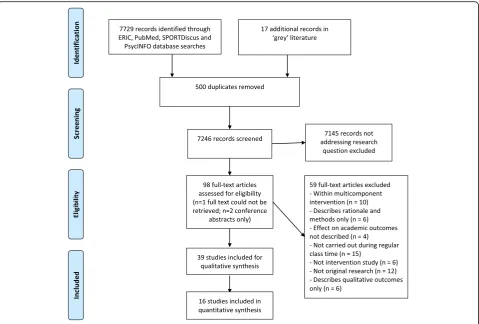
The search yielded 7729 citations from electronic data-base records, and 17 from‘grey’ literature (Fig. 1). After removing duplicates (n= 500), the titles and/or abstracts of 7246 unique publications were screened by one au-thor (AW). A total of 101 publications were identified as potentially relevant according to the inclusion criteria. Full texts of 98 of these 101 articles were obtained and reviewed independently by two authors to determine eli-gibility (AW, KB). Two full texts were conference ab-stracts only, and one full-text was unable to be retrieved despite extensive librarian-assisted enquiries and emails directly to the contact author. Of the 98 full-text articles, a total of 59 were excluded as not meeting inclusion cri-teria. Disagreements between the two reviewers were resolved through discussion with all authors. Reference lists of included articles were also examined, however no additional studies were identified. Thirty-nine unique citations satisfied the eligibility criteria and were included in this systematic review.
Data extraction
Paper characteristics including country of study, study design, participant characteristics, intervention charac-teristics, academic-related outcome measures, physical activity measures, and results were extracted by one au-thor (AW). Interventions were then categorised as active break, curriculum focussed active break, or physically active lesson intervention.
Methodological quality
Table
1
Article
search
terms
and
databases
searched
Classroom-b
ased
Physi
cal
activity
Ac
ademic-relat
ed
outcom
es
Stud
y
popu
lation
Database
searc
hed
Classroom[ti
ab]
OR
break
*[tiab]
OR
curricul*[tiab
]
O
R
“
activ
e
bre
ak
”
[tiab]
OR
inte
grat*[tiab]
O
R
lesson*
[tiab]
“
Physi
cal
activity
”
[tiab]
OR
“
physical
ly
activ
e
”
[tiab
]
OR
exerc
is*[tiab]
O
R
activ
e[tiab]
O
R
activ
ity[tiab]
Ed
ucational
status[tiab]
O
R
educ
ational
measuremen
t
[mh
:noexp]
OR
cognit
ion[mh:
noexp
]
O
R
A
cademic[tiab]
OR
“
Grade
point
average
”
[tiab
]
OR
“
Stan
dardised
test
sco
res
”
[tiab]
O
R
“
standardize
d
test
scores
”
[tiab]
OR
“
test
sco
res
”
[tiab]
O
R
Readi
ng[tiab]
OR
Math*[t
iab]
OR
learn
*[ti
ab]
O
R
grad
e*[tiab]
O
R
literacy[tiab
]
O
R
num
eracy[
tiab]
OR
acade
mic[tiab]
O
R
atte
nt*[tiab
]
O
R
Con
centrati
on[tiab]
OR
be
haviour[tiab]
OR
be
havior[t
iab]
OR
cogn
iti*[tiab
]
OR
“
exec
utive
function
”
[tiab
]
OR
“
fl
uid
intel
ligence
”
[tiab]
O
R
achievement
[tiab]
OR
learning[tiab]
Stud
ent[tia
b]
OR
Stud
ent*[ti
ab]
O
R
child[m
h]
OR
child*[tiab]
O
R
class*[
tiab]
PubMed
classro
om
or
sch
ool
or
lesson
physical
activit
y
o
r
exercis
e
aca
demic
or
achi
evem
ent
or
cogn
itive
chi
ldren
or
child
or
student
or
class
SPORTDiscus ERIC PsycINF
moderate (one weak component rating); or weak (more than one weak component rating), following the tool’s
accompanying instructions. Where disagreements
existed, deliberation occurred until a consensus was reached.
Meta-analyses
Meta-analyses were conducted where there were at least three studies investigating the same broad outcome, i.e. classroom behaviour, cognitive function, or academic achievement. Due to heterogeneity across study designs, for inclusion studies were required to have a separate comparison group (i.e. RCT or quasi experimental with control group). Studies that used a within subject or cross over study design were therefore excluded from meta-analysis.
To avoid duplication of studies under a single out-come, where studies reported intervention effects on multiple measures for an outcome (this happened only for cognitive functions) [32, 33] a decision was made to include outcomes relating to executive func-tions, over memory. Executive funcfunc-tions, inhibition in particular, have been shown to be consistently related
to academic achievement [34] and therefore were considered salient to teachers. Thus, where inhibition and memory were reported, only inhibition was in-cluded in the meta-analysis; where executive functions and short term memory were reported, only executive
functions were included in the meta-analysis.
Typically higher scores were reflective of better
academic-related outcomes. Where lower scores
reflected better academic-related outcomes these scores were reversed.
As academic achievement tools varied widely in qual-ity, only studies using national standardised tests or progress monitoring tools were included in the meta-analyses. Further, intervention effects on mathematics were used when studies reported multiple subject assess-ments, as math was the most commonly reported outcome. Of the 39 studies included in this systematic review, 16 were included in meta-analyses. Reasons for exclusion were: insufficient data for calculating effect sizes and authors did not respond to email requests for additional data (n= 6), using a within subject or cross-over study design (n= 9), not including a separate com-parison group (n = 2), insufficient studies investigating
an outcome (n= 4), or only reporting results separately for subgroups (e.g. BMI categories) (n= 2).
Analysis
Meta-analyses were conducted using Review Manager 5.3. The wide variation in interventions and academic-related outcomes employed in the different studies warranted use of a random effects model. Effect sizes (standardised mean difference) were computed as the difference between treatment and control means.
Results
Of the 39 studies identified, 19 examined the effect of
active breaks [24, 26, 35–51], seven examined
curriculum-focussed active breaks [25, 52–57], and thir-teen examined physically active lessons [27, 28, 32, 33, 58–66] on academic-related outcomes. The majority of studies (n= 27) were published in or after 2014 [24, 26, 32, 33, 36, 39–41, 43, 46–51, 57, 65, 66], and none be-fore 2006. Most (n = 18) were conducted in the USA [25, 36, 39, 40, 42, 44, 45, 51–55, 57–60, 64, 65], seven in the Netherlands [32, 41, 49, 50, 61, 62, 66], four in Australia [27, 28, 46, 47], three in Canada [24, 35, 43], two in Scotland [37, 38], and one each in South Africa
[48], UK [63], Greece [56] Denmark [33], and
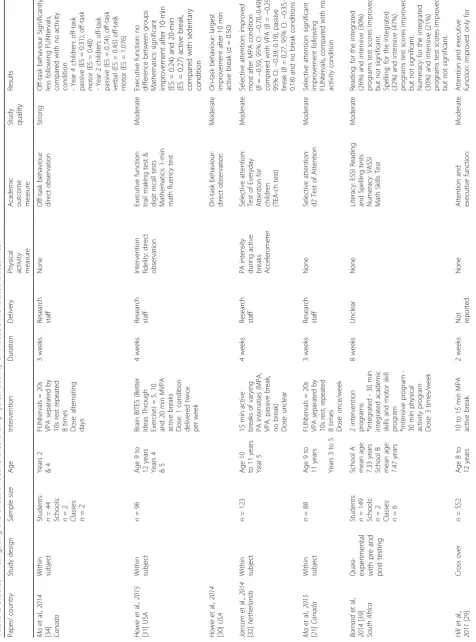
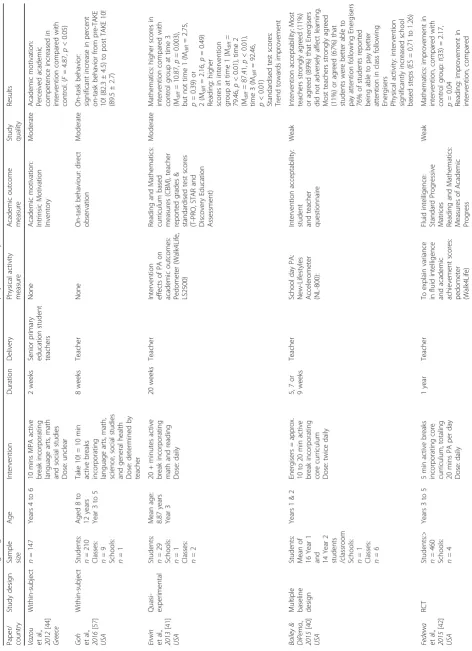
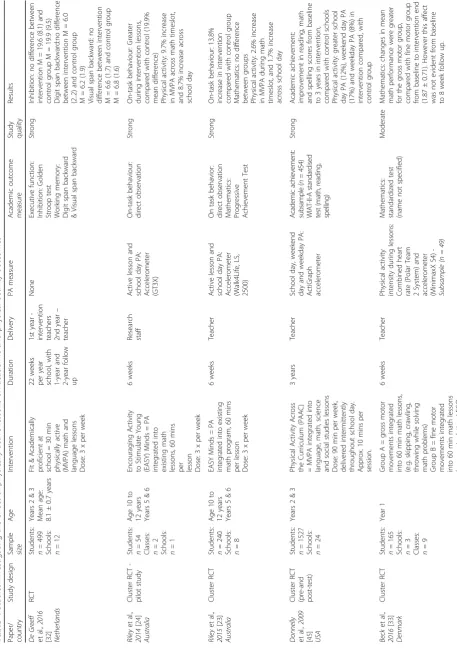
Switzerland [26]. Sample sizes ranged from 14 [60] to over 4500 participants [45], with sample sizes <300 in the majority of studies (n = 28) [24–28, 33, 35, 39–41, 43, 44, 46–51, 53, 55–57, 59–64]. Intervention periods spanned from single lessons [49, 55, 59, 65] to 3 year duration [58], with most lasting no longer than nine weeks (n = 23) [24–28, 33, 37–41, 43–46, 48, 50, 52, 55–57, 59, 63]. Study information is presented in Table 2 (active breaks), Table 3 (curriculum focused active breaks) and Table 4 (physically active lessons).
Intervention content
There was considerable variation across studies in intervention content. While most (12 out of 19) ac-tive break interventions featured basic aerobic move-ments that students could be performed in their classroom (e.g. jumping jacks), and required no set-up or equipment [24, 35–40, 42, 43, 45, 50, 51], others were performed outside the classroom (e.g. sports field) [26, 41, 46–48], and/or required additional equipment (e.g. markers, skipping ropes, balls, exer-cise bands, dance videos, or specialised stacking cups) [41, 44, 46, 49]. One study utilised both cognitively engaging active breaks (i.e. physical activity combined with cognitive demand) and active breaks to explore separate and combined effects of physical activity and cognitive engagement on cognitive function [26]. The target frequency, duration and physical activity inten-sity of the breaks varied, ranging from 4 min of
vigorous-intensity physical activity weekly [24, 43] to 20 min of moderate intensity physical activity done twice per day [49].
There was more consistency in content across curriculum-focussed active breaks, compared with the
active breaks without curriculum content. All
curriculum-focussed active breaks featured physical ac-tivity integrated into a combination of key learning areas, including mathematics, language, science and/or social studies, and aimed to reinforce previously taught lesson content [25, 52–57]. Further, most (5 out of 7) required daily participation in 10 to 20 min of physical activity [19, 52–54, 57]. When specified, participation was required at a moderate-[56] or moderate-to vigorous-physical activity intensity [55], but intensity was not specified in the majority (5 out of 7) of these studies [25, 52–54, 57].
While curriculum-focussed active breaks aimed to reinforce previously taught lesson content, physically active lessons were used to teach new lesson content [27, 28, 32, 33, 58–62, 64–66]. These lessons predom-inately incorporated physical activity into mathematics and/or language lessons, but some also incorporated science and/or social studies [27, 28, 32, 33, 58–62,
64–66]. Lessons ranged in duration from 30 to
60 min [27, 28, 32, 33, 60–64, 66] with most (8 out of 13) requiring participation three times per week [27, 28, 32, 33, 61, 62, 64, 66]. Other physically active lessons were described as single lessons as part of pilot interventions [59, 63, 65], or stipulated physical activity time per week, rather than number of lessons per week [58].
Intervention fidelity
Intervention fidelity was reported in twelve studies. For the three active break interventions delivered by teachers, various measures of fidelity were used, how-ever, no study clearly reported compliance with implementing active breaks daily or the number of active break sessions conducted. Active break inter-ventions delivered by research staff reported high fi-delity, showing most children achieved the required physical activity intensity [39–41], or at least 50% of each intervention session was spent at the required intensity [46, 47].
Table 2 Studies investigating the effect of active breaks on physical activity and academic-related outcomes Paper/ country Study design Sample size Age Intervention Duration Delivery
Physical activity measure Academic outcome measure Study quality Results Ma et al. , 2014 [ 34 ] Canada Within subject Students: n=4
4
Schools: n=2 Classes: n=2
Years 2 &4 FUNtervals = 20s VPA separated by 10s rest repeated 8 times Dose: altern ating days 3 weeks Research staff None Off-task behaviour: direct observation Strong Off-task behaviour Significantly less following FUNtervals, compared with no activity
condition -Year
4 children: off-task passive (ES = 0.31); off-task motor (ES = 0.48) -Year 2 children: off-task passive (ES = 0.74); off-task verbal (ES = 0.45) off-task motor (ES = 1.076) Howie et al. , 2015 [ 31 ] USA Within subject n = 96 Age 9 to 12 years Years 4 &5 Brain BITES (Better Ideas Through Exercise) = 5, 10 and 20 min MVPA active breaks Dose: 1 condition delivered twice per week 4 weeks Research staff Intervention fidelity: direct observation Executive function: trail making test & digit recall tests Mathematics: 1-min math fluency test Moderate Executive function: no difference between groups Mathematics: signi ficant im provement afte r 10-m in (ES = 0.24) and 20-m in (ES = 0.27) activ e break , com pared with seden tary cond ition Howie et al. , 2014 [ 30 ] US A On-task behaviour: direct observation Moderate On-task behaviour: largest improvement after 10 min active break (d = 0.50) Janssen et al. , 2014 [ 32 ] Netherlands Within subject n = 123 Age 10 to 11 years Year 5 15 min active breaks of varying PA intensities (MPA, VPA, passive break, no break) Dose: unclear 4 weeks Research staff PA intensity during active breaks: Accelero meter Selective attention: Test of Everyday Attention for children (TEA-ch test) Moderate Selective attention: improved most after MPA condition ( B = − 0.59, 95% CI: − 0.70,-0.49), compared with VPA ( B = − 0.29, 95% CI: − 0.39,-0.19), passive break ( B = 0.27, 95% CI: − 0.35,-0.18) and no break conditions Ma et al. , 2015 [ 21 ] Canada Within subject n = 88 Age 9 to 11 years Years 3 to 5 FUNtervals = 20s VPA separated by 10s rest, repeated 8 times Dose: once/w eek 3 weeks Research staff None Selective attention: d2 Test of Attention Moderate Selective attention: significant improvement following FUNtervals, compared with no activity condition Barnard et al. , 2014 [ 39 ] South Africa Quasi- exper iment al with pre and post testing
Students: n=
149
Schools: n=2 Classes: n=6
Table 2 Studies investigating the effect of active breaks on physical activity and academic-related outcomes (Continued) Scotland Years 4 to 7 Dose: once/day for one week, no intervention in the second week paced serial addition, size ordering, listening \span, digit span backwards & visual coding those receiving the intervention in week 2 (mean difference = 3.85, 95% CI = 0.26,7.44) Schmidt et al. , 2016 [ 26 ] Within subje ct n = 98 Year 5 10 min active break involving running at different speeds Dose: 5 different days over 3 weeks 3 weeks Not reported None Attention: d2 Test of Attention Moderate Attention: no significant improvement Ahamed et al. , 2007 [ 35 ] Canada Cluster RCT
Students: n=
288
Schools: n=1
0 Age 9 to 11 years Years 4 and 5 Action Schools! BC = 15 min MVPA active break. Dose: once/day 16 months Teacher Habitual PA: Modified Physical
Activity Questionnaire for
Children (PAQ-C) Mathematics, Reading and Language: Canadian Achievement Test Weak Mathematics, Reading and Language (total score) Although control school had significantly higher scores at baseline, no significant difference between intervention (mean = 1672 (9.6) and control groups (mean = 1688.6 (16.6) at follow
up Ph
ysi ca l act ivit y: inc rease b y 4 7 min /w eek in int e rven tio n sc h o o ls (1 3 9 ±6 2v s9 2± 45, p < 0 .001) Carlson et al. , 2015 [ 27 ] USA
Quasi- experimental (no
pre-testing)
Students: n=
1322
Teachers>: n=
397
Schools: n=2
Table 2 Studies investigating the effect of active breaks on physical activity and academic-related outcomes (Continued) Hill et al. , 2010 [ 28 ] Scotland Cross over n = 1224 Age 8 to 12 years Years 4 to 7 10 to 15 min MPA active break. Dose: once/day for one week, no intervention in the second week 2 weeks Not reported None Attention and executive functi on: paced serial addition, size ordering, listening span, digit span backwards & visual coding Weak Attention and executive function: improved only for those receiving the intervention on week 2 of the interv ention (control group mea n = 58.20 (18.03) vs. intervention group mean = 60.19 (19.38) Katz et al. , 2010 [ 33 ] US A RCT n = 1214 Years 2 to 4 Activity Bursts in the Classroom = MVPA active breaks totaling 30 mins per day. Dose: Le ngth and number of sessions/ day could vary 8 months Teacher None Classroom behaviour: Work and social skills component of Independence School District (ISD) progress report card Mathematics and English: Year 4: Missouri Academic Performance Test (MAP) Years 2 – 4: ISD progress report Weak Classroom behaviour: no difference between groups Academic achievement: no difference between groups for MAP test results (Year 4 only), but a greater proportion of control group students (Years 2 to 4) showed improvement in math (28.6% vs. 20.8%) and reading (21.1% vs. 16.1%) as measured via ISD report, compared with intervention group Lisahunter et al. , 2014 [ 38 ] Austr alia
Quasi- experimental with
control
group
Students: n=
107
Teachers: n=6 Schools: n=1 Classes: n=4 Age approx. 10
years Year 5 Active Kids, Active Minds (AKAM) = additional 30 mins of MPA active break. Dose: once/day 2 terms/ approx. 20 weeks
Specially employed PE
teacher Habitual and school day PA: Pedometer (Yamax CW700) School day PA of at least MPA: Accelero meter (ActiGraph) Cognitive function: Cognitive Assessment System Academic ac hievement: to tal score for 8 class room sub ject s Classroom behaviour: school behaviour records Weak No difference between groups for any of the academic outcomes assessed Physical activity: daily steps declined from pre-(control = 13,772; intervention = 12,447) to post-(control = 12,046; intervention = 9702) for both intervention and control groups Whit-Glover et al. , 2011 [ 36 ] US A RCT
Students n=
4599 Schools: n =8 Years 3 to 5 Instant Recess = 10 min MPA active break. Dose: once/day 8 weeks Teacher PA during Instant Recess lesson: Direct observation Classroom behaviour: direct observation Weak Classroom behaviour: 11% increase in time spent on-task in intervention, compared with control group Physical activity: MPA increased by 16% and LPA increased by 51% Wilson et al. , 2015 [ 37 ] Austr alia Within subje ct
Students: n=
58
boys
Schools: n=1 Classes: n=4
Mean age: 11.2 years Years 5 & 6 10 min MVPA active break outside the classroom Dose: once/day, 3 times/week 4 weeks Teacher PA intensity during active breaks: accelerometer Sustained attention: 5-min Psychomotor Vigilance Task On-task behaviour: direct observation Weak Sustained attention: no difference intervention group pre active break: mean = 477 (285) vs. post active break: mean = 479 (200) Off-task behaviour: no difference: intervention group pre active break: mean = 13.6 (10.0) vs. post active break: mean = 14.8% (11.6) Uhrich & Swarm., 2007 [ 35 ] Quasi- experimental Students: n=4
Table 2 Studies investigating the effect of active breaks on physical activity and academic-related outcomes (Continued) US A with control group n =1
Classes n=2
group o f 1 2 spec ialized cups in prede term ined combi natio ns Dose: 3 times/week Reading Test Fourth Edition (GMRT-4) Decoding and Comprehension skill subtests Comprehension skills: Improvement in intervention group, compared with control ( F1,41 = 4.54, p < 0.05) Altenbur g et al. , 2016 [ 49 ] Netherlands RCT
Students n=6
2
Schools n=5 *convenience sample
Aged 10 to 13 years 20 min MPA active breaks comprising video-based dance activities Dose: once per day & twice per day 1 day Supervised by research staf f PA intensity during active breaks: heart rate monitor Selective attention: Sky Search sub test of the Test of Everyday Attention for children (TEA-ch test) Weak Selective attention: test scores better after 2 bouts ( β = − 0.26 (95% CI:-0.52,-0.004), compared with one bout ( β = 0.06 (95% CI: − 0.23,0.36) and control condition. Note: a negative beta indicated a better attention score V an den Ber g et al. , 2016 [ 50 ] Netherlands Within subje ct
Students: n=
195
Schools: n=3 Classes:
n =8 Age 10 to 13 years Year 5 & 6 12 min MPA active breaks = 3 conditions (aerobic, coordinative & strength-based PA) Dose: once off 3 days Children followed pre-recorded video of active break sessions, supervised by research staff PA intensity during active breaks: heart rate monitor Information processing speed: Letter Digit Substitution Test Selective attention: d2 Test of Attention Weak Information processing speed: no change [ F (1174) = 0.71, p = 0.040 Selective attention: no change [ F (1172) = 0.91, p = 0.34 Mead et al. , 2016 [ 51 ] US A
Quasi- experimental with
pre
and
post
testing
Students: n=8
1
Schools: n=1 Classes:
n =3 Year 6 Age 11 to 12 years 3 conditions -implemented during 80 min math class (2 × 5-min active breaks, sitting on stability balls & traditional seated lesson) Dose: ev ery day Unclear Teacher None Reading, Mathematics and Scien ce: Minnesota
Comprehensive Assessments Reading,
Table 3 Studies investigating the effect of curriculum focussed active breaks on academic and physical activity outcomes Paper/ country Study design Sample size Age Intervention Duration Delivery Physical activity measure Academic outcome measure Study quality Results V
azou etal.
, 2012 [ 44 ] Greece Within-subject n = 147 Years 4 to 6 10 mins MPA active break incorporating language arts, math and social studies Dose: unclear 2 weeks Senior primary education student teachers None Academic motivation: Intrinsic Motivation Inventory Moderate Academic motivation: Perceived academic competence increased in intervention compared with control. ( F = 4.87, p < 0.05) Goh et al. , 2016 [ 57 ] US A Within-subject
Students: n=
210
Classes: n=9 Schools: n=1
Aged 8 to 12 years Year 3 to 5 Take 10! = 10 min active breaks incorporating language arts, math, science, social studies and general health Dose: determined by teacher 8 weeks Teacher None On-task behaviour: direct observation Moderate On-task behavior: significant increase in percent on-task behavior from pre-TAKE 10! (82.3 ± 4.5) to post TAKE 10! (89.5 ± 2.7) Erwin et al. , 2013 [ 41 ] US A Quasi- experimental Students: n=2
9
Schools: n=1 Classes: n=2
Mean age: 8.87 years Year 3 20 + minutes active break incorporating math and reading Dose: daily 20 weeks Teacher Intervention effects of PA on academic outcomes: Pedometer (Walk4Life, LS2500) Reading and Mathematics: curriculum based measures (CBM), teacher reported grades & standardised test scores (T-PRO, STAR and Discovery Education Assessment) Moderate Mathematics: higher scores in intervention compared with control group at time 3 (M diff = 10.87, p = 0.003), but not time 1 (M diff = 2.75, p = 0.39) or 2( Mdiff = 2.16, p = 0.49) Reading: higher scores in intervention group at time 1 (M diff = 79.46, p < 0.01), time 2 (M diff = 87.41, p < 0.01), time 3 (M diff = 92.46, p < 0.01) Standardised test scores: Trend towards improvement Bailey & DiPerna., 2015 [ 40 ] US A
Multiple baseline design Students: Mean of 16 Year 1 and 14 Year 2
students /classroom Schools: n=1 Classes: n=6
Years 1 & 2 Energisers = approx. 10 to 20 min active break incorporating core curriculum Dose: twice daily 5, 7 or 9 weeks Teacher School day PA:
New-Lifestyles Accelerometer (NL-800):
Intervention acceptability: student and teacher questionnaire Weak Intervention acceptability: Most teachers strongly agreed (11%) or agreed (89%) that Energisers did not adversely affect learning. Most teachers strongly agreed (11%) or agreed (67%) that students were better able to pay attention following Energisers 76% of students reported being able to pay better attention in class following Energisers Physical activity: intervention significantly increased school based steps (ES = 0.71 to 1.26) Fedewa et al. , 2015 [ 42 ] US A RCT
Students:> n=
460
Schools: n=4
Table
3
Studies
investigating
the
effect
of
curriculum
focussed
active
breaks
on
academic
and
physical
activity
outcomes
(Co
ntinued)
with
control
group
t
(32)
=
1.69,
p
=
0.10
Fluid
intelligence:
no
difference
between
groups
t
(36)
=
0.23,
p
=
0.82
Grieco et
al.
,
2009
[
43
]
US
A
Within subject Students: n=9
7
Schools: n=1 Classes: n=9
Age
8
to
10
years
Texas
I-CAN
=
one
10
–
15
min
MVPA
active
break
incorporating
math,
language
arts,
science,
social
studies
and
health
Dose:
one
off
lesson
1-day
Teacher
To
compare
PA
among
BMI
groups:
pedometer
(Omron
HJ
105)
On-task
behaviour:
direct
observation
Weak
On-task
behaviour:
slight
increase
after
intervention
lesson
compared
with
control,
although
not
significant
(
F1,94
=
2.19,
p
>
0.10)
Mahar et
al.
,
2006
[
22
]
US
A
Cluster
RCT
with
multiple
baseline design Students: n=
243
Schools: n=1 Classes: n=1
5
Kindergarten to
Year
4
Energisers
=
approx.
10
mins
active
break
incorporating
core
curriculum Dose:
daily
4o
r
8
weeks
Teacher
School
day
PA:
Pedometer
(Yamax
SW-200)
On-task
behaviour:
direct
observation
(assessed
in
2
Year
2,
and
2
Year
4
classes)
Weak
On-task
behaviour:
Improvement
in
intervention,
compared
with
control
group
(ES
=
0.60).
Greatest
improvement
in
on-task
behavior
for
students
most
off-task
(ES
=
2.20).
Physical
activity:
intervention
group
took
more
in
school
steps,
compared
with
control
group
(ES
=
0.49)
Abbreviations: MVPA
:
moderate
to
vigorous
physical
activity
intensity
MPA
:
moderate
physical
activity
intensity
PA
:
physical
activity
RCT
:
randomised
controlled
Table 4 Studies investigating the effect of physically active lessons on academic and physical activity outcomes Paper/ country Study design Sample size Age Intervention Duration Delivery PA measure Academic outcome measure Study quality Results De Greeff et al. , 2016 [ 32 ] Netherlands RCT
Students: n=
499
Schools: n=1
2 Years 2 & 3 Mean age: 8.1 ± 0.7 years Fit & Academically proficient at school = 30 min physically active (MVPA) math and language lessons Dose: 3 x per week 22 weeks per year school, with 1-year and 2-year follow up 1st year
-intervention teachers 2nd
year – teacher None Executive function: Inhibition: Golden Stroop test Working memory: Digit span backward & Visual span backward Strong Inhibition: no difference between intervention M = 19.6 (8.1) and control group M = 19.9 (9.5) Digit span backward:no difference between intervention M = 6.0 (2..2) and control group M = 6.2 (1.9) Visual span backward: no difference between intervention M = 6.6 (1.7) and control group M = 6.8 (1.6) Rile y et al. , 2014 [ 24 ] Australia Cluster RCT -pilot study
Students: n=5
4
Classes: n=2 Schools: n=1
Age 10 to 12 years Years 5 & 6 Encouraging Activity to Stimulate Young (EASY) Minds = PA integrated into existing math lessons, 60 mins
per lesson Dose:
3 x per week 6 weeks Research staff Active lesson and school day PA: Accelerometer (GT3X) On-task behaviour: direct observation Strong On-task behaviour: Greater during intervention lessons, compared with control (19.9% mean difference) Physical activity: 9.7% increase in MVPA across math timeslot, and 8.7% increase across school day Rile y et al. , 2015 [ 23 ] Australia Cluster RCT
Students: n=
240
Schools: n=8
Age 10 to 12 years Years 5 & 6 EASY Minds = PA integrated into existing math program, 60 mins per lesson Dose: 3 x per week 6 weeks Teacher Active lesson and school day PA: Accelerometer (Walk4Life, LS, 2500) On task behavior: direct observation
Mathematics: Progressive Achievement
Test Strong On-task behaviour: 13.8% increase in intervention compared with control group Mathematics: no difference between groups Physical activity: 2.6% increase in MVPA during math timeslot, and 1.7% increase across school day Donnelly et al. , 2009 [ 45 ] US A Cluster RCT (pre-and post-test) Students: n=
1527
Schools: n=2
4 Years 2 & 3 Physical Activity Across the Curriculum (PAAC) = MVPA integrated into language, math, science and social studies lessons Dose: 90 min per week, delivered intermittently throughout school day. Approx. 10 mins per session. 3 years Teacher School day, weekend day and weekday PA: ActiGraph accelerometer Ac ademic ac hie vement: su bsampl e ( n =4 54 ) WIAT -II-A standard ised test (math, reading, spel ling) Strong Academic achievement: improvement in reading, math and spelling scores from baseline to 3 years in intervention, compared with control schools Physical activity: greater school day PA (12%), weekend day PA (17%) and weekday PA (8%) in intervention compared, with control group Beck et al. , 2016 [ 33 ] Denmark Cluster RCT
Students: n=
165
Schools: n=3 Classes: n=9
Table 4 Studies investigating the effect of physically active lessons on academic and physical activity outcomes (Continued) bricks while solving math problems) Dose: 3 x per week McCr ady Spitzer et al. , 2015 [ 47 ] US A Quasi- experimental Students: n=1
4
Schools: n=1 Classes: N=1
Age 6 to 7 years Year 1 30 – 40 min math and language lesson using Active Classroom Equipment Dose: daily 9 months Teacher School day PA: Accelerometer Academic achievement: Dynamic Indicators of Basic Early Literacy Skills (DIBELS)-oral reading fluency, whole words read, correct letter sound Moderate Correct letter sound: children in intervention group showed greater improvement (M diff = 45 ± 34) compared with children in the control group (M diff = 15 ± 22) Whole words read: children in intervention group showed greater improvement (M diff = 20 ± 14) compared with children in the control group (M diff= 7±9 ) Oral reading fluency: no difference between intervention (M diff = 27 ± 27) and control groups (M diff = 19 ± 16) Physical activity: 46% increase on days used active classroom equipment, compared with days in traditional classroom Mullender- Wijnsma et al. , 2015a [ 49 ] Netherlands Within subject Students: n=8
6
Schools: n=4
Mean age: 8.2 years Years 2 & 3 Fit & Academically proficient at school = 30 min physically active (MVPA) math and language lessons Dose: 3 x per week 22 weeks Intervention teachers None On-task behaviour: direct observation Moderate On-task behaviour: higher post intervention, compared with post control lessons (ES = 0.41) Gr aham et al. , 2014 [ 46 ] US A
Non- randomised controlled trial Students: n=2
1
Schools: n=1 Classes: n=1
Age 7 – 8 years Year 2 Jump In! = PA integrated into math lesson Dose: one-off lesson 1 day Teacher and researcher None Mathematics: post session knowledge questionnaire Weak Mathematics: no difference between intervention (M = 4.08) and control groups (M = 4.25) Mullender- Wijnsma et al. , 2015b [ 48 ] Netherlands
Quasi- experimental with
control
group
Students: n=
228
Schools: n=6
Mean age: 8.1 years Years 2 & 3 Fit & Academically proficient at school = 30 min physically active (MVPA) math and language lessons Dose: 3 x per week 21 weeks Intervention teachers None Mathematics: speed test
arithmetic Reading: 1-min
test
Weak
Mathematics: -Year
3: intervention group had higher scores, compared with control group (F[1,99] = 11.72, p < 0.05). -Year 2: intervention group had lower scores compared with control group (F[1109] = 12.40, p < 0.05)
Reading: -Year
Table 4 Studies investigating the effect of physically active lessons on academic and physical activity outcomes (Continued) Norris et al. , 2015 [ 50 ] UK Quasi- experimental Students: n=8
5
Schools: n=2 Classes: n=4
Age 9 to 10 years Year 5 London Olympic theme virtual field trip = 30 mins completing prompted activities (e.g. running 100 m sprint on the spot) Dose: one off lesson May and June but intervention ran for 1-day in each class Teacher Active lesson PA: Accelerometer Lesson content recall: 10 item content recall quiz Weak Content recall quiz: no difference between groups Physical activity: increase in intervention group Reed et al. , 2010 [ 51 ] US A Cluster RCT; pre-and post-test
Students: n=
155
Schools: n=1 Classes: n=6
Age 9 to 11 years Year 3 30 mins PA integrated into language and math and social studies lessons. Dose: 3 x per week 3 months Teacher DIGI-WALKER pedometer SW 200-used in intervention group to record steps during lesson only Fluid intelligence: Standard Progressive Matrices Academic achievement: Palmetto Achievement Challenge Tests (English, math, science and social studies Weak Fluid intelligence: higher scores in intervention, compared with control g roup (M = 36.66, p = 0 .45) Social studies: higher scores in intervention, compared with control group (t = p = 0.004) Mathematics: no difference between groups ( t = 1.107, p = 0.09) English: no difference between groups ( t = 0.71, p = 0.0478) Science: no difference between groups ( t = 1.490, p = 0.140) Grieco et al. , 2016 [ 65 ] US A
Mixed factorial design Students: n=
320
School districts: n=1 Classes: n=2
0 Age 7 to 12 years Spelling Relay = 10 – 15 min PA integrated into spelling lessons delivered at different PA intensities (seated traditional lesson, seated game, LMPA game & MVPA game) 1 x lesson per condition Research staff Physical activity intensity during lessons: accelerometer On-task behavior: direct observation Weak On-task behaviour: significant increase in time on task from pre-to post-LMPA game (ES = 0.43) and MVPA game (ES = 1.22) Mullender- Wijnsma et al. , 2016 [ 66 ] Netherlands RCT
Students: n=
499
Schools: n=1
2 Years 2 & 3 Mean age: 8.1 ± 0.7 years Fit & Academically proficient at school = 30 min physically active (MVPA) math and language lessons Dose: 3 x per week 22 weeks per year school, with 1-year and 2-year follow up 1st year
-intervention teachers 2nd
Methodological quality
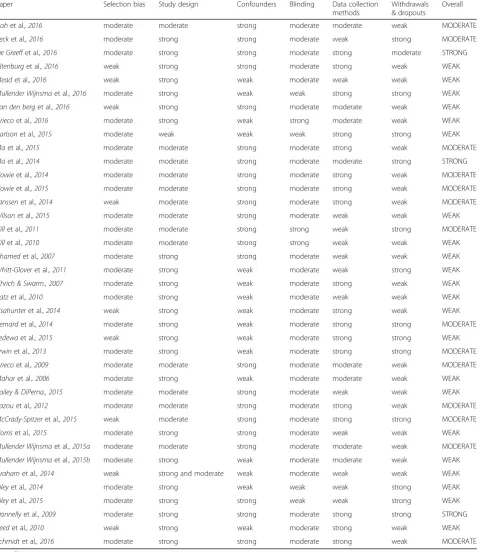
Of the 39 identified studies, most (36 out of 39) received a moderate [24, 26, 33, 38–41, 48, 53, 55–57, 60, 62], or weak quality rating score [25, 27, 28, 35–37, 42, 44–47, 49–52, 54, 59, 61, 63–66]. Three received a strong qual-ity rating score [32, 43, 58]. Low to moderate qualqual-ity score ratings were mostly attributable to not reporting or controlling for relevant demographic confounders, not reporting blinding of participants and researchers, and not reporting participant attrition. Further, for many studies, authors did not report the rate of participant or school participation. See Appendix A for further detail on quality assessment of included studies.
Academic-related outcomes: Classroom behaviour Studies assessed the effect of participation in these pro-grams on academic-related outcomes both immediately following participation in a session (acute) and after a longer exposure (chronic; e.g. pre- and post- interven-tion periods spanning up to 8 months). Regardless of type of classroom-based physical activity, the majority of studies (10 out of 12) showed participation in these pro-grams had an acute effect on improving on-task class-room behaviour [25, 27, 28, 39, 52, 57, 62, 65] and reducing off-task behaviour [36, 43] However, evidence in the few studies with longer term follow-up (2 out of 2 studies) suggest that this improvement may dissipate over time, with no difference between groups when chronic intervention effects on reported behaviour inci-dents were assessed [42, 47]. Due to few studies investi-gating chronic effects of classroom-based physical activity on on-task and off task classroom behaviour (<5) it was not possible to separate acute and chronic ef-fects in the meta-analysis. Results from the 4 included studies show classroom-based physical activity had a positive effect on improving on-task behaviour and redu-cing off-task behaviour (standardised mean differ-ence = 0.60 (95% CI: 0.20,1.00)) (see Fig. 2).
Academic-related outcomes: Cognitive function
Studies also assessed acute and chronic effects of classroom-based physical activity on a range of cognitive functions [24, 32, 37, 38, 40, 41, 46, 47, 49, 50, 54, 64].
Results showed active breaks had an acute positive effect on selective attention (3 out of 4 studies) [24, 41, 49]. No acute effect was reported for sustained attention [46], information processing [50] or focussed attention, processing speed and accuracy [26], and no chronic ef-fect was reported for planning, attention, simultaneous or successive cognitive processes [47] or executive tion [32]. Acute intervention effects on executive func-tion were inconsistent, with no difference between groups reported in one study [40], while another re-ported improvements in executive function but only for those receiving the intervention in the second week of delivery [37, 38]. Results were also inconsistent for chronic intervention effects on fluid intelligence, with one study reporting a significant improvement after 3 months [64], while another reported no difference be-tween groups after 1-year [54]. Due to few studies reporting chronic effects of participation (<5) results for acute and chronic studies were combined in the meta-analysis (5 studies). Results from the meta-meta-analysis indi-cate classroom-based physical activity had no effect on cognitive function (standardised mean difference = 0.33 (95% CI: -0.11,0.77) (see Fig. 3).
Academic-related outcomes: Academic achievement Studies assessed intervention effects on academic achievement using a range of academic assessment tools, including standardised tests, progress monitor-ing tools, grades and content recall quizzes. Reported effects on academic achievement varied by interven-tion durainterven-tion and the type of assessment tool used. Interventions of shorter duration tended to show im-provement in academic achievement if a progress monitoring tool was used, but not if a national stan-dardised test was used. Seven out of 8 studies using a progress monitoring tool reported significant improve-ment in academic achieveimprove-ment following intervention periods ranging from 4 weeks to 1-year [40, 44, 53, 54, 60, 61, 66]. In contrast, most (4 out of 7) studies indicated no difference between groups following intervention periods less than 1-year when national standardised tests were used as the outcome measure [27, 42, 64, 66]. However, standardised test scores
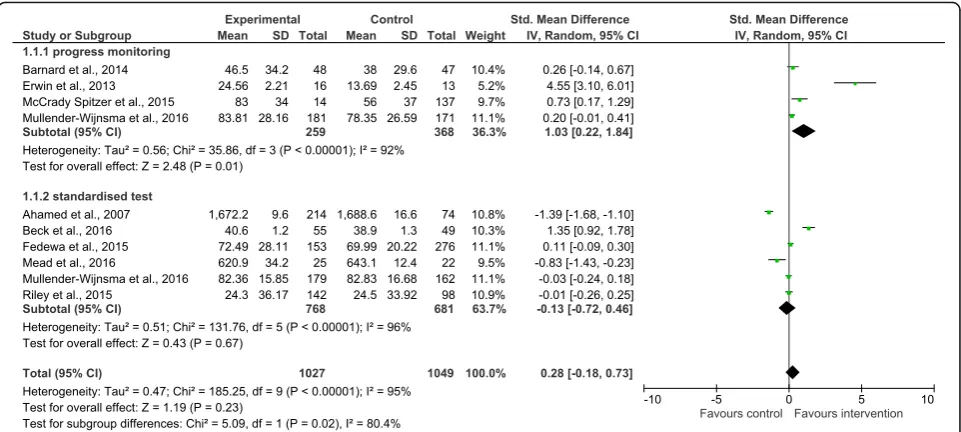
significantly improved following a 1-year [51] and 3-year physically active lesson intervention [58]. These results were confirmed in the meta-analysis. When progress monitoring tools were used (4 studies) as the outcome measure, academic-related outcomes generally showed improvement (standardised mean difference = 1.03 (95% CI: -0.22,1.84)). However, when measured using a national standardised test (6 stud-ies), academic-related outcomes generally showed no improvement (standardised mean difference = −1.13 (95% CI: -0.72,0.46)) (see Fig. 4).
In addition to standardised tests and progress moni-toring tools, a small number of studies (not included in the meta-analysis) measured academic achievement via grades, content recall quizzes and self-reported academic competence. Results were inconsistent. One study reported no difference between groups for grades across eight subjects (total score) following a 20-week active break program [47], Another reported a greater proportion of students in the control group
showed improvement in grades for math and reading, compared with an active break intervention group [42]. Other studies assessed academic achievement via content recall quizzes and perceptions of academic competence, with no difference between groups in math and social studies scores following participation in single lessons lasting between 10 and 30 min [59, 63]. Another study reported self-reported perceptions of academic competence improved during physically active lessons [56].
Dose response relationship
Four studies aimed to explore the optimal dose of active break (i.e. amount of physical activity required to confer academic benefits) required to provide max-imum effects on academic-related outcomes, by ma-nipulating intensity [41], duration [39, 40], and frequency [49] of active break sessions. Howie and colleagues [39, 40] compared 5-, 10- and 20-min ac-tive breaks with a 10-min no break condition. Results
Fig. 3Forrest plot of the effect of classroom-based physical activity on cognitive function
showed on-task classroom behaviour significantly im-proved after the 10-min active break condition [39] and math scores were highest after the 10-min (ES = 0.24) and 20-min (ES = 0.27) active break con-ditions [40]. Janssen et al. [41] compared selective at-tention scores across 15 min of each of the following four conditions: no break (continued with school work), passive break (teacher read story), moderate-intensity active break (jogging, passing, dribbling), and vigorous-intensity active break (running, jumping, skipping) [41]. Results showed that selective attention scores improved most after the moderate-intensity ac-tive break [41]. Altenburg and colleagues [49] com-pared acute effects of different frequencies (one per day vs. twice per day) of 20 min moderate-intensity active breaks. Results showed significantly better se-lective attention scores for children who received the twice per day frequency [49].
Physical activity outcomes
Eleven studies examined the effect of classroom-based physical activity interventions on children’s physical ac-tivity levels using a range of measures, including ques-tionnaire [35], direct observation [45], pedometer [25, 47, 52], and accelerometer [27, 28, 36, 47, 58, 60, 63]. Across most (10 out of 11) classroom-based physical activity interventions, small increases in physical activity were reported [25, 27, 28, 35, 36, 45, 52, 58, 60, 63]. Across studies there was a 2% to 16% increase in moder-ate- to vigorous- intensity physical activity during inter-vention lessons, [27, 28, 45, 60, 63], and 2% to 12% increase in school day moderate- to vigorous- intensity physical activity [27, 28, 58]. However, as shown in Fig. 5 results from 3 studies included in meta-analysis indicate classroom-based physical activity did not affect physical activity (standardised mean difference = 0.40 (95% CI: -0.15,0.95).
Discussion
A systematic search of the literature found 39 studies assessing the effect of classroom-based physical activity on academic-related outcomes, including classroom be-haviour, cognitive function and academic achievement. In the majority of studies, academic-related outcomes improved following participation in classroom-based physical activity programs. These findings are gener-ally consistent with earlier reviews finding that overall physical activity level was either positively associated, or was not associated with academic-related outcomes [14, 15, 17]. In addition, the interventions included in the current review generally resulted in more physical activity.
The finding that classroom-based physical activity
improves on-task or reduces off-task classroom
behaviour immediately following participation in intervention sessions is consistent with previous re-views of school-based physical activity. For example, systematic reviews of the effect of physical activity during the school break time on academic-related outcomes showed positive associations between par-ticipation in physical activity before class (e.g. during recess/snack time) and on-task classroom behaviour in subsequent lessons [17, 29]. Therefore, breaking up lesson time with physical activity offers a promising strategy to improve on-task behaviour. Further, phys-ically active lessons may provide a strategy to engage students in lesson content, which may lead to im-proved on-task classroom behaviour. However, this assumption is purely speculative and further research is needed to confirm this. One study reported a non-significant increase in on-task classroom behaviour after intervention sessions, compared with control [55]. A possible reason for this finding may be that the sample size in that study (n = 97) may not have been large enough to detect a significant improve-ment. Few studies (n = 3) reported that classroom-based physical activity had no effect on classroom behaviour. The majority of these studies (2 out of 3) reported that, while behaviour incidents and off-task behaviour increased in both the intervention and con-trol groups, the increase was greater in the concon-trol group, compared with the intervention group [46, 47]. These findings may encourage teachers to consider implementing classroom-based physical activity pro-grams by alleviating concerns about reducing on-task behaviour due to the disruption to the classroom rou-tine [10].
While classroom-based physical activity showed rela-tively consistent positive associations with classroom be-haviour, effects on cognitive function were inconsistent. A possible explanation for this finding may relate to the variability in the quality of measures used. Overall results showed studies that reported improvements in cognitive function used measures with moderate to high levels of reliability and validity [67, 68]. In con-trast, studies reporting no improvement in cognitive function mainly used measures with lower levels of reliability and validity [69–71]. It may be important for future studies to use tests of cognitive function with established validity and reliability.
A further possible explanation for inconsistent ef-fects on cognitive function may relate to the level of
cognitive engagement inherent in each type of
repetitive exercise) [72]. As curriculum-focused active breaks and physically active lessons can be considered cognitively engaging physical activity, it could be hypothesised that these types of classroom-based physical activity would lead to greater improvements in cognitive function, compared with active breaks that involve no cognitive content. While the majority of physically active lesson and curriculum focussed active break interventions (2 out of 3 studies) and only half of active break interventions (5 out of 10 studies) led to improvements in cognitive function, there were too few cognitively engaging interventions included in the review to draw a definitive conclu-sion. The one study that compared cognitively en-gaging and non-cognitively enen-gaging active breaks, showed an impact on cognitive outcomes for the cog-nitively engaging breaks group only, lending support to this hypothesis [26]. Although not explicitly stated, many studies which do not purport to involve cogni-tively engaging physical activity involve some activities which are likely to confer cognitive engagement e.g. hopping sequences to music [37, 38], and coordina-tive exercises [50]. Some of these report posicoordina-tive and some null findings, yet it is difficult to ascertain the proportion of physical activity children were exposed to that was cognitively engaging. Future studies are encouraged to separate the effects of cognitively en-gaging and non-cognitively enen-gaging physical activity on cognitive functions.
In addition to the cognitive test used, results may be dependent on the type of cognitive function assessed. For example, classroom-based physical activ-ity appeared to have a particularly beneficial effect on selective attention [24, 41, 49], compared with other components of cognitive function, including sustained attention [46], fluid intelligence [54, 64], information processing speed [50], and executive function [32, 37, 38, 40]. However, a recent systematic review con-cluded that there is insufficient evidence to conclude what specific cognitive functions are most affected by physical activity [73]. Exercise-induced arousal may provide a further explanation for inconsistency in findings. This theory suggests that the heightened
level of arousal during physical activity facilitates cog-nitive function and that this effect may be moderated by physical activity intensity [74]. However, while the majority of included studies reported a target physical activity intensity, few measured physical activity inten-sity during interventions precluding conclusions re-garding the role of physical activity intensity on cognitive function. Thus, the favourable effect of physical activity on selective attention indicated in this review requires further research for confirmation. Nonetheless, should improvements in selective atten-tion occur, such as the ability to ignore distracatten-tions this may be of particular interest to teachers and may provide motivation to incorporate physical activity into their classroom routine.
In addition to classroom behaviour and cognitive function, classroom-based physical activity may also have a positive effect on academic achievement. However, effects on academic achievement may be dependent on intervention duration and the type of assessment tool used to measure academic achieve-ment. In the current review it appeared that inter-ventions of shorter duration were more likely to show an improvement in academic achievement if a progress monitoring tool was used, rather than a national standardised test. This may be because curriculum-based measures are sensitive to small changes in academic achievement, and can be admin-istered frequently (e.g. weekly) [75, 76], while stan-dardised tests are usually designed to be administered less frequently (e.g. yearly), and are not sensitive to short-term progress. Therefore, progress monitoring tools may be a more suitable choice to determine intervention effects on academic achievement in the short-term. This finding has important implications for future research, indicating it may be important to consider intervention duration when selecting the measure of academic achievement. Therefore, future intervention studies may consider using a progress monitoring tool for intervention periods less than 1-year, and standardised tests for intervention periods longer than 1-year if academic achievement is the outcome of interest.
Other studies investigated the impact of different doses of classroom-based physical activity on academic-related outcomes. However, results are based on few (n = 4) heterogeneous studies which considered a lim-ited range of potential physical activity doses. Thus, fur-ther research is needed to be able to draw conclusions regarding the minimal dose of active break required to impact academic-related outcomes.
Several studies aimed to explore the effect of classroom-based physical activity on children’s phys-ical activity levels [25, 27, 28, 35, 36, 45, 47, 52, 58,
60, 63]. Results from the meta-analysis showed
classroom-based physical activity did not affect phys-ical activity levels. However, as only three of the 11 identified studies could be included in the meta-analysis these results should be interpreted with cau-tion, and further research is warranted. Findings from the systematic review consistently revealed small in-creases in physical activity in children participating in the intervention, compared with students in the com-parison group. These findings are in line with results from another review reporting positive associations between classroom-based physical activity interven-tions and children’s physical activity levels [21]. While promising, it is possible compensation for this activity occurs outside of school. However, with limited infor-mation available, it is difficult to make strong conclu-sions on this. Further, it can be difficult to implement physical activity interventions in schools, often due to a lack of time associated with competing curriculum demands [77]. However, classroom-based physical ac-tivity is unique from other forms of school-based physical activity (e.g. Physical Education class and school sport) in that it does not compete for instruc-tional time (physically active lessons and curriculum-focussed active breaks) or requires only minimal time commitment (active breaks). Thus, classroom-based physical activity may be a potentially appealing option for schools as it offers a time-efficient strategy to pro-mote physical activity.
Limitations
The considerable variation between studies in study designs, intervention content and outcome assessment tools make it difficult to draw definitive conclusions, as evidenced by the small proportion of studies that could be included in meta-analyses. For studies that assessed intervention effects on physical activity, the majority compared physical activity levels during the classroom-based physical activity session, with a trad-itional seated lesson [27, 28, 45, 47], or assessed intervention effects on school day physical activity levels only [25, 27, 28, 36, 52, 60]. Therefore, it is un-clear if the increase in physical activity during these
sessions is compensated for by a reduction in physical activity at other times of the day. However, as inter-vention effects on improving on-task, reducing
off-task classroom behaviour and cognitive function
appear to be primarily acute, this may not be a prob-lem for these outcomes. In addition, few studies used an objective measure of physical activity intensity [27, 28, 35, 36, 47, 58, 60, 63]. Thus, future studies using objective measures of physical activity are required to determine intervention effects on overall moderate-to- vigorous-intensity physical activity, and to deter-mine intervention fidelity (i.e. if the required physical activity intensity is met) within the sessions. Lastly, given that the majority of included studies reported significant improvements in academic-related out-comes, it is possible publication bias may have impacted the lack of published null associations.
Conclusion
Appendix
Table 5Quality assessment of included studies
Paper Selection bias Study design Confounders Blinding Data collection
methods
Withdrawals & dropouts
Overall
Gohet al., 2016 moderate moderate strong moderate moderate weak MODERATE
Becket al., 2016 moderate strong strong moderate weak strong MODERATE
De Greeffet al., 2016 moderate strong strong moderate strong moderate STRONG
Altenburget al., 2016 weak strong strong moderate strong weak WEAK
Meadet al., 2016 weak strong weak moderate weak weak WEAK
Mullender Wijnsmaet al., 2016 moderate strong weak weak strong strong WEAK
Van den berget al., 2016 weak strong strong moderate moderate weak WEAK
Griecoet al., 2016 moderate strong weak strong moderate weak WEAK
Carlsonet al., 2015 moderate weak weak weak strong strong WEAK
Maet al., 2015 moderate moderate strong moderate strong weak MODERATE
Maet al., 2014 moderate moderate strong moderate moderate strong STRONG
Howieet al., 2014 moderate moderate strong moderate strong weak MODERATE
Howieet al., 2015 moderate moderate strong moderate strong weak MODERATE
Janssenet al., 2014 weak moderate strong moderate strong weak MODERATE
Wilsonet al., 2015 moderate moderate strong moderate weak weak WEAK
Hillet al., 2011 moderate moderate strong strong weak strong MODERATE
Hillet al., 2010 moderate moderate strong strong weak weak WEAK
Ahamedet al., 2007 moderate strong strong moderate weak weak WEAK
Whitt-Gloveret al., 2011 moderate strong weak moderate weak strong WEAK
Uhrich & Swarm., 2007 moderate strong weak moderate strong weak WEAK
Katzet al., 2010 moderate strong weak moderate weak weak WEAK
Lisahunteret al., 2014 weak strong weak moderate strong weak WEAK
Bernardet al., 2014 moderate strong weak moderate strong strong MODERATE
Fedewaet al., 2015 weak strong weak moderate strong strong WEAK
Erwinet al., 2013 moderate strong weak moderate strong strong MODERATE
Griecoet al., 2009 moderate moderate strong moderate moderate weak MODERATE
Maharet al., 2006 moderate strong weak moderate moderate weak WEAK
Bailey & DiPerna., 2015 moderate moderate strong moderate weak weak WEAK
Vazouet al., 2012 moderate moderate strong moderate strong weak MODERATE
McCrady-Spitzeret al., 2015 weak moderate strong moderate strong strong MODERATE
Norriset al., 2015 moderate strong strong moderate weak weak WEAK
Mullender Wijnsmaet al., 2015a moderate moderate strong moderate moderate weak MODERATE
Mullender Wijnsmaet al., 2015b moderate strong weak moderate moderate weak WEAK
Grahamet al., 2014 weak strong and moderate weak moderate weak weak WEAK
Rileyet al., 2014 moderate strong weak weak weak strong WEAK
Rileyet al., 2015 moderate strong strong weak weak strong WEAK
Donnellyet al., 2009 moderate strong strong moderate strong strong STRONG
Reedet al., 2010 weak strong weak moderate strong weak WEAK
Schmidtet al., 2016 moderate strong strong moderate strong weak MODERATE
Overall rating