GENOME REPORT
Complete genome sequence of bile-isolated
Enterococcus avium
strain 352
Tao Yu
1,2, Lixiang Li
1,2, Qilin Zhao
3, Peng Wang
1,2and Xiuli Zuo
1,2*Abstract
Background: Enterococcus avium is a Gram-positive pathogenic bacterium belonging to the family Enterobacte-riaceae. E. avium can cause bacteremia, peritonitis, and intracranial suppurative infection. However, the mechanism of its pathogenesis and its adaptation to a special niche is still unclear.
Results: In this study, the E. avium strain 352 was isolated from human bile and whole genome sequencing was per-formed. The E. avium strain 352 consists of a circular 4,794,392 bp chromosome as well as an 87,705 bp plasmid. The GC content of the chromosome is 38.98%. There are 4905 and 99 protein coding sequences in the chromosome and the plasmid, respectively. The genome of the E. avium strain 352 contains number of genes reported to be associated with bile adaption, including bsh, sbcC, mutS, nifI, galU, and hupB. There are also several virulence-associated genes including esp, fss1, fss3, ecbA, bsh, lap, clpC, clpE, and clpP.
Conclusions: This study demonstrates the presence of various virulence factors of the E. avium strain 352, which has the potential to cause infections. Moreover, the genes involved in bile adaption might contribute to its ability to live in bile. Further comparative genomic studies would help to elucidate the evolution of pathogenesis of E. avium.
Keywords: E. avium, Virulence factors, Bile adaption
© The Author(s) 2019. This article is distributed under the terms of the Creative Commons Attribution 4.0 International License (http://creat iveco mmons .org/licen ses/by/4.0/), which permits unrestricted use, distribution, and reproduction in any medium, provided you give appropriate credit to the original author(s) and the source, provide a link to the Creative Commons license, and indicate if changes were made. The Creative Commons Public Domain Dedication waiver (http://creat iveco mmons .org/ publi cdoma in/zero/1.0/) applies to the data made available in this article, unless otherwise stated.
Background
Enterococcus avium is a Gram-positive bacterium of
the genus Enterococcus and is most commonly found in
birds. E. avium is also a cause of infectious diseases in humans including bacteremia, peritonitis, intracranial suppurative infection and osteomyelitis [1–5]. It was reported that E. avium is responsible for approximately
1% of infections in humans [3]. However, there is not
much known about the mechanism of its pathogenesis. Enterococcus avium was isolated from blood samples, fecal samples, spinal cords, jeotgals (a Korean fermented seafood), and scallop solutions [1, 3, 6, 7]. Thus, E. avium can adapt to various environments and this might be an important factor for its survival in humans and for sub-sequent infections. Currently, there are 8 draft genomes of E. avium accessible on NCBI databases. However, no
studies have analyzed these genomes for the niche adap-tation of E. avium.
Here, we report the first whole genome sequence of E. avium. We also analyzed the virulence-associated genes
and bile stress adaptation mechanism of the E. avium
strain 352.
Methods
Strain isolation and characterization
The E. avium strain 352 was isolated from a bile sample of a cholelithiasis patient. This strain was cultivated on blood plate agar under anaerobic conditions at 37 °C for 24 h. This strain was identified by 16S rRNA
sequenc-ing ussequenc-ing the followsequenc-ing primers includsequenc-ing 27F (5′-AGA
GTT TGA TCC TGG CTC AG-3′) and 1492R (5′-GGT TAC
CTT GTT ACG ACT T-3′). The PCR products were
subse-quently sequenced, and these sequences were compared against the 16S rRNA bacteria sequence database using BLAST from the NCBI website.
Open Access
*Correspondence: [email protected]
Genome sequencing and de novo assembly
The bacterial genomic DNA was extracted from
over-night culture of the E. avium 352 using the Bacteria
DNA Kit (OMEGA Bio-Tek Inc., Norcross, GA, USA) according to the manufacturer’s instructions, and qual-ity control was subsequently carried out using TBS-380 fluorometer (Turner BioSystems Inc., Sunnyvale, CA).
Then, high qualified DNA sample (OD260/280 = 1.8–
2.0, > 6 μg) was utilized to construct a fragment library. Genomic DNA (above 3 μg) was subjected to whole genome sequencing on an Illumina HiSeq Sequencer (PE150 mode) according to the sequencing protocol. Raw sequencing data was generated by Illumina base call-ing software CASAVA v1.8.2 (Illumina Inc. San Diego, CA, USA). Contamination reads, such as ones contain-ing adaptors or primers were identified by Trimmo-matic with default parameters. Clean data obtained by above quality control processes were used to do further analysis. Meanwhile, the whole-genome sequencing of E. avium 352 was also carried out on the single molecule real-time by the PacBio RS Platform (Pacific Biosciences of California, Inc., Menlo Park, CA, USA). A 20 K tem-plate library was generated and sequenced using stand-ard methods.
The Illumina data were used to evaluate the complex-ity of the genome and correct the PacBio long reads. First, we used ABySS to peform genome assembly with multiple-Kmer parameters and obtained optimal results for the assembly [8]. Second, canu (https ://githu b.com/ marbl /canu) was used to assemble the PacBio corrected long reads [9]. Finally, GapCloser software was subse-quently applied to fill the remaining local inner gaps and correct the single base polymorphism for the final assem-bly results [10].
Gene annotation was determined by Annotation NCBI
Prokaryotic Genome Annotation Pipeline [11].
Riboso-mal RNA genes were detected by RNAmer 1.2 [12] and
tRNA genes were recognized via tRNAscan SE v. 2.0 [13]. The circular genomic map was produced using CGView Server [14].
Phylogenetic analysis is based on orthologous genes. First, orthologous gene families were identified by the ORTHOMCL v2.0 program (reciprocal all-by-all BLASTP analysis) with an E-value of 10−5 [15]. Second, multiple alignments were generated with the MUS-CLE v3.8.31 program, and the alignments were exam-ined visually [16]. Third, the Maximum-likelihood (ML) methods were performed for the phylogenetic analyses
using PhyML 3.0, and the model GTR + G was selected
for ML analyses with 500 bootstrap replicates to calcu-late the bootstrap values [17]. The strains used for
phy-logenetic tree analysis included the E. avium strain
ATCC 14025 (GCA000406965.1), the E. faecalis strain
ATCC 19433 (GCA000392875.1), the E. faecium strain
DO (GCA000174395.2), the E. gilvus strain ATCC
BAA-350 (GCA_000394615.1), the E. pseudoavium strain
CBA7133 (GCA 003386455.1), the E. sulfureus strain
ATCC 49903 (GCA000407025.1), the E. raffinosus strain
ATCC 49464 (GCA000393895.1), the E. gallinarum strain
FDAARGOS_163 (GCA001558875.2), and the
Vagococ-cus fluvialis strain DSM 5731 (GCA003337315.1). The putative virulence related genes were identified based on
the whole genome of the E. avium strain 352 using the
VFDB [18].
Quality assurance
A single colony of the E. avium strain 352 was repeatedly transferred to fresh brain heart infusion (BHI) medium to obtain pure cultures. Before DNA extraction, the iden-tity of the strain was verified through 16S rRNA gene sequencing. After the genome sequence was obtained, the 16S rDNA gene was extracted from the genome using the RNAmmer 1.2 server and then confirmed through a BLAST search of the 16S rRNA gene against the NCBI microbial 16S database.
Results and discussion
General genome features of the E. avium strain 352
Total of 46,188,978 raw reads were obtained by Illumina HiSeq Sequencer, and 45,357,196 high quality reads were generated after quality control processes. In addi-tion, 168,754 (1.26 Gb) high-quality reads with an aver-age read length of 7500 bp and a 259-fold coveraver-age were generated by PacBio sequencer. These sequences were used to assemble the genome of the E. avium strain 352 and we obtained a circular chromosome without gap. The complete genome is 4.79 Mb in size with a plasmid of 87.7 kb (Fig. 1) and the mean G + C content is 38.98%. This genome contains 4905 predicted genes as well as 18 rRNA and 68 tRNA genes, while there were 99 predicted genes in the plasmid.
Phylogenetic analysis
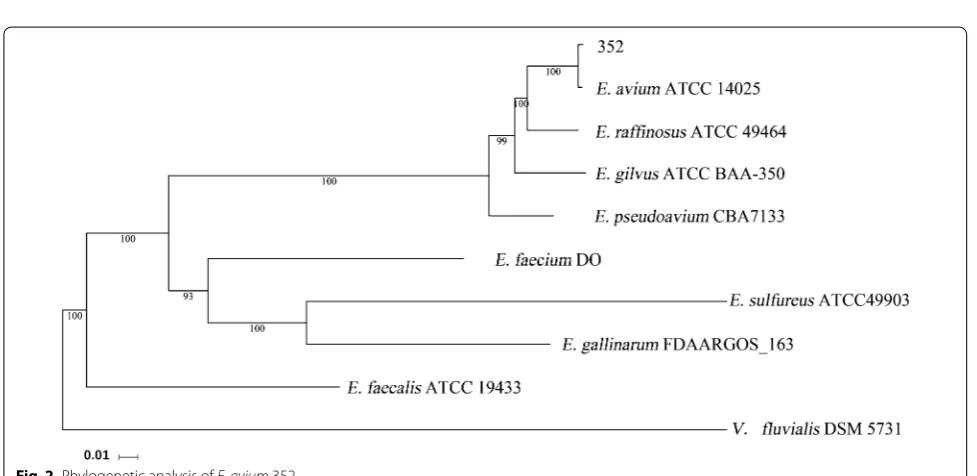
The 16S rRNA gene sequence verified the taxonomic status of the E. avium strain 352 (data not shown). To further elucidate the phylogenetic relationships, whole genome DNA-sequence-based phylogenetic analysis was carried out (Fig. 2). The genome of a highly related and similar type of E. avium strain, E. avium strain ATCC 14025, was selected as standard. The dendrogram of phy-logenetic trees illustrated that the E. avium strain 352
was most closely related to the E. avium strain ATCC
Identification of genes related to bile stress
Bile salts have potent antimicrobial activity via damaging membranes and DNA. Thus, bacteria must have intrinsic adapted mechanisms to survive in bile and subsequently cause biliary tract infections [19]. Genomic analysis of
the E. avium strain 352 showed the presence of numer-ous genes that may determine its bile resistance proper-ties (Table 1). The presence of the genes sbcC, mutS and nifI involved in bile resistance in Gram-positive bacteria was identified [19]. It is interesting that there were two
Fig. 1 Genome map of E. avium 352. Circles from the outside to inside showing: (1) DNA coordinates; (2, 3) function-based color-coded mapping of the CDSs predicted on the forward and reverse strands. Functions are color-coding; (4) tRNA genes and rRNA genes; (5) GC plot showing regions above the average (red) and below (blue); (6) GC skew
bsh genes encoding bile salt hydrolase with a protein sequence identity of 92.9% in the genome of the E. avium strain 352. This result indicated that the BSH might be play an important role in niche-specific adaptation for bile [20]. There were also some genes, including galU and hupB, involved in bile resistance in Gram-negative bac-teria [19]. Further studies are needed to verify its genetic properties and evolution traits.
Analysis of virulence associated genes
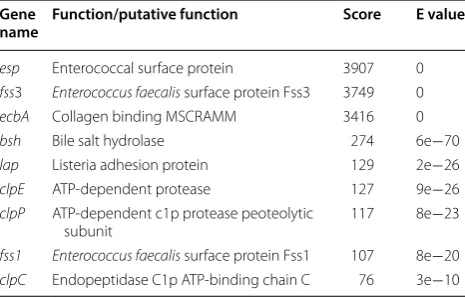
Further screening the genome of the E. avium strain 352 for putative virulence-associated genes was conducted by aligning gene sequences to the virulence factor data-base (Table 2). There are surface protein encoded genes including esp, fss1 and fss3. The E. avium strain 352 also contains the conservative heat shock protein genes clpC, clpE, and clpP [21]. The ecbA gene encoding a collagen binding MSCRAMM (acronym for microbial surface components recognizing adhesive matrix molecules) and gene lap encoding a listeria adhesion protein were found in the genome and might be contribute to adherence to the host tissue [22, 23]. The bsh gene encoding a bile salt hydrolase was also a virulence related factor in Listeria
monocytogenes [24]. The clinical significance of this find-ing warrants further investigation.
Authors’ contributions
TY and LXL designed the study; LXL and QLZ isolated and identified the E. avium 352; TY and LXL analyzed data and wrote the manuscript; PW revised the manuscript; XLZ support this study and revised the manuscript. All authors read and approved the final manuscript.
Author details
1 Department of Gastroenterology, Qilu Hospital, Shandong University, 107 Wenhuaxi Road, Jinan 250012, Shandong, People’s Republic of China. 2 Labo-ratory of Translational Gastroenterology, Qilu Hospital, Shandong University, Jinan 250012, People’s Republic of China. 3 High School Attached To Shan-dong Normal University, Jinan 250012, People’s Republic of China.
Acknowledgements
Not applicable.
Competing of interests
The authors declare that they have no competing interests.
Availability of data and materials
The completed genome sequence of E. avium 352 has been deposited into GenBank database with accession number CP034169 (chromosome) and CP034168 (plasmid), respectively.
Ethics approval and consent to participate
This study was approved by the ethics committees in Qilu hospital of Shan-dong University.
Funding
This research was supported by the Key Research and Development Program of Shandong Province (2017CXGC1215) and National Natural Science Founda-tion of China (81600428).
Publisher’s Note
Springer Nature remains neutral with regard to jurisdictional claims in pub-lished maps and institutional affiliations.
Received: 16 December 2018 Accepted: 23 March 2019
References
1. Cottagnoud P, Rossi M. Enterococcus avium osteomyelitis. Clin Microbiol Infect. 1998;4(5):290.
2. Na S, et al. Enterococcus avium bacteremia: a 12-year clinical experience with 53 patients. Eur J Clin Microbiol Infect Dis. 2012;31(3):303–10. 3. Okada A, Hangai M, Oda T. Bacteremia with an iliopsoas abscess and
osteomyelitis of the femoral head caused by Enterococcus avium in a patient with end-stage kidney disease. Intern Med. 2015;54(6):669–74. 4. Yildirmak T, et al. Community-acquired intracranial suppurative infections:
a 15-year report. Surg Neurol Int. 2014;5:142.
5. Ugur AR, et al. Enterococcus avium peritonitis in a child on continuous ambulatory peritoneal dialysis. Perit Dial Int. 2014;34(1):127–8. 6. Shin NR, et al. Isolation and characterization of human intestinal
Entero-coccus avium EFEL009 converting rutin to quercetin. Lett Appl Microbiol. 2016;62(1):68–74.
7. Yang H, et al. Accumulation of gamma-aminobutyric acid by Enterococ-cus avium 9184 in scallop solution in a two-stage fermentation strategy. Microb Biotechnol. 2016;9(4):478–85.
8. Jackman SD, et al. ABySS 2.0: resource-efficient assembly of large genomes using a Bloom filter. Genome Res. 2017;27(5):768–77. 9. Koren S, et al. Canu: scalable and accurate long-read assembly via
adaptive k-mer weighting and repeat separation. Genome Res. 2017;27(5):722–36.
Table 1 Putative genes for bile adaptation in E. avium 352 Gene name Fuction/putative fuction
hupB HU family DNA-binding protein
galU UDP-glucose-pyrophosphorylase
sbcC Exonuclease SbcC
mutS DNA mismatch repair
bsh1 Bile salt hydrolase
bsh2 Bile salt hydrolase
nifI Pyruvate: ferredoxin oxidoreductase
Table 2 Putative virulence associated genes in E. avium 352 predicted by VFDB
Gene
name Function/putative function Score E value
esp Enterococcal surface protein 3907 0
fss3 Enterococcus faecalis surface protein Fss3 3749 0
ecbA Collagen binding MSCRAMM 3416 0
bsh Bile salt hydrolase 274 6e−70
lap Listeria adhesion protein 129 2e−26
clpE ATP-dependent protease 127 9e−26
clpP ATP-dependent c1p protease peoteolytic
subunit 117 8e−23
fss1 Enterococcus faecalis surface protein Fss1 107 8e−20
•fast, convenient online submission
•
thorough peer review by experienced researchers in your field
• rapid publication on acceptance
• support for research data, including large and complex data types
•
gold Open Access which fosters wider collaboration and increased citations maximum visibility for your research: over 100M website views per year
•
At BMC, research is always in progress.
Learn more biomedcentral.com/submissions
Ready to submit your research? Choose BMC and benefit from:
10. Luo R, et al. SOAPdenovo2: an empirically improved memory-efficient short-read de novo assembler. Gigascience. 2012;1(1):18.
11. Tatusova T, et al. NCBI prokaryotic genome annotation pipeline. Nucleic Acids Res. 2016;44(14):6614–24.
12. Lagesen K, et al. RNAmmer: consistent and rapid annotation of ribosomal RNA genes. Nucleic Acids Res. 2007;35(9):3100–8.
13. Lowe TM, Eddy SR. tRNAscan-SE: a program for improved detec-tion of transfer RNA genes in genomic sequence. Nucleic Acids Res. 1997;25(5):955–64.
14. Grant JR, Stothard P. The CGView Server: a comparative genomics tool for circular genomes. Nucleic Acids Res. 2008;36(Web Server issue):W181–4. 15. Li L, Stoeckert CJ Jr, Roos DS. OrthoMCL: identification of ortholog groups
for eukaryotic genomes. Genome Res. 2003;13(9):2178–89.
16. Edgar RC. MUSCLE: multiple sequence alignment with high accuracy and high throughput. Nucleic Acids Res. 2004;32(5):1792–7.
17. Guindon S, et al. New algorithms and methods to estimate maximum-likelihood phylogenies: assessing the performance of PhyML 3.0. Syst Biol. 2010;59(3):307–21.
18. Chen L, et al. VFDB 2016: hierarchical and refined dataset for big data analysis—10 years on. Nucleic Acids Res. 2016;44(D1):D694–7.
19. Begley M, Gahan CG, Hill C. The interaction between bacteria and bile. FEMS Microbiol Rev. 2005;29(4):625–51.
20. Bi J, et al. Bile salt tolerance of Lactococcus lactis is enhanced by expres-sion of bile salt hydrolase thereby producing less bile acid in the cells. Biotechnol Lett. 2016;38(4):659–65.
21. Cassenego AP, et al. The CtsR regulator controls the expression of clpC, clpE and clpP and is required for the virulence of Enterococcus faecalis in an invertebrate model. Antonie Van Leeuwenhoek. 2016;109(9):1253–9. 22. Yang J, et al. Prevalence of diverse clones of vancomycin-resistant
Enterococcus faecium ST78 in a Chinese Hospital. Microb Drug Resist. 2016;22(4):294–300.
23. Drolia R, et al. Listeria adhesion protein induces intestinal epithelial barrier dysfunction for bacterial translocation. Cell Host Microbe. 2018;23(4):470–84.