ISSN:2278 7496
AJPER July-September. 2019, Vol 8, Issue 3 (20-29)
FORMULATION DEVELOPMENT AND EVALUATION OF BILAYER TABLETS OF SOFOSBUVIR FOR EFFECTIVE TREATMENT OF CHRONIC HEPATITIS C USING
NATURAL POLYMERS
Madankumar Daulatrao Kadwe*, Hemant Kumar Sharma, Prabhakar Budholiya
College of Pharmacy, Sri Satya Sai University of Technology and Medical Sciences, Bhopal (M.P)
*Corresponding Author’s E mail: [email protected]
Received 05 June 2019; Revised 18 June 2019; Accepted 20 June 2019, Available online 10 July 2019.
ABSTRACT
Formulation development is an important part of drug design and development. Bioavailability and bioequivalence are totally dependent on formulation development. Now-a-days formulation development is done by following QbD (Quality by Design). The purpose of this work is to develop bilayer tablets of Sofosbuvir by using natural polymers, which is an anti-viral drug. It is used to treat Hepatitis C. As it is a fatal disease which damages the liver to an extent that one may die suffering from this disease. So development of a lifesaving drug was very much necessary for this disease. Hence a new approach is tried that gives one immediate release dose and a sustained release dose in single dosage form call bilayer tablets. Immediate release layer delivers the initial dose, it contains superdisintegrant which increase drug release rate whereas sustained release layer gastro retentive by using natural polymers and releases drug at sustained manner for prolonged period. A direct compression method was used to formulate 8 batches. Superdisintegrants like sodium starch glycolate, croscarmellose sodium, crospovidone sodium was used for immediate release layer and xanthan gum, gaur gum, karaya gum, PVP K30 like natural polymers were used in gastro retentive sustained release layer. The powders were evaluated for their flow properties and the finished tablets were evaluated for their physical parameters. A simple visible spectrophotometric method was employed for the estimation of Sofosbuvir at 264 nm and Beer’s law is obeyed in the concentration range of 5-25 µg/ml. The prepared gastro retentive tablets were evaluated for general appearance, thickness and diameter, drug content, hardness, friability, uniformity of weight and in vitro dissolution studies. Successful formulation was developed having disintegration Time 100±4 sec and drug release was sustained up to 12 hrs. A biphasic drug release can be obtained by using bilayer tabletting technology which involved compression of immediate and sustained release layer together. Bilayered floating tablets with release characteristics offer critical advantages such as, site specificity with improved absorption and efficacy. This technology can be inculcated to various medicaments which have stomach as the major site of absorption.
Keywords: Bilayer floating tablets, Sofosbuvir, Biphasic drug release, Bioavailability, Xanthan gum, Gaur gum, Karaya gum
INTRODUCTION:
The new drug delivery system with better efficacy and safety with reduced dosing frequency and
improved patient compliance is the current area of research by formulation development scientists. Tablet
being most preferred dosage form for its ease of manufacturing and patient convenience is always a first
choice of dosage form. The single layer tablets lead to frequent dosing and unpredicted drug plasma level
for drugs with shorter half-life 1, 2. Number of diseases require immediate release of drug for instant effect
to manage the panic attack at its presentation and then drug concentration has to be requirement for such
a disease conditions, the multilayered tablet concept has been utilized 3. Such a tablet has a fast releasing
layer and may contain bi- or triple layers to sustain the drug release. Bilayer tablets present a better choice
where one layer provide immediate dose which is then maintains the plasma drug level by its controlled
release layer of the tablet. One of the novel approaches in the area of oral sustained release drug delivery
is gastro retentive drug delivery system 4. GRDDS can be retained in the stomach and assist in improving
the oral sustained delivery of drugs that have an absorption window in a particular region of the
gastrointestinal tract. These systems help in continuously releasing the drug before it reaches the
absorption window, thus ensuring optimal bioavailability 5. Sofosbuvir is chemically known as
(S)-Isopropyl 2-((S)-(((2R, 3R, 4R, 5R)-5-(2, 4-dioxo-3,
4-dihydropyrimidin-1(2H)-yl)-4-fluoro-3-hydroxy-4-methyltetrahydrofuran-2-yl) methoxy)-(phenoxy) phosphoryl amino) propanoate. It has a molecular
formula of C22H29FN3O9P and a molecular weight of 529.45. Sofosbuvir is a white to off-white powder
with a solubility of ≥ 2 mg/mL across the pH range of 2-7.7 at 37°C. The partition coefficient (log P) for
Sofosbuvir is 1.62 and the pKa is 9.3 6. Sofosbuvir is a pangenotypic inhibitor of the HCV NS5B
RNA-dependent RNA polymerase, which is essential for viral replication 7. Sofosbuvir is a nucleotide prodrug
that undergoes intracellular activation to form GS-461203 (active triphosphate, not detected in plasma),
and ultimately the inactive, renally eliminated metabolite GS-331007 8. The pharmacologically active
uridine analog triphosphate (GS-461203) can be incorporated by HCV NS5B and acts as a chain
terminator. In a biochemical assay, GS-461203 inhibits the polymerase activity of the recombinant NS5B
from HCV genotype 1b, 2a, 3a and 4a with an IC50 value ranging from 0.7 to 2.6 μm. GS-461203 is
neither an inhibitor of human DNA and RNA polymerases nor an inhibitor of mitochondrial RNA
polymerase 9. In recent years natural polymers have been widely used because of their effectiveness,
toxic nature, easy availability, biocompatible and cheap over synthetic polymers. Natural
polysaccharides and dried mucilage have been reported as an emulsifying, suspending agent, binding
agent, disintegrating agent, and as a sustained-release matrix. They have been utilized in variety of
formulations like mucoadhesive, gastro retentive, colon specific drug delivery system etc., 10-12. Guar
gum is obtained from endospermic seeds of Cyamopsis tetragonolobus belonging to family
Leguminosae. Guar gum occurs as nearly odorless, white to yellowish-white powder with a bland taste.
is branched heteropolysaccharides consist of D-galactouronic acid and D-glucoronic acid. It is used as
thickening agent in pharmaceutical preparations. Xanthan gum is a high molecular weight extra cellular
polysaccharide produced by the fermentation of the gram-negative bacterium Xanthomonas compestris.
The primary structure of this naturally produced cellulose derivative contains a cellulosic backbone
(β-D-glucose residues) and a trisaccharide side chain of β-D-mannose-β-D-glucuronicacid-α-D-mannose
attached with alternate glucose residues of the main chain. Xanthan gum showed a higher ability to retard
the drug release. It is also used as a thickening agent 13. Hepatitis C virus (HCV) infection is a major
cause of end-stage liver disease and hepatocellular carcinoma (HCC). There have been rapid advances
in treatment with the development of oral direct-acting antivirals (DAAs) such as sofosbuvir (NS5B
nucleotide analogue), daclatasvir and ledipasvir (NS5A inhibitors). Sofosbuvir (SFB) is an oral
nucleotide analogue inhibitor of non-structural 5B polymerase that has been approved for treatment of
hepatitis C virus genotypes 1 to 4 (HCV). It is a pro nucleotide analogue, prodrug metabolized to the
active antiviral agent 2'-deoxy-2'-α-fluoro-β-C-methyluridine-5'-triphosphate. The triphosphate serves as
a defective substrate for the NS5B protein, which is the viral RNA polymerase, thus acts as an inhibitor
of viral RNA synthesis. The active substance in sofosbuvir, blocks the action of an enzyme called ‘NS5B
RNA-dependent RNA polymerase’ in the hepatitis C virus, which is essential for the virus to multiply.
This stops the hepatitis C virus from multiplying and infecting new cells. NS5B is one of the
non-structural proteins essential for viral RNA replication, and has been found to be a valuable target for
directly acting antiviral agents (DAAs) 14. In the present study, a bilayer tablet for bimodal drug release
in which one layer of immediate release and second layer of sustained release of sofosbuvir was designed
by using natural polymers.
EXPERIMENTAL
Materials and methods
Materials
Sofosbuvir was obtained as free gift sample from M/s Hetero Drugs Pvt. Ltd. Hyderabad, xanthan gum,
gaur gum; karaya gum was procured from local market of Bhopal, MP, India. PVP K30, sodium starch
glycolate, croscarmellose sodium, crospovidone was obtained from Mapromax, Life sciences Pvt. Ltd.
Dehradun. Microcrystalline cellulose, magnesium stearate and talc were obtained from Loba Chemical
Pvt Ltd (Mumbai, India). Hydrochloric acid was obtained from S. D. Fine Chem. Ltd., Mumbai. All other
whenever required. All other chemicals used in this study including those stated were of analytical
reagent (A.R.) grade.
Procedure for the determination of λ max
The λmax of Sofosbuvir was determined by analyzing the drug solution in double beam ultraviolet
spectrophotometer. Accurately weighed 10 mg of drug was dissolved in 10 ml of 7.2 pH buffer solution
in 10 ml of volumetric flask. The resulted solution was 1000µg/ml of strength and from this solution 1
ml solution was pipette out and transfer into 10 ml capacity of volumetric flask and volume was made
upto 10 ml with 1.2 pH solution. This solution was scan at wavelength 400-200 nm on UV
spectrophotometer. The higher absorption peak was obtained at 264 nm which was the λmax of drug.
Formulation of immediate release (IR) layer
Fast dissolving tablets of Sofosbuvir were prepared by direct compression method after incorporating
different super disintegrates such as, croscarmellose sodium (Ac-Di-Sol), crospovidone and sodium
starch glycolate in different concentrations. The ingredients given below were weighed and mixed in
geometric progression in a dry and clean mortar. Then the ingredients were passed through mesh #60.
Magnesium stearate as lubricant and talc as glidant were added in a final step and mixed, this blend
was subjected to analysis of pre-compression parameters which included angle of repose, bulk density,
tap density, carr’s index and hausner’s ratio. The Blend was compressed on 8 mm (diameter) fat punches on a ‘Rimek mini press 16 station rotary compression machine. Nine formulations of sofosbuvir granules
were prepared and each formulation contained one of the three disintegrate in different concentration.
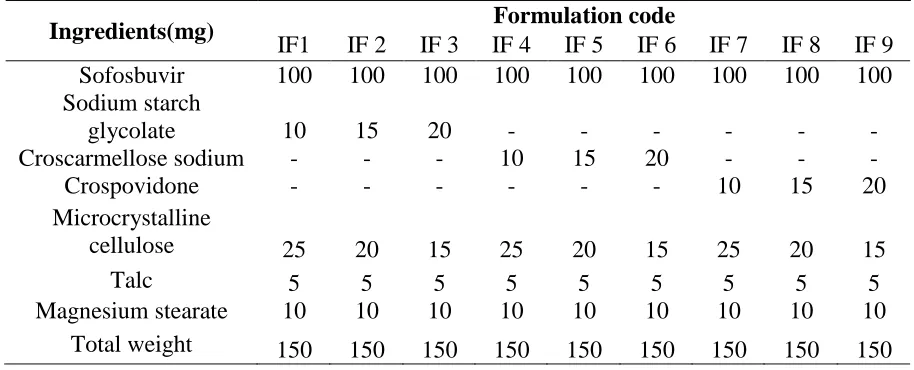
Each tablets weighing 150mg, were obtained. Composition of tablets is mentioned in Table 1.
Table 1 Composition of Sofosbuvir Fast Dissolving Tablets
Ingredients(mg) Formulation code
IF1 IF 2 IF 3 IF 4 IF 5 IF 6 IF 7 IF 8 IF 9 Sofosbuvir 100 100 100 100 100 100 100 100 100 Sodium starch
glycolate 10 15 20 - - - -
Croscarmellose sodium - - - 10 15 20 - - -
Crospovidone - - - 10 15 20
Microcrystalline
cellulose 25 20 15 25 20 15 25 20 15
Talc 5 5 5 5 5 5 5 5 5
Method for preparation of sofosbuvir gastroretentive tablets
Direct compression was followed to manufacture the gastroretentive tablets of sofosbuvir. Eight different
formulations (F1, F2, F3, F4, F5, F6, F7, & F8) were prepared by direct compression. All the polymers
selected, drug and excipients were passed through sieve no. 40 before using into formulation. The amount
and ratio of drug and polymers were weighed as per given in table 2 and all the formulation were used
for further evaluations parameters.
Table 2: Various formulations of sofosbuvir gastro retentive tablets
Formulation development of bilayer tablet
Optimized formulation IF-7 of Instant release layer and optimized formulation of F-7 for control release
used for formulation of Bi-layer tablet.
In vitro disintegration time of immediate release tablets
The disintegration time for all immediate release formulations was carried out using tablet disintegration
test apparatus. Six tablets were placed individually in each tube of disintegration test apparatus and discs
were placed. The medium, 0.1 N HCl was maintained at a temperature of 37° ± 2°C and time taken for
the entire tablet to disintegrate completely was noted.
In vitro dissolution studies
In vitro drug release of the sample was carried out using USP- type II dissolution apparatus (Paddle type).
The dissolution medium, 900 ml 0.1N HCl was placed into the dissolution flask maintaining the
temperature of 37±0.50ºc and rpm of 75. One sofosbuvir tablet was placed in each basket of dissolution
apparatus. The apparatus was allowed to run for 12 hours. Sample measuring 5 ml were withdrawn after
every 1 hour up to 10 hours using 10ml pipette. The fresh dissolution medium (370C) was replaced every
Excipients (mg) F1 F2 F3 F4 F5 F6 F7 F8
Sofosbuvir 300 300 300 300 300 300 300 300
Xanthan gum 90 120 - - - - 30 40
Gaur gum - - 90 120 - - 30 40
Karaya gum - - - - 90 120 30 40
PVP K30 15 15 15 15 15 15 15 15
Talc 5 5 5 5 5 5 5 5
Mg. Stearate 10 10 10 10 10 10 10 10
Lactose 80 50 80 50 80 50 80 50
time with the same quantity of the sample. From this take 0.5 ml and dilute up to 10 ml with 0.1 N HCl
and take the absorbance at 264nm using spectroscopy.
Stability studies
The stability of sofosbuvir bilayer GR tablets to assess their stability with respect to their physical
appearance, drug content and release characteristics after storing at 25°C/60% RH and 40°C/75% RH in
properly closed HDPE bottles along with 1 g desiccant for 3 months.
RESULTS AND DISCUSSIONS
λ max of sofosbuvir was found to be 264 nm by using U.V. spectrophotometer (Labindia-3000+) in
linearity range 5-25 µg/ml Fig.1.
The powdered blends of different formulations of immediate release tablets and sustained release tablets
were evaluated for angle of repose, bulk density (BD), tapped density (TBD) and compressibility index.
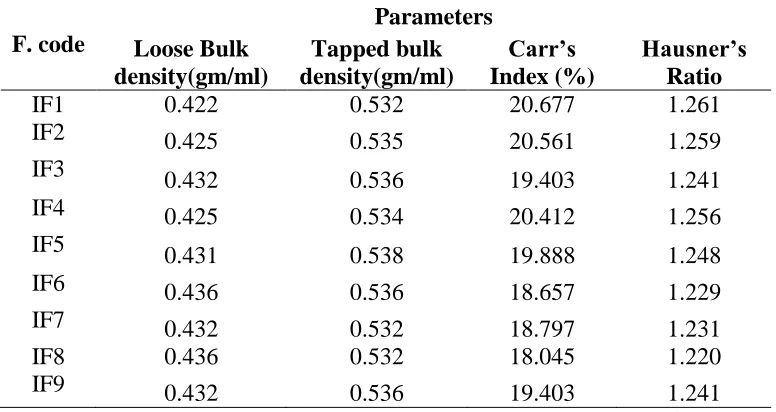
The results of immediate release tablets and SRGR tablets are summarized in Table 3& 4. The results of
SR tablets of BD and TBD ranged from 0.478 to 0.486 and 0.532 to 0.538 respectively. The range of
compressibility index was found to be 18.045 to 20.677. The results of angle of repose (<35) indicate
good flow properties of the powdered blend. The formulation of immediate release tablet prepared by
using the superdisintegrants exhibited the LBD, TBD, compressibility index and Hausner’s ratio of
Table 3 Results of pre-compression parameters of powder blend of immediate release
F. code
Parameters Loose Bulk
density(gm/ml)
Tapped bulk density(gm/ml)
Carr’s Index (%)
Hausner’s Ratio
IF1 0.422 0.532 20.677 1.261
IF2 0.425 0.535 20.561 1.259
IF3 0.432 0.536 19.403 1.241
IF4 0.425 0.534 20.412 1.256
IF5 0.431 0.538 19.888 1.248
IF6 0.436 0.536 18.657 1.229
IF7 0.432 0.532 18.797 1.231
IF8 0.436 0.532 18.045 1.220
IF9 0.432 0.536 19.403 1.241
Table 4 Result of pre-compression properties of sustained release GR tablets
F. code Bulk density(gm/ml)
Tapped density(gm/ml)
Compressibility index
Hausner’s Ratio
F1 0.485 0.580 16.379 1.196
F2 0.486 0.585 16.923 1.204
F3 0.482 0.586 17.747 1.216
F4 0.478 0.588 18.707 1.230
F5 0.482 0.583 17.324 1.210
F6 0.481 0.582 17.354 1.210
F7 0.482 0.583 17.324 1.210
F8 0.486 0.584 16.781 1.202
The prepared tablets were evaluated for different physico-chemical properties and the results are
summarized in Table 5 & 6. The tablets were white, circular in shape and were found to be uniform with
respect to weight variation, hardness; thickness, friability and content uniformity of different batch of
tablets were found within acceptable range and the distribution of drug in all the formulations was
Table 5 Results of post-compression parameters of immediate release
F. Code
Hardness test (kg/cm2)
Friability (%) Weight variation (%) Thickness (mm) Drug content (%) Disintegration Time (sec.) (n=3) Mean ± SD
IF1 3.2 0.489 155 2.32 99.52 110±3
IF2 3.1 0.498 152 2.42 98.89 95±4
IF3 3.2 0.758 153 2.35 99.36 86±5
IF4 3.4 0.658 150 2.33 98.98 115±6
IF5 3.4 0.698 152 2.35 99.56 100±5
IF6 3.5 0.458 155 2.34 98.89 95±6
IF7 3.2 0.568 148 2.21 99.98 100±4
IF8 3.3 0.478 142 2.25 99.65 73±3
IF9 3.4 0.658 152 2.32 99.56 98±2
Table 6 Results of post compression properties of sustained release GR tablets
F. code
Thickness (mm)
Hardness (kg/cm2)
Weight variation (mg) Friability (%) Drug content (%)
F1 3.5 5.2 498 0.858 98.89
F2 3.4 5.3 495 0.658 99.85
F3 3.5 5.1 498 0.489 98.89
F4 3.6 5.4 502 0.558 99.56
F5 5.5 5.3 505 0.658 99.28
F6 3.4 5.4 504 0.856 99.56
F7 3.4 5.2 503 0.658 99.23
F8 3.4 5.1 502 0.758 99.12
The prepared bilayer tablets were evaluated for different physico-chemical properties and the results are
summarized in Table 7. The tablets were found to be uniform with respect to weight variation and
hardness (6.2 kg/cm2). The thickness (5.36mm) and friability (0.856%) of optimized batch of tablets
were found within acceptable range. Content uniformity of formulations was found to be 98.12 %, where
the distribution of drug in all the formulations was uniform.
Table 7 Post-compressional parameters of bilayer tablets
Formulation Hardness test (kg/cm2)
Friability (%) Weight variation Thickness (mm) Drug content
SIS-1 6.2±0.1 0.856 Passes 5.36 98.12
The Instant layer of sofosbuvir release Approx 98.85±1.41 percent drug within 15 minutes and control
CONCLUSION
Bilayer tablets of sofosbuvir containing sustained release layer and immediate release layer were
successfully formulated. All the formulation batches tested for physical parameters like weight variation,
hardness, friability and drug content, all were found to be within the USP limits. The optimized
formulations were found to be stable at all the stability conditions. During stability studies, no significant
variation (1–4%) in drug release was observed, indicating that formulation batch SIS-1 was stable over
the chosen condition for 3 months. The optimized formulation SIS-1showed better drug release profile.
Combination of xanthan gum, gaur gum, karaya gum is an interesting polymer mixture for the preparation
of SR tablet because of good bioadhesive property, non toxicity and low cost and good binding capacity.
REFERENCES
1. Banker GS and Anderson NR. Tablets, in the Theory and Practice of Industrial Pharmacy, 3rd Edn,
Lachman L, Lieberman and Kanig JL (Philadelphia, PA: Leaand Febiger). 1986; 301–303.
2. Ansel HC, Allen LV Jr and Popovich NG. Pharmaceutical Dosage Forms and Drug Delivery
Systems, 9th Edn. Philadelphia, PA: Lippincott Williams &Wilkins. 2011.
3. Preeti K. Formulation and invitro evaluation of bilayer tablets of zolpidem tartrate for biphasic drug
release. Int. J. Pharm tech Res. 2011; 3: 1919–1929.
4. Md. Sarfaraz, Keerthi Chandra Reddy P, Udupi RH and Doddayya H, International journal of drug
development and research. 2012; 4(3): 335-347.
5. Guguloth M, Bomma R and Veerabrahma K. PDA Journal of Pharmaceutical science and
technology. 2011; 65: 198-206.
6. European Medicines Agency. Committee for Medicinal Products for Human Use (CHMP)
EMA,702742; 2014.
7. Keating GM. Sofosbuvir: a review of its use in patients with chronic hepatitis C. Drugs. 2014;
74(10): 1127-1146.
8. Kirby BJ, Symonds WT, Kearney BP and Mathias AA. Pharmacokinetic, Pharmacodynamic and
Drug-Interaction Profile of the Hepatitis C Virus NS5B Polymerase Inhibitor Sofosbuvir. Clin
Pharmacokinet. 2015; 54(7): 677-690.
9. Harvoni tablets for oral use. US Prescribing Information Gilead Sciences, Inc. Foster City, USA.
2014.
10.Baveja SK, Rao KVR and Arora J. Examination of natural gums and mucilage as sustaining
11.Rishabha M, Pranati S, Bansal V and Sharma PK. Formulation, evaluation and comparison of
sustained release matrix tablets of diclofenac sodium using natural polymers as release modifier.
Int. J .Pharma Bio Sci. 2010; 1: 1–8.
12.Momin MM, Kane S and Abhang P. Formulation and evaluation of bilayer tablet for bimodal
release of venlafaxine hydrochloride. Frontiers in Pharmacology. 2015; 6: 144.
13.Thorat RU, Puranik PK, Zinjan RV and Salve VK. Natural polymers used in modified drug delivery
and its incompatibility: a review International Journal of Pharmaceutical Research & Development,
2013; 4(11): 083 – 092.
14.Lankalapalli S, Sandela D, Pudi A and Kolluru N. Preparation and Evaluation of Sofosbuvir
Polyelectrolyte Microparticles. International Journal of Research in Pharmacy and Chemistry.
2017; 7(4): 547-557.
15.Liberman HA, Lachman L and Schwartz JB. Pharmaceutical dosage forms: Tablets, 3rd edition,
Marcel Dekker, New York, 1990.
16.Lordi GN. Sustained release dosage forms. In: Lachman L, Liberman HA, Kanig JL, 3rd edition.
The Theory and Practice of Industrial Pharmacy. Mumbai, India: Varghese Publishing House.
1987:430-456.
17.Aulton ME and Wells TI. Pharmaceutics: The Science of Dosage Form Design, Churchill