Abstract
Maintenance of professional competence remains an exercise of lifelong learning and an essential requirement for evidence–based medical practice. Physicians attend continuing professional development (CPD) programs to acquire new knowledge. Often CPD programs remain the main source of updating current information. CPD organizers have considerable responsibility in determining appropriate curriculum for their conferences.
Organizing an effective CPD activity often requires understanding principles of adult education. Prior to deciding
on the curriculum for a CPD, course organizers should conduct needs assessment of physicians. CPD planners should create activities that would consistently improve physician competence. CPD sessions that are interactive, using multiple methods of instructions for small groups of physicians from a single specialty are more likely to
change physician knowledge and behavior. Effectiveness of a CPD program should be evaluated at a level beyond
measuring physician satisfaction. CPD planners should incorporate methods to determine the course attendees’ improvement of knowledge, skills and attitudes during the CPD activities. Pre and post conference evaluations of physicians using multiple choice questions may form a useful method of assessment.
Keywords: continuing professional development (CPD); adult learning; needs assessment
reVieW
continuous professional development in medical practice
Amit K. ghosh1,* and Aditya ghosh21Professor of Medicine, Mayo Clinic College of Medicine, Rochester, Minnesota, USA 2Director Research Division, GlobeHealer, Philadelphia, Pennsylvania, USA
*corresponding author: Amit K. Ghosh, MD, MBA, FACP, Professor of Medicine, Division of General Internal Medicine, Mayo Clinic College of Medicine, Rochester, Minnesota, USA. Tel.: 507-284-0443; Fax: 507-284-4959; Email: ghosh.amit@mayo. edu
Received 5 April 2016; Revised 11 June 2015; Accepted 20 June 2015; Published 28 June 2016
citation: Ghosh AK, Ghosh A. Continuous professional development in medical practice. J Med Sci Res. 2016; 4(3):130-135. DOI: http://dx.doi.org/10.17727/JMSR.2016/4-030
copyright: © 2016 Ghosh AK, et al. Published by KIMS Foundation and Research Center. This is an open-access article distributed under the terms of the Creative Commons Attribution License, which permits unrestricted use, distribution, and reproduction in any medium, provided the original author and source are credited.
introduction
The wealth of knowledge available to professionals
in the medical field continues to grow at an
enormous pace. Because of this, physicians often
find information that is taught during their most
recent postgraduate trainings is obsolete and
in the need of substantial modification with the
availability of newer evidence. The problems lie wherein after graduation from medical institutions most physicians lack a formal method of acquiring new knowledge. Maintenance of professional competence remains an exercise of lifelong learning and an essential requirement for evidence–based
medical practice [1]. Physicians adopt different
hands-on workshops that focus on updating skills or learning newer techniques. Physicians traditionally attend CPD programs to meet their educational needs, however CPD lectures alone have not been shown to change physician behavior [1]. Medical licensing organizations have been working to assure the public, payers, and media that steps are being
made to improve the efficacy of CPD curriculum.
They have started doing this by increasing pressure on physicians to engage in meaningful activities of
life-long learning and self-assessment in the field
of medical education that provide competency-based education [2]. Documentation of physician participation in CPD activities has been perceived by hospitals and the public as a way of demonstrating the individual physician’s interest in keeping abreast of recent changes in medical practice. CPD organizers have considerable responsibility in determining appropriate curriculum for their meeting.
In the following review, we summarize essential requirements for organizing CPD activity based on recent evidence. The current review is not meant to provide an exhaustive step by step guideline for developing a CPD program, but meant to serve as a review of the current evidence on adult learning behavior and provide direction to enhance physician competence. We present an evidence-based summary of 1) the principles of adult learning, 2) needs assessment of CPD, 3) emerging guidelines for CPD instruction, and 4) assessment of CPD programs.
Principles of adult learning
Adult learning presumes that the adult will assess their lifelong learning needs and identify topics for their personal development [3]. Background experience and prior learning are essential components for adults in their assessment and application of new information in their work situations. Malcolm Knowles describes this form of learner centric adult learning as ‘andragogy,’
to differentiate it from teacher centric learning,
‘pedagogy’ (Figure 1) [4, 5].
Figure 1: Adult learning-pedagogy versus andragogy. Adult Learning experience
Pedagogy
Teacher centric Learner centricAndragogy
According to Knowles, adult learning is based on the
following seven principles: 1) To promote effective
environment for learning, adults should feel that the environment is safe and all opinions are respected; 2) people should be self-directed and involved in assessing their gaps in knowledge; 3) learners should be involved in planning their curriculum; 4) they should accept responsibility for their own learning and design their own learning objectives; 5) students should identify resources and devise strategies for using these sources to achieve their objectives; 6) they should receive support in an informal and personal environment; and 7) learners should be
involved in self-reflection and evaluation of their
own learning experience.4 There are other theories of on how adults learn including social cognitive
theory, reflective practice, transformative learning,
self-directed learning, experiential learning, situated learning, and learning in communities of practice [6-12]. Though many of these principles of adult education would apply in practice-based medicine, for our review, we will refer on the principles of Knowles adult-learning theory due to its widespread applicability [5].
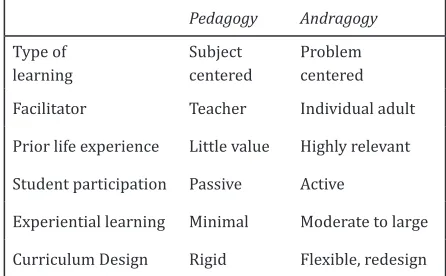
Andragogy assumes that adults are independent learners who have already accumulated a great deal of experience. Adults are interested in an immediate problem centered approach and are frequently motivated to learn by internal demands to integrate learning to resolve an emerging work related problem. Adult learning is often problem centered
rather than subject centered. The difference between
the pedagogy and andragogy are summarized in Table 1.
Table 1: Learning styles: Difference between pedagogy and andragogy*.
Pedagogy Andragogy
Type of learning
Subject centered
Problem centered Facilitator Teacher Individual adult Prior life experience Little value Highly relevant Student participation Passive Active
Experiential learning Minimal Moderate to large
Prior to embarking on the acquisition of knowledge on a topic, adults often have to recognize that they
have a knowledge gap [13]. They also have to find out
whether they have the necessary resources available
at hand to solve the problem and finally need to be
willing to change their behavior based on what they learnt [4, 6, 7].
While it has always been common practice for
adults to learn in different educational settings, the efficacy of different modalities of education result in
varying degree of retention of information based on the medium from which learning occurs [13]. The retention of information is only 10% of what is read, 20% of what is heard, 30% of what is observed or demonstrated, 50% of what is discussed, 70% of what is practiced and 90% if one is teaching the material to other learners [13]. Hence, adults remember best when they actively involve themselves in learning, practicing and teaching the material.
When designing strategies for adults that involve building knowledge, developers need to design sessions that would allow the adults to work in groups or have opportunities to discuss topics that the adult learner will experience in their work environment [5-12]. CPD organizers have to select the topics based on needs assessment (explained in greater detail in the next section) and provide documentation of the adult learners participation in the learning process. CPD organizers therefore require understanding of the principles of adult education in order to plan an
effective scientific program.
needs assessment in continuous professional development
CPD strives to improve physician behavior and ultimately improving patient health outcomes [14]. CPD programs that are designed on the basis of well
conducted needs assessments are more effective in changing physician behavior [15]. The first step in
identifying lacunae in physician’s knowledge is to
conduct a needs assessment. This process identifies
the gap between what the physician should know
in order to practice effective medicine and what the
physician actually knows.
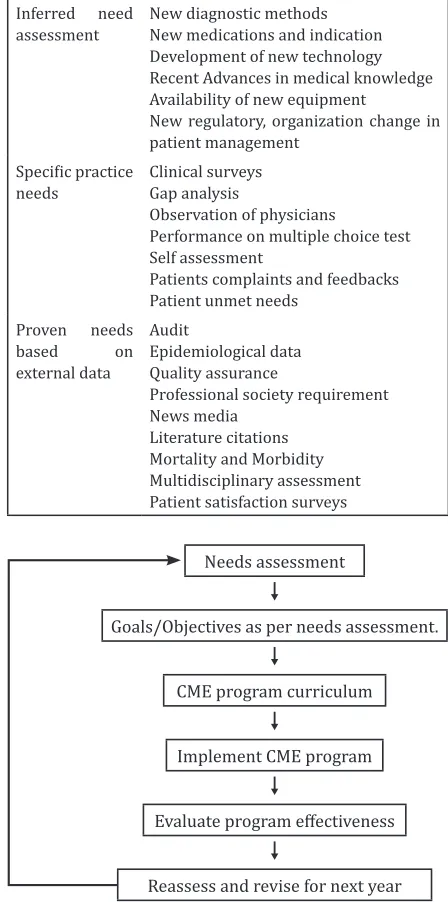
Needs assessment planning forms the foundation of a successful CPD program. There are several sources of needs assessment, 1) inferred need assessment
based on current evidence, 2) specific practice needs
based on surveys of physicians, and 3) proven need assessment based on objective external data [15]. Table 2 summarizes the various sources of need assessment. In a learner-centered CPD, the course
and objectives of all sessions should reflect topics
that have been selected on the basis of prior needs assessments (Figure 2).
Table 2 Sources of need assessment used for continuous medication education.
Inferred need
assessment New diagnostic methodsNew medications and indication Development of new technology Recent Advances in medical knowledge Availability of new equipment
New regulatory, organization change in patient management
Specific practice
needs Clinical surveysGap analysis
Observation of physicians
Performance on multiple choice test Self assessment
Patients complaints and feedbacks Patient unmet needs
Proven needs based on external data
Audit
Epidemiological data Quality assurance
Professional society requirement News media
Literature citations Mortality and Morbidity Multidisciplinary assessment Patient satisfaction surveys
Figure 2: CPD cycle: Constructing a CPD program based on need assessment.
Abbreviation: CME- continuing medical education.
Needs assessment
Goals/Objectives as per needs assessment.
CME program curriculum
Implement CME program
Evaluate program effectiveness
Reassess and revise for next year
educational needs. McClaren and colleagues studied 366 primary care providers who had to use new knowledge or skills to solve recent clinical
problems.16 Physicians used 55 different learning
methods to resolve their issues [16]. Hence, multiple interventions might be required to elicit positive
changes in specific behaviors [17].
guidelines for continuous professional development activity
Most medical institutions use a rigorous curriculum
to effectively educate their students [18]. Students
are closely supervised and frequently assessed in order to establish their competence and readiness to advance into clinical practice. Experts however have been concerned about a lack of formal course of study in the last 30 to 40 years of a physician’s professional career [1]. Most experts agree that lifelong learning constitute the longest phase of medical education [1].
In the past, continuous medical education (CME)
activities were felt to be sufficient in addressing the
learning needs of physicians. CME activities however
suffer from a few drawbacks, as they are episodic
interventions designed to address the needs of groups of learners, they are teacher-centered and driven, are often lecture based and conducted in formal settings, e.g., lecture halls and conference rooms, and
are different from the environment encountered by
a physician in their own practice [19]. CME lectures
alone are insufficient in changing physician behavior
[20]. Continuous professional development stresses lifelong learning based on ongoing self-assessments. CPD is meant to address individual needs, is driven by the learner, and comprehensive in scope. The topics for CPD include changes and challenges faced in clinical practice, practice management, topics on leadership and advances in medical education. CPD activities could include a variety of learning formats and media used in educational activities and can be conducted in a variety of venues (team-based, small group learning, online learning that can be used in
one’s office, etc.) [19].
Physicians attend CPD lectures with a goal to update their knowledge, learn new skills and obtain CPD
credits. Davis et.al showed that CME activities differ
in their ability to increase physician competence,
and performance and have variable effect on health
care outcomes [20]. In a meta-analysis of fourteen
studies regarding the effect of CME on physician
performance and health care outcomes, it was found that interactive CME sessions that included opportunities to learn new skills and practice them by interacting with others brought a change in clinical practice and occasionally changed patient health outcomes. CME sessions that included standard lecture format as their chief source of providing instructions did not appear to change physician performance [20].
A more recent meta-analysis that included thirty
one studies on the effectiveness of CME suggested
that CME activities resulted in a medium increase in physician knowledge and small increase in physician performance and patients outcomes [21].
The effectiveness was increased when the CME
sessions were interactive, using multiple methods of instructions for small groups of physicians from a single discipline [21].
Most physicians determine which CPD sessions to attend based on their own perceived needs for increased competency in their specialty. Often these activities are triggered by external pressures from certifying or state licensing boards [22]. Physicians often possess a limited ability to accurately self-assess their competency, and they may inaccurately evaluate their own competency often [23]. Davis and colleagues in a systematic review of 17 articles studied the relation of self-assessment of physicians compared with external observation of their competence [23]. Thirteen out of the 20 comparisons between self and external assessments revealed little to no inverse relationship between the perceived and observed improvement in personal competence after attending the CPD activity. Physicians who
were least skilled and over confident had the worst
accuracy in self-assessment. Hence, educators who plan CPD activities need to plan a diverse group of educational activities to ensure that they address strategies of improving physician competency and performance in these educational sessions.
[24]. The ACCME suggested that CPD activities should include Miller’s framework of clinical assessment (knowledge, competence, performance and action) [25]. The ACCME model suggests that physicians should start by asking questions that they encounter in practice and seek relevant information [24]. Through analysis, synthesis and
reflection, the information is processed to new
knowledge. Physicians then use their best judgment to process this knowledge into wisdom and use the new strategy to enhance their competence. This competence, when put into practice, could enhance physician performance.
Modalities of CPD activities would depend on
the specific domains of education that need to
be addressed [24]. For example, didactic lectures or seminars would be a good venue to review new medical data. Self-assessment activities, like
self-study or taking maintenance of certification
modules, would apply to answer questions that arise in clinical practice. CPD activities, that
involve reflection as a self or group, would address
the domain of judgment, wisdom, and improved strategy. Interactive sessions like workshops, group discussion and hand-on-activity like simulation or observed structured clinical examination (OSCE) could be used to assess physician competence. Physician performance in practice can be studied by audits and quality improvement studies. In order to organize a CPD activity and incorporate the ACCME model of enhanced practice-based learning, CPD
course organizers have to incorporate different activities that would implement different learning
modalities. Properly-selected CPD activities could lead to lifelong learning of physicians [24].
Assessments of cPD programs
There are several assessment tools to determine
the effectiveness of learning. Some of the commonly
used assessment tools are Miller’s pyramid and Kirkpatrick criteria of learning [25, 26]. When it comes to assessment of CPD programs several questions come to mind namely, i) what is being measured, ii) what evaluation tools are most appropriate for this task, iii) what are the strengths and limitations of the various tools of assessment [27].
Miller’s pyramid of clinical competence is commonly used to assess the knowledge, skills and attitudes
of the learner. This tool can be used to assess the cognitive (knows and knows how) and behavior (shows and does) competence of the learner. The ability to gather facts (knows) can be assessed by traditional multiple choice questions (MCQ’s). Interpretation and application of the knowledge (knows how) can be assessed by case presentations, essay type questions and MCQ’s that assess for deeper understanding of the subject. Demonstration of learning (shows) can be accessed via simulations and OSCE’s. Lastly, integrating knowledge and skills in practice (does) can be assessed by direct observation and work place based assessment.
The four levels of Kirkpatrick’s evaluation models often used to evaluate learning [26]. Level 1 assesses reaction to learning and it measures participant satisfaction with the program. Most CPD programs incorporate a post-course survey to assess student satisfaction, and they use the data for post hoc program assessment. The problem with Level 1 evaluation is that a positive reaction by the attendee does not guarantee learning. Level 2 assesses learning and goes beyond participant satisfaction by attempting to measure the students change in skills, knowledge, and attitude as a result of CPD activity. Examples for this kind of activity would be a pre- and post-test MCQ tests to determine knowledge and its application in real life simulated situations. Level 3 measures the change in behavior that has occurred after the course as a result of the CPD training. Individuals would need to answer if any of the new acquired skills, knowledge and attitudes were being used in their work environment. This
form of measurement is difficult due to the inherent
uncertainty in determining when the change in behavior occurred and appropriate timings of conducting the follow-up evaluation studies. Level 4 evaluation is a measure of outcome evaluation and is highest achievement of a learning session. This level of evaluation seeks to determine whether changes in behavior of the physicians resulting from the CPD session improved patient outcomes. Examples of improved patient outcomes could be reduced
frequency of adverse effects and improved quality
of life.
Though evaluation of experienced physicians is complex, as most practice in dynamic environments
that are influenced by many factors, recent
organizers construct programs that would measure learning (Level 2) [24]. Hence, CPD sessions should work to ensure learning by incorporating either some form of pre- and post-self-assessment using MCQ’s or by including the evaluation of a skill or task in their program.
conclusion
CPD activity requires both insights on how adults learn as well as knowledge of physicians’ needs based on information gathered from various sources. CPD planners need to organize activities that consistently improve physician competence. There is mounting
pressure to assess the effectiveness of a CPD
program beyond measures of physician satisfaction, and incorporate some measures in these programs that assess whether physicians have learnt the information discussed during the CPD activities. Pre- and post-course test of physicians using MCQs form a useful method of assessment, though the course organizers would need to ensure that the questions are appropriately constructed to assess the ability to use knowledge in real life situations.
Conflicts of interest
Authors declare no conflicts of interest.
references
[1] Mazmanian PE. Role of continuing medical education in the United States. J Contin Educ Health Prof. 2005; 25:132–133. [2] Mazmanian PE, Galbraith R, Miller SH, Schyve PM, Kopelow
M, et.al. Accreditation, certification and licensure: How six general competencies are influencing medical education and care. J Med Licensure and Discipline. 2008; 94:8–14 [3] Kaufman DM. Applying education theory in practice. BMJ.
2003; 326:213–216.
[4] Knowles MS. The modern practice of adult education: Andragogy versus pedagogy. New York, NY: Association Press. 1970.
[5] Knowles MS. Introduction: The art and science of helping adults learn. Andragogy in action: Applying modern principles of adult learning. San Francisco, Calif: Jossey-Bass. 1984.
[6] Bandura A. Social Foundations of Thought and Action. A social cognitive theory. Englewood Cliffs, NJ: Prentice-Hall, 1986.
[7] Schön DA. The Reflective Practitioner: how professionals think in action. New York: Basic books. 1983.
[8] Mezirow J. Understanding transformative theory. Adult education quarterly. 1994; 44:222–244.
[9] Candy PC. Self-direction in lifelong learning. San Francisco, Calif: Jossey-Bass. 1991.
[10] Kolb DA. Experiential learning: experience as the source of learning and development. Englewood Cliffs, NJ: Prentice– Hall. 1984.
[11] LaveJ, Wenger E. Situated learning: Legitimate peripheral participation. New York: Cambridge University Press. 1991. [12] Wenger E. Communities of Practice: Learning, meaning and
identity. New York: Cambridge University Press. 1998. [13] Collins J. Education techniques for lifelong learning:
Principles of adult learning. Radiographics. 2004; 24:1483– 1489.
[14] Wilcock PM, Janes G, Chambers A. Health care improvement and continuing interprofessional education: continuing interprofessional development to improve patient outcomes. J Contin Educ Health Prof. 2009; 29:84–90.
[15] Grant J. Learning needs assessment: assessing the need. BMJ. 2002; 324:156–159
[16] McClaren J, Franco E, Snell L. Type of clinical problem is a determinant of physicians’ self-selected learning methods in their practice settings. J Contin Educ Health Prof. 1998; 18:107–118.
[17] Pyatt RS, Moore DE, Caldwell SC. Improving outcomes through innovative continuing medical education partnership. J Contin Educ Prof. 1997; 17:239–244. [18] https://www.aamc.org/initiatives/cir/curriculumcontent/
assessed on Dec 7, 2013
[19] Sachdeva AK. The new paradigm of continuing education in surgery. Arch Surg. 2005; 140:264–269.
[20] Davis D, O’Brien MA, Freemantle N, Wolf FM, Mazmanian P, et al. Impact of formal continuing medical education: do conferences, workshops, rounds, and other traditional continuing education activities change physician behavior or health care outcomes? JAMA. 1999; 282(9):867–874. [21] Mansouri M, Lockyer J. A Meta-analysis of continuing
medical education effectiveness. J Contin Educ Health Prof. 2007; 27(1):6–15.
[22] http://www.abim.org/moc/requirements-for-MOC.aspx accessed on July 2, 2016.
[23] Davis DA, Mazmanian PE, Fordis M, Van Harrison R, Thorpe KE, et al. Accuracy of physician self–assessment compared with observed measures of competence: A systematic review. JAMA. 2006; 296(9):1094–1102.
[24] Regnier K, Kopelow M, Lane D, Alden E. Accreditation for learning and change: quality and improvement as the outcome. J Contin Educ Health Prof. 2005; 25:174–182. [25] Miller GE. The assessment of clinical skills/competence/
performance. Acad Med. 1990; 65(9 Suppl):S63–7. [26] Kirkpatrick D. Revisiting Kirkpatrick’s four-level model.
Training and development. 1996; 50:54–59.