Available Online at www.ijpret.com
860
INTERNATIONAL JOURNAL OF PURE AND
APPLIED RESEARCH IN ENGINEERING AND
TECHNOLOGY
A PATH FOR HORIZING YOUR INNOVATIVE WORK
PERFORMANCE OF 4G TECHNOLOGY USING VARIOUS ROUTING PROTOCOLS IN
MOBILE NETWORK
MS. MINAL G. KACHHAVAY1, PROF. A. P. THAKARE2
1. PG Student, Sipna college of Engg.& Technology, Amravati.
2. Faculty, Sipna college of Engg.& Technology, Amravati.
Accepted Date: 27/02/2014 ; Published Date: 01/05/2014
\
Abstract: This paper highlight the working of various routing protocols in wireless sensor network using 4G technology which is important to improve the performance of the wireless sensor network as effective and reliable. In this paper we propose new design framework for network architecture of future 4G mobile networks, including protocols. The basic concept of different protocols that are Proactive, Reactive and Hybrid protocols are describe. In this paper wireless sensor network (WSN) using 4G technology having different applications areas- Environmental monitoring, Resource monitoring and industrial monitoring. In these basic concept and architecture of 4G technology in mobile network are describe. Also include the working of different routing protocols such as RSVP, MRSVP, SMRP, ARSVP and WLRP in wireless sensor network. There are some drawbacks of MRSVP protocols in wireless sensor networks.
Keywords: WSN, 4G technology, RSVP, MRSVP, SMRP, ARSVP, WLRP.
Corresponding Author: MS. MINAL G. KACHHAVAY
Access Online On:
www.ijpret.com
How to Cite This Article:
Available Online at www.ijpret.com
861 INTRODUCTION
A wireless sensor network (WSN) of spatially distributed autonomous sensor
to monitor physical or environmental conditions, such as temperature, sound, pressure etc. and to cooperatively pass their data through the network to a main location. The development of wireless sensor networks was motivated by military applications such as battlefield surveillance; today such networks are used in many industrial and consumer applications, such as industrial process monitoring and control, machine health monitoring, and so on.
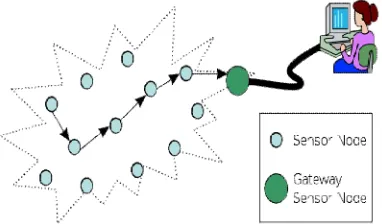
Fig 1: Typical multi-hop wireless sensor network architecture
The WSN is built of "nodes" – from a few to several hundreds or even thousands, where each node is connected to one (or sometimes several) sensors. Each such sensor network node has typically several parts: a radio transceiver with an internal antenna or connection to an external antenna, a microcontroller, an electronic circuit for interfacing with the sensors and an energy source, usually a battery or an embedded form of energy harvesting. A sensor node might vary in size. The cost of sensor nodes is similarly variable, ranging from a few to hundreds of dollars, depending on the complexity of the individual sensor nodes. Size and cost constraints on sensor nodes result in corresponding constraints on resources such as energy, memory, computational speed and communications bandwidth. The topology of the WSNs can vary from a simple star network to an advanced multi-hop wireless mesh networks. The propagation technique between the hops of the network can be routing or flooding.
[2]The sensors-nodes must have native capabilities to detect the nearest neighbors and help to
develop an ad-hoc network through a set of well defined protocols.
Available Online at www.ijpret.com
862 requested, it can be provided immediately. As it is necessary to exchange control messages for maintaining tables with the up-to-date information of routes, the bandwidth consumption is very high. As well as the energy consumption of the nodes in the network is also high. Whereas the reactive routing protocols do not maintain the information about the routes. Only they initiate the discovery of the
[4] routes on-demand. Normally the routes are maintained only during the communication or until some period of time. However, these routes can be stored in case if they are necessary very frequently. The main disadvantage of the reactive routing protocols is the routes discovery. That time required for the determination of routes in some cases is very high when the destination is distant.
The problem related to proactive and reactive routing protocol can be minimizing by using hybrid routing protocol. Zone Routing Protocol (ZRP) is one of these routing protocols, which is a hybrid routing protocol that proactively maintains routing information for a local neighborhood (routing zone), while reactively acquiring routes to destinations beyond the routing zone.
Characteristic of WSN:
The main characteristics of a WSN include:
Power consumption constraints for nodes using batteries or energy harvesting
Ability to cope with node failures
Mobility of nodes
Communication failures
Heterogeneity of nodes
Scalability to large scale of deployment
Ability to withstand harsh environmental conditions
Ease of use[2]
I. RELATED WORK/LITERATURE REVIEW
4G Technology in mobile network:
Available Online at www.ijpret.com
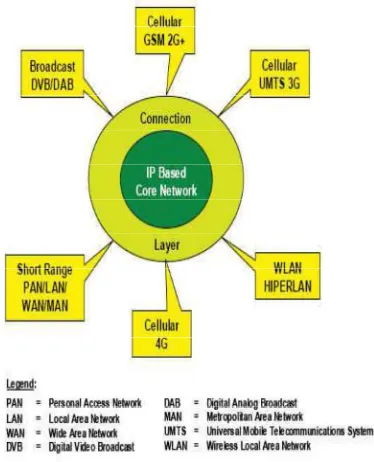
863 ever-increasing growth of user demand, the limitations of the third generation of wireless mobile communication systems, and the emergence of new mobile broadband technologies on the market have brought researchers and industries to a thorough reflection on the fourth generation. Many prophetic visions have appeared in the literature presenting 4G as the ultimate boundary of wireless mobile communication without any limit to its potential, but in practical terms not giving any design rules. The fourth generation will encompass all systems from various networks, public to private; operator-driven broadband networks to personal areas; and ad hoc networks as shown in fig 1[6] .The 4G systems will interoperate with 2G and 3G systems, as well as with digital (broadband) broadcasting systems.
Fig 2: 4G Seamless Connections
4G networks are an extension of current mobile communications networks, such as GPRS and UMTS. Besides the assumptions made by GPRS and UMTS that Internet and mobile communications will evolve side by side, 4G introduces the concept that a mobile terminal will be Always Best Connected (ABC) to the available networks. This is possible since a terminal may have multiple network interfaces, of different radio technologies, which are used according to the user requirements and, possibly, simultaneously. 4G also considers that all the information is conveyed as IP packets. In addition, 4G systems will be fully IP-based wireless Internet.
Available Online at www.ijpret.com
864 networks never initiate session, but packets are delivered independently to the receiver with the usage of different paths. [6]
• 4G Architecture:
An architectural consideration in the IP layer is taking vital role to 4G success. Both vertically and horizontally 4G mobile terminals are roaming easily and fastly across different wireless systems. There are two contradictory demands exist in 4G wireless network: The first one is ubiquity and the second one is diversity. [6]
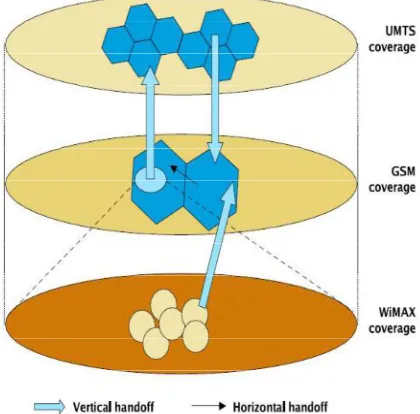
Horizontal handoffs: When a mobile terminal changes from one access point to another access point within the same wireless system then the horizontal handoff happens.
Vertical handoffs: When a mobile terminal moves from one wireless system to another then vertical handoff occurs. This Figure 2[6] shows the concept of vertical and horizontal handoffs.
Fig 3: Vertical and Horizontal Handoffs
• Resource Reservation Protocol (RSVP):
Available Online at www.ijpret.com
865 In 4G mobile networks mainly focused uni-cast communications, so in this work I mainly focused only uni-cast communication. This RSVP is always depending on User Datagram Protocol or Internet Protocol, because this RSVP is always transported over UDP or directly over IP. There are two types in RSVP-
A) Path message.
B) Resv message
In the first path message starts from the sender when it establishes an RSVP session by sending a Path message which contains three important pieces of an Objects. The first object is Sender Template, it mainly used to identify packets address and port number based on senders IP that belong to the sender’s data flow. The second object is Sender Tspec, it always used to provide the characteristics of the traffic to be sent from the sender’s side, and hence the Quality of Service level from the sender side.
In the receiver side after this path message comes to the destination, th
ere are two possibilities. They are may be the receiver accept the connection or it may reject the connection. For the acceptance then a new message is being created, this is Resv message. It has the below said two components. They are
1. Flow Spec: This is the most important object is used to be assigned to the data flow and explains the better quality of service.
2. Filter Spec: Based on the information provided by this object, the identity of the sanders data flow is assured.
Available Online at www.ijpret.com
866
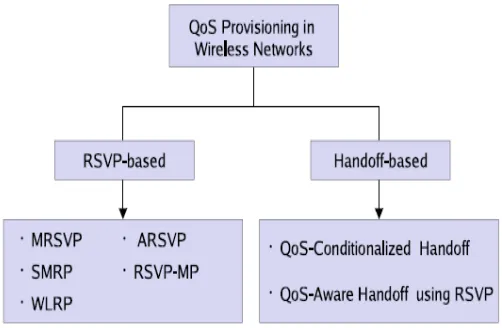
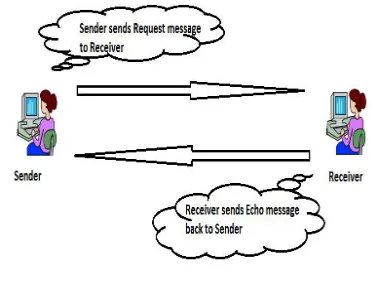
Fig 4: RSVP - Based Approach
Mobile Resource Reservation Protocol (MRSVP):
This is first developed version to Resource Reservation Protocol. It is very feasible as well it is used to provide good deployment facility to all wireless networks. It always provides a good support for reservations. They are
1) Active reservations.
2) Passive reservations.
Also this Mobile Resource Reservation Protocol (MRSVP) talks about three different types of messages. They are
1) MSpec message.
2) Passive Path message.
3) Passive Resv message.
Available Online at www.ijpret.com
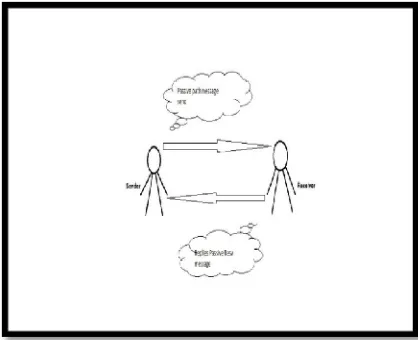
867 Fig 5: Establishing active and passive sessions between sender and receiver.
There are some draw backs:-
• The mobile networks movement is deterministic, but for real time applications it is difficult to use.
• This passive reservations always give large affects to the network’s bandwidth usage.
• There is a long waiting time for all MOBILE NODE.
• For this type of passive session always the complexity of the network is high.
Sender-initiated and Mobility-support Reservation Protocol (SMRP):
Available Online at www.ijpret.com
868 Fig 6: Working of SMRP protocol
Wireless Lightweight Reservation Protocol (WLRP):
This Wireless Lightweight Reservation Protocol (WLRP) is used to increase the probability to establish a successful reservation. This Wireless Lightweight Reservation Protocol always utilizes passive reservation. This WLRP continuously send 2 messages. They are
1) Mobility Profile
2) Application Profile
Both the messages consist of list of parameters. They are
• LProfile - It indicates Loss Profile
• QHO - It indicates levels of service.
• Br- It indicates application data rate.
• LNEG- It indicates loss negotiability.
WLRP the reservation is always active and there are no refresh message is required here. This active reservation is always hard state. But the passive reservation is always in a soft state. The Mobility Agent (MA) monitors the periodically received Mobility Profile and to send passive reservations to the nominated subnets. Here the passive reservations results may be success or failure. This result is fed back to the MOBILE NODE, so the chance for getting Quality of Service to the surrounding subnets is more efficient. If the passive reservation fails then user has to change its route. In some application like Voice and Video there should be an acceptable level application performance in Quality of Service parameters.
Available Online at www.ijpret.com
869 Adaptive Resource Reservation Protocol was mainly proposed to incarcerate the RSVP re-establishment process. Here the next hop router address is recorded by all the routers. It consist of all the messages same like RSVP and have one extra message named as Search. This message is used to identify the changed nodes in the event of handoff. If handoff occurs between the sender and receiver, then in RSVP a new session is being formed between the entire end to end paths. When an old RSVP with MOBILE NODE is getting disconnect then the following steps is proceed.
1. From its old Access Router (oAR) to the new access router MOBILE NODE sends a Search message.
2. Now the new message moves from old Access Router to the new access router, and it passes through the nodes and from this node it will get a new RSVP connection.
3. As this search message is received by each router, each router records the IP address of the PHOP router as PHOPSEARCH and NHOP router as NHOPSEARCH.
4. Then the router is updated regularly with the changed nodes with the new messages PHOPSEARCH and NHOPSEARCH .This is compared against the original RSVP session’s PHOP and NHOP stored in each RSVP router.
5. After the completion of handoff, MOBILE NODE gets Search message from the nAR, and send the Resv message to the sender.
II. CONCLUSION
Available Online at www.ijpret.com
870 III. REFERENCES
1. S. Arun Rajesh, Dr. M. Lakshmi, S. Arun Kumar “Routing Optimization Performance on
Ad-Hoc Network: Distributed Approach Using 4G Devices” International Journal of Electronics and Computer Science Engineering 263 Available Online at www.ijecse.org ISSN- 2277-1956.
2. Chhaya L. Mullemwar, Mr. Sandip. A. Kahate , Minal G. Kachhaway “Enhance Zone Routing
Protocol for MANET with Efficient Throughput ” International Conference On Novel Horizons &
Prospects Of Industry Institute Interaction-5th & 6th February 2012.
3. S. S. Iyengar, G. Seetharaman, R. Kannan, A. Durresi, S. Park , B. Krishnamachari , “ Next
Generation Distributed Sensor Networks ” Proceedings of Office of Naval Research, September 5-6, 2004, USA .
4. Manuel Ricardo, José Ruela “Research Activities in 4G Networks at INESC Porto ” INESC
Porto, Campus da FEUP, Rua Dr. Roberto Frias, 378, 4200-465 Porto, Portugal.
5. KAZEM SOHRABY, DANIEL MINOLI, TAIEB ZNATI “Wireless Sensor Networks/ Technology,
Protocols and Applications” A John Wiley & Sons, NIC., Publications.