6484 ANALYTICAL METHOD DEVELOPMENT AND VALIDATION FOR THE ESTIMATION OF BORTEZOMIB IN BULK AND ITS PHARMACEUTICAL
FORMULATION BY USING RP-HPLC
Dadabada Mounika1, Dr. K. Thejomoorthy*2, Dr. P.Sreenivasa prasanna3
Malineni Lakshmaiah College of Pharmacy, Kanumalla, Singarayakonda, Prakasam, A.P, India
*Corresponding author E-mail: [email protected]
ARTICLE INFO ABSTRACT
Key Words
Bortezomib, Acetonitrile, Formic acid, RP-HPLC,
Retention time, ICH guidelines
.
The aim of present research work method development and validation for the estimation of Bortezomib in bulk and its pharmaceutical formulation by using RP-HPLC. The chromatographic separation was achieved on Phenomenex Luna C18 column (250x4.6mm 5µm), flow rate was maintained at 1.0 ml/min and the mobile phase consist of Acetonitrile: 0.1% formic acid (50: 50 v/v), detection wavelength was monitored at 280 nm. The retention time was found to be 5.3min. The developed method was found to be linear in the concentration range of 20-120 μg/mL with a correlation coefficient of 0.9994. The percentage mean recovery was found to be 101.37%. The developed method was simple, precise, accurate and robust, it was statistically validated according to ICH guidelines. Thus the proposed method was successfully applied for the estimation of Bortezomib in routine quality control analysis in bulk and its pharmaceutical dosage forms.
INTRODUCTION
Bortezomib is the first therapeutic proteasome inhibitor to be tested in humans. The boron atom within Bortezomib catalytically binds the active site of the 26S proteasome with high affinity and specificity, thereby resulting in cell cycle arrest and apoptosis. In normal cells, the proteasome is involved in degradation of ubiquitylated proteins that have been tagged for destruction because they are damaged or unneeded by the cell. However, in cancerous cells, proteasome activity degrades pro-apoptotic proteins such as p53 that would normally result in programmed cell death of the dysfunctional cells. Proteasome inhibitors
such as Bortezomib interrupt this process, resulting in destruction of cancerous cells. Bortezomib is currently approved in the United States for the treatment of relapsed multiple myeloma and mantle cell lymphoma [4]. Extensive survey of literature review few methods have been reported for the estimation of Bortezomib by using RP-HPLC [5-8]. So, need to develop simple, precise, accurate and robust HPLC method for the estimation of Bortezomib in bulk and its pharmaceutical formulation.
MATERIALS AND METHODS
Instrument used: The liquid chromatographic system consists of
Journal of Global Trends in Pharmaceutical Sciences
6485 shimadzu LC Solutions- 20 AD UFLC
with UV-VIS detector, binary pump and septum injector valve with 20 μl fixed loop. The analytes were monitored at 280 nm. Chromatographic analysis was performed on Phenomenex Luna C18 column having 250 mm× 4.6 mm i.d. and 5μm particle size.
Materials used: API of Bortezomib gift sample was procured from Dr. Reddy’s labs, Hyderabad, India. Marketed formulation of Bortezomib was purchased from local pharmacy. HPLC grade methanol, water, acetonitrile and formic acid were purchased from E. Merck (India) Ltd., Mumbai, India.
Chromatographic conditions: The Phenomnex Luna C18 column (250 x 4.6mm, 5µm) equilibrated with mobile phase acetonitrile and 0.1% formic acid in the ratio of 50:50 (v/v) was used and the flow rate was maintained at 1.0 mL/min. Detection wavelength with UV detector at 280 nm, and the injection volume was 20 μL and run time was kept 10 min.
Preparation of mobile phase: Preparation of mobile phase by using Acetonitrile: 0.1% formic acid in the ratio of 50: 50 v/v. The mobile phase was filtered through 0.45 um membrane filter paper. After filtration it was sonicated with ultra sonicator for 10 minutes.
Preparation of stock solution of Bortezomib: API of Bortezomib (10mg) accurately weighed and transferred to 10 ml volumetric flask, dissolved in mobile phase. The solution contains 1000ug/ml of Bortezomib .The solution was filtered through 0.45 um membrane filter paper and firs few drops of filtrate were discarded. Further respected dilutions were prepared by stock solution.
Preparation of sample solution: Take 25 mg equivalent tablet powder of Bortezomib was transferred into 25 ml volumetric flask. It was dissolved in 10 ml
of mobile phase, finally it make up with up to the mark. Sonicate it for 10 minutes. Filter the solution through Whatmann filter paper no. 41. This solution was used as sample solution.20 µL of the blank, standard and sample was injected in to the chromatographic system and areas for the Bortezomib peaks were used for calculating the % assay by using the formulae.
System suitability: According to USP, system suitability test are integral part of liquid chromatographic methods. They are used to verify that the resolution and reproducibility of the chromatographic system are adequate for the analysis to be done. Tailing factor for the peaks due to Bortezomib in standard solution should not be more than 1.5.Theoritical plates for the Bortezomib peaks in standard solution should not be less than 1.5.
Method Validation: The developed analytical method was validated as per ICH guidelines Q2(R1) for the parameters like specificity, linearity, accuracy, precision and robustness [12-13].
Specificity: In the case of assay, demonstration of assay specificity is required to show that the procedure is unaffected by the impurities or exipients. Specificity of an analytical method indicates that the analytical method is its able to measure accurately and specifically the analyte of interest without any interference from blank.
6486 was injected in to the chromatographic
system and peak area was measured. Plot a graph of peak area versus concentration (on x –axis concentration and on y axis peak area) and the correlation was calculated.
Accuracy: The accuracy of the test method is demonstrated by % of recovery. The standard solutions of accuracy 50%, 100% and 150% were injected in to chromatographic system. Calculate the amount found and amount added for Bortezomib and calculate the individual % recovery and mean % recovery values. % Recovery at each spike level shall be not less than 98.0 and not more than 102.0. Precision: The standard solution was injected into the intraday and interday for five times. Then measured the area for all five injections in HPLC. The % RSD for the area of five replicate injections was found to be within the specified limits. The % RSD for the area of five standard injections results should not be more than 2.
Detection and quantification limits: Sensitivity of the proposed method was estimated in terms of Limit of Detection (LOD) and Limit of Quantitation (LOQ). LOD = 3.3 x ASD/S and LOQ = 10 x ASD/S, where ASD is the average standard deviation and S is the slope of the line.
Robustness: As Part of the robustness, deliberate change in the flow rate, mobile phase composition was made to evaluate the impact on the method. The flow rate was varied at ± 10%. Standard solution 40 µg/ml of Bortezomib was prepared and analysed using the varied flow rates along with method flow rate. The Temperature was varied (± 5oC) Standard solution 40 µg/ml of Bortezomib was prepared and analysed using the varied flow rates along with method flow rate.
RESULTS AND DISCUSSION
Specificity: There is no interference of mobile phase, and placebo with the analyte
peak and also the peak purity of analyte peak which indicate that the method is specific for the analysis of analytes in their dosage form. The data was shown in table 1 and fig 2.
Table1: Specificity Data
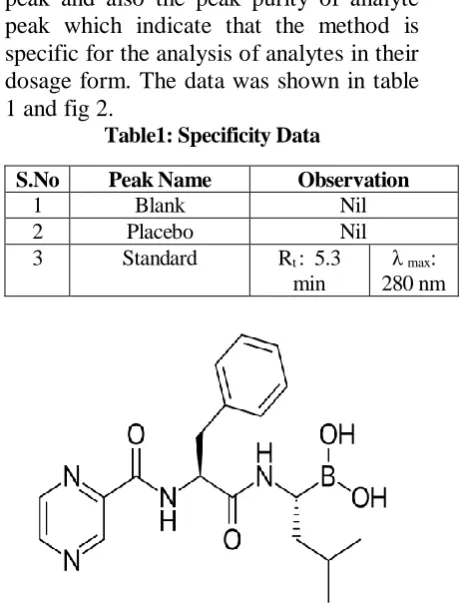
Fig1: Chemical Structure of Bortezomib
Fig 2: Bortezomib standard
chromatogram
System suitability:
System suitability test was an integral part of method development and has been used to ensure adequate performance of the chromatographic system. The results were shown in table 2.
S.No Peak Name Observation
1 Blank Nil
2 Placebo Nil
3 Standard Rt : 5.3
min
λ max:
6487 Table 2: Results of System Suitability
Parameter Result Acceptance Limit Retention time
(Rt)*
5.3 min More than 2
Resolution factor*
NA --
Number of theoretical plates (N)*
3652 More than 2000
Tailing factor (T)*
1.32 Less than 2
* Number of injections: 6 replicates
Linearity: Based on precision, linearity and accuracy data it can be concluded that the assay method is precise, linear and accurate in the range of 20-120 µg/ml of Bortezomib respectively. The correlation coefficient was found to be 0.999. The results were showed on table 3 and fig 3.
Fig 3: Calibration curve of Bortezomib
Table3: Linearity Results
S. No Concentration (µg/mL) Peak Area
1 20 68451
2 40 121021
3 60 184241
4 80 241520
5 100 304512
6 120 365412
Precision: The precision study was evaluated on the basis of % RSD value. The %RSD was found to be less than 2%. Results of precision study are shown in Table 4.
Table 4: Intraday and Inter day
precision S.No. Intraday precision Area Inter day precision Area
1 244125 242145
2 242451 241245
3 244512 248596
4 242010 245487
5 241201 242403
6 254125 251593
Mean 244737.3 245244.8
StdDev 4353.645 3769.877
%RSD 1.778905 1.537189
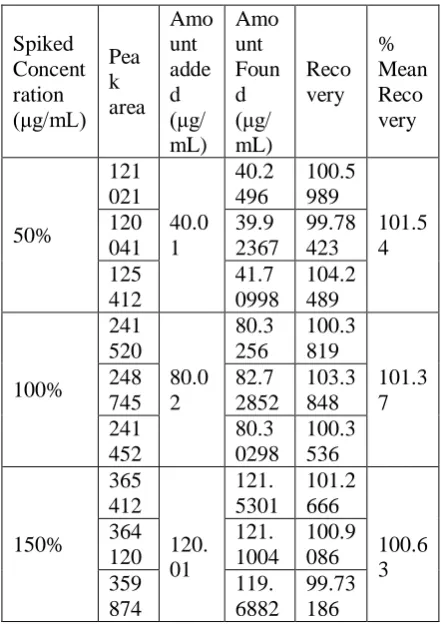
Accuracy: Accuracy of the method was determined by Recovery studies. To the formulation (pre analyzed sample), the reference standards of the drugs were added at the level of 50%, 100%, 150%. The data was shown in table 5.
Table5: Results of accuracy
6488 Detection and quantification limits:
LOD & LOQ results were shown in table 6.
Table6: LOD & LOQ Results
S.N
o Parameter Slope
Standard Deviatio
n
Value(μg/mL )
1 Limit of
Detection
597
8 4353
2.402 2 Limit of Quantificatio n 7.281
Robustness: Robustness was performed by changing of chromatographic conditions like change in flow rate (±1%) and temperature (± 5oC). The results were explained in table 7 and 8.
Table7: Change of Flow rate (± 0.1mL)
S. No Chromatog raphic condition 0.9mL/ min 1mL/ min 1.1mL/ min 1 Flow Rate
249875 2478
51
24178 2
2 241578 2469
87
24951 4
3 239874 2387
45
23789 1
4 Mean 243775.
6667
2445 27.7
24306 2.3
5 Stddev 4368.62
3302
4104. 148
4830.6 64
6 % RSD 1.79206
7011
1.678 398
1.9874 18
Table 8: Change in Temperature (± 5oC)
S. No
Chromatogr aphic condition
30oC 35oC 40oC
1
Temperature
231457 23415
4
24159 8
2 241547 23145
1
24658 7
3 239874 24154
8
23985 2
4 Mean 237626 23571
7.7
24267 9
5 Stddev 4415.288
062
4267.7 97
2853.8 25
6 % RSD 1.858082
896 1.8105 55 1.1759 67 CONCLUSION
A new method was established for estimation of Bortezomib by RP-HPLC method. The chromatographic conditions were successfully developed for the separation of Bortezomib by using Phenomenex Luna C18 column 250x 4.6mm 5µm, flow rate was 1.0 ml/min, mobile phase ratio was Acetonitrile : 0.1% formic acid (50: 50 v/v),detection wavelength was 280 nm. The retention time was found to be 5.3 mins. The % purity of Bortezomib was found to be 100.443% respectively. The system suitability parameters for Bortezomib such as theoretical plates and tailing factor were found to be more than 2000 and less than 2 respectively, the resolution was found to be less than 2. The analytical method was validated according to ICH guidelines (ICH, Q2 (R1). The linearity study for Bortezomib was found in concentration range of 20µg-120µg/ml and correlation coefficient (r2) was found to be 0.9994, % recovery was found to be 101.37%, % RSD for repeatability was 1.778, % RSD for intermediate precision was 1.537 respectively. The precision study was precise, robust, and repeatable. LOD value was 2.6402, and LOQ value was 7.281 respectively. Hence the suggested RP-HPLC method can be used for routine analysis of Bortezomib in API and pharmaceutical dosage form.
REFERENCES
1. Snyder LR, Practical HPLC method development. 2nded.John Wiley and sons, New York, 1997. pp.180-182.
2. Skoog D A, West D M,Holler FJ: Introduction of analytical chemistry. Sounder college of publishing, Harcourt Brace college pubilishers, 1994, 1-5.
6489 Journal pharma tech 2003;
5:110-114.
4. Indian pharmacopeia 2016, Vol 1. 5. M.N.Brindaet.al., Development
and validation of RP-HPLC method for determination of related substances of Bortezomibin injection. WJPPS 2003;3 (2): 2521-2529.
6. Jagadeswararaoet.al.,A validated reverse phase stability-indicating HPLC method for Bortezomib in the presence of degradation products and its process-related impurities. Int J PharmaChem and Anal 2016; 3(3):150-161. 7. B. Chandramowliet.al.,
Development and validation of HPLC-UV method for the estimation of Bortezomib in human plasma. Int. J. of Pharma Anal Res 2017; 6(3): 501-506.
8. C. Rambabuet.al., Estimation of Bortezomib in bulk and its pharmaceutical dosage forms by Using a novel validated accurate reverse phase high performance liquid Chromatography. Int J Pharm PharmSci 2011; 3(3): 303-305.
9. K.Srinivasuluet.al. Development and Validation of a Stability Indicating LC Method for the Assay and Related Substances Determination of a Proteasome Inhibitor Bortezomib. Hindawi Publishing Corporation 2012; 1-13. 10. Stephen R. et.al., Analysis of Two
Commercially Available
Bortezomib Products:
Differencesin Assay of Active Agent and Impurity Profile. AAPS Pharm Sci Tech 2011; 12(2): 461-467.
11. Venkataramana et.al. A validated
stability-indicating UFLC method for Bortezomib in the presence of degradation product and its process-related impurities. IJLSPR 2012; 2 (1): 135-146.
12. ICH Q 2A, “Validation of analytical methods, definitions and terminology”, ICH Harmonized tripartite guideline, (1999).