Glaucoma Suspect, the Dilemma, What is New? (Update)
M Yasser S Saif MD
1,*, Ahmed T. S. Saif MD
2, Passant S Saif MD
3, Wesam Salah
41Assistant Professor of Ophthalmology, Beni Suef University, Egypt 2Lecturer of Ophthalmology, Fayoum University, Egypt
3Lecturer of Ophthalmology, Misr University for Science and Technology, Egypt 4Lecturer of mathematics, NILES, Cairo University, Egypt
Abstract
Principle: The risk factors for getting glaucoma will channel into the resultant level of IOP and disc damage. The probability was calculated by the equation Y1 = Y0 + A1e X/T1 using the IOP and cup disc ratio. Accordingly people are classified into: Normal, Ocular hypertension, Possible, Probable, Highly probable and Definite glaucoma. In this way the clinical entities of normal, ocular hypertension, and glaucoma suspect, low tension glaucoma and definite glaucoma cases are precisely digitized and diagnosed. The target IOP is calculated according to the cup disc ratio. The details of combined probability of IOP, C/D ratio and the target IOP will be presented in details. Material and method: In the last 5 years 101458 Egyptians were screened in the charity campaigns (organized by Cairo University). In this study 1546 eyes (probability ranged from 0.1 - 0.2) divided into 3 groups: 841 eyes of ocular hypertension, 621 eyes suspicious cupping (c/d 0.5 or more) and 84eyes with nerve fibre defect. Results: With the use of the glaucoma probability table dividing them into normal (probability till 0.1) possible(probability till 0.2) probable (probability more than 0.2 were treated aiming at a target IOP as described in the table).Note the IOP was corrected for the corneal thickness and the C/D ratio was corrected for the disc damage and the remaining viable rim. Conclusion: Follow up for 5 years denotes the validity of the table that we can consider that the glaucoma suspect is no more a dilemma. This paper is in principle basic science and epidemiology.
Keywords
Risk Factors for Getting Glaucoma, Cupping, a Target IOP, Ocular Hypertension1. Introduction
For early diagnosis of glaucoma or glaucoma suspect in absence of stigmata of one or more of the triad(IOP, field changes and Cupping) we introduce the solution .
The risk factors for getting glaucoma include age, race, sex, heridity, family history , systemic (Diabetes, Obesity, Hypertension, Hypotension, arterioscerosis and s moking) and socioeconomic factors as well as local factors (myopia, corneal thickness and scleral regidity) all will channel into the resultant level of IOP and disc damage . So calculation of the combined probability of getting glaucoma for these 2 factors alone will include all the above mentioned variables.[1-10]
Early diagnosis : Accordingly people are classified after calculation of the probability of getting glaucoma into the following:[1-10]
• Normal up to 0.10 on the probability scale with normal IOP up to 21 mmHg and C/D ratio up to 0.5: (Nothing to be done)
• Ocular hypertension in whom the rise of IOP above 21 mmHg is the only s ign with normal C/D ratio and their
* Corresponding author:
[email protected] (M Yasser S Saif MD) Published online at http://journal.sapub.org/ophthal
Copyright © 2013 Scientific & Academic Publishing. All Rights Reserved
management will follow the general scheme of possible , probable, or definate as will be demonstrated.
• Possible up to 0.20 on the probability scale with rise of IOP more than 21 mmHg and increase of C/D ratio but the combined probability will not exceed 0.20 .(Observation)
• Probable up to 0.30 on the probability scale (these has to be treated and observed) a monotherapy may be suffiecent to achieve the target IOP
• Highly probable up to 0.40 on the probability scale
(treatment vigrously and observe) a bitherapy may be needed to achieve the target IOP
• Definite more than 0.40 on the probability scale (full tolarable treatment, laser or surgery and observe to achieve the target IOP) [1-10]
2. Subject and Methods
The charity campaigns organized by Cairo University give us the chance to screen a vast no of populations in isolated areas and there follow up is easy is done by a team that may amount to more than 70 ophthalmologist divided into 6 groups .
defects othere cases of ocular hypertension or suspecious cupping of 0.5 or more with a combined probabilityof the IOP and cup disc ratio of less than 0.1 where considered normal and they were assured.
Cases with a combined probability of more than 0.1 to 0.2 were considered as possible and they were followed up for
The net result of this screening came to 1546 out of 101458 with a probability of more than 0.2 were treated and were considered as glaucomatous inspite of the lack of other stigmata of glaucoma
The details of the age sex, are shown in figure 3.
18 20 22 24 26 28 30 32 34
0.0 0.2 0.4 0.6 0.8 1.0
Data: Data1_B Model: ExpGrow1 Chi^2 = 0.00375
y0 0 ±0
x0 15.81756 ±11625096.92989
A1 0.027 ±71633.40731
t1 4.38096 ±0.31175
pr
obabl
ity
of
pr
im
ar
y
open angl
e gl
auc
om
a
Intraocular pressure (mmHg)
Y1= the probability of the incidence of POAG in the next 5 years when the IOP = x
Figure 1. demonstrates the probabilty of getting glaucoma (Y1)in relation to the IOP(X) and its derived equation [10]
Y
1=Y
0+A
1e
X/ T1
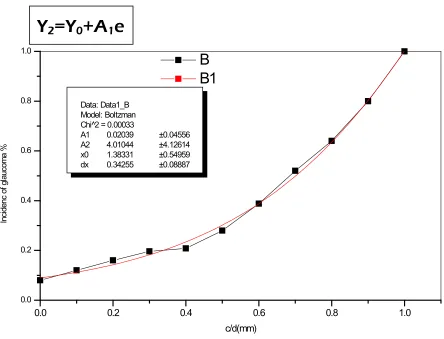
Y2= the probability of the incidence of POAG in the next 5 years when the C/D ratio = x
Figure 2. demonstrates the probabilty of getting glaucoma (Y2) in relation to the C/D ratio (X)
The combined probability will take in consideration the IOP (Y1) and the C/D (Y2) ratio as the resultant outcome as shown in table1.
Figure 3. age group dustribution of patients in the staudy
0.0 0.2 0.4 0.6 0.8 1.0
0.0 0.2 0.4 0.6 0.8 1.0
B
B1
Data: Data1_B Model: Boltzman Chi^2 = 0.00033
A1 0.02039 ±0.04556
A2 4.01044 ±4.12614
x0 1.38331 ±0.54959
dx 0.34255 ±0.08887
Inc
idenc
of
gl
auc
om
a %
c/d(mm)
age
41-50 51-60 61-70 71-80 81-
Y
2
=Y
0
+A
1
e
Figure 4. percentage of C/D ratio of patients in the staudy
3. Results
With the use of the glaucoma probability tables we catageroise the patients into normal (probility till 0.1) and excluded from the study , posible i.e probility till 0.2were observed for the follow up period , and probable or definite (probility more than 0.2 were treated aiming at a target IOP as described in the table). The IOP is corrected for the corneal thickness and the C/D ratio is corrected for the disc damage and the remaining viable rim
4. Conclosions
Follow up of the cases for at least 5 years denotes the validy of the table that we can consider that the glaucoma suspect is no more a dilemma. The glucoma table is a simple tool can be used by all ophthalmologist in diagnosis and early detection of glaucoma patient.
ACKNOWLEDGEMENTS
• Prof Dr Kamal Hamouda: prof of mathmatics, Cairo Universirty
• Prof Dr Essmat Tharwat : prof of Bio-statistics, Cairo Universirty
• Dr Hamadan A. S. El Shemairy: Researcher of Physics, NILES, Cairo Uni
REFRENCES
[1] Saif SSEH, Saif MYS, Saif ATS. 2005, Early Detection of Glaucoma , A New Scoring System; Bull. Ophthalmol. Soc. Egypt, vol 98,number 3, 351-358
[2] Saif SSEH, Saif MYS, Saif ATS. Target intraoclar pressre what is new?; 2006;Bull. Ophthalmol. Soc. Egypt, vol 99,number 3, 445-449
[3] Saif SSEH, Saif MYS, Saif ATS. Early Detection and Management of Glaucoma: A New Scoring System (Update). Available online http://www.elibraryweb.net/index.php?opti on=com_content&task=category§ionid=9&id=24&Item id=59
[4] Saif SSEH, Saif MYS, Saif ATS, Target IOP, what is New? Poster at the 6th International Glaucoma Symposium, Athens, Greece, March 28 - 31, 2007
[5] Saif SSEH, Saif MYS, Saif ATS. Glaucoma; is it still a dilemma in the 21st century? Poster at the 6th International Glaucoma Symposium, Athens, Greece, March 28 - 31, 2007 [6] Saif SSEH, Saif MYS, Saif ATS. Glaucoma; is it still a
dilemma in the 21st century? Poster at the World Glaucoma Congress, Singapore; 18-21 July 2007.
[7] Saif SSEH, Saif MYS, Saif ATS ,2007,Glaucoma; is it still a dilemma in the 21st century? Bull Ophthalmol Soc Egypt, Vol 100, Number 3, 395-399
[8] Saif SSEH, Saif MYS, Saif ATS. 2007;Early Detection of Glaucoma, A New Scoring System. Highlights of Ophthalmology Volume 35, Number 6, 2-4
[9] Saif SSEH, Saif MYS, Saif ATS; 2008;The Glaucoma suspect, the dilemma. What is new? Bull Ophthalmol Soc Egypt, Vol 101,
[10] Saif SSEH, Saif MYS, Saif ATS; The Glaucoma suspect , the dilemma. What is new? Poster at European Glaucoma Society Meeting Berlin 2008:
0 5 10 15 20 25 30 35
0.5 0.6 0.7 0.8 0.9 1
![Figure 1. demonstrates the probabilty of getting glaucoma (Y1)in relation to the IOP(X) and its derived equation [10]](https://thumb-us.123doks.com/thumbv2/123dok_us/8720579.1743718/2.596.86.523.203.521/figure-demonstrates-probabilty-getting-glaucoma-relation-derived-equation.webp)