Available Online At www.ijpret.com
INTERNATIONAL JOURNAL OF PURE AND
APPLIED RESEARCH IN ENGINEERING AND
TECHNOLOGY
A PATH FOR HORIZING YOUR INNOVATIVE WORK
IT IN FINANCIAL SERVICES (F.S.): FROM GRID TO CLOUD COMPUTING
MANOJ D.DAMAHE 1, NEHA K.CHEDE 2
M. E. (I.T.) Appeared Prof. Ram Meghe Institute of Technology & Research, Badnera Dist – Amravati.
Accepted Date:
27/02/2013
Publish Date:
01/04/2013
Keywords
IT
Technology
Dynamic Resources
Corresponding Author Mr. Manoj D. Damahe
Abstract
IT organizations will have to deliver more value through better
utilization of existing infrastructure in order to drive ROI up for
Financial services (FS). The technology that allows resource
sharing is increasingly being viewed as a good solution.
Enterprises cannot afford to waste their investments in IT by
letting resources sit idle in one department while others are
scrambling to add capacity. The answer is to enable sharing
through the cloud. Dynamic resource management supports the
cloud by enabling enterprises to build agile, responsive data
center infrastructures that facilitate meeting strategic business
goals in a fast-paced market environment. Cloud computing
economic resource sharing model enables on demand IT resource
delivery without additional capital expenditure. Platform EGO
provides the benefits for Cloud Computing such as Deliver IT
Services Faster, Reduce IT Costs and Increase Utilization,
Guarantee SLA. This paper gives an overview of how cloud
computing is more beneficial than grid for Financial services and
Available Online At www.ijpret.com
INTRODUCTION
Modernization from Grid to Cloud:
Financial services (FS) institutions are still
spending billions of dollars on IT, yet the
current financial environment demands
that these expenditures be curtailed in a
radical way, by some estimates, budgets
will fall up to 20%. Though the cut backs
can’t happen overnight, it is imperative that
a solution is found to allow financial
institutions to continue offering their
services. Economic crisis or not, internal
compute demand will continue to grow
within most FS organizations. As the market
consolidates and absorbs the disappearance
or reorganization of some venerable
organizations, there will be more business
for fewer players. To overcome both of
these obstacles, more demand for
resources and less money, IT organizations
will have to deliver more value through
better utilization of existing infrastructure
in order to drive ROI up. The technology
that allows resource sharing is increasingly
being viewed as a good solution. This
technology is available today to share
resources without making drastic cut backs
to personnel and without impeding the
organization’s ability to continue innovating
products and services.
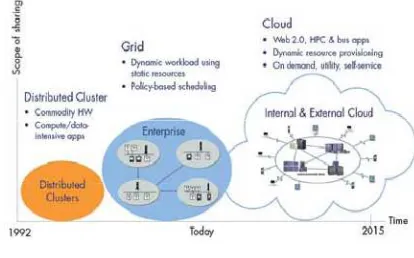
Figure 1: The evolution towards cloud
computing
Many FS companies are already sharing
resources to maximize resource utilization
in order to raise infrastructure ROI. IT
departments are swiftly becoming service
providers for LOBs, opening the door to
opportunities for sharing common
resources among a number of internal
customers. The financial crisis is simply
providing another reason to look at
infrastructure options that enable FS
companies to remain competitive and
decrease the costs of IT infrastructure while
making better use of the existing IT
resources. In such an environment, cloud
computing economic resource sharing
Available Online At www.ijpret.com delivery without additional capital
expenditure.
Cloud Computing:
Cloud computing is Internet-based
computing, whereby shared resources,
software and information are provided to
computers and other devices on-demand,
like a public utility.
A technical definition is "a computing
capability that provides an abstraction
between the computing resource and its
underlying technical architecture (e.g.,
servers, storage, networks), enabling
convenient, on-demand network access to a
shared pool of configurable computing
resources that can be rapidly provisioned
and released with minimal management
effort or service provider interaction."
Clouds have five essential characteristics:
• On-demand self-service, • Broad network access, • Resource pooling, • Rapid elasticity, • Measured service.
• Reducing Data Center Waste
FS organizations are virtualizing IT resources
to reduce costs and increase their ability to
meet unpredictable current and future
business requirements with a finite amount
of resources. Today’s data center is not
structured to provide this sort of low-cost
flexibility –
the cloud model is.
Platform Computing is leading the way in
leveraging cloud technology to help FS
enterprises accelerate data center
performance to the speed of business
demand. By dynamically allocating
resources to users on a real-time basis,
removing bottlenecks and having better
visibility into IT resources, organizations can
increase resource utilization, defer the need
for additional hardware acquisition,
increase overall reliability of application
performance, and meet organizational goals
at the lowest total cost of ownership.
Cloud computing is the next evolution for
Available Online At www.ijpret.com architecture that automates the allocation
and reallocation of IT resources to end-user
applications in order to dynamically
respond to changing business demands and
priorities, while billing users for
consumption. Companies deploying clouds
benefit from cost savings, performance
improvements, and enhanced operating
flexibility. The promise of cloud computing
is the ability to provision infrastructure
quickly, on-demand, and to flexibly scale up
or down based on fluctuations in actual
demand and usage. Compute clouds can
take many forms depending on the needs of
the organizations deploying them. However
they can be divided into two broad
categories, “external clouds” offered by a
service provider to paying customers or,
“internal (private) clouds” deployed by the
IT department of an enterprise to its
internal users.
A hybrid cloud combines an internal cloud
for mission critical, security sensitive, or
data-intensive application workload, with
external cloud resources for less critical
workloads in peak usage periods. Thus you
can both minimize the cost of servicing
higher SLA workloads by running in shared
on-site infrastructure, and minimize the
cost of servicing lower SLA workloads by
dynamically leveraging the lowest cost
external provider. Many FS organizations
are implementing a hybrid approach in their
data centers. This approach provides a
great degree of flexibility for IT service
delivery, while minimizing costs through
effective placement of applications
according to SLA criteria.
• Dynamic Resource Management:
Dynamic resource management is the glue
that maximizes the efficiency of cloud
computing infrastructure, providing a
solution for the barriers to internal clouds
while making best use of external cloud
capabilities. Dynamic allocation of
resources is enabled through robust supply
and demand policies that are automatically
“matched” to achieve SLAs at lowest
possible cost. Dynamic resource
management is not about tearing the silo
model apart. It is about finding new ways
for IT to provide a sharing function that
Available Online At www.ijpret.com trust from application and budget owners.
To deploy resources as needed, when
needed, enterprises must have timely data
about the state of their entire IT
infrastructure. They need to be able to
monitor their IT environment, manage the
flow of application processes within the
environment, detect, identify and route
around anomalies, provide streamlined,
secure access to resources for all users,
anticipate changes in business demand for
resources, and bill usage to consumers.
The most widely adopted dynamic resource
management solution in the world, that
does just this, is Platform Enterprise Grid
Orchestrator (EGO). It is the enabling
technology behind Platform Symphony and
Platform LSF. Within a Platform-enabled
internal cloud, enterprises can collaborate,
share data and software, store increasingly
large volumes of information, and reliably
and securely access vast amounts of
processing power – on demand. The
internal cloud also allows effective
alignment of the IT infrastructure with
underlying business objectives for greater
impact on corporate performance. But
organizational barriers continue to pose
obstacles to private clouds and shared
computing – at enormous cost to the
business. Organizations miss out on billions
of dollars of potential savings each year
when they fail to share IT resources across
the business.
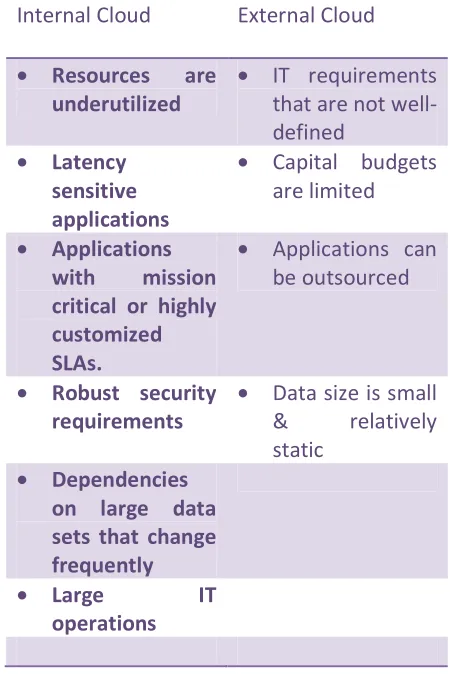
The following table determines the
conditions that must be met for cloud
model to succeed.
Internal Cloud External Cloud
• Resources are
underutilized
• IT requirements that are not well-defined
• Latency
sensitive applications
• Capital budgets are limited
• Applications
with mission
critical or highly customized SLAs.
• Applications can be outsourced
• Robust security
requirements
• Data size is small & relatively static
• Dependencies
on large data sets that change frequently
• Large IT
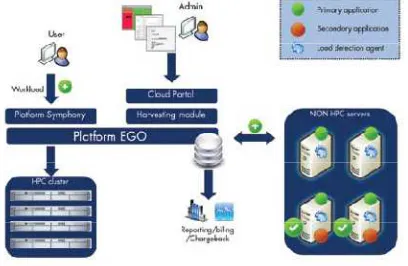
Available Online At www.ijpret.com Figure 2: Build your internal cloud by using
existing non-clustered machines to increase
grid capacity on demand.
• Critical Elements of Cloud Infrastructure:
1. Automation
Automation tools are a must in order to
move logical resources between consumers,
in a timely and guaranteed manner.
2. Virtualization
Virtualization enables pooling physical
resources and deploying them in a flexible
manner. Capacity can be added or removed
on the fly, machines migrated to different
physical locations, or rapidly repurposed.
3. Utility Infrastructure
Robust utility solutions, such as a common
data fabric that spans data centers, enable
enterprise applications to access data
regardless where they’re placed. These
technologies are a significant requirement
for transforming IT to run like a business.
4. Matching Supply with Demand
Meeting SLAs in a dynamic cloud
infrastructure relies on dynamic resource
management. Without it, cloud projects risk
becoming nothing but science projects for
non-production work.
Enterprise-Class Dynamic Resource
Management:
Platform EGO (the kernel of all Platform
products for years) is a robust, scalable, and
trusted dynamic resource management
product that enables IT managers to find
new ways to provide a sharing function that
supports corporate goals. Platform EGO’s
unique approach to sharing – leaving
infrastructure silos and their corresponding
ownerships alone – implements robust
sharing policies outside the silos that grow
Available Online At www.ijpret.com obtrusive manner. External cloud resources
can be leveraged seamlessly when internal
enterprise resources are insufficient, or
where the cost model for external
resources is appropriate.
Platform EGO’s sharing policies control how
cloud resources can be allocated among
participating application owners. Priorities
are set to ensure the highest priority
applications have access to the right
amount of resources to meet service levels.
Once sharing policies are defined, Platform
EGO dynamically places applications on
appropriate resources to optimally utilize
available supply. Since the impact to the
business owner is a reduction in capital and
operational expenditure, this hidden supply
and demand matching engine quickly
becomes a trusted component of the
application’s operations. Thus validated, the
cloud business model can then expand to
an economy of scale reflected in the
bottom line.
• Platform EGO:
Platform Enterprise Grid Orchestrator (EGO)
is a general-purpose systems infrastructure
software platform that allows other
software products, such as applications,
system utilities and workload schedulers, to
share and optimize IT resources. Platform
EGO is the only infrastructure platform that
delivers a shared, virtualized pool of IT
resources to meet the demands of multiple
application types based on business
policies. Platform EGO supports a multitude
of application execution models — batch
processing, online, transactional, parallel,
data-centric, management applications,
and, of course, Service Oriented
Architecture (SOA) applications. With
Platform EGO businesses can increase the
utilization of existing servers, scale-out
applications without having to purchase
more hardware and lower operating costs
through centralized management and
sharing of resources. Platform EGO takes
this unique grid approach to the enterprise
and leverages Platform’s 14 years of
leadership and expertise in high
performance computing (HPC).
The features of Platform Enterprise Grid
Orchestrator (EGO) are;
• Optimize the Resources
Available Online At www.ijpret.com • Increases Availability, Scalability and
Performance for Applications
• Heterogeneous Support of Physical and Virtual Servers
• Open, Standards-based SDK and Architecture
The overwhelming resource sharing
requirement from business owners is to
retain control of the sharing process.
Concurrently, business owners don’t want
to own the end-to-end operational
management of a sharing solution; this
would simply be exchanging capital
expenses for operating costs. A centralized
IT sharing broker is required to handle the
day-to-day operations of shared
infrastructure, while giving business owners
the tools and authority they need to
determine what resources and under what
conditions sharing can occur. To enable this
balancing act, Platform EGO provides two
complementary sharing models that work in
unison.
Peer-to-Peer Sharing – Individual
application and resource owners define
rules for when they will lend out
resources and when they will borrow
from others. Peer-to-peer trading leaves
control of budgets within the business
units yet facilitates improved utilization.
Centralized Sharing – A pool of
resources is dynamically rented to
application owners in the organization.
Central IT managers define the rules for
whom can get access to what, and
when; the same model is employed by
external cloud service providers. This
sharing model is used to replace
over-provisioning as an IT strategy. Instead of
buying for peak demand, bursty usage
patterns can be addressed by owning a
smaller resource footprint, and
supplementing it with additional
resources only when they’re needed.
Cloud deployments generally use a mixture
of both sharing models. For this combined
approach to be effective a centralized IT
body is
required to facilitate and broker the trading
function. This IT brokerage provides a
Available Online At www.ijpret.com that breaks down the psychological barriers
to sharing.
• Optimizing virtualization:
Platform EGO supports automated,
policy-driven, virtual machine (VM) lifecycle
management and self-service VM
management needed for cloud projects.
Several forms of virtualization are currently
evolving that make it easier to pool and
carve up physical hardware resources and
deploy then dynamically. Servers and
storage pools can be created through
software abstractions and offered to users
rather than having to physically procure,
setup, and test hardware. Virtualization also
enables mobility so that capacity can be
added or removed on the fly, machines
migrated to different physical locations, or
rapidly repurposed. To maximize the ROI
promised by virtualization, users need tools
specifically built for managing enterprise
virtualization deployments. Platform offers
the only virtualization solution that meets
the scale and dynamic computing
requirements of enterprise data centers.
• Benefits for Cloud Computing
Platform EGO provides the capabilities to
truly maximize the amount of waste that
can be shed by dynamically sharing IT
resources.
Deliver IT Services Faster
Platform EGO automates resource
allocation in response to changing supply
and demand, enabling acceleration of
resource delivery to users from weeks or
months to minutes or hours.
Reduce IT Costs
Defer capital and operational expenses.
Instead of procuring new machines to meet
demand, resources are rented from
application groups with low server
utilization. The renter absorbs a smaller
increase in operational expense – and no
extra capital expenditure – while
cross-charging nets the seller a decrease in
operational expenses.
Increase Utilization, Guarantee SLA
Platform EGO eliminates manual demand
and supply matching, for optimum use of
Available Online At www.ijpret.com resources across different application
groups and business units, FS organizations
can increase utilization significantly. The
policies that enable this ensure that
application priorities are respected. For a
Conclusion:
IT organizations will have to deliver more
value through better utilization of existing
infrastructure in order to drive ROI up for
Financial services (FS). The technology that
allows resource sharing is increasingly being
viewed as a good solution.
Dynamic resource management supports
the cloud by enabling enterprises to build
agile, responsive data center infrastructures
that facilitate meeting strategic business
goals in a fast-paced market environment.
Platform EGO provides the capabilities to
truly maximize the amount of waste that
can be shed by dynamically sharing IT
resources.
Platform EGO provides two complementary
sharing models that work in unison.
1. Peer-to-Peer Sharing
2. Centralized Sharing
Cloud deployments generally use a mixture
of both sharing models. For this combined
approach to be effective a centralized IT
body is required to facilitate and broker the
trading function.
References:
1. “Cloud Computing: Implementation,
Management and Security”, By John
Rittinghouse.
2. “Grid and Cloud Computing: A Business
Perspective on Technology and
Applications”, By Katrina
Stanoevska-Slabeva.
3. http://searchcloudcomputing.techtarge
t.com/tip/0,289483,sid201_gci1355036,
00.html
4. http://en.wikipedia.org/wiki/Cloud_co
mputing
5. http://www.ngp.org.sg/apectel/NG_Se
minar-Intesection_Cloud_Grid-20Jan09.pdf