http://www.sciencepublishinggroup.com/j/jeee doi: 10.11648/j.jeee.20170502.16
ISSN: 2329-1613 (Print); ISSN: 2329-1605 (Online)
Methodology Article
Robust Detection Method of Arrival Time Difference Under
Minimum Maximum Entropy Criterion
Wenhong Liu
1, Junhao Li
2, Niansheng Chen
1, Guangyu Fan
11
School of Electronic and Information, Shanghai Dianji University, Shanghai, China
2
School of Electrical Engineering, Shanghai Dianji University, Shanghai, China
Email address:
[email protected] (Wenhong Liu)
To cite this article:
Wenhong Liu, Junhao Li, Niansheng Chen, Guangyu Fan. Robust Detection Method of Arrival Time Difference Under Minimum Maximum Entropy Criterion. Journal of Electrical and Electronic Engineering. Vol. 5, No. 2, 2017, pp. 63-67. doi: 10.11648/j.jeee.20170502.16
Received: February 6, 2017; Accepted: March 24, 2017; Published: April 10, 2017
Abstract:
Accurate measurement of arrival time difference is one of the key technologies in many areas, such as the global positioning system. Due to the effects of environmental noises around receiver, the classic methods under least mean-square error rule are the lack of robustness. In this paper, a robust method of the time difference detection is addressed based on the minimum maximum entropy, referred to MMEATD. The maximum entropy function used in this method is a smooth approximation of the L1 norm. It has robustness to large outliers, but also is differentiable. Under the minimum maximum entropy criterion, the adaptive filter weight vector will be convergence, and its peak position indicates the arrival time difference. The computer simulation experiments show the estimation performance of this algorithm under different signal and noise ratio or different impulsive noise intension. Meanwhile, its estimation performance is compared with minimum mean square error algorithm. Results show that the proposed method has a good robustness under the impulsive noise environment.Keywords:
Time Difference Detection, Impulsive Noises, Robustness, Minimum Maximum Entropy, Adaptive Filter1. Introduction
In many areas, such as the global positioning system, arrival time difference detection accurately is one of the core technologies [1]. Noises are one of the main problems on arrival time difference detection to consider [2]. When noises are in conformity with the Gaussian distribution, traditional methods under minimum mean square error criterion have good estimation performance, and also have advantageous for the theoretical analysis. However, actual application category may have significant spike pulse noises, and their probability density functions have thick tail compared with Gaussian distribution. There is no second order moment and above. At this point, under the minimum mean square error criterion designing adaptive time difference detection algorithms, the performances appear degradation, can't even use [2, 3]. One of solutions is to use more accord with the actual noises model, choose a more robust criterion functions. A subclass of alpha stable distribution - SαS [4] can better describe this kind of impulsive noises. The minimum dispersion criterion is alpha
non-differentiable optimization problems [7-10]. Robust signal processing methods are currently researched, and detection methods of arrival Time difference under robust criterions are considered [11-15].
Impulse noise modeling with SαS, moving average filter is adopted to simulate the channel delay effect of the source signals reaching the second receiver under the minimum maximum entropy. The relative time delay can be obtained. Maximum entropy function is differentiable and smooth approximation to the absolute deviation of cost function. This will be change under the minimum L1 norm criterion of adaptive time difference problems into the minimum Maximum Entropy criterion of the adaptive arrival time difference problems. This adaptive time difference detection algorithm based on minimum Maximum Entropy function is used under the computer simulation experiment compared the traditional minimum mean square error of the time difference algorithm. The proposed algorithm, referred to MMEATD, under the condition of Gaussian and non-Gaussian SαS noises, estimation performances are better. So the MMEATD has good robustness. It is a kind of adaptive time difference detection algorithm in wide application scope.
2. Maximum Entropy Function
The linear parameter estimation model widely used in signal processing can be described by a set of linear equations:
= +
b Ax e (1)
here, b=[b1,b2,…,bm]T∈Rm represents the observation vector
containing error; A=[aij]∈Rm×n(m≥n) is a matrix composed of known signal; x=[x1,x2,…,xn]T∈ Rn is to estimate the
parameters of the vector; e=[e1,e2, …,en]T∈Rm for unknown
error vector.
Parameter vector x can be minimized the error vector L1 norm optimization, algorithm is:
1 1
min[ ( ) ]=min[ − ]
x e x x b Ax (2)
Although minimal L1 norm criterion of fractional lower order SαS pulse data parameter estimation has better robustness, but the non differentiable character of the L1 norm limits its use widely.
Maximum entropy function method is a kind of new approximate method for solving non-differentiable optimization problem [2]. The basic idea is to change the maximum function f(x)=max[fi(x)], (i=1,2,…,m) of the optimal solution to the maximal entropy function value function into:
e e
1 e
1
( , ) ln( exp( ( )))
m
i i
F x p p f x
p =
=
∑
(3)here, the pe> 0. The approximate optimal solution of original
problem is obtained.
Maximum entropy function has the following properties [8, 10]:
(1) For any x∈Rn, have 0≤F(x,pe)-f(x)≤(1/pe)ln(m), when
the pe→∝, F(x, pe) is uniform convergence in f(x).
(2) F(x, pe) in term of x is differentiable.
(3) Linear L1 norm of the maximum entropy function F(x, pe) in term of x is a convex function.
Obviously, F(x, pe) is a very good approximation f(x), and
has a good nature.
The smallest L1 norm can be thought of as a minimax problem:
1
min[ ( ) ]=min{max[ ( ),− ( )]}
x e x x e x e x (4)
therefore, it can be transferred into a differentiable maximum entropy function of unconstrained optimization problems. For the following to deduce linear minimum L1 norm time difference problems, it has a unique solution.
3. Time Difference Detection Under
Minimum Maximum Entropy
Criterion
Two signals x1(n) and x2(n) are described the discrete signal
model:
1 1 1
2 2 2
( ) ( ) ( )
( ) ( ) ( )
x n s n d v n x n λs n d v n
= − +
= − + (5)
s(n- d1) and s(n- d2) are the two received delay signals; d1
and d2 respectively are the source signals to reach the
receiving end with two time delays; λ is for attenuation factor (for simple, often take λ = 1); v1(n) and v2(n) are background
noises with two receiver, obeying to SαS. Assuming the signal and the noise, and the noise and the noise were independent of statistics. Needing to estimate the arrival time difference of two received signals true value is D=|d2-d1|. The following
derivation has assume of d1<d2.
Two signal x1(n), x2(n) in the moving average filter
modeling is followed:
2 1
0
( ) ( ) ( ) ( )
Q
i
x n w i x n i e n =
=
∑
− + (6)e(n) is moving average model error; w(i) (i=1,2, …,Q) is the moving average model parameter, Q>D. At i=D, w(i) have a maximum value, namely i≠D, |w(i)|<|w(D)|.
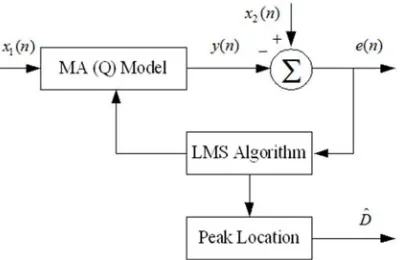
The block diagram of arrival time difference detection using adaptive filter is shown in Figure 1.
Figure 1. The principle block for arrival time difference using adaptive filter.
The MMEATD is derived. Considering cost function of adaptive systems:
T
2 1
1 1
[ ( )] ( ) ( ) ( )
J= ewn = x n −w nx n (7)
It can be expressed in the maximum function:
max[ ( ( )), ( ( ))]
J= e w n −e wn (8)
Maximum entropy function has differentiable structure:
e e e e
( ( ), ) (1 / ) ln(exp( ( )) exp( ( )))
F w n p = p p e n + −p e n (9)
First, convert the least absolute deviation time difference to minimum maximum entropy time difference. Then, according to the linear L1 norm of the maximum entropy function is convex, using the steepest descent method to solve moving average filter weight coefficient of the optimal solution. Iterative formula is:
e e e e
( ( ), ) (1 / ) ln(exp( ( )) exp( ( )))
F w n p = p p e n + −p e n (10)
here, e(w(n))=x2(n)-w T
(n)x1(n); µ is adaptive filter
convergence factor, often taken a smaller number.
Adaptive filter is used in the process of adaptive iteration, and gradually achieve moving average model simulation of
channel delay effect. When adaptive filter convergence, x2(n)
and y(n) to minimize the absolute deviation, namely the actual s(n-D) and estimate of s(n-D) similarity of the biggest, the adaptive filter weight vector w(n) becomes a copy of moving average model, and its position of the maximum value dictates the arrival time difference estimation.
4. Computer Simulations
The computer simulation experiments validate the estimation performances of the MMETDD in Gaussian and non-Gaussian SαS noises, and the traditional algorithm is compared with.
According to Equation (5), two received signals are modeled, which is the band-limited flat spectrum source signal s(n) made from white Gaussian signal through the 0.2 bandwidth of low-pass filter with 10 orders length. The impulsive noises are in compliance to simulated non-Gaussian SαS signal. Mixed signal-to-noise ratio is the MSNR=10lg(σs2/γv) [3], here, the σs2 represents the source signal variance, γv is the dispersion coefficient of noise. Dispersion coefficient is half of the variance with Gaussian noise. Assume that the signal and the noise, the noise and the noise are not relevant. Set two received signals arrival time difference value of D=10Ts, Ts is signal sampling interval in time domain. The length of signal sequence is n=5000 points, select the order number m=20 of filter, set filter weight vector of the initial value of w(0)=[0…0]. In the MMEATD, the selection of maximum entropy function approximation parameter pe=1. Iterative step are µ=0.0001 in the traditional
algorithm and the proposed algorithm. The following results are 100 times independent experiment statistics.
First, in α=1.5, under different MSNR, compare estimation precisions of the traditional algorithm and the proposed algorithm. MSNR is from - 6 dB changes to 3 dB at 3 dB intervals. Root mean square errors (referred to RMSE) of estimated time differences of two algorithms are shown in Figure 2.
Figure 2. The RMSE of the traditional algorithm and the proposed algorithm with α=1.5 impulsive noises at different MSNRs.
-6 -5 -4 -3 -2 -1 0 1 2 3
0 0.5 1 1.5 2 2.5 3 3.5 4
)
MSNR/dB
R
M
S
E
/T
s
As you can see in Figure 2, in different MSNR cases, RMSE of the proposed algorithm were less than the proposed algorithm’s.
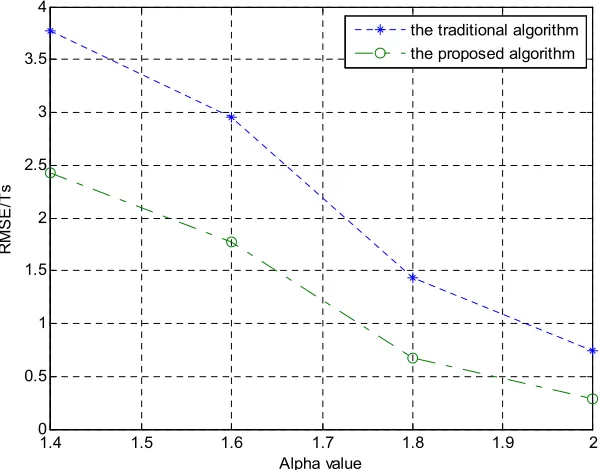
Then, setting the MSNR=0dB, under different α value, α changes from 1.4 to 2 with the interval of 0.2, time difference RMSEs of the two algorithms are also shown in Figure 3.
Figure 3. The time difference RMSEs of the two algorithms with MSNR=0dB at different impulsive noises α values.
As you can see in Figure 3, the MSNR=0dB, α value is not same, the RMSE of the proposed algorithm were less than the traditional algorithm in Gaussian and non-Gaussian distribution noise cases, so the MMEATD has high estimation precision.
The computer simulations show that the traditional algorithm is only applicable to Gaussian noise environment, while the proposed algorithm under Gaussian noise and non-Gaussian has good estimation performance. The MMEATD is a kind of robust time difference detection method, and has a wider scope of application than the traditional algorithm.
5. Conclusions
Minimum L1 norm criterion has robustness, but is not differentiable. The maximum entropy function is a kind of smooth approximation of L1 norm, so it can transfer a L1 norm optimization problem into a differentiable maximum entropy function optimization problem, thus the steepest descent method can be used. In this paper, Iterative formula of the moving mean filter parameter is deduced and obtained based on minimal maximum entropy criterion in proposed method.
The computer simulation verifies the MMEATD has good estimation performance both in Gaussian and in non-Gaussian alpha stable distribution noise condition, compared with the traditional algorithm. As a result, when the signal to noise conditions does not conform to the Gaussian distribution or unknown circumstances, the MMEATD is a better choice. In
the future, more practical data would be further used to demonstrate the better performance of the MMEATD.
Acknowledgments
The first author would like to express sincere thanks to Professor Tianshuang Qiu at Dalian University of Technology, Professor Yuanyuan Wang at Fudan University, and Professor Fai Ma at California University, Berkeley. They gave her knowledge, progress, and higher hope in the different stages of life.
References
[1] Lin Zhao, Jicheng Ding, Xuefei Ma. The principle and application of satellite navigation. Northwestern Polytechnical University Press, 2011.
[2] Wenhong Liu. Under the impulse noise time delay estimation method and application research. Ph.D. Dissertation, Dalian University of Technology, 2007.
[3] Xinyu Ma. Robust signal processing in impulsive noise with stable distributions: estimation, identification and equalization. Ph.D. Dissertation, University of Southern California, 1996. [4] Chrysostomos Loizos Nikias, Shao Ming. Signal processing
with Alpha-stable distributions. New York: John Wiley & Sons Inc, 1995.
[5] Qiu Tianshuang Wang Hong, Zhang Yang, et al. The Non-linear transform based robust adaptive latency change estimation of evoked potentials. Methods of Information in Medicine, 2002, 41 (4): 331-336.
1.4 1.5 1.6 1.7 1.8 1.9 2
0 0.5 1 1.5 2 2.5 3 3.5 4
Alpha value
R
M
S
E
/T
s
[6] Wang Zhishun, He Zhenya, Chen Jiande. Robust time delay estimation of bioelectric signals using absolute deviation neural network. IEEE Trans. On Biomedical Engineering, 2005, 52 (3): 454-462.
[7] Xingsi Li. An effective solution to non-linear minimax problem. Chinese Science Bulletin, 1991, 36 (9): 1448-1450.
[8] Xingsi Li. Effective solution of a class of non-differentiable optimization problems. China Science (A), 1994, 24 (4): 371-377.
[9] Huanwen Tang, Zhang Li. Maximum entropy method for convex programming. Chinese science bulletin, 1994, 39 (8): 682-684.
[10] Chao Tang, Dexin Cao, Yanjiang Wu. Linear L1 minimization problem of the entropy function continuation method. Journal of Applied Mathematics and Computational Mathematics, 2006, 20 (1): 99-102.
[11] Wenhong Liu, Yuanyuan Wang, Bin Wang. The minimum
maximum entropy under impulse noise adaptive time delay estimation. Journal of instruments and meters, 2008, 29 supplement IV (4): 519-522.
[12] He Jin, Liu Zhong. Impulsive noise environment minimum geometry power error beam forming algorithm. Acta Electronica Sinica, 2008, 36 (3): 510-515.
[13] Liu Yang, Qiu Tianshuang, Li Jingchun. Joint estimation of time difference of arrival and frequency difference of arrival for cyclostationary signals under impulsive noise. Digital Signal Processing, 2015, 46(C): 68-80.
[14] Zhang Jinfeng, Qiu Tianshuang. A robust correntropy based subspace tracking algorithm in impulsive noise environments. Digital Signal Processing, 2017, 62: 168-175.