_____________________________________________________________________________________________________
*Corresponding author: E-mail: [email protected];
(Past name: British Journal of Pharmaceutical Research, Past ISSN: 2231-2919, NLM ID: 101631759)
Antibacterial Effects of Hydro-alcoholic Extract of
Pennyroyal, Cinnamon and Rhubarb on
Klebsiella
pneumoniae
and
Staphylococcus aureus
: An
In-vitro
Study
Zohreh Gheisari
1, Leila Kalani
2, Mansoor Khaledi
3, Ali Nouri
4,
Yaser Eshaghi Milasi
4, Nahal Hossainy
5,6and Ali Soleymani
7*1Student Research Committee, Shoushtar Faculty of Medical Sciences, Shoushtar, Iran.
2
Critical Care Nursing, School of Paramedical Sciences, Dezful University of Medical Sciences, Dezful, Iran. 3Department of Microbiology and Immunology, Shahrekord University of Medical Sciences,
Shahrekord, Iran. 4
Clinical Biochemistry Research Center, Shahrekord University of Medical Sciences, Shahrekord, Iran. 5Department of Medical Biotechnology, School of Advanced Technologies, Shahrekord University of
Medical Sciences, Shahrekord, Iran. 6
Cellular and Molecular Research Center, Basic Health Sciences Institute, University of Medical Sciences, Shahrekord, Iran. 7Department of Public Administration, Dezful University of Medical Sciences, Dezful, Iran.
Authors’ contributions
This work was carried out in collaboration among all authors. Author ZG designed the study, performed the statistical analysis, wrote the protocol and wrote the first draft of the manuscript. Authors LK and MK managed the analyses of the study. Author MK managed the literature searches. Author AS was responsible for all the steps involved in writing and publishing the article. All authors read and approved the final manuscript.
Article Information
DOI: 10.9734/JPRI/2019/v28i630218 Editor(s): (1) Dr. Triveni Krishnan, Division of Virology, National Institute of Cholera and Enteric Diseases, India. Reviewers: (1) Rodrigo Asfury Rodrigues, University Center Uninorte Acre, Brasil. (2) Maria Demetriou, Metaxa Memorial Anticancer Hospital, Greece. (3) Vivek Kumar Singh, Public Health and Infectious Disease Research Center (PHIDReC), Nepal. Complete Peer review History:http://www.sdiarticle3.com/review-history/47785
ABSTRACT
Background: Medicinal plants have been used for many different purposes in the past. These plants may produce antimicrobial metabolites that affect the natural growth of microorganisms. The aim of this research was to study the antibacterial properties of rhubarb, cinnamon and pennyroyal on Staphylococcus aureus and Klebsiella pneumoniae.
Materials and Methods: In this study, the effect of hydro-alcoholic extract of pennyroyal, cinnamon and rhubarb on Staphylococcus aureus and Klebsiella pneumoniae was investigated after their collection and extraction process. The Minimum Inhibitory Concentration (MIC) and the Minimum BactericidalConcentration (MBC) of this extract on bacteria were also measured.
Results: The MIC of hydro alcoholic extract of pennyroyal was above 400 mg/ml for both Klebsiella pneumoniae and Staphylococcus aureus. Also the MBC has been reported 400 and 500 mg/dL, respectively. The MIC of cinnamon extract for Klebsiella pneumoniae and Staphylococcus aureus were reported 250 and higher and 500 and higher, respectively. Also, the MBC was reported 500 and 600 mg/ml, respectively. Klebsiella pneumoniae was resistant to rhubarb plant extract, and the MIC and the MBC for Staphylococcus aureus were reported 200 mg/ml and higher and 400 mg/ml and higher, respectively.
Conclusion: The results of this study demonstrated that the hydro alcoholic extract of cinnamon, pennyroyal and rhubarb has anti bacterial effect against Klebsiella pneumoniae and Staphylococcus aureus.
Keywords: Pennyroyal; cinnamon; rhubarb; Klebsiella pneumoni; Staphylococcus aureus.
1. INTRODUCTION
The bacteria that cause infection in the urinary system are located in the intestine, anal areas and perineum. Escherichia coli (80% of cases),
Proteus, Pseudomonas, Klebsiella,
Staphylococcus aureus,and Coagulase Negative Staphylococcus are considered as the cause of these infections [1]. In staphylococcus genus, Staphylococcus aureus species, that exists on skin and everywhere such as respiratory system, is considered to be one of the most important pathogens in hospital and outpatient infections [2]. The emergence of resistant strains has caused many problems in the treatment of
infections caused by pathogen SA
(Staphylococcus aureus). Over the past twenty years, Methicillin Resistant Staphylococcus aureus (MRSA) strains have increased in different regions of the world [3]. Staphylococcus aureus is a gram-positive cocci, which is one of the most important factors in hospital infections and is found in various diseases such as skin disease and toxic shock syndrome, endocarditis and osteomyelitis, etc. This bacterium is fast resistant to antibiotics and can simultaneously withstand several antibiotics [4]. Klebsiella is a gram-negative, rod-shaped bacterium that is non-motile and has a polysaccharide capsule that covers the entire cell surface and creates resistance against many of the host's defense mechanisms. Klebsiella is a causative agent of pneumonia and also urinary tract infection [5].
The antimicrobial properties of herbal essential oils have been proven against a wide range of microbes, including bacteria, yeasts, and molds. Rhubarb with the scientific name “Rheum ribes” is a plant that is renowned as an antimicrobial drug in the traditional medicine. The extract of this plant in the laboratory has prevented the growth or elimination of microorganisms [6]. The oregano plant is a member of the Lamiaceae family and is a perennial herb. This genus includes more than 25 species and grows as a wild plant in the humid areas of the central and southern parts of Europe, southwest Asia and North Africa. The therapeutic properties of this herb have been proven in eliminating digestive disorders, vomiting, anorexia, ulcerative colitis, and liver disorders. The antimicrobial and antioxidant properties of several species of this plant are also well characterized [7].
Cinnamon, scientifically known as Cinnamomum spp, is a herb whose stems and young branches, as well as the oil from its leaves, have therapeutic applications. Cinnamon has mucilage, tannin, sugar, resin and essential oil; the essence of cinnamon is the most important part, and is found especially in the bark of the trunk. The major part of this essential oil is cinnamate aldehyde. In addition, the antibacterial effect of cinnamon has been considered and proven in many studies [8].
agents. Prior to the establishment of antimicrobials and antioxidants agents derived from plants, the knowledge of traditional medicine needs scientific studies to validate the characteristics of medicinal plants. Considering the importance of studies against pathogenic bacteria and considering the antibacterial properties of these plants less attention was paid to studies, hence this study was designed [8]. The aim of this study was to investigate the antimicrobial effect of hydroalcoholic extract of rhubarb, pennyroyal, and cinnamon, on the
growth of Klebsiella pneumoniae and
Staphylococcus aureus.
2. MATERIALS AND METHODS
2.1 Chemicals and Reagents
Dimethyl sulfoxide (DMSO) (Merck, cat no.: 472301), Alcohol, Blood Agar (Merck, cat no.:70133), Muller Hinton broth (Mueller-Hinton Broth |Sisco Research Laboratories cat no.: 49550 (SRL) (India)), 0.5 Whatman filter paper (Sigma).
2.2 Plant Collection
In this experimental study, pennyroyal, cinnamon and rhubarb plants were collected from different regions of Chaharmahal and Bakhtiari province, and then identified and verified by a botanist (Dr. Shirmardi) at the Research Center of the Agriculture Jihad Organization of Chaharmahal and Bakhtiari province.
2.3 Extraction
The plants were dried and milled. Extraction was done by maceration method, that is, 100 g of the plant in combination with 80% alcohol in 1-liter volume was kept for 72 hours in a dark environment. The obtained liquid was placed in a rotary machine (vacuum distillation) after filtration with 0.5 Whatman filter paper twice. It was then collected and placed at 37°C incubator. Finally the extract with honey consistency was obtained and a stock solution was prepared using Dimethyl sulfoxide (DMSO).
2.4 Preparation of Standard Bacterial Strain
The Staphylococcus aureus standard strain with ATCC 25923 and Klebsiella pneumoniae with ATCC 700603 and Escherichia coli with 25922 ATCC were prepared in Lyophilized form from
Iranian Research Organization for Science and Technology.
2.5 Preparation of Microbial Suspension
To prepare a microbial suspension which is equivalent to 0.5 McFarland standard CFU/ml, a 24 hour culture of bacteria was prepared on Blood Agar and then a suspension with 0.5 McFarland opacity was prepared in normal saline.
2.6 Determination of the MIC and MBC
The experiment of MIC was performed in sterile 96-well plates by micro-broth dilution method. An amount of 1000 μl of 0.5 McFarland suspension diluted 1:75 to a well with 1810 ×1.5 CFU/ml bacteria equivalent to 5000 μl from concentrations between 2 and 75 μg/ml were added to the Muller Hinton broth medium. The microbial suspension and the culture medium were poured into one control row and the concentrations of the extracts were poured in another row.
The microplates were placed in a 37°C incubator for 24 hours, after that the lowest concentration of extract which had no turbidity due to the arrest in growth of bacteria, was considered as the Minimum Inhibitory Concentration [9].
To determine MBC, all the wells without turbidity were cultured on blood agar medium separately and incubated at 37°C for 24 hours and the lowest concentration of the extract in which the bacterium was not able to grow determined as MBC.
The MIC and MBC determining experiments were conducted 3 times for each extract [10].
The negative control of a well containing 106 μl of non-extracted culture medium and 5 μl of microbial suspension was considered.
The positive control of the different concentrations of ciprofloxacin plus the Muller-Hinton Bruth culture medium and 5 μl of bacterial suspension were considered.
3. RESULTS
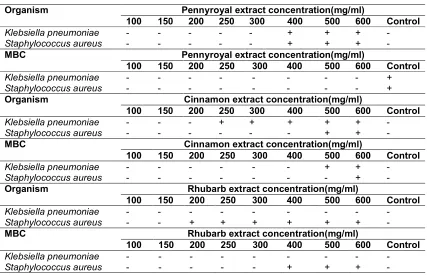
concentration. The activity of Staphylococcus aureus was stopped at 400, 500 and 200 mg / ml concentrations of pennyroyal, cinnamon and rhubarb, respectively (Table 1).
On the other hand, the minimum bactericidal concentration (MBC) for Staphylococcus aureus to pennyroyal, cinnamon and rhubarb has been calculated 600, higher than 600 and 400 mg / ml respectively, and also the Klebsiella pneumoniae bacteria were completely eliminated by pennyroyal, cinnamon and rhubarb at 600, 500 and higher than 600 mg / ml concentrations, respectively (Table 1).
The sign (+) indicates the lack of microorganisms growth on the culture medium and the presence of anti-bacterial activity of the hydroalcoholic extract of the savory plant. Sign (-) indicates the growth of microorganism on the culture medium and the absence of antibacterial activity of the hydroalcoholic extract of the savory plant (Table 1).
4. DISCUSSION
Increasing resistance to excessive use of synthetic antibiotics found that alternative drugs that have both antibacterial and
anti-inflammatory effects should be considered. Many studies have highlighted the anti-microbial effects of plants with medicinal properties. Antibacterial properties of many plants are available in various studies on infections and infectious diseases. Also the results of the current study on the antibacterial properties of pennyroyal, cinnamon and rhubarb herbs demonstrated that all these three plants have antibacterial properties against Klebsiella pneumoniae and Staphylococcus aureus. Staphylococcus aureus is one of the five most common causes of hospital infections, especially postoperative wound infections. Each year, 500,000 people in US hospitals become infected with Staphylococcus aureus [11]. The major bacteria responsible for urinary tract infections are intestinal bacteria. Klebsiella pneumoniae is one of the opportunistic pathogens that causes hospital infections. The prevalence of extended-spectrum beta-lactamases in Klebsiella pneumoniae strains leads to the spread of antibiotic resistance and mortality in patients [12].
Klebsiella pneumoniae typically causes bronchopneumonia and bronchitis. In these patients, the risk of pulmonary abscess (empyema) is increased. Even with an antibiotic, it has 50% mortality rate, and mortality for those
Table 1. MIC and MBC at different concentrations of pennyroyal, cinnamon, rhubarb extract
Organism Pennyroyal extract concentration(mg/ml)
100 150 200 250 300 400 500 600 Control
Klebsiella pneumoniae - - - + + + -
Staphylococcus aureus - - - + + + -
MBC Pennyroyal extract concentration(mg/ml)
100 150 200 250 300 400 500 600 Control
Klebsiella pneumoniae - - - +
Staphylococcus aureus - - - +
Organism Cinnamon extract concentration(mg/ml)
100 150 200 250 300 400 500 600 Control
Klebsiella pneumoniae - - - + + + + + -
Staphylococcus aureus - - - + + -
MBC Cinnamon extract concentration(mg/ml)
100 150 200 250 300 400 500 600 Control
Klebsiella pneumoniae - - - + + -
Staphylococcus aureus - - - + -
Organism Rhubarb extract concentration(mg/ml)
100 150 200 250 300 400 500 600 Control
Klebsiella pneumoniae - - - -
Staphylococcus aureus - - + + + + + + -
MBC Rhubarb extract concentration(mg/ml)
100 150 200 250 300 400 500 600 Control
Klebsiella pneumoniae - - - -
who have alcoholism or bacteremia reaches 100%. This opportunistic pathogen can also cause chronic pulmonary disease, nasal epithelium atrophy and rhinoscleroma. Recently, the antibiotic resistance of the Klebsiella pneumoniae strains has prevailed [13].
Due to the lack of similar studies that worked exactly on the bacteria and plants we studied, we had to use studies that have been working on the antibacterial effects of the plants studied on other bacteria.
Lei Guo et al. demonstrated that rhubarb and its compounds have antibacterial effects against Vibrio harveyi. In this study, the lowest dose with the MIC was reported 0.25 mg / dL [14]. In the current study, the antibacterial effects of rhubarb on Staphylococcus aureus were detected, whereas no antibacterial effects against Klebsiella pneumoniae were observed. However, the reported dosage was significantly higher in the current study compared to the one by Lei Guo at 400 mg / ml.
A study by Nassan et al. showed that cinnamon has antibacterial effects against Staphylococcus aureus at a dose of 3-4 mg / dL [15]. The findings of current research, consistent with the study of Nassan et al., showed the antibacterial effects of cinnamon against Staphylococcus aureus at concentrations of 500 mg / ml.
Wang et al. studied the effect of Cinnamomum
zeylanicum and the main aldehyde
(Cinnamaldeyde) against Porphyromonas
gingivalis, and their results showed that the aldehyde within cinnamon, as an antibacterial agent, can be effective for its inhibitory effect on P. gingivalis bacterium [16]. The results of our study are also in accordance with previous research and have proven the antibacterial effect of cinnamon against Staphylococcus aureus.
Syahdiana Waty et al. studied the antibacterial effect of hydroalcoholic extract of cinnamon on Streptococcus bacteria. Eight species of Streptococcus sp. including S. sanguinis, S. salivarius, S. pluranimalium, S. pneumoniae, S. alactolyticus, Kocuria rosea, Kocuria kristinae, and Spingimonas paucimolis were studied and the results showed that ethanolic extract of cinnamon bark has significantly inhibited the growth of Streptococcus. The results of the present study are consistent with the study by Syahdiana Waty, confirming the antibacterial properties of cinnamon [17].
In the research by Chunxia et al., the antibacterial properties of raw extract of rhubarb and its main compounds against Aeromonas hydrophila were studied. The results showed that anthraquinones (anodyne) isolated from the rhubarb, after penetration into the membrane through binding to the DNA, causes the death of the cells [18].
Our study and such other studies has some limitations. One of the limitations of our study was the lack of molecular studies to determine the pathway to the effect of these herbal medicines on stopping the growth of the bacteria in question. Another limitation of the study was the lack of time-dependent evaluation of herbal drugs in doses.
5. CONCLUSION
In general, this study showed that the studied medicinal herbs may have antibacterial effects on Staphylococcus aureus and Klebsiella pneumoniae. However, further experiments are necessary to study other extracts of these plants and purify the important compounds, as well as the use of different bacterial strains.
CONSENT
It is not applicable.
ETHICAL APPROVAL
It is not applicable.
COMPETING INTERESTS
Authors have declared that no competing interests exist.
REFERENCES
1. Doddanna SJ, Patel S, Sundarrao MA, Veerabhadrappa RS. Antimicrobial activity of plant extracts on Candida albicans: An in vitro study. Indian J Dent Res. 2013;24(4):401.
2. Chambers HF. Methicillin resistance in staphylococci: Molecular and biochemical basis and clinical implications. CMR. 1997;10(4):781-91.
3. Cunha B. Methicillin-resistant
4. George D, Bhat SS, Antony B.
Comparative evaluation of the
antimicrobial efficacy of Aloe vera tooth gel and two popular commercial toothpastes:
An in vitro study. Gen Dent.
2009;57(3):238-41.
5. Ranade AN, Wankhede SS, Ranpise NS, Mundada MS. Development of bilayer floating tablet of amoxicillin and Aloe vera gel powder for treatment of gastric ulcers. AAPS PharmSciTech. 2012;13(4):1518- 23.
6. Saeedi M, Ebrahimzadeh MA, Morteza-Semnani K, Âkha O, Rabiei K. Evaluation of antibacterial effect of ethanolic extract of Foeniculum vulgare Mill. JMUMS. 2010;20(77):88-91.
7. Gulluce M, Sahin F, Sokmen M, Ozer H, Daferera D, Sokmen A, et al. Antimicrobial and antioxidant properties of the essential oils and methanol extract from Mentha longifolia L. ssp. longifolia. Food Chem. 2007;103(4):1449-56.
8. Yano Y, Satomi M, Oikawa H.
Antimicrobial effect of spices and herbs on Vibrio parahaemolyticus. Int J Food Microbiol. 2006;111(1):6-11.
9. Andrews JM. Determination of minimum inhibitory concentrations. J Antimicrob Chemother. 2001;48(Suppl_1):5-16. 10. Khaledi M, Asadi-Samani M,
Mahmoodi-Kouhi A, Gholipour A. Antibacterial effect of the hydroalcoholic extracts of four
Iranian medicinal plants on
Staphylococcus aureus and Acinetobacter baumanii. Int. J. Pharm. Phytopharm. Res. 2017;7(2):10-4.
11. Bowersox J. Experimental staph vaccine broadly protective in animal studies. NIH News. 1999;27.
12. Jalal Pour S, Kasra Kermanshahi R, Nouhi A, Zarkesh Isfahani H. Comparing the frequency of â-lactamase enzyme in isolated nosocomial infectious bacteria. Zahedan. J. Res. Med. Sci. 2010;12(4):3-10.
13. Groopman J. The new generation of resistant infections is almost impossible to treat. Medical Dispatch, Superbugs; 2008. 14. Guo L, Guo J, Xu F. Optimized extraction
process and identification of antibacterial substances from Rhubarb against aquatic pathogenic Vibrio harveyi. 3 Biotech. 2017;7(6):377.
15. Nassan M, Mohamed E, Abdelhafez S, Ismail T. Effect of clove and cinnamon extracts on experimental model of acute hematogenous pyelonephritis in albino rats: Immunopathological and antimicrobial study. Int J Immunopathol Pharmacol. 2015;28(1):60-8.
16. Soltan Dallal M, Yazdi M, Aghaamiri S, Haghighat Khajavi S, Abedi Mohtasab T, Amin Harati F, et al. Antimicrobial effect of Zataria multiflora and Rosemarinus officinalis on antibiotic-resistant Staphylococcus aureus strains isolated
from food. J Med Plant Res.
2014;4(52):41-7.
17. Sharifi A, Naghmachi M, Jahedi S, Khosravani S. A study on antimicrobial effects of Plantago psyllium. Armaghane
Danesh Bimonthly Journal.
2011;16(2):191-9.
18. Lu C, Wang H, Lv W, Ma C, Xu P, Zhu J, et al. Ionic liquid-based ultrasonic/ microwave-assisted extraction combined with UPLC for the determination of
anthraquinones in Rhubarb.
Chromatographia. 2011;74(1-2):139.
© 2019 Gheisari et al.; This is an Open Access article distributed under the terms of the Creative Commons Attribution License
(http://creativecommons.org/licenses/by/4.0), which permits unrestricted use, distribution, and reproduction in any medium,
provided the original work is properly cited.
Peer-review history: