_____________________________________________________________________________________________________ 4(1): 1-24, 2019; Article no.JERR.46001
MEMS Technology: A Review
Manish Kumar Mishra
1*, Vikas Dubey
2, P. M. Mishra
3and Isharat Khan
41
School of Engineering and Technology, Career Point University, Kota, Rajasthan, 324005, India.
2
Department of Physics, Bhilai Institute of Technology, Raipur, CG, 493661, India.
3Department of Mechanical Engineering, MANIT, Bhopal, MP, India. 4Department of Electrical Engineering, MANIT, Bhopal, MP, India.
Authors’ contributions
This work was carried out in collaboration between all authors. All authors read and approved the final manuscript.
Article Information
DOI: 10.9734/JERR/2019/v4i116891 Editor(s): (1)Dr. Qing Li, College of Mechanical Engineering, Donghua University, Shanghai, China and Department of Mechanical Engineering, University of Alberta, Edmonton, Canada. Reviewers: (1)A. Ayeshamariam, Khadir Mohideen College, India. (2)Fumio Uchikoba, Nihon University, Japan. (3)Sunipa Roy, Guru Nanak Institute of Technology, India. Complete Peer review History:http://www.sdiarticle3.com/review-history/46001
Received 19 October 2018 Accepted 14 January 2019 Published 18 February 2019
ABSTRACT
This review article through light on a highly promising & demanding technology, which is set to revolutionize nearly every product category in present era, while discussing the Concept, Design & Development, Fabrication techniques and applications of micro electro-mechanical systems (MEMS) based Devices or systems. Microelectromechanical system discloses outstanding flexibility and adaptability in miniaturization devices followed by their compact dimension, low power consumption, and fine performance. The MEMS devices have numerous and very high potentials of creating a new field of applications for mobile equipment’s with increased flexibility & more reliability. This work deals with research carried out for the development of MEMS based sensors & Actuators and appropriate uses of MEMS. This work carries information’s regarding subsequent commercial and real life applications of MEMS and discusses various recent technological innovations carried out with their advantages & disadvantages. This work also describes the historical development of micro-electromechanical system (MEMS) sensor technology.
Mishra et al.; JERR, 4(1): 1-24, 2019; Article no.JERR.46001
Keywords: MEMS; scaling of MEMS devices; categorization and applications of MEMS; sensors; actuators; MEMS design & fabrication processes; materials for MEMS.
1. INTRODUCTION OF MEMS
TECHNOLOGY
MicroElectroMechanical systems (MEMS) are the integrated micro devices or systems relating electrical and mechanical components developed by using Integrated Circuit (IC) compatible batch-processing techniques and range in size from micrometers to millimeters. These systems are capable to sense, control and actuate on the micro scale and function/ operate individually or in arrays to generate effects on the macro scale.
From the beginning of mid-1970, MEMS (microelectromechanical systems) have emerged as an innovative technology by creating new openings in physical [1], chemical [2] and biological [3] sensors and actuator applications. Even though MEMS technology emerges from IC fabrication techniques, test methods [4] of both technologies significantly differ from each other. This is because MEMS devices respond to both electrical and nonelectrical (physical, chemical, biological, and optical) stimuli.
Technology has been pushed to the point that we can build machinery so small that it cannot be seen by human eye. The typical size of MEMS devices is usually measured in micrometers or even microns. Using similar fabrication techniques as building microprocessors, we are now able to build sensors and actuators on the same microscopic level with the processor chip. Measured in microns, thermal sensors, pressure sensors, inertial sensors, flow and viscosity sensors, resonators, levers, gears, transmission systems, micro-mirrors, valves, pumps, motors, can be batch produced together on the same chip with the processing unit. They indeed compose a system on a chip [5].
A whole new line of applications is opened up by this fast developing technology, limited maybe only by imagination. We can now make medical and biomedical devices so small that they can be injected into humans' bloodstream. They may selectively kill sick cells or germs, leaving healthy body tissue intact [5]. They may intelligently monitor blood substance and release drugs whenever necessary. Microsurgery is assigned a new meaning by intelligent MEMS devices. Controlled by outside central computers, MEMS microsurgery devices can do surgery inside human body without any cut on the skin. One
day they may even be able to do DNA processing and sequencing right on site.
The various commercial applications [5] MEMS technology include the following, due to which MEMS devices becomes demand of future technology:
1. Inkjet printers, which use piezo-electrics or thermal bubble ejection to deposit ink on paper.
2. Accelerometers in modern cars for a large number of purposes including airbag deployment in collisions.
3. Accelerometers in consumer electronics devices such as game controllers, personal media players’ / cell phones and a number of Digital Cameras.
4. In PCs to park the hard disk head when free-fall is detected, to prevent damage and data loss.
5. MEMS gyroscopes used in modern cars and other applications to detect yaw; e.g. to deploy a roll over bar or trigger dynamic stability control.
6. Silicon pressure sensors e.g. car tire pressure sensors, and disposable blood pressure sensors.
7. Displays e.g. the DMD chip in a projector based on DLP technology has on its surface several hundred thousand micro-mirrors.
8. Optical switching technology, which is, used for switching technology and alignment for data communications. 9. Interferometric modulator displays (IMOD)
applications in consumer electronics (primarily displays for mobile devices). 10. Improved performance from inductors and
capacitors due the advent of the RF-MEMS technology.
Some of the few examples of real MEMS technology based products are [5]:
Adaptive Optics for Ophthalmic
Applications.
Optical Cross Connects. Air Bag Accelerometers. Pressure Sensors.
Mirror Arrays for Televisions and Displays. High Performance Steerable Micro-mirrors. RF MEMS Devices (switches and tunable
Disposable Medical Devices.
High Force, High Displacement
Electrostatic Actuators.
MEMS Devices for Secure
Communications.
Accelerometers and gyroscopes for inertial navigation.
Tunable mirror arrays for adaptive optics. Micro-power sources and turbines. Propulsion and attitude control.
Bio-reactors and Bio
Microfluidics.
Fig. 1 (a). Applications of MEMS Devices/Systems [
Fig. 1 (b). Applications of MEMS Devices/Systems [
Mishra et al.; JERR, 4(1): 1-24, 2019; Article no.
High Force, High Displacement
MEMS Devices for Secure
and gyroscopes for inertial
Tunable mirror arrays for adaptive optics. power sources and turbines. Propulsion and attitude control.
reactors and Bio-sensors,
Thermal control.
Micro-scale energy harvesting
piezoelectric [6] electrostatic and electromagnetic micro harvesters.
Micro-machined ultrasound transducers [7,8].
Bio-MEMS applications in medical and health related technologies from Lab Chip to Micro-Total-Analysis (
chemo-sensor), or embedded in medical devices e.g. stents [9].
Applications of MEMS Devices/Systems [10]
Applications of MEMS Devices/Systems [10]
; Article no.JERR.46001
energy harvesting including electrostatic and electromagnetic micro harvesters.
ultrasound transducers
applications in medical and health related technologies from
2. ABOUT MEMS TECHNOLOGY
Microelectromechanical systems (MEMS) (also
written as micro-electro
MicroElectroMechanical or microelectronic and microelectromechanical systems in the United States) [11] is the technology of very small devices. It is also known as Micro machines, a term often used in Japan, or more broadly as Microsystems Technology (MST), in Europe [12,13].
Micro Electro Mechanical Systems or MEMS is a technology of small devices familiarized by several researches to describe
research field [13], where mechanical elements, like cantilevers or membranes, had been developed and manufactured at a scale closer to microelectronics circuit than to lathe machining.
Actually, what could link inkjet printer head, video projector DLP system, disposable bio
chip and airbag crash sensor and many more they are all MEMS devises & these devices share the existence of structures below 100 µm that are not machined using standard machining like lathe but using other techniques world known as micro-fabrication technology [13 MEMS devices are quite dissimilar in comparison with electronic & microelectronics circu electronic circuits are inherently solid and compact structures, MEMS have holes, cavity, channels, cantilevers, membranes, etc., and, in some other way, try to be like mechanical parts. This difference has a direct impact on MEMS manufacturing process. When MEMS devices are based on silicon, microelectronics process needs to be improved to provide for thicker layer
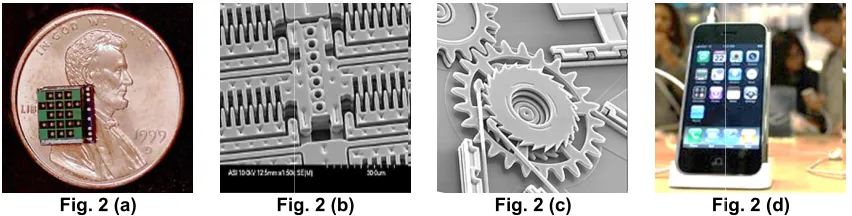
Fig. 2 (a) Fig
Fig. 2 (a). represents the feature represents the feature Electro(electric
feature Mechanical(mechanical components / functionality) feature Systems(integrated, system
Mishra et al.; JERR, 4(1): 1-24, 2019; Article no.
ABOUT MEMS TECHNOLOGY
Microelectromechanical systems (MEMS) (also electro-mechanical, MicroElectroMechanical or microelectronic and ystems in the United 1] is the technology of very small devices. It is also known as Micro machines, a term often used in Japan, or more broadly as Microsystems Technology (MST), in Europe
l Systems or MEMS is a technology of small devices familiarized by an emerging ], where mechanical elements, like cantilevers or membranes, had been developed and manufactured at a scale closer
microelectronics circuit than to lathe
Actually, what could link inkjet printer head, video projector DLP system, disposable bio-analysis chip and airbag crash sensor and many more - they are all MEMS devises & these devices of structures below 100 µm that are not machined using standard machining like lathe but using other techniques world-wide fabrication technology [13]. MEMS devices are quite dissimilar in comparison with electronic & microelectronics circuit as electronic circuits are inherently solid and compact structures, MEMS have holes, cavity, channels, cantilevers, membranes, etc., and, in some other way, try to be like mechanical parts. This difference has a direct impact on MEMS ss. When MEMS devices are based on silicon, microelectronics process needs to be improved to provide for thicker layer
deposition, deeper etching and to introduce special steps to free the mechanical structures. In additional to this many more MEMS are not based on silicon and can be manufactured in polymer, in glass, in quartz or even in metals [13].
MEMS technology is separate and distinct from the hypothetical vision of
nanotechnology or molecular electronics Microelectromechanical systems (MEMS) are small integrated devices or systems that brings together electrical and mechanical components. These micro-systems can sense, control, and activate mechanical processes on the micro scale, and can work individually or in arrays to generate effects on the macro scale [14 micro fabrication technology enables fabrication of large arrays of devices, which individually perform simple tasks, but in combination can accomplish complicated functions. MEMS are simultaneously a toolbox, a physical product, a methodology, all in one [15]:
It is a portfolio of techniques and processes to design and create miniature systems.
It is a physical product often specialized
and unique to a final application one can seldom buy a generic MEMS product
at the neighborhood electronics store [16 MEMS is a way of making things, reports
the Microsystems Technology Offi
United States DARPA [17]. These things merge the working of sensing and
actuation with computation and
communication to locally control physical parameters at the microscale, yet cause effects at much outstanding scales [1
Fig. 2 (b) Fig. 2 (c) Fig
represents the feature Micro (small) i.e. dimensional comparision, Fig
Electro(electric components / functionality), Fig. 2 (c). represents the Mechanical(mechanical components / functionality) and Fig. 2 (d). represents the
Systems(integrated, system-like functionality) [18]
; Article no.JERR.46001
deposition, deeper etching and to introduce special steps to free the mechanical structures. In additional to this many more MEMS are not based on silicon and can be manufactured in in quartz or even in metals
MEMS technology is separate and distinct from the hypothetical vision of molecular molecular electronics [11]. Microelectromechanical systems (MEMS) are small integrated devices or systems that brings ther electrical and mechanical components. systems can sense, control, and activate mechanical processes on the micro scale, and can work individually or in arrays to e effects on the macro scale [14]. The ables fabrication of large arrays of devices, which individually perform simple tasks, but in combination can accomplish complicated functions. MEMS are simultaneously a toolbox, a physical product, and
techniques and processes to design and create miniature
It is a physical product often specialized
and unique to a final application one can seldom buy a generic MEMS product
ghborhood electronics store [16]. y of making things, reports the Microsystems Technology Office of the ]. These things merge the working of sensing and
actuation with computation and
communication to locally control physical parameters at the microscale, yet cause
at much outstanding scales [16].
Fig. 2 (d)
Fig. 3 (a) [19]
MEMS are not about any one application or device, nor are they defined by a single fabrication process or limited to a few materials [20]. They are a production approach that carries the benefits of miniaturization, multiple components, and microelectronics to the design and manufacture of integrated electromechanical
systems. MEMS are not only about
miniaturization of mechanical systems; they are also a new model for designing mechanical devices and structures.
The functional working elements of MEMS are miniaturized structures, sensors, actuators, and microelectronics, the most noteworthy (and perhaps most interesting) elements are the micro-sensors and micro-actuators [
actuators are suitably categorized as transducers, which are described as devices that transform energy from one form to
the case of micro-sensors, the device typically transforms a measured mechanical signal into an electrical signal [21]. Fig. 3 (a) represents the functional elements of MEMS [19,21
(b) represents the microsystem architecture of MEMS devices [18].
Microelectronic integrated circuits can
of as the brains [21] of a system and MEMS augments this decision-making ca
eyes and arms [21], to allow Microsystems to sense and control the environment. Sensors gather information from the environment through measuring mechanical, thermal, biological, chemical, optical, and magnetic phenomena. The electronics then process the information derived from the sensors and through some decision making capability direct the actuators
by moving, positioning, regulating, pumping, and
Mishra et al.; JERR, 4(1): 1-24, 2019; Article no.
Fig. 3 (b) [18]
MEMS are not about any one application or device, nor are they defined by a single limited to a few materials ]. They are a production approach that carries the benefits of miniaturization, multiple components, and microelectronics to the design ctromechanical
systems. MEMS are not only about
miniaturization of mechanical systems; they are also a new model for designing mechanical
The functional working elements of MEMS are miniaturized structures, sensors, actuators, and microelectronics, the most noteworthy (and perhaps most interesting) elements are the actuators [21]. Micro-actuators are suitably categorized as transducers, which are described as devices that transform energy from one form to another. In sensors, the device typically transforms a measured mechanical signal into an 3 (a) represents the 21] and Fig. 3 (b) represents the microsystem architecture of
Microelectronic integrated circuits can be thought ] of a system and MEMS making capability with ], to allow Microsystems to sense and control the environment. Sensors mation from the environment through measuring mechanical, thermal, biological, chemical, optical, and magnetic phenomena. The electronics then process the information derived from the sensors and through some decision making capability direct the actuators to respond by moving, positioning, regulating, pumping, and
filtering, thereby controlling the environment for some desired outcome or purpose [
Examples of MEMS device applications include inkjet-printer cartridges, accelerometers, miniature robots, micro-engines, locks, inertial sensors, micro-transmissions, micro
micro actuators, optical scanners, fluid pumps, transducers, and chemical, pressure and flow sensors. New applications are emerging as the existing technology is applied to the miniaturization and integration of conventional devices.
3. ADVANTAGES OF MEMS
TECHNOLOGY
In broader aspects, numerous advantages associated with MEMS Technologies and systems are [5]:
Minimize energy and materials
requirements.
Improved reproducibility.
Improved sensitivity, accuracy and reliability of operations.
Low cost production (When Produced in Mass)
Low power is required for
working/operations.
Easier to alter the parts of a device as compared to its macro counterpart.
Very small size, mass, volume.
Very low power consumption as compared to other systems.
Easy to integrate into systems or modify. Small thermal constant.
Can be highly resistant to vibration, shock and radiation.
; Article no.JERR.46001
filtering, thereby controlling the environment for some desired outcome or purpose [19,21].
Examples of MEMS device applications include printer cartridges, accelerometers, engines, locks, inertial transmissions, micro-mirrors, micro actuators, optical scanners, fluid pumps, transducers, and chemical, pressure and flow sensors. New applications are emerging as the existing technology is applied to the miniaturization and integration of conventional
ADVANTAGES OF MEMS
In broader aspects, numerous advantages associated with MEMS Technologies and
Minimize energy and materials
Improved sensitivity, accuracy and
Low cost production (When Produced in
Low power is required for
Easier to alter the parts of a device as compared to its macro counterpart.
size, mass, volume.
Very low power consumption as compared
Easy to integrate into systems or modify.
Batch fabricated in large arrays. Improved thermal expansion tolerance. Parallelism in operations (Sensing &
Actuations).
Automotive, Biomedical, IC, MEMS
Sensor are the various potential fields where MEMS Technologies can easily adopted [ The development and fabrication of a MEMS component has a cost that cannot be underestimated, but the technology has many of the possibility to bring unique bene
mankind [13]. The reasons that attract the researchers to use the MEMS technology can be classified broadly in three classes [23
i. Miniaturization of existing devices [13
Taking an example that, the fabrication of silicon based gyroscope which lowers the existing devices weighting several kg and with a volume of 1000 cm
a few grams contained in a 0.5 cm package.
ii. Using physical principles that work at larger scale [13
illustration is given by the biochips where electric field is utilized to pump the reactant around the chip. This known electro
Fig.
Fig. 5. Scale of things representing the region for dimensions of MEMS devices [1 Mishra et al.; JERR, 4(1): 1-24, 2019; Article no.
Batch fabricated in large arrays. ansion tolerance. Parallelism in operations (Sensing &
MEMS, Optical, are the various potential fields where chnologies can easily adopted [22]. The development and fabrication of a MEMS component has a cost that cannot be underestimated, but the technology has many of que benefits for the ]. The reasons that attract the researchers to use the MEMS technology can be
23]:
ization of existing devices [13]:
Taking an example that, the fabrication of silicon based gyroscope which lowers the existing devices weighting several kg and with a volume of 1000 cm3 to a chip of a few grams contained in a 0.5 cm3
Using physical principles that do not at larger scale [13]: A typical illustration is given by the biochips where utilized to pump the reactant around the chip. This known electro
osmotic effect which is based on the existence of a drag force in the fluid works only in channels with dimension of a fraction of one mm, that is, at micro
iii. Developing tools for operation in the micro-world [24]: In 1986 H. Rohrer and G. Binnig at IBM were awarded the Nobel prize in physics for their work on scanning tunneling microscope. This
the development of a new range of microscopes (atomic force microscope, scanning near-field optical microscope etc.) that shares the presence of micro machined sharp micro tips with radius below 50 nm. This micro-tool was utilized to position atoms in complex organization, writing Chinese character or helping verify some prediction of quantum mechanics.
4. SCALING OF MEMS DEVICES
MEMS are made up of components between 1 to 100 micro-meters in size (i.e. 0.001 to 0.1 mm), and MEMS devices generally range in size from 20 micro-meters (20 millionths of a meter) to a millimeter (i.e. 0.02 to 1.0 mm) [11]. Fig. 4 & Fig. 5 represents the size of MEMS devices with compare to the existing world.
4. Scale of things, in meters [25]
Scale of things representing the region for dimensions of MEMS devices [1
; Article no.JERR.46001
ect which is based on the existence of a drag force in the fluid works s with dimension of a fraction of one mm, that is, at micro-scale.
peration in the
In 1986 H. Rohrer and G. Binnig at IBM were awarded the Nobel prize in physics for their work on scanning tunneling microscope. This work indicates the development of a new range of microscopes (atomic force microscope, field optical microscope etc.) that shares the presence of micro-machined sharp micro tips with radius
tool was utilized n atoms in complex organization, writing Chinese character or helping verify some prediction of quantum mechanics.
4. SCALING OF MEMS DEVICES
MEMS are made up of components between 1 to meters in size (i.e. 0.001 to 0.1 mm), generally range in size from meters (20 millionths of a meter) to a 1]. Fig. 4 & Fig. 5 represents the size of MEMS devices with
Mishra et al.; JERR, 4(1): 1-24, 2019; Article no.JERR.46001
5. HISTORY OF MEMS
MEMS are tiny electro-mechanical devices that are built onto semiconductor chips and are measured in micrometers. These devices are developed in the research labs during the 1980s [26]. MEMS devices began to materialize as commercial products in the mid-1990s [26].
Piezoresistive silicon strain gauges were introduced in the late 1950s by Kulite Semiconductor [24], Bell Lab’s first licensee of patents on semiconductor piezoresistance reported in 1954 [24,27]. Kulite’s strain gauges represent some of the first commercially distributed microelectromechanical systems
(MEMS) [28]. Although research on
microsystems grew over the ensuing decades [24,29,30] relatively few became widespread commercial products until manufacturing advances driven by the integrated circuits industry were widely available.
The history of MEMS is useful to illustrate its diversity, challenges and applications. The following list summarizes some of the key MEMS milestones [31,32].
i. The invention of the transistor at Bell Telephone Laboratories in 1947 sparked a fast-growing microelectronic technology. ii. Piezoresistive silicon strain gauges were
introduced in the late 1950s by Kulite Semiconductor, Bell Lab’s first licensee of patents on semiconductor piezoresistance reported in 1954 [24,27].
iii. In 1954 it was discovered that the piezoresistive effect in Ge and Si had the potential to produce Ge and Si strain gauges with a gauge factor (i.e., instrument sensitivity) 10 to 20 times greater than those based on metal films [24]. As a result, Si strain gauges began to be developed commercially in 1958. iv. Kulite’s strain gauges represent some of
the first commercially distributed microelectromechanical systems (MEMS). v. The first high-volume pressure sensor was
marketed by National Semiconductor in 1974. This sensor included a temperature controller for constant-temperature operation.
vi. In 1982 Silicon as a Mechanical Material [33]. Instrumental paper to entice the scientific community – reference for material properties and etching data for silicon.
vii. Around 1982, the term micromachining came into use to designate the fabrication of micromechanical parts (such as
pressure-sensor diaphragms or
accelerometer suspension beams) for Si microsensors.
viii. During 1987-1988, a turning point was reached in micromachining when, for the first time, techniques for integrated fabrication of mechanisms (i.e. rigid
bodies connected by joints for
transmitting, controlling, or constraining
relative movement) on Si were
demonstrated.
ix. During a series of three separate workshops on microdynamics held in 1987, the term MEMS was coined.
x. The RGT (Resonant Gate Transistor) [34] was dissimilar with conventional transistors in that it was not fixed to the gate oxide. As an alternative, it was movable and cantilevered with respect to the substrate used. In 1967 The RGT was the earliest demonstration of micro electrostatic actuators. It was also the first demonstration of surface micromachining techniques.
xi. In 1971, Intel publicly introduced the world's first single chip microprocessor, the Intel 4004. The 4004 powered the Busicom calculator and was Intel's first microprocessor [35].
xii. In 1992, Cornell University introduces a bulk micromachining process called as Single Crystal Reactive Etching and Metallization (SCREAM) [36,37]. It was
developed to fabricate released
microstructures from single crystal silicon and single crystal Gallium Arsenide (GaAs).
xiii. The deformable grating light modulator (GLM) was introduced by O. Solgaard in
1992 [38]. It is a Micro Opto
Electromechanical System (MOEMS).
Since it was introduced, it has been developed for uses in various applications such as in display technology, graphic printing, lithography and optical communications.
Mishra et al.; JERR, 4(1): 1-24, 2019; Article no.JERR.46001
xv. In 1998, surface micromachining foundry
was started at Sandia National
Laboratories and the process was called SUMMiT IV. This process later evolved into the SUMMiT V which is a five-layer
polycrystalline silicon surface
micromachining process. SUMMiT is an acronym for Sandia Ultra-planar, Multi-level MEMS Technology [39].
xvi. In 1999 Lucent Technologies developed the first MEMS optical network switch. Optical switches are opto-electric devices, consisting of a light source and a detector that produces a switched output. It provides a switching function in a data communications network.
xvii. Applications include drug delivery systems, insulin pumps, DNA arrays, lab-on-a-chip (LOC), glucometers, neural probe arrays, and microfluidics just to name a few. The area of Bio-MEMS has only just begun to
be explored [40]. Research and
development at this time is occurring at a very rapid pace [41].
xviii. The mechanical and electronic portions were integrated on the same chip. The accelerometer chip detects the sudden increase or decrease in speed that occurs during a crash. The company Analog Devices Corporation later introduced in 2017, a gyroscope-on-a-chip, capable of working with an automobile’s global positioning system to create more accurate maps and directions for drivers [42]. xix. From 2005 to 2018 with the advancement
in MEMS fabrication & Manufacturing technologies & processes the various application of MEMS structures are explored and developed, some of which are Airbag sensors, Intelligent tires, Vehicle Security Systems, Inertial Brake Lights, Headlight Leveling, Rollover Detection, Inkjet printer heads, Projection screen & televisions, Mass data storage systems, Sports Training Devices, Earthquake Detection and Gas Shutoff,
Projection displays in portable
communications devices and
instrumentation, Voltage controlled oscillators (VCOs), Surveillance, Arming
systems, Embedded sensors, Data
storage, Aircraft control, Tanks control, Blood pressure sensor, Muscle stimulators & drug delivery systems, Implanted pressure sensors, Prosthetics body parts,
Polymerase Chain Reaction (PCR)
microsystems for DNA amplification and identification, Micro-machined Scanning Tunneling Microscopes (STMs), Biochips for detection of hazardous chemical and biological agents, Microsystems for high-throughput drug screening and selection.
6. CATEGORIZATION OF MEMS DEVICES
MEMS devices can be categorized in following six distinct types based on the core application areas [15,23,25,43,44,45]. These include:
1) Sensors [45]:- These class of MEMS are fabricated to sense changes and act together with their environments. These classes of MEMS contain chemical, motion, inertia, thermal, and optical sensors.
2) Actuators:- These kind of devices are generated to supply power or to activate to other components. In MEMS, actuators are either driven electrostatically or thermally. 3) RF MEMS:- These devices are used to
change or transmit high frequency or Radio Frequency signals. Some distinctive devices include; metal contact switches, shunt switches, tunable capacitors, antennas etc.
4) Optical MEMS:- These are fabricated to direct, reflect, filter, and/or amplify light. These include optical switches and reflectors.
5) Microfluidic MEMS [45]:- These are those devices which are designed to interact with fluid-based environments. Some of the devices such as pumps and valves have been developed to move, eject, and mix small volumes of fluid.
6) Bio MEMS [45]:- Under this category devices are designed to interact with proteins, biological cells, medical reagents, etc. and can be used for drug delivery or other in some situation of medical analysis.
7. APPLICATIONS OF MEMS
TECHNOLOGY
Mishra et al.; JERR, 4(1): 1-24, 2019; Article no.JERR.46001
1. Automotive
Applications
Air conditioning compressor sensor
Brake force sensors & suspension control accelerometers
Fuel level & vapour pressure sensors
Airbag sensors
Intelligent tyre’s.
Vehicle Security Systems
Inertial Brake Lights
Headlight Leveling
Rollover Detection
Automatic Door Locks
Active Suspension
Vehicle Navigation Devices
Gyroscope & Crash sensor
2. Consumer
Electronics Applications
Disk drive heads
Inkjet printer heads
Projection screen & televisions
Avionics pressure sensors
Mass data storage systems
Appliances
Sports Training Devices
Computer Peripherals
Active Subwoofers
3. Industrial Applications
Earthquake Detection and Gas Shutoff
Machine Health
Shock and Tilt Sensing
4. Communications
Applications
Fibre-optic network components
RF Relays, switches and filters
Projection displays in portable communications devices and
instrumentation
Voltage controlled oscillators (VCOs)
Splitters and couplers
Tuneable lasers
5. Defense / Military
Applications
Munitions guidance
Surveillance
Arming systems
Embedded sensors
Data storage
Aircraft control
Tanks control
Equipment for Soldiers (Based on Energy Harvesting)
6. Medical / Biomedical
/ Microfluidics Applications
Blood pressure sensor
Muscle stimulators & drug delivery systems
Implanted pressure sensors
Prosthetics
Miniature analytical instruments
Self powered Pacemakers (Based on Energy Harvesting)
7. Biotechnology
Applications [5]:
Polymerase Chain Reaction (PCR) microsystems for DNA
amplification and identification.
Micromachined Scanning Tunneling Microscopes (STMs).
Biochips for detection of hazardous chemical and biological agents.
Microsystems for high-throughput drug screening and selection.
Bio-MEMS in medical and health related technologies from
Fig. 6. Growth in MEMS
8. MATERIAL FOR MEMS TECHNOLOGY
Following are the various materials used for production of MEMS devices [15,23
50,51,52,53,54,55]:
Silicon (Si) / poly-silicon (PolySi) [
Silicon Oxide (SiO2 or SiOx) and/or silicate glass.
Silicon Nitride (Si3N4 orSixNy).
Thin Metal Films of Gold, Nickel, Aluminum, Platinum, Palladium Chromium,
titanium, Titanium-Tungsten and
Permalloy™ (NixFey).
Indium-tin oxide (ITO). Quartz.
Silicon Carbide and Diamond (SiC & Diamond) [57].
GaAs.
AlN.
92% Al2O3.
Polyimide PMMA
[poly(methylmethacrylate)], polypropylene, polyvinyl chloride, acrylic and other thermoplastics [58].
Polymers [59].
Piezoelectric ceramics e.g. Lithium niobate (LiNbO3) and barium titanate (BaTiO
Piezoelectric Composites (with lead & lead free composites).
Glass and Fused Quartz Substrates. Gallium Arsenide and Other Group I
Compound Semiconductors [16
Mishra et al.; JERR, 4(1): 1-24, 2019; Article no.
Fig. 6. Growth in MEMS application based products [48]
8. MATERIAL FOR MEMS TECHNOLOGY
Following are the various materials used for 23,31,32,33,49,
silicon (PolySi) [56]. and/or silicate
).
Thin Metal Films of Gold, Nickel, Aluminum, Platinum, Palladium Chromium,
Tungsten and
Diamond (SiC &
Polyimide PMMA
[poly(methylmethacrylate)], polypropylene, polyvinyl chloride, acrylic and other
Piezoelectric ceramics e.g. Lithium niobate te (BaTiO3) Piezoelectric Composites (with lead & lead
Glass and Fused Quartz Substrates. Gallium Arsenide and Other Group III-V Compound Semiconductors [16].
Shape-Memory Alloys.
Piezoelectric materials e.g. Lead Zirconate Titanate (PZT) a ceramic based on solid solutions of lead zirconate (PbZrO lead titanate (PbTiO3 ), zinc oxide (ZnO) and PVDF (Polyvinylidene-fluoride).
9. MEMS DESIGN PROCESSES
The MEMS design process commence with defining requirements of the product for the MEMS device [24]. These requirements are foundout through interviews and surveys of customers and users, as well as reviews of competitive products, and are de
conditions of customer specifications. Quality function deployment (QFD) is a instrument t formalizes process of the product de
[24]. Concepts with geometric and material property detail are analyzed for forecasted performance and the design can be reshaped & refined based on results from analytical, numerical, or finite element models using data from in-house processes or the literature. Models for the general performance of commonly available classes of MEMS transducers are available elsewhere [24,60–62].
A lot of examples express the bene
design methods [24,63–66], and design methods are commonly applied in industries from automotive to aerospace to semiconductors. Yet, design methodologies have less frequently been applied to MEMS products [24,67,68
; Article no.JERR.46001
Piezoelectric materials e.g. Lead Zirconate a ceramic based on solid solutions of lead zirconate (PbZrO3 ) and ), zinc oxide (ZnO)
fluoride).
MEMS DESIGN PROCESSES
The MEMS design process commence with fining requirements of the product for the ]. These requirements are foundout through interviews and surveys of customers and users, as well as reviews of competitive products, and are defined in fications. Quality function deployment (QFD) is a instrument that formalizes process of the product definition stage ]. Concepts with geometric and material property detail are analyzed for forecasted performance and the design can be reshaped & fined based on results from analytical, odels using data house processes or the literature. Models for the general performance of commonly available classes of MEMS transducers are
A lot of examples express the benefits of using and design methods are commonly applied in industries from automotive to aerospace to semiconductors. Yet, design methodologies have less frequently been
10. PROCESS SELECTION FOR MEMS
The list of materials used for MEMS continues to raise, while CMOS [2,24,44] compatible materials and silicon still include a large portion of commercial products for their noticeable
compatibilities with electronics and
Fig. 7. The quality of materials data required for design increases as the design process progresses, First appearing in Srikar and Spearing [
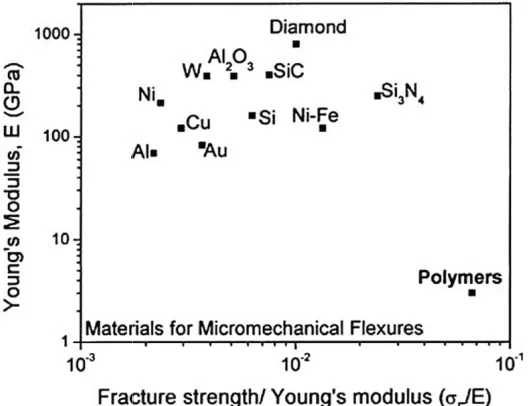
Fig. 8. Micromechanical flexures require a large ratio of fracture First appearing in Srikar and Spearing [
Mishra et al.; JERR, 4(1): 1-24, 2019; Article no.
10. PROCESS SELECTION FOR MEMS
EMS continues to ] compatible materials and silicon still include a large portion of commercial products for their noticeable
compatibilities with electronics and
characteristics for micromachining. Srikar and Spearing [69] classified five materials indices to aid in materials selection. For their resonator case study these are based on attributes including mass, stiffness, inertial load, de
and frequency and are related to materials properties.
Fig. 7. The quality of materials data required for design increases as the design process progresses, First appearing in Srikar and Spearing [69]
flexures require a large ratio of fracture strength to Young’s modulus, First appearing in Srikar and Spearing [69]
; Article no.JERR.46001
characteristics for micromachining. Srikar and fied five materials indices to aid in materials selection. For their resonator case study these are based on attributes including mass, stiffness, inertial load, deflection, and frequency and are related to materials
Fig. 7. The quality of materials data required for design increases as the design process
Mishra et al.; JERR, 4(1): 1-24, 2019; Article no.JERR.46001
MEMS devices comprises of major (structural) materials and minor (dielectric, interconnect) materials [24,70]. MEMS processes often also employ secondary materials (not contributing to the structure) as sacrificial materials in the manufacturing flow. Characteristic of concern to the design process comprise the material properties, net shape of the device together with surface roughness and tolerances, the processing restraint on pressure, temperature, and materials interfaces/compatibilities [16,24].
11. MEMS FABRICATION
TECHNO-LOGIES
This segment of the paper presents a summary of the key processes and process instructions usually employed in the deposition of semiconductor and dielectric thin films used in the production of microelectromechanical systems (MEMS) [24]. These methods contain chemical vapor deposition, epitaxy, physical vapor deposition, atomic layer deposition, and spin-on techniques. The materials used in this section include silicon and its oxide, nitride, and carbide derivatives, silicon–germanium, diamond and diamondlike carbon, III-V semiconductors,
aluminum oxide, and other notable
semiconductor and dielectric materials used as structural, sacrificial, and passivation layers [16,24]. An explanation of the oxidation process, including a careful development of the Deal– Grove model & the data required to compute oxidation times and thicknesses can be found in nearly any advanced undergraduate or graduate text on silicon VLSI fabrication technology, including two notable texts commonly used by MEMS process engineers [24,71–73].
The process method presented in this section of the paper largely comes from publications that report not only processing details, but also key material properties of importance to MEMS that result from the reported processes [24]. Whenever possible, the references included in this section are papers that are readily available via commonly used electronic
databases such as IEEE Xplore and
ScienceDirect so as to aid the reader in gathering more detailed information than can be practically presented herein.
11.1 Thermal Conversion
Silicon’s place as the leading semiconductor in modern IC technology can be attributed to the passivating oxide that can be readily formed on
its surface [16]. Normally referred by the process engineers as silicon oxide this material is theoretically silicon dioxide in chemical composition. Silicon dioxide (SiO2) physically forms on the surface of Si by a method known as oxidation. Oxidation is a thermally driven translation process that occurs over a very broad range of temperatures, together with ambient conditions. If developed at room temperature, the material is known as a native oxide and has a thickness of approximately 1–2 nm [24].
For MEMS functions, much thicker oxides (hundreds of nm to several microns) are characteristically required, demanding the need for processing tools to construct such films. Of all the thin-film growth processes used in MEMS, oxidation of silicon is one of the most uncomplicated due to the simplicity of the process [16,24]. Dissimilar to the other materials commonly used in MEMS, thermal SiO2 films can only be developed on silicon substrates, thereby restraining their applicability in multilayered structures. That being said, thermal oxidation is not limited to single crystalline Si wafers, but can also be executed to produce SiO2 on polysilicon films, for as long as the materials under the polysilicon layer can abide the high temperatures connected with the oxidation process. Thermal oxides can also be developed on silicon carbide substrates, even though at a much lower rate than for silicon [24,74].
Desai explained a process to produce silicon nanoporous membranes using a thermal oxide as a sacrificial material for pore formation [24,75]. The process engages the growth of a thin (20–100 nm) thermal oxide on a boron-doped Si substrate that is photolithographically patterned and etched to form an array of vias.
11.2 Chemical Vapor Deposition
Chemical vapor deposition (CVD) [16,24,76] process is the most broadly used resources to deposit semiconductor and dielectric materials employed in MEMS technology. In general CVD is a method where a thin film is created by the deposition of vapor-phase components onto a heated substrate. CVD has several key characteristics that make it the dominant deposition method for semiconductors and dielectrics in MEMS [24]. The commonly available types of CVD are as followes [24,76]:
Mishra et al.; JERR, 4(1): 1-24, 2019; Article no.JERR.46001
b) Plasma-Enhanced Chemical Vapor
Deposition (PECVD).
c) Atmospheric Pressure Chemical Vapor Deposition (APCVD) [76].
d) Hot Filament Chemical Vapor Deposition (HFCVD).
e) Microwave Plasma Chemical Vapor
Deposition (MPCVD).
The microstructure of polysilicon thin films consists of a collection of small grains whose microstructure and orientation is a function of the deposition conditions [24,77]. For typical LPCVD processes (e.g., 200 mtorr), the amorphous-to-polycrystalline transition temperature is about 570°C, with polycrystalline films deposited above the transition temperature. At 600°C, the grains are small and equiaxed, whereas at 625°C, the grains are large and columnar [77]. The inclusion of boron generally increases the deposition rate of polysilicon relative to undoped films, whereas phosphorus reduces the rate [24,78]. In SiO2 doping is commonly used to produce conductive films for electrostatic devices, but has also been used to create polysilicon-based piezoresistive strain gauges, with gauge factors as high as 15 having been reported [79]. The density of polysilicon has been reported as 2.25 − 2.33 g/cm3 under varied conditions [79]. The refractive index of polysilicon has been reported as 3.22 − 3.40 also under varied conditions [80]. The fracture toughness of polysilicon has been measured to be 1.2 ± 0.2 MPa√m [81].
The MUMPS process is a popular multiuser process whose design guidelines can be found in [24,82]. Although the exact growth conditions of these films are not typically published in the literature, it has been reported that the films are deposited using silane gas at a temperature of 580◦C and pressure of 250 mtorr [83]. High cycle fatigue testing of these films was explored in [84]. The complete design guidelines for this process can be found in [85]. The dielectric constant of LPCVD SiO2, commonly referred to as LTO or low temperature oxide due to its low deposition temperature when compared to thermal oxidation, is 4.3. The dielectric strength of LTO is about 80% of that for thermal oxide [86].
PSG films are useful as sacrificial layers because they generally have higher etching rates in HF than LTO films. PSG is compatible with LPCVD polysilicon deposition conditions, thus enabling its use in multilayered polysilicon surface micromachining processes [87]. The residual stress in stoichiometric Si3N4 is large and tensile, with a magnitude of about 1 GPa [88]. Thin
stoichiometric Si3N4 films have been used as mechanical support structures and electrical insulating layers in piezoresistive pressure sensors [89]. Nearly stress-free films can be deposited using a SiH2Cl2-to-NH3 ratio of 6:1, a deposition temperature of 850°C and a pressure of 500 mtorr [90]. A detailed study concerning the influence of the Si-to-N ratio on the residual stress in silicon nitride films can be found in [91,92]. The composition of low- stress nitride has been reported to be Si1.0N1.1 [93].
The strength of silicon nitride films also varies with the Si-to-N ratio. For example, the tensile strength has been reported to be 6.4 GPa for stoichiometric films and 5.5 GPa for silicon-rich films [94]. A similar decrease in fracture toughness is observed for silicon-rich silicon nitride with an upper bound to be <14 MPa√m for stoichiometric nitride and 1.8 MPa√m for low-stress nitride [95]. Reference [96] describes a study to characterize the mechanical properties of stoichiometric Si3N4 using 70–80 nm thick membranes. Load-deflection testing was then used to characterize the films, yielding a biaxial modulus of 288 GPa, a fracture stress of 10.8– 11.7 GPa, and a residual stress of 1040 MPa [96]. Surface micromachined structures have also been used to determine the Young’s modulus of low-stress nitride films [97].
Germanium (Ge) and silicon–germanium (SiGe) are of interest to the MEMS community because of the low temperatures required to deposit polycrystalline films, making them potentially compatible with Si CMOS structures in integrated MEMS devices. Polycrystalline Ge (poly-Ge)
films can be deposited by LPCVD at
temperatures as low as 325°C on Si, Ge, and silicon–germanium (SiGe) substrate materials [98]. The mechanical properties of poly-Ge are comparable with polysilicon, with a Young’s modulus of 132 GPa and a fracture stress ranging between 1.5 and 3.0 GPa [99].
Mishra et al.; JERR, 4(1): 1-24, 2019; Article no.JERR.46001
boron-doped films with residual compressive stresses as low as 10 MPa. PolySiGe has a lower thermal conductivity than Si, making it a well-suited alternative to polysilicon for thermopiles [105]. Poly-SiGe films exhibit a residual stress that can either be moderately tensile or moderately compressive depending on the Ge content and deposition temperature [103,106].
Polycrystalline SiC (poly-SiC) is a more versatile material for SiC MEMS than its single-crystal counterparts because poly-SiC is not constrained to single-crystalline substrates but can be deposited on a variety of materials, including polysilicon, SiO2, and Si3N4, Commonly used
deposition techniques include LPCVD
[107,108,109] and APCVD [110,111].
11.3 Epitaxy
Epitaxy [24] is a special case of thin-film growth where a single-crystalline thin-film is grown upon a single-crystalline substrate such that the crystalline structure of the film is formed using the crystalline structure of the substrate as a template. Most epitaxial semiconductor films are grown by a process called vapor phase epitaxy (VPE). Unlike conventional LPCVD processes that typically have deposition rates less than10 nm/min, epitaxial processes have deposition rates on the order of 1 μm/min [112].
The Young’s modulus of epi-poly measured from micromachined test structures is comparable with LPCVD polysilicon [113]. The fact that epi-poly does not readily nucleate on SiO2 surfaces has recently been exploited in a selective growth process for patterning epi-poly films [114]. For designs that require electrical isolation from the substrate, 3C-SiC devices can be made directly on SOI substrates [115] or by wafer bonding and etchback, such as the capacitive pressure sensor developed by Young et al. [116]. High-quality 3C-SiC films can be grown on Si substrates by molecular beam epitaxy [117], although the process is much less commonly used than APCVD or LPCVD.
11.4 Physical Vapor Deposition
Physical vapor deposition (PVD) [24] is a process by which a physical mechanism is the primary means by which a film-producing vapor is generated (in contrast to CVD where gaseous chemical precursors are used). PVD techniques have been developed to produce Si thin films [118,119] as a low temperature alternative to
LPCVD polysilicon and PECVD amorphous silicon. Sputtered SiC films can be deposited by RF magnetron sputtering of a SiC target [120] or by dual source DC magnetron sputtering of Si and graphite targets [121]. Bhatt and Chandra [122] have developed a sputtering process suitable for the production of micromachined SiO2 structures.
11.5 Atomic Layer Deposition
Atomic layer deposition (ALD) is a variant of CVD where compound materials, typically binary compounds, are formed on a substrate surface by sequential exposure to two highly reactive vapor-phase chemical precursors [24]. Hoivik et al. showed that alumina films deposited by ALD can overcoat all exposed surfaces of a released surface micromachined polysilicon cantilever, albeit with a small variation in thickness between the top and bottom surfaces of the beam [123]. Yang and Kang investigated the chemical durability of ALD alumina films in aqueous and vapor phase HF and found that the films were much more chemically stable when exposed to vapor phase HF than when exposed to aqueous solutions [124].
11.6 Spin-On Films
Spin-on dielectrics, such as siloxane-based spin-on glass (SOG), have become a mainstay material of backend processing in IC fabrication because the material can be conveniently deposited and processed at reasonable temperatures, and it retains acceptable dielectric properties for surface passivation and mechanical protection ofelectronic interconnects
[24]. Although the processing conditions vary depending on the source of SOG, the
following sequence is representative of a common SOG known as Honeywell Accuglass 512BTM [125]. SOG has been used as a thick film sacrificial molding material to pattern thick polysilicon films [126]. The cured SOG films were completely compatible with the LPCVD process
and posed no contamination risk. SOG has also been used as a structural material in high-aspect-ratio channel plate microstructures
[127].
11.7 Bulk Micromachining
selective removal of the substrate material in order to realize miniaturized mechanical components. Bulk micromachining can be accomplished using chemical or physical means, with chemical means being far more widely used in the MEMS industry. A widely used bulk micromachining technique is chemical wet etching, which involves the immersion of a substrate into a solution of reactive chemical that will etch exposed regions of the substrate at measurable rates [21,24].
11.8 Surface Micromachining
Surface micromachining is another very popular technology used for the fabrication of MEMS devices. There are a very large number of variations of how surface micromachining is performed, depending on the materials and etchant combinations that are used. However, the common theme involves a sequence of steps starting with the deposition of some thin material to act as a temporary mechanical layer onto which the actual device layers are built; followed by the deposition and patterning of
Fig. 9. Illustration of a surface micromachining process [
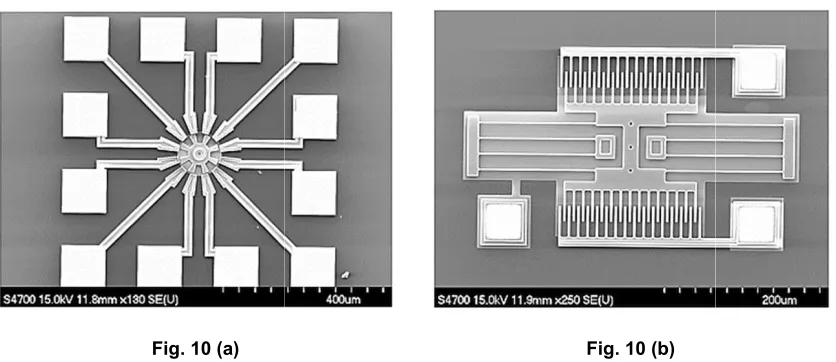
Fig. 10 (a)
Fig. 10 (a). represents Polysilicon micromotor & Fig
structure fabricated using a surface micromachining process
Mishra et al.; JERR, 4(1): 1-24, 2019; Article no.
selective removal of the substrate material in order to realize miniaturized mechanical components. Bulk micromachining can be accomplished using chemical or physical means, with chemical means being far more widely used industry. A widely used bulk micromachining technique is chemical wet etching, which involves the immersion of a substrate into a solution of reactive chemical that will etch exposed regions of the substrate at
Surface micromachining is another very popular technology used for the fabrication of MEMS devices. There are a very large number of variations of how surface micromachining is performed, depending on the materials and that are used. However, the common theme involves a sequence of steps starting with the deposition of some thin-film material to act as a temporary mechanical layer onto which the actual device layers are built; followed by the deposition and patterning of the
thin-film device layer of material which is referred to as the structural layer; then followed by the removal of the temporary layer to release the mechanical structure layer from the constraint of the underlying layer, thereby allowing the structural layer to move. An illustration of a surface micromachining process is shown in Fig 9, wherein an oxide layer is deposited and patterned.
11.9 The Lithography / Photolithography Module
Photolithography is a patterning process that uses light to transfer a pattern from a mask to a photosensitive polymer layer. The resulting pattern can either be etched into the underlying surface or used to define the patterning of a layer deposited onto the masked surface. This is essentially a two-dimensional pro
be repeated numerous times to fabricate various structures and devices. A classic use of these techniques is the fabrication of transistors on a silicon substrate as practiced in the semiconductor industry [24].
Illustration of a surface micromachining process [11,24]
Fig. 10 (b)
represents Polysilicon micromotor & Fig. 10 (b). represents Polysilicon resonator structure fabricated using a surface micromachining process [11,21]
; Article no.JERR.46001
film device layer of material which is referred to as the structural layer; then followed by the removal of the temporary layer to release the mechanical structure layer from the constraint of the underlying layer, thereby allowing the layer to move. An illustration of a surface micromachining process is shown in Fig. 9, wherein an oxide layer is deposited and
The Lithography / Photolithography
Photolithography is a patterning process that transfer a pattern from a mask to a photosensitive polymer layer. The resulting pattern can either be etched into the underlying fine the patterning of a layer deposited onto the masked surface. This is dimensional process that can be repeated numerous times to fabricate various structures and devices. A classic use of these techniques is the fabrication of transistors on a silicon substrate as practiced in the
Mishra et al.; JERR, 4(1): 1-24, 2019; Article no.JERR.46001
Typically lithography is performed as part of a well-characterized module, which includes the wafer surface preparation, photoresist deposition, alignment of the mask and wafer, exposure, develop and appropriate resist conditioning. The lithography process steps need to be characterized as a sequence in order to ensure that the remaining resist at the end of the modules is an optimal image of the mask, and has the desired sidewall profile.
Photolithography is the process that defines and transfers a pattern onto a thin film layer on the wafer. In the photolithography process a light source is typically used to transfer an image from a patterned mask to a photosensitive layer (photoresist or resist) on a substrate or another thin film. This same pattern is later transferred into the substrate or thin film (layer to be etched) using a different process called etch [55,128,129].
The Various Types of lithography process are[24, 130]:
a) UV Lithography (Photo Masks, Photoresist, Substrate).
b) Grayscale Lithography (Photomask
Pixelation).
c) X-Ray Lithography (X-Ray Masks, X-Ray Photoresists).
d) Direct-Write Lithography (E-Beam
Lithography, Ion Beam Lithography and Focused Ion Beam (FIB), Gas-Assisted Electron and Ion Beam Lithography, Dip-Pen Lithography (DPN), Direct-Write
Laser, Stereolithography and
Microstereolithography).
e) Print/Imprint Lithography (Inkjet Printing, Soft Lithography, Nanoimprint Lithography, Transfer Printing).
11.10 Etching Processes
In order to form a functional MEMS structure on a substrate, it is necessary to etch the thin films previously deposited and/or the substrate itself. In general, there are two classes of etching processes:
a) Wet etching where the material is dissolved when immersed in a chemical solution. Wet chemical etching through openings in photoresist or hard masks underlies many process sequences for MEMS device fabrication [11,24,128,129]. In present era more than 800 wet-etch
recipes for over 400 varieties and combinations of substrates and deposited thin films, with emphasis on processes that use laboratory chemicals often found in university and industrial cleanrooms. b) Dry etching where the material is sputtered
or dissolved using reactive ions or a vapor phase etch. Dry etching processes provide the tools to machine precision high- aspect-ratio structures that form the basic building blocks of microelectromechani-cal systems.
Dry etching processes consist of
[11,24,128,131,132]:
1. Purely chemical (spontaneous gasphase etching),
2. Purely physical (ion beam etching or ion milling), and
3. A com-bination of both methods (reactive ion or plasma etching) for the controlled removalof desired substrate materials.
12. CHALLENGES & REQUIREMENTS
Muhammad Shoaib, et al. [133] discussed and provides information relevant to issues and challenges in MEMS testing techniques that
are implemented to analyze the
microelectromechanical systems (MEMS)
behavior for specific application and operating conditions. MEMS devices are more complex and extremely diverse due to the immersion of multi-domains. Their failure modes are distinctive under different circumstances. Therefore, testing of these systems at device level as well as at mass production level, that is, parallel testing, is becoming very challenging as compared to the IC test, because MEMS respond to electrical, physical, chemical, and optical stimuli. Currently, test systems developed for MEMS devices have to be customized due to their nondeterministic behavior and complexity.
R. J. Pryputniewicz and K. G. Merriam [134]
explored about the field of
Mishra et al.; JERR, 4(1): 1-24, 2019; Article no.JERR.46001
MEMS machines are batch‐fabricated with no
piece‐part assembly required, and are ready to use at the end of the fabrication process
[134].
Following are the various challenges associated with MEMS technology [43,135,136,137,138,133, 139,140,141,142]:-
a) Access to Fabrication and manufacturing [135,136]: Most of the companies who wish to investigate the potential of MEMS have very few options for manufacturing devices, and have less expertise in microfabrication technology. A mechanism giving smaller organization responsive and affordable access to MEMS is essential.
b) Packaging of MEMS devices [135]:
MEMS packaging is more challenging than IC packaging due to diversity of MEMS devices and the requirement that many of these devices be in contact with their environment. Most companies find that packaging is the single most expensive and time consuming task in their overall product development program.
c) Knowledge Required for Fabrication and manufacturing [137]: Currently the designer of MEMS device require a high level of fabrication knowledge in order to create a successful design. MEMS devices require a dedicated research effort to find a suitable process sequence for fabricating it.
d) MEMS testing & requirements for testing’s [139-146]: Several efforts have been made to cope with the challenges and issues in MEMS testing and its requirement. MEMS final testing has limited visibility in the literature from industries that have successfully manufactured MEMS devices such as humidity sensors, pressure sensors, and magnetic field sensor. This type of trend shows an indication of custom nature of test for MEMS. According to MIG’s (MEMS
Industry Group) METRIC (MEMS
Technology Roadmap and Industry
Congress) there are no agreed testing standards and this is the major limitation for the industries growth and innovation.
Peterson et al. [147], Brown et al. [148,149], Miller et al. [150,151] described about some
common MEMS failures are found in the study of micro-engines. These are:
(i) External Particulate Contamination. (ii) Fused Components due to Overdriving. (iii) Sticking.
(iv) Electrostatic Clamping of Gears (Links). (v) Static overload.
(vi) Delamination. (vii) Creep.
(viii) Environmental attack. (ix) Fatigue.
13. CONCLUSION
MEMS technology has a very strong potential to become an upcoming technological revolution of miniaturization. Micro electro mechanical Systems (MEMS) have been accepted as worthwhile products for many commercial and government applications. Only with the help of MEMS devices the development of micro-machineries with compact dimension, low power consumption and fine performance can be carried out. It has been found that MEMS based sensor-actuator applications continue to grow in the sectors like automotive, consumer electronics and industries, wireless Communications devices, Defense / Military applications, Medical / Biomedical / Microfluidics Applications and Biotechnology, which consume many millions of sensors every year. New product developments in this context reflect the requirement for smaller and lower-cost sensors and actuators with enhanced performance and greater functionality. Availability of Micromachining fabrication process and MEMS technologies are influential utensils for enabling the miniaturization of MEMS based sensors, actuators and Industrial / Commercial / Bio-Medical systems. With the reductions in cost price and augment in performance of micro-sensors, micro-actuators and microsystems will enable the society. With the continuous efforts in this field, now the researchers are approaching towards NEMS (Nano electro mechanical Systems), which are far smaller (of the order of nanometers) in size, in comparison to MEMS devices and are able to perform with either equal or high potential when compared to MEMS systems. NEMS Devices may replace the MEMS systems in future because of their dimensions and functional abilities.
COMPETING INTERESTS
![Fig. 1 (b). Applications of MEMS Devices/Systems [Applications of MEMS Devices/Systems [10]](https://thumb-us.123doks.com/thumbv2/123dok_us/9832833.1969459/3.612.102.499.90.461/applications-mems-devices-systems-applications-mems-devices-systems.webp)
![Fig. 3 (a) [19]](https://thumb-us.123doks.com/thumbv2/123dok_us/9832833.1969459/5.612.116.283.91.271/fig-a.webp)
![Fig. 4. Scale of things, in meters [25]](https://thumb-us.123doks.com/thumbv2/123dok_us/9832833.1969459/6.612.132.474.407.685/fig-scale-things-meters.webp)
![Fig. 6. Growth in MEMS application based products [48]Fig. 6. Growth in MEMS](https://thumb-us.123doks.com/thumbv2/123dok_us/9832833.1969459/10.612.118.499.93.306/fig-growth-mems-application-based-products-growth-mems.webp)