R. Kiran Babu
et al
, International Journal of Computer Science and Mobile Applications,
Vol.2 Issue. 12, December- 2014, pg. 16-22
ISSN: 2321-8363
©2014, IJCSMA All Rights Reserved, www.ijcsma.com 16
D
ESIGNING OF
A
D HOC
N
ETWORKS BY USING
O
PPORTUNISTIC
P
ETAL
R
OUTING
P
ROTOCOL
Mr. R. Kiran Babu
1Mr. J.Sagar Babu
2Assistant Professor1 Associate Professor2
Head, Department of Information Technology1 Head, Department of Computer science & engineering2
Princeton College of Engineering & Technology12 Ghatkesar12
Hyderabad.12
A
BSTRACT:
This paper addresses the problem of delivering data packets for highly dynamic mobile ad hoc
networks in a reliable and timely manner. Most existing ad hoc routing protocols are susceptible to node mobility,
especially for large-scale networks. Driven by this issue, we propose an efficient Position-based Opportunistic
Petal Routing (OPR) protocol which takes advantage of the stateless property of geographic routing and the
broadcast nature of wireless medium. In the case of communication hole, a Virtual Destination-based Void
Handling (VDVH) scheme is further proposed to work together with OPR. Both theoretical analysis and
simulation results show that OPR achieves excellent performance even under high node mobility with acceptable
overhead and the new void handling scheme also works well.
Index Terms — Geographic routing, opportunistic forwarding, Petal routing, reliable data delivery, void
handling, mobile ad hoc network
I.
I
NTRODUCTIONR. Kiran Babu
et al
, International Journal of Computer Science and Mobile Applications,
Vol.2 Issue. 12, December- 2014, pg. 16-22
ISSN: 2321-8363
©2014, IJCSMA All Rights Reserved, www.ijcsma.com 17
which directly uses location information to guide packet forwarding. The main contributions of this paper can be summarized as follows:
a) We propose a position-based opportunistic petal routing mechanism which can be deployed without complex modification to MAC protocol and achieve multiple reception without losing the benefit of collision avoidance provided by 802.11. The concept of in-the-air backup significantly enhances the robustness of the routing protocol and reduces the latency and duplicate forwarding caused by local route repair.
b) In the case of communication hole, we propose a Virtual Destination-based Void Handling (VDVH) scheme in which the advantages of adjusting the petal width according to the need of nodes for flooding. Thus reducing collision and overheads and routing can still be achieved while handling communication voids.
c) We analyze the effect of node mobility on packet delivery and explain the improvement brought about by the participation of forwarding candidates based on the petal area.
d) The overhead of OPR with focus on buffer usage and bandwidth consumption due to forwarding candidates‟ duplicate relaying is also discussed. Through analysis, we conclude that due to the selection of forwarding area and the properly designed duplication limitation scheme, POR‟s performance gain can be achieved at little overhead cost.
e) Finally, we evaluate the performance of OPR through extensive simulations and verify that OPR achieves excellent performance in the face of high node mobility while the overhead is acceptable .
II.
L
ITERATURER
EVIEWA. Geographic routing
Geographic routing (location/position-based routing) for communication in ad-hoc wireless networks has recently received increased attention, especially in the energy saving area . In geographic routing, each node has knowledge of its own geographic information either via Global Positioning System (GPS) or network localization algorithms, and broadcasts its location information to other nodes periodically. The next relay node is selected only based on the location of the source node, its neighbors and its ultimate destination (contained in the data packet). Therefore, geographic routing is generally considered to be scalable and applicable to large networks.
B. Greedy Perimeter Stateless Routing (GPSR)
GPSR protocol [8] is the earliest geographical routing protocols for ad hoc networks which can also be used for WSN environment. The GPSR adapts a greedy forwarding strategy and perimeter forwarding strategy to route messages. It makes uses of a neighborhood beacon that sends a node’s identity and its position. However, instead of sending this beacon periodically and add to the network congestion, GPSR piggybacks the neighborhood beacon on every message that is sent or forwarded by the node. Every node in GPSR has a neighborhood table of its own. Whenever a message needs to be sent, the GPSR tries to find a node that is closer to the destination than itself and forwards the message to that node. However, this method fails for topologies that do not have a uniform distribution of nodes or contain voids. Hence, the GPSR adapts to this situation by introducing the concept of perimeter routing utilizing the right-hand graph traversal rule. Every packet transmitted in GPSR has a fixed number of retransmits [1, 8]. This information is given to the node by the medium access (MAC) layer that is required to be compliant to the IEEE 802.11 standard. This may render the GPSR protocol unusable in its normal form for WSN. The GPSR does not elucidate more on the action taken in case message is unable to be transmitted even in perimeter mode. Finally GPSR disallows the use of periodic broadcast of the neighborhood beacons and piggybacks these beacons on the messages sent by each node. As a strong geographical routing protocol GPSR is allowing nodes to send packets to a particular location and holding a promise in providing routing support in WSN. Many recent research works in WSN are building applications using GPSR protocol. However, GPSR is not originally designed for sensor networks, several problems are required to be fixed before it is applied in sensor networks.
C. AOMDV
R. Kiran Babu
et al
, International Journal of Computer Science and Mobile Applications,
Vol.2 Issue. 12, December- 2014, pg. 16-22
ISSN: 2321-8363
©2014, IJCSMA All Rights Reserved, www.ijcsma.com 18
of the AOMDV protocol lies in ensuring that multiple paths discovered are loop-free and disjoint, and in efficiently finding such paths using a flood-based route discovery. AOMDV route update rules, applied locally at each node, play a key role in maintaining loop-freedom and disjointness properties [9].
D. Problem statement
Mostly ad hoc routing protocols are susceptible to node mobility, especially for large-scale networks. One of the main reasons is due to the pre-determination of an end-to end route before data transmission. Owing to the constantly and even fast changing network topology, it is very difficult to maintain a deterministic route. The discovery and recovery procedures are also time and energy consuming. Once the path breaks, data packets will get lost or be delayed for a long time until the reconstruction of the route, causing transmission interruption. Pre-determination of an end-to-end route will be constructed before data transmission also no guarantee the data will send to destination. Without knowing location requires more time and energy to discovery and recovery the route to send data. So, there is a need for routing protocol which take advantage of location information is required for high amount of data delivery in highly dynamic mobile ad hoc networks.
III.
L
OCATIONB
ASEDO
PPORTUNISTICR
OUTINGP
ROTOCOL(LOR)
The design of LOR is based on geographic routing and opportunistic forwarding. The nodes are assumed to be aware of their own location and the positions of their direct neighbors. Neighborhood location information can be exchanged using one-hop beacon or piggyback in the data packet’s header. While for the position of the destination, we assume that a location registration and lookup service which maps node addresses to locations is available just as in [6]. It could be realized using many kinds of location service. In our scenario, some efficient and reliable way is also available. For example, the location of the destination could be transmitted by low bit rate but long range radios, which can be implemented as periodic beacon, as well as by replies when requested by the source. When a source node wants to transmit a packet, it gets the location of the destination first and then attaches it to the packet header. Due to the destination node’s movement, the multi hop path may diverge from the true location of the final destination and a packet would be dropped even if it has already been delivered into the neighborhood of the destination. To deal with such issue, additional check for the destination node is introduced. At each hop, the node that forwards the packet will check its neighbor list to see whether the destination is within its transmission range. If yes, the packet will be directly forwarded to the destination, similar to the destination location prediction scheme described in [5]. By performing such identification check before greedy forwarding based on location information, the effect of the path divergence can be very much alleviated. In conventional opportunistic forwarding, to have a packet received by multiple candidates, either IP broadcast or an integration of routing and MAC protocol is adopted. The former is susceptible to MAC collision because of the lack of collision avoidance support for broadcast packet in current 802.11, while the latter requires complex coordination and is not easy to be implemented. In LOR, we use similar scheme as the MAC multicast mode described in. The packet is transmitted as unicast (the best forwarder which makes the largest positive progress toward the destination is set as the next hop) in IP layer and multiple reception is achieved using MAC interception. The use of RTS/CTS/DATA/ACK significantly reduces the collision and all the nodes within the transmission range of the sender can eavesdrop on the packet successfully with higher probability due to medium reservation. As the data packets are transmitted in a multicast-like form, each of them is identified with a unique tuple (src_ip, seq_no) where src_ip is the IP address of the source node and seq_no is the corresponding sequence number. Every node maintains a monotonically increasing sequence number, and an ID_Cache to record the ID (src_ip, seq_no) of the packets that have been recently received. If a packet with the same ID is received again, it will be discarded. Otherwise, it will be forwarded at once if the receiver is the next hop, or cached in a Packet List if it is received by a forwarding candidate, or dropped if the receiver is not specified. The packet in the Packet List will be sent out after waiting for a certain number of time slots or discarded if the same packet is received again during the waiting period (this implicitly means a better forwarder has already carried out the task).
A. Void Handling Based on Virtual Destination (VHVD)
R. Kiran Babu
et al
, International Journal of Computer Science and Mobile Applications,
Vol.2 Issue. 12, December- 2014, pg. 16-22
ISSN: 2321-8363
©2014, IJCSMA All Rights Reserved, www.ijcsma.com 19
an opportunistic routing like fashion; virtual destination is introduced, as the temporary target that the packets are forwarded to. A fundamental issue in void handling is when and how to switch back to normal greedy forwarding.. After a packet has been forwarded to route around, the communication void for more than two hops (including two hops), the forwarder will check whether there is any potential candidate that is able to switch back. If yes, that node will be selected as the next hop, but the mode is still void handling. Only if the receiver finds that its own location is nearer to the real destination than the void node and it gets at least one neighbor that makes positive progress towards he real destination, it will change the forwarding mode back to normal greedy forwarding. In VDVH, if a trigger node finds that there are forwarding candidates in both directions, the data flow will be split into two where the two directions will be tried simultaneously for a possible route around the communication void. In order to reduce unnecessary duplication, two control messages are introduced, namely, path acknowledgment and reverse suppression. If a forwarding candidate receives a packet that is being delivered or has been delivered in void handling mode, it will record a reverse entry. Once the packet reaches the destination, a path acknowledgment will be sent along the reverse path to inform the trigger node. Then, the trigger node will give up trying the other direction. For the same flow, the path acknowledgment will be periodically sent (not on per-packet basis; otherwise, there will be too many control messages). If there is another trigger node upstream, the path acknowledgment will be further delivered to that node, and so on. On the other hand, if a packet that is forwarded in void handling mode cannot go any further or the number of hops traversed exceeds a certain threshold but it is still being delivered in void handling mode, a DISRUPT control packet will be sent back to the trigger node as reverse suppression. Once the trigger node receives the message, it will stop trying that direction.
IV.
S
IMULATION ANDR
ESULTSR. Kiran Babu
et al
, International Journal of Computer Science and Mobile Applications,
Vol.2 Issue. 12, December- 2014, pg. 16-22
ISSN: 2321-8363
©2014, IJCSMA All Rights Reserved, www.ijcsma.com 20
The improved random way point without pausing is used to model nodes’ mobility. The minimum node speed is set to 1 m/s and we vary the maximum speed to change the mobility degree of the network. The following metrics are used for performance comparison:
Packet delivery ratio: The ratio of the number of data packets received at the destination(s) to the number of data packets sent by the source(s). From Fig.1, it is clear that the PDR of the LOR is better w.r.t GPSR and AOMDV. Also PDR decreases when the number of nodes increases
Figure 1: PDR Comparison Graph
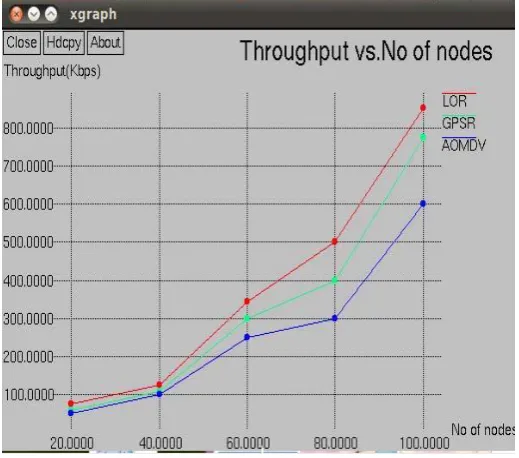
Throughput: is the average rate of successful message delivery over a communication channel. Fig 2 shows the increase in throughput when the number of participating node increases.
R. Kiran Babu
et al
, International Journal of Computer Science and Mobile Applications,
Vol.2 Issue. 12, December- 2014, pg. 16-22
ISSN: 2321-8363
©2014, IJCSMA All Rights Reserved, www.ijcsma.com 21
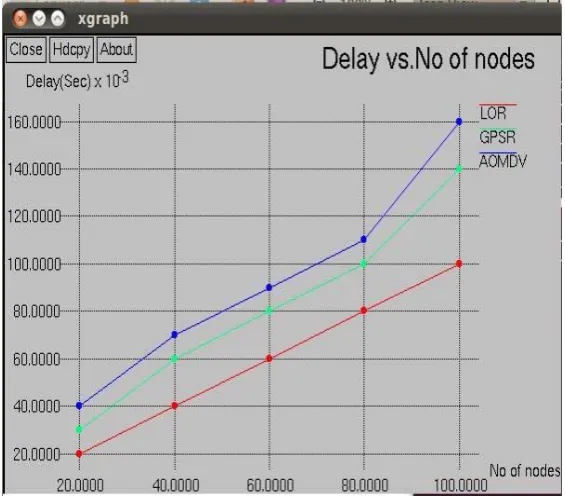
End-to-end delay: The average and the median end-to end delay are evaluated, together with the cumulative distribution function of the delay End to End Delay will increases as amount of participating node increases. LOR has lower delay compared with others as shown in Fig.3
Figure 3: End t End Delay Comparison Graph
V.
C
ONCLUSIONOne way of assuring that data packets reach the destination in wireless ad hoc networks, is by using multipath routing algorithms. This method, however, increases the overall traffic substantially. In this report, we survey the literature for existing multipath routing techniques. We then present a routing technique that we call Petal Routing, which minimizes the number of transmissions while maximizing reliability. Individual nodes in this routing technique do not need to maintain any routing tables or neighbor information. We test our routing protocol using simulations on NS2. Simulation results show that the coordinated back-off method works best in terms of the number of transmissions, while the randomized coordinated back-off works best in terms of the delay. In a network with failures, the number of transmissions is reduced due to failed nodes, but the delay is high. In addition to that, it is observed that the reliability increases with increase in petal width and decrease in node failure probability.
We compare our approach to a multipath routing technique that uses network coding to increase the redundancy of data and thereby increase the reliability and greedy forwarding. Simulation results show that the Petal Routing approach is more reliable in a network with patterned failures or jammers. We also conclude that the number of transmissions in Petal Routing is low in a network with fewer failed nodes, since we use the concept of back-off. Thus, even though the number of transmissions is higher for Petal Routing in networks with high failure, the increase is to maintain higher reliability.
R
EFERENCES[1] J. Broch, D.A. Maltz, D.B. Johnson, Y.-C. Hu, and J. Jetcheva, “A Performance Comparison of Multi-Hop Wireless Ad Hoc Network Routing Protocols,” Proc. ACM MobiCom, pp. 85-97, 1998.
[2] M. Mauve, A. Widmer, and H. Hartenstein, “A Survey on Position-Based Routing in Mobile Ad Hoc Networks,” IEEE Network, vol. 15, no. 6, pp. 30-39, Nov./Dec. 2001.
[3] D. Chen and P. Varshney, “A Survey of Void Handling Techniques for Geographic Routing in Wireless Networks,” IEEE Comm. Surveys and Tutorials, vol. 9, no. 1, pp. 50-67, Jan.-Mar. 2007.
[4] D. Son, A. Helmy, and B. Krishnamachari, “The Effect of Mobility Induced Location Errors on Geographic Routing in Mobile Ad Hoc Sensor Networks: Analysis and Improvement Using Mobility Prediction,” IEEE Trans. Mobile Computing, vol. 3, no. 3, pp. 233-245, July/Aug. 2004.
R. Kiran Babu
et al
, International Journal of Computer Science and Mobile Applications,
Vol.2 Issue. 12, December- 2014, pg. 16-22
ISSN: 2321-8363
©2014, IJCSMA All Rights Reserved, www.ijcsma.com 22
[6] S. Biswas and R. Morris, “EXOR: Opportunistic Multi-Hop Routing for Wireless Networks,” Proc. ACM SIGCOMM, pp. 133-144, 2005. [7] B. Karp and H. Kung, “Greedy Perimeter Stateless Routing,” Proceedings of the 6th Annual International Conference on Mobile Computing and Networking, Boston, pp.243-254, August 2000.
Mr.J.Sagar Babu is Associate Professor & Head, Department of Computer science & engineering, Princeton College of Engineering & Technology, Ghatkesar, R.R-Dist, He has Working experience in teaching field since 2008.His qualification is B.Tech in Computer Science & Engineering from Dr.Samuel George Institute of Engineering & Technology, Markapur, Prakasam-Dist in 2005.M.Tech in Computer Science & Engineering from QIS College of Engineering & Technology, Ongole,Prakasam-Dist. Completed In 2008.