
Development and validation of stability indicating HPLC-method for estimation of cefotaxime sodium in injection
7
0
0
Full text
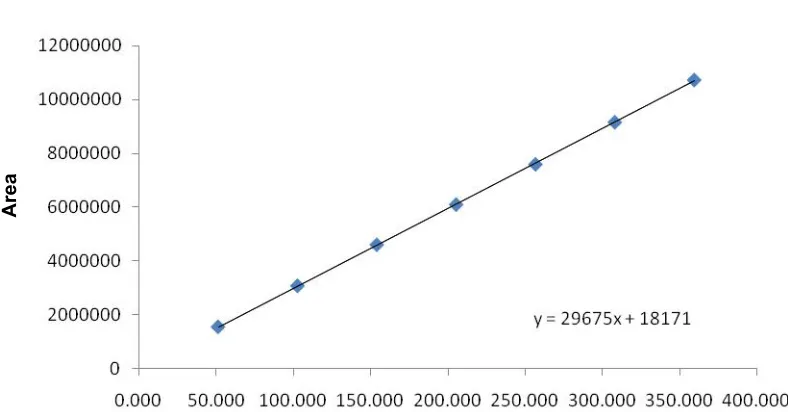
(2) 161. and impurities in a single method. Since Cefotaxime is unstable in solution, its estimation method should be stability indicating in the assay method in order to estimate the actual Cefotaxime content. In the present study rapid, precise, accurate, simple and stability indicating method was developed for the estimation of Cefotaxime Sodium from injections and also verified the separation of its impurities in the same method and found that all the impurities are eluted within 10 minutes of HPLC run time.. Materials and Methods Instrumentation The high pressure liquid chromatographic (HPLC) system was used bearing the configuration by equipped with pump (Waters 2695 separators module), auto sampler, thermo stated column compartment and detector (Waters 2487 dual wavelength absorbance detector) controlled by Empower software. A column Symmetry ODS, 150mm X 4.6mm, 5µ, Make: Waters, was used as a stationary phase. Materials Working standard and impurities of Cefotaxime sodium were received as a gift sample from Kreszent Pharma. Disodium hydrogen orthophosphate anhydrous, Potassium dihydrogen orthophosphate anhydrous and Orthophosphoric acid used were of analytical grade and methanol and acetonitrile were procured form commercial source and HPLC grade water was obtained using Millipore water purification system. All other chemicals were of analytical reagent grade unless specified. Methods Chromatographic conditions: The analysis was carried out on binary HPLC system using the column Symmetry ODS, 150mm X 4.6mm, 5µm with UV- detection of 254 nm at 25oC. The injection volume was 20μl with a flow rate of 1.3 ml per minute and a run time of 10 minutes.. Int. J. Pharm & Ind. Res. Vol - 01. Mobile phase and solutions Prepared a mixture of buffer (2.8 gm of disodium hydrogen orthophosphate anhydrous + 1.4gm potassium dihydrogen orthophosphate anhydrous in 1000 ml of water), methanol and acetonitrile in the ratio of 80:15:05. Adjusted the pH between 5.9 to 6.1 with diluted ortho phosphoric acid. Degassed and filtered through 0.45µ membrane filter Standard & Resolution solution Preparation of standard solution Weighed and transferred accurately 26.3mg of Cefotaxime sodium working standard into 100 ml volumetric flask; dissolved and diluted up to the volume with mobile phase and mixed well. Preparation of resolution solution Weighed and transferred accurately 1.2mg of each Cefotaxime sodium working standard and impurity-B into 10 ml of volumetric flask; dissolved the material in 1 ml of 1N hydrochloric acid (diluted 8.5 ml of concentrated hydrochloric acid to 100 ml with HPLC grade water) and 2 ml of acetonitrile. Diluted the solution to the volume with mobile phase and mixed well. Calibration Seven different concentrations (51.348-359.43 μg/ml) of Cefotaxime sodium solutions were prepared for linearity studies. The responses were measured as peak areas and plotted against concentration. Estimation of Cefotaxime sodium from injectable formulation Accurately weighed and transferred about 24.9 mg of Cefotaxime sodium for injection in to 100 mL volumetric flask, shaken well to dissolve and diluted to volume with mobile phase. Forced degradation sample solutions – Forced degradation samples are neutralized after treatment of the sample in acidic and basic conditions. Stressed sample solutions are further diluted with mobile phase to get a final concentration of 0.25mg/ml.. Issue - 03. Jul - Sep 2011.
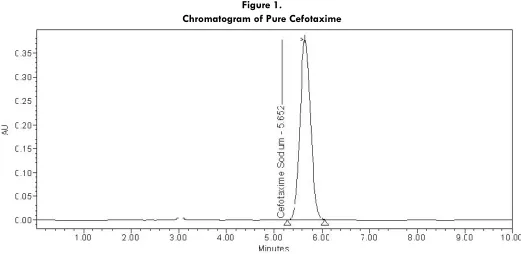
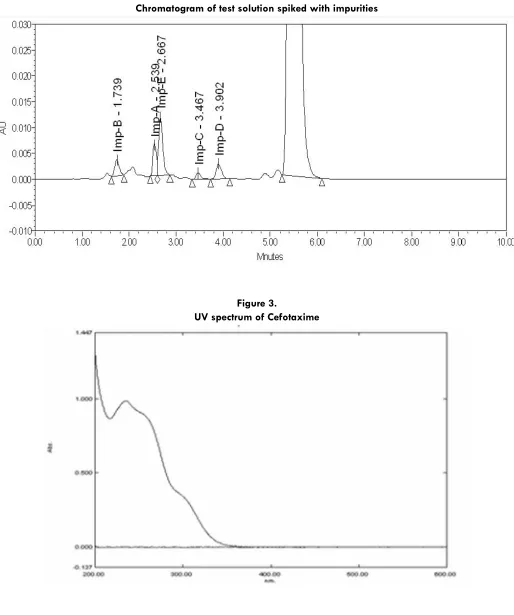
(3) 162. Validation Parameters Various method validation parameters ascertained are as follows: Precision Injection repeatability (System precision): The injection repeatability was established by six replicate injections of the standard solution containing the analyte of interest. Sample repeatability (Method precision): The sample repeatability was established by carrying out the analysis of the analytes six times. Specificity /selectivity Specificity of the method was evaluated by injecting the blank, impurities spiked in sample and the sample solution to check the interference if any at the retention time of Cefotaxime peak. Stress testing (Forced degradation) The Cefotaxime for injection sample was subjected to forced degradation under the following stress conditions. i) Hydrolytic and Oxidative degradation The Cefotaxime for injection sample was separately treated with 5ml of 0.5 N Hydrochloric acid, 5ml of 1N Sodium Hydroxide and 5ml of 10%v/v solution of hydrogen peroxide for 2 minutes. ii) Thermal Degradation The sample was subjected to thermal degradation by keeping the sample at 80oC for 18 hours and analyzed as per the method. iii) Photolytic Degradation The sample was exposed to sun light for about 24 hours and analyzed as per the developed method. The spectral purity of the main peaks were evaluated using photodiode array detector and Empower software used to verify that the degradation peaks are well resolved from the main peaks. Stability of the solution A sample solution of Cefotaxime for Injection was prepared as per the test method, analyzed initially and also analyzed at different time intervals by keeping the sample solution at room temperature. Int. J. Pharm & Ind. Res. Vol - 01. System suitability tests The resolution solution was prepared and injected as per the test method during the course of validation study. The resolution between Cefotaxime and Impurity-B peaks was calculated using the chromatographic software. The standard solution was prepared and injected as per the test method. The tailing factor, theoretical plates of Cefotaxime peak and the percentage relative standard deviation of five replicate injections of standard preparation were calculated.. Results and Discussion Precision The values of the relative standard deviation of six replicate injections of the standard solution containing were lie well within the limits (% RSD ≤ 2), indicating the injection repeatability of the method. Specimen chromatogram of standard is given in figure 1. Specificity /selectivity Specificity of the method was evaluated by injecting the blank to check the interference if any at the retention time of Cefotaxime peak from the blank solution. There was no peak eluted at the retention time Cefotaxime peak from the blank solution shows the method is specific. Also five impurities (namely impurity A, B, C, D and E) of Cefotaxime spiked in the sample were eluted separately and not interfered with the principle peak. Spiked impurity chromatogram and UV spectrum of Cefotaxime are given in figure 2 and 3 respectively. Stress testing (Forced degradation) The results of forced degradation studies conducted on Cefotaxime for injection sample are summarized in Table 1. At every stage of forced degradation study peak purity of the Cefotaxime peak was checked using photodiode array detector (PDA). The peak purity data was found passed and it revealed that there are no co eluting peaks at the retention time of Cefotaxime peak and it is homogeneous. This illustrates the test method to separate degradation products from Cefotaxime peak. Linearity Calibration curve obtained by the least square regression analysis between average peak area and concentration showed linear relationship with a Issue - 03. Jul - Sep 2011.
(4) 163. correlation coefficient of 0.999 over the calibration ranges tested. The linearity of response for Cefotaxime was determined in the range of 51.348 to 359.438 mcg/ml. Linearity graph is given in figure 4.. % Assay. % Degradation w.r.t. untreated sample. Peak Purity. Mode of Degradation. Table 1 : Forced Degradation. Untreated sample. 98.86. -. Passes (No flag). Acid. 81.54. 17.32. Passes (No flag). Alkali. 75.67. 23.19. Passes (No flag). Hydrogen Peroxide. 80.25. 18.61. Passes (No flag). Thermal. 97.07. 1.79. Passes (No flag). Photolytic. 98.14. 0.72. Passes (No flag). Accuracy Accuracy of the method is inferred from the data of specificity, linearity and precision data System suitability and stability of analytical solution The tailing of Cefotaxime sodium was found in the range of 1.4 to 1.6. The % RSD for five replicate injection of standard was found in the range of 0.29 – 0.65. Resolution between the peaks was found in the range of 14.1 to 15.1. A sample solution of Cefotaxime for Injection was analysed at different time intervals by keeping the sample solution at room temperature. The cumulative % RSD of area of Cefotaxime was found to be 1.36 indicates that solution is stable up to at least 14 hours.. Figure 1. Chromatogram of Pure Cefotaxime. Conclusion The analytical method is simple, specific and precise. The method is stability indicating and all the five potential impurities are eluted in the short HPLC run time of 10 minutes, where no published method is. Int. J. Pharm & Ind. Res. Vol - 01. available for the estimation of potency and impurities in a common method and in a very short time. Hence it can be used for routine quality control analysis as well as stability studies of injections, bulk and also for other dosage forms like solids (Tablet/Capsule).. Issue - 03. Jul - Sep 2011.
(5) 164. Figure 2. Chromatogram of test solution spiked with impurities. Figure 3. UV spectrum of Cefotaxime. Int. J. Pharm & Ind. Res. Vol - 01. Issue - 03. Jul - Sep 2011.
(6) 165. Area. Figure 4. Linearity Graph. Acknowledgement The help rendered by R.P.G College, Jamuhai for providing the facilities at Jaunpur, Uttar Pradesh was gratefully acknowledged. One of the author thanks to References 1. USP-27-NF, The United States Phamacopoeial Convection Inc. Rockville, MD, 2004, 328. 2. Martindale, The Extra Pharmacopeia, The Pharmaceutical Press, London, Edition 29, 1989, 151. 3. O. Layne and M.D. Gentry, Cefotaxime and prophylaxis: New approaches with a proven agent. Am. J. Med., 88, 1990, S32. 4. V. D. Gupta, stability of cefotaxime aodium after reconstitution in 0.9% sodium chloride injection and storage in polypropylene syringes for pediatric use, Int. J. Pharm. Compound., 6, 2002, 234. 5. M.Y.Yoon, H. B. Lee, H. Shin, Bull. Development of an Isolable Active Ester, Diethyl Thiophosphoryl [(Z)-(2-Aminothiazol-4-yl)-2-(Methoxyimino)acetate (DAMA) for the Synthesis of Cefotaxime. Korean Chem. Soc., 32, 2011, 407. 6. S. A. Signs, T. M. File and J. S. Tan. High pressure liquid chromatographic method for analysis of Cephalosporins, Antimicrob. Agents Chemother., 26, 1984, 652. Int. J. Pharm & Ind. Res. Vol - 01. Dr. Narendra Singh, Associate Professor, Department of Chemistry, R.P.G. College, Jamuhai, Jaunpur for his support.. 7. S. S.N. Ling, K.H. Yuen and S.A.Barker. Simple liquid chromatographic method for the determination of cefotaxime in human and rat plasma, J. Chromatogr., B. 1, 2003, 297. 8. D.Dell, J. Chambarlain and F. Coppin. Determination of cefotaxime and desacetylcefotaxime in plasma and urine by highperformance liquid chromatography J. Chromatogr., B: Biomed. Sci. Appl, 226, 1981, 431. 9. R. L. Yost and Derendorf. Rapid chromatographic determination of cefotaxime and its metabolite in biological fluids. J. Chromatogr., B: Biomed. Sci. Appl, 341, 1985, 131. 10. V. D. Gupta, stability of cefotaxime aodium after reconstitution in 0.9% sodium chloride injection and storage in polypropylene syringes for pediatric use, Int. J. Pharm. Compound., 6, 2002, 234. 11. T.E. Rivers, H.A. McBride and J.M. Trang, Stability of cefotaxime sodium and metronidazole in an IV admixture at 8° c, Am J Hosp Pharm., 48, 1981, 2638. Issue - 03. Jul - Sep 2011.
(7) 166. 12. P.P Belliveau, C.H. Nightingale and R. Quintiliani, Stability of cefotaxime sodium and metronidazole in 0.9% sodium chloride injection or in ready to use metronidazole bags, Am J Health Syst Pharm., 52, 1995, 1561. 13. C.M. Paap, M.C. Nahata, Stability of cefotaxime sodium in two perotoneal dialysis solutions, Am J Hosp Pharm., 47, 1990, 147. 14. V.D. Gupta, Stability of cefotaxime sodium as determined by high performance liquid chromatography, J Pharm Sci., 73, 1984, 65. 15. S. Eric-Jovanovic, Agbaba D., Zivanov-Stakic. Dand Vladimirov. S., HPTLC determination of ceftriaxone, cefixime and cefotaxime in dosage forms., J .Pharm. Biomed Anal., 18, 1998, 893-898 16. R.K. Nandha, V.V.Bhagwat, S.E. Potawale and S.C.Hamane. Development and validation of a HPTLC method for simultaneous densitometric analysis of Cefotaxime Sodium and sulbactam sodium as the bulk drugs and in the pharmaceutical dosage form. J. Pharm. Res., 3, 2010, 1667. 17. N. N. Okoye, G.I.C. Nwokedi, N.N. Ukwueze and B.C. Festus. Spectrophotometric determination of some cephalosporin antibiotics using Prussian blue reaction. Sci. Res. Essay, 2, 2007, 342.. Int. J. Pharm & Ind. Res. Vol - 01. 18. C. H. Aswani Kumar, T. Anil Kumar, B. M. Gurupadayya, S. Navya Sloka and M. B. Rahul Reddy. Novel spectrophotometric determination of Valacyclovir and Cefotaxime using 1, 2napthaquinone-4-sulfonic acid sodium in bulk and pharmaceutical dosage form. Archiv. Appl. Sci. Res., 2, 2010, 278. 19. B. Morelli. Derivative spectrophotometry in the analysis of mixtures of cefotaxime sodium and cefadroxil monohydrate. J. Pharm. Biomed. 32, 2003, 257. 20. L. Nuevas, R. Gonzalez, J.C. Rodriguez and J. Hoogmartens. Derivative spectrophotometric determination of the triethylammonium salt of cefotaxime in presence of related compounds from the synthesis. J. Pharm. Biomed. Anal.,18, 1998, 579. 21. M. M. Abdel-K.Halek, M.S. Mahrous. Use of ammonium molybdate in the colorimetric assay of cephalosporins. Talanta, 31, 1984, 635. 22. Y. N. Manohara, K. Srinivasa Rao, M. Chandra Sekar and B.M Gurupadayya. Spectrophotometric Determination of Cefotaxime Sodium. Asian J. Chem., 18, 2006, 2519.. Issue - 03. Jul - Sep 2011.
(8)
Figure
Related documents
Hitch Hiker classifies LooCI bindings as high-priority and low-priority, and this classifica- tion allows Hitch Hiker to support data aggregation by appending low-priority data in
In this article, we propose a fast and robust framework (RSNMF) based on symmetric nonnegative matrix factorization (SNMF) and similarity network fusion (SNF) for clustering
3.0 The evidence of Divine Matrix as container of Bridging, Time, Space, Miracles, and Belief as continuous advancement in computer science. Series of groundbreaking experiments
28 Natasha Korda, Labor’s Lost: Women’s Work and the Early Modern English Stage (Philadelphia: University of Pennsylvania Press, 2011) 1.. 29 In Staging Domesticity:
Interestingly, predictions made by IPA were pointing towards directional changes in functions which may lead to a decreased risk of cancer among individuals with high scores for
Department; PORALG: President ’ s Office - Regional Administration and Local Government; PPP: Public-Private Partnership; PPRA: Public Procurement Regulatory Authority; PV:
Corroborating their strong desire to ensure patients were informed were HCPs concerns that the ever- increasing mainstream specialities now ordering genetic tests might not grasp
ATT: Attitude; AVE: Average variance extracted; BC: Perceived behavioural control; GNAS: Ghana national accounting standards; ICAG: Institute of chartered accountants-Ghana;
