Volume 2, Issue 3, March 2013
Page 444
A
BSTRACTAdopting a correlational method, in this research, an attempt is made to assess factors influencing the organizational success of schoolmasters in smart schools. The statistical population comprises all schoolmasters of smart schools in Tehran. The research tools in this research comprise three questionnaires (the researcher-made questionnaire of factors influencing
organizational success (α= 0.85), the researcher-made questionnaire of efficient interpersonal relations (α= 0.94), and the
researcher-made questionnaire of the indexes of the success of schoolmasters (α= 0.89). The validity of the questionnaires in terms of content was established by using the views of experts and professors. For data analysis, the structural equation modeling was employed. The findings generally show that of the factors influential in the organizational success of principals of smart schools, the most important ones are leadership style (0.172 direct effect)T individual control source (0.148 direct effect), comprehensive decision-making style (0.143 direct effect), and management skills (0.138 direct effect). In addition, the findings also reveal that efficient interpersonal relations mediate between the five factors and the organizational success of the managers. Besides, according to the structural equation modeling, the findings show that the GFI equals 0.96, the AGFI 0.82, the RMSEA 0.237, and Chi-square (x2) equals 253.64 which is an indication of the model's efficiency.
Keywords : Managers’ organizational success, managers, smart schools, individual-idiosyncratic factors, leadership style, decision-making styl
1.
I
NTRODUCTIONThe role and the position of managers are such that the viability and sustainability of organization depends on their success and proficiency (Tosi,1993)[1]. In every organization, the main and the most fundamental issue for the authorities, planners and managers is to achieve the organization's objectives and the manpower, especially the managers, play the most important role in achieving these objectives(Dorbeheshti,1996)[2]. Therefore, the managers' success, the factors influencing their success and the priority of these factors have always been paid attention by organizations and their authorities(Ahmadi, 2002)[3]. Success generally means achieving the objectives. In fact, success depends upon the manager's achieving the organizational objectives.
Various factors influence managers' success some of which pertain to the managers' personal characteristics and idiosyncrasies on which various researchers in the area of management (e.g. Koontz, stogdill, Bentoon, etc.) have stated their views. Other factors influencing managers' success are organizational factors such as the organization's objectives and plans, the organizational structure and the organization's resources. Environmental factors and factors outside the organization are another group of influencing factors which include social-cultural and legal-political factors. According to shafiepour Motlagh
etal(2011), the following factors influence managers' success in achieving organizational objectives: 1) subsidiary factors considered as the subcategory of individual factors such as the manager's personality, education and specialty, skills, management experience, motivation and interest in management, as well as intelligence;
Various factors influence managers' success some of which pertain to the managers' personal characteristics and idiosyncrasies on which various researchers in the area of management (e.g. Koontz, stogdill, Bentoon, etc.) have stated their views. Other factors influencing managers' success are organizational factors such as the organization's objectives and plans, the organizational structure and the organization's resources. Environmental factors and factors outside the organization are another group of influencing factors which include social-cultural and legal-political factors. According to shafiepour Motlagh etal(2011), the following factors influence managers' success in achieving
Designing an Adjusted Model for Assessing
factors Influencing Managers' Organizational
Success (Case study: principals of smart middle
schools of Tehran)
Farhad Shafiepour Motlagh1, Mohammad Hassan Hariri21
Department of Educational administration, Mahallat Branch, Islamic Azad University, Mahallat, Iran.
2
Volume 2, Issue 3, March 2013
Page 445
organizational objectives: 1) subsidiary factors considered as the subcategory of individual factors such as the manager's personality, education and specialty, skills, management experience, motivation and interest in management, as well as intelligence; 2) subsidiary factors considered as the subcategory of the performance factors such as personnel motivation by the manager, planning of the manager's activities, control and supervision of activities by the manager, conferment of authority on the employees by the manager, assessing employees' performance, and attention to the safety of the employees; 3) factors considered as the subcategory of human factors such as the organization's objectives and plans, manpower, resources and facilities at the manager's disposal, conferment of authority on the managers, managers' authority, and on-duty training for the managers; and 4) subsidiary factors considered as the subcategory of environmental factors such as economic, socio-cultural and legal-political factors[4]
2.
T
HEORETICALF
RAMEWORK OF THER
ESEARCHIn the success motivation theory proposed by McClelland (1971), the need for success is based upon competition, challenging goals, emphasis on performing the task and overcoming difficulties, and seeking supremacy(Kaiser
Volume 2, Issue 3, March 2013
Page 446
3.
R
ESEARCHH
YPOTHESESThere is a significant correlation between individual-idiosyncratic factors and manager's organizational success. There is a significant correlation between organizational structure factors and the development of managers' organizational success.
There is a significant correlation between decision-making styles and the development of organizational success. There is a significant correlation between leadership style and the development of organizational success.
Efficient interpersonal correlations mediate between the four factors and the development of organizational success.
4.
R
ESEARCHM
ETHODOLOGYThis study is a descriptive-correlational research. The statistical population comprises all the principals of the smart school in Tehran. . The research tool in this research comprises three questionnaires (the researcher-made
questionnaire of factors influencing organizational success (α= 0.85), the researcher-made questionnaire of efficient
interpersonal relations (α= 0.94), and the researcher-made questionnaire of the indexes of the success of schoolmasters
(α= 0.89). The validity of the questionnaires in terms of content had been determined by using the views of experts and professors. The structural equation modeling has been employed for data analysis (SPSS 18 software) and the index of goodness of processing (including RMR, AGFI, GFI, RMSR, i.e. root mean square residual, adjusted goodness of fit index, goodness of fit index and root mean square error of approximation) has been calculated.
Table 1. Cronbach Alpha Coefficient of research Questionnaires
Questionnaires Cronbach Alpha Coefficient
Factors influencing success 0.85
Efficient interpersonal relations 0.94 Indexes of the success of schoolmasters 0.89
Table 2. Descriptive and correlational indexes among research variables
**p<0.01
Volume 2, Issue 3, March 2013
Page 447
transformational leadership (r=0.343), and transactional leadership (r= 0.387). Besides, there is a significant, positive correlation between self-confidence and management skills (r=0.502), comprehensive decision-making (r=0.442), limited decision-making (r=0.385), transformational leadership (r=0.423), and transactional leadership (r= 0.478). In addition, there is a significant, reverse correlation between management skills and the formal structure (r=0.224). There is a significant correlation between management skills and transformational leadership (r=0.423). There is also a significant correlation between focused structure and limited decision-making and non-interfering leadership (r=0.498). There is also a significant, positive correlation between transformational leadership and transactional leadership (0.483).
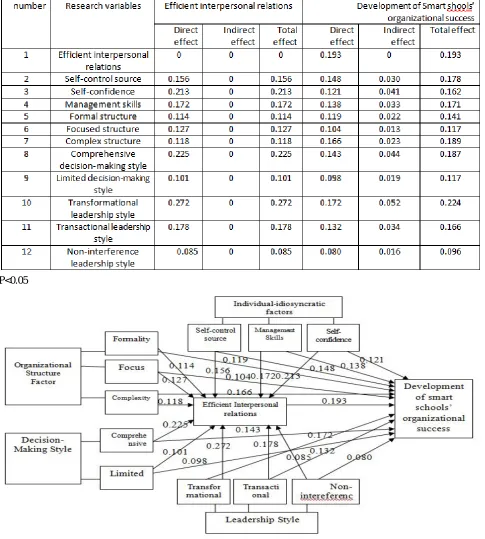
Table 3. Tested paths in the structural equation modeling
P<0.05
Figure1. the empirical model of the correlation between individual-idiosyncratic factors, organizational structure factors, decision-making style, leadership style and the development of the success of the principals of smart schools by the mediation
Volume 2, Issue 3, March 2013
Page 448
Table 4. Indexes of the goodness of the empirical model of the research
According to the results of the above table, GFI = 0.96, AGFI = 0.82, RMSEA = 0.237, and Chi Square (
2
x
) = 253.64which shows the goodness of the model.
5.
D
ISCUSSION ANDR
ESULTSVolume 2, Issue 3, March 2013
Page 449
R
EFERENCES[1]Tosi, M.(1993). “Participation in Management “, Public Management Instruction Cente.
[2]Dorbeheshti, A.(1996). “Stability and Competency in Management “, Management of Education Quarterly,4,No14, Summer,P.74.
[3]Ahmadi. M.(2002). “ Fondimental of Organization and Management”,Tehran,Publieshed by Virayesh.
[4]Shafiepour Motlagh, F., Yarmohammadian, M.(2011).”Designing a Model for Examining in perceived Responding Curriculums Developing “, Research in Curriculum Planning Quarterly 8year,Period 2,Spring & Summer.
[5]Kaiser, Kate M.; Ross, Jeanne W. (1994). “Technology management and control over resources: An application of strategic contingencies theory”. The Journal of High Technology Management Research. Vol. 5. Issue 2. (Autumn): Pages 299-321. [Online]. Available at: www.srlst.com.
[6]Quinn, Robert E.; Rohrbaugh, John. (1983). “A Spatial model of effectiveness criteria: toward a competing values approach to organizational analysis”. Management Science. 29. P. 363- 377.
[7]Kreitner, R. (1995).” Management (6th ed)”, Boston: Houghton Mifflin Company.
[8]Samari,E., Rasoolzadeh, B.( 2008).” The study of Efficiency Variables on increasing Achievement Motivation and Success Attainment in Coorporation’s Managers “, Public Management Quarterly,No 1,Full & Winter,PP33-50. [9]Aplin Jr., John C.; Schoderbek, Peter P.(1976).” Public Personnel Management”; Mar/Apr76, Vol. 5 Issue 2, p88. [10] Koontz, Harold, and Cyril O'Donnell. (1955).”Principles of Management: An Analysis of Managerial Functions”.
New York: McGraw-Hill Book Co.
[11]Davis, M. H., Capobianco, S., & Kraus, L. A. (2010). “Gender differences in responding to conflict in theworkplace: evidence from a large sample of working adults”. Sex Roles, 63, 500-514.http://dx.doi.org/10.1007/s11199-010-9828-9.
[12]Stogdill, R. M. (1969). “Leadership, Membership, Organization. Leadership”, Gibb, C.A., Baltimore, & Maryland (Ed): Penguin Books.
[13]Shafiepour Motlagh, F & Yarmohamadian, M.(2011), "The Organizational Climate,Job Involvment and Organizational Trust with Knowledge Management Culture: Educational Systems in iran", Eleven International conference on Knowledge, Culture and Change in Organizations, San Pablo CEU University, Madrid, Spain, 15-17 June
[14]Mirza Ghaderi, A.(2007).”The study of Relationship between Managerial styles( communicatal & Criteria of managers and Morale in Bokan city “,Tesis of Master of art.Tabriz Baranch, Islamic Azad Univer.
[15] House, R.J., Javidan, M., Hanges, P.J., & Dorfman, P.W. (2002)."Understanding Cultures & Implicit Leadership Theories Acrossthe Globe: An Introduction to Project GLOBE". Journal of World Business, 37, 3-10.
[16] Magliocca ,L . A. , Christakis , A. N (2001) , “Creating transforming leadership for organizational change: the cogniscope system approach, System Research and Behavioral Science , Vol 18 , pp 259- 277. sity.
[17]Stewart, G. L. and M. R. Barrick . (2000).” Team structure and performance: Assessing the mediating role of intrateam process and the moderating role of task type”. The Academy of Management Journal 43(2): 135-148. [18]Hedayati Katooli,H. (2010). “The study of Efficiency Variables on increasing Achievement Motivation and Success
Attainment in Coorporation’s Managers’ Golestan Province “, The first International Conference of Innovation and Management.
[19]Malekzadeh, GH., and Kiani Nejad , A.(2011).”The study of Individual Indicators influencing on New Technological Corporations (Case study; Khorason technology & Science Corporations “, Growth of Technology Quarterly ,Spring,(27),pp25-33.
[20] E'rabi , M, (2003). “Comparative Research “,Theran: Cultural researches office.
[21]Stanic, Ana; Caron, David D. (2004). "Removal of the head of a multilateral organization—independence of international organizations and their secretariats—political interference by member states in the operation of... ". American Journal of International Law; Oct., Vol. 98, Issue 4, p810-814, 5p.