M/G/1 Queue with Restricted availability
during Service interruption and Compulsory
Vacation of Deterministic time
S. Maragathasundari, B.Anandapriya, S.B.Gothaiammal,V.Gowri
Dept of Mathematics, Kalasalingam UniversityKrishnankoil, Virudhunagar District India
Abstract— This paper characterizes a non markovian queuing model in which arrival takes after a poisson procedure. All the arriving clients are rendered the administration following a general distribution. What's more, system may interrupt aimlessly because of different reasons. Immediately, the server gets into a repair procedure. Amid the season of breakdown, not all the arriving clients are permitted to join the framework. An idea of limited tolerability is connected over amid the service intrusion. After the consummation of the service, if there are no clients in the framework, the server experiences a mandatory vacation. At the season of get-away, support work are completed for the server which causes the system to keep running with superior along with insignificant intrusion. By the use of supplementary variable strategy, probability creating function of the queue size and the various execution measures are resolved. For the legitimization of the model, numerical delineation is completed.
Keywords - Non markovian queue, Restricted admissibility, compulsory vacation, deterministic time, probability generating function of the queue size.
1. INTRODUCTION
Queues with server get-away have increased significant significance in the zone of research lately. It has risen as an essential zone of concentrate promotion scientists has been investigating distinctive ideas of lining models with get-aways.. Further, dominant part of creators who examined a lining framework in which server takes an vacation of irregular length. However in numerous genuine circumstances, the server may enjoy a reprieve or an excursion of deterministic length as it occurs in a factories, enterprises, bank part, railroad stations etc. In order to minimize uncertainty of availability of a server, a fixed length vacation is more realistic in many queuing situations. Choi.et.al [1] studied a non marovian queue with multiple type of vacations and gated vacations.Madan[5] contemplated lining framework with deterministic vacations. A Non Markoviaan line with optional administrations has
been researched by Srinivasan and
Maragathasundari [9].. In some lining frameworks
with bunch landing there is a limitation to such an extent that not all groups are permitted to join the framework at untouched. This approach is named limited acceptability. Madan and choudhury [4] proposed a queuing framework with limited tolerability of arriving clumps and Bernoulli plan server excursions. Kavitha and Maragathasundari [3] looked into constrained mediocrity and discretionary sorts of repair in a Non Markovian line. Vignesh et.al [12] explored a Queuing procedure of confined admissibility. Madan and Abu-Rub [6,7] examined lining framework in light of thorough administration and deterministic excursion.
In this paper, we consider a non markovian line, in which the clients arrive one by one into the framework takes after a poisson dispersion. Administration is given by a solitary server with general distribution. After the fruition of the service , the server under goes a compulsory get-away of settled span. Furthermore, if the server breaks down, it goes into a repair procedure immediately. Amid the season of interference, if the client arrives the framework, not every one of the clients is permitted to enter the system. A confined acceptability is actualized in arriving clients amid the season of server separate. For this model, probability generating function of the queue estimate, system execution measures are inferred. Furthermore, numerical illustrations are exhibited to picturise the impact of parameters on framework execution measures.
2. MATHEMATICAL DESCRIPTION OF THE MODEL
We assume the following to describe the queuing model of our study.
Expecting that the enduring state exists, let 𝑆𝑛 𝑥 denote the steady state probability that are n(≥ 0) customers in the queue excluding one customer in Service and the elapsed service time of this customer is x. Next we define 𝑇𝑛 as a steady state
probability that there are n(≥ 0) customers in the queue and the server is on compulsory vacation. After the completion of the service, the server undergoes a compulsory vacation with probability
of j arrivals during the vacation period and therefore
𝑀𝑗 =
𝑒−𝜆𝑓 𝜆𝑓 𝑗
𝑗!
Finally let G denote the steady state probability that the system is empty.
Customers arrive at the system one by one in a compound poisson process with mean arrival rate𝜆. They are provided service on a first come first served basis. Service follows a general distribution. Let R(s) and r(s) be the distribution function and the density function of the service time S of a customer and let 𝜇 𝑥 be the conditional probability of completion of a service given that the elapsed time is x, so that 𝜇 𝑥 =
𝑟 𝑥
1−𝑅 𝑥 , 𝑟 𝑣 = 𝜇 𝑣 𝑒
− 𝜇 𝑥 𝑑𝑥0𝑣
We assume interruptions occur at random while serving the customers follows a poisson process with mean time rate 𝜂 > 0.Repair process is immediately implemented The repair time follows a general probability law with distribution function K(𝑥) and the density function 𝑘(𝑥),.Let 𝜓 (x) be the conditional probability of completion of repair and so
𝜓 x =1−𝐾 𝑣 𝑘 𝑣 , 𝑘 𝑣 = 𝜓 𝑣 𝑒− 𝜓 𝑥 𝑑𝑥0 𝑣
Furthermore, an idea of confined acceptability is presented amid the season of patch up. Let d > 0 be the probability that an arriving client will be permitted to join the framework amid the time of server revamp period.
3. STEADY STATE EQUATIONS
GOVERNING THE SYSTEM
Connecting states of the system at time t + dt with those at time t and then taking limit as t →∞ , we obtain the following set of steady state equations governing the system.
𝑑
𝑑𝑥𝑆𝑛 𝑥 + 𝜆 + 𝜂 + 𝜇(𝑥) 𝑆𝑛 𝑥 =
𝜆𝑆𝑛−1 𝑥 (1) 𝑑
𝑑𝑥𝑆0 𝑥 + 𝜆 + 𝜂 + 𝜇(𝑥) 𝑆0 𝑥 =
0 (2)
𝑇𝑛 =
𝛿 𝑆0∞ 𝑛 𝑥 𝜇 𝑥 𝑑𝑥 (3)
𝑑
𝑑𝑥𝐾𝑛 𝑥 + 𝜆 + 𝜓(𝑥) 𝐾𝑛 𝑥 = 𝜆 1 −
𝑑 𝑥 𝐾𝑛 𝑥 + 𝑑𝜆𝐾𝑛−1 𝑥 (4)
𝜆𝐺 =
𝑆0∞ 0 𝑥 𝜇 𝑥 𝑑𝑥 +
𝑇0𝑀0 (5)
𝑀𝑟 =
𝑒−𝜆𝑓 𝜆𝑓 𝑟
𝑟! (6)
The above set of equations is to be solved under the following boundary conditions at
𝑥 = 0 & for 𝑛 ≥ 1.
𝑆𝑛 0 = 𝑆0∞ 𝑛+1 𝑥 𝜇 𝑥 𝑑𝑥 + 𝑇0𝑀𝑛+1+ 𝑇1𝑀𝑛+
⋯ … . +𝑇𝑛𝑀0 (7)
𝑆0 0 = 𝑆0∞ 1 𝑥 𝜇 𝑥 𝑑𝑥 + 𝑇0𝑀1+ 𝑇1𝑀0+
𝜆𝐺 (8)
𝐾𝑛 0 =
𝜂 𝑆0∞ 𝑛 𝑥 𝑑𝑥 (9)
The Steady state Probability Generating functions
We define the following probability generating function
𝑆𝑞 𝑥, 𝑧 = ∞𝑛=0𝑆𝑛 𝑥 𝑍𝑛, 𝑆𝑞 𝑧 = ∞𝑛=0𝑆𝑛𝑍𝑛,
𝐾𝑞 𝑥, 𝑧 = ∞𝑛=0𝐾𝑛 𝑥 𝑍𝑛, 𝐾𝑞 𝑧 = ∞𝑛=0𝐾𝑛𝑍𝑛,
𝑇 𝑧 = ∞𝑛=0𝑇𝑛𝑍𝑛, 𝑍 ≤ 1
(10)
𝑀 𝑧 = 𝑀𝑛 𝑥 𝑍𝑛, = 𝑒
−𝜆𝑓 𝜆𝑓
𝑛!
∞
𝑛=0
∞
𝑛=0 𝑍𝑛 =
𝑒−𝜆𝑓 (1−𝑍)
𝑀′ 𝑧 = 𝑒−𝜆𝑓 (1−𝑍) 𝜆𝑓 𝑀′′ 𝑧 = 𝜆𝑓 2
On multiplying equations 1 & 2 by 𝑍𝑛 sum over 𝑛 & using (10), we have
𝑑
𝑑𝑥𝑆𝑞 𝑥, 𝑧 + 𝜆 − 𝜆𝑧 + 𝜂 + 𝜇(𝑥) 𝑆𝑞 𝑥, 𝑧 =
0 (11) Similarly
𝑑
𝑑𝑥𝐾𝑞 𝑥, 𝑧 + 𝜆𝑑 − 𝜆𝑧𝑑 + 𝜂 + 𝜓(𝑥) 𝐾𝑞 𝑥, 𝑧 =
0 (12)
𝑇𝑞 𝑧 =
𝛿 𝑆0∞ 𝑞 𝑥, 𝑧 𝜇 𝑥 𝑑𝑥 (13)
The same process has to be applied for the boundary conditions we get
𝑍𝑆𝑞 0, 𝑧 = 𝑆0∞ 𝑞 𝑥, 𝑧 𝜇 𝑥 𝑑𝑥 + 𝑇 𝑧 𝑀 𝑧 +
𝜆 𝑍 − 1 𝐺 +
𝐾0∞ 𝑞 𝑥, 𝑧 𝜓 𝑥 𝑑𝑥 (14)
𝐾𝑞 0, 𝑧 =
𝜂𝑧𝑆𝑞 𝑧 (14𝑎)
Next we integrate equations (11),(12),(13) between the limits 0 and 𝑥 and the resultant equations to be integrated with respect to 𝑥.
We obtain
𝑆𝑞 𝑧 =
𝑆𝑞 0, 𝑧 1−𝑅 𝜆−𝜆𝑧 +𝜂 𝜆−𝜆𝑧 +𝜂 (15)
𝐾𝑞 𝑧 =
𝐾𝑞 0, 𝑧 1−𝐾 𝜆𝑑 −𝜆𝑧𝑑 +𝜂 𝜆𝑑 −𝜆𝑧𝑑 (16)
Where 𝑆 𝜆 − 𝜆𝑧 + 𝜂 and 𝐾 𝜆𝑑 − 𝜆𝑧𝑑 are Laplace Stieltjes transform of the service time and repair time respectively.
To find 𝑆0∞ 𝑞 𝑥, 𝑧 𝜇 𝑥 𝑑𝑥
For this purpose, we multiply (15),(16) by
𝜇 𝑥 , 𝜓(𝑥) respectively and integrate them with respect to 𝑥 and use (b), we get
𝑆0∞ 𝑞 𝑥, 𝑧 𝜇 𝑥 𝑑𝑥 = 𝑆𝑞 0, 𝑧 𝑆 𝜆 − 𝜆𝑧 +
𝜂 (17)
𝐾0∞ 𝑞 𝑥, 𝑧 𝜓 𝑥 𝑑𝑥 = 𝐾𝑞 0, 𝑧 𝐾 𝜆𝑑 −
𝜆𝑧𝑑 (18)
𝑆𝑞 0, 𝑧 =
𝜆 𝑧−1 𝐺
𝜆−𝜆𝑧 +𝜂 𝑧−𝑆 𝜆−𝜆𝑧 +𝜂 1+𝛿𝑀 𝑧 −𝜂𝑧 𝐾 𝜆𝑑 −𝜆𝑧𝑑 1−𝑆 𝜆−𝜆𝑧 +𝜂 (19)
Hence,
𝑆𝑞 𝑧 =
𝜆 𝑧−1 𝐺
𝜆−𝜆𝑧 +𝜂 𝑧−𝑆 𝜆−𝜆𝑧 +𝜂 1+𝛿𝑀 𝑧 −𝜂𝑧 𝐾 𝜆𝑑 −𝜆𝑧𝑑 1−𝑆 𝜆−𝜆𝑧 +𝜂
×
1−𝑆 𝜆−𝜆𝑧 +𝜂 𝜆−𝜆𝑧 +𝜂
1−𝐾 𝜆𝑑 −𝜆𝑧𝑑 +𝜂
𝜆𝑑 −𝜆𝑧𝑑 (20)
𝐾𝑞 𝑧 =
𝜂𝑧 𝜆 𝑧−1 𝐺
1−𝑆 𝜆−𝜆𝑧 +𝜂 𝜆 −𝜆𝑧 +𝜂
𝜆−𝜆𝑧 +𝜂 𝑧−𝑆 𝜆−𝜆𝑧 +𝜂 1+𝛿𝑀 𝑧 −𝜂𝑧 𝐾 𝜆𝑑 −𝜆𝑧𝑑 1−𝑆 𝜆−𝜆𝑧 +𝜂
(21)
𝑇𝑞 𝑧 =
𝛿 𝜆 𝑧−1 𝐺𝑆 𝜆−𝜆𝑧 +𝜂 (22) 𝜆−𝜆𝑧 +𝜂 𝑧−𝑆 𝜆−𝜆𝑧 +𝜂 1+𝛿𝑀 𝑧 −𝜂𝑧 𝐾 𝜆𝑑 −𝜆𝑧𝑑 1−𝑆 𝜆−𝜆𝑧 +𝜂
4. IDLE TIME 𝝆 AND UTILIZATION
FACTOR 𝝆
In order to determine 𝑄, we proceed as follows
𝑆𝑞 1 = lim𝑧→1𝑆𝑞 𝑧 =00 form
Hence we apply L’Hopital’s rule
𝑆𝑞 1 =
1−𝑅 𝜂 𝐺𝜆
−𝜆 1−𝑆 𝜂 1+𝛿 +𝜂 1+𝜆𝑅 𝜂 1+𝛿 −𝑅 𝜂 𝜆𝛿𝑑 ′
−𝜂𝐾 𝜂 1−𝑅 𝜂 +𝜂𝐾 𝜂 𝜆𝑑 1−𝑅 𝜂 ′
23
Similarly
𝐾𝑞 1 =
𝜂𝐺 1−𝑅 𝜂
−𝜆 1−𝑅 𝜂 1+𝛿 +𝜂 1+𝜆𝑅 𝜂 1+𝛿 −𝑅 𝜂 𝜆𝛿𝑑 ′
−𝜂𝐾 𝜂 1−𝑅 𝜂 +𝜂𝐾 𝜂 𝜆𝑑 1−𝑅 𝜂 ′
(24)
𝑇𝑞(1) =
𝜂𝛿𝐺 𝑅 𝜂
−𝜆 1−𝑅 𝜂 1+𝛿 +𝜂 1+𝜆𝑅 𝜂 1+𝛿 −𝑅 𝜂 𝜆𝛿𝑑 ′
−𝜂𝐾 𝜂 1−𝑅 𝜂 +𝜂𝐾 𝜂 𝜆𝑑 1−𝑅 𝜂 ′
(25)
IDLE TIME AND UTILIZATION FACTOR Now we use the normalizing condition to obtain 𝐺
𝑆𝑞 1 + 𝐾𝑞 1 + 𝑇𝑞 1 + 𝐺 =
1 (26)
Therefore Substituting (23,(24),(25) in (26) we get
𝐺 =
−𝜆 1−𝑅 𝜂 1+𝛿 +𝜂 1+𝜆𝑅 𝜂 1+𝛿 −𝑅 𝜂 𝜆𝛿𝑑 ′
−𝜂𝐾 𝜂 1−𝑅 𝜂 +𝜂𝐾 𝜂 𝜆𝑑 1−𝑅 𝜂 ′
−𝜆 1−𝑅 𝜂 1+𝛿 +𝜂 1+𝜆𝑅 𝜂 1+𝛿 −𝑅 𝜂 𝜆𝛿𝑑 ′
−𝜂𝐾 𝜂 1−𝑅 𝜂 +𝜂𝐾 𝜂 𝜆𝑑 1−𝑅 𝜂 +( 1−𝑅 𝜂 𝐺𝜆+𝜂𝐺 1−𝑅 𝜂 +𝜂𝛿𝐺 𝑅 𝜂 ′
(27)
The Utilization factor 𝜌 is obtained from 𝜌 = 1 −
𝐺 < 1 which is the stability condition under which the steady state exists.
Next we substitute the value of 𝐺 in equations (20)(21) and (22). Thus 𝐾𝑞 𝑧 , 𝑇𝑞(𝑧) and 𝑆𝑞(𝑧) are
completely determined.
5. STEADY STATE AVERAGE NUMBER OF CUSTOMERS AND AVERAGE WAITING TIME IN THE QUEUE AS WELL AS IN THE SYSTEM
We define 𝐷𝑞(𝑧) as the steady state probability
generating function for the number of customers in the queue. So we have
𝐷𝑞 𝑧 = 𝑆𝑞 𝑧 + 𝐾𝑞 𝑧 + 𝑇𝑞 𝑧 = 𝑁(𝑧)
𝐷(𝑧)
Let 𝐿𝑞 denote the mean number of customers in the queue under the following steady state.
𝐿𝑞=𝑑𝑧𝑑 𝐷𝑞 𝑧 𝑧=1
But 𝐷𝑞 𝑧 =00 form at 𝑧 = 1
Therefore,
𝐿𝑞=
lim𝑧→1𝑑𝑧𝑑 𝑃𝑞 𝑧 =
lim
𝑧→1
𝐷′ 𝑧 𝑁′′ 𝑧 −𝑁′ 𝑧 𝐷′′(𝑧)
2 𝐷′(𝑧) 2 (28)
=𝐷′ 1 𝑁′′ 1 −𝑁′ 1 𝐷′′(1)
2 𝐷′(1) 2
Where primes and double primes indicates single and double differentiation with respect to 𝑧 respectively.
Here,
𝑁′ 1 =
𝜆 1 − 𝑆 𝜂 1 + 𝛿𝜂 (29)
𝑁′′ 1 =
2𝜆 𝑆 𝜂 1 − 𝛿𝜂 + 𝜆2𝑆′ 𝜂 (30)
𝐷′ 1 =
−𝜆 1 + 𝜂 1 − 𝑆 𝜂 + 𝜂 1 + 𝜆𝑆 𝜂 1 + 𝛿 ′ −𝑆 𝜂 𝛿𝜆𝑓 −𝜂 1 − 𝑆 𝜂 − 𝜂𝐸(𝐾)𝜆𝑑
1 − 𝑆 𝜂 (31)
𝐷′′ 1 =
−2𝜆 1 + 𝑆 𝜂 𝜆 1 + 𝜂 − 𝑆 𝜂 𝛿𝜆𝑑 + 𝜂 −𝑆′ ′′ 𝜂 𝜆2 1 + 𝛿 + 2𝑆 𝜂 𝜆′ 2𝛿𝑓 − 𝑆 𝜂 𝛿𝜆𝑓2 − 2𝜂𝜆𝑆′ 𝜂 + 2𝜂𝐸 𝑘 𝜆𝑑 1 − 𝑆 𝜂 − 𝜂𝐸 𝐾2 𝜆𝑑2 1 − 𝑆 𝜂 +
2𝜂𝐸 𝐾 𝜆2𝑑𝑆 𝜂 ′ (32)
Substituting (29) in (28), we get 𝐿𝑞 in closed form Using 𝐿𝑞 obtained in (29) into Little’s formulae we
can obtain the following
The steady state average number of customer in the system 𝐿 = 𝐿𝑞+ 𝜌
The Steady state average waiting time in the queue
𝑊𝑞= 𝐿𝑞
𝜆
The Steady state average waiting time in the system
𝑊 =𝐿𝜆
6. NUMERICAL ILLUSTRATION
For the purpose of numerical illustration we assume that the service time and vacation time are exponentially distributed. We choose the following arbitrary values
𝛿 𝜂 G 𝜌 𝐿𝑞 𝐿 𝑊𝑞 𝑊
0.5 3 0.6800 0.3200 2.800 3.120 0.9333 1.040
4 0.5231 0.4769 5.400 5.876 1.800 1.959
5 0.3680 0.6320 12.270 12.902 4.090 4.300
0.6 3 0.6735 0.3265 2.469 2.796 0.823 0.932
4 0.6083 0.3917 3.889 4281 1.296 1.427
5 0.5385 0.4615 6.679 7.141 2.226 2.380
0.7 3 0.6694 0.3306 2.150 2.481 0.7167 0.827
4 0.6181 0.3819 3.159 3.541 1.053 1.180
5 0.5677 0.4323 3.910 4.342 1.303 1.447
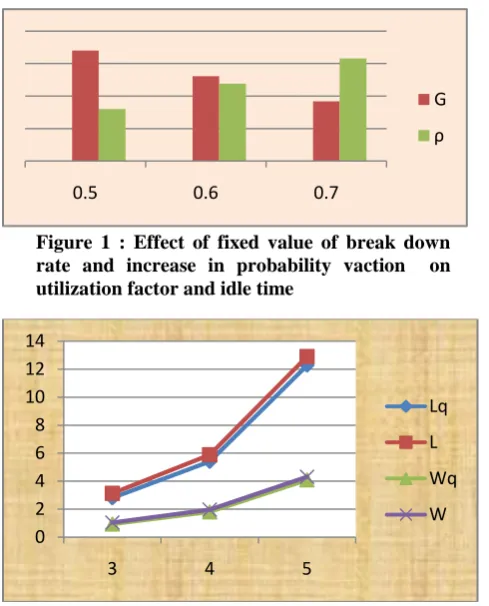
All the values are chosen such that the steady state condition is satisfied.The above table gives the computed values of various states of the server, the proportion of idle time, the utilization factor,number of customers in the queue, number of customers in the system, waiting time in the queue and waiting time in the system.The values clearly show that as long as we increase 𝛿 for a constant arrival of break down, the utilization factor increases while the idle time of the server gets decreases.In addition the other performance measures also gets decreased.More over, for a constant value of 𝛿,if the arrival of break down increases, then idle time reduces and hence the utilization factor increases.Also the length of the queue and all the other execution measures gets increased. All the values are as expected.
Figure 1 : Effect of fixed value of break down rate and increase in probability vaction on utilization factor and idle time
Figure 2: Effect of constant probability vacation and increase in break down rate on various performance measures
7. CONCLUSION
In this examination, we have contemplated a non markovian queue with mandatory vacation of deterministic time and restricted suitability amid benefit interference. The expository outcomes approved with the assistance of numerical representations might be helpful in different genuine circumstances to outline the outputs.The probability generating function of the queue estimate is resolved utilizing supplementary variable method.The other queuing execution measures are additionally obtained.As a future work, stand by server, phases of administration, various vacations can be actualized in this examination.
REFERENCES
[1] Choi. B.D., Kim. B. and Choi. S.H., (2003), “A M/G/1 queue with multiple types of feedback, gated vacations and
FCFS policy”, Computers and Operations Research,
Vol.30, No.9, pp.1289-1309.
[2] Choudhury, G., (2002), “A batch arrival queue with a
vacation time under single vacation policy”, Computers
and Operations Research, Vol.29, No.14, pp.1941-1955.
[3] Kavitha. K and Maragathasundari.S (2012),“Analysis of Non Markovian queue with restricted admissibility and
optional types of repair”, International journal of
scientific research and management studies, Vol.2, No.5, pp.244-252
[4] Madan. K.C. and Chodhury. G (2004), “An M[x]/G/1
queue with Bernoulli vacation schedule under restricted
admissibility policy”,Sankhaya,Vol.66, pp.172-193.
[5] Madan. K.C (2000), “An M/G/1 queue with second
optional service”, Queueing Systems Vol.34, pp.37-46.
[6] Madan Kailash C. and Abu-Reb, Adel:On a single server queue with optional phase type server vacations based on exhaustive deterministi service with a single vacation
policy,Applied Math and computation,
(2004),Vol.149,723-734
[7] Madan Kailash C. and Abu-Reb, Adel:On a single server queue with phase type service and phase type server vacations based on exhaustive deterministic service under
a single vacation policy,Journal of applied statistical
science,(2005),Vol.15,No.1,49-66
[8] Maragathasundari.S and Mirian cathy joy (2017), Queueing model of optional type of services with service
stoppage and revamp process in web hosting (2017), Int. J.
Knowledge Management in Tourism and Hospitality, Vol. 1, No. 2, 2017 241Copyright © 2017 Inderscience Enterprises Ltd
[9] Srinivasan. S and Maragathasundari.S (2017), “Optional services in a Non Markovian Queue”,
International Journal of Operational Research, Vol.28, No.1, pp.1-17.
[10] Sowmiah. S and Maragathasundari. S (2015), “M/G/1 queueing system with extended vacation, service
interruption, Delay time and stages in repair”, Journal of
Computer and Mathematical Sciences, Vol.6 (7), 363-370, July 2015
[11] SuthersanP. and MaragathasundariS.(2017), “), Co axian – 2 general queuing Model with Restricted Admissibility,
0.5 0.6 0.7
G
ρ
0 2 4 6 8 10 12 14
3 4 5
Lq
L
Wq
International journal of scientific research in science ,Engineering and technology,| Volume 3 | Issue 6 | Print ISSN: 2395-1990 | Online ISSN : 2394-4099
[12] Vignesh and Maragathasundari.S (2017) “Analysis of Non Markovian Single server Batch arrival queueing system of compulsory three stages of service and fourth
optional stage service service interruptions and
deterministic server vacations, International Journal of