http://dx.doi.org/10.22161/ijeab/4.1.13 ISSN: 2456-1878
Cassava Processor’s
Awareness of Improved
Processing Technologies in Oyo State
Olayemi, O.O.
1; Ajanaku, A.O; Ewebiyi, I.O.
21Department of Agricultural Extension and Management, Federal College of Forestry, Ibadan, Oyo State. P.M.B.5087 [email protected] 08054035443, [email protected] m 07035071223
2Department of Agricultural Science (Agricultural Extension and Rural development Unit), Tai-Solarin University of Education,
Ijagun, Ijebu-Ode, Ogun State. [email protected] 08055210068
Abstract—The cassava production is most carried out by smallholder farmers in the rural areas using low -level production techniques which have left them with production of cassava tubers without much value addition. Therefore cassava processors’ awareness of improved processing technologies in Oyo State was investigated.
Simple random approach was employed through
questionnaire and interviews to collect information from 176 Cassava processors. Descriptive and inferential statistics such as frequency counts, percentages, mean, Chi -square were used in data analysis at 0.05 l evel of significance.
Results of analysis revealed that majority (77 .2%) of the respondents fell within the age range of 21 years to 50 years with mean age of 41.23 and greater population of females (75.6%) than the males (24.4%). Over 45.5% had secondary and below as their educational qualification with most (75.6%) married, with fairly large household size 4-6 persons.
The respondents’ level of awareness of improved
processing technologies among most need respondents low (54.5%) and this may accounted for low level of utilization of improved processing technologies among majority (56.8%) of the respondents. Chi-square analysis revealed that, among socio-economic characteristics of the respondents, religion(x2= 6.805, p= 0.033), educational qualification (x2 = 10.572, p= 0.032), mode of processing (x 2 = 14.015, p= 0.001) and mode of Labour (x2=11.960,
p=0.003) were significantly related to respondents’
awareness of improved processing technologies. The result revealed clearly that respondents’ awareness of improved processing technologies does not depend on marital status, sex, household size and experience.
It is therefore recommended that Government and NGO’s should encourage extension agents by giving them motivation as at when due to improve their servi ces of dissemination of information to the cassava processors on
awareness of improved processing technologies toward enhancing higher productivity, income and better standard of living of the respondents in the study area.
Keywords— Cassava processors, awareness, Improved processing technologies.
I. INTRODUCTION
In the area of cassava production, the recent Agricultural Transformation Programme of the Federal Government which has facilitated the establishment of Cassava processing plants, exportation of Cas sava chips to countries like China has led to increase in the interest of the rural famers including women to increase their level of Cassava production and processing. In the domestic parlance the rural women process ing cassava into various products such as cassava flour, chips, and starch among other products. In Nigeria, women cassava utilizers constitute more than 60% of the adult population resident in the rural areas (Odebode, 1997). However, their traditional contribution to agricultural production has been rendered inefficient by the crude and inappropriate form of agricultural technologies frequently used (Olawoye, 1988), the result is a relatively low agricultural productivity, which is inversely proportional to the enormous labour intensive input. It is against this backdrop that this research investig ated the
extent of the cassava processors’ awareness of improved processing technologies in Oyo State.
Specific objectives
The specific objectives of this study include to:
i. Identify socio-economic characteristics of the cassava processors in Oyo state.
ii. Determine the level of awareness of improved processing technology by cassava processors in Oyo State.
http://dx.doi.org/10.22161/ijeab/4.1.13 ISSN: 2456-1878 Hypothesis of the study
The hypothesis stated in the null form is tested:
Ho1 – There is no significant relationship between awareness of the respondents and their utilization of improved processing technology in the study area.
II. MATERIALS AND METHODS
The study was carried out in Oyo state, which is one of the six states in south west Nigeria. The economy of the state is based on the agriculture and the major occupation of the rural people is farming. The climate in the state favour the cultivation of crops like maize, yam, cassava, millet, rice, plantains, cocoa, oil-palm, cashew etc. They engage in other activities such as transport operation, blacksmithing, tailoring, and carpentry and so on. The state is homogenous and comprises the Oyos, the Ibadans and the Ibarapas, all belonging to the Yoruba family and speaking the s ame Yoruba language. People within and outside the country trade and settle in the urban areas. The capital, Ibadan is reputed to be the largest city in African, south of the sah ara.
Sampling Procedure and Sample size
A Multi-stage sampling procedure was used to select respondents for the study. Random selection of 50% of the two ADP zones (Ogbomoso and Ibadan/Ibarapa), Purposive sampling Technique was used to select Local Government and Communities that are predominantly noted for cassava production and processing from the selected two zones: Ogbomoso South Local government ( Ogbomoso zone) and Ibarapa East Local government (Ibadan/Ibarapa zone). List of registered cassava processors in selected communities was collected from the Department of Agric. and Health at the Local Government Headquarters in Arowomole and Eruwa respectively. 50% of registered Cassava Processors in selected communities was randomly selected and this gives a total of one hundred and seventy six (176) respondents that was used for the study.
Analysis of data
Data Collected were subjected to descriptive and inferential Statistical analysis using Statistical Package for the Social Sciences (SPSS). Descriptive statistical tools used included frequency counts, mean and percentage while inferential statistical used is Chi-square.
III. RESULTS AND DISCUSSION
Socio-economic characteristics of respondents
The mean age of all the respondents was 41.23. This implies that most of the respondents are in their active ages and this may urge them favourably to utilize improved processing technologies for their cassava processing.
This finding is in line with that of Akinbile (2007) and Adedeji et al (2013) who reported a mean age of 41.42 with age-range (20-50years) that constitutes the active workforce of the population.
http://dx.doi.org/10.22161/ijeab/4.1.13 ISSN: 2456-1878 Table.1: Socio-economic characteristics of the respondents
Variable Frequency Percentage Mean Age (years)
11-20 3 1.7 41.23 21-30 27 15.3
31-40 65 36.9 41-50 44 25.0 51-60 28 15.9 Above 60 9 5.1
Sex
Male 43 24.4 Female 133 75.6
Religion
Christian 107 60.8 Muslim 64 36.4 Tradition 5 2.8
Marital status
Single 16 9.1 Married 133 75.6 Divorce 4 2.3 Separated 7 4.0 Widowed 16 9.1
Educational background
No formal 20 11.4 Vocational education 2 1.1 Primary school 62 35.2 Secondary school 80 45.5 Tertiary school 12 6.8
Household size
1-3 41 23.3 4-6 102 58.0 7-9 28 15.9 10-12 1 0.6 No states 4 2.3
Year of experience
1-5 52 29.5 6-10 58 33.0 11-15 31 17.6 16-20 31 17.6 21-25 4 2.3
Method of processing
Traditional 37 21.0 Modern 95 54.0 Traditional & modern 44 25.0
Income earn (#)
http://dx.doi.org/10.22161/ijeab/4.1.13 ISSN: 2456-1878
Not stated 1 0.6
Total 176 100.0
Source: Field survey, 2017.
Respondents’ awareness on improved processing technologies
By categorization of level of awareness in table 2b showed that the level of awareness of improved processing technologies is low (54.5%) and high (45.5%) in the study area. The implication of this is that those who claimed to be
awared got the information through educational backgroun d or exposure to social network. This is in line with Bamikole et al (2016) that reported that apart from grater, presser, fryer machines that have their awareness rate above 50% awareness rates of processing is low.
Table.2a: Respondents’ awareness on Improved Processing Technologies
Improve d processing technologies Aware Not Aware F % F %
1. Mechanical grater 161 91.5 15 8.5 2. Screw Press hydraulic jack 160 90.9 16 9.1 3. Motorized Peeler 67 38.1 109 61.9 4. Granulator 128 72.7 48 27.3 5. Kiln Dryer/Drum Dryer 154 87.5 22 12.5 6. Improved Pulverized 66 37.5 110 62.5 7. Sifter 81 46.0 95 54.0 8. Aluminum Fermentation tank 72 40.9 104 59.1 9. Hammer mill 157 89.2 19 10.8 10. Washing Machine 81 46.0 95 54.0 11. Dewatering 123 69.9 53 30.1 12. Rotating Sieve 121 68.8 55 31.3 Source: Field survey, 2017.
Table.2b: Level of awareness
Category f % Mean SD Minimum Maximum
Low 96 54.5 7.76 3.62 0.00 12.00
High 80 45.5
Source: Field survey, 2017.
Respondents’ attitude on the improved processing technologies.
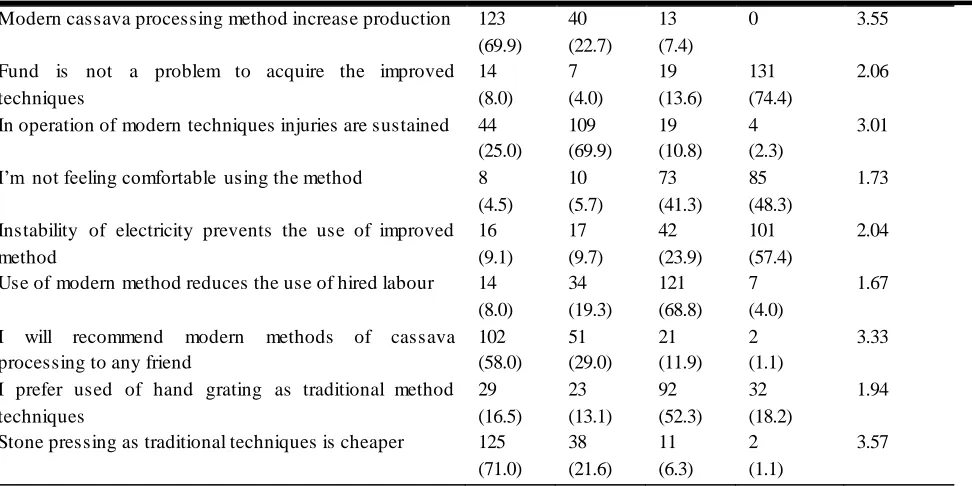
Table 3b revealed that (56.8%) of the respondents had positive attitude to utilize improved processing technologies while (43.2%) had positive attitude towards utilization of improved processing technologies. Also table 3a showed that (69.9%, 66.5% and 58.0%) agreed strongly to modern
cassava processing method increase production, modern processing save time and also ready to recommend the techniques to their friends respectively. The implication is that the respondents may eager to utilize the improved processing technologies due to the benefits cum the improvement of their standard of livings.
Table.3a: Respondents Attitude on the improved Processing Technologies (N= 176)
Attitudinal Statement SA A D SD Mean
Modern cassava processing method save time 117 (66.5)
46 (26.1)
12 (6.8)
1 (0.6)
3.52 Spare parts of improved methods are not readily
available
4 (2.3)
35 (19.9)
81 (46.0)
56 (31.8)
http://dx.doi.org/10.22161/ijeab/4.1.13 ISSN: 2456-1878
Modern cassava processing method increase production 123 (69.9)
40 (22.7)
13 (7.4)
0 3.55 Fund is not a problem to acquire the improved
techniques 14 (8.0) 7 (4.0) 19 (13.6) 131 (74.4) 2.06 In operation of modern techniques injuries are sustained 44
(25.0) 109 (69.9) 19 (10.8) 4 (2.3) 3.01
I’m not feeling comfortable using the method 8
(4.5) 10 (5.7) 73 (41.3) 85 (48.3) 1.73 Instability of electricity prevents the use of improved
method 16 (9.1) 17 (9.7) 42 (23.9) 101 (57.4) 2.04 Use of modern method reduces the use of hired labour 14
(8.0) 34 (19.3) 121 (68.8) 7 (4.0) 1.67 I will recommend modern methods of cassava
processing to any friend
102 (58.0) 51 (29.0) 21 (11.9) 2 (1.1) 3.33 I prefer used of hand grating as traditional method
techniques 29 (16.5) 23 (13.1) 92 (52.3) 32 (18.2) 1.94 Stone pressing as traditional techniques is cheaper 125
(71.0) 38 (21.6) 11 (6.3) 2 (1.1) 3.57 Source: Field survey, 2017.
Table 3b: Categorization of respondents by their attitude
Category F % Mean SD Minimum Maximum
Unfavorable 76 43.2 28.20 5.03 11.00 41.00
Favorable 100 56.8
Source: Field survey, 2017.
Hypothesis: test of relationship between awareness of the respondents and their utilization of improved processing technologies.
This hypothesis was tested with the aid of PPMC. The result of the analysis in Table 4 revealed that there is a
significant positive relationship between awareness (r=0.524, P= 0.000) of the respondents and their utilization of improved processing technologies This implies that the more the respondents aware of improved processing technologies, the more they will utilize it.
Table 4: Pearson Product Moment Correlation (PPMC) analysis between Awareness of improved processing technologies and their utilization
Variable r p Decision Awareness 0.524 0.000 Significant ** Correlation is significant at the 0.01 level (2- tailed)
IV. CONCLUSION AND RECOMMENDATIONS
More females than males that married with secondary education alternative involves in cassava processing in the study area. Awareness of the respondents of improved processing technologies was low.
The study thus, concludes that
Based on the empirical findings of this study, the following recommendations are made;
Government should create or build factory or industry where improved processing technologies would be
http://dx.doi.org/10.22161/ijeab/4.1.13 ISSN: 2456-1878 REFERENCES
[1] Adedeji, T.O., Nosiru, M.O., Akinsulu, A.A., Ewebiyi, I.O., Abiona, B.G. and Jimoh, T.S. 2013. Adoption of New Rice for African (NERICA) technology in Ogun State, Nigeria.Journal of Development and Agricultural Economic. 5(9): 365-371. Sept. 2013. [2] Akinbile, L. 2007. Social impact of limestone
exploitation in Yewa North Local Government of Ogun State.Pak istan journal of social science. 1:107-111
[3] Ewebiyi, I.O. and Arimi, K. 2013. Gender differentials in adoption of improved cassava production Technology in Ogun State.Journal of Agricultural Science and Policy research Vol.3 (2) 1-10.
[4] Oluwatayo, I.B. and Aliyu, A.A. 2007. Gender differentials in Information Communication Technologies (ICTs) Usage in Rural Nigeria: Case of Atisbo Local Government Area of Oyo State. Nigerian Journal of Rural Sociology. 7.1&2:64.
[5] Torimori, D.O., Kolawole, O.D and Adeogun, M.O.