Volume 2, Issue 9, September 2013
Page 291
Abstract
This paper provides a way to deal with the presentation faults of the traditional linear file format for data sets from databases, especially in database clustering. A better approach called extensive data set that allow attributes of an object to have multiple values and it is shown how enhanced extensive data set can represent structural information in databases for clustering. Analyzing the problems of linear file format this extensive data set proves to be better. A unified similarity measure framework is proposed for single valued and multivalued attributes.
Keywords:clustering, multi-valued data, cardinality, similarity measures.
1.
I
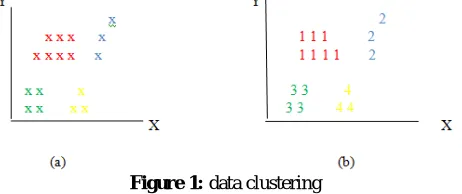
NTRODUCTIONClustering is the unsupervised classification of patterns (observations, data items, or feature vectors) into groups (clusters) an example of clustering is shown below.
Figure 1: data clustering
The input patterns are shown in figure 1 (a) and the desired clusters are shown in figure 1 (b). Here points belonging to same cluster are given in the same label. Clustering is useful in several exploratory pattern-analysis,grouping,decision-making and machine-learning situations including data mining,document retrieval,image segmentation and pattern classification.The stages in clustering are shown in the below figure(2).
Figure 2: stages in clustering
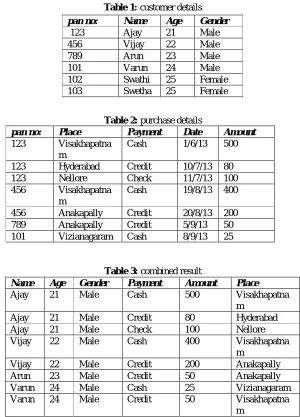
Data mining tools and data analysis tools such as statistical analysis tools, clustering tools, and inductive learning tools assume that data sets to be analyzed are represented as a table in which an object is portrait by attributes that have a single value. Many of these data analysis approaches are applied to data sets that have been taken from databases. However a database may consists of many relations or related data sets and the cardinality ratio of relations between datasets in such a database are frequently 1:k or k:L which leads to problems when data that is taken from database have represented in to a linear file in order to apply analysis tools and mining tools. Linear file format is not appropriate for representing similar information that is found in databases. For instance, if we have a relational database as in table1 and table2 that consists of customer and purchase relations that save data of a customer purchase and we list customer that
An Enhanced Technique for Database
Clustering using an Extensive Data set for
Multi-valued Attributes
Mugada Swathi1, Khandapu Usha Rani2, Nitta Moni Sudeep Chand3, Mugada Swetha4 and Danthuluri Manisri Madhuri5
1Assistant professor, LENDI INSTITUTE OF ENGINEERING AND TECHNOLOGY, Vizianagaram, INDIA 2Assistant professor, LENDI INSTITUTE OF ENGINEERING AND TECHNOLOGY, Vizianagaram, INDIA 3Assistant professor, AVANTHI INSTITUTE OF ENGINEERING AND TECHNOLOGY, Tagarapuvalasa, INDIA
4
Volume 2, Issue 9, September 2013
Page 292
occur in the database in to many groups that have same characteristics.It is evident that the attributes found in the customer relation alone are not enough, because many important features of customer are found in other related relations such as the purchase relation that save the purchase history for persons. This emerges the question how the customer and purchase table can be joined in to an individual single linear file so that old clustering or machine learning algorithm can be applied to it.
Table 1: customer details
Table 2: purchase details
pan no: Place Payment Date Amount
123 Visakhapatna m
Cash 1/6/13 500
123 Hyderabad Credit 10/7/13 80
123 Nellore Check 11/7/13 100
456 Visakhapatna m
Cash 19/8/13 400
456 Anakapally Credit 20/8/13 200 789 Anakapally Credit 5/9/13 50 101 Vizianagaram Cash 8/9/13 25
Table 3: combined result
Some systems like ribeiro95 [1] and Thompson 91[5] tried to identify knowledge directly from domains which are structured. In order to generate a linear file the most straight forward approach is to join related tables. The combined result table depicts the results of the natural join operation for the two relations in purchase and customer tables. Using the pan card number as the join attribute the object Vijay in the customer relation is represented using two different tuples in the combined table. The issue with this representation is that several clustering algorithms or machine learning tools would consider each tuple as a different object i.e., they would depict the table of 8 customer objects rather than 4 unique customer objects. So, therefore this representation between a structured database and linear file format assumed by many data analysis ways seems to be overloaded. This paper introduces a datamining framework and a knowledge discovery to deal with this drawback of the old linear file representations and we finally focus on the issues of structured database clustering and discovery of a set of queries that describe the features of objects in each cluster.
2.
E
XTENSIVE DATASETSConsidering the problem mentioned in the above section has drove to a better representation procedure that is needed to represent information for objects that are co-related with other objects. One easy procedure to deal with this issue is to
pan no: Name Age Gender
123 Ajay 21 Male
456 Vijay 22 Male
789 Arun 23 Male
101 Varun 24 Male
102 Swathi 25 Female
103 Swetha 25 Female
Name Age Gender Payment Amount Place
Ajay 21 Male Cash 500 Visakhapatna
m
Ajay 21 Male Credit 80 Hyderabad
Ajay 21 Male Check 100 Nellore
Vijay 22 Male Cash 400 Visakhapatna
m
Vijay 22 Male Credit 200 Anakapally
Arun 23 Male Credit 50 Anakapally
Varun 24 Male Cash 25 Vizianagaram
Varun 24 Male Credit 50 Visakhapatna
Volume 2, Issue 9, September 2013
Page 293
join all the related objects into a single object by applying aggregate operations i.e., to group all the related objects.to replace related values by a single value for the object. The issue with this approach is that the user has to make decisions as to which aggregate function to use before only and another issue by applying the aggregate function frequently important information is lost. For example how many purchases a customer has made or what the maximum purchase of a customer was. Clustering which is a data analysis technique can benefit significantly considering group similarities and set.
We introduce another technique that allows attributes to be multivalued for an object to deal with this issue. So we mentioned this generalization of the linear file format as extensive dataset. In this extensive dataset characterization of objects are done through attributes that have single value or basket of values. A basket allows for duplicate elements but set does not provide duplication. The value elements must be in the same domain incase of duplicates
Let us see an example the basket {100,100,400,400,200} for amount attribute might signify five purchases 100,100,200,400,400 rupees by a person.Table4 depicts extensive data sets that has been built from the two relations mentioned in the table3. In this table4 p.type, p.amount and p.place which are related attributes and are also called structured attributes and can have set of values. The related object group is mixed in to unique object with a set of values for similar attributes. We represent set of values {500, 80,200} i.e., we use curly bracket and also null to resemble empty sets and we just give its element, if the set has a single value.
Table 4: A transformed table with a basket of attributes
Our approach to discover useful set of queries through clustering databases faces the below problems. How to identify a set of queries that explain the features of objects in each cluster.
How to use datamining techniques to cope up with multi-valued attributes.
Most similarity- based clustering algorithms which are existed fail to deal with this dataset representation because similarity metrics deal with an object with a single-value for an attribute but not a set of values. So, we need an approach to measure group similarity for clustering and identify useful set of queries for each cluster.
3.
G
ROUPS
IMILARITYM
EASURESWe introduce existing similarity measures based on qualitative type, quantitative type and categorize types of attributes into these types and generalize those to cope with effective datasets with mixed types
3.1 Quantitative type
One way to measure inter-group distance is to substitute group means for the mth attribute of an object in the formulae for inter-object measures such as Euclidean distance (Everitt 93). The problem with this approach is that it does not consider cardinality of quantitative elements in a group. Another approach called group average can be used to measure inter-group similarity. The inter-group similarity is measured by taking the average of all the inter-object measure for those pair of objects. Here each pair of objects is in different groups.
The average dissimilarity between group X and Y can be defined as: n
d(X,Y) = d(x,y)m n , m1
Where n is the total number of object pairs, d(X,Y)m is the dissimilarity measure for the m th
pair of objects x and y,xϵx,yϵy. Here average for every pair of similarity or the average for a subset of pairs of similarity is considered for computing group similarity based on group average. Let us see an example, suppose we have a pair of value set :{ 40, 10} :{ 8, 30} and use city block measure as a distant function. One way to compute group average from corresponding pair of distance(│10-8│+│40-30│)/2 after sorting each value set and the other way is to compute from every possible pairs (│40-8│+│40-30│+│10-8│+│10-30│)/4. For example the total difference of every possible pair for value sets {2, 5} and {6, 3} is 8 and the sorted individual value difference for the same set {2, 5} and {3, 6} is 2. From this example computing similarity after sorting the value sets may result in better similarity index between multi-valued objects. This approach considers both quantitative variance and cardinality of element in a group in computing similarity between to group of values.
Name Age p.type Gender p.place p.amount
Ajay 21 {cash,credit,check} Male {Visakhapatnam,Hyderabad,Nellore }
{500,80,100}
Vijay 22 {cash,credit} Male {Visakhapatnam,anakapally} {400,200}
Arun 23 Credit Male Anakapally 50
Volume 2, Issue 9, September 2013
Page 294
3.2 Qualitative typeTversky (1977) model [6] such as ratio model and contrast model proposed set-theoretical similarity models. Tversky considers objects as set of features instead of geometric points in a metric space. For example let x and y be two objects and X and Y denote the set of features associated with the objects x and y respectively. Tversky contrast model proposed the following family of similarity measures.
S(x, y) =θf (X∩Y)- αf(X-Y)-βf(Y-X),
For some θ, α, β≥0; f is usually the cardinality of the set. Here in contrast model, the similarity of a pair of objects is expressed as a linear combination of the measure of the common and the distinctive features. This model shows similarities between objects as a weighted difference of the measure. The ratio model shows the family of similarity measures
S(x, y) =f (X∩Y)/[(X∩Y)+αf(X-Y)+βf(Y-X)]
Here the similarity value is normalized to a value range of 0 and 1 for the qualitative type of multivalued case. Also α, β≥0. Similarity can be used since we deal this case as an attribute for an object and having group feature property (example: set of values).
4.
A UNIFIED SIMILARITY MEASURE
Gower (1971) [8] proposed a similarity measure and is particularly useful for such data sets that contain a variety of attribute types.It is defined as follows
M M
S(a,b) = wi
si (ai , bi ) / wi i 1 i 1
The normalized similarity index in the range 0 and 1 is shown by s(ai ,bi) and is measured by the function si for ith attribute and wi as weight for the ith attribute between objects a and b.
Extending Gower’s similarity function to measure similarity for extensive datasets with mixed-types. Gower’s function consists of two sub functions, similarity for q number of quantitative attributes and similarity for l number of qualitative attributes. The extensive similarity measure is represented as follows:
Where m = l + q. The functions, sl(a,b) and sq(a,b) are similarity functions for qualitative attributes and quantitative attributes respectively. User makes the choice of specific similarity measures and proper weights based on attribute types and applications for each similarity measure. For example, we can use the Tversky’s set similarity measure for the l number of qualitative attributes for the similarity function, sl(a,b). We can use the group similarity function for the q number of quantitative attributes for the similarity function, sq(a,b). The quantitative type of multi-valued objects has additional property, group feature property including cardinality information as well as quantitative property. Therefore, sq(a,b) may consist of two sub-functions to measure group features and group quantity, sq(a,b) = sl(a,b) + sg(a,b), where the functions
sl(a,b) and sg(a,b) can be Tversky’s set similarity and group average similarity functions respectively. The main objective of using Tversky’s set similarity here is to give more weights to the common features for a pair of objects.
5.
DATABASE CLUSTERING ARCHITECTURE
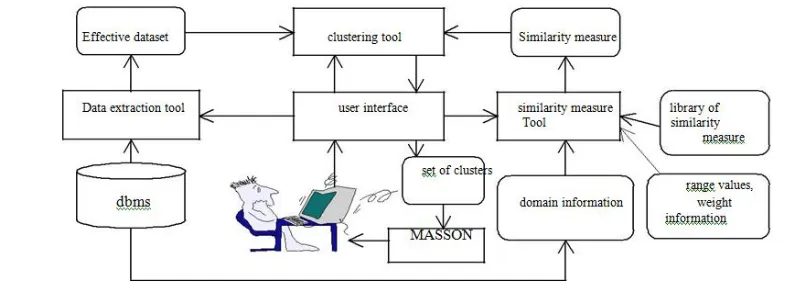
The unified similarity measure requires basic information such as attribute type (i.e., qualitative or quantitative type), range values and weight of quantitative attributes before it can be applied. Figure 3 shows the architecture of a database clustering environment we are presently developing.
Figure 3: Architecture of a Database Clustering Environment L Q L Q
S(a,b) = [wisl (ai , bi ) wjsq (aj , bj )]/( wi w j),
Volume 2, Issue 9, September 2013
Page 295
Extensive data set is generated database extraction tool from a database based on requirements of the user. The similarity
measure tool assists the user in building a similarity measure that is appropriate for user application. Depending on a library
of similarity measures, it interactively guides the user through the construction process, inquiring information about types, weights, and other characteristics of attributes, offering alternatives and choices to the user, if more than one similarity measure seems to be appropriate. Default assumptions are made and default choices are provided, and occasionally necessary information is taken from the database if the user cannot provide suitable information. Clustering algorithm is applied on extensive dataset and similarity measure which are inputs for clustering tool. Clustering algorithm such as Nearest-neighbor (Everitt93) [7] chosen by the user to the extensive data set. MASSON (Ryu96a)[2] returns a set of discovered queries that describe the common values for the set of objects in the given cluster by taking objects with only object-IDs from each cluster. MASSON is a query discovery system that uses database queries as a rule representation language (Ryu96b)[3]. MASSON discovers a set of queries that describes only the given set of objects in a cluster not any other objects in other cluster in structured databases (Ryu98)[4] using genetic programming (Koza90)[9].
6. CONCLUSION
In this paper, we examined the issue of generating single linear file format to represent data sets that have been retrieved from structured databases, and shown its representational unseemliness to represent relevant information, that has been frequently unnoticed by recent data mining research. To conquer these difficulties, we introduced a better representation scheme, called extensive data set, which allows attributes of an object to have a basket of values, and deliberate how existing similarity measures for single-valued attributes could be induce to measure group similarity for extensive data sets in clustering. We also dealt extensive data sets with mixed types by introducing a unified framework for similarity measures. Finally MASSON a query discovery system can discover useful characteristic information for a set of objects that belong to a cluster from the database which is ready with the clusters with similar properties.
References
[1] Ribeiro, J.S., Kaufmann, K., and Kerschberg, L. (1995). Knowledge Discovery from Multiple Databases, In Proc. of the 1st Int’l Conf. On Knowledge Discovery and Data Mining, Quebec, Montreal.
[2] Ryu, T.W and Eick, C.F. (1996a). Deriving Queries from Results using Genetic Programming, In Proceedings of the 2nd Int’l Conf. on Knowledge Discovery and Data Mining. Portland, Oregon.
[3] Ryu, T.W and Eick, C.F. (1996b). MASSON: Discovering Commonalities in Collection of Objects using Genetic Programming, In Proceedings of the Genetic Programming 1996 Conference, Stanford University, San Francisco.
[4] Ryu ,T.W. and Eick ,C.F. (1998). Automated Discovery of Discriminant Rules for a Group of Objects in Databases, In Conference on Automated Learning and Discovery, Carnegie Mellon University, Pittsburgh, PA, June 11-13.
[5] Thompson, K., and Langley, P. (1991). Concept formation in structured domains, In Concept Formation: Knowledge and Experience in Unsupervised Learning, Eds., Fisher, D.H; Pazzani, M.; and Langley, P., Morgan Kaufmann.
[6] Tversky, A. (1977). Features of similarity, Psychological review, 84(4): 327-352, July.
[7] Everitt, B.S. (1993). Cluster Analysis, Edward Arnold, Copublished by Halsted Press and imprint of John Wiley & Sons Inc., 3rd edition.
[8] Gower, J.C. (1971). A general coefficient of similarity and some of its properties, Biometrics 27, 857-872.
[9] Koza, John R. (1990). Genetic Programming: On the Programming of Computers by Means of Natural Selection, Cambridge, MA: The MIT Press.
AUTHORS
Mugada Swathi received B.Tech degree from Avanthi Institute of Engineering And Technology, Narasipatnam and M.Tech degree from Pydah College of Engineering, Visakhapatnam, presently working as an Assistant professor in Lendi Institute of Engineering And Technology, Jonnada, Vizianagaram.
Khandapu Usharani received B.Tech degree from GMR Institute of Technology, Rajam and completed her M.Tech from Andhra University. Presently working as an Assistant Professor in Lendi Institute of Engineering And Technology, Jonnada, Vizianagaram.
Volume 2, Issue 9, September 2013
Page 296
Mugada Swetha received B.Tech degree from Avanthi Institute of Engineering And Technology, Narasipatnam and M.Tech degree from Pydah College of Engineering, Visakhapatnam, presently working as an Assistant professor in Lendi Institute of Engineering And Technology, Jonnada, Vizianagaram.