The Thirty-Third AAAI Conference on Artificial Intelligence (AAAI-19)
A Human-Like Semantic Cognition
Network for Aspect-Level Sentiment Classification
Zeyang Lei,
1Yujiu Yang,
∗,1Min Yang,
2Wei Zhao,
3Jun Guo,
4Yi Liu
5 1Graduate School at Shenzhen, Tsinghua University,2Shenzhen Institutes of Advanced Technology, CAS,3Technische Universitt Darmstadt,4TBSI†, Tsinghua Universitys,5Peking University Shenzhen Institute,
[email protected], [email protected], [email protected] [email protected], [email protected]
Abstract
In this paper, we propose a novel Human-like Semantic Cog-nition Network (HSCN) for aspect-level sentiment classifica-tion, motivated by the principles of human beings’ reading cognitive process (pre-reading, active reading, post-reading). We first design a word-level interactive perception module to capture the correlation between context words and the given target words, which can be regarded as pre-reading. Second, to mimic the process of active reading, we propose a aware semantic distillation module to produce the target-specific context representation for aspect-level sentiment pre-diction. Third, we further devise a semantic deviation metric module to measure the semantic deviation between the target-specific context representation and the given target, which evaluates the degree we understand the target-specific context semantics. The measured semantic deviation is then used to fine-tune the above active reading process in a feedback reg-ulation way. To verify the effectiveness of our approach, we conduct extensive experiments on three widely used datasets. The experiments demonstrate that HSCN achieves impressive results compared to other strong competitors.
Introduction
Sentiment analysis has attracted increasing attention re-cently due to its broad applications. The majority of liter-ature addressed the sentiment for a whole piece of text, such as a document, a sentence etc. (Liu 2012). However, in real world, people may mention several target entities in one doc-ument/sentence. For example, the sentence “although the service is not that great, I still like the food” is positive re-garding the food of the restaurant, but negative with regard to its service. Considering merely the overall sentiment of the sentence fails to capture the aspect-level sentiments. When inferring the sentiment in response to a given aspect, it is essential to effectively capture the relatedness of the aspect with its context words. Several recent studies have been pro-posed to build aspect-level sentiment classifiers with atten-tion mechanisms and explicit memory. For example, Tang, Qin, and Liu (2016) developed deep memory networks to capture importance of context words. Wang et al. (2016)
∗
Corresponding author
†
Tsinghua-Berkeley Shenzhen Institute
Copyright c2019, Association for the Advancement of Artificial Intelligence (www.aaai.org). All rights reserved.
proposed to learn an embedding vector for each aspect, and these aspect embeddings were used to calculate the atten-tion weights to capture important informaatten-tion with regard to a given aspect. As far as our knowledge, human-beings’ reading cognitive process has rarely been explored in aspect-level sentiment classification.
When human-beings read and comprehend text, their ex-ploration of the reading process organizes itself most natu-rally into an examination of three phrases: pre-reading, ac-tive reading (i.e., during-reading), and post-reading (Press-ley M 1995; Avery and Graves 1997; Toprak and Al-macıo˘glu 2009). In the pre-reading stage, humans set the purpose of reading and preview the text with prior knowl-edge to form the initial reading cognition. Active reading is a complex cognitive process by which the reader constructs meaning from text. During the active reading stage, good readers use skimming ability to find relevant information to specific target by locating distinguishable target-related con-text, instead of thorough reading. It is beneficial to eliminate the distraction of irrelevant information so as to focus on the target-specific information.
As more information becomes available, the readers will evaluate their understanding of the text and revise their hypothesis when necessary. This post-reading stage (re-reading) creates opportunities for deeper understanding and error correction. If one desires to create a machine intel-ligence imitating such a reading comprehensive skill of humans, studying these three-stage human-beings’ reading cognitive process is quite necessary.
composition module to encode the target-specific context representation. Third, we further design a semantic deviation metric module to measure the semantic deviation between our target-specific context representation and the given tar-get, which evaluates the degree we understand the target-specific context semantics. The measured semantic devia-tion is then used to fine-tune the above active reading pro-cess in a feedback regulation way.
The main contributions can be summarized as follows:
• We propose HSCN, a human-like semantic cognition net-work to simulate the three stages in human-beings’ read-ing cognitive process: pre-readread-ing, active readread-ing, and post reading.
• To fully model human-beings’ reading cognitive process, our proposed HSCN is a hierarchical semantic network, including the word-level interactive perception module, target-aware semantic distillation module, semantic feed-back module.
• To verify the effectiveness of our approach, we conduct extensive experiments on three widely used datasets. The experimental results demonstrate that our model achieves impressive results compared to other strong competitors.
Related work
Sentiment analysis is commonly explored at three levels: document level, sentence level and entity level. In this pa-per, we mainly focus on entity level sentiment classifica-tion. In order to capture the sentiments towards target en-tities, there are a variety of approaches being proposed for target-dependent or aspect-level sentiment classification. In (Hu and Liu 2004), the features of a product were considered to predict the sentiment polarity towards the target entity. Kiritchenko et al. (2014) trained one multi-class SVM clas-sifier with two copy features, where each feature had two copiesf general(for all the aspect categories) andf c(for the specific category). Tang et al. (2015) extended LSTM by considering the target word. Inspired by the recent success of attention-based neural networks (Bahdanau, Cho, and Ben-gio 2014; Yang et al. 2016), Wang et al. (2016) proposed an attention-based LSTM method to learn an aspect embed-ding for each aspect and made aspects participate in com-puting attention weights, and Liu and Zhang (2017) also de-signed an attention module for targeted sentiment classifi-cation. Tang, Qin, and Liu (2016) developed a deep mem-ory network for aspect level sentiment classification which learned the importance of each context word and then uti-lized this information to calculate continuous text repre-sentation. Chen et al. (2017) employed a position-weighted memory network to capture sentiment features separated by a long distance. Ma et al. (2017) proposed the interac-tive attention networks (IAN) to interacinterac-tively learn attention weights in the contexts and targets. Wang and Lu (2018) proposed a segmentation attention based LSTM model to effectively capture the structural dependencies between the target and the sentiment expressions with a linear-chain con-ditional random field (CRF) layer. Li et al. (2018) proposed a transformation network to model target-oriented senti-ment classification by overcoming the drawbacks of
atten-tion mechanism and convoluatten-tion neural networks. Xue and Li (2018) proposed a model based on convolutional neural networks and gating mechanisms.
Currently, some researchers began to attempt introduc-ing human cognitive behaviors into their researches (Lake, Salakhutdinov, and Tenenbaum 2015; Zhao et al. 2017; Guo and Zhu 2018). To date, no work exploits the human-beings’ reading cognitive process in aspect-level sentiment classification. Our work takes the lead in this topic.
Methodology
Overview
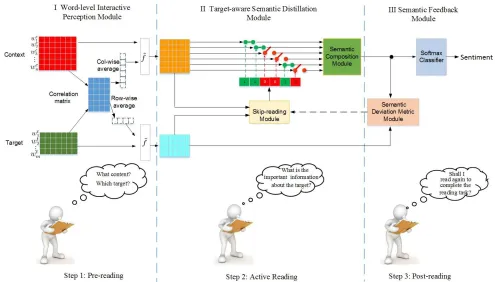
As discussed in Section 1, human-beings’ reading cogni-tive process mainly consists of three phases: pre-reading, active reading, and post-reading. Accordingly, we propose a Human-like Semantic Cognition Network (HSCN) to sim-ulate human-beings’ reading cognitive process, which also consists of three components: word-level interactive percep-tion module, target-aware semantic distillapercep-tion module, and semantic feedback module.
Our goal is to strengthen the target-specific context repre-sentation learning through simulating human-beings’ read-ing cognitive process. First, the word-level interactive per-ception module pre-reads text content and the given target to form an initial cognition, which captures the correlation be-tween words in the context and the given target words. After initial perception, a target-aware skip-reading mechanism is proposed to select target-related words of the context. With the selected target-related words as inputs, we design a se-mantic composition module to obtain the target-specific con-text representation. Finally, we design a semantic feedback module to perform post-reading, which measures the seman-tic deviation between the target-specific context representa-tion and the representarepresenta-tion of the given target. This seman-tic deviation, to a certain extent, reflects the degree that we understand the semantics of the context. We use the seman-tic deviation to fine-tune the above active reading process in a feedback regulation way. In this section, we elaborate the three components in detail. To prevent conceptual con-fusion, we use a superscript “c” to indicate the variables that are related to context and a superscripts “t” to indicate the variables that are related to the given target for each context.
Word-level Interactive Perception Module
The word-level interactive perception module acts as the pre-reading in human-beings’ reading cognitive process. It captures the correlation between the context words and the given target words by calculating the mutual information between them. The detailed implementation is similar with (Seo et al. 2017; Lei, Yang, and Yang 2018).
Assuming that a contextxc withnwords can be denoted
asxc= [wc
1, wc2, ..., wcn]and a targetxtcontainingmwords
can be represented asxt = [wt
1, wt2, ..., wtm]. Here, eachw
represents a specific word. First, Each wordwwas embed-ded into a low-dimensional and dense vector spacee(w)∈
Rd, where e(·) denotes the embedding operation and d
Figure 1: The overall Framework of Human-like Semantic Cognition Network (HSCN)
embeddings of the contextxc and the corresponding target
xt can be obtained as e(xc) = [e(wc
1),e(wc2), ...,e(wcn)]
and(xt) = [e(w1t),e(wt2), ...,e(wmt )], respectively. Then, we compute the correlation matrixM to represent the relatedness between the context and the target, as follow:
M =e(xc)T·e(xt)∈Rn×m (1)
where each elementMi,jin the correlation matrix refers to
the relevance between thewc
i in the context and thewtj in
the target.
Then, we perform mean-pooling operation on the values of each row ofSand obtain a column vector of sizen. This obtained column vector is fed into asoftmaxlayer, produc-ing an attention vector for the context:
ρρρ=sof tmax(
Pm
i=1M[:, i]
m ) (2)
Similarly, a row vector of sizemcan be obtained by com-puting the average values of each column ofS. We use the row vector as the input of asoftmaxlayer to get an attention vector for the target words:
σσσ=sof tmax(
Pn
j=1M[j,:]
n ) (3)
Finally, with the context embedding matrixe(xc)and the attention vector ρρρ as inputs, we can compute the target-enhanced context representation matrixWc∈Rk×nas
fol-lows:
Wc=ELU(Uc(e(xc) + (ed⊗ρρρ)e(xc))) (4)
whereUcis a projection parameter,e
d= [1,1, ..,1]T
repre-sents ad-dimensional all-ones vector,ed⊗ρρρ= [ρρρ;ρρρ;...;ρρρ]
denotes the kronecker product operation betweenedandρρρ, refers to the element-wise multiplication, and exponen-tial linear unit (ELU) (Clevert, Unterthiner, and Hochreiter 2016) is a nonlinear activation function. In the same way, we can also obtain the contextual enhanced target representation matrixWt∈
Rk×mas follow:
Wt=ELU(Ut(e(xt) + (ed⊗σσσ)e(xt))) (5)
whereUtis a projection parameter,ed = [1,1, ..,1]T
de-notes ad-dimensional all-ones vector,ed⊗σσσ= [σσσ;σσσ;...;σσσ]
denotes the kronecker product operation betweenedandσσσ.
The Eq. (1-5) can help establish the relatedness between the context and the target and thus we call the process as word-level interactive perception module, which is benefi-cial for the following active reading process.
Target-aware Semantic Distillation Module
As depicted in Figure 1, the target-aware semantic distilla-tion module contains two parts: the skip-reading module for selecting target-related words and the semantic composition module for encoding the target-specific context representa-tion. In the following, we will elaborate the two parts in de-tail.
target-related words from the context. Specifically, with the context representation matrixWc and the target
represen-tation matrix Wt as inputs, we build a semantic
decision-making scheme to extract target-related information and de-termine whether a word in the context should be deleted or retained. Formally, we formulate this process as follows:
γγγ=sof tmax(Uγγγ{Wt}TWc) (6)
g=argmax(γγγTTT) (7)
whereUγγγ is a learnable parameter,γγγ ∈
R2×n denotes a
skip-reading state matrix with two dimensions indicating the probability of being skipped and not be skipped respectively,
g∈Rn is a gate-controlled vector with each element value
being 0 or 1. The value being 0 denotes that the correspond-ing word should be deleted while the value becorrespond-ing 1 denotes that the corresponding word should be retained.
Note that theargmax operation is a hard-decision pro-cess and non-differentiable, direct application of the gradient propagation may be difficult. For the gradient estimation of discrete variables, some feasible approaches achieve unbi-ased gradient estimation using the REINFORCE algorithm (Williams 1992; Ke et al. 2018). However, the REINFORCE algorithms suffer from high variance of the gradient esti-mation, model instability, and hard training (V et al. 2015; Maddison, Mnih, and Teh 2017). We instead use a Gumbel-Softmaxdistribution (Gumbel and Lieblein 1954; Seo et al. 2018) to approximate Equation (7), which is fully differen-tiable. The approximate implementation˜gofgis shown as follow:
˜
g= exp((log(γγγ
T) +δδδ)/τ)
P
exp((log(γγγT) +δδδ)/τ) (8)
whereδδδis an independent sample from Gumbel(0,1)=-log(-log(Uniform(0,1))) andτ is the temperature coefficient, an inherent hyper-parameter of Gumbel-Softmax function to adjust the approximation degree towards one-hot sampling. Note that whenτ → 0, the gumbel-softmax operation ap-proximately approaches discrete one-hot sampling, namely theargmax operation. Generally,τ <= 0.1 can obtain a sharper distribution and τ = 0.5 ∼ 1 can obtain a more smoothing distribution.
Giveng˜1as the final gate-controlled vector, we formulate
the distilled representation matrixWrof the context that is
composed of the selected target-related words, as follow:
Wr=WcT (ek⊗˜g) (9)
whereek = [1,1, ..,1]T denotes a k-dimensional all-ones
vector,denotes the element-wise multiplication, andek⊗ ˜
gdenotes the kronecker product operation betweenekand ˜
g.
Semantic Composition Module After obtaining the target-related words in the context, we devise an appropriate semantic composition module to encode the target-specific context representation. To be specific, with the distilled con-text representation matrix Wr as inputs, we first employ
1
To simply, We randomly choose any one of the two dimension of˜gas the final˜gto participate in the following calculation.
GRU networks (Chung et al. 2015) to obtain the hidden statesHrof the context,
Hr=GRU(Wr) (10)
Then, motivated by the superiority of attention models in sentence semantic composition (Lin et al. 2017; Shen et al. 2018; Shaw, Uszkoreit, and Vaswani 2018), we also design a target-aware attention mechanism to learn the composi-tional weights about the hidden states of the context words. Concretely, we first encode the contextual enhanced target representation matrixWtto obtain its hidden representation
Ht. Then we execute the mean-pooling operation overHt.
Finally, we utilize the result of mean-pooling operation as attention source to learn the attention weights over the con-text. The detailed process can be summarized as follows:
Ht=GRU(Wt) (11)
zt=
m
X
i=1
Ht[i,:]/m (12)
ϕ
ϕϕ=sof tmax(f( ˆU[Hr; (en⊗zt])) (13)
o={Hr}Tϕϕϕ
(14)
whereUˆ is a learnable parameter,ϕrefers to the attention weights for the target-related context words,f denotes the nonlinear activation function. Here, we may choosetanh,
elu, orreluasf.Ht[i,:]denotes thei-th row vector ofHt
andois the final target-specific context representation.
Semantic Feedback Module
After obtaining the target-specific context representation, we design a semantic deviation metric module to measure the semantic deviation between our target-specific context rep-resentation and the given target, which models the degree we understand the target-specific context semantics. In par-ticular, we adopt a fully connection network to project the target-specific context representation to the target seman-tic space. In the target semanseman-tic space, we directly use the residual vector between the projected context vector and the target vector as semantic comprehension deviation. The ob-tained semantic residual vector is then used to fine-tune the aforementioned skip-reading step in a feedback regulation way. The detailed implementation process is formulated as follow.
∆r=zt−tanh(Uoo+bo) (15)
ˆ
γˆγγˆ=sof tmax(Ur∆rTHr) (16)
˜
γ˜γγ˜=γγγ+ηˆγˆγγˆ (17)
where ∆r is the semantic comprehending deviation, ˆγˆγγˆ is the incremental skip-reading state matrix via semantic de-viation, γγ˜˜˜γ is the final augmented skip-reading state ma-trix by fine-tuning the pervious skip-reading resultγ, and
Uo, Ur,boare projection parameters,ηis the
hyperparame-ter, which can be set as 1 in this paper.
again to obtain the regulated final enhanced centext seman-ticso1viarereadingas follow.
o1=SR(˜γγ˜˜γ) (18)
whereSRdenotes the entire transformation process of one-turn rereading. In real world, human beings may perform multi-turn rereading to determine the final semantics of the sentences.
Sentiment Classifier
The final context representation˜o= [o,o1]can be fed to a softmax function to predict sentiment polarity distribution:
ˆ
y=sof tmax(UoT˜o+bo) (19)
whereyˆis the predicted sentiment polarity distribution,Uo
andboare learned parameters. Suppose that a training corpus
contains N training samples(xi, yi), we can train the entire
networks by minimizing the following loss function.
L(ˆy, y) =−
N
X
i=1 C
X
j=1
yjilog(ˆyji) +λ(X
θ∈Θ
θ2) (20)
where yij is the ground truth sentiment polarity, C is the number of sentiment polarity categories,yˆijdenotes the pre-dicted sentiment probabilities,θrepresents each parameter to be regularized,Θis a collection of all parameters,λis the weight coefficient forL2regularization.
Experimental Setup
Datasets
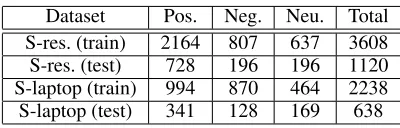
SemEval-14 This data is constructed for the aspect based sentiment analysis task (SemEval-2014 Task 4)2. Two domain-specific datasets forrestaurants(S-res.) andlaptops
(S-laptop) have been provided for training and testing. Table 1 shows the statistics of these two datasets. There are five aspect categories in the restaurants dataset, includingprice, food, service, ambience, anecdotes/miscellaneous. Since the laptop dataset does not have the aspect-specific polarities, we modified the dataset to include annotations for aspect categories and their sentiment polarities (i.e., positive, neg-ative, neutral). The tags of the aspect category field for the laptop dataset areperformance, price, quality, appearance.
Tweets
The original dataset is a collection of tweets from Twitter by (Dong et al. 2014), using keywords (e.g., “bill gates”, “google”) to query the Twitter API. Each tweet has a manu-ally labeled sentiment polarity (i.e., positive, neutral or nega-tive) for the target entity (keywords). The training data con-sists of 6,248 tweets, and the testing data has 692 tweets. The percentages of positive, negative and neutral tweets in both the training set and the test set are 25%, 25%, 50%, respectively.
2
http://alt.qcri.org/semeval2014/
Dataset Pos. Neg. Neu. Total S-res. (train) 2164 807 637 3608 S-res. (test) 728 196 196 1120 S-laptop (train) 994 870 464 2238 S-laptop (test) 341 128 169 638
Table 1: Statistics of SemEval-14 dataset.
Baselines
In the experiments, we evaluate and compare our model with several baseline methods, including SVM-feature (Kir-itchenko et al. 2014),LSTM,TD-LSTM(Tang et al. 2015),
ATAE-LSTM(Wang et al. 2016),MemNet(Tang, Qin, and Liu 2016),RAM(Chen et al. 2017),IAN(Ma, Yuan, and Wu 2017), SA-LSTM-P (Wang and Lu 2018),PRET+MULT
(He et al. 2018). For more details, please refer to the cor-responding references.
Implementation Details
Model hyper-parameters are set by a grid search. To avoid overfitting, we use a dropout strategy (Wager, Wang, and Liang 2013) to randomly omit part of the feature detec-tors on each training case. Meanwhile, to reduce the vul-nerability of neural networks, we adopt the label smooth-ing technique (Szegedy et al. 2016), which replaces out-put vectors ylabel = [1,0,0,0, ...,0] withylabel = [1−
,C−1,C−1,C−1, ...,C−1], where is smoothing coeffi-cient.
In our experiments, we use 300-dimensional GloVe3 vec-tors to initialize the word embeddings for words in the con-text and target words, and all out-of-vocabulary words are initialized by sampling from the uniform distribution U(-0.25,0.25). We initialize all the weight matrices as random orthogonal matrices, and all the bias vectors are initialized to zero. The dimension of GRU hidden states is set as 10. We conduct mini-batch (with size 40) training using RMSprop optimization algorithm to train the model. The dropout rate is set to 0.5, and the coefficientλofL2normalization is set
to10−5. Label smoothing coefficientis set as 0.01.
Experimental Results
Main Results
In our experiments, the evaluation metrics are classification accuracy and Macro-averaged F1 (D. Manning, Schtitze, and Lee 2002). We report the best results and the average results by running our model five times. The mean and the standard deviation of our model is also shown in Table 2.
We summarize the experimental results in Table 2. As is shown in Table 2, SVM-feature obtains an impressive re-sult in Laptop and Restaurant datasets. But it needs labor-intensive feature engineering works and an amout of ex-tra linguistic resources, which limits its advantage. The LSTM performs poorly since they do not consider the target-specific information when deciding the sentiment polar-ity of different aspects. TD-LSTM obtains a better result
3
Methods Laptop Restaurant Tweets
Acc Macro-F1 Acc Macro-F1 Acc Macro-F1
SVM-feature 70.5 NA 80.2 NA 63.4* 63.3*
LSTM 66.5 60.1 74.3 63.0 66.5 64.7
TD-LSTM 68.1 63.9 75.6 64.5 66.6* 64.0*
ATAE-LSTM 68.7 64.2 77.6 65.3 67.7 65.8
MemNet 68.9# 62.8# 76.9# 66.4# 68.5 66.9
RAM 72.1# 68.4# 78.5# 68.5# 69.4 67.3
IAN 72.1 NA 78.6 NA NA NA
SA-LSTM-P 75.1 NA 81.6 NA 60.9 NA
PRET+MULT 71.2 67.5 79.1 69.7 NA NA
HSCN 76.1
(74.9±1.0)
72.5
(70.9±1.1)
77.8 (77.1±0.6)
70.2
(70.0±0.3)
69.6
(68.8±0.8)
66.1 (65.4±0.7)
Table 2: Evaluation results. The best result on each dataset is in bold. The results with∗are retrieved from (Chen et al. 2017), and the results with#are retrieved from (He et al. 2018). For HSCN, the upper results represent the best performance for the model and the lower are the mean and the standard deviation when running the model five times.
than LSTM because it considers the left and right con-text with target when modeling the sentence representa-tion. The attention-based models such as ATAE-LSTM and IAN consistently perform better than LSTM and TD-LSTM. This may be because that these attention-based models cap-ture the important information in response to the given as-pect. Memory-based methods such as MemNet and RAM also obtain comparable results, which verifies the effec-tiveness of integrating memory into sentiment modeling.
Our modelperforms even better than the strong attention-based or memory-attention-based competitors by simulating human-beings’ reading cognitive process. For example, for the Lap-top dataset, the average classification accuracy increases by
2.8%and the average Macro-F1 also increases by2.5%than RAM, the strongest baselines until 2017. As for the Restau-rant dataset, the average Macro-F1 also obtains the start-of-the-art result compared with other methods. For Tweets, our model can also get a comparable result, which verifies our model’s effectiveness to some extent.
Quantitative Analysis
The Effect of Each Component To further investigate the effect of each component of the HSCN model, we also con-duct the ablation test of HSCN in terms of discarding word-level interactive perception module (denoted as HSCN-I), skip-reading module (denoted as HSCN-II), semantic com-position module (denoted as HSCN-III), and semantic feed-back module (denoted as HSCN-IV). The results are re-ported in Figure 3. Generally, all four factors contribute, and semantic composition module contributes most. This is within our expectation since the third component refers to the final context semantics comprehension that plays most important role in target-specific text understanding. The pre-reading component also makes great contribution to aspect-level sentiment classification. We believe this is because that the pre-reading module, establishing the correlation relation between the target and the content, is the basis of the latter comprehension stages. This also inspires us in the future text modelling, pre-reading and semantic composition should be paid more attention.
Effect of the Number of Readings
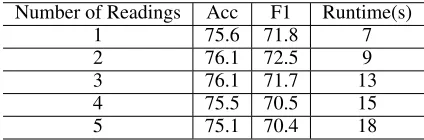
Number of Readings Acc F1 Runtime(s)
1 75.6 71.8 7
2 76.1 72.5 9
3 76.1 71.7 13
4 75.5 70.5 15
5 75.1 70.4 18
Table 3: The experimental results for the models with the different numbers of readings on the Laptop dataset. Run-time denotes the running Run-time for each training epoch.
One may wonder how many times of readings is appropri-ate for a reader. Therefore, we study the performance of the models with different times of reading in this part. Specifi-cally, we implement the HSCN model with different num-ber of copies of semantic feedback module based on the same network infrastructure and run them on the same CPU server. The detailed results are shown in Table 3. We can find that, with reading times increasing from 1 to 3, the classifi-cation accuracy increases from 75.6 to 76.1 and the runtime of each training epoch also increases from 7s to 13s. This verifies that rereading can really enhance our understanding for context semantics but suffers expensive time cost. When reading times surpasses 3, we find that the performance de-clines instead to some extent but the runtime still increases by a certain margin. We infer that one possible reason is that the model is over-fitting with the increasing of hyper-parameters when the number of reading times increases. In our experiment, taking into account the performance and the runtime, we choose only reread once.
Case Study
Figure 2: Ablation Test results
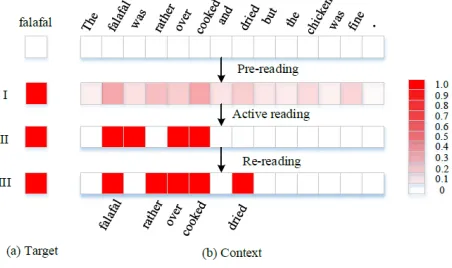
chicken was fine.”, and the corresponding target is“falafal”. Our model successfully predicts the sentiment polarity to-wards“falafal”as negative. Figure 3 shows how attention weights vary with the influence of a given target in the read-ing cognitive process (i.e., pre-readread-ing, active readread-ing, post-reading). The color depth indicates the importance degree of the attention. The darker the color, the more important the word. Figure 3(I) denotes the attention weights of the context words toward the given target after performing pre-reading. We reveal that the context words related to the tar-get“falafal”such as“falafal”,“over”,“cooked”,“dried”
are paid much more attention than the irrelevant words such as “the”, “and”. This verifies that pre-reading can estab-lish the initial correlation between the target and the context. Then, active reading process locates the most important fea-tures and ignores the rest. As shown in 3(II), the importance of target-related words are risen, while the target-irrelevant words are ignored. This step can be regarded as skimming in the process of the reading comprehension, which elim-inates the distractions of irrelevant words and obtains the distilled if. Finally, post reading is performed to fine tune the active reading process. Figure 3(III) shows that the attention weights after post reading (rereading) sightly. In particular, some new target-related words such as”rather”,”dried”are added while some selected irrelevant words are discarded. This verifies that post reading (rereading) creates the oppor-tunities for deeper understanding of the text and error cor-rection.
Figure 3: Case Study
Conclusion and Future Work
In this paper, motivated by the principles of human being’s reading cognitive process, we proposed a novel Human-like Semantic Cognition Network (HSCN) for aspect-level sen-timent classification. HSCN consists of three components, including word-level interactive perception module, target-aware semantic distillation module, and semantic feedback module. To the best of our knowledge, we take the lead to concretely exploit human-beings’ reading cognitive process for aspect- level sentiment analysis. Experiments on three widely used datasets showed the superiority of HSCN.
As for future work. we will work on the two aspects: one is that we will explore more proper ways to model the hu-man reading cognition process, and the other is that we will attempt applying our model in longer text to further verify the effectiveness of human reading cognition process.
Acknowledgements
We sincerely thank all the anonymous reviewers for their valuable comments to improve this paper. This work was supported in part by the National Key Research and De-velopment Program of China (No. 2017YFC1601004), and Shenzhen special fund for the strategic development of emerging industries (No. JCYJ20170412170118573 and JCYJ20160331104524983). Zeyang Lei and Jun Guo were partly supported by the 2018 Tencent Rhino-Bird Elite Training Program. Min Yang was sponsored by CCF-Tecent Open Research Fund.
References
Avery, P. G., and Graves, M. F. 1997. Scaffolding young learners’ reading of social studies texts. Social Studies & the Young Learner9:10–14.
Bahdanau, D.; Cho, K.; and Bengio, Y. 2014. Neural ma-chine translation by jointly learning to align and translate.
Computer Science.
Chen, P.; Sun, Z.; Bing, L.; and Yang, W. 2017. Recurrent attention network on memory for aspect sentiment analysis. InEMNLP, 452–461.
Clevert, D.-A.; Unterthiner, T.; and Hochreiter, S. 2016. Fast and accurate deep network learning by exponential linear units (elus).
D. Manning, C.; Schtitze, H.; and Lee, L. 2002. Re-view: Foundations of statistical natural language processing, christopher d. manning and hinrich sch¨utze.
Dong, L.; Wei, F.; Tan, C.; Tang, D.; Zhou, M.; and Xu, K. 2014. Adaptive recursive neural network for target-dependent twitter sentiment classification. InACL, 49–54. Gumbel, E. J., and Lieblein, J. 1954. Statistical theory of extreme values and some practical applications: a series of lectures.
Guo, J., and Zhu, W. 2018. Partial multi-view outlier de-tection based on collective learning. InProc. AAAI Conf. Artificial Intell. (AAAI), 298–305.
He, R.; Lee, W. S.; Ng, H. T.; and Dahlmeier, D. 2018. Exploiting document knowledge for aspect-level sentiment classification. InProceedings of ACL(2).
Hu, M., and Liu, B. 2004. Mining and summarizing cus-tomer reviews. InSIGKDD, 168–177.
Ke, N. R.; Zolna, K.; Sordoni, A.; Lin, Z.; Trischler, A.; Ben-gio, Y.; Pineau, J.; Charlin, L.; and Pal, C. 2018. Focused hierarchical rnns for conditional sequence processing. In
Proceedings of ICML.
Kiritchenko, S.; Zhu, X.; Cherry, C.; and Mohammad, S. 2014. Nrc-canada-2014: Detecting aspects and sentiment in customer reviews. InInternational Workshop on Semantic Evaluation, 437–442.
Lake, B. M.; Salakhutdinov, R.; and Tenenbaum, J. B. 2015. Human-level concept learning through probabilistic pro-gram induction.Science350(6266):1332–1338.
Lei, Z.; Yang, Y.; and Yang, M. 2018. Saan: A sentiment-aware attention network for sentiment analysis. In Proceed-ings of SIGIR.
Li, X.; Bing, L.; Lam, W.; and Shi, B. 2018. Transforma-tion networks for target-oriented sentiment classificaTransforma-tion. In
Proceedings of ACL.
Lin, Z.; Feng, M.; dos Santos, C. N.; Yu, M.; Xiang, B.; Zhou, B.; and Bengio, Y. 2017. A structured self-attentive sentence embedding. InICLR.
Liu, J., and Zhang, Y. 2017. Attention modeling for tar-geted sentiment. InProceedings of the 15th Conference of the European Chapter of the Association for Computational Linguistics.
Liu, B. 2012. Sentiment analysis and opinion mining. Syn-thesis Lectures on Human Language Technologies1–167. Ma, D.; Li, S.; Zhang, X.; and Wang, H. 2017. Interactive attention networks for aspect-level sentiment classification. InIJCAI, 4068–4074.
Ma, B.; Yuan, H.; and Wu, Y. 2017. Exploring perfor-mance of clustering methods on document sentiment anal-ysis.Journal of Information Science43(1):54–74.
Maddison, C. J.; Mnih, A.; and Teh, Y. W. 2017. The Concrete Distribution: A Continuous Relaxation of Discrete Random Variables. InICLR.
Pressley M, A. P. 1995. Verbal protocols of reading: The nature of constructively responsive reading.
Seo, M.; Kembhavi, A.; Farhadi, A.; and Hajishirzi, H. 2017. Bidirectional attention flow for machine comprehension. In
Proceedings of ICLR.
Seo, M.; Min, S.; Farhadi, A.; and Hajishirzi, H. 2018. Neu-ral speed reading via skim-rnn. InProceedings of ICLR. Shaw, P.; Uszkoreit, J.; and Vaswani, A. 2018. Self-attention with relative position representations. InNAACL.
Shen, T.; Zhou, T.; Long, G.; Jiang, J.; Pan, S.; and Zhang, C. 2018. Disan: Directional self-attention network for rnn/cnn-free language understanding. InAAAI.
Szegedy, C.; Vanhoucke, V.; Ioffe, S.; Shlens, J.; and Wojna, Z. 2016. Rethinking the inception architecture for computer vision. InCVPR, 2818–2826.
Tang, D.; Qin, B.; Feng, X.; and Liu, T. 2015. Target-dependent sentiment classification with long short term memory.Computer Science.
Tang, D.; Qin, B.; and Liu, T. 2016. Aspect level sentiment classification with deep memory network. InEMNLP, 214– 224.
Toprak, E. L., and Almacıo˘glu, G. 2009. Three reading phases and their applications in the teaching of english as a foreign language in reading classes with young learners.
Journal of Language & Linguistic Studies5(1):20–36. V, M.; K, K.; D, S.; AA, R.; J, V.; MG, B.; A, G.; M, R.; AK, F.; and G, O. 2015. Human-level control through deep reinforcement learning. Nature518(7540):529.
Wager, S.; Wang, S.; and Liang, P. S. 2013. Dropout training as adaptive regularization. InNIPS, 351–359.
Wang, B., and Lu, W. 2018. Learning latent opinions for aspect-level sentiment classification. InAAAI.
Wang, Y.; Huang, M.; Zhu, X.; and Zhao, L. 2016. Attention-based LSTM for aspect-level sentiment classifica-tion. InEMNLP, 606–615.
Williams, R. J. 1992. Simple statistical gradient-following algorithms for connectionist reinforcement learning. Ma-chine Learning8(3):229–256.
Xue, W., and Li, T. 2018. Aspect based sentiment analysis with gated convolutional networks. InProceedings of ACL. Yang, Z.; Yang, D.; Dyer, C.; He, X.; Smola, A.; and Hovy, E. 2016. Hierarchical attention networks for document clas-sification. InNAACL.