Photo:
For
Introduction
The term “artisanal and small scale mining” (ASM) describes the use of manual labor and low-level technologies that character-ize the activity (Hruschka and Echavarría, 2011), as opposed to the capital-intensive and high technological input of industrial, large-scale mining (LSM). ASM is often an informal activity and artisanal miners’ lack of recognition, formal rights, and support creates a structural inability that can make it difficult for them to move out of poverty. Described as being amongst the poorest members of society, their trade is often fraught with dangerous practices and, in conflict and post-conflict countries, can have serious implications for security (Hayes and Wagner, 2008). At the local level, however,
CHAPTER 6
and in contrast to other subsistence-based livelihoods, artisanal miners are often better off than their neighbors, as their income can enable them to invest in their families’ health care and education, buy consuma-bles, and better cope with shocks. But while ASM is an important and increasingly popular livelihood for tens of millions of people around the world, bringing in needed income to rural communities, it is also a serious and growing threat to biodiversity and the integrity of protected areas due to the extraction methods and the livelihood practices that support mining populations (Villegas et al., 2012).
This chapter attempts to integrate the extent of artisanal mining activity within previously identified ape habitats with those mitigation strategies currently in existence, alongside the emerging lessons and knowl-edge gaps. In the context of conservation, economic activity, and human rights, it illustrates just how dire the environmental impacts of uncontrolled ASM can be, as well as highlighting the importance of this sector as an economic force that requires better regulation and understanding. Critical issues to be addressed include:
An overview of the structure of ASM activity in protected areas and critical ecosystems (PACE) around the world;
The policy and regulation of artisanal mining;
The nature of ASM experiences in ape range states, illustrated through case stud-ies of artisanal mining in ape habitats, focusing primarily on central Africa; Mitigation strategies and their challenges.
Key findings:
The presence of ASM in PACE can have a devastating impact on local biodiver-sity and thus apes, through obvious, direct activities such as habitat destruc-tion, degradadestruc-tion, and fragmentadestruc-tion, but also no less significantly through a multitude of indirect impacts such as water pollution, soil removal, and the increase in hunting pressure that accom-panies migration to mining sites (see Chapter 7).
ASM activities increase the risk of the spread of diseases to ape populations due to poor sanitation and poor hygiene within mining communities, as well as zoonotic disease transmission from animal to human populations due to increased contact through habitat intru-sion (see Chapter 7).
The role of LSM as a magnet in drawing ASM into these areas (as they are seen as viable for exploitation) is complex and misunderstood, and with current mitigation thinking generally focused at the site level, an analysis of markets at both the supply and demand ends also requires further investigation.
Both political perceptions and attitudes towards the ASM sector are central to pro-gressive policy processes. But while it remains poorly understood, with this knowledge deficit reflected in weak or non-existent legislation, so too have recent management options been few in number and with little analysis as to what extent they have either NOTE
Protected areas and critical ecosystems
succeeded or failed. While existing pro-grams are slowly beginning to rectify this situation, the often immature and corrupt governance structures found in many ape range states exacerbate ASM’s environ-mental and social impacts. With increased encroachment on ape habitat, there is now a recognized need amongst conservationists to focus on the opportunities for not only mitigating the environmental impacts of the sector, but also improving the social impacts, through better regulation and the formali-zation of tenure rights. In areas considered critically important for ape conservation there may also be the need to ban mining altogether, and this will require interventions supported by more robust law enforcement. As long as ASM remains an economically rational choice for often chronically poor individuals, the ultimate aim will be to find ways of navigating these complex conser-vation and development trade-offs that it produces in sites of high conservation value. Some of the shortfalls apparent in existing management strategies highlight how inte-grated interventions that include policy and legislative development in traditional spheres of control, coupled with poverty alleviation measures, are more likely to mit-igate the impacts of ASM on great apes and gibbons than efforts that focus on any one of these alone.
The structure of
artisanal mining
There are four main types of ASM (Hruschka and Echavarría, 2011):
Permanent: refers to ASM as a full time, year round activity. Mining is frequently the primary economic activity and is sometimes accompanied by other activ-ities such as farming, herding, or other localized extractive practices.
bOx 6.1
Overview of ASM sites and the key minerals obtained through them
Artisanal mining primarily depends on the most basic tools (hammers, picks, shovels, buckets, wheelbarrows, etc.) and manual labor for excavation. More advanced organization and production methods – such as the use of bulldozers and advanced mechanization – can also be referred to as small-scale mining. The term ‘ASM’ is thus used to describe a sector that is in fact quite diverse. Different types of ASM include: recovery of alluvial material from river beds or banks; recovery of tailings from old processing plant discharges or rejected material; open-pit mining, with or without benches to stabilize the pit walls; vertical or inclined shafts, of which tunnels or galleries may be excavated; irregular tunnels into hillsides following mineral veins; extraction from abandoned industrial mines, whether open pits or underground mines, which can include removal of ore-bearing pillars and other supports for underground galleries or destabilization of pit walls; and appropria-tion from large-scale mine stockpiles of rejected or prepared materials (Hayes and Wagner, 2008).
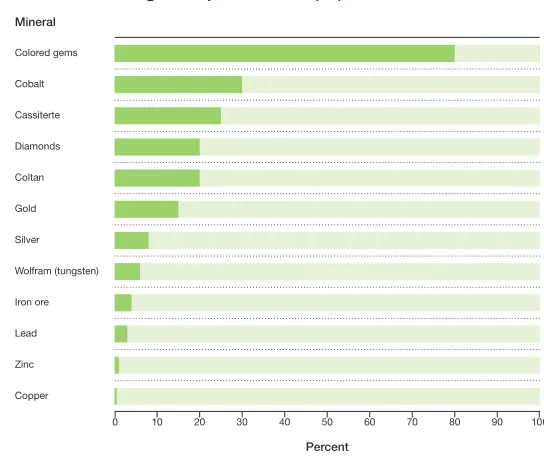
Using data collected by the German Federal Institute for Geosciences and Natural Resources (BGR), Figure 6.1 shows the contribution of ASM to the global production of minerals, including those commonly extracted in or adjacent to protected areas or critical ecosystems (and thus great ape habitats).
Many other minerals are also mined (both artisanally and otherwise). These include bauxite, different gemstones, iron ore, marble, limestone, and other construction materials.
FiguRE 6.1
ASM share of global production (%)
Colored gems
Cobalt
Cassiterte
Diamonds
Coltan
Gold
Silver
Wolfram (tungsten)
Iron ore
Lead
Zinc
Copper
Mineral
Villegas et al., 2012, p. 9, courtesy of ASM-PACE.
Percent
Seasonal: refers to ASM taking place during specific seasons owing to sonal alternating of activities or sea-sonal migration of people into artisanal mining areas during idle agricultural periods, for example, to supplement their annual incomes.
Rush-type: massive migration of arti-sanal miners to an area, based on the perception that the expected income opportunity from recently discovered deposits far exceeds the current actual income of those people who are lured into it.
Shock-push: refers to when ASM is a poverty-driven activity emerging after recent loss of employment in other sec-tors, often as a result of conflict or nat-ural disasters.
ASM can impact and become a threat to endangered species when initially tem-porary mining sites become increasingly permanent, in turn bringing affiliated
serv-ice industries, increasing associated liveli-hood activities (hunting, forest clearing for mining or agriculture, etc.), or through the mining techniques themselves (use of toxic chemicals, dynamite, forest clearing, diver-sion or dredging of rivers and streams). However, given that the processes involved in preparing the terrain, and extracting and processing the materials, differ greatly, there are differing degrees of impact on humans, wildlife, and the environment.
Driving factors behind
artisanal mining
There are many reasons why people under-take ASM. Often the primary motivation is that, although extremely physically demand-ing, and physically and financially risky, ASM is an economically rational choice for chronically poor individuals in a context of limited options. People generally undertake ASM because it offers:
Immediate cash, which is otherwise dif-ficult to acquire in rural, subsistence-farming contexts (Villegas et al., 2012). Potential relief during difficult circum-stances in fragile societies that have undergone or are undergoing deepen-ing poverty, natural disasters (e.g. in Mongolia), economic transition or col-lapse (e.g. in Zimbabwe), or civil con-flict or post-concon-flict reconstruction (e.g. in Sierra Leone and Liberia) (Villegas
et al., 2012).
Opportunity to earn higher income for unskilled or illiterate individuals (Villegas
et al., 2012).
Subsistence for people who are desolate and mine in exchange for food or other basic provisions (Villegas et al., 2012). Emancipation from traditional
hierar-chies and social structures; artisanal mining economies (especially in rush situations) are often highly individual-istic and provide scope for young people to organize and discipline themselves as they see fit (King, 1972; Levin, 2010, cited in Villegas et al., 2012).
Hope that mining will help them break free of poverty and bring them increased dignity and respect from their commu-nity (Levin, 2005; Zoellner, 2006, cited in Villegas et al., 2012).
ASM is an economic activity that rises and falls with global mineral prices and shifts production of certain minerals in accordance with local or global demand. For example, Nyame and Grant’s (2012) analysis of the recent shift from artisanal dia-mond production to artisanal gold mining in Ghana emphasizes the fact that artisanal miners would rather adapt their activities to the extraction of other minerals (some-times at great environmental cost, e.g. the use of mercury) rather than return to tra-ditional activities. In the context of high mineral prices, ASM is a rational economic
choice for people seeking to escape absolute poverty or improve their lives. In Uganda, for example, the average miner contributes almost 20 times more to GDP than the aver-age woman or man in farming, forestry, or fishing (Hinton, 2009, p80; Hinton, 2011). In Liberia, the average artisanal digger work-ing north of Sapo National Park has the potential to make 17 to 50 times more than the average Liberian per day (Small and Villegas, 2012).
Unfortunately, the increasing price of precious minerals has launched rushes on all continents. More often than not, these rushes are attracting people to relatively undisturbed places that are important con-servation sites, including protected areas and other critical ecosystems (Villegas et al., 2012). Furthermore, it is also important to note that if and when miners decide to move to other livelihoods, these might be more damaging to ape populations and their habitat than mining alone (e.g. hunting, char-coal making, slash and burn agriculture, etc.). The complex, market-based forces that drive ASM can be further exacerbated by the following factors:
Impact of international legislation aimed at increasing transparency in the “conflict minerals” sector. In response to the perceived connection between mining and armed rebel activity in the eastern Democratic Republic of Congo (DRC), there have been a series of ini-tiatives aimed at so-called “conflict minerals,” including tin, tantalum, tung-sten, and gold (“3TG”) originating from this or any adjoining country. This has served to further stigmatize and mar-ginalize the sector, in some cases tak-ing away ASM buyers for fear of betak-ing the target of conflict-minerals-inspired consumer campaigns. This has the
out-come of pushing it further underground without constructive restructuring of legislative environments to be support-ive of formalizing existing practices in the sector.
Large-scale land-use change. Commer-cial or industrial agricultural activities may drive local farmers out of business or deprive them of land, and could then push them towards ASM as an alterna-tive means of business.
The effects of climate change may make traditional livelihood activities less viable, and there is a great deal of uncertainty as to whether and how this might impact future ASM scenarios.
FiguRE 6.2
Sample supply chain of tin, tantalum, or tungsten from a mine in the DRC
RESOLVE, 2010, p. 12, courtesy of RESOLVE, www.resolv.org. INTERNATIONAL
TRADERS
PRODUCT COMPONENT REfINER/
SMELTER REfINED METAL PRODUCTfINAL
EXPORTERS/ PROCESSORS
(COMPTOIRS)
ASM OR COMMERCIAL
MINE
CONSUMER TRADERS
(NEGOCIANTS)
Surrounding country
Primarily Rwanda Within DRC – Can be > 3 layers (rebel influenced/taxation)
METAL ORE
METAL GLOBAL MARKETPLACE – Routed by ground out of adjacent nations or via air globally
The supply chain
The nature of the commodity chain itself also plays an important role in defining ASM. Much of artisanal mineral trading is infor-mal. There is not usually any type of paper trail during the early stages of the commod-ity chain, making transactions vulnerable to smuggling, money laundering, or other types of illegal trade. Thus the ability of miners to receive a “fair price” for their min-eral varies considerably. In some cases, they do not know the true value of their goods, are innumerate or illiterate, or do not have transparency on where their mineral goes and the costs of getting it to the international trader, so cannot judge if a price is fair or not. In addition, the need for immediate cash to continue living and mining often outweighs the effort of selling the product further up the chain or stockpiling it to sell in larger quantities, even though they would be likely to get a higher price were they to do so. In other cases, however, miners are able to achieve prices that are close to or even above the international reference price. This occurs when a trader is buying gold either to launder money or to use the min-eral as a financial instrument to limit costs associated with his/her primary economic activity (e.g. importing food or goods from a neighboring country that works with a different currency).
As is the case with many resource com-modity chains, there can be multiple levels or layers of buyers and sellers (see Figure 6.2). These can include locals, residents from urban areas, foreigners, and the military and government agents, with mined products being exchanged for both cash and in trade. It is usually at the point of export (when the international trade occurs) that the paper trail begins and the trade becomes formal or legal. The lack of price transparency, the lack of value addition early on in the chain, the multitude of middlemen, and the convo-luted (and often corrupted) path to market
leave miners in a vulnerable economic posi-tion, whereby miners capture little value of the end product (such as with diamonds), thus fuelling a cycle of poverty.
The relationship between
artisanal and large-scale
mining
Recent research undertaken for this publi-cation on the spatial overlap between mining activity and 27 ape taxa indicates that only six have no commercial mining projects within their range (see Chapter 5), and that the remaining taxa ranges are characterized by a predominance of development stage mining projects. While these activities are not nec-essarily a direct indicator of the future threat from mining operations, their concentration is indicative of potential commodity reserves within ape ranges, which may lead to future conflict in relation to resource exploitation at both the large and the artisanal scale.
ASM because they occur at depth and/or are low grade and/or are metallurgically complex. LSM may attract ASM where exca-vations create access to otherwise inacces-sible ore (e.g. illegal miners underground at the Obuasi gold mine in Ghana) or where it creates waste dumps that can be picked over by individuals (e.g. coltan/tin in the DRC, diamonds at the Williamson mine in Tanzania). However, given this complexity, and multi-scale patterns in the spatial vari-ability of the potential impacts from mining operations on great ape and gibbon taxa ranges needs to be further investigated.
Given that ASM and LSM can often occur side by side, and that there now appears to be increased recognition that large mining companies should engage with artisanal miners and their dependents, the particular sustainable development challenges of ASM – including security, human rights, and relocation programs – need specific con-sideration. However, the fact that much of
ASM occurs outside regulatory frameworks can present significant challenges for com-panies and regulators. This relationship has also been troubled by a mismatch of expectations between the two sectors, which in some cases can lead to mistrust and con-flict. This might include potential competi-tion over the same minerals, impacts on livelihoods if access to resources is limited, and changing social conditions, including between host communities and companies (IFC, unpublished data).
ASM in protected areas
and critical ecosystems
(PACE) around the world
An appreciation of this complex economic and social context is essential in attempting to understand why ASM is increasing in areas of high biodiversity. The ASM–PACE
FiguRE 6.3
Map of countries with ASM in PACE
Courtesy of ASM–PACE.
ASM occuring in PACE Insufficient/
inconclusive data ASM not occuring in PACE
Global Solutions Study (Villegas et al., 2012) provides the following analysis on the scope and scale of ASM encroachment into PACE and thus the habitats of endangered species, including great apes and gibbons.
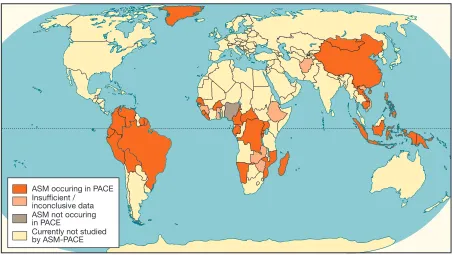
ASM is occurring in or around 96 of 147 protected areas evaluated in the Global Solution Study, and in 32 of 36 countries studied (Figure 6.3).
Affected sites include at least seven nat-ural World Heritage Sites and at least 12 World Wildlife Fund (WWF) Priority Landscapes.
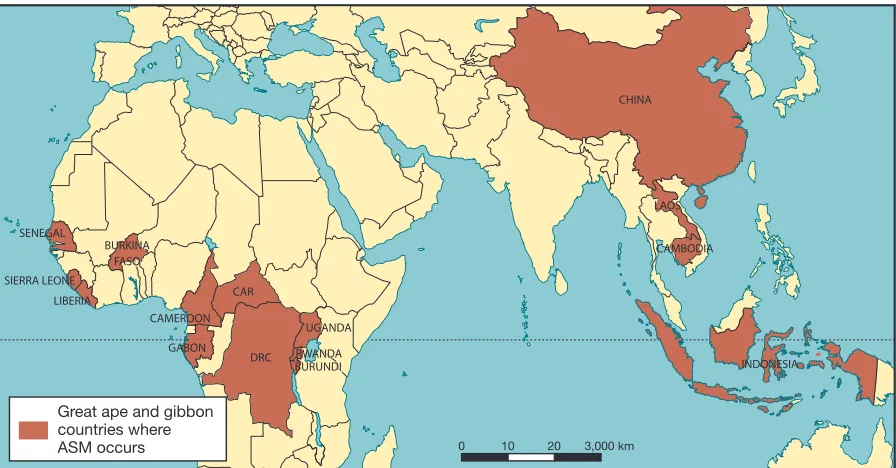
ASM is occurring in or impacting a wide range of critical ecosystems, not only trop-ical rainforests in Central Africa and South Asia, which are typical ape habitats (Figure 6.4), but also arctic landscapes (Green land) and coral reefs (Philippines). On a global scale, ASM of gold has the
most significant negative environmental impacts; however other minerals have
significant localized impacts within spe-cific ecoregions or countries, such as tin, tantalum, and tungsten in the DRC; colored gemstones in Madagascar, and diamonds in West Africa.
There are many “push” and “pull” fac-tors behind why men and women choose to mine in or around protected areas in par-ticular. Often they are seen as untouched, virgin areas, or they have not been mined in living memory (e.g. Liberia). Many colonial governments created forest reserves (which later became protected areas) in places where rich mineral deposits were known to exist, and there may also be a lack of rec-ognition or knowledge of park borders amongst the local population (e.g. in Sapo National Park in Liberia and the Kahuzi-Biéga National Park in DRC). In some parts of the world, protected areas are perceived as common land, in which there is no stat-utory or customary landowner to whom one must pay for access rights (e.g. mining DRC
CAR
UGANDA CAMEROON
SENEGAL
BURKINA FASO
GABON RWANDA
BURUNDI INDONESIA
CHINA
CAMBODIA LAOS
Great ape and gibbon countries where
ASM occurs 0 10 20 3,000 km
LIBERIA SIERRA LEONE
FiguRE 6.4
Map showing the overlap of ape countries with ASM
TAblE 6.1
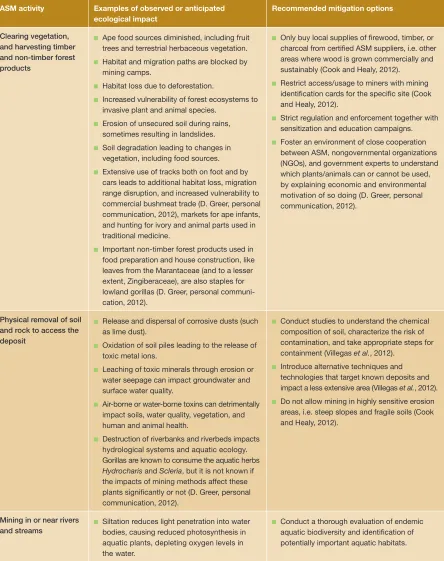
Impact and mitigation of ASM
ASM activity Examples of observed or anticipated ecological impact
Recommended mitigation options
Clearing vegetation, and harvesting timber and non-timber forest products
Ape food sources diminished, including fruit trees and terrestrial herbaceous vegetation. Habitat and migration paths are blocked by mining camps.
Habitat loss due to deforestation.
Increased vulnerability of forest ecosystems to invasive plant and animal species.
Erosion of unsecured soil during rains, sometimes resulting in landslides. Soil degradation leading to changes in vegetation, including food sources. Extensive use of tracks both on foot and by cars leads to additional habitat loss, migration range disruption, and increased vulnerability to commercial bushmeat trade (D. Greer, personal communication, 2012), markets for ape infants, and hunting for ivory and animal parts used in traditional medicine.
Important non-timber forest products used in food preparation and house construction, like leaves from the Marantaceae (and to a lesser extent, Zingiberaceae), are also staples for lowland gorillas (D. Greer, personal communi-cation, 2012).
Only buy local supplies of firewood, timber, or charcoal from certified ASM suppliers, i.e. other areas where wood is grown commercially and sustainably (Cook and Healy, 2012).
Restrict access/usage to miners with mining identification cards for the specific site (Cook and Healy, 2012).
Strict regulation and enforcement together with sensitization and education campaigns. Foster an environment of close cooperation between ASM, nongovernmental organizations (NGOs), and government experts to understand which plants/animals can or cannot be used, by explaining economic and environmental motivation of so doing (D. Greer, personal communication, 2012).
Physical removal of soil and rock to access the deposit
Release and dispersal of corrosive dusts (such as lime dust).
Oxidation of soil piles leading to the release of toxic metal ions.
Leaching of toxic minerals through erosion or water seepage can impact groundwater and surface water quality.
Air-borne or water-borne toxins can detrimentally impact soils, water quality, vegetation, and human and animal health.
Destruction of riverbanks and riverbeds impacts hydrological systems and aquatic ecology. Gorillas are known to consume the aquatic herbs
Hydrocharis and Scleria, but it is not known if
the impacts of mining methods affect these plants significantly or not (D. Greer, personal communication, 2012).
Conduct studies to understand the chemical composition of soil, characterize the risk of contamination, and take appropriate steps for containment (Villegas et al., 2012).
Introduce alternative techniques and technologies that target known deposits and impact a less extensive area (Villegas et al., 2012). Do not allow mining in highly sensitive erosion areas, i.e. steep slopes and fragile soils (Cook and Healy, 2012).
Mining in or near rivers
and streams Siltation reduces light penetration into water bodies, causing reduced photosynthesis in
aquatic plants, depleting oxygen levels in the water.
Direct (tailing, diesel from pumps) and indirect (turbidity) pollution of water sources for humans, apes, and other wildlife
Smaller streams and waterways can cease to flow due to numerous open pits and clogging of springs.
Erosion of unprotected earth during rains lead-ing to landslides, additional sediment release, and riverbank deterioration.
Loss and degradation of aquatic herbaceous vegetation through riverbank impacts, some of which can be important seasonal gorilla foods.
Conduct statutory environmental studies in PACE sites (Cook and Healy, 2012).
Minimize extraction for mine sites and conserve/ recycle water (Cook and Healy, 2012). Create dedicated sites for washing/panning with settlement holes or tanks to reduce waste-water flowing into watercourses with high sediment loads (Cook and Healy, 2012).
Use of toxic chemicals in gold processing
Risk of “dead zones” and localized death of animals (including birds and fish) exposed to unmanaged cyanide releases.
Aquatic faunal and other animals’ health affected by mercury in air or water (including great apes).
UNEP promotes a two-step approach to reduce mercury use in ASM:
Step 1: Reduce mercury use and emissions through improved practices, which use less mercury.
Step 2: Eliminate mercury use by using alternative mercury-free technologies that increase (or at least maintain) income for miners, and are better for health and the environment (UNEP, 2011b).
Anciliary/support services
Hunting of animals for bushmeat for personal consumption or sale Opportunistic and deliberate poaching of endangered species for trade
Population decline of critically threatened and endangered species due to hunting (including great apes).
Animals maimed or mortally wounded after escaping from snares (including great apes). Disturbance of wildlife habitats and migration routes due to large number of people resident in and moving through forest, as well as light and sound pollution of mining activities.
Ban commercial hunting as part of a mining permit, but allow closely monitored subsis-tence hunting (Cook and Healy, 2012). Include artisanal miners in the creation of park patrols and ecoguards where possible (Hollestelle, 2012).
Restrict access to the ASM site to reduce pressure on the biodiversity and the site’s environmental impact (D. Greer, personal communication, 2012).
Establishment of permanent and semi-permanent camps, villages, and towns
Enlarged settlements may result in reduced great ape home ranges and increased resource competition, resulting in lower quality of diet and increased great ape interactions (D. Greer, personal communication, 2012).
Noise may alter great ape home-range movement. Increased human–wildlife conflict.
Population monitoring (pre-, during, and post-mining activity) and habitat quality preservation completed in association with relevant ministries, NGOs, universities, etc.
Initiate education programs tailored to ASM to minimize human–wildlife conflict (e.g. what to do or not do when animal approaches, etc.)
Larger ecosystem impacts
Ecological changes due to loss of keystone species such as elephants and apes. Long-term changes in watershed due to rapid run-off in deforested areas.
Downstream hydrological impacts with respect to water quality and flow due to widespread siltation and pollution of rivers and streams.
license, surface rent). Gazetting of protected areas can also stimulate ASM activities by making other livelihoods less viable owing to the limited availability of land for farming and other activities (e.g. Uganda).
The closure of industrial mining sites can also create a surge of impoverished and out-of-work miners in rural areas who migrate towards protected areas in order to maintain their livelihoods (e.g. in Ecuador and the DRC). Furthermore, protected areas offer a variety of livelihood options that comple-ment ASM in a logical livelihood strategy for individuals or households, for example timber extraction, bushmeat and other wild-life products, and charcoal making (Villegas
et al., 2012).
The impact of ASM
activities in ape habitats
While the scale of ASM will impact ape pop-ulations in different ways, as with timber extraction, it can disrupt behavior, alter habi-tat, reduce food resources, disperse popu-lations, and increase exposure to hunting pressures (see Chapters 3 and 7). According to Hruschka and Echavarría (2011):
[M]ost artisanal miners have little knowl-edge or awareness about the environmental impact of their activity; their main concern is the subsistence of their family [. . .] The eco-nomic situation of artisanal miners forces environmental protection issues to be second-ary concerns as expenditure on environmen-tal protection remains a lesser priority as long as basic needs are not satisfied.
A number of these impacts are given as examples in Table 6.1, alongside potential mitigation options. It is necessary to bear in mind, however, that limited research has been done on both the direct and indirect impacts of ASM on ape populations, especially in Asia.
Thus some of the following assumptions about anticipated outcomes warrant further investigation.
Policy and regulation of
artisanal mining
The recognition of ASM as a potentially important part of the economy and an engine for poverty alleviation has led many countries to draft specific laws for its man-agement. However, often these mining laws and policies do not adequately define and give recognition to the sector. In the Tapajos River Basin of the Brazilian Amazon, for example, assessments indicate that around 99% of miners operate without the environ-mental and mining permits required by law (Sousa et al., 2011). This is a result of a com-bination of unrealistic and/or ineffectual policies and regulations, lack of political will, lack of infrastructure to enforce the exist-ing regulations, and lack of incentives to miners to comply with legal requirements. Artisanal miners operate in vast and remote areas and the government lacks the resources (personnel, vehicles, information, and mate-rials) to enforce the laws. Furthermore, idio-syncrasies in the regulation of over 20 laws, decrees, and resolutions relating to ASM reveal massive gaps between policy and reality (Sousa et al., 2011). The slow evolution of appropriate and effective policy tools has been hindered by a number of more general, contextual issues that often reoccur in the regulation and formalization of ASM in ape range states.
Land-rights issues
law defines how artisanal miners can acquire rights to exploit the resource, the majority of artisanal mining is either conducted
a-legally (outside of the law) or illegally (in violation of the law). A-legal mining means that the law either does not provide for artisanal mining or the state does not put in place the structures necessary for miners to comply with the law, so it is not possible for miners to be legal. This is commonly known as informality, which must be understood as being distinct from illegality.
In some cases, there may also be an eth-nic dimension to ASM, with certain etheth-nic groups traditionally being artisanal miners, with the activity now a part of their
herit-age, and not just a source of revenue (Lahm, 2002). Furthermore, ASM is often conducted in line with customary practices around land tenure, which may have been in place for many decades or more (see Chapter 2). This means that the miners follow regulations and customs set by traditional authorities includ-ing payinclud-ing taxes, followinclud-ing site rules, and so on, even where they are not compliant with what is required in national law. In these cir-cumstances, miners view their practices as
formal to some degree as they are compliant with local regulations, even where they may be in violation of national ones. This is espe-cially common in places where the state has limited reach and influence in rural areas.
In these settings, conflict between miners and the state and between local authorities and the state can occur where the state chooses to clamp down on what it judges to be illegal activities but what locals con-sider to be legitimate. For example, miners may be mining illegally within a protected area whilst respecting the rules and regula-tions of the traditional landowners who held ownership rights before the land was gazetted. Conflict may also occur when the local authorities and/or communities and/ or miners specifically see park boundaries as illegitimate, or where the precedence of national over local regulations is not accepted, or when massive rush-type migrations take place (Villegas et al., 2012).
Institutional or structural
discrimination
Artisanal miners are often not capable of meeting legal requirements set by govern-ments and other governmental agencies (Hruschka and Echavarría, 2011). This is due to various factors: for example, miners are often illiterate and unaware of their rights and responsibilities under the national mining law and policies; often legislation is designed with large-scale industrial mining in mind and miners are therefore structurally unable to fulfill the requirements (e.g. South African mining law). In other cases, miners are institutionally prevented from formalizing due to the stigma and negative connota-tion of the activity. In some countries, like Gabon, artisanal mining is not a nationally recognized “profession” (although miners do have some status in the government’s Mining Code), therefore miners lie about their real profession, obscuring the scale and scope of the activity, and the need for developmental, legal, and financial support (Hollestelle, 2012).
Such structural issues can bind ASM activities to its informal and illegal status,
making it vulnerable to violence, corrup-tion, exploitacorrup-tion, and also exacerbating its negative environmental and social impacts due to a lack of state support or services that could otherwise mitigate some of its impacts (Hruschka and Echavarría, 2011). It can also leave ASM camps vulnerable to influence by persons engaged in illegal activ-ities such as hunting elephants for ivory, with ASM camps used to disguise activities. There is thus a key need to be clear about stakeholder roles and responsibilities among actors and ensure a coherence of policy and governance across sectors in order to create structures that facilitate this.
Lack of good governance
and conflict among
government agencies
Case studies
The following are a set of case studies exam-ining the specifics of ASM in ape habitats, focusing primarily on central Africa. For each there is a brief situational summary, a discussion of ASM’s known or presumptive impacts on ape populations, and a summary of previous intervention attempts to manage ASM’s environmental impacts.
Central African Republic (CAR)
Spanning the northern edge of the Congo Basin rainforest in the south all the way up to the Sahel, CAR has a wealth of natural resources and biodiversity, including signifi-cant populations of western lowland gorilla (Gorilla gorilla gorilla), central chimpanzee(Pan troglodytes troglodytes), and the eastern chimpanzee (Pan troglodytes schweinfurthii). ASM, primarily in diamonds, represents a key threat to CAR’s great apes. Addressing ASM’s impact is complicated by the extreme poverty in the country; it ranks 180 out of 187 on the Human Development Index (UNDP, 2012) and exploitation of resources like diamonds offers a critical opportunity not only for national income, accounting for 40–50% of all export revenue, but also constitutes a fundamental livelihood strat-egy for over 10% of the country’s population of 5.2 million people. Indeed, ASM is both poverty-driven and poverty-alleviating, and taking this into account is both challeng-ing and essential to protectchalleng-ing its wildlife (Tieguhong, Ingram, and Schure, 2009).
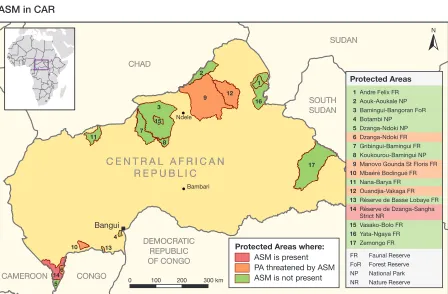
6 5 1 16 12 9 2 3 11 10 4 13 17 15 DEMOCRATIC REPUBLIC OF CONGO DEMOCRATIC REPUBLIC OF CONGO CONGO CONGO SUDAN SUDAN CHAD CHAD CAMEROON CAMEROON SOUTH SUDAN SOUTH SUDAN
C E N T R A L A F R I C A N R E P U B L I C C E N T R A L A F R I C A N
R E P U B L I C
Bangui Bambari Ndele 146 5 8 15 7 N
Andre Felix FR Aouk-Aoukale NP Bamingui-Bangoran FoR Botambi NP Dzanga-Ndoki NP Dzanga-Ndoki FR Gribingui-Bamingui FR Koukourou-Bamingui NP Manovo Gounda St Floris FR Mbaéré Bodingué FR Nana-Barya FR Ouandjia-Vakaga FR Réserve de Basse Lobaye FR Réserve de Dzanga-Sangha Strict NR
Vasako-Bolo FR Yata-Ngaya FR Zemongo FR Protected Areas
FR Faunal Reserve FoR Forest Reserve NP National Park NR Nature Reserve
1 2 3 4 5 6 7 8 9 10 11 12 13 14 15 16 17
0 100 200 300 km
Protected Areas where:
ASM is present PA threatened by ASM ASM is not present FiguRE 6.5
ASM in CAR
Using data provided by PRADD/WWF-CARPO/GTZ (Chantiers d’exploitation miniere (diamants) dans la Reserve Speciale de Dzanga-Sangha) the CAR map shows where known ASM occurs. By cross-referencing known diamond deposits with protected areas, a list of protected areas threatened by ASM has been produced.
Overview of the ASM sector
and its impact on critical
protected areas
The ASM sector dominates the CAR extrac-tive industry, particularly in the diamond field, and brings with it a host of social issues. As in other countries, exploitative labor rela-tionships, smuggling, and links to armed groups have been documented (ICG, 2010). Despite ASM being a fundamental liveli-hood activity for thousands of people, most are unable to escape poverty. In addition, ASM activity in a number of protected areas, including Mbaére-Bodingué National Park, Manovo-Gounda-Saint-Floris National Park, and near Dzanga-Sangha National Park, poses an environmental threat and nega-tively impacts apes (Figure 6.5).
This network of protected areas in the CAR together makes up more than 10% of the national territory (World Bank, 2010). However, one-third of these areas have been deemed ‘paper parks’, in the sense that they afford little protection owing to a lack of resources and enforcement (Blom, Yamindou, and Prins, 2004). The parks in the south-west are the only ones located in dense closed Guineo-Congolian rainforest, which makes up about 15% of the country’s envi-ronment (de Wasseige et al., 2009). This northern part of the Congo basin is great ape habitat, and Dzanga-Sangha in partic-ular has important populations of western lowland gorillas and chimpanzees, among a total of 16 species of primates (Tieguhong
et al., 2009). Gorilla concentrations in the Dzanga sector of the park were estimated at 1.6 km-2 in 1996–97 (CARPE, 2010), and even higher in the Ndoki section. A more recent study from 2005 estimated concentra-tions in the park at around 1 km-2 (MIKE, 2005). Another important attribute of the area is its inclusion in the transboundary Sangha Trinational Landscape (TNS), one of 12 priority ecological landscapes
identi-fied in 2000 by the Congo Basin Partner-ship Facility. Overall, TNS has some of the health iest populations of great apes in Central Africa, making this accord partic-ularly important, as it enables cross-border patrols and harmonization of laws and regulations. Indeed, the principal threats to the TNS landscape include hunting and commercial bushmeat trade, but also unsus-tainable commercial logging, the ivory trade, the capture of grey parrots, and uncontrolled ASM (de Wasseige et al., 2009).
Mining activity was first observed in the Dzanga-Sangha area during a patrol in 1997 (CARPE, 2009). While most of the activity is located in the special reserve, sur-veys conducted in 2002 and 2006 show a steady movement towards the Dzanga sector of the park, in some places coming within 2 km of the boundary (Tieguhong et al., 2009). Characterizing the ecological impact of ASM, however, requires looking at the specific impact, and its geographical as well as temporal scale (DeJong, 2012a). While a single miner may destroy plenty of vegetation, the severity of an impact cannot be assessed without looking at the cumulative effect of many miners, as well as to what extent regen-erative capacity naturally reverses the effects through time (World Bank, 2008).
minimal negative impact on the environment, given the small geographical scale and the fact that many of the effects, such as forest degradation, are reversible (Tieguhong et al., 2009). Nevertheless, the largest direct threats to great apes besides habitat loss, including disease outbreak and poaching, are exacer-bated by their proximity to humans, and ASM brings hunters and disease-carriers closer to gorillas and chimpanzees (see Chapter 7).
Motivations of miners
While CAR’s mining communities are often refugees and have come from elsewhere (Freudenberger and Mogba, 1998), diamond mining near Dzanga-Sangha is not a “rush” situation, but instead has a long and grad-ual history of advancement. Indeed,
socio-economic studies reveal that diamonds have been the primary livelihood for the majority of people for many years (DeJong, 2012a). In this sense, pull factors appear to be less prominent. Instead, push factors seem to be at work, including the fact that many of the best claims near villages are either already mined out or belong to someone else, which pushes people towards new territory (DeJong, 2012a). However, there is also evidence that people have customary claims in areas in the special reserve that go back many years, per-haps pre-dating the park’s creation (DeJong, 2012a) . However, most are aware that they are operating in or near the park, suggest-ing that poorly understood limits are not an issue. In addition, miners report on con-frontations with state authorities, including ecoguards (Tieguhong et al., 2009), which
suggests that enforcement is not enough to deter people from working. At a most basic level, since mining is the most important source of revenue for many people, working in unexploited areas known to have depos-its is worth the risk of some harassment and the hardship of living for weeks or months as far as 50 km from home.
Attempts to mitigate the impact
of ASM in the CAR
A number of mitigation techniques to reduce the impact of ASM on protected areas have been suggested in the case of the CAR.
Enforcement
Effective enforcement requires sensitization, establishing a clear and accepted under-standing of park boundaries, and building positive relationships with surrounding communities. These have all been important cornerstones of the strategy in Dzanga-Sangha (CARPE, 2010). However, percep-tions by miners of unwarranted harassment by guards (DeJong, 2012a) and the fact that guards continue to confiscate mining mate-rial (DeJong, 2012b) show that this tactic may be too narrow in scope.
Alternative livelihoods
Understanding how mining fits into an overall livelihood picture is needed for any “alternative” livelihood to succeed. Accord ing to WWF, the problem of mining in Dzanga-Sangha will not be resolved unless the would-be miners can make a decent living outside the park doing other activities (J. Yarissem, personal communication, 2012). However, it is difficult to find activities that can provide better financial prospects than artisanal min-ing (Tschakert, 2009).
The Property Rights and Artisanal Diamond Development (PRADD) program is a joint US State Department and USAID
initiative aimed at increasing the amount of diamonds entering the legal chain of custody. Its objectives are to:
Clarify and formalize rights to land and natural resources;
Improve monitoring of the production and sale of diamonds;
Increase the benefits accruing to mining communities;
Strengthen capacity to mitigate environ-mental damage; and
Improve stakeholders’ access to crucial information.
While new mines are continually being established, others are inherited, purchased, or given as gifts. Through the clarification of these customary means of acquisition, and by focusing specifically on claimant identity, land transactions, and mining documenta-tion PRADD has been able to take advan-tage of opportunities present in the current Mining Code for registering legitimate claims. The environmental rehabilitation program includes the provision of technical assist-ance to miners to convert mined-out pits into fishponds, agroforestry plots, and vegetable gardens. The program is a unique attempt to meld together livelihood diversification with environmental rehabilitation, and stands out from other regulatory-driven attempts which have had limited success (DeJong, 2012a). It has also proved popular, with at least 381 rehabilitated sites being counted in under a year (DeJong, 2012a).
aim was never to foster alternative liveli-hoods, but rather to promote complementary ones while strengthening the legal and fiscal regimes that underlie ASM.
Sustainable development policies
It is possible that a sustainable development of the diamond economy could in fact have a positive long-term effect on great ape con-servation, provided it leads to economic growth, stronger institutions, and greater respect for the rule of law. CAR is still far from reaching this point, considering its extreme poverty, lack of institutional coor-dination, limited capacity, and the recent uptick in industrial mining deals. However, the holistic approaches being piloted, like land-use planning and property rights clari-fication (e.g. PRADD), offer a glimpse of strategies that stand a good chance of ena-bling both people and primates to thrive.
The Democratic Republic of
Congo (DRC)
Environmental impacts of ASM
and associated threats to apes
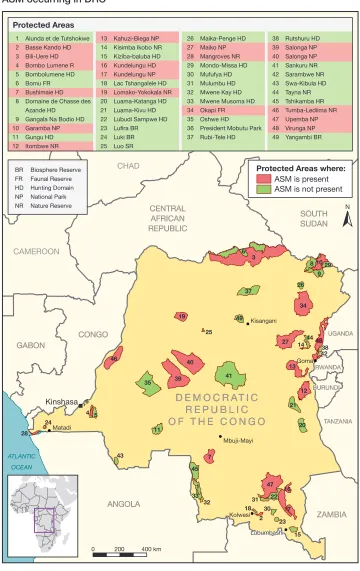
The DRC is a unique region for biodiver-sity in Africa and the only country on earth to have three species of great ape (Draulens and Van Krunkelsven, 2002), the mountain gorilla (Gorilla beringei beringei), Grauer’s gorilla (Gorilla beringei graueri), bonobo (Pan paniscus), central chimpanzee (Pan troglodytes troglodytes), and eastern chim-panzee (Pan troglodytes schweinfurthii). ASM and associated activities such as wildlife hunting and the bushmeat trade are known to occur in many of the DRC’s protected areas and critical ecosystems (Figure 6.6). However, judging the relative significance of ASM as a threat to protected areas and apes against other activities is not a simple task because they often occur in tandem,rather than being independent of one another. Moreover, many of the threats are less obvi-ous as they relate to habitat destruction or reduction. Major threats include: logging (legally and illegally), large-scale extractive projects, the presence of refugees and/or armed groups, and the site-specific partic-ularities of mining, charcoal making, agri-cultural conversion, and bushmeat hunting and other illegal wildlife trade. An addi-tional ring of environmental degradation is created by the construction of access routes for miners allowing other people to penetrate further into remote areas well beyond the time frame of direct mining activity.
Bushmeat hunting and the illegal wild-life trade is a case in point of ASM occurring in conjunction with, and often inciting, other human activities that have a detrimental impact on the environment. Hunting for ivory, and the capture of birds and baby chimpanzees, often takes place at artisanal mining sites, as the buyers of minerals are likely to engage in other lucrative activities as well. In the southern Congo alone, 300 gorillas were estimated to have been killed in 2009 to supply the local bushmeat markets (Endangered Species International, 2009). Concurrent with the invasion of the Bili– Uéré Domaine de Chasse by approximately 3000 gold miners in June 2007, a five-year survey documented expansion of the bush-meat trade to the south of the Uélé River, linked to the artisanal diamond and gold mining industries and centered on Buta (Hicks et al., 2010). By contrast, in areas where there was no ASM, they found no snares and limited evidence of bushmeat and related trades (e.g. skins) in nearby forest zones. While researchers found that the miners consumed primate bushmeat, and that a higher proportion of miners admitted to hunting and eating chimpanzees than did villagers (Darby, Gillespie, and Hicks, 2010; L. L. Darby, unpublished data), it should be noted that a 2012 ASM–PACE study
“
Judging the relative signifi-cance of ASM as a threat to protected areas and apes against other activities is not a simple task because they often occur in tandem.FiguRE 6.6
ASM occurring in DRC
Courtesy of ASM–PACE. 5 33 20 21 44 26 29 48 38 42 Lubumbashi BURUNDI BURUNDI Kisangani ZAMBIA ZAMBIA CONGO CONGO ANGOLA ANGOLA RWANDA RWANDA TANZANIA TANZANIA UGANDA UGANDA BURUNDI BURUNDI SOUTH SUDAN SOUTH SUDAN CENTRAL AFRICAN REPUBLIC CENTRAL AFRICAN REPUBLIC GABON GABON CAMEROON CAMEROON CHAD CHAD
D E M O C R AT I C R E P U B L I C O F T H E C O N G O
D E M O C R AT I C R E P U B L I C O F T H E C O N G O
Kinshasa Mbuji-Mayi Matadi Lubumbashi Kolwesi Goma ATLANTIC OCEAN 28 24 6 4 5 43 11 35 39 40 41 46 19 25 49 37 15 23 18 2 30 31 47 7 45 1 33 32 16 17 22 20 21 12 13 27 1444 48
38 42 34 26
9 8 10 29 6
3
Alunda et de Tutshokwe Basse Kando HD Bili-Uere HD Bombo Lumene R Bombolumene HD Bomu FR Bushimaie HD Domaine de Chasse des Azande HD
Gangala Na Bodio HD Garamba NP Gungu HD Itombwe NR 1 2 3 4 5 6 7 8 9 10 11 12 Kahuzi-Biega NP Kisimba Ikobo NR Kiziba-baluba HD Kundelungu HD Kundelungu NP Lac Tshangalele HD Lomako-Yokokala NR Luama-Katanga HD Luama-Kivu HD Lubudi Sampwe HD Lufira BR Luki BR Luo SR 13 14 15 16 17 18 19 20 21 22 23 24 25 Maika-Penge HD Maiko NP Mangroves NR Mondo-Missa HD Mufufya HD Mulumbu HD Mwene Kay HD Mwene Musoma HD Okapi FR Oshwe HD President Mobutu Park Rubi-Tele HD 26 27 28 29 30 31 32 33 34 35 36 37 Rutshuru HD Salonga NP Salonga NP Sankuru NR Sarambwe NR Swa-Kibula HD Tayna NR Tshikamba HR Tumba-Lediima NR Upemba NP Virunga NP Yangambi BR 38 39 40 41 42 43 44 45 46 47 48 49 Protected Areas
Protected Areas where:
0 200 400 km
N BR Biosphere Reserve
FR Faunal Reserve HD Hunting Domain NP National Park NR Nature Reserve
found this not to be the case in the eastern part of the Itombwe Reserve where cultural beliefs kept people from consuming apes (Weinberg et al., 2012, 2013).
Kahuzi-Biéga National Park
(KBNP): co-existence and
conflict between conservation
and the ASM sector
Located in South Kivu, near the DRC’s border with Rwanda, the Kahuzi-Biéga National Park (KBNP) was founded in 1970 and became a World Heritage Site in 1980 (Walker Painemilla et al., 2010). Its status was upgraded to World Heritage Site in Danger in 1997 (Plumptre et al., 2009), and it is now managed by the Congolese Wild-life Authority (ICCN – Institut Congolais pour la Conservation de la Nature), with support from a host of international organ-izations. The park forms a part of the Congo Basin ecosystem as well as the Albertine Rift. With an area of 6000 km2, it boasts a wide array of dense primary tropical for-ests, montane forfor-ests, and bamboo galleries. The high mountains in the east, including the non-active volcanoes Mount Kahuzi (3308 m) and Mount Biéga (2790 m), are connected by a corridor to the lower alti-tude tropical forests of the west (D’Souza, 2003). This critical ecological corridor is one of the most conflicted parts of the park, with tensions especially high between local communities and park authorities as those communities which were originally located within park boundaries seek to regain access to the land.
The high and low altitudes serve as the habitat for 136 species of mammals, includ-ing 13 species of primates: the endangered Grauer’s gorilla, chimpanzees, baboons, three different colobus species, and five different guenon species (D’Souza, 2003). Studies at the end of the twentieth century estimated eastern lowland gorilla populations to be at
and then Deutsche Gesellschaft für Technische Zusammenarbeit (GTZ, German Technical Cooperation enterprise) increased the low-land area of the park’s boundaries from 750 km2 (UNEP-WCMC, 2011) to 6000 km2, culminating in an official extension of the park (UNEP-WCMC, 2011). The 13 000 people of the Shi, Tembo, and Rega tribes who were living in the extension zone were told to move outside of the new conservation zone (Barume, 2000). These tribes had practiced agriculture, cattle grazing, and mining on the land years before these lands became protected.
As the population was unwilling to move after the decision to extend the national park, authorities used force and destroyed farms and cattle that remained in the exten-sion zone. People retaliated by setting fire to hundreds of hectares of the park (Barume, 2000). By 1995, there were still 15 000 people living inside, despite the ICCN’s efforts to negotiate compensation for their coopera-tion in resettlement. It was not until 2007 that the KBNP, with support from partners, engaged with these communities in a lengthy negotiation over the demarcation.
Programs offering an
alternative way forward in
dealing with ASM in the
DRC’s conservation areas
There are a number of examples of on-going programs and initiatives in the DRC that engage with ASM on environmental con-cerns. Some of these include:Central African Regional Program
for the Environment (CARPE)
CARPE began operation in 1997 and is cur-rently under consideration for extension into 2016 (CARPE, 2011). It is a USAID-funded consortium focusing primarily on “reducing the rate of forest degradation andloss of biodiversity [in the Congo Basin forest of which the DRC forms a large part of the landscape] by supporting increased local, national, and regional natural resource management capacity” (IUCN, 2011). Through CARPE funding NGOs such as WWF have been able to engage with ASM.
Growth with Governance in
the Mineral Sector Project
(PROMINES)
PROMINES is an integrated, multi-sectorial and multi-component program initiated by the Government of the DRC, the World Bank, and the UK Department for Inter-national Development (DFID) to provide technical assistance to the mining sector, as well as improve its governance, efficiency, and future growth. The objective of the arti-sanal mining component of PROMINES is to improve the legal status, working prac-tices, and economic return of artisanal min-ing in the DRC whilst establishmin-ing mecha-nisms to sustainably reduce its negative impacts on society, security, and the envi-ronment. This project has a multi-million dollar component to tackle some of the key issues in the DRC’s ASM sector, including:
Improving environmental and social management aspects of ASM and mining sector legislation as a whole;
Helping to ensure that the revenues from ASM contribute to local and regional development;
Recommending an extensive environ-mental impact assessment of the mining sector.
Mining and mindful conservation
planning in the Itombwe Nature
Reserve
PACE are being neglected or underestimated early in planning processes. ASM–PACE, a joint program founded by Estelle Levin Ltd. and global conservation organization WWF, is working with WWF DRC and other conser-vation stakeholders focused on the Itombwe Nature Reserve (RNI),where final demar-cation is still awaiting approval by the State (Weinberg et al., 2012, 2013). Conservation and local CSOs (civil society organizations) have proposed the RNI be split into three zones: a human habitation zone, a resource-use zone, and a core protected zone. While it is in its early stages, this process aims to take into account existing mining activities in the proposed protected area and plan conservation strategies accordingly.
Gabon
Looking for a green future and
balancing conservation and
development
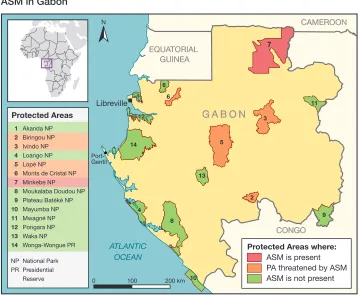
ASM in Gabon (Figure 6.7) is currently regu-lated by the Mining Code (Law N° 5/2000 of 12 October 2000), two additional texts, and a Presiden tial Decree fixing the condi-tions of application of law. Permission to engage in artisanal mining is granted by the Ministry of Mines in the form of a card for artisanal exploitation, the Carte d’Exploitation Artisanale (Hollestelle, 2012). By law, the Ministry of Mines can support small-scale operators in improving existing technolo-gies or introducing new techniques with regard to artisanal mining, but there remain several weaknesses in the law. For example (Hollestelle, 2012):
Legal artisanal miners are not bound by environmental or health regulations. The only mention of health is in an article that states that the Ministry of Mines needs to inform relevant local authorities of concentrations of human beings in artisanal mining camps as a
means of preventing epidemics such as cholera, AIDS, and Ebola.
Neither the Code nor the Decree men-tions any environmental obligation with respect to the practice of artisanal mining other than the aforementioned support to technology improvement.
Technically the government requires artisanal miners to sell mined gold at fixed prices that may be uncompetitive with the black market rates available. This require-ment – if and when enforced – may have the unintended consequence of exacerbat-ing smugglexacerbat-ing operations in the country. There are also currently problematic
def-initions in the government’s classification of “artisanal” and “small-scale” mining. Owing to imprecise language, there is a legal ‘gray’ area for certain types of ASM, specifically those artisanal sites that employ fewer than 70 people. There is currently very little incentive
to formalize activities. Indeed, artisanal miners gain little with the purchase of a Carte d’Exploitation. If anything, it puts them on the radar of the government when they are already in a weak negoti-ating position, even if legal.
Minkébé National Park –
Government interest in finding
“common ground”: using ASM
as a force for conservation
The environmental stakes are particularly high in Gabon. It has the highest forest cover as a proportion of national surface area in any African country, its pristine forests have brought attention from global conservation organizations, and it has been dubbed the “Green Heart of Africa.” Indeed, Gabon is home to five of the world’s 200 Global eco-regions, which together cover the entirety of the country, and its national parks contain important populations of western lowland gorillas and western chimpanzees. Thus far,
“
The environ-mental stakes are particularly high in Gabon. It has the highest forest cover as a propor-tion of napropor-tional surface area in any African country.low population density, government stew-ardship, and a case of ‘Dutch disease’ (due to its large dependence on the petroleum indus-try and mainly offshore wells) has meant that Gabon’s precious forests are largely intact.
“Dutch Disease implies declining com-petitiveness and structural change across sectors, normally triggering ‘deindustri-alisation’ in developed countries and ‘de-agriculturisation’ in developing countries. Yet, this de-agriculturisation also tends to significantly reduce pressures to convert land for agricultural uses, which globally is the principal direct cause of deforestation” (Hollestelle, 2012).
However, since oil production “peaked” in the late 1990s in Gabon, there have been few major oil discoveries, and logging and mining have steadily increased in impor-tance as sources of revenue (Lahm, 2002). A series of oil palm plantations is currently under development in the country as a means of further diversifying the economy and sev-eral large mining projects have commenced or are planned, including in neighboring areas of Cameroon and Republic of Congo, with associated regional infrastructure projects.
For years, ASM was a relatively over-looked sector at the national level, although gold panning has been a major source of
1
12
CONGO CONGO
CAMEROON CAMEROON
EQUATORIAL GUINEA EQUATORIAL
GUINEA
G A B O N G A B O N
Libreville
Port-Gentil
Libreville
Port-Gentil
ATLANTIC OCEAN
6 6
14
8 4
13 5
3
9 11
7
10 12
2 1
0 100 200 km
N
Protected Areas where:
ASM is present PA threatened by ASM ASM is not present
Protected Areas
NP National Park PR Presidential
Reserve
1 2 3 4 5 6 7 8 9 10 11 12 13 14
Akanda NP Biringou NP Ivindo NP Loango NP Lopé NP Monts de Cristal NP Minkebe NP Moukalaba Doudou NP Plateau Batéké NP Mayumba NP Mwagné NP Pongara NP Waka NP Wonga-Wongue PR
Minkébé National Park is the only protected area in Gabon where ASM is known to be occurring with a significant numbers of miners, and thus where it is likely to have significant impacts on apes. ASM is also known to have taken place in Moukalaba Doudou National Park and Monts de Cristal National Park; however those in Moukalaba Doudou areas were inactive at the time of writing, and the ASM within Monts de Cristal is deemed manageable due to the low number of miners present. The map derives from a sketch map of Gabonese Greenstone belts and major banded iron formations (Hollestelle, 2012). Where these formations overlap PAs, they are considered at risk of ASM activities. Indeed, Ivindo National Park is known to have ASM activity on its outskirts.
Courtesy of ASM–PACE.
FiguRE 6.7
revenue for many families in northeastern Gabon since the 1940s (Lahm, 2002). While artisanal and small-scale gold mining in the buffer zone of Minkébé National Park has long been a source of tension, in 2008 the situation became significantly worse in terms of the large number of miners present in the Minkébé camps following the climb in global gold prices. This was facilitated by the sparse presence of national park guards and monitoring teams in the park. A com-bination of local discontentment with the view that foreigners were financially ben-efitting from uncontrolled illegal ASM, concern by the State as to the illegality and lack of revenues from the gold sector in Minkébé, and concerns that poaching for bushmeat, ivory and other illegal activities were increasing at an alarming rate, led the government to evict all miners from Minkébé in June 2011 (Koumbi, 2009; Mbaza, 2011). The purge led to between 2000 and 5000 mainly Cameroonian illegal immigrants leav-ing the Minkébé ASM zone. The Gabonese military personnel have remained in the area, also evicting illegal fishing and hunt-ing camps, and they still occupy these camps to prevent the miners from returning (Hollestelle, 2012).
However, there is now significant gov-ernment and local interest in re-opening the Minkébé camps to local Gabonese miners. The forced exit of illegal Cameroonian miners has apparently been welcomed by local miners, but they too lost their liveli-hoods and personal property as a result of the mass eviction. Though outnumbered in recent years, the Minkébé zone was his-torically populated with Gabonese miners, pit owners, and predominantly foreign traders, while most Gabonese traders were ambulant (Lahm, 2002). Gabonese miners who engaged with the different conserva-tion initiatives have often been keen for the government to step in, a sentiment likely to have been shared by other miners. As a
matter of fact, throughout the last decade reports on Minkébé and other mining camps consistently show a desire of Gabonese miners for their trade to be formalized and for the government to address the influx of foreigners. Combined with the government’s desire to control the gold trade and cou-pled with the Park Authorities’ desire to safe-guard the park for conservation purposes, the notion of economically and socially responsible artisanal and small-scale min-ing (ESER-ASM) gold seems appealmin-ing to all parties as a viable solution. The govern-ment has received support from donors to do a national scoping of ASM in PACE loca-tions as a first step to this larger vision of having ASM develop in line with the gov-ernment’s vision of a “Green Gabon.” When examples of “best practice” are few and far between, signals of pragmatism in solutions, constructive attention to the sector, and a desire to capitalize on its potential benefits and minimize its environmental impacts are a welcome change.
Management options for
mitigating the impacts of
ASM in protected areas
of existing national laws, due to low human capacity, insufficient budgets and equip-ment, corruption, and inadequate training or technical knowledge; something that is particularly relevant for many ape range states. Whether or not all of the stakehold-ers involved (minstakehold-ers, government agencies, international NGOs and governmental organizations) work together on a long-term strategy and have enough funding to finance the longevity of the strategy also has a major influence on policy success (Tranquilli
et al., 2012). Whatever the extent of such collaboration, population increases and pressures associated with greater devel-opment will likely increase over time, thus paying attention to the mining sector now will likely yield more fruit than paying attention when the threat becomes more severe. The following list of the most widely adopted policy strategies to contain ASM in PACE provides a limited overview of their successes and constraints.
Eviction
To clear miners from a specified area by use of force, or threat of force
This appears to be the most commonly used strategy, although it is more likely to be suc-cessful if coupled with alternative livelihood programs and improved park security. The risks with taking this approach include:
worsening relations with forest-adjacent communities;
the interruption of mining-dependent rural economies;
the potential for human rights abuse if eviction is done by undisciplined mili-tary (or risk of milimili-tary involvement in mining sector), and
pushing miners into increasingly remote and sensitive ecosystems, which has significant and deleterious effects for bio-diversity.
Furthermore, a long-term security strat-egy must be in place in order to prevent miners from re-entering the area in question. Without a robust program offering them an economic stake in respecting the border areas of the park, eviction is likely to fail and ultimately, perhaps, be a waste of time and resources.
Recent examples in ape range states include Sapo National Park in Liberia and Gola Forest Reserve in Sierra Leone. In Gola, the reason for eviction was given as the need to establish both the rule of law and the primacy of conservation priorities in the contested national park. In Liberia, the official rationale for the 2011 “voluntary departure” was for conservation. Other reasons suggested included an upcoming presidential election, the park’s remote loca-tion near an internaloca-tional border yet with access to roads leading to the capital city, and the profile of miners as ex-combatants. In the short-to-near term, the “voluntary departure” process seemingly left people eco-nomically worse off than before because of the disruption of the local economy and live-lihoods, and alleged actions by the enforce-ment agencies to maintain the eviction of all persons from the national park. Furthermore, LSM in the south of the park was due to begin soon after, and the potential for dis-placing ASM participants back towards the national park was high. It was likely that due to insufficient government monitoring, LSM push factors, and poor knowledge of park boundaries by ASM participants that miners/diggers would soon once again be active in the park (Villegas et al., 2012).
Negotiated access
To allow conditioned access to protected areas where limited ASM is permitted under agreed conditions
The aim of this is to regulate and limit ASM in PACE, and is more likely to be successful
in long-established mining sites with strong local community connections and the poten-tial for collaborative efforts to fulfill the agreement. In Brownsberg National Park in Suriname, a 2010–11 agreement was nego-tiated between park authorities, a facilitating NGO, and local gold miners. In exchange for legal access, the miners would help maintain the road leading up to the tourist lodges in the park. This agreement mutu-ally broke down, however, when authorities failed to clearly delineate the park bounda-ries and the miners did not fix the road within the desired time frame. Ultimately, the dialog appears to have stopped and the miners continue to work as before. While the potential for this to either be reinitiated in Brownsberg National Park or replicated elsewhere is currently unclear, it is evident that without the necessary trust-building, accountability, and arbitration methods, conditions for negotiated access are unlikely to be met. Indeed, since 2011, the government has returned to a policy of no artisanal gold mining in protected areas.
Geographically based
multi-stakeholder supply
chain initiatives
To use a participatory method to engage all stakeholders in developing a sustainable supply chain