Study on the effectiveness of transfusion program in
dengue patients receiving platelet transfusion
Nagarekha Kulkarni
ABSTRACT
Aims: Dengue infection is a global health problem affecting an estimated population of 50–100 millions every year. Thrombocytopenia is an essential diagnostic criteria. Platelet transfusion is given in those patients who have
haemorrhagic manifestations along with
thrombocytopenia. The aim of the study was to know the effectiveness of platelet transfusion in dengue patients. Methods: The study was conducted during the epidemic of dengue fever from July 2011 to October 2011. Serologically confirmed dengue cases were included in the study. Results: Two hundred thirty two patients were positive for dengue serological tests of which 195 (84.2%), 35 (15%), 2 (0.8%) were DF, DHF DSS respectively. One hundred eighty two (78.4%) patients received platelet transfusion. One hundred eighteen (51%) cases received single unit of platelet transfusion though platelet count was between 0.2–1.0x10⁵/mm3.
Sixty four (27.5%) patients who had platelet count <0.2x10⁵/mm3 received multiple platelet
transfusions. The patient who received multiple platelet transfusion of 10–12 units showed post transfusion increment of >0.5x10⁵/mm3 and
they were discharged after 5–6 days of hospitalization. Conclusion: This study suggests
that 51% platelet transfusions are inappropriate and it is more effective when it is given to patients with platelet count <0.2x10⁵/mm3.
Platelet transfusion practice should be based
upon platelet count and haemorrhagic
manifestations as this decreases hospitalization of the patients and complications of dengue. Keywords: Dengue, Thrombocytopenia, Platelet transfusion, Haemorrhagic manifestation
*********
Kulkarni N. Study on the effectiveness of transfusion program in dengue patients receiving platelet transfusion. International Journal of Blood Transfusion and Immunohematology 2012;2:11–15.
Article ID: 100008IJBTINK2012
*********
doi:10.5348/ijbti20128OA3
INTRODUCTION
Dengue is the most prevalent mosquito–borne viral disease. In recent years, dengue has become world wide public health concern affecting an estimated population of 50–100 million people each year. The South–Asian countries such as India, Indonesia, Myanmar and Thailand are at highest risk of dengue accounting for nearly half of the global risk [1]. In India, epidemics are becoming more frequent and are straining the limited resources of the public health system. Many dengue cases are self–limiting but complications such as hemorrhage and shock can be life threatening [2].
Based on the studies in children in Southeast Asia in the year 1960 WHO has classified dengue cases into dengue fever (DF), dengue hemorrhagic fever (DHF)
ORIGINAL ARTICLE OPEN ACCESS
Nagarekha Kulkarni
1,
Affiliations:
1Associate Professor, Department of
Pathology, Vijayanagara Institute of Medical Sciences,
Bellary - 5831 04, Karnataka, India.
Corresponding Author: Dr. Nagarekha Kulkarni, Associate
Professor, Department of Pathology, Vijayanagara
Institute of Medical Sciences, Bellary - 5831 04.
Karnataka, India.
WHO, dengue fever is clinically defined as an acute febrile illness with two or more manifestations (headache, retroorbital pain, myalgia, arthralgia, rash, haemorrhagic manifestations or leucopenia) and occuring at the same location and time as other confirmed cases of dengue fever. The hallmark of DHF that differentiates it from DF is not haemorrhage as its name suggests, but rather the increased vascular permeability that leads to a capillary leak syndrome. DHF cases must meet all four of the following criteria: i) fever or history of fever lasting 2–7 days, ii) a haemorrhagic tendency shown by a positive tourniquet test or spontaneous bleeding, iii) thrombocytopenia (platelet count 1x10⁵/mm3 or less), iv) and evidence of
plasma leakage shown either by haemoconcentration with substantial changes in serial measurements of packedcell volume or by the development of pleural effusion, ascites or both. DHF is further classified into four severity grades according to the presence or absence of spontaneous bleeding and the severity of plasma leakage.
The DSS refers to DHF grade III and grade IV, in which shock is present along with four DHFdefining criteria. Moderate shock, identified by narrowing of the pulse pressure or hypotension for age, is present in grade III DHF, whereas profound shock with no detectable pulse or blood pressure is present in grade IV DHF.
The clinical diagnosis of DF/DHF especially in the early phase of illness is not easy. Thrombocytopenia is an essential dagnostic criteria for DHF [2]. In the confirmed DHF cases, Samsie et al. in Jakarata, observed thrombocytopenia in 9% cases on admission and in 38% during hospitalization [4]. Bleeding is one of the dreaded complication and is associated with higher mortality in DHF/DSS. Bleeding manifestations are highly variable and do not always correlate with the laboratory abnormalities in the coagulation profile. Platelet transfusion is given in those patients who is either bleeding or having other haemorrhagic symptoms along with thrombocytopenia [5]. There is shortage of blood and blood components in most of the developing world. The resources are inadequate in terms of meeting the ever growing demand of blood components especially platelets. Appropriate use of blood components is required to ensure their availability for needy patients as well as to avoid the unnecessary risk of transfusion transmitted diseases [6].
The aim of the study was to evaluate the effectiveness of platelet transfusion in dengue patients.
MATERIALS AND METHODS
The study included clinically suspected cases of dengue infection who had come with a requisition for platelet transfusion to the blood bank between July 2011 to October 2011 at Medical College Hospital blood bank. Cases who were positive for dengue serological tests were included in the study and rest were excluded from the study. Patients were identified as suspected dengue
following symptoms: myalgia, arthralgia, headacha, retroorbital pain, bleeding, shock or low platelet count. All clinical findings and laboratory investigations were recorded from the time of admission to the time of discharge. The age of the patient, duration of fever before admission, result of the dengue serological test, haematocrit and platelet count on admission and during hospitalization, presence of haemorrhagic manifestation like petechiae, haematemesis, melena, gum bleeding and epistaxis and admission of platelet transfusion were recorded and analysed. Guidelines for platelet transfusion (including indications, dose and monitoring of response to platelet transfusion) developed at University College of Medical Sciences and Guru Teg Bahadur (UCMS & GTB) Hospital, Delhi were utilized as the criteria to assess the effectiveness of platelet transfusion during the study as shown in (Table 1) [7].
Laboratory tests to confirm dengue infection includes haemaglutination inhibition (HI) test and the IgM dengue blot test. The HI antibody titre was performed in paired sera, while the IgM dengue blot tests were performed on the acute sera only.
RESULTS
During the epidemic of dengue fever, of the 280 clinically suspected dengue cases, 232 (82.85%) cases were positive for dengue serological tests. Among 232 serologically posititve dengue cases, 195 (84.2%) cases were DF, 35 (15%) cases were DHF and 2 (0.8%) cases were DSS. One hundred thirty six (58.6%) patients were males and 96 (41.4%) were females. Involvement of all age groups were observed, but most patients were between the age group of 1–10 years 95 (41%) cases as shown in table 2. For 20 (9%) out of 232 serologically confirmed cases there was no information about the duration of fever in the medical records. The information was available for only 212 cases as shown in table 3. Two DSS patients developed shock after two to four days of fever and were hospitalized.
Table 1: Criteria for platelet transfusion in dengue haemorrhagic fever.
Indications
Prophylactic transfusion (in a non bleeding patient): Platelet count <0.2x10⁵/mm3
Therapeutic transfusion (in a bleeding patient):
Significant active clinical bleeding with platelet count <0.5x10⁵/mm3
Proven disseminated intravascular coagulation Dosage:
Adults:1–1.5 units of platelet concentrate/10kg Neonates:1 unit of platelet concentrate/2.5kg Response to platelet transfusion
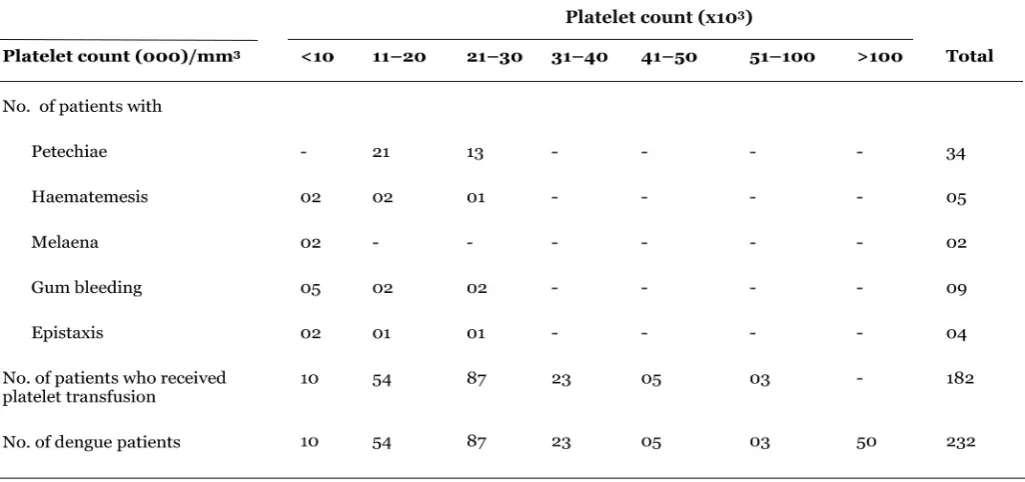
Haemorrhagic manifestations were present in 54 (23.3%) cases out of 232 dengue cases as shown in table 4. Sixty nine percent of the haemorrhagic manifestations occurred in patients with severe thrombocytopenia with platelet count <0.2x10⁵/mm3. Fifty four percent
haemorrhagic manifestations occurred between 4thto 6th
day, 33% occurred between 7th to 9th day and 17%
occurred more than nine days after the onset of fever. Of 232 serologically confirmed cases of dengue, thrombocytopenia with platelet count <10x105/mm3was
present in 72 cases (31%) on admission and 110 cases (47%) during hospitalization. Majority of cases developed thrombocytopenia between the fifth and sixth day of illness. One hundred fifty five (79%) of the 195 cases with DF required platelet transfusion. Similarly 25 (71%) out of 35 DHF cases and both DSS cases required platelet transfusion. Severe thrombocytopenia with platelet count <0.2x10⁵/mm3was present in 64 (27.5%)
out of 232 dengue cases. Platelet count between 0.2–10x105/mm3 was present in 118 (51%) cases.
Platelet count >10x105/mm3 was present in 50 (21.5%)
patients. Out of 232 serologically confirmed cases 182 (78.4%) received whole blood derived random donor platelet (RDP) transfusion therapy.
The patients having platelet count >10x105/mm3 did
not receive platelet transfusion. One hundred eighteen (51%) patients whose platelet count was between 0.2–10x105/mm3 as per the clinicians advice received
single unit of platelet transfusion. Sixty four (27.5%) patients who had platelet count <0.2x10⁵/mm3received
multiple platelet transfusions. Among 64 patients, 47 (74%) patients received 12 units and 17 (26%) patients received 10 units of platelets. Twenty patients who had abnormal coagulation profile, received FFP with platelet transfusions.
Thirty patients who had Hb <7.0 g/dl received packed red cells (PRC) along with platelet transfusion.
Five patients were suffering from falciparum malaria along with dengue. Information regarding clinical recovery or on post transfusion platelet increment was available in 182 (82%) cases out of 222 cases, because 10 patients died during hospitalization (mortality 4%). Subsequent bleeding, platelet increment, platelet recovery were similar in the patients who received single unit of platelet transfusion or those who did not receive platelets. The patient who received multiple platelet transfusions of 1012 units showed post transfusion platelet increment of >0.5x10⁵/mm3. All the
patient recovered completely within 5–6 day of hospitalization and were discharged.
Eight patients who were suffering from DHF died in hospital more than 48 hours after admission and two Table 2: Incidence of DF/DHF/DSS patients by age and sex.
Age
(Years) Male(n = 136) (58.6%)
Female (n = 96) (41.4%)
Total (n = 232) (100%)
1–10 61 34 95 (41%)
11–20 26 25 51 (22%)
21–30 32 22 54 (23.5%)
31–40 12 10 22 (9%)
41–50 3 5 8 (3%)
>50 2 2 (1.5%)
Table 4: Dengue patients with thrombocytopenia and bleeding who received platelets transfusion.
Platelet count (x103)
admission.
DISCUSSION
Dengue infection is a major public health problem in India which is endemic in this area. Platelet transfusion is given in those patients who are either bleeding or have other haemorrhagic symptoms along with thrombocytopenia. There is perennial shortage of blood and blood components in most of the developing world. The resources are inadequate in terms of meeting the ever growing demand of blood components, especially platelets [6]. Makroo et al. studied 225 serologically confirmed cases and classified 199 (88.4%), 21 (9.3%) and 5 (2.2%) patients as DF, DHF, DSS respectively which is similar to the present study [1]. This study shows that majority of dengue cases (41%) were children with the largest population in the age group of 1–10 years. This is similar with other studies from Indonesia, Thailand and Myanmar [5, 8, 9]. As per other workers, in the serologically and virologically confirmed cases, most patients were in the 5–9 year age group and recorded 60–180 infections/1000 children from 2001 to 2003 [8, 9]. In concurrent transmission of several serotypes, primary dengue virus infections are seen in young children, whereas symptomatic dengue generally occurs during secondary dengue virus infections in school age children or young adults [11].
The clinical diagnosis of dengue infection especially in the early phase of illness is not easy. It is difficult to differentiate dengue cases from other febrile illness. Later, usually after 3–4 days, when thrombocytopenia and haemoconcentration are present, DHF is easier to diagnose [5]. In this study 53% dengue cases were admitted before day four of their illness, but in the study by Nimmannitya et al. 59% of dengue cases were admitted between 5–7 days of the illness [11].
Makroo et al. recorded 15.11% and Chairulfatah et al. recorded 6% of dengue cases with haemorrhagic manifestation and both observed severe bleeding with platelet count <0.2x10⁵/mm3 [12, 13]. In the present
study haemorrhagic manifestations were present in 37% cases which includes petechiae, haematemesis, melaena, gum bleeding and epistaxis. These were more often seen in patients with platelet count <0.2x10⁵/mm3
[1, 5]. Bleeding during DF/DHF/DSS may result from a combination of factors such as thrombocytopenia, coagulation defect and vasculopathy [14]. Before platelet transfusion is given to a patient of DF/DHF/DSS coagulation profile should be done to rule out the cause of bleeding.
In this study thrombocytopenia was found in 78.4% of the confirmed cases on admission. This prevalence is similar to the findings of Sumaro et al. but differ from other authors [8–11].
Published data from various institutions [15, 16] and countries have put varying figures as the trigger for platelet transfusion in hospitalized dengue patients. The DHSguidelines stipulate that platelet transfusion
<0.2x10⁵/mm3. In this study 64 (27.5%) patients who
had platelet count <0.2x10⁵/mm3 received multiple
platelet transfusions and 118 (51%) patients whose platelet count was between 0.2–10x105/mm3 received
single unit of platelet transfusion. Guidelines of platelet transfusion developed at UCMS & GTB Hospital were utilized as the criteria to assess the effectiveness of platelet transfusion during this study [7]. In the present study 51% patients received platelet transfusion with out any indication. Kumar et al. [17] had found 56.2% of inappropriate platelet transfusion during dengue epidemic in Delhi during 1999 and Makroo et al. [1] recorded inappropriate platelet transfusion in 13% patients without any specific indications because of panic reaction during the epidemic of dengue fever. Observing a fall in platelet count even if the count were well above 0.2x10⁵/mm3the prescribing clinicians start
sending requisition not based on medical rationale, but as a response to an intense social pressure on the treating physicians by the patient and their relatives. Makroo et al. found 0.8% mortality rate but in the present study the high rate (4%) may be due to severe bleeding.
No difference in the frequency of bleeding was observed by Sugianto et al. [18] in the patients who received single unit of platelet transfusion or the one who did not receive platelets. In the study by Makroo et al. patients were discharged with in 2–5 days of their last transfusion which is similar to the present study.
Makroo et al. [1] studied 242 dengue cases and categorized the dengue cases into four categories based on the platelet count:
1. High risk: Transfusion should be given top priority for the patients whose platelet count <0.2x10⁵/mm3.
2. Moderate risk: Those patients whose platelet count is >0.2x10⁵/mm3but < 10x105/mm3 should
be given platelet transfusion if they have haemorrhagic manifestation.
3. Low risk: If the platelet count is >0.4x10⁵/mm3
and <10x105/mm3 for the age and sex should be
observed carefully but should not receive platelet transfusion .
4. No risk:If the platelet count is >10x105/mm3 they
should never be transfused with platelet and should be managed conservatively with supportive therapy.
CONCLUSION
complications and mortality. Platelet products are scarcely available and expensive hence a judicious use is suggested. Patients should be counselled about the improvements in the clinical features, as suggested by WHO in the form of improved appetite, decrease in fever, absence of bleeding and platelet count >0.5x10⁵/mm3as the discharge criteria for dengue.
*********
Author Contributions
Nagarekha Kulkarni – Substantial contributions to conception and design, Acquisition of data, Analysis and interpretation of data, Drafting the article, Revising it critically for important intellectual content, Final approval of the version to be published
Guarantor
The corresponding author is the guarantor of submission.
Conflict of Interest
Authors declare no conflict of interest.
Copyright
© Nagarekha Kulkarni et al. 2012; This article is distributed under the terms of Creative Commons attribution 3.0 License which permits unrestricted use, distribution and reproduction in any means provided the original authors and original publisher are properly credited. (Please see www.ijbti.com/copyright policy.php for more information.)
REFERENCES
1. RN Makroo, V Raina, P Kumar, RK Kanth. Role of platelet transfusion in the management of dengue patients in a tertiary care hospital. Asian J TransSci 2007;1:4–7.
2. Pankaj Garg B. utility of clinical improvement and platelet count recovery Tim in children Hospitalized with suspected dengue in a resourcepoor area. http://www.jcdr.net/year 2008;2:6.
3. World Health Organization guidelines for treatment of dengue fever/dengue hemorrhagic fever (DF/DHF) Grading the severity of dengue infection 1999;2:3–5.
4. Samsie TK, sugianto D. Evaluation on concentrated platelet transfusion in severe dengue haemorrhgic fever: in proceedings of the national conference of Indonesian Paediatrics Association. Ujung pandang 1990:138–9.
5. Alex chairulfatah, Djatnika setiabudi, Ridad Agoes, Robert colebunders. Thrombocytopenia and platelet transfusion in dengue hemorrhagic fever and dengue shock syndrome. WHO Dengue Bulletin 2003;27:138–43.
6. Anupam Verma, Prashant Agarwal. platelet utilization in the developing world strategies to optimize platelet transfusion practices. Transfusion and Apheresis Science 2009;41(2):145–9.
7. Kumar ND, Tomar V, Singh B, Kela K. Platelet
transfusion practice during dengue fever epidemic. Indian J Pathol Microbiol 2000;42(1):55–60. 8. World health organization. Dengue haemorrhagic
fever: Diagnosis, treatment and control. 2nd ed. 1997, WHO, Geneva
9. Harun SR. Clinical aspects of dengue haemorrhagic fever in children: in proceedings of the seminar and workshop on dengue haemorrhagic fever and its control. Jakarta, 2728 November 1990:63–8. 10. Deen JL, Harris E, Wills B, et al. The WHO dengue
classification and case definitions:time for a reassement. Lancet 2006:170–3.
11. Nimmannitya S, Halstead SB, Cohen SN, Margiotta MR. Dengue and chikungunya virus infection in man in Thailand, 19621964. I. Observations on hospitalized patients with hemorrhagic fever. Am J of tropical medicine and hygiene 1969;18:954–71. 12. Sumarmo poorwosudarmo. Dengue haemorrhgic
fever (thesis). University of Indonesia Press 1983. 13. Chairulfatah A, Djatnika S, Agoes R, Colebunders R.
Clinical manifestations of dengue haemorrhagic fever in children in Bandung, Indonesia. Ann Soc Belg Med Trop 1995 Dec;75(4):291–5.
14. Shivbalan S, Anandnathan K, Balasubramanian S, Datta M, Amalraj E. Predictors of spontaneous bleeding in Dengue. Indian J Pediatr 2004;71:33–6. 15. Chairulfatah A, Setiabudi D, Agoes R, Colebunder R.
thrombocytopenia and platelet transfusions in dengue Haemorrhagic fever and Dengue Shock Syndrome. WHO Dengue Bulletin 2003;27:141–3. 16. Epidemiological News Bulletin: Management of
guidelines for dengue patients at Tan Tock Seng Hospital and communicable. Diseases centre, Singapore. Platelet Transfusion 2005;49.
17. Kumar ND, Tomar V, Singh B, Kela K. Platelet transfusion practice during dengue fever epidemic. Indian J Pathol Microbiol 2000;43:55–60.