
Volume 1, Issue 2, October 2012
Page 226
ABSTRACT
Cloud computing is an attractive computing model since it allows for resources to be provisioned according to a demand basis. It has also made it possible to process a large amount of data, using clusters of commodity computers. Moreover, the diffusion of cloud computing is expected to generate substantial direct and indirect impacts on economic and employment growth and also to face the world with new possibilities which are specific to cloud computing. In this paper we have introduced the most renowned cloud solution providers at present, and explained their features and different aspects. Besides, we have given a telling overview of cloud computing concept, service models and deployment methods.
Keywords: Cloud Solution Providers, Deployment Methods, Cloud Service Models, Cloud Concept
1. INTRODUCTION
Cloud computing is a pay-per-use consumption and delivery model that enables real-time delivery of configurable computing resources (for example, networks, servers, storage, applications, services) [2]. Typically, these are highly scalable resources delivered over the Internet to multiple companies, which pay only for what they use. Cloud delivery models can help organizations scale their investments as they grow their business. They can also open the door to new business approaches through standardized applications, infrastructure, testing environments and business processes that help improve service delivery and efficiency [1]. This concept that is broadly recognized by Australian businesses and government agencies. But not always well understood in details. To some degree, this is due to the rapid evolution of cloud computing service offering. Indeed, cloud computing is a catchall term that is often misused. The US National Institute of standards and Technology (NIST) defines cloud computing as:”A model for enabling ubiquitous, convenient, on demand network access to a shared pool of configurable computing resources that can be rapidly provisioned and released.”
In practice, cloud computing describes three over-aching and related service models, delivered over a network to replace product models. Each of these service lines displays the same core criteria. The concept itself has been around since the 1960s and has been boosted in recent years. Various factors have contributed to this such as the increased availability of broadband internet, improved technologies such as virtualization and new models to deliver web-based services. The concept itself has been around since the 1960s and has been boosted in recent years. Various factors have contributed to this such as the increased availability of broadband internet, improved technologies such as virtualization and new models to deliver web-based services. Cloud computing has the following main characteristics[4]:
• Multi-tenancy – IT resources are shared between different users and customers
• Rented service delivery model – customers pay for the service instead of buying software licenses and hardware • On-demand usage/flexibility – cloud services can be used almost instantly and can easily be scaled up and down • External data storage – a customers’ data is usually stored externally at the location of the cloud computing vendor Parts of IT resources can also be reserved and dedicated for one customer only. This type of cloud computing is called private cloud computing Cloud services can also be hosted, delivered and used exclusively within one organization. This is called internal cloud computing. As this variant is almost fully dependent on internal, on-premise IT resources, it is highly questionable if internal cloud computing should be defined as cloud computing at all. In this paper, we have first explained about the concept of cloud computing and its various categories. We have mentioned Cloud service models and Deployment methods at present in chapter 2. After that, in chapter three, we have focused on current reputed solution providers in the scope of cloud computing. Finally, chapter 4 concludes the paper.
2. CLOUD SERVICE MODELS AND DEPLOYMENT METHODS
A Survey on Cloud Computing and Current
Solution Providers
Vahid Ashktorab1 , Seyed Reza Taghizadeh2 , Dr. Kamran Zamanifar3
1
Department of Computer Engineering, Islamic Azad University of NajafAbaad, Isfahan, Iran
2Department of Information Technology, Kahje-Nassir-Toosi University of Technology, Tehran, Iran 3
Volume 1, Issue 2, October 2012
Page 227
Defining what comprises Cloud Computing is hard because it is so many things. Many vendors do not help clarify it because labeling products as Cloud Computing makes them appear current and more relevant. Despite all the marketing hype, Cloud Computing can be readily broken down into one of three delivery models as defined by NIST and known as the SPI model. SPI stands for Software, Platform and Infrastructure. When all the hype is stripped away, these just represent hardware and software[9].Cloud computing enables hardware and software to be delivered as services, where the term service is used to reflect the fact that they are provided on demand and are paid on a usage basis – the more you use the more you pay. Draw an analogy with a restaurant. This provides a food and drinks service. If we would like to eat at a restaurant, we do not buy it, just use it as we require. The more we eat the more we pay. Cloud Computing provides computing facilities in the same way as restaurants provide food, when we need computing facilities, we use them from the cloud. The more we use the more we pay[8]. When we stop using them we stop paying.
Although the above analogy is a great simplification, the core idea holds. Since computing is many things, Cloud Computing has a lot of things to deliver as a service. These services are described as below:
•Software as a Service (SaaS):
SaaS supports a software distribution with specific requirements. In this layer, the users can access an application and information remotely via the Internet and pay only for that they use. Salesforce is one of the pioneers in providing this service model. Microsoft’s Live Mesh also allows sharing files and folders across multiple devices simultaneously. SaaS employs the provider’s applications running on a cloud infrastructure. The applications are accessible from various client devices through either a thin client interface, such as a web browser (e.g., web-based email), or a program interface[13]. The provider manages or controls the underlying cloud infrastructure with the possible exception of limited user-specific application configuration settings.
•Platform as a Service (PaaS):
PaaS offers an advanced integrated environment for building, testing and deploying custom applications. Created or acquired applications supported by the provider are deployed onto the cloud infrastructure which the provider manages or controls. The consumer has control over the deployed applications and possible configuration settings for the application-hosting environment[13]. The examples of PaaS are Google App Engine, Microsoft Azure, and Amazon Map Reduce/Simple Storage Service Consumer.
•Infrastructure as a Service (IaaS) :
IaaS is built on top of the data center layer. IaaS enables the provision of storage, hardware, servers and networking components. The client typically pays on a per-use basis. Thus, clients can save cost as the payment is only based on how much resource they really use. The consumer is able to deploy and run arbitrary software, which can include operating systems and applications[14]. The provider manages or controls the underlying cloud infrastructure while the consumer has control over operating systems, storage, and deployed applications; and possible limited control of select networking components. Infrastructure can be expanded or shrunk dynamically as needed. The examples of IaaS are Amazon EC2 (Elastic Cloud Computing) and S3 (Simple Storage Service).
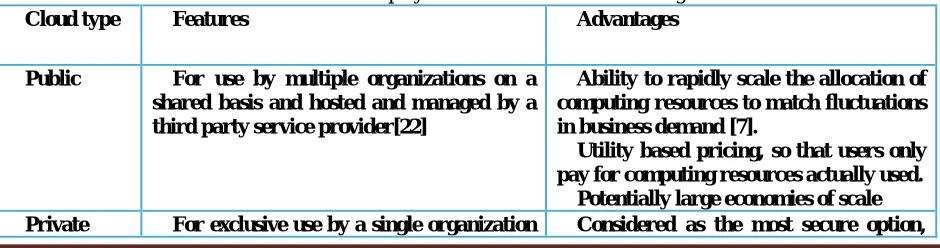
The cloud model is composed of four deployment models: private cloud, community cloud, public cloud, and hybrid cloud. Here is a definition for each deployment model. Further information is given in table 1.
•Public Cloud – The cloud infrastructure is provisioned by the cloud provider for open use by the general public. It may be owned, managed, and operated by a business, academic, or government organization, or some combination of them. •Private Cloud – Infrastructure provisioned solely for a single organization, whether managed internally or by a third-party and hosted internally or externally.
•Community Cloud – Shares infrastructure between several organizations from a specific community with common concerns (e.g., security, compliance, jurisdiction), whether managed internally or by a third-party and hosted internally or externally.
•Hybrid Cloud – A composition of two or more clouds (private, community, or public) that remain unique entities but are bound together, offering the benefits of multiple deployment models. It can also be defined as multiple cloud systems that are connected in a way that allows programs and data to be moved easily from one deployment system to another.
Table 3 : Cloud Deployment Models and their advantages
Cloud type Features Advantages
Public For use by multiple organizations on a shared basis and hosted and managed by a third party service provider[22]
Ability to rapidly scale the allocation of computing resources to match fluctuations in business demand [7].
Utility based pricing, so that users only pay for computing resources actually used.
Volume 1, Issue 2, October 2012
Page 228
and typically controlled, managed and hosted in private data centers [23].
Currently the most common form of cloud in Australia, and the first in company’s cloud journey
but with reduced potential for economies of scale and productivity gains available through multi-tenant options[17]
Community For use by a group of related organizations that wish to make use of a common cloud computing environment i.e. local councils with a shared service offering
Effectively half way between private and public cloud[19]
Reduced economies of scale traded off for increased security
Hybrid Both private and public cloud models are adopted by a single organization
Allows multiple deployment methods to meet specific business needs[9]
3. CLOUD SOLUTION PROVIDERS
Even though there have been some comparative researches about cloud computing that are carried by different academic or enterprise perspectives, we have scrutinized cloud solution providers in terms of various classifications such as infrastructure technology, PaaS provider, programming platform, security, and so on. In this part, different solution provider will be introduced and explained.
3.1 Xen Cloud Platforms (XCP)
The Xen hypervisor is a solution for infrastructure virtualization that provides an abstraction layer between servers’ hardware and the operating system. A Xen hypervisor allows each physical server to run several “virtual servers” handling the operating system and its applications from the underlying physical server. The Xen solution is used by many cloud solutions such as Amazon EC2, Nimbus and Eucalyptus. Recently, Xen.org announced the Xen Cloud Platform (XCP) as a solution for cloud infrastructure virtualization. But, differently from existent open source cloud solutions, XCP does not provide the overall architecture for cloud services[26]. Their goal is to provide a tool to cope with automatic configuration and maintenance of cloud platforms.
The XCP architecture is based on the XCP hosts that are responsible to host the virtual machines. these hosts are aggregated in a XCP resource pool and using a Shared Storage the virtual machines can be started and restarted on any XCP host[29]. The Master XCP host offers an administration interface and forwards command messages to others XCP hosts.
3.2 Amazon web service
It takes advantage of elastic computer cloud (EC2) that allows uploading XEN virtual machine images to the infrastructure and gives client APIs to instantiate and manages them. Virtualization management is done on OS level. It uses IaaS service and Xen images service. In the scope of load balancing, service will allow users to balance incoming request and traffic across multiple EC2 instances[15]. It also makes use of Round-Robin load balancing. The Amazon load balancing is recognized as an elastic load balancing. This system also alerts failover automatically and re-sync back to the last known state as if nothing had failed. It utilizes Simple Storage Service (S3) and SimpleDB. SimpleDB provides a semi-structured data store with query capability. The service also benefits from X 509 certificate, SSL ,Firewall, and acees control list to meet the security concerns. The programming framework of Amazon is Amazon Machine Image (AMI) , and Amazon Mapreduce Framework[9]. Figure bellow shows how the services in Amazon web service fit together.
Volume 1, Issue 2, October 2012
Page 229
3.3 GoGrid
This solution provider uses data centered architecture which is designed to deliver a guaranteed QoS level for the exported services. It automatically reconfigures for infrastructure to cater for fluctuations in the demand. Virtualization management is done by Xen Hypervisor. It makes use of IaaS service. The employed algorithms in load balancing are Round Robin, Sticky Session, and SSL Least Connect. In the realm of fault tolerability, instantly scalable and reliable file-level backup service is used. To store data, it uses a two step process: first connecting each server to private network, then utilizing transfer protocols, such as RSYNC, FTP, SAMBA, SCP) to transfer data to cloud storage and to receive from it[19]. GoGrid does not guarantee a secure data transmission, but it supports java, python, and Ruby programming languages.
3.4Flexiscale
Flexiscale benefits from a data centered architecture which is designed to deliver a guaranteed QoS level for the exported services. It automatically reconfigures for infrastructure to cater for fluctuations in the demand. It also allows multilayer architectures through s high speed internal GigE network[4]. Virtualization management is done by Xen Hypervisor. It makes use of IaaS service. Load balancing is done by Automatic Equalization of server load within Cluster. It also uses a full self-service fault tolerance mechanism which can start, stop, delete and change memory and IPs of Virtual Dedicated Servers. Storage management is committed to a persistent storage, based on a fully virtualized high-end SAN/NAS back-end. To guarantee a secure data transmission, each user is given the possibility to use his own VLAN, Virtual Dedicated Servers with SLA and Tier 1 top quality storage backend. it also supports C,C#, C++, Java, PHP, Perl, and Ruby programming languages.
3.5 Mosso
Mosso merges the idea of cloud computing with the traditional managed and shared server environment which many web hosts provide. Servers are in intelligent clusters which provides a fairly efficient environment from infrastructure and power usage points of view, but it doesn’t provide root access to servers. Virtualization is managed by VMware ESX Server. It profits from IaaS service. . Mosso storage is based on Rackspace Mosso Cloud files, which is reliable, scalable, and affordable web-based storage for backing up and archiving the static contents of all users[10]. It also obeys data security standards i.e. those which are presented by Payment card industry. Mosso currently support ASP and AHP.
3.6 Nimbus
Nimbus is an open source solution (licensed under the terms of the Apache License) to turn clusters into an IaaS for Cloud Computing focusing mainly on scientific applications. This solution gives the users the possibility to allocate and configure remote resources by deploying VMs – known as Virtual Workspace Service (VWS). A VWS is a VM manager that different frontends can invoke. To deploy applications, Nimbus offers a “cloudkit” configuration that consists of a manager service hosting and an image repository. The workspace components are as follow[21]:
• Workspace service: is web services based and provides security with the GSI authentication and authorization. Currently, Nimbus supports two frontends: Amazon EC2 and WSRF.
• Workspace control: is responsible for controlling VM instances, managing and reconstructing images, integrating a VM to the network and assigning IP and MAC addresses. The workspace control tools operate with the Xen hypervisor and can also operate with KVM5.
• Workspace resource management: is an open source solution to manage different VMs, but can be replaced by other technologies such as OpenNebula.
• Workspace pilot: is responsible for providing virtualization with few changes in cluster operation. This component handles signals and has administration tools.
3.7 OpenNebula
OpenNebula is an open-source toolkit used to build private, public and hybrid clouds. It has been designed to be integrated with networking and storage solutions and to fit into existing data centers. The OpenNebula architecture is based on three basic technologies to enable the provision of services on a distributed infrastructure: virtualization, storage and network[31]. All resource allocation is done based on policies. The Cumulus Project was an academic proposal based on OpenNebula. Cumulus intends to provide virtual machines, virtual applications and virtual computing platforms for scientific applications. Visualizing the integration of already existing technologies, the Cumulus project uses HP and IBM blade serves running Linux and Xen hypervisor. The Cumulus networking solution was called the “forward” mode, where users do not need to specify any network configuration information. Instead the backend servers are responsible for allocating a dynamic IP address for a VM and returning these to the users, making such networking solution transparent to the users.
3.8 Google App engine
Volume 1, Issue 2, October 2012
Page 230
authentication is another brilliant feature used by Google App[22]. The programming framework of Google map supports Python, Java as well as several Java related standards such as the Java Servlet API, JDO and JPA.Figure 4 : The OpenNebula architecture [17]
3.9 GigaSpaces
GigaSpaces offers an appropriate architecture for mission-critical applications, where the need for extreme performance, reliability and scalability necessitates an alternative to traditional tire-based architectures. In this solution provider, virtualization is done in application level. It profits from PaaS service. And load balancing is performed through the GigaSpaces high performance communication protocol over the EC2 network infrastructure. In this solution provider each node in the AMI cluster automatically discovers the other nodes and helps the cluster to become a fault tolerant cluster[22]. Heterogeneous environment of GigaSpaces allows seamless interoperability between the different programming languages. In the security scope, it benefits from built-in SSH tunneling. The programming framework of GigaSpaces supports Java and C++ programming languages.
3.10 SunCloud
SunCloud makes use of Solaris OS and Zettabyte File System (ZFS). It has clusters of servers and public IP addresses, and profits from Open Dynamic Infrastructure Management Strategy. Virtualization is managed by Hypervisor (SunxVM Server). It uses PaaS service, and benefits from hardware balancers, that outperform software balancers, to reach load balancing. SunCloud has a resource based scheduling of service request mechanism and an automatic failover method which is used when a node fails. This procedure makes SunCloud to be fault tolerant. It has interoperability for large-scale computing resources across multiple clouds[28]. MySQL row based replication, and routine use of backup with replication are those who help SunCloud with storing data. It also uses user-provisioning and metadirectory solution to provide a secure environment. Some other tasks such as role-based access management to back line resources, and Access Control are also performed to have a more secure environment. The programming framework of SunCloud supports Java, C, C++, RESTful, FORTRAN, Python, and ruby.
3.11 Eucalyptus
Eucalyptus is an open source cloud computing framework focused on academic research. It provides resources for experimental instrumentation and study. Eucalyptus users are able to start, control, access and terminate entire virtual machines. In its current version, Eucalyptus supports VMs that run atop the Xen supervisor [11]. Eucalyptus presents four characteristics that differentiate it from others cloud computing solutions: a) it was designed to be simple without requiring dedicated resources; b) it was designed to encourage third-party extensions through modular software framework and language-agnostic communication mechanisms; c) its external interface is based on the Amazon API (Amazon EC2) and d) it provides a virtual network overlay that isolates network traffic of different users. The Eucalyptus architecture is hierarchical and made up of four high level components[26]:
• Node Controller (NC): this component runs on every node that is destined for hosting VM instances. An NC is responsible to query and control the system software (operating system and hypervisor) and for conforming requests from its respective Cluster Controller. The role of NC queries is to collect essential information, such as the node’s physical and the state of VM instances . NC is also responsible for assisting CC to control VM instances on a node.
• Cluster Controller (CC): this component generally executes on a cluster frontend machine, or any machine that has network connectivity to two nodes: one running NCs and another running the Cloud Controller (CLC). A CC is responsible to collect/report information about and schedule VM execution on specific NCs and to manage virtual instance network overlay.
Volume 1, Issue 2, October 2012
Page 231
• Cloud Controller (CLC): this component is the entry-point into the cloud for users. Its main goal is to offer and manage the Eucalyptus underlying virtualized resources. CLC is responsible for querying node managers for resources’ information, making scheduling decisions, and implementing them by requests to CC.
3.12 Azure
It has an internal-scale cloud service platform that is hosted in Microsoft data centers. It provides an OS and a set of developer services that can be used individually or together. Virtualization is managed by means of Hypervisor, type Hyper-V[11]. it uses PaaS service and a kind of built-in load balancing hardware. Azure applies containers to balance the load. If a failure occurs, SQL data service will automatically begin using another replica of the container [20]. Interoperable platform of Azure can be used to built new applications that can be run from the cloud, or enhance existing applications with cloud based capabilities. Storage is managed by means of SQL Server Data Services (SSDS) that allows storing binary large objects (blobs). It has also a Security Token Service (STS) that creates security assertion markup language token according to the rule.
3.13 TPlatform
TPlatform is a cloud solution that provides a development platform for web mining applications, which is inspired in Google cloud technologies, and which acts as a PaaS solution. Their infrastructure is supported by three technologies: a scalable file system called Tianwang File System (TFS) what is similar to the Google File System (GFS), the BigTable data storage mechanism, and the MapReduce programming model. The TPlatform framework is composed by three layers [33]:
• PC Cluster: this layer provides the hardware infrastructure for data processing.
• Infrastructure: this layer consists of file system (TFS), distributed data storage mechanism (BigTable), and programming model (MapReduce).
• Data Processing Applications: this layer provides the services for users to develop their application i.e. web data analysis and language processing.
3.14 Apache Virtual Computing Lab (VCL)
Apache VCL is an open-source solution for the remote access over the Internet to dynamically provision and reserve computational resources for diverse applications, using SaaS service. VCL has a simple architecture formed by three tiers [7]:
• Web server: represents the VCL portal and uses Linux/Apache/PHP solution. This portal provides a user interface that enables the requesting and management of VCL resources;
• Database server: storages information about VCL reservations, access controls, machine and environment inventory. It uses Linux/SQL solution;
• Management nodes: is the processing engine. A management node controls a subset of VCL resources, which may be physical blade servers, traditional rack, or virtual machines. It uses Linux/VCLD (perl)/image library solution. VCLD is a middleware responsible to process reservations or jobs assigned by the VCL web portal. According to type of environment requested, VCLD should assure that the computational environment will be available to user. Users may request a reservation to use the environment immediately or schedule to use it in the future[18].
4. CONCLUSION
Cloud has the power to open doors to more efficient, responsive and innovative ways of doing business. Companies worldwide are beginning to recognize cloud capabilities to generate new business models and promote sustainable competitive advantage. The cloud provides the infrastructure necessary to provide services directly to customers over the Internet. There is a clear need for the standardization of current cloud platforms at least in terms of interface, negotiation and access through Web services. Understandably, this is a considerable task as many clouds use different abstraction levels, some are generic whereas others focus on a specific application domain, etc. in this paper we explained about the concept of cloud computing. Then we introduced famous solution provider in the realm of cloud computing. We also cited different Cloud Service Models, and deployment methods.
R
EFERENCES[1] M. Satyanarayanan, “Mobile computing: the next decade,” in Proceedings of the 1st ACM Workshop on Mobile Cloud Computing & Services: Social Networks and Beyond (MCS), June 2010.
[2] M. Satyanarayanan, “Fundamental challenges in mobile computing,” in Proceedings of the 5th annual ACM symposium on Principles of distributed computing, pp. 1-7, May 1996.
[3] M. Ali, “Green Cloud on the Horizon,” in Proceedings of the 1st International Conference on Cloud Computing (CloudCom), pp. 451 - 459, December 2009.
Volume 1, Issue 2, October 2012
Page 232
[6] Jacson H. Christensen, “Using RESTful web-services and cloud computing to create next generation mobileapplications,” in the 24th ACM SIGPLAN conference (OOPSLA), pp. 627-634, October 2009.
[7] L. Liu, R. Moulic, and D. Shea, “Cloud Service Portal for Mobile Device Management,” in Proceedings of IEEE 7th International Conference on e-Business Engineering (ICEBE), pp. 474, January 2011.
[8] I. Foster, Y. Zhao, I. Raicu, and S. Lu, “Cloud Computing and Grid Computing 360-Degree Compared,” in Proceedings of Workshop on Grid Computing Environments (GCE), pp. 1, January 2009.
[9] C. Vecchiola, X. Chu, and R. Buyya, “Aneka: A Software Platform for .NET-Based Cloud Computing,” Journal on Computing Research Repository (CORR), pp. 267 - 295, July 2009.
[10] R. Buyya, C. S. Yeo, S. Venugopal, J. Broberg, and I. Brandic, “Cloud computing and emerging IT platforms: Vision, hype, and reality for delivering computing as the 5th utility,” Journal on Future Generation Computer Systems, vol. 25, no. 6, , June 2009.
[11] Y. Huang, H. Su, W. Sun, J. M. Zhang, C. J. Guo, M. J. Xu, B. Z. Jiang, S. X. Yang, and J. Zhu, “Framework for building a low-cost, scalable, and secured platform for Web-delivered business services, vol. 54, no. 6, pp. 535-548, November 2010.
[12] W. Tsai, X. Sun, and J. Balasooriya, “Service-Oriented Cloud Computing Architecture,” in Proceedings of the 7th International Conference on Information Technology: New Generations (ITNG), pp. 684-689, July 2010. [13] G. H. Forman and J. Zahorjan,“The Challenges of Mobile Computing,” IEEE Computer Society Magazine,
April 1994.
[14] R. Kakerow, “Low power design methodologies for mobile communication,” in Proceedings of IEEE International Conference on Computer Design: VLSI in Computers and Processors, pp. 8, January 2003.
[15] L. D. Paulson, “Low-Power Chips for High-Powered Handhelds,” IEEE Computer Society Magazine, vol. 36, no. 1, pp. 21, January 2003.
[16] J. W. Davis, “Power benchmark strategy for systems employing power management,” in Proceedings of the IEEE International Symposium on Electronics and the Environment, pp. 117, August 2002.
[17] R. N. Mayo and P. Ranganathan, “Energy Consumption in Mobile Devices: Why Future Systems Need RequirementsAware Energy Scale-Down,” in Proceedings of the Workshop on Power-Aware Computing Systems, October 2003.
[18] A. Rudenko, P. Reiher, G. J. Popek, and G. H. Kuenning, “Saving portable computer battery power through remote process execution,”
Journal of ACM SIGMOBILE on Mobile Computing and Communications Review, vol. 2, no. 1, January 1998. [19] A. Smailagic and M. Ettus, “System Design and Power Optimization for Mobile Computers,” in Proceedings of
IEEE Computer Society Annual Symposium on VLSI, pp. 10, August 2002.
[20] U. Kremer, J. Hicks, and J. Rehg, “A Compilation Framework for Power and Energy Management on Mobile Computers,” in Proceedings of the 14th International Conference on Languages and Compliers for Parallel Computing, pp. 115 - 131, August, 2001.
[21] E. Cuervo, A. Balasubramanian, Dae-ki Cho, A. Wolman, S. Saroiu, R. Chandra, and P. Bahl, “MAUI: Making Smartphones Last Longer with Code offload the 8th International Conference on Mobile systems, pp. 49-62,June 2010.
[22] X. Jin and Y. K. Kwok, “Cloud Assisted P2P Media Streaming for Bandwidth Constrained Mobile Subscribers,” in Proceedings of the 16th IEEE International Conference on Parallel and Distributed Systems (ICPADS), pp. 800, January 2011.
[23] A. Klein, C. Mannweiler, and H. D. Schotten, “A Framework for Intelligent Radio Network Access Based on Context Models,” in Proceedings of the 22nd WWRF meeting 2009, May 2009.
[24] L. Andersien, “Program analysis and specialization for the C programming language,” Ph.D thesis, DIKU, University of Copenhagen, 1994.
[25] Kimmo. E. E. Raatikainen, “Cluster analysis and workload classification,” in ACM SIGMETRICS Performance Evaluation Review, vol. 20, no. 4, May 1993.
[26] A. Garcia and H. Kalva, “Cloud transcoding for mobile video content delivery,” in Proceedings of the IEEE International Conference on Consumer Electronics (ICCE), pp. 379, March 2011.
[27] K. Kumar and Y. Lu,“Cloud Computing for Mobile Users: Can Offloading Computation Save Energy,” IEEE Computer Society, vol. 43, no. 4, April 2010.
[28] L. Li, X. Li, S. Youxia, and L. Wen, “Research on Mobile Multimedia Broadcasting Service Integration Based on Cloud Computing,” in the IEEE International Conference, pp. 1, November 2010.
[29] P. Zou, C. Wang, Z. Liu, and D. Bao, “Phosphor: A Cloud Based DRM Scheme with Sim Card,” in Proceedings of the 12th International Asia-Pacific on Web Conference (APWEB), pp. 459, June 2010.
Volume 1, Issue 2, October 2012
Page 233
[31] E. Vartiainen, and K. V. -V. Mattila, “User experience of mobile photo sharing in the cloud,” in Proceedings ofthe 9th International Conference on Mobile (MUM), December 2010.
[32] X. Yang, T. Pan, and J. Shen, “On 3G Mobile E-commerce Platform Based on Cloud Computing,” in Proceedings of the 3rd IEEE International Conference on Ubi-Media Computing (U-Media), pp. 198 - 201, August 2010.
[33] J. Dai, and Q. Zhou, “A PKI-based mechanism for secure and efficient access to outsourced data,” in Proceedings of the 2nd International
AUTHOR
Vahid AshkTorab is a M.Sc. student in Computer Engineering at Islamic Azad University of Iran Najafabad Branch. He received his B.Sc. degree in Computer Science from Islamic Azad University of shiraz , Iran, in 2007. His research interests Cloud Computing and Distributed Systems
Seyed Reza Taghizadeh has received his bachelor degree in software engineering in 2008, and his master degree in information technology in 2011. His fields of interest are network security, routing algorithm of networks, and wireless sensor networks. He has taught different courses of network such as Network security, computer networks, and network lab. He has also published lots of research papers in the fields of network routing and network security.
![Figure 1: Relation of Amazon cloud services [12]](https://thumb-us.123doks.com/thumbv2/123dok_us/9721388.1955565/3.595.172.432.605.759/figure-relation-amazon-cloud-services.webp)
![Figure 4 : The OpenNebula architecture [17]](https://thumb-us.123doks.com/thumbv2/123dok_us/9721388.1955565/5.595.183.402.122.263/figure-the-opennebula-architecture.webp)
