The Thirty-Third AAAI Conference on Artificial Intelligence (AAAI-19)
A Deep Cascade Model for Multi-Document Reading Comprehension
Ming Yan, Jiangnan Xia, Chen Wu, Bin Bi,
Zhongzhou Zhao, Ji Zhang, Luo Si, Rui Wang, Wei Wang, Haiqing Chen
Alibaba Group{ym119608, jiangnan.xjn, wuchen.wc, b,bi}@alibaba-inc.com
{zhongzhou.zhaozz, zj122146, luo.si, masi.wr, hebian.ww, haiqing.chenhq}@alibaba-inc.com
Abstract
A fundamental trade-off between effectiveness and efficiency needs to be balanced when designing an online question answering system. Effectiveness comes from sophisticated functions such as extractive machine reading comprehension (MRC), while efficiency is obtained from improvements in preliminary retrieval components such as candidate docu-ment selection and paragraph ranking. Given the complexity of the real-world multi-document MRC scenario, it is diffi-cult to jointly optimize both in an end-to-end system. To ad-dress this problem, we develop a novel deep cascade learn-ing model, which progressively evolves from the document-level and paragraph-document-level ranking of candidate texts to more precise answer extraction with machine reading comprehen-sion. Specifically, irrelevant documents and paragraphs are first filtered out with simple functions for efficiency consid-eration. Then we jointly train three modules on the remaining texts for better tracking the answer: the document extraction, the paragraph extraction and the answer extraction. Experi-ment results show that the proposed method outperforms the previous state-of-the-art methods on two large-scale multi-document benchmark datasets, i.e., TriviaQA and DuReader. In addition, our online system can stably serve typical scenar-ios with millions of daily requests in less than 50ms.
Introduction
Machine reading comprehension (MRC), which empowers computers with the ability to read and comprehend knowl-edge and then answer questions from textual data, has made rapid progress in recent years. From the early cloze-style test (Hermann et al. 2015; Hill et al. 2015) to answer ex-traction from a single paragraph (Rajpurkar et al. 2016), and to the more complex open-domain question answering from web data (Joshi et al. 2017; Nguyen et al. 2016), great ef-forts have been made to push the MRC technique to more practical applications.
The rapid progress of MRC in recent years mostly owes to the release of the single-paragraph benchmark dataset SQuAD (Rajpurkar et al. 2016), on which various deep attention-based methods have been proposed to constantly push the state-of-the-art performance (Seo et al. 2016; Wang et al. 2017c; Yu et al. 2018). It is a significant
mile-Copyright c2019, Association for the Advancement of Artificial Intelligence (www.aaai.org). All rights reserved.
stone that several MRC models have exceeded the perfor-mance of human annotators on the SQuAD dataset1. How-ever, the SQuAD dataset makes a strong assumption that the answers are contained in the given paragraphs. Besides, the parapraphs are rather short, approximately 200 words on average, while a real-world scenario usually involves mul-tiple documents of much longer length. Therefore, several latest studies (Joshi et al. 2017; Clark and Gardner 2017; Tan et al. 2017) begin to design the task into more re-alistic settings: the MRC models are required to read and comprehend multiple documents to reach the final answer.
In multi-document MRC, depending on the way of com-bining the two components, document selection and ex-tractive reading comprehension, there are two categories of approaches: 1) The pipeline approach treats the doc-ument selection and extractive reading comprehension as two separate parts, where a document is firstly selected through document ranking and then passed to the MRC model for extracting the final answer (Joshi et al. 2017; Wang et al. 2017a); 2) Several recent studies (Tan et al. 2017; Clark and Gardner 2017; Wang et al. 2018) adopt a joint learning method to optimize both sub-tasks in a unified framework simultaneously.
The pipeline method relies heavily on the quality of the document ranking module. When it fails to give the rele-vant documents higher ranks or filters out the ones that con-tain the correct answers, the downstream MRC module has no way to recover and extract the answers of interest. For the joint learning method, it is computationally expensive to jointly optimize both tasks with all the documents. This computation cost limits its application to the operational on-line environment, such as Amazon2and Taobao3, where ef-ficiency is a critical factor to be considered.
To address the above problems, we propose a deep cas-cade model which combines the advantages of both meth-ods in a coarse-to-fine manner. The deep cascade model is designed to properly keep the balance between the effec-tiveness and efficiency. At early stages of the model, simple features and ranking functions are used to select a candi-date set of most relevant contents, filtering out the irrelevant
1https://rajpurkar.github.io/SQuAD-explorer/ 2
https://www.amazon.com/ 3
documents and paragraphs as much as possible. Then the selected paragraphs are passed to the attention-based deep MRC model for extracting the actual answer span at word level. To better support the answer extraction, we also intro-duce the document extraction and paragraph extraction as two auxiliary tasks, which helps to quickly narrow down the entire search space. We jointly optimize all the three tasks in a unified deep MRC model, which shares some common bottom layers. This cascaded structure enables the models to perform a coarse-to-fine pruning at different stages, better models can be learnt effectively and efficiently.
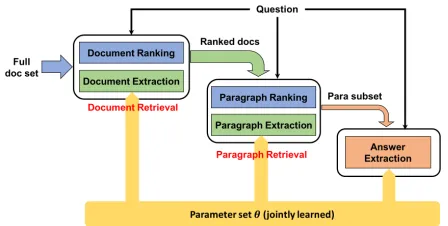
The overall framework of our model is demonstrated in Figure 1, which consists of three modules: document re-trieval, paragraph retrieval and answer extraction. The first module takes the question and a collection of raw docu-ments as input. The module at each subsequent stage con-sumes the output from the previous stage, and further prunes the documents, paragraphs and answer spans given the ques-tion. For each of the first two modules, we define a ranking function and an extraction function. The ranking function is first used as a preliminary filter to discard most of the irrele-vant documents or paragraphs, so as to keep our framework efficient. The extraction function is then designed to deal with the auxiliary document and paragraph extraction tasks, which is jointly optimized with the final answer extraction module for better extraction performance. The local ranking functions in different modules gradually increase in cost and complexity, to properly keep the balance between the effec-tiveness and efficiency.
The main contributions can be summarized as follow: • We propose a deep cascade learning framework to
address the practical multi-document machine reading comprehension task, which considers both the effective-ness and efficiency in a coarse-to-fine manner.
• We incorporate the auxiliary document extraction and paragraph extraction tasks to the pure answer span pre-diction, which helps to narrow down the search space and improves the final extraction result in multi-document MRC scenario.
• We conduct extensive experiments on two large-scale multi-document MRC benchmark datasets: Trivi-aQA (Joshi et al. 2017) and DuReader (He et al. 2017). The results show that our deep cascade model can out-perform the previous state-of-the-art out-performance on both datasets. Besides, the proposed model has also been successfully applied in our online system and stably serve various scenarios in a quick response time of less than 50ms.
Related Work
Machine Reading Comprehension
Recently, we can see emerging interests in multi-document MRC research (Nguyen et al. 2016; Clark and Gardner 2017; Wang et al. 2017b; He et al. 2017; Wang et al. 2018), where multiple documents are given as input. There are two categories of approaches: the pipeline-based approaches and the joint learning models. The pipeline approach firstly se-lects a single document via ranking and then pass it to the
Figure 1: The overall framework of our deep cascade model, which consists of the document retrieval, paragraph retrieval and answer extraction modules.
MRC model to extract the precise answer (Joshi et al. 2017; Wang et al. 2017a). This approach gives huge burden to the document ranking model, in which the downstream MRC model has no way to extract the right answer if the relevant documents are missed. The joint learning approaches take all the documents into consideration and extract the answer by comparing it against other documents (Clark and Gard-ner 2017; Tan et al. 2018; Wang et al. 2018). (Clark and Gardner 2017) proposes a confidence-based method with a shared normalization training objective, which enables the model to produce globally correct output. (Tan et al. 2018) proposes an extraction-then-synthesis framework, by also incorporating passage ranking to answer span prediction. (Wang et al. 2018) further proposes a verification method to make use of the extracted answers in different documents to verify each other for more accurate prediction. However, taking all the documents into consideration will inevitably bring more computation cost, which can be unbearable in the operational online environment. Our deep cascade model can serve as a proper tradeoff between the pipeline method and joint learning method. It has a coarse-to-fine structure which can eliminate irrelevant documents and paragraphs in the early stages with simple features and models, and better identify more relevant answers in a well-designed multi-task deep MRC model on the remaining content.
Cascade Learning
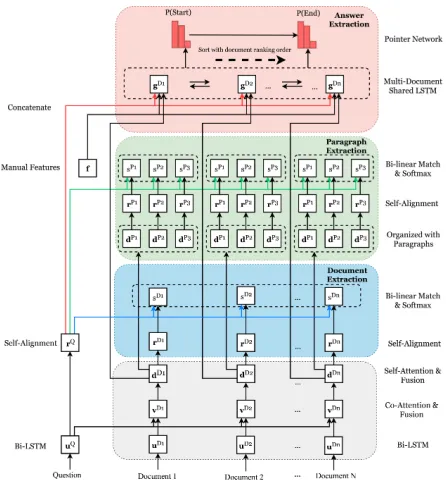
Figure 2: The deep attention-based multi-task MRC model.
We apply the idea of cascade learning to machine read-ing comprehension, from a preliminary document-level and paragraph-level ranking of the candidate texts, to a more pre-cise answer span extraction. The extracted answer spans are progressively narrowed down across different levels, and the ranking and extraction functions also progressively increase in complexity for more precise answer prediction.
The Deep Cascade Model
Following the overview in Figure 1, our approach consists of three cascade modules: document retrieval, paragraph re-trieval and answer extraction. The cascade ranking functions in the first two modules aim to fast filter out the irrelevant document content based on the basic statistical and struc-tural features, and obtain a coarse ranking for the candidate documents. For the remaining document content, we design three extraction tasks at different granularities, with the goal to simultaneously extract the right document, paragraph and also the answer span. A deep attention-based MRC model is designed to jointly optimize all the three extraction tasks, by sharing the common bottom layers, as is shown in Figure 2. The final answer is thus determined by not only the answer span prediction score, but also the corresponding document and paragraph prediction score.
Cascade Ranking Functions
Given a questionQand a set of candidate documents{Di}, we first introduce the cascade ranking functions of the first two modules for pruning the documents, which gradually increases in complexity.
Document Ranking This part aims at fast filtering out the irrelevant documents and obtaining a coarse ranking for the
candidate documents. We utilize the traditional information retrieval methods, such as BM25 and TF-IDF distance, to measure the relevance between the question and document. The matching is conducted between the textual metadata of question and document, including the document title and main content. Besides, the recall ratio of the question words from the document metadata is used as another feature to indicate the relevance of the document.
To learn the importance of different features, we use a learning-to-rank model to assign a weighted relevance score to each retrieved document. By design, the first stage needs to be quick and simple, so we cast the task as a binary clas-sification problem and adopt the pointwise logistic regres-sion as the ranking function. The documents containing the answer are labeled as positive. After this ranking, we only keep the top-K ranked documents for further processing.
Paragraph Ranking This part aims at fast discarding the irrelevant content within each document at a paragraph level. Specifically, given an output documentDi={Pij}from the previous stage, we first prune the noisy paragraphs without word or entity match. The simple question and paragraph textual matching features are also extracted as in that of doc-ument ranking. Moreover, the docdoc-ument structure can con-tain some sort of inherent information, for example, the first paragraph within a document may tend to possess more in-formative content as a document abstract. Therefore, we also add some structural features, such as whether the paragraph is the first or last paragraph of the document, the length of the paragraph, the length of the previous or subsequent paragraphs. To understand the question, we also incorporate the question type information as several binary features if is given, e.g. for DuReader dataset.
To better combine different kinds of features, we adopt a scalable tree boosting method XGBoost (Chen and Guestrin 2016) for ranking, which is widely used to achieve state-of-the-art results on many large-scale machine learning chal-lenges. Again, we use the binary logistic loss for model training and label the paragraph containing the answer as positive. As a result, we select the top-N paragraphs from each document for the subsequent answer prediction.
Multi-task Deep Attention Model
locate on the final answer span. The final answer prediction is based on the results of all the three tasks, which is jointly optimized with a joint learning method.
Shared Q&D Modeling Given a questionQand a set of selected documents {Di}, one of the keys in MRC model lies in how to incorporate the question context into the doc-ument, so that important information can be highlighted. We follow the attention & fusion mechanism used in (Wang, Yan, and Wu 2018), which is a previous state-of-the-art MRC method on SQuAD dataset.
Specifically, we first map each word into the vector space by concatenating its word embedding and CNN-based char-acter embedding. Then we use bi-directional LSTM (BiL-STM) to encode the questionQand documents{Di}as:
uQt = BiLSTMQ(uQt−1,[e Q t ,c
Q t]) uDt = BiLSTMD(uDt−1,[e
D t ,c
D t ])
(1)
whereetandctare the word embedding and character em-bedding of thetthword.uQ
t anduDt are the encoding vectors of thetthword inQandD, respectively.
After the encoding, we use the co-attention method to ef-fectively incorporate the question information into the docu-ment context, and obtain the question-aware docudocu-ment rep-resentationu˜Dt =P
jαtj·uDj . We adopt the attention func-tion used in DrQA (Chen et al. 2017a), which computes the attention score αij by the dot products between nonlinear mappings of word representations:
αij = softmax(ReLU(W>l u Q i )
>·ReLU(W>
l uDj )) (2)
whereWlis a linear projection matrix,softmaxis the nor-malization function, and ReLUis the nonlinear activation function.
To combine the original representationuD
t and the atten-tion vectoru˜Dt , we adopt the fusion kernel used in (Wang, Yan, and Wu 2018) for better semantic understanding:
vDt = Fuse(uDt,˜u D
t ) (3)
where the fusion kernelFuse(·,·)is actually a gating layer to combine two representations, we do not give the details here due to space limitation.
To model the long distance dependency issue of document context, we also introduce the self-attention layer to further align the document representationvD
t against itself, as:
βij = softmax(vDi ·W
>
s ·v D j )
˜
vDt =X
j
βtj·vDj
dDt = Fuse(vDt ,˜vDt )
(4)
whereWsis a trainable bilinear projection matrix. Another fusion kernel is again used to combine the original and self-attentive representations. For all the previous encoding and attention steps, we process each document independently given the question. Finally, we obtain a question-aware rep-resentationDDi={dDi
t }for each word in each document.
For the question side, since it is generally short, we di-rectly self-align the question to a vectorrQ, which is inde-pendent from the document, as
γt= softmax(w>q ·u Q t)
rQ =X
t
γt·u Q t
(5)
wherewq is a trainable linear weight vector.
The shared question and document modeling lay the foun-dation for the subsequent three extraction tasks. Based on the document and question representations DDi = {dDi
t } andrQ, we introduce the three joint extraction tasks.
Document Extraction In multi-document MRC, in addi-tion to annotating the answer span, the benchmark datasets generally also annotate which documents are correct for ex-tracting the answer, or it can also be easily obtained given the labeled answer. Therefore, we also introduce an auxil-iary document extraction task, to help improve the answer prediction. Compared to the answer span extraction, the doc-ument extraction is relatively easier. The aim is to better lay the foundation for the answer prediction and help learn the shared bottom layers.
Firstly, we also self-align the document representation DDi = {dDi
t } for each selected document Di, to obtain a weighted document vectorrDias:
µt= softmax(w>d ·d Di t )
rDi=X t
µt·dDti (6)
Next, the question vectorrQand document vectorrDiare matched in a bilinear function for a relevance score as,
sDi =rQ·W
qd·rDi (7)
whereWqd is a trainable bilinear projection matrix, which helps to match the two vectors in the same space.
For one question, each selected documentDihas a match-ing scoresDi. We normalize their scores and optimize the following objective function:
˜
sDi = 1/(1 + exp−sDi) (8)
LDE=−
1
K
K X
i=1
[yDilogs˜Di+ (1−yDi)log(1−˜sDi)] (9)
whereKis the number of selected documents.yDi∈ {0,1} denotes the label,yDi = 1means documentD
icontains one golden answer, otherwiseyDi = 0.
We first organize each selected document with para-graphs, and follow the same way as in document extraction to calculate a question-paragraph matching score for each paragraph. Specifically, for each paragraph in documentDi withDDi ={VPi1,· · ·,VPiN}, we first self-align the word-level paragraph representationVPijto a weighted vector rep-resentationrPij as in Equ. 6. Then a bilinear matching func-tion is used betweenrQandrPij to obtain the corresponding relevance score as:
sPij =rQ·W
qp·rPij (10)
where Wqp is the trainable bilinear projection matrix be-tween question and paragraph.
For one document, each paragraphPij in the document has a matching scoresPij. We normalize the scores among each document and obtain˜sPij as in Equ. 8. In this sub-task, we optimize the average cross-entropy loss among all the selected documents and paragraphs as:
LP E=−
1
K
1
N
K X
i=1 N X
j=1
[yPijlog˜sPij+ (1−yPij)log(1−s˜Pij)]
(11) whereN is the number of remaining paragraphs for each document.yPij ∈ {0,1}denotes the paragraph-level label for thejthparagraph inithdocument.
Answer Span Extraction The ultimate goal is to predict a correct answer, where the afore-mentioned document extrac-tion and paragraph extracextrac-tion actually act as two auxiliary tasks, so that the shallow semantic representations can be better learnt. In this stage, we aim to combine all the avail-able information to accurately extract the answer from all the selected documents at a span level. To make the document representation aware of information in different documents and enable a direct comparison across different documents, we concatenate all the selected documents together and in-troduce a muilti-document shared LSTM layer for contex-tual modeling as:
gDt = BiLSTM(gDt−1,[dDt;rQ;f]) (12)
wherefis a manual feature vector including the popular fea-tures such as whether each document word occurs in the question words and whether the word is a sentence ending separator. Here we also concatenate the question vectorrQ to each word representationdDt of the document for better modeling the interaction.
Since all the words from different documents will be passed to the shared LSTM layer, the sequence order is thus very important. We follow the document ranking order ob-tained via the document ranking function in document re-trieval module, as is shown in top of Figure 2. In this way, we expect that the answer prediction model can also bear the ranking relevance in document retrieval module in mind and it shows good performance in our experiment.
Finally, the pointer network (Wang and Jiang 2016) is used to predict the start and end position of the answer with the probabilitiesα1tandα2t, and the answer extraction model
can be trained by minimizing the negative log probabilities of the true start and end indices:
αt= exp(w>ag D t )/
|Dw| X
j=1
exp(w>agDj ) (13)
LAE=−
1
M
M X
i=1
(logα1y1 i +logα
2 y2
i) (14)
wherewa is a trainable vector,|Dw|is the total number of words.M is the number of question samples,y1
i,yi2are the golden start and end positions across the entire documents.
Joint Training and Prediction According to the design, the three extraction tasks share the same embedding, encod-ing and matchencod-ing layers. Therefore, we propose to train them together as multi-task learning. The joint objective function is formulated as follows:
L=LAE+λ1LDE+λ2LP E (15) whereλ1andλ2are two hyper-parameters that control the weights of those tasks.
To keep the training process stable, we adopt a coarse-to-fine joint training strategy and progressively finetune one upper task with the joint loss. Specifically, we first train the downside document extraction and paragraph extraction tasks to obtain an initial shallow representation, and then jointly train the three tasks with Equ.15 based on it. Be-sides, when training a new upper task, we follow the method in (Hashimoto et al. 2016) and introduce a successive regu-larization term on the shared parameters, as:
L=L+δ||θs−θ0s|| 2
(16)
whereθs,θ0sare the shared parameters at successive training stages. In this way, we can restrain the joint training process so that the shared parameters will not change so much.
When predicting the final answer, we take the document matching score, paragraph matching score and answer span score into consideration and choose the answer with the highest prediction score, given as:
s= (αk1·α2k)·s˜Di·s˜Pij (17)
Experiments
This section presents the experimental methodology. We first verify the effectiveness of our model on two benchmark datasets: TriviaQA (Joshi et al. 2017) and DuReader (He et al. 2017). Then we test our model in operational online en-vironment, which can stably and effectively serve different scenarios promptly.
Datasets
Off-line Benchmark Dataset We choose the TriviaQA Web and DuReader benchmark datasets to test our method, since both of them are multi-document MRC datasets which is more realistic and challenging.
6 evidence documents (context) per question on average, which are generated from either Wikipedia or Web search. In this paper, we focus on the TriviaQA Web dataset, which contains more context data for each question.
DuReader is so far the largest Chinese MRC dataset, which contains 200K questions, 1M documents and more than 420K human-summarized answers. All the questions and documents are extracted from real data, by the largest Chinese search engine Baidu. The average length of the doc-uments is 396.0 words, and on average each question has 5 evidence documents, each document has about 7 paragraphs.
On-line Environment We also apply our model to the Al-iMe Chatbot system, which is an intelligent online assistant designed for creating an innovative online shopping expe-rience in e-commerce. Currently, it serves millions of cus-tomer questions per day. We test our model in two practical scenarios, i.e., e-commerce promotion and tax policy read-ing. E-commerce promotion scenario is about consulting in-structions on shopping games and sales promotion, which mostly involves with a short document with no more than 500 words. Tax policy scenario is about reading tax pol-icy articles, which can be viewed as a multi-document MRC task. The length of the article is much longer, which consist of many sections and paragraphs.
Implementation Details
For the cascade ranking functions, the number of selected documentsK and paragraphsN are the key factors to bal-ance the effectiveness and efficiency trade-off. We choose
K = 4andN = 2for the good performance when eval-uating on the dev set. Since the TriviaQA documents often contain many small paragraphs, we also restructure the doc-uments by merging consecutive paragraphs to a maximum size of 600 words for each paragraph as in (Clark and Gard-ner 2017). The detailed analysis will be given and discussed in the next section.
For the multi-task deep attention framework, we adopt the Adam optimizer for training, with a mini-batch size of 32 and initial learning rate of 0.0005. We use the GloVe 300 dimensional word embeddings in TriviaQA and train a word2vec word embeddings with the whole DuReader cor-pus for DuReader. The word embeddings are fixed during training. The hidden size of LSTM is set as 150 for TriviaQA and 128 for DuReader. The task-specific hyper-parameters
λ1andλ2in Equ. 15 are set asλ1=λ2= 0.5. Regulariza-tion parameterδin Equ. 16 is set as a small value of 0.01. All models are trained on Nvidia Tesla M40 GPU with Cudnn LSTM cell in Tensorflow 1.3.
Off-line Evaluation
Main Results The results of our single deep cascade model 4 on TriviaQA Web and DuReader 1.0 are summa-rized in Table 1 and Table 2, respectively. We can see that by adopting the deep cascade learning framework, the pro-posed model outperforms the previous state-of-the-art meth-ods by an evident margin on both datasets, which validates
4
We only submit the single model without any model ensemble.
Table 1: Performance of our method and competing models on the TriviaQA Web leaderboard.
Full Verified
Model EM/F1 EM/F1
BiDAF Baseline (Joshi et al. 2017) 40.74 / 47.05 49.54 / 55.80 Smarnet (Chen et al. 2017b) 40.87 / 47.09 51.11 / 55.98 M-Reader (Hu, Peng, and Qiu 2017) 46.65 / 52.89 56.96 / 61.48 Re-Ranker (Wang et al. 2017b) 63.04 / 68.53 69.70 / 74.57 S-Norm (Clark and Gardner 2017) 66.37 / 71.32 79.97 / 83.70 Weissenborn (Weissenborn 2017) 67.46 / 72.80 77.63 / 82.01
Our-Single 68.65/73.07 82.44/85.35
Table 2: Performance on the DuReader 1.0 test set.
Model BLEU-4 ROUGE-L
Match-LSTM (Wang and Jiang 2016) 31.8 39.0 BiDAF (Seo et al. 2016) 31.9 39.2 PR + BiDAF (Wang et al. 2018) 37.55 41.81 Cross-Passage Verify (Wang et al. 2018) 40.97 44.18 R-net (Wang et al. 2017c) 44.88 47.71
Our-Single 49.39 50.71
Human Performance 56.1 57.4
the effectiveness of the proposed method in addressing the challenging multi-document MRC task.
Ablation Study To get better insight into our model ar-chitecture, we conduct an in-depth ablation study on the de-velopment set of DuReader and TriviaQA, which is shown in Table 3. The main goal is to validate the effectiveness of the critical components in our architecture including the manual features and multi-document shared LSTM in the pure answer span extraction task, the cascade document and paragraph ranking functions for pruning irrelevant document content and the adoption of multi-task learning strategy.
From the results, we can see that: 1) the shared LSTM plays an important role in answer extraction among multiple documents, the benefit lies in two parts: a) it helps to normal-ize the content probability score from multiple documents so that the answers extracted from different documents can be directly compared; b) it can keep the ranking order from doc-ument ranking component in mind, which may serve as an additional signal when predicting the best answer. By incor-porating the manual features, the performance can be further improved slightly. 2) Both the preliminary cascade ranking and multi-task answer extraction strategy are vital for the fi-nal performance, which serve as a good trade-off between the pure pipeline method and fully joint learning method. By removing the rich irrelevant noisy data in the cascade document and paragraph ranking stage, the downside MRC model can better extract the answer from the more relevant content data. Jointly training the three extraction tasks can provide great benefits, which shows that the three tasks are actually closely related and can boost each other with shared representations at bottom layers.
Table 3: Ablation study on model components.
Model DuReader TriviaQA
Bleu-4 score ∆ F1 ∆
Complete Model 50.8 – 73.8 –
w/o Manual Features 49.8 -1.0 73.0 -0.8 w/o Shared LSTM 48.7 -2.1 70.5 -3.3 w/o Cascade Ranking 47.0 -3.8 71.1 -2.7 w/o Multi-task Learning 48.5 -2.3 70.9 -2.9
Boundary Baseline 41.0 -9.8 61.5 -12.3
Table 4: Effectiveness and efficiency w.r.t document and paragraph selection number on DuReader development set (Efficiency is indicated by time cost at prediction stage).
Document No. Paragraph No. Time cost(s) / batch Bleu-4 score
1
1 0.42 32.1
2 0.53 35.4
3 0.69 36.0
2
1 0.56 40.5
2 0.89 44.8
3 1.14 44.2
3
1 0.71 48.1
2 1.09 49.5
3 1.36 49.0
4
1 0.88 49.6
2 1.39 50.8
3 1.75 50.0
5
1 0.98 49.6
2 1.70 50.0
3 2.03 48.8
DuReader development set is presented in Table 4. We can see that: 1) By properly taking more documents or para-graphs into consideration, the performance of the model gradually increases when it reaches 4 documents and 2 para-graphs, and then the performance decreases slightly which may be due to that much noisy data is introduced. 2) The time cost can be largely reduced by removing more irrele-vant documents and paragraphs in the cascade ranking stage, while keeping the performance not change that much. For example, for the best setting at 4 documents and 2 para-graphs, if we instead only keep the top-1 paragraph for each document, the time cost will be reduced by 36.7%, while the performance only decreases about 2.4%. As a result, we can adaptively change our model to meet the practical situation and we choose 4 documents and 2 paragraphs in our off-line experiment where effectiveness is most emphasized.
Advantage of Multi-task Learning Next, we also ana-lyze the benefits brought in via the adoption of the multi-task learning strategy in detail. The performance of jointly training the answer extraction module with different aux-iliary tasks on DuReader development set is shown in Ta-ble 5. We can see that by incorporating the auxiliary doc-ument extraction or paragraph extraction task in the joint learning framework, the performance can always improve which again shows the advantage of introducing auxiliary tasks for helping to learn shared bottom representations. Be-sides, the performance gain by adding document extraction task is larger, which may be due to that it can better lay the foundation of the model with that information from different documents can be distinguished.
Table 5: Performance with different extraction tasks. Task Bleu-4 score ∆ Pure Answer Span Extraction 48.5 – + Document Extraction 49.7 +1.2 + Paragraph Extraction 49.2 +0.7 + Document & Paragraph Extraction 50.8 +2.3
Table 6: Performance and response time (RT) in two real-world online scenarios.
Tax E-Commerce
Model F1/RT F1/RT
BiDAF (Joshi et al. 2017) 40 / 130ms 63 / 65ms DrQA (Chen et al. 2017a) 46 / 122ms 67 / 61ms Our-Single (w/o Cascade Ranking) 55 / 138ms 71 / 70ms
Our-Single (K=3, N=1) 76.5/45ms 73/38ms
On-line Evaluation
Results on E-commerce and Tax data We also test the effectiveness and efficiency of our model in two practical scenarios, E-commerce and tax policy reading, where real-time responses are expected and a large number of cus-tomers are being served simultaneously. The comparative result is shown in Table 6. We can see that by introducing the cascade ranking stage and keeping the selected number properly, our method can serve the requests with a much higher speed of less than 50ms, especially for tax scenario where the improvement is about 3 times. Besides, the perfor-mance with respect to F1 score is also largely improved with the proposed multi-document MRC model, which demon-strates the effectiveness of our method for removing the rich irrelevant noisy content in our online scenario.
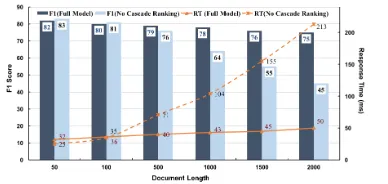
Results on Different Document Lengths We further ex-amine how the F1 score and response time change on tax scenario when processing documents with different lengths, ranging from 50 to 2000 words. The result is shown in Fig-ure 3. We can see that without incorporating with the cas-cade ranking module, the answer extraction module per-forms rather poorly both in effectiveness and efficiency as the document length increases. In particular, when the docu-ment length exceeds 1,000 the total response time increases 3 to 6 times, while for our full cascade model only 15ms more are needed.
Conclusion
In this paper, we propose a novel deep cascade learning framework to balance the effectiveness and efficiency in the more realistic multi-document MRC. We design three cas-cade modules, which can eliminate irrelevant document con-tent in the earlier stages with simple features and models, and discern more relevant answers at later stages. The ex-periment results show that our method can achieve state-of-the-art performance on two large-scale benchmark datasets. Besides, the proposed method has also been effectively and efficiently applied in our online system.
References
Bourdev, L., and Brandt, J. 2005. Robust object detection via soft cascade. InComputer Vision and Pattern Recognition, 2005. CVPR 2005. IEEE Computer Society Conference on, volume 2, 236–243. IEEE.
Chen, T., and Guestrin, C. 2016. Xgboost: A scalable tree boost-ing system. InProceedings of the 22nd acm sigkdd international conference on knowledge discovery and data mining, 785–794. ACM.
Chen, D.; Fisch, A.; Weston, J.; and Bordes, A. 2017a. Read-ing wikipedia to answer open-domain questions. arXiv preprint arXiv:1704.00051.
Chen, Z.; Yang, R.; Cao, B.; Zhao, Z.; Cai, D.; and He, X. 2017b. Smarnet: Teaching machines to read and comprehend like hu-man.arXiv preprint arXiv:1710.02772.
Clark, C., and Gardner, M. 2017. Simple and effec-tive multi-paragraph reading comprehension. arXiv preprint arXiv:1710.10723.
Hashimoto, K.; Xiong, C.; Tsuruoka, Y.; and Socher, R. 2016. A joint many-task model: Growing a neural network for multiple nlp tasks.arXiv preprint arXiv:1611.01587.
He, W.; Liu, K.; Lyu, Y.; Zhao, S.; Xiao, X.; Liu, Y.; Wang, Y.; Wu, H.; She, Q.; Liu, X.; et al. 2017. Dureader: a chinese ma-chine reading comprehension dataset from real-world applica-tions.arXiv preprint arXiv:1711.05073.
Hermann, K. M.; Kocisky, T.; Grefenstette, E.; Espeholt, L.; Kay, W.; Suleyman, M.; and Blunsom, P. 2015. Teaching machines to read and comprehend. InAdvances in Neural Information Processing Systems, 1693–1701.
Hill, F.; Bordes, A.; Chopra, S.; and Weston, J. 2015. The goldilocks principle: Reading children’s books with explicit memory representations.arXiv preprint arXiv:1511.02301. Hu, M.; Peng, Y.; and Qiu, X. 2017. Reinforced mnemonic reader for machine comprehension.CoRR, abs/1705.02798. Joshi, M.; Choi, E.; Weld, D. S.; and Zettlemoyer, L. 2017. Trivi-aqa: A large scale distantly supervised challenge dataset for read-ing comprehension.arXiv preprint arXiv:1705.03551.
Lefakis, L., and Fleuret, F. 2010. Joint cascade optimization using a product of boosted classifiers. In Advances in neural information processing systems, 1315–1323.
Liu, S.; Xiao, F.; Ou, W.; and Si, L. 2017. Cascade ranking for operational e-commerce search. InProceedings of the 23rd ACM SIGKDD International Conference on Knowledge Discovery and Data Mining, 1557–1565. ACM.
Nguyen, T.; Rosenberg, M.; Song, X.; Gao, J.; Tiwary, S.; Ma-jumder, R.; and Deng, L. 2016. Ms marco: A human
gen-erated machine reading comprehension dataset. arXiv preprint arXiv:1611.09268.
Rajpurkar, P.; Zhang, J.; Lopyrev, K.; and Liang, P. 2016. Squad: 100,000+ questions for machine comprehension of text. arXiv preprint arXiv:1606.05250.
Schneiderman, H. 2004. Feature-centric evaluation for effi-cient cascaded object detection. InComputer Vision and Pattern Recognition, 2004. CVPR 2004. Proceedings of the 2004 IEEE Computer Society Conference on, volume 2, II–II. IEEE. Seo, M.; Kembhavi, A.; Farhadi, A.; and Hajishirzi, H. 2016. Bidirectional attention flow for machine comprehension. arXiv preprint arXiv:1611.01603.
Tan, C.; Wei, F.; Yang, N.; Lv, W.; and Zhou, M. 2017. S-net: From answer extraction to answer generation for machine reading comprehension.arXiv preprint arXiv:1706.04815. Tan, C.; Wei, F.; Yang, N.; Du, B.; Lv, W.; and Zhou, M. 2018. S-net: From answer extraction to answer synthesis for machine reading comprehension. InAAAI.
Wang, S., and Jiang, J. 2016. Machine comprehen-sion using match-lstm and answer pointer. arXiv preprint arXiv:1608.07905.
Wang, S.; Yu, M.; Guo, X.; Wang, Z.; Klinger, T.; Zhang, W.; Chang, S.; Tesauro, G.; Zhou, B.; and Jiang, J. 2017a. R 3: Reinforced reader-ranker for open-domain question answering. arXiv preprint arXiv:1709.00023.
Wang, S.; Yu, M.; Jiang, J.; Zhang, W.; Guo, X.; Chang, S.; Wang, Z.; Klinger, T.; Tesauro, G.; and Campbell, M. 2017b. Ev-idence aggregation for answer re-ranking in open-domain ques-tion answering.arXiv preprint arXiv:1711.05116.
Wang, W.; Yang, N.; Wei, F.; Chang, B.; and Zhou, M. 2017c. Gated self-matching networks for reading comprehension and question answering. InProceedings of the 55th Annual Meet-ing of the Association for Computational LMeet-inguistics (Volume 1: Long Papers), volume 1, 189–198.
Wang, Y.; Liu, K.; Liu, J.; He, W.; Lyu, Y.; Wu, H.; Li, S.; and Wang, H. 2018. Multi-passage machine reading compre-hension with cross-passage answer verification. arXiv preprint arXiv:1805.02220.
Wang, L.; Lin, J.; and Metzler, D. 2011. A cascade ranking model for efficient ranked retrieval. InProceedings of the 34th international ACM SIGIR conference on Research and develop-ment in Information Retrieval, 105–114. ACM.
Wang, W.; Yan, M.; and Wu, C. 2018. Multi-granularity hierar-chical attention fusion networks for reading comprehension and question answering. InProceedings of the 56th Annual Meet-ing of the Association for Computational LMeet-inguistics (Volume 1: Long Papers), volume 1, 1705–1714.
Weissenborn, e. a. . 2017. Dynamic integration of back-ground knowledge in neural nlu systems. arXiv preprint arXiv:1706.02596.