in the population sciences published by the Max Planck Institute for Demographic Research Konrad-Zuse Str. 1, D-18057 Rostock · GERMANY www.demographic-research.org
DEMOGRAPHIC RESEARCH
VOLUME 20, ARTICLE 7, PAGES 97-128
PUBLISHED 13 FEBRUARY 2009
http://www.demographic-research.org/Volumes/Vol20/7/ DOI: 10.4054/DemRes.2009.20.7
Research Article
The impact of female employment on fertility
in Dakar (Senegal) and Lomé (Togo)
Donatien Beguy
© 2009 Beguy.
This open-access work is published under the terms of the Creative Commons Attribution NonCommercial License 2.0 Germany, which permits use, reproduction & distribution in any medium for non-commercial purposes, provided the original author(s) and source are given credit.
1 Introduction 98
2 Contexts of the study: Dakar vs. Lomé 100
2.1 Sociocultural differences in marriage patterns 100 2.2 Female labour force participation in Dakar and Lomé 101
2.3 Fertility differences in Dakar and Lomé 101
3 Theoretical and empirical considerations 102
3.1 Theoretical framework 102
3.2 Prior empirical evidence in developing countries 104
4 Data and methods 106
4.1 Data 106
4.2 Methodology of analysis 107
4.3 Explanatory variables and hypotheses 109
4.3.1 Female employment and human capital 109
4.3.2 Control variables 110
5 Results and discussions 113
5.1 Descriptive statistics 113
5.2 Results of the multivariate analysis 114
5.2.1 The effects of socio-demographic and cultural factors 115 5.2.2 The effect of female employment on fertility 115
6 Conclusion 120
7 Acknowledgements 122
The impact of female employment on fertility
in Dakar (Senegal) and Lomé (Togo)
Donatien Beguy 1
Abstract
This paper investigates the impact of female employment on fertility in two urban contexts in sub-Saharan Africa: Dakar (Senegal) and Lomé (Togo). The hypothesis that wage employment and maternal obligations are incompatible seems to be corroborated in Lomé, where women are likely to consider work as a legitimate alternative to their role as a mother or spouse. Being involved in economic activity is a real option and can therefore impact upon their reproductive life. By contrast, in Dakar working does not seem to hinder family formation. Greater involvement of women in the labour force is not the main reason for fertility decline in Dakar. These findings illustrate how important it is to consider social gender-specific roles in order to accurately determine the influence of female employment on reproductive life.
1 African Population and Health Research Center, Shelter Afrique Center, 2nd Floor, Longonot Road,
1. Introduction
It is recognized that women’s employment plays an important role in the variation in fertility levels within and between countries (Becker 1993; Rindfuss and Brewster 1996; Shockaert 2005; Standing 1983). As a result, the relationship between female economic activity and fertility is one of the most studied areas in fertility research. The participation of women in the economic market is presumed to compete with their family obligations, since mothers are often the only ones responsible for household duties. Accordingly, a negative relationship is generally expected between female labour force participation and fertility at the micro level, although there is controversy about the causal direction of the relationship between the two phenomena (Cramer 1980; Felmlee 1993; Stolzenberg and Waite 1977). While a consistent negative relationship between women’s paid work and fertility has been found at the micro level in developed countries (Budig 2003; Lloyd 1991), no clear pattern has emerged in developing countries (Lloyd 1991; Piché, Poirier, and Neill 1989). In particular, in sub-Saharan Africa it has been suggested that no relationship should exist between labour force status and fertility because of limited wage employment, extended family networking, and cheap domestic labour, as well as traditional social norms regarding gender roles and the division of household duties between men and women. However, it is likely that these mediating factors vary across different settings in sub-Saharan Africa, thereby resulting in the discrepancy in the female employment–fertility relationship in this region (Oppong 1988, 1991).
Second, the two societies exhibit different cultural contexts in terms of gender relations, resulting in different sociological meanings for women’s economic participation outside home. In Dakar women’s work outside the domestic sphere clashes with the tenacious model of a clear separation between husbands’ and wives’ roles and with the ideal of wives being financially dependent on their husbands (Adjamagbo et al. 2004; Nanitelamio 1995). By contrast, in Lomé women’s economic independence has been one of the marital norms for quite some time, although this tends to be more frequent outside the formal framework of marriage (Antoine and Dial 2005, Locoh 1984). The gender division of family roles would alter women’s attitudes and aspirations for both employment and fertility. To better understand the importance of social values and norms in the work–fertility relationship, it is therefore interesting to compare two contrasting cities whose cultural contexts may lead to different aspirations and attitudes with regard to women’s economic participation.
There are two major differences between the present analysis and similar ones conducted in the past on the same topic in sub-Saharan Africa. First, this study focuses only on urban areas. Second, it adopts a longitudinal approach, based on retrospective socio-economic and demographic data collected in the two capital cities. The use of longitudinal data analysis could help to overcome some of the methodological limitations encountered by previous studies. Unlike cross-sectional data, longitudinal data integrate the time dimension, which is fundamental for causal analysis. Temporal order issues are avoided through the use of time-varying covariates.
This paper investigates the relationships between female employment and fertility in an urban context in sub-Saharan Africa. Besides casting light on the role of the cultural environment on the mechanisms at work underlying any comparison between two cities, it uses a longitudinal approach to understand fertility as a process. Increasing female labour force participation and fertility decline have both been clearly recognized in Africa, but their possible interrelations have not been thoroughly researched so far.
2. Contexts of the study: Dakar vs. Lomé
2.1 Sociocultural differences in marriage patterns
In Dakar the majority of the population are Muslims, whereas in Lomé the majority are Christians and Animists. In Senegal about nine out of ten (94%) individuals are Muslims (Ndiaye, Gaye, and Ayad 1997); in Togo about half (51%) and a quarter (28%) are Christians and Animists respectively (Anipah et al. 1999). Marriage remains the main pathway to adulthood in both societies. While in Senegal marriage is marked by a religious ceremony, in Togolese society marriage is a long process marked by a series of specific stages. The increase in age at first marriage is more significant in Senegal than in Togo. Demographic and Health Surveys (DHS) reported that, overall, the median age at first marriage of women who were 25–49 years old increased from 16.4 in 1986 to 17.4 years in 1997 (Ndiaye, Sarr, and Ayad 1988; Ndiaye, Gaye, and Ayad 1997). The delay before entry into marriage is even greater in urban areas. Indeed, between 1986 and 1997 the median age at marriage increased from 17.6 to 19.6 years in urban areas but remained stable in rural areas (from 16.0 to 16.3 years during the same period). In Togo marriage is celebrated later and the median age at marriage increased only slightly from 18.4 in 1988 to 18.8 years in 1998. Between 1988 and 1998 the median age at marriage increased from 19.3 to 20.0 years in urban areas and from 17.9 to 18.5 years in rural settings (Agounké, Assogba, and Anipah 1988; Anipah et al. 1999).
2.2 Female labour force participation in Dakar and Lomé
In both capital cities women have lower labour force participation rates than men, but the gap is more significant in Dakar than in Lomé. The results of the “Surveys 1-2-3”2 carried out in seven African capital cities show the gender difference in labour force participation in Dakar and Lomé (Brilleau, Roubaud, and Torelli 2004). Overall, a gap of only 2% was observed between males’ and females’ labour force participation rates in Lomé, while the difference was about 21% in Dakar. Moreover, female labour force participation was higher in Lomé than in Dakar. For example, the labour force participation rate among women aged 10–29 years was 58% in 2001 in Lomé, compared to 32% in 2002 in Dakar. Similarly, 90% of women aged 30–49 were working in Lomé, compared to 60% of their counterparts in Dakar. However, 86% of women in Dakar in 2002 and 91% of women in Lomé in 2001 were involved in insecure and low-paid jobs within the informal sector. Thus women were underrepresented in the formal sector of the economy, which mainly comprises the public sector. In Dakar in 2002 only a quarter and in Lomé in 2001 only a third of jobs in the formal sector were done by female workers.
2.3 Fertility differences in Dakar and Lomé
In both countries fertility has started to decrease, but Togo experienced an earlier decline of fertility, which has now reached levels that are lower than in Senegal. In Togo the decrease in fertility rates reported by DHS between 1988 and 1998 was from 4.9 children per woman to 3.3 in urban areas. The decline was very small in rural areas, from 6.9 to 6.5 (Agounké et al. 1988; Anipah et al. 1999). In 1998 the total fertility rate (TFR) was about 2.9 children per woman in Lomé, about four children less than in rural areas. In urban Senegal the TFR dropped from 5.5 children per woman in 1986 to 4.3 in 1997, while it decreased slightly in rural areas (from 7.1 to 6.7 during the same period) (Ndiaye et al. 1988, 1997). In Dakar the TFR was about 3.7 children per woman in 2004 (Ndiaye and Ayad 2006).
This fertility decline can hardly be explained by changes in contraceptive use, since the use of modern birth control methods is still limited in Senegal (8% in 1997) and Togo (7% in 1998). In both countries the prevalence of modern contraception is higher in urban areas (including the two capital cities), where the supply of family planning services is more prevalent. The results of the DHS show that in Dakar the
2 Surveys on employment in the informal sector in seven capital cities in the Western Africa Economic and
prevalence of modern contraception among women in union has decreased slightly, dropping from 21% in 1997 to 19% in 2004. In Lomé this indicator was 7% in 1988 and 11% in 1998.
3. Theoretical and empirical considerations
3.1 Theoretical framework
adherence to rules, punctuality, and a clear separation of work from familial roles (Kollehon 1984).
A second factor that could lessen the conflict between work and childbearing is the availability and low cost of domestic help or parental surrogates (grandparents, cousins, older children, etc.), allowing women to fulfil both roles and thereby resulting in higher fertility (Blau and Robins 1989; Rindfuss and Brewster 1996). The traditional social norms regarding gender roles and the division of household duties between men and women could also mitigate the relationship between female employment and fertility. In many societies such norms assign to women the role of rearing children, while men have to take care of the household by working and providing revenue. When prevailing, these social norms can alter women’s aspirations and attitudes towards work outside the home. Negative attitudes towards work outside the home could reduce a woman’s employment chances or predispose her towards a job that is more compatible with her maternal responsibilities. Traditional women favour the mother-and-wife role, resulting in large family sizes, while modern women favour the professional life and are therefore more likely to have lower fertility levels. These conditions, which prevail generally in developing countries, have led some authors (Engracia and Herrin 1984) to make the assumption that no or a weak relationship should exist between labour force status and fertility. But this could be true in rural settings in developing countries only, where such conditions are more likely to prevail. By contrast, urban areas offer opportunities to women to be involved in paid, non-agricultural work outside the home and to have attitudes and aspirations more favourable to paid work.
It appears, then, that the relationship between professional and reproductive lives depends on the specific characteristics of each society, particularly social gender relations and roles. In the African urban context we expect a negative relationship between female employment and fertility: that is, wage employees should have lower fertility than non-wage working women and others. However, we expect this relationship to be stronger in Lomé than in Dakar, given the prevalence of traditional gender roles in the latter.
involved in economic activity is a real option in their life and can therefore significantly impact upon their reproductive life.
In the following section, we provide a brief description of the previous studies on the work–fertility relationship in developing countries.
3.2 Prior empirical evidence in developing countries
Empirical evidence on the link between women’s employment and fertility is quite scarce in developing countries, especially in sub-Saharan Africa. Most of the studies date back to the World Fertility Survey (WFS) conducted in the 1970s.
The United Nations conducted two studies based on the WFS. The first (United Nations 1985a), which aims to verify role incompatibility, estimates the effect of the place of work on fertility in 30 developing countries. In most countries women who have never worked since their first marriage have higher fertility, whereas for women working outside the home or at home fertility differences are not consistent. Moreover, the observed differences in fertility between these two categories of women are weak when considering the control factors. The second study (United Nations 1985b) estimates the effect of the type of professional activity on marital fertility in 38 developing countries. Findings showed that, after controlling for other socio-economic variables, only women occupied in modern and mixed professional activities tend to have fewer children than those working in transitional and traditional occupations. But although employment is significantly related to low fertility in most countries, the differences are quite weak (United Nations 1985b). More generally, this study concluded that the relationship between female employment and fertility is stronger in countries with a high level of development.
Findings from another United Nations study (1987) showed that women occupied in modern transitional and mixed occupations had on average fewer children than did working women. But the differentials between transitional and mixed categories on the one hand and non-working women on the other are smaller. However, this significant effect was observed in most developing countries in Asia and Latin America but not in many African countries. Moreover, women working in agriculture and non-working women had similar fertility levels.
Analysing WFS data for the Philippines, Engracia and Herrin (1984) indicated that the effect of work on fertility depends upon the time framework. In the short run women currently working end up with higher fertility, while in the long run having ever worked appears to be associated with lower fertility. But this study did not consider the intensity or the type of work.
In their study of the work–fertility relationship using WFS data for Malaysia, Mason and Palan (1981) demonstrated the importance of the household’s opportunity structures in interpreting the maternal role incompatibility hypothesis. The concept of a household’s opportunity structures refers to the types of social relations through which households accumulate status or resources, and by which they redistribute them between generations. These social relations are expected to influence households’ decisions about the division of the labour within families, childcare standards, and fertility levels. Their findings indicated that the work–fertility relationship varied across ethnic groups, which faced different opportunity structures. In fact some groups exhibited positive relationships between work and fertility in situations where working and caring for children were expected to be strongly incompatible.
Analysing the work–fertility relationship using data from the 1974 Liberian census, Kollehlon (1984) reported that non-wage working women and other women have generally similar levels of fertility, while the fertility of wage working women is slightly lower than that of non-wage working and other women. But the findings suggested that role incompatibility may be more pronounced in urban areas than in rural areas, thereby leading to lower fertility among wage working women in the former setting relative to non-wage working and other women.
Most of these studies fail to control for the area of residence with regard to the effect of female employment on fertility, especially in sub-Saharan Africa. Yet the nature of the environment – whether it is urban or rural – in which women are called upon to combine the roles of worker and mother is likely to change this relationship. For sub-Saharan countries, previous country-level studies mainly reported on the situation of rural women involved in agricultural activities in the 1970s, when women were mostly involved in agricultural activities. In the present paper we are analysing the specificity of urban areas. From a methodological point of view previous analyses are based on cross-sectional data, which do not permit exploration of the causal influence of female employment on fertility levels. The contribution of this paper is to link reproductive behaviour to professional activity at the time of the reproductive event.
affecting fertility or the opposite), there is evidence that there may be mutual causation between employment and fertility (Cramer 1980; Felmlee 1993). But this interdependence is far from being clearly understood, since inconsistent findings have been reported, with some studies seeing reciprocal effects (Budig 2003; Felmlee 1993) and others seeing only a one-way relationship (Hout 1978; Smith-Lovin and Tickamyer 1978). Since my main interest is in exploring the factors that explain fertility reduction in an urban African context, this paper will focus only on the effect of employment on fertility.
4. Data and methods
4.1 Data
This analysis used data from two event history surveys that retrospectively collected the residential, family (union, childbearing), schooling, and professional trajectories of three birth cohorts aged 45–59, 35–44 and 25–343 at the time of the survey. The total sample consisted of 1,312 women in Lomé and 473 in Dakar.4 Only women who had at least one child – 1,060 in Lomé and 397 in Dakar – were considered.
For Lomé and its suburbs, biographies were collected from 2,700 selected households. The sample was stratified by sex and age, so that an equal number of individuals could be interviewed in each birth cohort; the problems of inadequate numbers could then be minimized when comparing cohorts. Biographies for all people of both sexes aged between 45 and 59 were recorded. For those aged between 35 and 44 only one out of two male biographies and all female event histories were collected. Lastly, for those aged between 25 and 34 one out of four male event histories and one out of two female event histories were collected. For Dakar and its suburbs, stratification by age, sex, and neighbourhood was used, but individuals with complex matrimonial biographies (experiencing at least one divorce and/or a remarriage) were
3
The women aged 45–59 were born between 1942 and 1956 in Dakar and between 1940 and 1954 in Lomé; they are called the oldest cohort in the remainder of this paper. The intermediate cohort, women aged 35–44, were born between 1957 and 1966 in Dakar and between 1955 and 1964 in Lomé. The youngest cohort, women aged 25–34, were born between 1967 and 1976 in Dakar and between 1965 and 1974 in Lomé.
4
overrepresented in the sample. An equal number of individuals were selected in each stratum.
Although each survey pursued its own research interests, a common methodology was used for design, sampling, and questionnaires, allowing for direct comparison between the two cities (Antoine, Ouédraogo, and Piché 1998; Antoine and Bocquier 1999; Antoine and Fall 2002; URD-DGSCN 2002).
The retrospective data used in this analysis present some limitations for the study of life course events. First, memory biases can be important, as a result of the fact that older respondents may have difficulty recalling all the events that took place in their lifetime. However, these memory lapses are minimized in the biographical surveys by the use of an ‘age event’ form to help respondents remember the precise chronology of events (Antoine et al. 1998). For event history analysis, respecting this chronology is more important than collecting the exact dates of events. Moreover, only respondents who survived or did not emigrate (from Dakar or Lomé) at the moment of survey were interviewed in each capital city, inducing some selection bias. In particular, the sample of women interviewed in each capital city could be biased because the risks of maternal mortality and infant mortality, as well as of miscarriage, abortion, and other negative pregnancy outcomes, are higher when birth intervals are short. Lastly, the observations are truncated at the moment of survey for the younger generations, who are still at the beginning of their adult life and have not experienced most of the main biographical events studied. It is also the case that the sample is much smaller for Dakar than for Lomé; this may affect the robustness of estimations in Dakar. These inherent data limitations should be kept in mind when interpreting the final results.
4.2 Methodology of analysis
The study analyses pregnancy spacing rather than cumulative number of pregnancies at the time of survey in Dakar and Lomé. In both cities data on reproductive life concerned only live births, so the analysis takes into account only pregnancies resulting in live births. Data about pregnancies that ended in spontaneous or induced abortion are not available. The fact that I use date of pregnancy instead of date of birth helps avoid reverse causation when pregnancy triggers a change in employment status: for example, when a pregnant woman decides to quit her job before delivery.
I consider the pregnancies at the time they are likely to be confirmed, counting back seven months from the date of birth recorded in month and year. The analysis time is the time between a birth and the next confirmed pregnancy.
pregnancy. This study is therefore based on parity progression analysis, addressing the issue of fertility reduction and not entry into motherhood. The occurrence of a pregnancy is considered a repeatable event: that is, women contribute to multiple pregnancy intervals. The time between the pregnancy and the actual birth is not included in the analysis. In order to measure only the conditions prevailing in either Dakar or Lomé, time when women were not in Dakar or Lomé or were temporarily out of Dakar or Lomé is excluded. In regression models the bootstrap option is used to estimate standard errors.
In total 1,060 women in Lomé and 397 in Dakar who had at least one birth are covered by the analysis. For the oldest cohort, aged 45–59, women are considered to be at risk of pregnancy until 45 years of age. Only pregnancies that occurred during residence in the capital city are included in the analysis. The observations are truncated at the moment of survey for the younger generations since they are still at the beginning of their reproductive life. Survival methods (Kaplan-Meier estimator) take into consideration this kind of right censoring in the estimation of indicators (Blossefeld, Hamerle, and Mayer 1989; Trussel, Hankinson, and Tilton 1992; Bocquier 1996).
For the multivariate analysis Cox’s proportional hazards model is preferred, as it does not require specification of the form of the distribution of the baseline hazard rate (Cox 1972; Blossefeld et al. 1989; Courgeau and Lelièvre 1989; Trussel et al. 1992). One of its originalities is that it allows the use of time-varying covariates: characteristics acquired in each time of life explaining an event’s occurrence. The Cox model enables us to see whether these time-varying factors speed up or slow down the timing of an event’s occurrence. In this way the model captures the dynamic interaction of changes in fertility and employment across time.
Hazard ratios are interpreted in the same way as odds ratios in a logistic model. When the hazard ratio is greater than one, this means a higher risk of next pregnancy in the corresponding category, as compared to the reference category. Conversely, the risk of next pregnancy is lower when the hazard ratio is less than one. For instance, if being in paid employment rather than self-employed diminishes the risk of becoming pregnant, the corresponding coefficient will be less than one (for example, 0.33) and we can say that, all things being equal, earning a salary diminishes by 67% the risk of becoming pregnant (or divides this risk by 3.03, the multiplicative inverse of 0.33). The Cox model asserts that the hazard rate is:
)) ( exp( ) ( ) /
(t z h0 t z t
h j = ⋅ βj j
where the regression coefficients are to be estimated from the data. is the baseline hazard function (the hazard when
) ( 0 t h 0 =
and βj is a vector of the regression parameters that indicate the effects of these
covariates, most of them varying with t (hence the term time-varying covariates). The relative hazard is given by exp(zj(t)β). The statistical software used for modelling is Stata/SE version 9.2.
It is worth noting that in the remainder of the paper the term “pregnancy” will be replaced by birth or fertility. This is because, although for methodological reasons I used confirmed pregnancies instead of births in the analysis, I am actually interested in birth intervals: that is, the chance of having one additional child over time.
4.3 Explanatory variables and hypotheses
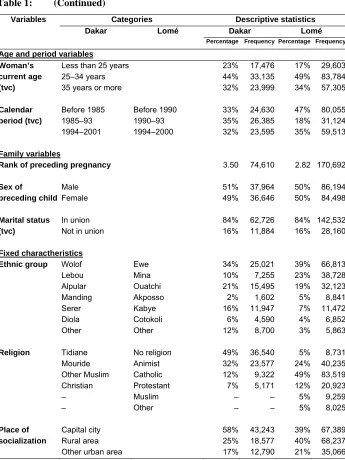
Apart from female employment, the differences between birth intervals may be explained by other sociocultural and demographic factors, which will serve as controls in the regression models. The employment and human capital factors include time-varying covariates such as female professional activity, duration of work experience, and educational level. In order to examine the possible effects of women’s employment, I control on a number of variables (family and background) which have been found to influence fertility. These include family characteristics, such as marital status, sex of preceding child, and rank of preceding child, and background characteristics, such as ethnicity, religion, parents’ profession, and place of socialization. Women’s current age and a calendar period are also included in the models to control for changing age and period effect respectively.
4.3.1 Female employment and human capital
are registered in an educational establishment or engaged in an apprenticeship. Inactive individuals include those who are retired, ill, incapacitated, or homemakers, and others who have not been working or seeking a job for six months and more.
Hypotheses regarding the relation between female employment and fertility are as follows. First, women who are occupied in either salaried employment or self-employed activities are more likely than non-working women to delay the next birth over time. Second, women occupied in salaried activities are expected to have lower chances of giving birth than those who are self-employed. Unlike self-employment, paid jobs may demand high levels of commitment in terms of hours. Rigid time schedules can limit flexibility in childcare arrangements. As a result, such employment may conflict with childbearing and childrearing, thereby inducing a lower risk of birth over time. Third, women with a longer duration of work experience would be more likely to delay the next pregnancy because of work commitments, to the detriment of family life. Duration of work experience is measured in years and is used as a continuous variable in the analysis. Duration of work experience is a cumulative sum of time spent in all jobs, thus excluding periods of non-work. We expect fertility to decrease with a longer duration of work experience. To account for non-linearity, the squared duration value is also introduced into the models. Lastly, education is expected to have an important effect (direct or indirect) on fertility (Joshi 2002). Fertility aspirations vary by educational level. Indirectly, education affects fertility levels in that it influences age at marriage, knowledge and use of contraception, and participation in economic activities, as well as the perception of the opportunity costs of having children. Accordingly, it could be expected that longer schooling would increase the interval between pregnancies and lower the risk of next birth. Education is measured at four levels: none (without education), primary, secondary, and at least high school. Higher educational levels are expected to lower the chances of giving birth in both cities.
4.3.2 Control variables
To control the effect of changing age on the fertility behaviours, three age groups are used in the analysis: less than 25 years, 25–34, and 35 or more. For the time-varying calendar variable that characterizes the economic cycles in each city, three categories are considered: the period before 1985, 1985–93, and 1994–2001 for Dakar; and the period before 1990, 1990–93, and 1994–2000 for Lomé.
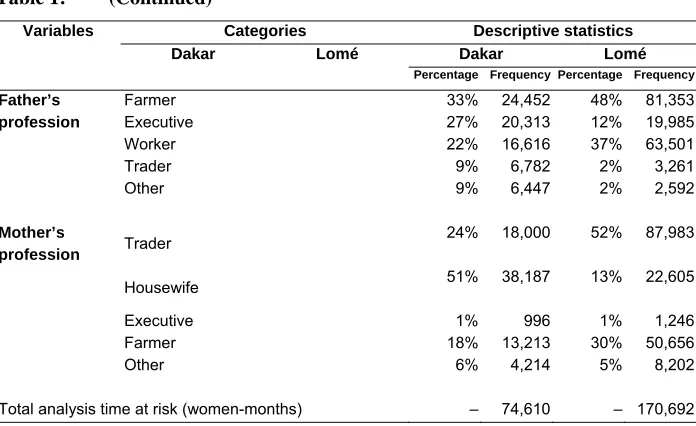
The major ethnic groups in Senegal are the Wolof, Lebou, Alpular, Manding, Serer, and Diola . In Togo they are the Ewe, Mina, Ouatchi, Akposso, Kabye , Cotokoli. There is a residual group of other ethnic groups in each country. In Senegal Islam is the dominant religion but is divided into three different brotherhoods (Muslim Tidiane, Muslim Mouride, and Other Muslim); there are also Christians. In Togo six categories are considered: No religion, Animists, Catholics, Protestants , Muslims, and others. The professions of both parents are divided into five groups: farmer, executive, worker, trader, and other profession for the father; trader, housewife, executive, farmer, and other profession for the mother. Three categories are distinguished for the place of socialization: capital city, rural area, and other urban area.
Table 1: Distribution of women-months by covariates used in the Cox model
Variables Categories Descriptive statistics
Dakar Lomé Dakar Lomé Percentage Frequency Percentage Frequency
Economic activity and human capital
Wage employee 16% 12,279 10% 17,429
Self-employed 39% 28,938 73% 125,052
Current economic
activity (tvc) Unemployed 3% 2,013 1% 1,367
Student/Apprentice 2% 1,242 5% 8,475
Inactive 40% 30,138 11% 18,369
Duration (years) of work experience (tvc) 7.70 74,610 11.68 170,692
None 54% 40,481 44% 74,976
Educational
level (tvc) Primary school 27% 20,237 31% 52,295
Secondary school 8% 6,076 20% 34,717
At least high school
Table 1: (Continued)
Variables Categories Descriptive statistics
Dakar Lomé Dakar Lomé
Percentage Frequency Percentage Frequency
Age and period variables
Less than 25 years 23% 17,476 17% 29,603
25–34 years 44% 33,135 49% 83,784
Woman’s current age
(tvc) 35 years or more 32% 23,999 34% 57,305
Before 1985 Before 1990 33% 24,630 47% 80,055
Calendar
period (tvc) 1985–93 1990–93 35% 26,385 18% 31,124
1994–2001 1994–2000 32% 23,595 35% 59,513
Family variables
Rank of preceding pregnancy 3.50 74,610 2.82 170,692
Male 51% 37,964 50% 86,194
Sex of
preceding child Female 49% 36,646 50% 84,498
In union 84% 62,726 84% 142,532
Marital status
(tvc) Not in union 16% 11,884 16% 28,160
Fixed charactheristics
Ethnic group Wolof Ewe 34% 25,021 39% 66,813
Lebou Mina 10% 7,255 23% 38,728
Alpular Ouatchi 21% 15,495 19% 32,123
Manding Akposso 2% 1,602 5% 8,841
Serer Kabye 16% 11,947 7% 11,472
Diola Cotokoli 6% 4,590 4% 6,852
Other Other 12% 8,700 3% 5,863
Religion Tidiane No religion 49% 36,540 5% 8,731
Mouride Animist 32% 23,577 24% 40,235
Other Muslim Catholic 12% 9,322 49% 83,519
Christian Protestant 7% 5,171 12% 20,923
– Muslim – – 5% 9,259
– Other – – 5% 8,025
Capital city 58% 43,243 39% 67,389
Place of
socialization Rural area 25% 18,577 40% 68,237
Table 1: (Continued)
Variables Categories Descriptive statistics
Dakar Lomé Dakar Lomé
Percentage Frequency Percentage Frequency
Farmer 33% 24,452 48% 81,353
Father’s
profession Executive 27% 20,313 12% 19,985
Worker 22% 16,616 37% 63,501
Trader 9% 6,782 2% 3,261
Other 9% 6,447 2% 2,592
Trader 24% 18,000 52% 87,983
Mother’s profession
Housewife 51% 38,187 13% 22,605
Executive 1% 996 1% 1,246
Farmer 18% 13,213 30% 50,656
Other 6% 4,214 5% 8,202
Total analysis time at risk (women-months) – 74,610 – 170,692
Note: tvc: time-varying covariates.
Source: Estimations based on survey data: Dakar (2001) and Lomé (2000).
5. Results and discussions
5.1 Descriptive statistics
30 women of the oldest and the intermediate generations had on average respectively 1.9 and 1.4 children when they were wage employees, while their counterparts working as self-employed had on average, 2.7 and 2.2 children respectively. In both cities and across generations this table confirms the prior assumption that wage employees should have lower fertility than women involved in self-employed activities.
Table 2: Mean number of children ever born to women at age 30 by economic activity status
Dakar Of which working as Generation
Working
Wage employee Self-employed
Not working Total
Oldest 3.9 (75) 2.2 (25) 4.7 (50) 3.6 (47) 3.8 (122)
Intermediate 2.5 (78) 1.3 (26) 3.0 (52) 2.7 (64) 2.5 (142)
Youngest 1.6 (38) 0.9 (21) – 1.7 (34) 1.6 (72)
Lomé Of which working as Generation
Working
Wage employee Self-employed
Not working Total
Oldest 2.6 (255) 1.9 (46) 2.7 (209) 2.5 (35) 2.6 (290)
Intermediate 2.1 (333) 1.4 (41) 2.2 (292) 1.8 (52) 2.1 (385)
Youngest 1.8 (160) – 1.9 (144) 0.9 (35) 1.7 (195)
Notes: the figures in brackets are the numbers of women; –: fewer than 20. The total number of women (336 for Dakar and 870 for Lomé) is not the same as in Table 3 (397 and 1,060) because only women aged 30 are considered in this table, while all women aged 25–59 at the moment of the survey are considered in Table 3.
Source: Estimations based on survey data: Dakar (2001) and Lomé (2000).
5.2 Results of the multivariate analysis
Findings of the estimated Cox regression model for the hazard of giving birth are given in Tables 3 and 4. Table 3 displays the findings for all the variables considered in the models with no interaction between employment and marital status. Table 4 presents the results of the model including this interaction. In this model the effect of the other controlling factors does not differ from the first model presented in Table 3.
5.2.1 The effects of socio-demographic and cultural factors
The effect of the rank of preceding pregnancy is only significant in Lomé, where women who have reached a certain number of pregnancies are more likely to postpone the next birth (Table 3). The higher the rank of preceding pregnancy, the lower the hazard of giving additional birth. For each additional rank of preceding pregnancy, the hazard of additional birth decreases by 19% in Lomé. But this relation is not linear, since the effect of the squared term is positive and significant: that is, the chances of giving additional birth increases after a certain number of births.
As expected, marital status is associated with higher likelihood of giving birth over time in both Dakar and Lomé. As shown in Table 3, women in union are over five times more likely to give additional birth in Lomé. In Dakar the chances of giving birth are over four times higher when women are living in union.
In both cities the older the woman, the lower is her chance of giving additional birth. The effect of the calendar period variable is translated by lower likelihood of giving additional birth for the recent periods in both Dakar and Lomé. Indeed, compared to the period prior to 1990, the chances of giving birth are reduced by 17% and 40% during the 1990–93 and 1994–2000 periods respectively. In Dakar the chances of giving birth decrease by 16% and 31% for the 1985–93 and 1994–2001 periods respectively. This confirms the crude fertility trends.
Sociocultural variables such as ethnic group, religion, and parents’ profession are not significantly associated with the hazard of birth in either Dakar or Lomé.
5.2.2 The effect of female employment on fertility
to put their employment at risk through frequent work interruptions resulting from many pregnancies. Some employers may prefer recruiting men because they believe that women are less productive as they are likely to take time off for motherhood and other maternal obligations.
Undergoing training also seems to lead women to delay their next birth, since being student or apprentice reduces by 48% the risk of giving birth (compared to self-employment). This result shows that training periods conflict with mothering roles in Lomé.
Contrary to prior assumption, not being involved in economic activity is not conducive to higher chances of fertility, since inactivity in Lomé is not significantly associated with higher risk of giving birth over time. It appears that most women in Lomé are engaged in economic activity and become inactive when they age. Hence the effect of inactivity is captured by the effect of women’s age over time. This is confirmed by the fact that the negative effect of inactivity observed in a prior model not shown here (with only female employment, work experience, and education introduced as explanatory variables) has disappeared after controlling for women’s current age. However, statistical tests show that inactive women are more likely than wage employees (at 5% level) on the one hand and female students/apprentices (at 1% level) on the other hand to give additional birth in Lomé.
Table 3: Hazard ratio of birth for women in Dakar and Lomé (Cox model)
Variables Categories Dakar Lomé
Dakar Lomé Hazard ratio
(standard error)
Hazard ratio (standard error) Economic activity and human capital
Wage employee 1.078 (0.134) 0.727*** (0.083)
Self-employed Ref. Ref.
Current economic
activity (tvc) Unemployed 1.220 (0.259) 0.525 (1.144)
Student/Apprentice 1.184 (0.351) 0.518*** (0.083)
Inactive 1.004 (0.095) 0.969 (0.076)
Duration (years) of work experience (tvc) 1.019 (0.014) 0.994 (0.011)
Duration squared 0.999 (0.000) 1.000 (0.000)
None Ref. Ref.
Educational
level (tvc) Primary school 0.993 (0.101) 0.808*** (0.051)
Secondary school 1.046 (0.169) 0.753*** (0.061) 0.977 (0.164) 0.981 (0.130) At least high
school
Age and period variables
Less than 25 years Ref. Ref.
25–34 years 0.545*** (0.047) 0.756*** (0.049)
Current age (tvc)
35 years or more 0.217*** (0.028) 0.342*** (0.038)
Before 1985 Before 1990 Ref. Ref.
Calendar
period (tvc) 1985–93 1990–93 0.839*** (0.057) 0.826** (0.063)
1994–2001 1994–2000 0.689*** (0.063) 0.601*** (0.056)
Family variables
Rank of preceding pregnancy 1.040 (0.059) 0.813*** (0.051)
Rank squared 0.998 (0.006) 1.025*** (0.009)
Male Ref. Ref.
Sex of
preceding child Female 1.051 (0.064) 0.959 (0.048)
In union Ref. Ref.
Marital status
Table 3: (Continued)
Variables Categories Dakar Lomé
Dakar Lomé
Hazard ratio (standard error)
Hazard ratio (standard error)
Fixed charactheristics
Ethnicity Wolof Ewe Ref. Ref.
Lebou Mina 0.999 (0.137) 1.088 (0.082)
Alpular Ouatchi 0.975 (0.098) 1.035 (0.070) Manding Akposso 1.156 (0.254) 0.965 (0.133)
Serer Kabye 1.085 (0.113) 0.963 (0.104)
Diola Cotokoli 0.961 (0.145) 0.948 (0.194)
Other Other 1.047 (0.146) 0.698 (0.166)
Religion Tidiane No religion Ref. 0.962 (0.113)
Mouride Animist 0.896 (0.079) 1.053 (0.072) Other Muslim Catholic 0.704** (0.098) Ref.
Christian Protestant 0.973 (0.153) 1.035 (0.082)
Muslim 1.361 (0.257)
Other 1.242** (0.108)
Capital city Ref. Ref.
Place of
socialization Rural area 1.147 (0.105) 1.041 (0.065)
Other Urban area 1.038 (0.106) 1.011 (0.073)
Farmer Ref. Ref.
Father’s
profession Executive 1.008 (0.119) 1.020 (0.104)
Worker 1.050 (0.122) 1.091 (0.081)
Trader 0.943 (0.149) 0.765 (0.163)
Other 0.885 (0.117) 0.850 (0.235)
Trader 1.180* (0.104) Ref.
Mother’s
profession Housewife Ref. 1.066 (0.091)
Executive 1.373 (0.481) 0.658 (2.957)
Farmer 0.914 (0.094) 1.132* (0.083)
Other 0.951 (0.165) 1.151 (0.173)
Number of women at risk (events) 397 (1,158) 1060 (1,975)
Total analysis time at risk (women-months) 74,610 170,692
-2log-likelihood 14,916.808 24,034.26
Wald chi2 491.462*** 724.568***
In Dakar neither female employment nor human capital has a significant effect on the likelihood of giving birth. In particular, the risk of giving birth for wage employees is not significantly different from that for self-employed women (the reference group). In the model that takes into account only female employment and work experience, I found that wage employees are less likely to give birth than self-employed (at 1% level). The introduction of the educational attainment weakens this negative effect (lowering the significance level from 1% to 10%). This suggests that the lower risk of wage employee is somehow connected to higher educational attainment (at least secondary school), which is associated with lower chances of giving birth. However, the negative effect of both wage employment and high educational level completely disappears when taking into account women’s age. As observed in Lomé, the older the woman, the lower her chance of giving additional birth.
As observed in Lomé, women’s duration of work experience is not significantly associated with the risk of giving additional birth in Dakar.
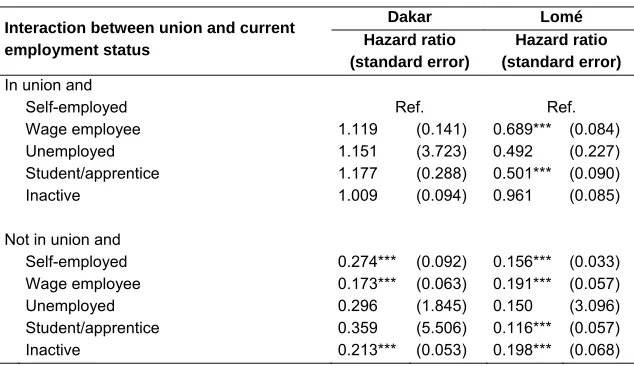
I have assumed so far that the effect of female employment on fertility does not vary according to marital status. However, it is probable that economic activity does not have the same impact on the likelihood of giving birth for married and unmarried women. To verify this hypothesis, I include the interaction term between female economic activity and union by combining these two covariates. This allows for direct comparison of socio-professional groups within marital status. Table 4 displays the hazard ratios of the effect of female employment on fertility across marital status. The effects of other covariates remain the same and therefore are not displayed in this table.
The results confirm that, for each type of current employment, the chances of giving birth are lower when women are not in union in Dakar and Lomé.
In Dakar none of the interaction terms between employment and marriage are significantly associated with the chances of giving additional birth. In fact women’s current employment does not significantly affect the probability of giving birth, irrespective of marital status.
Table 4: Interaction effects of marital status and economic activity on the hazard of giving birth in Dakar and Lomé
Dakar Lomé Interaction between union and current
employment status Hazard ratio
(standard error)
Hazard ratio (standard error)
In union and
Self-employed Ref. Ref.
Wage employee 1.119 (0.141) 0.689*** (0.084)
Unemployed 1.151 (3.723) 0.492 (0.227)
Student/apprentice 1.177 (0.288) 0.501*** (0.090)
Inactive 1.009 (0.094) 0.961 (0.085)
Not in union and
Self-employed 0.274*** (0.092) 0.156*** (0.033)
Wage employee 0.173*** (0.063) 0.191*** (0.057)
Unemployed 0.296 (1.845) 0.150 (3.096)
Student/apprentice 0.359 (5.506) 0.116*** (0.057)
Inactive 0.213*** (0.053) 0.198*** (0.068)
Note: ***: p ≤ 0.01.
Source: Estimations based on survey data: Dakar (2001) and Lomé (2000).
6. Conclusion
This paper investigates the influence of women’s professional life on fertility in two different urban African cultural contexts through the analysis of the impact of female employment on the risk of pregnancy over time. The comparison between Dakar and Lomé casts light on the role of the cultural environment on the mechanisms that underlie any study of the work–fertility relationship in sub-Saharan Africa.
In Dakar, where female employment is less widespread than in Lomé, it appears that women have to pay great attention to their family roles, namely bearing and rearing children, even if they are involved in economic activities. Working does not seem to hinder family formation. Greater involvement of women in the labour force is not the main reason for fertility decline in Dakar. A greater female labour participation will probably not affect fertility trends, unless gender-specific roles change dramatically.
In Lomé, where they have been involved in the labour market for a long time (since before men lost their economic or purchasing power), women seem to consider work as a legitimate alternative to their role as a mother or spouse. Being involved in an economic activity is a real option in their life and can therefore impact upon their reproductive life. Their long-lasting and appreciated participation in economic activities appears to enable women to control their fertility and improve their social status. Their established economic autonomy might facilitate their decision to have fewer children during their lifetime. In Lomé women who are self-sufficient are likely to be more involved in fertility decisions.
These findings illustrate how important it is to consider the social gender-specific roles in order to accurately determine the influence of female employment on reproductive life. The relationships between professional and reproductive lives depend on the specific gender relations and roles attributed in each society. A woman’s place in the society, the gender-specific division of work, and the patriarchal nature of the relations between men and women are closely related to reproductive behaviour in a given society.
7. Acknowledgements
References
Adjamagbo, A., Antoine, P., Béguy, D., and Dial, F.B. (2006). Comment les femmes concilient-elles mariage et travail à Dakar et à Lomé? Paris: DIAL (Document de travail DIAL; DT/2006-04).
Adjamagbo, A., Antoine, P., and Dial, F.B. (2004). Le dilemme des Dakaroises: entre travailler et bien travailler. In: Diop, M.C. (ed.). Gouverner le Sénégal: entre ajustement structurel et développement durable. Paris: Karthala: 247-272.
Agounké, A., Assogba, M., and Anipah, K. (1989). Enquête démographique et de santé au Togo 1988 (EDS I). Lomé/Calverton: Unité de Recherche Démographique, Direction de la Statistique, Direction Générale de la Santé et Institute for Resource Development/Macro Systems.
Anipah, K., Mboup, G., Ouro-Gnao, A. M., Boukpessi, B., Messan, P. A., and Salami-Odjo R. (1999). Enquête démographique et de santé au Togo 1998 (EDS II). Lomé/Calverton: Ministère de la planification et du développement économique, Direction de la Statistique, Macro International Inc.
Antoine, P. and Dial, F.B. (2005). Mariage, divorce et remariage à Dakar et Lomé. In: Vignikin, K. and Vimard, P. (eds.). Familles au Nord, Familles au Sud. Louvain-la-Neuve: Academia-Bruylant: 205-232.
Antoine, P. and Fall, A. S. (2002). Crise, passage à l’âge adulte et devenir de la famille dans les classes moyennes et pauvres à Dakar. Dakar: CODESRIA/IFAN/IRD (Rapport d'étape).
Antoine, P., Ouedraogo, D., and Piché, V. (1998). Trois générations de citadins au Sahel. Trente ans d’histoire sociale à Dakar et à Bamako. Paris: Harmattan.
Antoine, P. and Bocquier, P. (1999). L’enquête “Insertion urbaine à Dakar et à Pikine.” In: Groupe de réflexion sur l’approche biographique (ed.). Biographies d’enquêtes: bilan de 14 collectes biographiques. Paris: INED: 179-202 (Méthodes et Savoirs, 3).
Becker, G. S. (1993). A treatise on the family. Enlarged Edition. Cambridge/ Masschussets: Harvard University Press.
Blau, D. M. and Robins, P. K. (1989). Fertility, employment and child care costs.
Blossfeld, H. P., Hamerle, A., and Mayer, K. U. (1989). Event History Analysis. Statistical Theory and Application in the Social Sciences. Millsdale: Lawrence Erlbaum Associates Publishers.
Bocquier, P. (1996). L’analyse des enquêtes biographiques à l’aide du logiciel Stata. Paris: CEPED: 208pp. (Documents et manuels du CEPED, 4).
Brilleau, A., Roubaud, F., and Torelli, C. (2004). L’emploi, le chômage et les conditions d’activité dans les principales agglomérations de sept États membres de l’UEMOA. Principaux résultats de la phase 1 de l’enquête 1-2-3 de 2001-2002. Paris: DIAL (Document de travail; DT/2004-06).
Budig, M. J. (2003). Are women’s employment and fertility histories interdependent? An examination of causal order using event history analysis. Social Science Research 32: 376-401. doi:10.1016/S0049-089X(03)00012-7.
Collier, P., Edwards, A.C., Roberts, J., and Bardhan, K. (1994). Gender Aspects of Labour Allocation During Structural Adjustment - A Theoretical Framework and the African experience. In: Horton, S., Kanbar, R., and Mazumdar, D. (eds.).
Labour Markets in an Era of Adjustment. Washington D.C.: World Bank: 277-345.
Cordonnier, R. (1987). Femmes africaines et commerce. Les revendeuses de tissu de la ville de Lomé (Togo). Paris: Harmattan.
Courgeau, D. and Lelièvre, E. (1989). Analyse démographique des biographies. Paris: INED: 268 pp.
Cox, D.R. (1972). Regression models and life tables. Journal of the Royal Statistical Society Series B (Methodological) 34: 187–220.
Cramer, J. (1980). Fertility and female employment: problems of causal direction.
American Sociological Review 45: 167-190. doi:10.2307/2095117.
Engracia, L. T. and Herrin, A. N. (1984). Female work participation and fertility in the Philippines. In: L. T. Engracia et al. (eds.). Fertility in the Philippines: Further analysis of the Republic of the Philippines Fertility Survey 1978. Vooburg: International Statistical Institute.
Felmlee, D.H. (1993). The dynamic interdependence of women’s employment and fertility. Social Science Research 22: 333-359. doi:10.1006/ssre.1993.1017.
Hout, M. (1978). The determinants of marital fertility in the United States, 1968-70:
inferences from a dynamic model. Demography 15: 139-160.
Joshi, H. (2002). Production, reproduction and education: women, children and work in a British perspective. Population and Development Review 28(3): 445-474.
doi:10.1111/j.1728-4457.2002.00445.x.
Kempeneers, M. (1987). Femmes et mouvements du travail. Pour un élargissement de l’analyse démographique de l’activité salariée et de l’activité maternelle des femmes. [Thèse de PhD en démographie]. Montréal: Université de Montréal Collection de thèses et mémoires, 29).
Kollehlon, K. T. (1984). Women’s work role and fertility in Liberia. Journal of the International African Institute 54(4): 31-45. doi:10.2307/1160395.
Lloyd, C.B. (1991). The contribution of the World Fertility Surveys to an understanding of the relationship between women’s work and fertility. Studies in Family Planning 22(3): 144-161. doi:10.2307/1966642.
Locoh, T. (1996). Changements de rôles masculins et féminins dans la crise: la révolution silencieuse. In: Coussy, J. and Vallin, J. (eds..). Crise et population en Afrique: crises économiques, politiques d'ajustement et dynamiques démographiques. Paris: CEPED: 445-469 (Les Études du CEPED, 13).
Locoh, T. (1984). Fécondité et famille en Afrique de l’Ouest. Le Togo méridional contemporain. Paris: INED-PUF.
Mason, K. O. and Palan V. T. (1981). Female employment and fertility in Peninsular Malaysia: the maternal role incompatibility reconsidered. Demography 18(4): 549-575. doi:10.2307/2060947.
Nanitelamio, J. (1995). Insertion urbaine et représentations des statuts féminins. In: Antoine, P. and Diop, A. B. (eds.). La ville à guichets fermés ? Dakar: IFAN/ORSTOM: 277-289.
Ndiaye, S. and Ayad, M. (2006). Enquête Démographique et de Santé au Sénégal 2005 (EDS IV). Calverton/Maryland: Centre de Recherche pour le Développement Humain [Sénégal] et ORC Macro.
Ndiaye, S., Gaye, A., and Ayad, M. (1997). Enquête Démographique et de Santé au Sénégal 1997 (EDS III). Dakar/Calverton: Ministère de l’Économie et des Finances et Macro International Inc.
Oppong, C. (1991). Les rapports entre le travail des femmes et les comportements démographiques: quelques éléments tirés de recherches en Afrique de l’Ouest. Genève: BIT (Document de travail “Travail et population en Afrique subsaharienne”, 12).
Oppong, C. (1988). Les femmes africaines: les épouses, les mères et les travailleuses. In: Tabutin, D. (ed.). Populations et sociétés en Afrique au Sud du Sahara. Paris: Harmattan: 421-440.
Piché, V., Poirier, J., and Neill, G. (1989). Travail des femmes et fécondité dans les pays en développement: que nous a appris l’Enquête mondiale de la fécondité ?
Cahiers québécois de démographie 18(1): 159-184.
Rindfuss, R.R. and Brewster, K. L. (1996). Childrearing and fertility. Population and Development Review 22: 258-289 (Supplement: Fertility in the United States: New Patterns, New theories). doi:10.2307/2808014.
Rodriguez, G. and Cleland, J. (1981). The effects of socioeconomic characteristics on fertility in 20 countries. International Family Planning Perspectives 7(3): 93-101. doi:10.2307/2948042.
Shockaert, I. (2005). Travail féminin et fécondité en Amérique latine: Un état de la question. Population 60(1-2): 157-178.
Smith-Lovin, L. and Tickamyer, A. (1978). Non recursive models of labor force participation, fertility behavior, and sex role attitudes. American Sociological Review 43: 541-557. doi:10.2307/2094778.
Standing, G. (1983). Women’s work activity and fertility. In: Bulatao, R.A. and Lee, R.D. (eds.). Determinants of fertility in developing countries. New York: Academic Press: 517-546.
Stolzenberg, R. and Waite, L. (1977). Age, fertility expectations and plans for employment. American Sociological Review 42: 769-783. doi:10.2307/2094865.
Thiriat, M. P. (2000). Les pratiques matrimoniales, au principe des systèmes de genre. In: Bozon, M. and Locoh, T. (eds.). Rapports de genre et questions de population. Paris: INED: 81-94.
Trussell, J., Hankinson, R., and Tilton J. (1992). Demographic applications of event history analysis. Oxford: Clarendon Press.
United-Nations (1985b). Women’s Employment and Fertility. A comparative Analysis of World Fertility Survey for 38 Developing Countries. New-York: Department of International Economic and Social Affairs (Population Studies, 96).
United-Nations (1987). Fertility behavior in the context of development. Evidence from the World Fertility Survey. New-York: Department of International Economic and Social Affairs (Population Studies, 100).