University of New Orleans University of New Orleans
ScholarWorks@UNO
ScholarWorks@UNO
University of New Orleans Theses and
Dissertations Dissertations and Theses
Spring 5-18-2012
A Software Framework for Augmentative and Alternative
A Software Framework for Augmentative and Alternative
Communication
Communication
Adam Loup
University of New Orleans, [email protected]
Follow this and additional works at: https://scholarworks.uno.edu/td
Part of the Databases and Information Systems Commons, Software Engineering Commons, and the
Systems Architecture Commons
Recommended Citation Recommended Citation
Loup, Adam, "A Software Framework for Augmentative and Alternative Communication" (2012). University of New Orleans Theses and Dissertations. 1461.
https://scholarworks.uno.edu/td/1461
This Thesis is protected by copyright and/or related rights. It has been brought to you by ScholarWorks@UNO with permission from the rights-holder(s). You are free to use this Thesis in any way that is permitted by the copyright and related rights legislation that applies to your use. For other uses you need to obtain permission from the rights-holder(s) directly, unless additional rights are indicated by a Creative Commons license in the record and/or on the work itself.
A Software Framework for Augmentative and Alternative Communication
A Thesis
Submitted to the Graduate Faculty of the University of New Orleans
in partial fulfillment of the requirements for the degree of
Master of Science In
Computer Science
Database Systems and Distributed Applications
By
Adam Loup
B.S. University of New Orleans, 2006
ii
Table of Contents
List of Figures ...iii
Abstract ...iv
Chapter 1 ...1
Chapter 2 ...2
Chapter 3 ...8
Chapter 4 ...10
Chapter 5 ...17
Chapter 6 ...25
References ...27
iii List of Figures
Figure 1 ...11
Figure 2 ...15
Figure 3 ...18
Figure 4 ...20
Figure 5 ...21
Figure 6 ...22
Table 1 ...23
Figure 7 ...24
iv
Abstract
By combining context awareness and analytical based relevance computing software, the
proposed Augmentative and Alternative Communication (AAC) framework aims provide a
foundation to create communication systems to dramatically increase the words available to
AAC users. The framework will allow the lexicon available to the user to be dynamically
updated by varying sources and to promote words based on contextual relevance. This level of
customization enables the development of highly customizable AAC devices that evolve with
use to become more personal while also broadening the expressiveness of the user. In order to
maximize the efficient creation of conversation for AAC users, the framework provides a lexicon
with the ability to obtain words from multiple sources which are then organized according to
relevance in a situational context.
Keywords: context awareness, Alternative and Augmentative Communications, AAC device,
1
1 Introduction
Conversation is one of the most important human interactions. For some, this
fundamental means of communication becomes impaired due to illness, age, disability or injury.
The sciences of Speech and Language Pathology exist to therapeutically treat speech-related
disabilities. Alternative and Augmentative Communications (AAC) devices were created to aid
both speech pathologists and their patients. The most important function of AAC devices is to
allow the creation of conversation for users. These conversations aid in fulfilling the agendas of
communication: expressing wants and needs, the transfer of information, social intimacy and
social etiquette [9]. The methods of conversation creation are not always straight forward,
ranging from predictable, to novel, to intimate. In many cases, the meaning of conversation
dramatically changes based on contextual situations as well. Traditionally, AAC devices
construct conversation with lexical items that are made available through the device’s lexicon.
The lexicons are made up of a predefined core vocabulary which has been developed over time
by Speech Pathologists to contain the most commonly used words in general conversations.
While this core vocabulary helps a great deal with device-aided communication, it is often
lacking words that are specific to a user or a conversation context. In some cases the core
vocabulary has been found to contain only 33% of the words for a desired communication [1].
Lexicons can be updated; however, the user or the family of the user is often unable to do so. In
principle, the lexicon of a device can be enhanced by the addition of new words from updates or
even customized by speech pathologists with specialized software. Even with regular updates
the lexicon can still return words that are not useful in a situational context.
The goal of this research project is to provide a framework for a context aware system
2
applications to transparently adapt results to fit the context of the request [14,15]. The lexicon of
the proposed system filters and sorts words based on situational contexts, consisting of the
location and the categories the words are used in. The objective is to lessen the burden of
device-aided communication by proactively delivering situational dependent words derived from
usage history.
2 Background
2.1 Augmentative and Alternative Communication
There are many people, adult and children alike, that have extreme difficulty
communicating via oral speech. These speech impediments stem from various congenital and
degenerative causes such as; Cerebral Palsy, Stroke, ALS, Autism and Muscular Dystrophy. The
American Speech and Hearing Association's (ASHA) defines AAC systems as "an integrated
group of components, including the symbols, aids, strategies and techniques used by individuals
to enhance communication."[10] For those who are unable to express themselves through
speech, AAC devices are an assistive technology to aid and enhance communication capabilities.
In some cases AAC devices are used to develop a stronger understanding of communication.
There are two main types of Augmentative and Alternative Communication, unaided and
aided. Unaided AAC refers to nonverbal natural communication, such as sign language.
Typically, these forms of AAC are used by adults or children that have used of their hands and
the motor-skills necessary to perform the gestures used for communication.
Conversely, aided AAC refers to approaches that rely on additional peripherals that
render representations of what the user wants to convey. Aided devices also include digital
3
language representation in aided AAC devices has been accomplished by presenting the user
with alphabet-based symbols. Access to individual words, through spontaneous novel utterance
generation (SNUG), has been proven to increase participation in casual conversation and to
promote natural language development [10]. Pre-stored messages or phrases rarely meet the
needs of conversing in the natural environment and often fail to give the user adequate
conversational ability [1].
While effective, whole word symbols require a large symbol set. The choice of
vocabulary available to the user is a critical aspect to the success of AAC usefulness. There are
two main divisions of vocabulary, core and extended [9,10]. The core vocabulary are the few
hundred words that speech pathology research has deemed critical to create general conversation
and the majority of social interactions. Extended vocabularies are those words which are used to
describe specific items and are used infrequently. Together, these two categories provide a solid
foundation for improvements to the augmentative and alternative communication. In addition to
these vocabularies, AAC devices must include the full communication ability of the individual.
2.2 Android
Over the last few years, innovations in mobile technology have already greatly aided and
enhanced methods of human communication. Modern mobile technology provides an always on
and always connected ecosystem. One such class of mobile devices that have gained huge
amounts of popularity are tablets. Tablets are mobile personal computers with flat touch screens
larger than five inches. Like personal computers, tablets allow users to access the Internet
4
also come with extra features, such as a gyroscope, GPS, and an accelerometer, that developers
harness to provide innovative uses through Apps.
To unify the mobile device market, the Open Handset Alliance and Google worked to
design and implement an “open, complete and free platform created specifically for mobile
devices.” The result of this alliance is the Android Operating System. Android, an open-sourced
software architecture platform consisting of Linux-based operating system, middleware and
applications designed for mobile devices to create the best possible experience to mobile end
users [12]. The Android team has created an open ecosystem for developers to create
applications to distribute to any Android-compatible device [11]. The platform provides an
interface with the host device’s hardware components, such as GPS, as well as access to Google
authored and third party authored libraries to increase functionality of developer created
applications. Most importantly, Android devices are delivered with text to speech, data storage,
HTTP communication and location libraries. The application layer of Android is handled by the
Dalvik Virtual Machine optimized for memory and CPU constrained devices. Dalvik provides a
full featured Java programming environment and is capable of executing modern Java code. It is
important to note that Dalvik is not a J2ME environment and supports most current Java
libraries. [11]
In addition to the ability to run standard Java libraries, the two most recent versions of
Android, Honeycomb (3.0) and Ice Cream Sandwich (4.0), provide enhancements beneficial to
5
2.3 Relevance Index
Often, obtaining results that match a specific pattern is enough to satisfy a search request.
However, In the field of Information retrieval where large data sets are queried, the relevancy of
a particular item is more significant than if an item matches a query or not [7]. The Term
Frequency times Inverse Document Frequency (TF-IDF) weighting formula is a means of
computing the relevance of an item based on terms of the query[7]. The TF-IDF assigns a higher
weight to term that occurs more often in a sub set of the larger data set and a lower weight to
terms that occur often across the entire data set. First released in 1972, TF-IDF has proven to be
very robust and is used in the core of most ranking based search engines [8]. Adding a weighted
relevance index to results provides an extra layer of confidence that the results not only satisfy a
query but also contain relevance to context in which it as made.
2.4 Stemming algorithm and Lucene Snowball API
When performing Natural Language Processing (NLP) the base form of a word is more
important than then conjugated forms of a word. Often the input for NLP contains conjugations
of words and the base must be derived via Stemming algorithms. The Porter Stemmer is a step
based approach that works on the idea that most English words are comprised of a combination
of suffixes [6]. Each step of the algorithm applies rules, defined using the Snowball language, to
match and remove a suffix from a word until a stem can be produced [6]. Lucene is a Java based
indexing and search tool that performs stemming using the Porter approach and has made the
6
2.5 Context-Aware Computing
Through the rise in ubiquitous computing the a focus on the physical environment in
which an application runs has surfaced. Context-awareness allows applications to adapt to and
make assumptions based on situational changes [14, 15]. Context generally consists of a
geographic location along with other domain specific information [17]. Applications can
respond to context changes in different manners from the availability of certain aspect of an
application or the items it manages to events that are triggered when entering or exiting a context
[17]. Taking into account the user context allows application to continue to innovate and
personalize the use of computers in daily life [15].
2.6 Related Work
The framework proposed in [15] is made up modules, each with a specific task. Context
data that originated from sensory data is conditioned and introduced to the system via the
Context Normalization Module. The module is also responsible for abstraction or conversion of
raw data into recognized types. From this point the Context Aggregation Module combines
related contexts by organizing the contexts based on UserId, DeviceId or LocationId, or by
domain specific rules. Resulting contexts are added to the Current Context and also to the Filter
Module. The Filter Module filters out essential contexts which are then are stored in a history
database for future processing. Contexts are not defined purely by sensory data. The Context
Inference module uses a rules based approach backed by an established knowledge base to infer
contexts, such as the kind of activity the user is doing, based on sensory driven contexts. The
patterns of a particular user also play a role in context awareness. The Context Learning
7
Finally, the presence of a particular context can cause actions to occur. These are invoked by
the Event Triggering Module.
The context-awareness of the AAC framework is concerned with acting on a particular
context more so than building a complex context model. There is a finite number of sensory data
from which these contexts are established. Situational contexts are straight forward pairings of a
word with the geospatial coordinates a word is used in and the categories traversed by the user in
order to get to that word. The driving force behind the AAC framework is the current state of the
LexicalContext and how to act upon it to best serve the user. The Lexicon is a connecting point
between the WordProviders, the requester of data, and the history of user interaction created by
the PhraseAnalyzer.
2.7 Survey of Contextual-Awareness
Context Awareness is used across many disciplines in order to achieve enhancements in
life quality, to aid daily activities and to provide a better understanding of current tasks. Context
awareness is used in [19] order to maintain a distributed electronic patient record across multiple
ubiquitous devices both mobile and stationed at key locations throughout a large hospital. The
devices were used make patient records available at any time, in any location.
The Sense Everything, Control Everything (SECE) platform is used to trigger events
based on user defined rules [19]. SECE connected previously isolated services in to a useful,
user personalized composite service. In one example the user’s current location being so far
away from a meeting location triggered alerts to be sent to workmates informing them that the
8
As seen in [18], context-awareness is used to improve the focus and efficiency of a small
meeting by analyzing single person and group interactions though audio and video sensors.
Contextual clues were used in order to direct microphones to the current presenter the cameras
to a particular object. These automated adjust can perform transparent of user interaction and
without disruption of the meeting.
3 Requirements
A one size fits all solution is not practical since the physical ability and literacy level
varies from user to user. On the other hand, the underlying operation and lexicon storage is
similar across different AAC devices. Having a foundation promotes efficient creation of new
applications and improvements to the quality and robustness of existing applications. An
established base will allow developers to focus on the special case they are designing for without
having to recreate the infrastructure on which every device or application runs.
3.1 Basic Requirements of the AAC Framework
The framework was designed considering three issues critical to the usefulness of
applications requiring it. Most importantly, the framework must provide the essential features of
AAC devices to impart effective interactive communication. Users should at least be able to
access words in the same manner as current AAC devices. Words are divided into logical
categories. Categories are collections of words organized based on predetermined logical
groupings in contextual situations. For example, words such as “pencil”, “notebook” and
“teacher” might be found in the “classroom” and in the “school” categories. The relationships
9
must provide a means to store and return words based on categories, whenever requested by the
user. Words for AAC devices are not solely determined by speech pathologists. There must be a
means for words imperative to daily life to be added by the user or a family member. Second, to
encourage quick conversation creation the framework must respond quickly to context changes
when retrieving and combining results from multiple sources. Therefore, the framework must
perform tasks in a non-blocking manner. The user should never have to wait more than 0.1
seconds for words to be available [13]. Finally, a single method of computing relevancy is not
enough to handle the needs of all users. Relevancy is an index relating a word to a situational
context. The framework must be easily extensible and facilitate other forms of relevance
computation [14].
3.2 Problem with the Basic AAC
Current AAC devices provide a closed and rigid lexicon. A static vocabulary does not
always adhere to the individual needs of users especially in a variety of social situations. Many
users do not always choose words that are present in core vocabularies. Typically, family
members and/or speech pathologists are responsible for maintaining the device. They should
keep it up-to-date and they should prepare the device for the needs of the user for the next day
[9]. While the user can have a direct impact on the words present on a device, there still exists a
strong need for fine-grained personalization. Awareness of how the user combines words to
create conversation allows AAC devices to fulfill the main purposes of communicative
interactions to a higher degree. [5, 9]
In addition to a predefined vocabulary, the size of the screen is also a factor limiting the
10
can appear on the screen at one time is very limited. Many devices employ dynamic layouts in
order to display more meaningful words on the screen. Words in a layout are organized in a
specific fashion decided upon by the device designers. The methods of organizing words for
layouts vary greatly. Some devices display words divided into categories of semantic frames
that the user chooses for the desired conversations [9]. There have also been efforts to improve
the selection of words by taking into account details and daily patterns of the user to display
words that are more relevant to a situation.
3.3 Context-Aware AAC
Users of AAC devices are often bound to a limited number of conversational contexts.
Meanings expressed through conversations are highly dependent upon the context in which it is
created. A better understanding of the conversational context gives a greater insight into the
intentions and motivations of the speaker. Imparting context awareness and usage data
collection into the lexicon can improve word selection with items that are not only relevant to the
context but also to how the user has communicated in the past [15]. With continual usage the
context-aware AAC can harvest a model of the user based on daily usage patterns in order to
bring attention to words relevant to a conversation. Therefore the words that are used most often
in a particular location will be marked in order to draw the attention of the user.
4 Design
Drawing upon the different techniques of managing and providing lexical items to AAC
users, this framework is designed to be flexible. The framework provides methods to easily add
11
methods in which word relevance is computed. The framework is intended to be a foundation to
create applications on mobile devices and is designed to be lightweight with a low resource
footprint.
4.1 AAC Framework Architecture
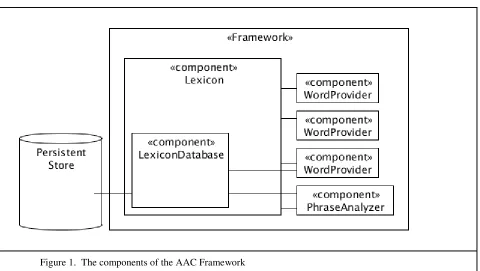
Figure 1. The components of the AAC Framework
Similar to the framework proposed by Park and Lee [15], the AAC framework is
compartmentalized into modules responsible for a specific duty. The Lexicon is a Context
Service that leverages these modules to manage collecting, organizing and maintaining words
available to the user by observing how and where words are used [14]. Modules communicate
by responding to changes in the context and by events triggered by other components. These
modules are also thread safe and work concurrently in order to carry out tasks in a non-blocking
fashion. Context awareness is achieved by leveraging multiple contexts into a singular
12
is combined with inferred context information consisting of the actual words spoken and the
categories currently used [15]. It should be noted that the Lexical Context is not limited to
location awareness. Any number of contextual parameters can be used to define lexical contexts.
Contextual information is then passed to the PhraseAnalyzer, the filtering and learning module,
which records the history of contexts that is later used to enhance adaptation to the user [14, 15].
The Lexicon obtains words by querying WordProviders, passing the current location and
category. Results are combined and filtered based on their accompanying relevance score and
ultimately are presented to the user.
4.2 Lexicon Management
The structure of the data set lends itself to produce a well-defined user profile to apply
context awareness. In addition to categories, words are also grouped based on the results of
word usage. The Lexicon is tasked with returning a word set relevant to the current situational
context. Relevance refers to how often a word is used in a context based on the statistics of past
interactions. After a phrase is created, the Lexicon passes it to the PhraseAnalyser. At this point
the phrase is broken down into the individual words that make up the phrase. First, any stop
words are removed. Stop words are functional words used to construct and join concepts but are
irrelevant to a situational context [6]. Generally stop words consists of articles, pronouns,
interjections, and any other group of function words that are ambiguous in meaning and serve to
create grammatical structures. Initially the set of stop words is created from a predefined list
used throughout applications that perform natural language processing. However, stop words can
be unique to the purposes of an application. To promote personalization, words can be added to
the stop word list at any time. For example, through usage history statistics, a user finds that a
13
score decreases however, the user still wants to have easy access to it. Adding it to the stop word
list will cause the word to be present at all times and will prevent any future usage recording.
Next, Word objects are created for any new items in the word set. New words will not
always be base words. Identifying the base of a word can be accomplished with stemming
algorithms. The PhraseAnalyser handles stemming using the Lucene Snowball API, an
implementation of the Porter-Stemming algorithm. The base may or may not exist in the
database. In the event that the base word does not exist in the Lexicon, a Word object for the
base is also created. Any new Word objects created by the PhraseAnalyser are store to the local
database, through the persistence layer, for future use. Finally, a usage record is created for each
word and category pair remaining, along with the current geographic location. Since one word
can have multiple conjugations the base ID of a word is used in place of the word ID. If a usage
record for this word/category/location combination already exists, the frequency is incremented.
Word usage is kept to track how the user relates words to supplement the predefined grouping,
enabling the lexicon to reflect the user on a personal level over time.
Efficient conversation construction greatly depends on the words readily available to the
user. AAC devices employ many techniques to improve the rate at which conversation is
created. One such method is to display words in an order based on some method of relevance.
While helpful, relevance dictated by outside sources is not always beneficial to the
personalization of the Lexicon [1, 4]. All words presented to the user for conversation creation
are made available through the Lexicon. Word Providers are used to populate the lexicon with
words and to facilitate evolving and future methods of discovering meaningful lexical items,
14
4.3 Word Providers
Word Providers are a component of the lexicon that delivers words from various internal
or external sources. They dictate which words are contained by the lexicon at a given time. To
impart a particular influence on which words are presented, the framework supplies an API to
support the creation and management of custom word providers. Desired providers must be
registered to the lexicon through the addProvider and removeProvider methods. Custom word
providers must extend the WordProvider class and implement the get method to return a set of
WordProviderResults. Each WordProviderResult object contains the Word object and a
corresponding relevance score representing a weighted importance that is calculated at the
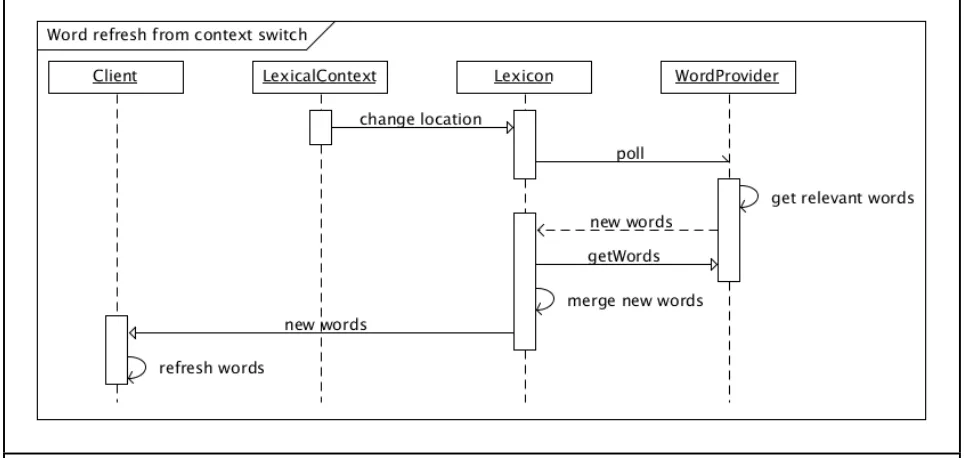
discretion of the provider. Registered providers are invoked by the lexicon in response to a
change in the lexical context (i.e. when the user chooses a different category), and the context is
passed to all registered word providers. All communication between the lexicon and word
providers is synchronous to prevent the word gathering process from prolonging the construct of
conversation due to execution blocking due to the creation of large result sets.
A single change in context can trigger multiple updates to the lexicon. The lexicon
combines and sorts the WordProviderResults for display to the user as each word provider
returns results. When the Lexicon is notified of a change by a WordProvider, the set of words
contained by that provider is re-evaluated against the set of WordProviderResults contained by
the Lexicon. Any new WordProviderResults from the originating word provider are added to the
lexicon. In the event that a WordProviderResult from the provider already exists in the lexicon
the relevance scores are compared; the WordProviderResult with the lower score is removed
15
Figure 2. Sequence Diagram showing the interaction between the Lexicon and WordProviders triggered by events from the client user interface.
Word Providers are not only a means to introduce new words into the Lexicon, but also
act to create new relationships and improve existing relationships between words. In order to
add words from a provider into the Lexicon, the word has to be used in conversation. When the
PhraseAnalyser is invoked for usage information gathering, it also checks if the word being
processed is currently a part of the Lexicon. In the event a new word is found, it is added to the
Lexicon with no category associations.
Real-time updating and expansion of the vocabulary along with expandable methods of
word discovery aid in lifting the constraints of a limited word pool in conversation. The user is
not limited to a predefined lexicon. The combination of these capabilities in a single core library
allow the development of a robust AAC devices that encapsulates existing, desired and any
16
4.4 Reference Implementation of Word Providers
Two word providers are included with the framework, the LocationWordProvider and the
LocalWordProvider. The LocationWordProvider returns relevant word results based on the
current geographical location of the user. This is achieved through the usage history data
collected by the PhraseAnalyser. The usage history records the situational contexts in which
words were used as well as the frequency in which they were used. The importance of a word to
a particular geographic location is determined by using term frequency normalization. This
relevance is computed by term frequency times inverse document frequency (tf*idf) (Manning,
2008). For purposes of this provider, term frequency (tf) is the normalized frequency in which a
word has been used in a situational context and is computed as ) where ctc is the
number of times a word has been used in all contexts and ctt is the total number of times a word
has been used in the current context. Document frequency (df) is the number of categories, per
geographic location, associated with the word divided by the total number of categories (n). The
Inverse Document Frequency (idf) is then computed as . The
LocationWordProvider uses the result of tf*idf for each term as the relevance score for the
WordProviderResult of the term. Computing the relevance using IDF ensures that a lower
importance is given to words that occur greatly throughout all situational contexts. A higher
score is given to words that are used more often in a particular situation. The more a word is
used in a specific situation the higher the relevance score becomes. The more a word is used in a
specific situation the higher the relevance score becomes.
Words stored locally are also accessed through a word provider. The
LocalWordProvider returns words that are most relevant based on the predetermined categories
17
history is capable of supplying valid results independently. The framework provides two basic
implementations of the word provider class, the basic WordProvider and the cache based
CachedWordProvider. These two classes are meant to be extended in order to create customized
Word Providers. For any provider that extends WordProvider the get method is called every
time the lexicon requests words. Conversely, for any word provider that extends the
CachedProvider the get method is only called when a new context passed to the provider or if
the results of a previous request have expired.
Whenever the CachedWordProvider is polled for a given context the result set is cached
for a set amount of time. For every new context passed to the provider the get method is called.
This leads to a side effect of the caching the results sets. Word usage frequencies are not
updated for a context until the new results are requested. A word list will not immediately be
reordered after usage processing has been performed on a phrase.
5 Implementation and Prototype
Implementation of the framework is done in the Java programming language to ensure
that the framework will be able to operate on a large number of relatively easy to acquire
devices. Any libraries used by the framework, including the framework itself, are compatible
with the Standard Java 6.0 Run-time Environment. The framework was developed with the
18
5.1 Persistence Layer
In order to maintain a constantly evolving vocabulary, a local SQLite database managed
though ORMLite 4.33, a lightweight Java object-relationship data access layer, is used to persist
the Lexicon.
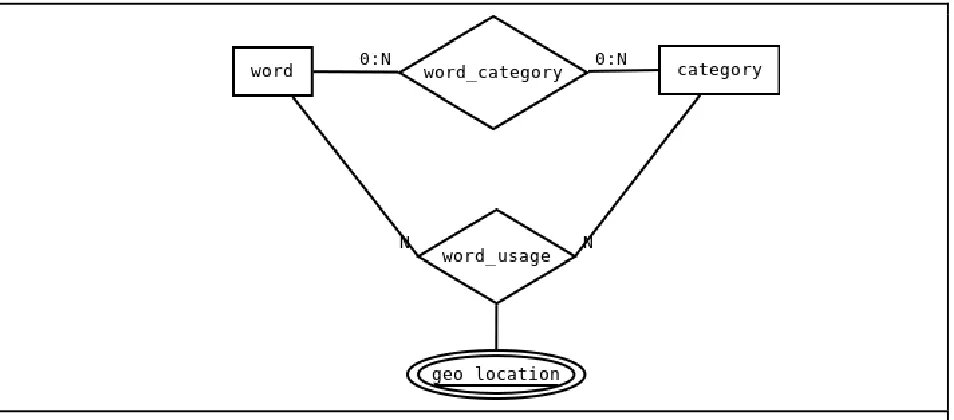
Figure 3. The database structure for Words and Categories
Word objects are the basic elements of the framework which represent single spoken
language words. Each Word contains an ID, the text of the word, the word’s pronunciation, the
locale (language, country, dialect) of the word. Since there is a possibility of words entering the
Lexicon from outside sources, the ID is created by the concatenation of the lower case word’s
text and the word’s locale. Similar to Words, Categories have an ID, name and locale. The ID
for categories is formed in the same manner as the Word ID, from the locale and the name of the
Category. The lexicon maintained by the framework must contain and organize words by
category. The many-to-many relationship of Words and Categories is represented by the
19
Categories, used to store usage history data, that also includes a geographic location and a
frequency.
Access to the database from the components of the framework is handled through the
LexiconDatabase object. This object is a wrapper for an external persistent data store that
contains methods to obtain the Data Access Objects (DAO) for words, categories, word
categories and word usages. Each DAO manages the persistence and retrieval of the respective
type.
5.2 Prototype
A practical AAC system has been created using the described framework. This prototype
was designed to run on a touch screen tablet running the Android operating system. Large
screen tablet devices are ideal for the purpose of this prototype. The available screen real estate
increases not only the number of words that can be displayed on the screen at one time, but also
allows for the inclusion of methods to switch categories faster. The main focus of the interface is
to utilize the screen space to its full extent by displaying the most important elements to the user:
words and the controls to create speech. The main workspace is divided into two areas; phrase
creation and word display. All words are displayed to the user as text which limits the
effectiveness of the prototype to literate users with basic understanding of sentence building.
However, the underlying framework can be used to support image or icon-based communication
construction.
Delivered and customizable Word Providers create a means for multiple sources to
contribute relevant words to the conversation. A base lexicon is established by importing
20
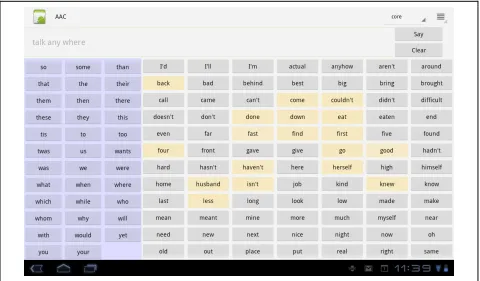
the conversational contexts. Once a category is selected, the words for the chosen context are
displayed. Touching a word causes it to be added to the current phrase, it is vocalized with the
speak button. As the user uses an application base on the framework, the context and the words
used are recorded in the usage history. The next time the user is in the same context any words
that had been used previously will be highlighted in the word list. The brightness of the
highlight is based on the computed usage frequency returned by the WordProviders, results with
a higher frequency are displayed brighter.
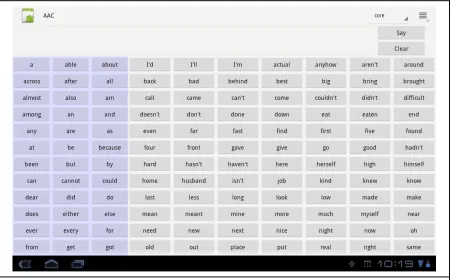
Figure 4. View of the prototype interface before word relevance has been computed.
5.3 Prototype Evaluation
Once the initial core vocabulary has been entered the user is present with a screen
displaying all of the stop words on the left side and the words that belong to the “core” category
on the right side. The intensity of the background color for a word is dependent on the relevance
21
test phrases were entered. Upon navigating back to the “core” category there is a noticeable
difference between words that have and have not been used in the current context.
Figure 5. View of the prototype interface after word usage data has been created. The highlighted words have been computed as relevant to the current LexicalContext.
In order to build a useful profile large amount of usage data is needed. Various movie
and comic book reviews were collected and parsed to be introduced into the lexicon through the
PhraseAnalyzer. LexicalContexts with predefined categories and geographical locations were
created for this test. After the data was imported, the PhraseAnalyzer succeeded in both adding
new words and creating word usage records. Words were requested from the
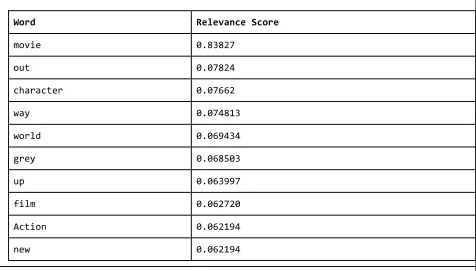
LocationWordProvider using the same context passed to the PhraseAnalyzer, the top ten results
22
Word Relevance Score
movie 0.83827
out 0.07824
character 0.07662
way 0.074813
world 0.069434
grey 0.068503
up 0.063997
film 0.062720
Action 0.062194
new 0.062194
Figure 6: Results Found using LexicalContext{locale=en_US, location=GeoLocation{latitude=29.9692345, longitude=-90.1064286}, categories=[core]}.
Filtering the results by relevance scores was able to determine that the word “movie” was
most relevance to the user in this contest. Sorting by frequency alone is not enough to calculate
meaningful relevance. The LocationWordProvider calculates the relevance of a word to a
specific context. Based on frequency alone “movie” was the twenty first ranked value. Tthe raw
word usage records from the database for the category “core” with the same geographic context
passed to the LocationWordProvider are shown in Table 1. The frequency for “movie” in this
context was 27, compared to the highest frequency word “comic”, with 101. The main factor in
determining relevance is how the unique usage a word in a context. The fact that the other
twenty words were heavily used in other contexts promoted “movie” to the top for this particular
23
Category Name Word Frequency
core comic 101
core book 76
core DC 71
core new 47
core World 43
core way 41
core up 39
core app 38
core story 38
core more 38
core time 38
core out 37
core art 34
core title 32
core make 31
core really 30
core first 29
core before 29
core year 28
core good 28
core movie 27
core character 27
core digital 26
core digitally 26
core read 26
24
5.4 Creating an Application Using the Framework
Using the framework in an application is very straight forward. A LexicalContext
singleton instance is obtained to pass to the Lexicon along with a LexiconDatabase. The
Lexicon, as an Observable, follows the Observer pattern alerting the client when the state of the
lexicon has changed. All change notifications from the lexicon are intended to trigger UI
updates. It is recommended that the client follow the Observer pattern as an Observer, to always
have the most recent view of the current lexicon. After the Lexicon has been constructed any
desired WordProviders should be instantiated then added. The code shown in Figure 7 illustrates
this process.
//create the Lexical Context
LexiconDatabase db = getHelper().getLexiconDatabase();
LexicalContext context = LexicalContext.getInstance(Locale.US);
Lexicon lexicon = new Lexicon(context, db); lexicon.addObserver(this);
//Add desired WordProviders
LocalWordProvider localProvider = new LocalWordProvider(db); lexicon.addProvider(localProvider);
LocationWordProvider locationProvider = new LocationWordProvider(db); lexicon.addProvider(locationProvider);
Figure7. Instantiating and configuring the Lexicon to use WordProviders
The Lexicon is designed to react to the events of changes to the LexicalContext passed to
it during creation. Acting on the LexicalContext by adding new categories or changing the
current geographic location, will trigger the Lexicon to make the necessary calls to obtain the
words. Words provided by the providers are made available with the getWords method of the
Lexicon. As mentioned earlier, the framework allows for the construction of customized word
25
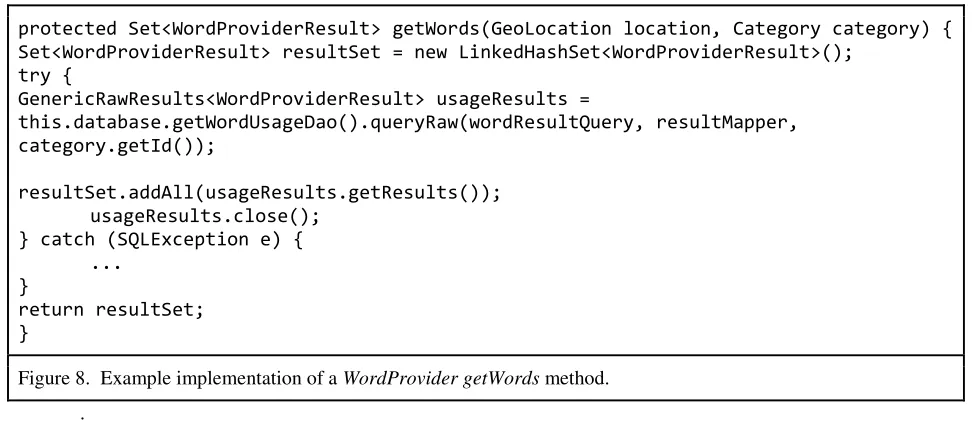
the getWords method to return a set of WordproviderResults. The code segment in Figure 9
illustrates the corresponding steps.
protected Set<WordProviderResult> getWords(GeoLocation location, Category category) { Set<WordProviderResult> resultSet = new LinkedHashSet<WordProviderResult>();
try {
GenericRawResults<WordProviderResult> usageResults =
this.database.getWordUsageDao().queryRaw(wordResultQuery, resultMapper, category.getId());
resultSet.addAll(usageResults.getResults()); usageResults.close();
} catch (SQLException e) { ...
}
return resultSet; }
Figure 8. Example implementation of a WordProvidergetWordsmethod.
.
6 Conclusion
Due to the complexity of natural language, there is no one best method to determine the
conversational relevance of words in a situational context. Word Providers allow the Lexicon
the flexibility required to achieve a level of personalization that many current Augmentative and
Alternative Communication devices do not provide. A centralized mechanism of evaluating
relevance based on usage combined with external relevance evaluation and flexible methods of
word gathering enable users to expand means of communication in real time. Applying varying
methods of relevance computation with a predefined organization of words allows for the
discussion of a broader range of topics that may have previously been unavailable to the user. In
addition to relevance scoring, usage statistics can be used to generate profiles for word or phrase
level prediction to improve the speed at which sentences are formed.
Future work on the framework will include further decoupling of the components that
26
of the Word Providers to the Phrase Analyzer will allow a finer control on which data is
recorded. Allowing developers to customize the data that is stored further enhances the
personalization the framework aims to provide. In addition, future work will also introduce ad
hoc device discovery capabilities to allow data sharing between users. Data sharing has the
potential to add another means of adding new words.
Constantly connected mobile technology presents an opportunity to seamlessly and
transparently increase the ability of a user to express themselves through conversation in new
and different ways. The user base of AAC devices is comprised a vast variety of unique needs
and situations that spans all ages, race and ability. There is no one solution that will work for
every user. However, the development of a framework that enhances the usability of the device
through content-based relevance over input from multiple word sources streamlines
communication creation for multiple types of users. Merging conventional methods of word
selection with customizable delivery systems whose results are filtered by content-based
relevance systems can provide faster and more accurate access to situational dependent words [1,
2, 3]. By employing dynamic, relevance based methods of word gathering, the framework for
augmentative and alternative communications hopes to provide a foundation for devices that
27
References
[1] Patel, R. & Radhakrishnan, R. (2007):Enhancing Access to Situational Vocabulary by Leveraging Geographic Context. Assistive Technology Outcomes and Benefits, 4(1), 99-114.
[2] Michael J. Pazzani and Daniel Billsus :Content-Based Recommendation Systems
[3] Jun Wang, Arjen P de Vries, Marcel J. T. Reinders :A User-Item Relevance Model for Log-based Collaborative Filtering[10
[4] Linnea R. McAfoose (2004): Using AAC Device Features to Enhance Teenager’s Quality of Life. Assistive Technology Outcomes and Benefits 1(1).
[5] Cynthia Overton, Cheryl Volkman, Heidi Silver-Pacuilla, Tracy Gray: Understanding Consumer Needs Through Market Research. Assistive Technology Outcomes and Benefits, 5(1) 2000
[6] Porter, Martin F.: Snowball: A language for stemming algorithms , October (2001) .
[7] Christopher D. Manning, Prabhakar Raghavan, and Hinrich Schtze. 2008. Introduction to Information Retrieval. Cambridge University Press, New York, NY, USA.
[8] Stephen Robertson: Understanding Inverse Document Frequency:On theoretical arguments for IDF. 2004. Journal of Documentation 60 no. 5, pp 503–520
[9] David R. Beukelman, Pat Mirenda. Augmentative and Alternative Communications: Supporting Children and Adults with Complex Communication Needs, third edition.
[10] Augmentative and Alternative Communication Decisions.
http://www.asha.org/public/speech/disorders/CommunicationDecisions.htm
[11] Android, “Home page,” Jan. 2010. [Online]. Available: http://www.android.com/
[12] O. H. Alliance, “Home page,” Jun. 2010. [Online]. Available:
http://www.openhandsetalliance.com/
[13] Card, S. K., Robertson, G. G., and Mackinlay, J. D. (1991). The information visualizer: An information workspace. Proc. ACM CHI'91 Conf. (New Orleans, LA, 28 April-2 May), 181-188.
[14] H. Lei, D. M. Sow, I. John S. Davis, G. Banavar, and M. R. Ebling. The design and applications of a context service. ACM SIGMOBILE Mobile Computing and Communications Review, 6(4):45–55, 2002
28
Proceedings of the 3rd international workshop on Services integration in pervasive environments(SIPE '08). ACM, New York, NY, USA, 25-30.
[16] Lucene, “Home page,” Nov. 2011. [Online]. Available: http://lucene.apache.org/
[17] B. Schilit, N. Adams, and R. Want. 1994. Context-Aware Computing Applications. In Proceedings of the 1994 First Workshop on Mobile Computing Systems and Applications (WMCSA '94). IEEE Computer Society, Washington, DC, USA, 85-90.
DOI=10.1109/WMCSA.1994.16 http://dx.doi.org/10.1109/WMCSA.1994.16
[18] Peng Dai, Guangyou Xu. “Context Aware Computing for Assistive Meeting System” PETRA '08: Proceedings of the 1st international conference on Pervasive Technologies Related to Assistive Environments. July 2008.
29 Vita
The author was born and raised in Metairie, Louisiana. He obtained his Bachelor’s degree in computer science from The University of New Orleans in 2006. During the following years he was employed as a Programmer with the University Of New Orleans University