DEMOGRAPHIC RESEARCH
VOLUME 33, ARTICLE 3, PAGES 65
−
92
PUBLISHED 7 JULY 2015
http://www.demographic-research.org/Volumes/Vol33/3/ DOI: 10.4054/DemRes.2015.33.3
Research Article
Educational differences in early childbearing:
A cross-national comparative study
James M. Raymo
Marcia J. Carlson
Alicia VanOrman
So-jung Lim
Brienna Perelli-Harris
Miho Iwasawa
©2015 James M. Raymo et al.
This open-access work is published under the terms of the Creative Commons Attribution NonCommercial License 2.0 Germany, which permits use, reproduction & distribution in any medium for non-commercial purposes, provided the original author(s) and source are given credit.
1 Introduction 66
2 Background 68
2.1 Early childbearing defined 68 2.2 Early childbearing in cross-national comparative perspective 69 2.3 Factors related to education and early childbearing 70 2.4 Research questions and hypotheses 72
3 Data and methods 73
3.1 Measures 75
3.2 Methods 76
4 Results 76
5 Discussion 84
6 Acknowledgments 85
References 86
Educational differences in early childbearing:
A cross-national comparative study
James M. Raymo1
Marcia J. Carlson1
Alicia VanOrman2
So-jung Lim3
Brienna Perelli-Harris4
Miho Iwasawa5
Abstract
BACKGROUND
Recent research on fertility in industrialized countries focuses primarily on delayed childbearing, despite the facts that large numbers of women continue to enter parenthood at relatively young ages and that early childbearing has been linked to economic disadvantage.
OBJECTIVE
This cross-national comparative study describes relationships between women’s educational attainment and young age at first birth and evaluates the extent to which these differences have changed over time for women born 1955–1981.
METHODS
Defining ‘early’ childbearing as the age by which 20% of first births have occurred to women in a given birth cohort and country, we describe differences in early childbearing by educational attainment across three cohorts of women in 20 countries.
1 Department of Sociology and Center for Demography and Ecology, University of Wisconsin-Madison,
U.S.A. E-Mail: [email protected].
2 Population Reference Bureau, U.S.A. 3
Department of Sociology, Utah State University, U.S.A.
RESULTS
We find a strong negative educational gradient in early childbearing across all 20 countries and some evidence of an increase in the relative prevalence of early childbearing among the least-educated women. In 10 countries, the relative prevalence of early childbearing among women with low education is significantly higher for one or both of the more recent birth cohorts compared to the earliest cohort. However, many countries show no significant change, and in one country (Poland) there is modest evidence of a decreasing educational gap.
CONCLUSIONS
Evidence that educational differences in early childbearing have grown in some countries is generally consistent with the notion of family bifurcation and ‘diverging destinies’ by socioeconomic status. However, the pattern is not universal and future work should examine the various factors that shape these patterns, including the role of public policies.
1. Introduction
Recent research on fertility trends in industrialized countries has focused primarily on delayed onset of childbearing (e.g., Frejka and Sobotka 2008; Morgan and Taylor 2006) and fertility recuperation at older ages (e.g., Lesthaeghe and Willems 1999). Studies of early childbearing are less common, despite the fact that large numbers of women continue to enter parenthood at relatively young ages. A better understanding of the patterns of early childbearing across a range of national contexts is important in light of evidence that, at least in the U.S. and the U.K., early first births are associated – and perhaps increasingly so – with socioeconomic disadvantage (Amato et al. 2008; Hobcraft and Kiernan 2001; Geronimus and Korenman 1992) and less favorable outcomes for both parents (Brien and Willis 1997; Taniguchi 1999) and children (Hoffman and Scher 2008).
across countries. For example, theories of “reproductive polarization” (Schulze and Tyrell 2002) posit that the extent to which public policy regimes effectively support women’s balancing of work and family may be associated with growing socioeconomic differentials in the timing of births over time. Consistent with this hypothesis, Rendall and colleagues (Rendall et al. 2009, 2010) find that the positive association between educational attainment and age at first birth has diminished over time in several European countries with stronger work-family policies, but has remained unchanged in less generous welfare states: in other words, when women can more easily balance employment with childrearing, they do not wait as long to begin having children as in countries where there is less support. An alternative possibility is that the link between low educational attainment and early births may be more pronounced in countries where early childbearing has become a relatively rare, and thus non-normative, pathway to family formation. In such contexts it may be particularly difficult to combine childrearing with continued education. These three scenarios are not mutually exclusive – McLanahan’s theory of “diverging destinies” (2004) recognizes that there may be cross-national differences in the pace and magnitude of change in educational differences, which might reflect differences in policy, demography, or social context.
The relatively narrow geographical focus on Western Europe and the U.S. in prior research is an important limitation. The absence of comparable evidence from low-fertility countries in other parts of the world makes it difficult to evaluate the extent to which increasing socioeconomic differences in early childbearing observed in the U.S. and Western Europe are indeed a general feature of recent family change in a broader context. Our goal in this paper is to extend existing cross-national research by providing new descriptive evidence about educational differences in early childbearing across three cohorts in 20 countries, as follows: first, we examine a wide range of low-fertility societies, including understudied countries in Eastern Europe and East Asia. Second, we examine change over time in the relationship between educational attainment and early childbearing. By examining data from three birth cohorts of women (over the years 1955–1981), we can more directly assess the generality of the growing differences observed in the countries considered in previous studies.
uncommon. Disentangling these alternative causal linkages is not easy, but efforts to this end have made creative use of a range of data and statistical techniques (Snow et al. 1999), including sibling data (Hoffman, Foster, and Furstenberg 1993) and information on miscarriages (Hotz, Mullin, and Sanders 1997).
The primary objective of this paper is not to evaluate these causal linkages (for which we do not have the requisite data), but rather to establish an empirical basis for evaluating the extent to which the magnitude of educational differences in early childbearing differs across a wide range of countries, and whether and how those differences have changed over time. This information is of theoretical and substantive value. Broad theoretical claims regarding “diverging destinies” and “reproductive polarization” have received a good deal of attention and have motivated several ambitious cross-national comparative efforts to evaluate their generality (e.g., Perelli-Harris and Lyons-Amos 2014; Perelli-Perelli-Harris et. al. 2010; Rendall et. al. 2010). Early childbearing is one understudied component of the family formation process central to these theoretical frameworks. Evidence that early childbearing is associated with subsequent disadvantage for both mothers and children in the U.S. and the U.K. also highlights the importance of understanding how patterns of early childbearing may be associated with cross-national differences in relationships between family behavior and processes of stratification and inequality. Future research can build on our descriptive portrait (and identification of broad policy environments across countries) to more fully consider the role of public policies and other contextual factors in shaping these patterns.
2. Background
2.1 Early childbearing defined
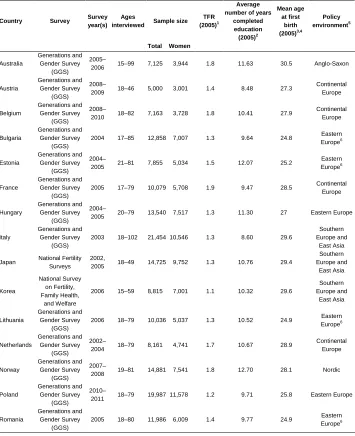
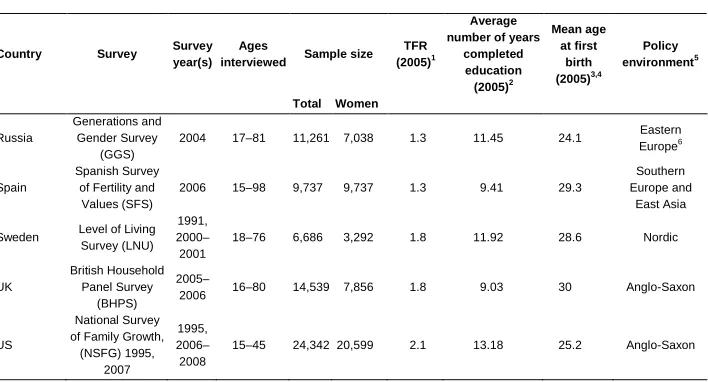
Substantial variation in the timing of first births across countries, as well as the change in childbearing ages within countries across cohorts, motivates our decision to define early childbearing in relative terms, i.e., in relation to the observed/normative timing of childbearing within a given society and cohort. For example (and as shown in Table 1), women’s mean age at first birth in 2005 ranged from 24 in Russia to over 30 in Australia. Furthermore, because postponement of childbearing has emerged only recently in Eastern European countries (Frejka and Sobotka 2008), what is considered ‘early’ differs both by society and over time. We examined both relative and absolute measures of early childbearing, but for the sake of simplicity, we use a single measure of early childbearing in our main analyses – the age by which the first 20% of women in a given cohort (and country) have become mothers. We discuss the ways in which the findings differed in analyses using an absolute measure of early childbearing (age 22 or younger) in the Results section, and tables summarizing these results are available upon request.
2.2 Early childbearing in cross-national comparative perspective
While research on early childbearing across multiple countries is limited, several recent studies have provided relevant information. Using cross-sectional data from the Luxembourg Income Study, McLanahan (2004) showed that young motherhood and other behaviors with potentially negative implications for the well-being of children and mothers (e.g., divorce and single parenthood) are more prevalent among women with lower levels of education in the U.S., Canada, and several Western European countries. Although the theoretical and empirical basis of McLanahan’s argument comes primarily from research on the U.S. (and limited data from several European countries), she makes the broad and compelling argument that socioeconomic bifurcation in early childbearing and other family behaviors linked to well-being is a key feature of the ‘second demographic transition’.6 If the growing socioeconomic differences in family behavior observed in the U.S. since the late 20th century are indeed part of a broader transition in demographic behavior, we would expect similar patterns to characterize other low-fertility countries.
In a series of recent papers, Rendall and colleagues described socioeconomic differences in the timing of childbearing in a number of Northern and Southern
6The term “second demographic transition” has been used in a number of ways, including characterization of
European countries (Rendall and Smallwood 2003; Rendall et al. 2005, 2009, 2010), providing evidence of an increasing concentration of relatively early childbearing among women with lower levels of education and occupational status in the English-speaking countries and Southern Europe. By contrast, they find evidence of declining educational differentials in age at first birth in France and Norway, reflecting increases in the age at childbearing among all women in France and particularly rapid decline in early childbearing among women with more limited educational attainment in Norway.
Continuous increase in the mean age at first birth in recent years across industrialized countries (Mills et al. 2011) implies that early childbearing (defined either in relative or absolute terms) has become an increasingly non-normative pathway to family formation. We would therefore expect women who give birth at younger ages – despite the societal trend toward older births – to be an increasingly select group with respect to both background and future prospects. Alternatively, policies may be less supportive of mothers' continued enrollment in school where early childbearing is uncommon. Both of these scenarios suggest that educational differences may be more pronounced in countries where early childbearing has become a relatively rare and thus non-normative pathway to family formation, such as those in Northern and Southern Europe as well as in East Asia. Just as socioeconomic differences are expected to decline or reverse as non-normative behaviors such as divorce become more common (Goode 1963; Hӓrkönen and Dronkers 2006), differentials in formerly common behaviors such as early childbearing may grow as they become more non-normative, less consistent with existing policies, and increasingly associated with less favorable outcomes. Consistent with this hypothesis, one recent cross-national comparative study found that associations between teenage motherhood and unfavorable socioeconomic outcomes were strongest in countries where the prevalence of non-marital childbearing was lowest (Robson and Berthoud 2003).
2.3 Factors related to education and early childbearing
2004; Smock, Manning, and Porter 2005). Overall, women’s labor market opportunities have expanded across low-fertility, industrialized countries, suggesting that the relative prevalence of early childbearing among less-educated women may be increasing, as women with moderate to higher education further delay childbearing. At the same time, career employment opportunities for women remain limited in some countries, especially those in East Asia and Southern Europe. An emphasis on the differential opportunity costs of early childbearing thus suggests that a negative educational gradient in early childbearing should be less pronounced in these societies to the extent that women, overall, are less able to work while raising children.
However, the work of Rendall and colleagues referenced above demonstrates an increasing concentration of early childbearing in societies where policies are relatively unsupportive of work-family balance for women. Employing the welfare regime typology developed by Esping-Andersen (and modified by others), they find that the negative educational gradient in early childbearing is now most pronounced in the ‘conservative’ welfare regimes of Southern Europe and least pronounced in ‘universalistic’ welfare societies (of Northern and Western Europe), with ‘liberal’ Anglo-American countries somewhere in between. The authors emphasize differences in work-family policy regimes, with universalistic support promoting delayed childbearing across the educational spectrum (thus reducing educational differences over time), and means-tested support providing incentives for early childbearing among women with lower levels of educational attainment who likely qualify for public assistance (thus increasing educational differences over time). This is consistent with the ideas of “reproductive polarization” put forth by Schulze and Tyrell (2002) and with McLanahan’s (2004) emphasis on the role of means-tested welfare policies in generating educational differences in women’s (dis)incentives to have early births, often outside of marriage.
measures of primary theoretical relevance – policies that support the ability to balance work and family. Thévenon’s (2011) recent paper uses 23 different indicators to classify OECD countries on two dimensions – the comprehensiveness and the generosity of public support for families with children under the age of three. This provides a useful framework for evaluating our results from 20 different countries, in that it is based on data from a large number of countries (including OECD countries in East Asia and Eastern Europe) and employs information on a wide range of policies relevant to the theoretical frameworks described above.
2.4 Research questions and hypotheses
Building upon the earlier cross-national studies noted above, we use comparable data from 20 low-fertility countries to address two research questions. First, we ask whether a negative educational gradient in early childbearing is a general characteristic of low-fertility, industrialized countries and whether/how the magnitude of educational differences in early childbearing varies across countries. Second, we examine whether the relative likelihood of early childbearing among women with lower levels of education has increased over time.
3. Data and methods
We use data from 20 industrialized countries: Australia, Austria, Belgium, Bulgaria, Estonia, France, Hungary, Italy, Japan, Korea, Lithuania, the Netherlands, Norway, Poland, Romania, Russia, Spain, Sweden, the U.K., and the U.S. For the majority of countries, data come from the first round of the UN Generations and Gender Surveys (GGS) conducted between 2003 and 2011. The GGS was developed by the United Nations Economic Commission for Europe as a key element of the Generations and Gender Programme (GGP), launched in 2000. In the context of declining fertility and changing union formation patterns, the GGP is designed to improve understanding of demographic and social patterns across Europe and factors that may influence their development, including public policy (United Nations 2000). As described by Vikat and colleagues (2007), the GGS uses comparable survey designs, definitions, and questionnaires across countries, and the surveys cover a wide array of topics related to economic status, education, social networks, families, relationships, fertility, housing, transfers, and health. The GGS collects nationally-representative samples of non-institutionalized men and women age 18 and older (Simard and Franklin 2008).
Since GGS data are currently available only for a sub-set of countries, we use alternative data sources for Japan, Korea, Spain, Sweden, the U.K, and the U.S. Data for Japan come from the 2002 and 2005 National Fertility Surveys; data for Korea come from the 2006 National Survey on Fertility, Family Health, and Welfare; data for Spain come from the 2006 Spanish Survey of Fertility and Values; data for Sweden come from the Swedish Level of Living Survey; data for the U.K. come from the British Household Panel Survey; and data from the U.S. come from the combined 1995 and 2006–2008 rounds of the National Survey of Family Growth. The European and American surveys have been harmonized according to the procedure outlined in Perelli-Harris, Kreyenfeld, and Kubisch (2010) (see www.nonmarital.org for further information about each survey).7 As a result of these harmonization procedures, we are able to analyze comparable data on age at first birth and educational attainment for similar cohorts of women across the 20 countries. Table 1 provides information about the survey(s) for each of the countries, as well as information about fertility, educational attainment, and general policy environment across countries.
7
Table 1: Country-specific data source and sample information
Country Survey Survey year(s)
Ages
interviewed Sample size TFR (2005)1
Average number of years
completed education (2005)2 Mean age at first birth (2005)3,4 Policy environment5
Total Women
Australia
Generations and Gender Survey
(GGS)
2005–
2006 15–99 7,125 3,944 1.8 11.63 30.5 Anglo-Saxon
Austria
Generations and Gender Survey
(GGS)
2008–
2009 18–46 5,000 3,001 1.4 8.48 27.3
Continental Europe Belgium Generations and Gender Survey (GGS) 2008–
2010 18–82 7,163 3,728 1.8 10.41 27.9
Continental Europe Bulgaria Generations and Gender Survey (GGS)
2004 17–85 12,858 7,007 1.3 9.64 24.8 Eastern Europe6 Estonia Generations and Gender Survey (GGS) 2004–
2005 21–81 7,855 5,034 1.5 12.07 25.2
Eastern Europe6 France Generations and Gender Survey (GGS)
2005 17–79 10,079 5,708 1.9 9.47 28.5 Continental Europe Hungary Generations and Gender Survey (GGS) 2004–
2005 20–79 13,540 7,517 1.3 11.30 27 Eastern Europe
Italy
Generations and Gender Survey
(GGS)
2003 18–102 21,454 10,546 1.3 8.60 29.6
Southern Europe and
East Asia
Japan National Fertility Surveys
2002,
2005 18–49 14,725 9,752 1.3 10.76 29.4
Southern Europe and East Asia Korea National Survey on Fertility, Family Health, and Welfare
2006 15–59 8,815 7,001 1.1 10.32 29.6
Southern Europe and East Asia Lithuania Generations and Gender Survey (GGS)
2006 18–79 10,036 5,037 1.3 10.52 24.9 Eastern Europe6 Netherlands Generations and Gender Survey (GGS) 2002–
2004 18–79 8,161 4,741 1.7 10.67 28.9
Continental Europe Norway Generations and Gender Survey (GGS) 2007–
2008 19–81 14,881 7,541 1.8 12.70 28.1 Nordic
Poland
Generations and Gender Survey
(GGS)
2010–
2011 18–79 19,987 11,578 1.2 9.71 25.8 Eastern Europe
Romania
Generations and Gender Survey
(GGS)
Table 1: (Continued)
Country Survey Survey year(s)
Ages
interviewed Sample size TFR (2005)1
Average number of years
completed education (2005)2
Mean age at first
birth (2005)3,4
Policy environment5
Total Women
Russia
Generations and Gender Survey
(GGS)
2004 17–81 11,261 7,038 1.3 11.45 24.1 Eastern Europe6
Spain
Spanish Survey of Fertility and Values (SFS)
2006 15–98 9,737 9,737 1.3 9.41 29.3
Southern Europe and
East Asia
Sweden Level of Living Survey (LNU)
1991, 2000– 2001
18–76 6,686 3,292 1.8 11.92 28.6 Nordic
UK
British Household Panel Survey
(BHPS)
2005–
2006 16–80 14,539 7,856 1.8 9.03 30 Anglo-Saxon
US
National Survey of Family Growth,
(NSFG) 1995, 2007
1995, 2006– 2008
15–45 24,342 20,599 2.1 13.18 25.2 Anglo-Saxon
1
World Bank (2014).
2
Barro and Lee (2013).
3
United Nations Economic Commission for Europe (2014).
4
The World Factbook (2014).
5
Thévenon (2011).
6
Thévenon (2011) does not include these countries in his analysis of family policies; given their geographic location, we include such with Eastern Europe.
3.1 Measures
Early childbearing: We use retrospective fertility history data collected in each of the surveys to calculate respondents’ age at first birth and define early childbearing in reference to country- and cohort-specific distributions of age at first birth. In particular, we define early births as those occurring prior to the age at which 20% of women have a first birth for a given cohort of women in each country.8
Cohort: Because our interest is in relatively recent change, we limit our attention to women born since 1955. In the analyses reported below, we examine three recent birth cohorts; 1955–1963 (cohort 1), 1964–72 (cohort 2), and 1973–1981 (cohort 3). Respondents in cohort 3 who had not yet reached the threshold age for identifying early
8
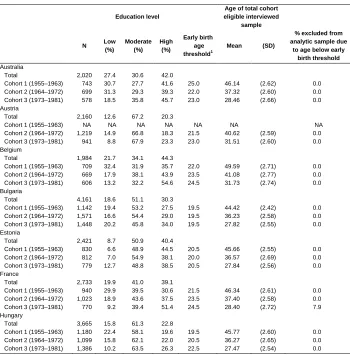
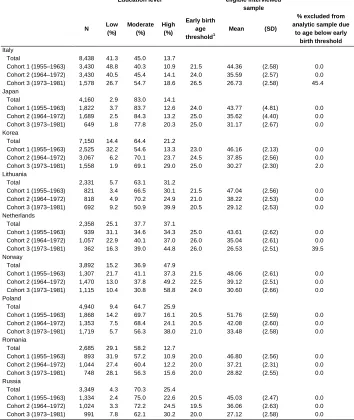
births are excluded from the analyses. As shown in Table 2, the proportion of respondents in the youngest cohort excluded by this age restriction is 0% in 13 countries, less than 10% in France, Korea, Spain, and Sweden (1964–1972 cohort), 30%–45% in Italy, the Netherlands, and the U.S., and 63% in Sweden. Because we have excluded over half of the respondents in the youngest Swedish cohort we suggest interpreting the results for Sweden with caution.
Educational attainment: Because cross-country differences in educational systems are substantial, we follow prior research (e.g., Rendall et al., 2010) by drawing upon existing efforts to generate comparable measures of educational attainment. In the GGS, comparable measures have been created according to the International Standardized Classification of Education (ISCED). We collapse these measures into three categories: low education – less than secondary school; moderate education – completed secondary school or some college; and high education – completed tertiary education or higher. Given cross-country differences in both levels of educational attainment and the meaning of educational qualifications, this method cannot produce perfectly comparable measures of educational attainment (nor can any other method), and our results should be evaluated with this caveat in mind. Using years of completed education to generate country- and cohort-specific measures of relatively low and high education would be another useful strategy: however, these data are not available for most countries in our analysis.
3.2 Methods
We estimate logistic regression models predicting the log odds of having an early birth separately for each country. Model 1 includes measures of women’s educational attainment and cohort, and Model 2 adds interactions between education and cohort. The first model allows us to estimate the direction and strength of educational differences in early childbearing and to observe similarities and differences in these relationships across countries. Results from the second model describe the extent to which differences by educational attainment in early childbearing have changed over time, allowing for an assessment of the generality of patterns discussed by McLanahan (2004) and others.
4. Results
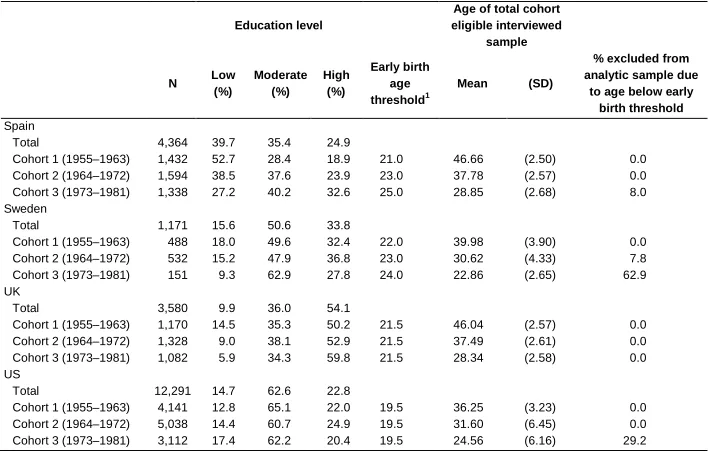
threshold by country and cohort (i.e., the age at which 20% of women had given birth). Not surprisingly, we see notable differences in the early birth thresholds across both countries and cohorts, ranging from age 19.5 to age 26.5. In general, the early birth threshold has gotten older across cohorts, as women are delaying childbearing, although this is not consistently true; in some countries the age threshold has gotten younger (Australia and Lithuania) or stayed about the same (many Eastern European countries, the U.K., and the U.S.).
Table 2: Country- and country-cohort-specific descriptive statistics
Education level
Age of total cohort eligible interviewed
sample
N Low (%)
Moderate (%)
High (%)
Early birth age threshold1
Mean (SD)
% excluded from analytic sample due
to age below early birth threshold Australia
Total 2,020 27.4 30.6 42.0
Cohort 1 (1955–1963) 743 30.7 27.7 41.6 25.0 46.14 (2.62) 0.0 Cohort 2 (1964–1972) 699 31.3 29.3 39.3 22.0 37.32 (2.60) 0.0 Cohort 3 (1973–1981) 578 18.5 35.8 45.7 23.0 28.46 (2.66) 0.0 Austria
Total 2,160 12.6 67.2 20.3
Cohort 1 (1955–1963) NA NA NA NA NA NA NA
Cohort 2 (1964–1972) 1,219 14.9 66.8 18.3 21.5 40.62 (2.59) 0.0 Cohort 3 (1973–1981) 941 8.8 67.9 23.3 23.0 31.51 (2.60) 0.0 Belgium
Total 1,984 21.7 34.1 44.3
Cohort 1 (1955–1963) 709 32.4 31.9 35.7 22.0 49.59 (2.71) 0.0 Cohort 2 (1964–1972) 669 17.9 38.1 43.9 23.5 41.08 (2.77) 0.0 Cohort 3 (1973–1981) 606 13.2 32.2 54.6 24.5 31.73 (2.74) 0.0 Bulgaria
Total 4,161 18.6 51.1 30.3
Cohort 1 (1955–1963) 1,142 19.4 53.2 27.5 19.5 44.42 (2.42) 0.0 Cohort 2 (1964–1972) 1,571 16.6 54.4 29.0 19.5 36.23 (2.58) 0.0 Cohort 3 (1973–1981) 1,448 20.2 45.8 34.0 19.5 27.82 (2.55) 0.0 Estonia
Total 2,421 8.7 50.9 40.4
Cohort 1 (1955–1963) 830 6.6 48.9 44.5 20.5 45.66 (2.55) 0.0 Cohort 2 (1964–1972) 812 7.0 54.9 38.1 20.0 36.57 (2.69) 0.0 Cohort 3 (1973–1981) 779 12.7 48.8 38.5 20.5 27.84 (2.56) 0.0 France
Total 2,733 19.9 41.0 39.1
Cohort 1 (1955–1963) 940 29.9 39.5 30.6 21.5 46.34 (2.61) 0.0 Cohort 2 (1964–1972) 1,023 18.9 43.6 37.5 23.5 37.40 (2.58) 0.0 Cohort 3 (1973–1981) 770 9.2 39.4 51.4 24.5 28.40 (2.72) 7.9 Hungary
Total 3,665 15.8 61.3 22.8
Table 2: (Continued)
Education level
Age of total cohort eligible interviewed
sample
N Low (%)
Moderate (%)
High (%)
Early birth age threshold1
Mean (SD)
% excluded from analytic sample due
to age below early birth threshold Italy
Total 8,438 41.3 45.0 13.7
Cohort 1 (1955–1963) 3,430 48.8 40.3 10.9 21.5 44.36 (2.58) 0.0 Cohort 2 (1964–1972) 3,430 40.5 45.4 14.1 24.0 35.59 (2.57) 0.0 Cohort 3 (1973–1981) 1,578 26.7 54.7 18.6 26.5 26.73 (2.58) 45.4 Japan
Total 4,160 2.9 83.0 14.1
Cohort 1 (1955–1963) 1,822 3.7 83.7 12.6 24.0 43.77 (4.81) 0.0 Cohort 2 (1964–1972) 1,689 2.5 84.3 13.2 25.0 35.62 (4.40) 0.0 Cohort 3 (1973–1981) 649 1.8 77.8 20.3 25.0 31.17 (2.67) 0.0 Korea
Total 7,150 14.4 64.4 21.2
Cohort 1 (1955–1963) 2,525 32.2 54.6 13.3 23.0 46.16 (2.13) 0.0 Cohort 2 (1964–1972) 3,067 6.2 70.1 23.7 24.5 37.85 (2.56) 0.0 Cohort 3 (1973–1981) 1,558 1.9 69.1 29.0 25.0 30.27 (2.30) 2.0 Lithuania
Total 2,331 5.7 63.1 31.2
Cohort 1 (1955–1963) 821 3.4 66.5 30.1 21.5 47.04 (2.56) 0.0 Cohort 2 (1964–1972) 818 4.9 70.2 24.9 21.0 38.22 (2.53) 0.0 Cohort 3 (1973–1981) 692 9.2 50.9 39.9 20.5 29.12 (2.53) 0.0 Netherlands
Total 2,358 25.1 37.7 37.1
Cohort 1 (1955–1963) 939 31.1 34.6 34.3 25.0 43.61 (2.62) 0.0 Cohort 2 (1964–1972) 1,057 22.9 40.1 37.0 26.0 35.04 (2.61) 0.0 Cohort 3 (1973–1981) 362 16.3 39.0 44.8 26.0 26.53 (2.51) 39.5 Norway
Total 3,892 15.2 36.9 47.9
Cohort 1 (1955–1963) 1,307 21.7 41.1 37.3 21.5 48.06 (2.61) 0.0 Cohort 2 (1964–1972) 1,470 13.0 37.8 49.2 22.5 39.12 (2.51) 0.0 Cohort 3 (1973–1981) 1,115 10.4 30.8 58.8 24.0 30.60 (2.66) 0.0 Poland
Total 4,940 9.4 64.7 25.9
Cohort 1 (1955–1963) 1,868 14.2 69.7 16.1 20.5 51.76 (2.59) 0.0 Cohort 2 (1964–1972) 1,353 7.5 68.4 24.1 20.5 42.08 (2.60) 0.0 Cohort 3 (1973–1981) 1,719 5.7 56.3 38.0 21.0 33.48 (2.58) 0.0 Romania
Total 2,685 29.1 58.2 12.7
Cohort 1 (1955–1963) 893 31.9 57.2 10.9 20.0 46.80 (2.56) 0.0 Cohort 2 (1964–1972) 1,044 27.4 60.4 12.2 20.0 37.21 (2.31) 0.0 Cohort 3 (1973–1981) 748 28.1 56.3 15.6 20.0 28.82 (2.55) 0.0 Russia
Total 3,349 4.3 70.3 25.4
Table 2: (Continued)
Education level
Age of total cohort eligible interviewed
sample
N Low (%)
Moderate (%)
High (%)
Early birth age threshold1
Mean (SD)
% excluded from analytic sample due
to age below early birth threshold Spain
Total 4,364 39.7 35.4 24.9
Cohort 1 (1955–1963) 1,432 52.7 28.4 18.9 21.0 46.66 (2.50) 0.0 Cohort 2 (1964–1972) 1,594 38.5 37.6 23.9 23.0 37.78 (2.57) 0.0 Cohort 3 (1973–1981) 1,338 27.2 40.2 32.6 25.0 28.85 (2.68) 8.0 Sweden
Total 1,171 15.6 50.6 33.8
Cohort 1 (1955–1963) 488 18.0 49.6 32.4 22.0 39.98 (3.90) 0.0 Cohort 2 (1964–1972) 532 15.2 47.9 36.8 23.0 30.62 (4.33) 7.8 Cohort 3 (1973–1981) 151 9.3 62.9 27.8 24.0 22.86 (2.65) 62.9 UK
Total 3,580 9.9 36.0 54.1
Cohort 1 (1955–1963) 1,170 14.5 35.3 50.2 21.5 46.04 (2.57) 0.0 Cohort 2 (1964–1972) 1,328 9.0 38.1 52.9 21.5 37.49 (2.61) 0.0 Cohort 3 (1973–1981) 1,082 5.9 34.3 59.8 21.5 28.34 (2.58) 0.0 US
Total 12,291 14.7 62.6 22.8
Cohort 1 (1955–1963) 4,141 12.8 65.1 22.0 19.5 36.25 (3.23) 0.0 Cohort 2 (1964–1972) 5,038 14.4 60.7 24.9 19.5 31.60 (6.45) 0.0 Cohort 3 (1973–1981) 3,112 17.4 62.2 20.4 19.5 24.56 (6.16) 29.2
Note: NA - not applicable/data not available
1
Calculated as the age at which 20% of the cohort has had a first birth
There is substantial variation in the educational distributions across countries. Some countries have relatively large proportions of women in the lowest educational category (e.g., Italy and Spain), especially for the cohort born 1955–63, whereas others have much larger proportions in the highest category (e.g., Norway and the U.K.). However, it is important to note that ISCED classification schemes do not necessarily produce strictly comparable categories (Perelli-Harris et al. 2010), so we suggest caution in comparing educational distributions across countries. In most countries there is evidence of substantial improvement in women’s education across cohorts, especially in the Western European countries (such as Belgium, France, and Spain). In other countries, such as the U.S.,the change is less pronounced or negligible.
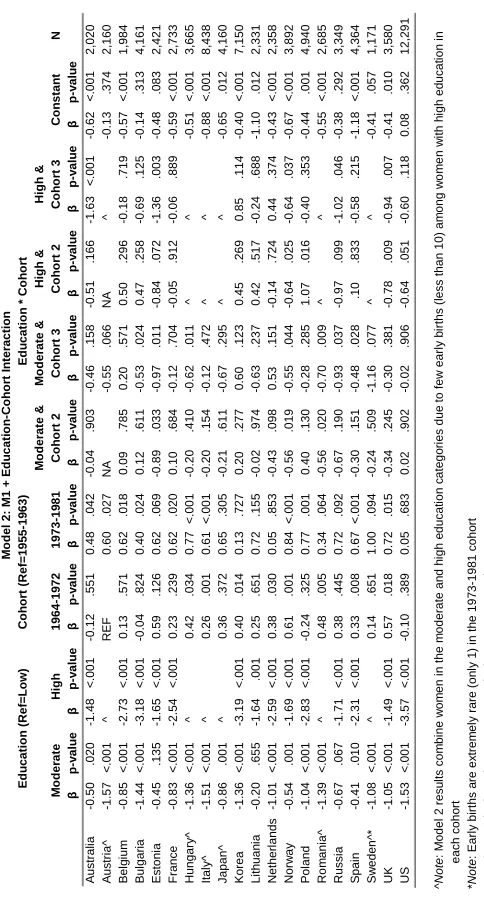
only present the estimated interactions between education and cohort: complete results are available in the Appendix.
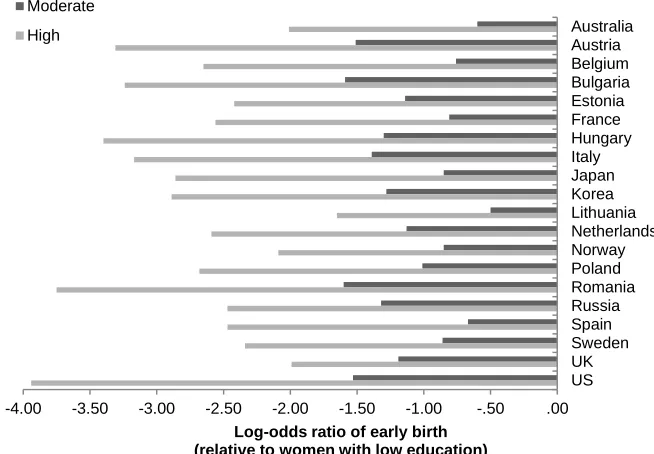
Figure 1: Log-odds ratios of early birth, by level of education
As shown in Figure 1, across all 20 countries, women in the moderate and high education categories are significantly less likely to have an early birth than those with low education (log-odds ratios are less than zero in all cases). In all countries, the coefficient associated with the high educational category is also significantly different from that associated with the moderate category, thus indicating that a negative educational gradient in the likelihood of early first birth exists in each of these countries. Although we do not conduct formal tests of cross-country differences, educational differences (between the highest and lowest educational categories) appear to be most pronounced in Austria, Bulgaria, Hungary, Romania, and the U.S.
Because the number of women with both high education and an early birth is very small in several countries, we are concerned that small fluctuations in the numbers of early births across cohorts may lead to erroneous conclusions about the extent to which educational differences in early childbearing have changed. To avoid over-interpreting
-4.00 -3.50 -3.00 -2.50 -2.00 -1.50 -1.00 -.50 .00
Australia Austria Belgium Bulgaria Estonia France Hungary Italy Japan Korea Lithuania Netherlands Norway Poland Romania Russia Spain Sweden UK US
Log-odds ratio of early birth (relative to women with low education)
Moderate
results, we collapsed moderate- and high-education categories in countries where fewer than 10 highly-educated women in each birth cohort had an early birth. This recoding of education applies to Austria, Hungary, Italy, Japan, Romania, and Sweden in Model 2. Additionally, highly-educated women in the youngest cohort in Sweden have very few early births; thus we suggest interpreting results for these countries with caution. Even with these restrictions, results from Model 2 provide evidence (though not entirely consistent) of an increase in the relative prevalence of early childbearing among the least-educated women (as compared to those with moderate and high education).
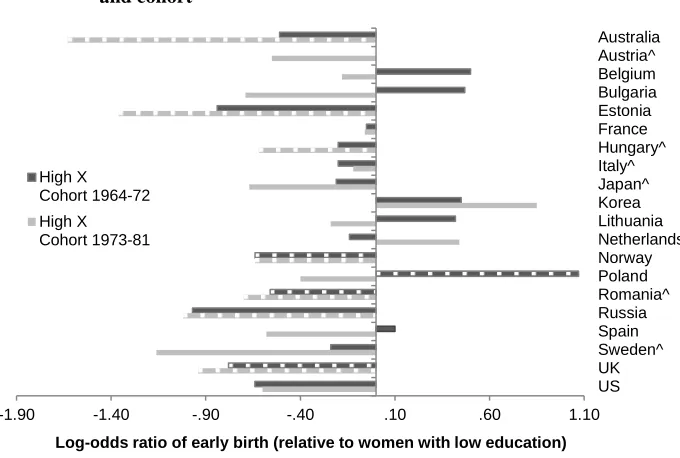
Figures 2 and 3 display the estimated cohort interactions (in log odds ratios) for women in the moderate and high education groups, respectively. In these figures, negative coefficients indicate larger educational differences in the second cohort (dark gray bars) and the third cohort (light gray bars) relative to the first cohort (patterned bars indicate coefficients that are statistically different from zero at p < .05). From both figures it is clear that almost all of the interaction coefficients are negative (although not always statistically significant), suggesting a pattern of growing educational differences in the likelihood of early motherhood across cohorts.
Figure 2: Log-odds ratio of early birth: Interaction between moderate education and cohort
^Note: Results combine women in the moderate and high education categories due to few early births (less than 10) among women with high education in each cohort
-1.30 -1.10 -.90 -.70 -.50 -.30 -.10 .10 .30 .50
Australia Austria^ Belgium Bulgaria Estonia France Hungary^ Italy^ Japan^ Korea Lithuania Netherlands Norway Poland Romania^ Russia Spain Sweden^ UK US
Log-odds ratio of early birth (relative to women with low education)
Moderate X Cohort 1964-72
Another interesting finding is that differences between the moderate and low education groups have remained unchanged across time in the U.K and the U.S. (as well as a number of other countries). This is consistent with emerging family scholarship about the (growing) behavioral similarities of the less educated and moderately educated in the U.S. (Cherlin 2010, 2014), but begs the question of why we see growing gaps between these two groups in some of the other countries we examine (and in the prior U.S. literature).
Cross-national differences also raise important questions about the underlying mechanisms. In terms of overall differences in early childbearing by education across countries as classified by policy environments (shown in Table 1), the reproductive-polarization hypothesis would suggest a larger educational gradient in countries where balancing work and family is more difficult. As classified by Thévenon (2011), the Nordic countries are at the top of the spectrum of providing public support for balancing work and family, while the Anglo-Saxon countries along with Southern Europe and East Asia are at the bottom, continental Europe is somewhere in the middle, and the Eastern European countries are in a separate transitional category. In general, the data on the overall gradient fits these expectations – gradients are especially large in some of the Anglo-Saxon, Southern European, and East Asian countries (as well as some Eastern European countries).
Figure 3: Log-odds ratio of early birth: Interaction between high education and cohort
^Note: Results combine women in the moderate and high education categories due to few early births (less than 10) among women with high education in each cohort
Overall, our results suggest that across all 20 countries examined there is a striking educational gradient in early childbearing – women with high education are much less likely to have children at an early age, compared to women with low or moderate education. In terms of change over time, we find that in the majority of industrialized countries we examined there appears to be some evidence of an increasing gradient by education in early childbearing across cohorts. Where there are statistically significant differences, with one exception (Poland for cohort 2 compared to cohort 1) they always point to an increasing negative educational gradient. The general pattern of results in Figures 2 and 3 is thus largely in accord with McLanahan’s (2004) description of a universal concentration of family behaviors with potentially negative implications for well-being (including early parenthood) at the lower end of the educational spectrum. Paradoxically, however, we do not observe a significant increase in the gap by education in the U.S., where we would have expected such, but this may reflect differences in the outcome: McLanahan (2004) focused on mothers’ overall median ages, as opposed to the age at first birth. Our results are also generally consistent with the negative educational gradient in childbearing within cohabitation observed across a
-1.90 -1.40 -.90 -.40 .10 .60 1.10
Australia Austria^ Belgium Bulgaria Estonia France Hungary^ Italy^ Japan^ Korea Lithuania Netherlands Norway Poland Romania^ Russia Spain Sweden^ UK US
Log-odds ratio of early birth (relative to women with low education)
High X Cohort 1964-72
number of European countries by Perelli-Harris et al. (2010), although we do not necessarily observe the expected differences across public policy contexts.
In order to consider the sensitivity of our results to the use of a relative measure of early childbearing, we also estimated models using an absolute measure of early childbearing (results not shown). Here, we defined ‘early’ births as those occurring by age 22, the typical age of completion of tertiary education in many countries and an age before which mothers may not have attained the level of socio-emotional maturity and socioeconomic resources that promote positive child development. The pattern of results we observe is largely similar to that just described for models using the relative measure of early childbearing (the age by which 20% of each cohort has experienced a birth), although we find somewhat stronger evidence of a growing educational gradient over time using the absolute measure. When using age 22 as the threshold to define early childbearing, 14 countries have at least one statistically significant estimate for moderate or high education (as compared to low education) for cohort 2 or 3 (as compared to cohort 1). Also, some of the coefficients are slightly larger than the corresponding coefficients from models using our relative measure, while a few become smaller or are no longer statistically significant. The difference in the estimates for the relative versus absolute measure depends on how close age 22 is to the age at which 20% of the cohort has had a first birth. Where the relative age is substantially older than 22 and the absolute threshold for early childbearing results in a more selective group of mothers (e.g., in Japan, only 6%–7% of women across all three cohorts have had a birth by age 22), results using the absolute measure tend to be stronger than those for the relative measure. By contrast, results using the absolute age are generally weaker when age 22 does not represent a particularly young age at birth (e.g., in Estonia, 29%–45% of women across the three cohorts have had a birth by age 22).
5. Discussion
Marked differences in the overall magnitude of the negative educational gradient across countries are largely consistent with hypotheses emphasizing the role of public policy (e.g., Rendall et al. 2010). For example, the negative gradient is particularly pronounced in Japan, Korea, the U.S., and Italy, where support for work-family balance is relatively limited (Gornick and Heron 2006; Thévenon 2011). There are exceptions to this general pattern, however, with a large gradient observed in some countries that do not have weak work-family policies (e.g., Belgium) and smaller gradients in countries with less generous work-family policies (e.g., the U.K.). In the Eastern European countries the magnitude of the negative gradient varies greatly, perhaps reflecting the diverse and transitional nature of social policies in this region (Thévenon 2011). The role of public policies and other contextual factors in shaping patterns of early childbearing is an important topic for future investigation.
Evaluating change over time, we found that the educational gradient in early childbearing has increased in the majority of countries considered and remained stable in the rest. We found almost no evidence that education is becoming a less important correlate of early childbearing over time across this wide array of industrialized countries with very different cultural backgrounds and policy regimes. Evidence that early childbearing is becoming more common among women with less education in countries like Italy suggests the potential importance of growing labor market returns to higher education and associated disincentives for highly-educated women to have children at younger ages, or perhaps the increasing social and economic costs of engaging in an increasingly non-normative pathway to family formation. Incorporation of direct measures of social, economic, and policy context into multi-level models is thus a potentially fruitful avenue for subsequent research. It will also be imperative to study outcomes following early births, such as the subsequent economic well-being of mothers and children, to determine if the (negative) outcomes associated with early childbearing are similar across contexts.
6. Acknowledgments
References
Amato, P.R., Landale, N.S., Havasevich-Brooks, T.C., Booth, A., Eggebeen, D.J., Schoen, R., and McHale, S.M. (2008). Precursors of Young Women's Family Formation Pathways. Journal of Marriage and Family 70(5): 1271–1286. doi:10.1111/j.1741-3737.2008.00565.x.
Barro, R.J. and Lee, J.W. (2013). A new data set of educational attainment in the world, 1950–2010. Journal of Development Economics 104: 184–198. doi:10.1016/j.
jdeveco.2012.10.001.
Becker, G.S. (1991). A treatise on the family. Cambridge, Mass.: Harvard University Press.
Brien, M.J. and Willis, R.J. (1997). The Partners of Welfare Mothers: Potential Earnings and Child Support. The Future of Children 7(1): 65–73. doi:10.2307/ 1602578.
Cherlin, A. (2010). Between Poor and Prosperous: Do the Family Patterns of Moderately-Educated Americans Deserve a Closer Look? In: Carlson, M.J. and England, P. (eds.). Social class and changing families in an unequal America. Stanford, Calif.: Stanford University Press.
Cherlin, A.J. (2014). Labor's love lost : the rise and fall of the working-class family in
America. New York: Russell Sage Foundation.
Edin, K., Kefalas, M.J., and Reed, J.M. (2004). A peek inside the black box: What marriage means for poor unmarried parents. Journal of Marriage and Family
66(4): 1007–1014. doi:10.1111/j.0022-2445.2004.00072.x.
Frejka, T. and Sobotka, T. (2008). Fertility in Europe: Diverse, delayed and below replacement. Demographic Research 19(3): 15–46. doi:10.4054/DemRes.2008. 19.3.
Geronimus, A.T. and Korenman, S. (1992). The Socioeconomic Consequences of Teen Childbearing Reconsidered. The Quarterly Journal of Economics 107(4): 1187– 1214. doi:10.2307/2118385.
Goode, W.J. (1963). World Revolution and Family Patterns. New York: Free Press. Gornick, J.C. and Heron, A. (2006). The regulation of working time as work-family
reconciliation policy: Comparing Europe, Japan, and the United States. Journal
of Comparative Policy Analysis: Research and Practice 8(2): 149–166.
Härkönen, J. and Dronkers, J. (2006). Stability and Change in the Educational Gradient of Divorce. A Comparison of Seventeen Countries. European Sociological
Review 22(5): 501–517. doi:10.1093/esr/jcl011.
Hakim, C. (2003). A New Approach to Explaining Fertility Patterns: Preference Theory. Population and Development Review 29(3): 349–374. doi:10.1111/ j.1728-4457.2003.00349.x.
Hobcraft, J. and Kiernan, K. (2001). Childhood poverty, early motherhood and adult social exclusion. The British Journal of Sociology 52(3): 495–517. doi:10.1080/ 00071310120071151.
Hoffman, S.D., Foster, E.M., and Furstenberg, F.F. (1993). Reevaluating the Costs of Teenage Childbearing. Demography30(1): 1−13. doi:10.2307/2061859.
Hoffman, S.D. and Scher, L.S. (2008). Consequences of Teen Childbearing for the Life Chances of Children, 1979–2002. In: Hoffman, S.D. and Maynard, R.A. (eds.).
Kids having kids: economic costs and social consequences of teen pregnancy.
Washington, D.C.: Urban Institute Press: 342–358.
Hotz, V.J., Mullin, C., and Sanders, S. (1997). Bounding Causal Effects Using Data from a Contaminated Natural Experiment: Analyzing the Effects of Teenage Childbearing. Review of Economic Studies 64(4): 575−603.
doi:10.2307/2971732.
Jones, A.S., Astone, N.M., Keyl, P.M., Kim, Y.J., and Alexander, C.S. (1999). Teen Childbearing and Educational Attainment: A Comparison of Methods. Journal
of Family and Economic Issues20(4): 387–418. doi:10.1023/a:1022932305898.
Lesthaeghe, R. (2010). The Unfolding Story of the Second Demographic Transition.
Population and Development Review 36(2): 211–251. doi:10.1111/j.1728-4457.
2010.00328.x.
Lesthaeghe, R. and Willems, P. (1999). Is Low Fertility a Temporary Phenomenon in the European Union? Population and Development Review 25(2): 211–228. doi:10.1111/j.1728-4457.1999.00211.x.
Martin, S.P. (2004). Women's Education and Family Timing: Outcomes and Trends Associated with Age at Marriage and First Birth. In: Neckerman, K.M. (ed.).
Social inequality. New York: Russell Sage Foundation: 79–118.
McLanahan, S. and Percheski, C. (2008). Family Structure and the Reproduction of Inequalities.Annual Review of Sociology 34(1): 257–276. doi:10.1146/annurev. soc.34.040507.134549.
Mills, M., Rindfuss, R.R., McDonald, P., te Velde, E., and ESHRE Reproduction and Society Task Force (2011). Why do people postpone parenthood? Reasons and social policy incentives. Human Reproduction Update 17(6): 848–860. doi:10.1093/humupd/dmr026.
Morgan, S.P. and Taylor, M.G. (2006). Low Fertility at the Turn of the Twenty-First Century.Annual Review of Sociology 32(1): 375–399. doi:10.1146/annurev.soc. 31.041304.122220.
Perelli-Harris, B. (2008). Family Formation in Post-Soviet Ukraine: Changing Effects of Education in a Period of Rapid Social Change. Social Forces 87(2): 767–794. doi:10.1353/sof.0.0140.
Perelli-Harris, B. and Lyons-Amos, M. (2014). Partnership patterns in the United States and across Europe: “Diverging destinies" or “diverging contexts”? Southampton, GB: ESRC Centre for Population Change (Working Paper Series, 53).
Perelli-Harris, B., Kreyenfeld, M.R., and Kubisch, K. (2010). Harmonized Histories Manual for the Preparation of Comparative Fertility and Union Histories. Rostock: Max Planck Institute for Demographic Research (MPIDR Working Paper WP-2010-011).
Perelli-Harris, B., Sigle-Rushton, W., Kreyenfeld, M.R., Lappegård, T., Keizer, R., and Berghammer, C. (2010). The Educational Gradient of Childbearing within Cohabitation in Europe. Population and Development Review 36(4): 775–801. doi:10.1111/j.1728-4457.2010.00357.x.
Rendall, M., Aracil, E., Bagavos, C., Couet, C., DeRose, A., DiGiulio, P., Lappegard, T., Robert-Bobée, I., Rønsen, M., Smallwood, S., and Verropoulou, G. (2010). Increasingly heterogeneous ages at first birth by education in Southern European and Anglo-American family-policy regimes: A seven-country comparison by birth cohort. Population Studies 64(3): 209–227. doi:10.1080/00324728. 2010.512392.
Rendall, M. S., Couet, C., Lappegard, T., Robert-Bobée, I., Rønsen, M., and Smallwood, S. (2005). First births by age and education in Britain, France and Norway. Population Trends 121: 27–34.
Rendall, M.S., Ekert-Jaffé, O., Joshi, H., Lynch, K., and Mougin, R. (2009). Universal versus Economically Polarized Change in Age at First Birth: A French–British Comparison. Population and Development Review 35(1): 89–115. doi:10.1111/
j.1728-4457.2009.00262.x.
Robson, K. and Berthoud, R. (2003). Teenage Motherhood in Europe: A Multi-Country Analysis of Socioeconomic Outcomes. European Sociological Review 19(5): 451–466. doi:10.1093/esr/19.5.451
Robson, K. and Pevalin, D.J. (2007). Gender differences in the predictors and socio-economic outcomes of young parenthood in Great Britain. Research in Social
Stratification and Mobility25(3): 205–218. doi:10.1016/j.rssm.2007.08.002.
Schulze, H.J. and Tyrell, H. (2002). What Happened to the European Family in the 1980s? The Polarization Between the Family and Other Forms of Private Life. In: Kaufman, F.-X. , Kuijsten, A. , Schulze, H.-J. , and K.P., Strohmeier; (eds.).
Family Life and Family Policies in Europe. New York: Oxford University Press:
69–119.
Shirahase, S. (2000). Women's increased higher education and the declining fertility rate in Japan. Review of Population and Social Policy 9: 47–63.
Simard, M. and Franklin, S. (2008). GGS Sample Design Guidelines. Statistics Canada. Smock, P.J., Manning, W.D., and Porter, M. (2005). “Everything's There Except
Money”: How Money Shapes Decisions to Marry Among Cohabitors. Journal of
Marriage and Family 67(3): 680–696. doi:10.1111/j.1741-3737.2005.00162.x.
Sobotka, T. (2008). The diverse faces of the Second Demographic Transition in Europe.
Demographic Research 19(8): 171–224. doi:10.4054/DemRes.2008.19.8.
Taniguchi, H. (1999). The Timing of Childbearing and Women's Wages. Journal of
Marriage and Family 61(4): 1008–1019. doi:10.2307/354020.
The World Factbook (2014). Mean Age of Mothers at Birth of First Child: Australia (2006 estimate), Japan (2007 estimate), Korea (2008 estimate), UK (2006 estimate). Washington, DC: Central Intelligence Agency.
Thévenon, O. (2011). Family Policies in OECD Countries: A Comparative Analysis.
Population and Development Review 37(1): 57–87. doi:10.1111/j.1728-4457.
Thornton, A.D., Axinn, W.G., and Teachman, J.D. (1995). The Influence of School Enrollment and Accumulation on Cohabitation and Marriage in Early Adulthood. American Sociological Review 60(5): 762−774.
doi:10.2307/2096321.
United Nations (2000). Generations and Gender Programme: Exploring Future Research and Data Collection Options. New York and Geneva: United Nations. United Nations Economic Commission for Europe (2014). Mean Age of Women at
Birth of First Child, 2005 estimates. New York and Geneva: UNECE Statistical Database
Vikat, A., Spéder, Z., Beets, G., Billari, F., Bühler, C., Desesquelles, A., Fokkema, T., Hoem, J.M., MacDonald, A., Neyer, G., Pailhé, A., Pinnelli, A., and Solaz, A. (2007). Generations and Gender Survey (GGS): Towards a Better Understanding of Relationships and Processes in the Life Course. Demographic Research
17(14): 389–440. doi:10.4054/DemRes.2007.17.14.
Appendix
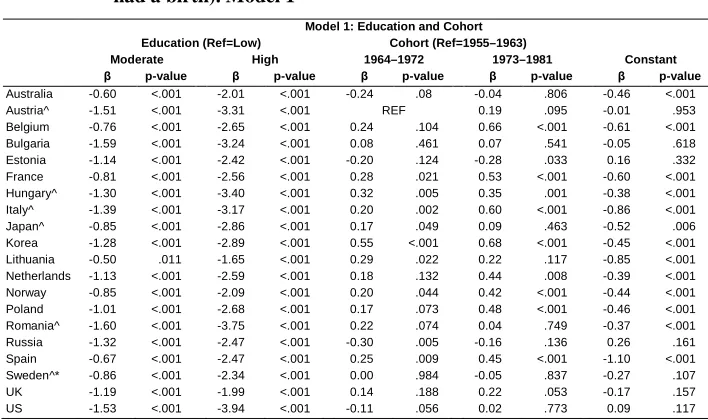
Table A1: Log-odds ratio of women having an early birth using a relative threshold (country-cohort-specific age at which 20% of women have had a birth). Model 1
Model 1: Education and Cohort Education (Ref=Low) Cohort (Ref=1955–1963)
Moderate High 1964–1972 1973–1981 Constant β p-value β p-value β p-value β p-value β p-value Australia -0.60 <.001 -2.01 <.001 -0.24 .08 -0.04 .806 -0.46 <.001 Austria^ -1.51 <.001 -3.31 <.001 REF 0.19 .095 -0.01 .953 Belgium -0.76 <.001 -2.65 <.001 0.24 .104 0.66 <.001 -0.61 <.001 Bulgaria -1.59 <.001 -3.24 <.001 0.08 .461 0.07 .541 -0.05 .618 Estonia -1.14 <.001 -2.42 <.001 -0.20 .124 -0.28 .033 0.16 .332 France -0.81 <.001 -2.56 <.001 0.28 .021 0.53 <.001 -0.60 <.001 Hungary^ -1.30 <.001 -3.40 <.001 0.32 .005 0.35 .001 -0.38 <.001 Italy^ -1.39 <.001 -3.17 <.001 0.20 .002 0.60 <.001 -0.86 <.001 Japan^ -0.85 <.001 -2.86 <.001 0.17 .049 0.09 .463 -0.52 .006 Korea -1.28 <.001 -2.89 <.001 0.55 <.001 0.68 <.001 -0.45 <.001 Lithuania -0.50 .011 -1.65 <.001 0.29 .022 0.22 .117 -0.85 <.001 Netherlands -1.13 <.001 -2.59 <.001 0.18 .132 0.44 .008 -0.39 <.001 Norway -0.85 <.001 -2.09 <.001 0.20 .044 0.42 <.001 -0.44 <.001 Poland -1.01 <.001 -2.68 <.001 0.17 .073 0.48 <.001 -0.46 <.001 Romania^ -1.60 <.001 -3.75 <.001 0.22 .074 0.04 .749 -0.37 <.001 Russia -1.32 <.001 -2.47 <.001 -0.30 .005 -0.16 .136 0.26 .161 Spain -0.67 <.001 -2.47 <.001 0.25 .009 0.45 <.001 -1.10 <.001 Sweden^* -0.86 <.001 -2.34 <.001 0.00 .984 -0.05 .837 -0.27 .107 UK -1.19 <.001 -1.99 <.001 0.14 .188 0.22 .053 -0.17 .157 US -1.53 <.001 -3.94 <.001 -0.11 .056 0.02 .773 0.09 .117
^Note: Model 2 results combine women in the moderate and high education categories due to few early births (less than 10) among women with high education in each cohort
Table A2: Log-odds ratio of women having an early birth using a relative threshold (country-cohort-specific age at which 20% of women have had a birth). Model 2