journal homepage: http://jac.ut.ac.ir
k
-Total difference cordial graphs
R. Ponraj
∗1, S.Yesu Doss Philip
†2and R. Kala
‡31Department of Mathematics, Sri Paramakalyani College, Alwarkurichi-627412, Tamilnadu,
India.
2Research Scholar,Department of Mathematics, Manonmaniam sundarnar university,
Abishekapatti, Tirunelveli-627 012, Tamilnadu, India.
3Department of Mathematics Manonmaniam sundarnar university, Abishekapatti,
Tirunelveli-627 012, Tamilnadu, India.
ABSTRACT ARTICLE INFO
Let G be a graph. Let f : V(G) → {0,1,2, . . . , k −1}
be a map where k ∈ N and k > 1. For each edge
uv, assign the label |f(u)−f(v)|. f is called a k -total difference cordial labeling ofGif |tdf(i)−tdf(j)| ≤
1, i, j ∈ {0,1,2, . . . , k − 1} where tdf(x) denotes the
total number of vertices and the edges labeled with
x.A graph with admits a k-total difference cordial la-beling is called a k-total difference cordial graphs. We investigate k-total difference cordial labeling of some graphs and study the 3-total difference cordial labeling behaviour of star,bistar,complete bipartiate graph,comb,wheel,helm,armed crown etc.
Article history:
Received 14, May 2018
Received in revised form 3, April 2019
Accepted 8 May 2019
Available online 01, June 2019
Keyword: Star, Bistar, Complete bipartiate,Comb, Wheel, Helm, Armed Crown
AMS subject Classification: 05C78.
∗Corresponding author: R. Ponraj Email: [email protected] †[email protected]
1
Introduction
[1] introduced notion of cordial labeling of graphs. The cocept of k-difference cordial graph was introduced in [4] . Recently Ponraj etal [5] has been introduced the concept of k-total prime cordial graph . Motivated by this, we introduce k-total difference cordial labeling of graphs. Also we prove that every graph is a subgraph of a connected k-total differnce cordial graphs and investigate 3-total prime cordial labeling of sevarel graphs like path,star, bistar, complete bipartite graph etc .
2
k
-Total difference cordial labeling
Definition 2.1LetGbe a graph. Letf :V(G)→ {0,1,2, . . . , k−1}be a function where
k ∈ N and k > 1. For each edge uv, assign the label |f(u)−f(v)|. f is called k-total difference cordial labeling ofGif|tdf(i)−tdf(j)| ≤1,i, j ∈ {0,1,2, . . . , k−1}wheretdf(x)
denotes the total number of vertices and the edges labelled withx.A graph with a k-total difference cordial labeling is called k-total difference cordial graph.
Remark. 2- total difference cordial graph is 2-total product cordial graph.
3
Preliminaries
Definition 3.1 The corona of G1 with G2,G1G2 is the graph obtained by taking one
copy of G2 and p1 copies of G2 and joining the ith vertex of G1 with an edge to every
vertex in the ith copy of G
2.
Definition 3.2Armed crownACnis the graph obtained from the cycleCn:u1u2. . . unu1
withV(ACn) = V(Cn)∪{vi, wi : 1≤i≤n}andE(ACn) = E(Cn)∪{uivi, viwi : 1≤i≤n}.
Definition 3.3Cn(m) denotes the one point union of m copies of cycle Cn.
Definition 3.4An edge x=uv ofGis said to be subdivided if it is replaced by the edges
uwand wvwherew is a vertex not inV(G).If every edge ofGis subdivided,the resulting graph is called the subdivision graph S(G).
4
Main Results
Theorem 4.1.LetGbe a (p, q)graph.ThenGis a subgraph of a connectedk-total different cordial graph.
Proof. Consider the graphKp.Let u1, u2, . . . , unbe the vertices ofKp.Letm =p+ (p2) and
Take r=
m
2, if m is even
m−1
2 , if m is odd
. Considerk−1 copies of the star K1,r.Let K1i,r be the
ithcopy of the starK
1,r andV(K1i,r)=
ui, vi
j : 1≤j ≤r ,E(K1i,r)=
uivi
j : 1≤i≤r .The
super graphG∗ is obtained from Kp by identifyui with ui,1≤i≤k−1 . We now assign
the label to the vertices of G∗ as given below.Assign the label 0 to u1, u2. . . , un.Next
assign the label i to the vetices vi
...tdf(k−1) =m ortdf(0) =m,tdf(1) =tdf(2) =...tdf(k−1) =m−1 according as m is
even or odd.
Theorem 4.2.Ifn ≡0( mod k) then the star K1,n is k-total difference cordial.
Proof. Let V(K1,n)={u, vi : 1≤i≤n} and E(K1, n)={uvi : 1≤i≤n}. Let n = kt,t ∈
N Assign the label 0 to the central vertexu.We now move to the pendent vertices.Assign the label 0 to the first t pendent vertices v1, v2, . . . , vt. Now assign the label 1 to
the next t pendent vertices vt+1, vt+2, . . . , v2t. Next assign the label to the pendent
v2t+1, v2t+2, . . . , v3t.We now assign the label 2 to the next t pendent vertices and so
on.In this process,the vertices v(k−1)t+1. . . v(k−1)t+t receive the label k−1.Clearlytdf(0) =
t+ 1,tdf(1) =tdf(2) =tdf(3) =. . .=tdf(k−1) =t.
Theorem 4.3. The path Pn is 3-total difference cordial iff n6= 2
Proof. LetPn be the path u1, u2. . . , un.
Case 1. n∈ {1,3,4,5,6,7,8}.
3-total difference cordial labeling is given in table 1
n u1 u2 u3 u4 u5 u6 u7 u8
0
1 0 2 1 0 2 0 0 2 2 1 1 0 2 2 1 1 0 0 2 2 1 1 0 2 0 2 2 2 2 1 0 1
Table 1:
Case 2. n= 2.
Supposef is a 3-total difference cordial labeling ofP2.Thentdf(0) =tdf(1) =tdf(2) = 1.To
get the label 2,2 must be the vertex label.Without loss of generality f(u1) = 2.
Subcase 1. f(u2) = 0.
Here,tdf(1) = 0,a contradiction.
Subcase 2. f(u2) = 1.
In this casetdf(0) = 0 a contradiction.
Subcase 3. f(u2) = 2.
Here,tdf(1) = 0,a contradiction.
Case 3. n= 3t, t >2
Subcase 1. n = 3t,t is odd.
Assign the label 1 to the vertices u1, u2, . . . , ut and 2 to the vertices u2,u4,. . . ,ut−1.
Next assign the label 1 to the vertices ut+1, ut+2, . . . , u3t+1 2 .
Next assign the label 2 to the vertices u3t+1 2 , u
3t+3
2 , . . . , un.Clearly tdf(0) = 2t−1,tdf(1) =
Subcase 2. n = 3t,t is even. Assign the label 1 to the verticesu1, u3, . . . , ut−1,ut+1 and
2 to the vertices u2, u4, . . . , ut. Next assign the label1to the vertices ut+2, ut+3, . . . , u3t+2 2 .
We now assign the label 2 to the next consequent vertices u3t
2, u 3t+1
2 , . . . , u3t−2.
Finally assign the 0 to the verticesu3t+1andu3t. Clearlytdf(0) = 2t−1,tdf(1) = 2t,tdf(2) =
2t.
Case 4. n= 3t+ 1, t >2.
Subcase 1. t is odd.
As in subcase 1 of case 3 as the label to the verticesu1, u2, . . . , un−1.
Finally assign the label 0 to the vertex un.Clearly tdf(0) = 2t,tdf(1) = 2t,tdf(2) = 2t+ 1.
Subcase 2. t is even.
Letf be the 3-difference cordial labels of subcase 2 of case 3. Define g(ui+1) =f(ui),1≤
i≤n and g(u1) = 0.Clearly tdf(0) = 2t,tdf(1) = 2t+ 1,tdf(2) = 2t.
Case 5. n= 3t+ 2.t >2
Subcase 1. t is odd.
Let f be the 3-difference cordial labels of subcase 2 of case 4 Define g(ui+1) =f(ui),1≤
i≤n and g(u1) = 1.Clearly tdf(0) = 2t+ 1,tdf(1) = 2t+ 1,tdf(2) = 2t.
Subcase 2. t is even.
As in subcase 2 case 4 assign the label to the vertices u1, u2, . . . , un−1. Finally assign the
label 2 to the last vetexun. Clearlytdf(0) = 2t+ 1,tdf(1) = 2t+ 1,tdf(2) = 2.
Theorem 4.4.The bistar Bn,n is 3-total different cordial iff n≡1,2( mod 3).
Proof. LetV(Bn,n) = {u, v, ui, vi : 1≤i≤n}andE(Bn,n)={uui, vvi, uv : 1≤i≤n}. Note
that Bn,n has 2n+ 2 vertices and 2n+ 1 edges.
Case 1. n≡(1 mod 3).
Let n = 3t+ 1. Assign the label 0 to the central vertices u and v. We now move to the pendent vertices ui. Assign the label 1 to the vertices u1, u2, . . . , u2t, u2t+1 and 0 to the
vertices u2t+2, u2t+3, . . . , un. Now we consider the vertices v1, v2, . . . , vn. Assign the label
2 to the vertices v1, v2, . . . , v2t+1 and 0 to the vertices v2t+2, v2t+3, . . . , vn.
Case 2. n≡2( mod 3).
Let n = 3t+ 2,t ∈ N.As in case 1 assign the label to the vertices u, v, ui,vi (1 ≤ i ≤
n−1).Finally assign the label 1 and 2 respectively to the verticesunandvn.The table given
below establish that this vertex labeling pattern is a 3 total difference cordial labeling.
Values of n tdf(0) tdf(1) tdf(2)
3t+ 1 4t+ 3 4t+ 2 4t+ 2 3t+ 2 4t+ 3 4t+ 4 4t+ 4
Table 2:
Case 3. n≡0( (mod 3)).
Let n= 3t, t∈ N.Supposef is a 3- total difference cordial labeling.This implies tdf(0) =
Subcase 1. f(u) =f(v) = 0. Clearly to get the edge label 0,the pendent vertices should be received the label 0.Since the edge uv receive the label 0,We have 3 receive the label 0.That is the edgeuv together with the verticesuandv.We need remain 3t−2,0 labels.For the odd values of t,3t−2 is odd.So we can not label 3t2−2 vertices by 0.For the even values oft,assume 3t2−2 vertices ofu1, u2, . . . , un is labelled by 0.In this casetdf(2) = 3t−22 ≤3t+ 1
a contradiction.
Subcase 2. f(u) = 0, f(v) = 1. To get the edge label 2,2 should be label of the vertices
ui.Therefore the sum label 2 of the vertices and corresponding edge label is 3t + 1,a
contradiction is odd.
Subcase 3. f(u) = 0, f(v) = 2 To get the edge label 1,0 and 1 are labels of adjacent vertices (or) 2 and 1 are the labels of adjacent vertices.Therefore the sum of label 1 of the vertices ui and corresponding edge label is 3t+ 1 or the sum of label 1 of ui with
corresponding edge label and label 1 of verticesvi with corresponding edge label is 3t+ 1,
a contradiction.
Theorem 4.5 The complete bipartite graph K2,n is 3-total difference cordial.
Proof. LetV1 ={u, v}andV2 ={u1, u2. . . un}where (V1, V2) is the bipartition ofK2,n.We
now give the vertex labeling.Assign the label 1 and 2 respectively to the vertices u and
v of V1.Next assign the label 0 to all the vertices u1, u2, . . . , un of V2.It is easy to verify
that,tdf(1) =tdf(2) =n+ 1 andtdf(0) =n
Theorem 4.6 All combs are 3-total difference cordial.
Proof. Let Pn K1 be the comb with Pn = u1u2. . . un and V(Pn K1) = V(Pn)∪
{vi : 1≤i≤u} and E(PnK1) = E(Pn)∪ {uivi : 1≤i≤u}. clearly |V(PnK1)|+
|E(PnK1)|= 4n−1
Case 1. n≡0(mod3).
Let n = 3t,t ∈ N.Assign the label 2 to the all the path vertices u1, u2, . . . , un.We now
move to the pendent vertices.Assign the label 2 to the pendent verticesv1, v2, . . . , ut.Next
assign the label 1 to the remaining pendent vertices vt+1, vt+2. . . v3t.
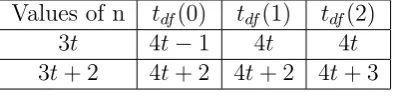
Case 2. n≡2(mod3).
Letn = 3t+2.In this case assign the label 2 to the all the path vertices and to the pendent vertices v1, v2, . . . , vt+1. Next assign the label 1 to the remaining pendent vertices.The
table given below shows that this labeling f is a 3-total difference cordial labels.
Values of n tdf(0) tdf(1) tdf(2)
3t 4t−1 4t 4t
3t+ 2 4t+ 2 4t+ 2 4t+ 3
Table 3:
Proof. Let Wn = Cn+K1 where Cn is the cycle u1u2. . . unu1 and V(K1) = {u}.Assign
the label 1 to the central vertex u and assign the label 2 to the all the rim vertices
ui(1≤i≤n).Clearlytdf(1) =n+ 1 andtdf(0) =tdf(2) =n.HenceWn is 3-total difference
cordial.
Theorem 4.8 Helms Hn is 3-total difference cordial.
Proof. HelmHnis obtained from the wheelWn=Cn+K1whereCnis the cycleu1u2. . . un
and V(K1) ={u} by attaching pendent edges to the rim vertices.Letv1, v2, . . . , vn be the
pendent vertices adjacent to u1, u2, . . . , un respectively.Assign label to the verticesu and
ui as in theorem 4.7.
Case 1. n≡0 (mod 3).
Let n= 3t,t ∈N.Assign the label 0 to the vertices u1, u4, . . . , u3t−2 and 1 to the vertices
u2, u5, . . . , u3t−1 and 2 to the vertices u3, u6, . . . , u3t
Case 2. n≡1 (mod 3).
Let n = 3t+ 1,t ∈ N.Assign the label to the vertices u1, u2, . . . , u3t as in case (1).Next
assign the label 0 to the vertex u3t+1.
Case 3. n≡2 (mod 3).
Letn = 3t+ 2,t ∈N.In this case,assign the label to the verticesu1, u2, . . . , u3t,u3t+1 as in
case 2.Finally assign the label 1 to the vertex u3t+2.
The table given below shows that this labeling f is a 3-total difference cordial labelling of Hn.
Values of n tdf(0) tdf(1) tdf(2)
3t 4t 4t+ 1 4t
3t+ 1 4t+ 1 4t+ 1 4t
3t+ 2 4t+ 2 4t+ 1 4t+ 1
Table 4:
Theorem 4.9ACn is 3-Total difference cordial for all n ≥3
Proof. Clearly ACn has 3 vertices and 3n edges.Assign the label 2 to the all the cycle
vertices u1u2. . . un.Neext assign the label 2 to the all the vertices with degree 2.That is
assign the label 2 to the verticesv1, v2, . . . , vn.Finally assign the label 1 to all the pendent
vertices w1w2. . . wn.It is easy to verify that tdf(0) =tdf(1) =tdf(2) = 2n.
Any star isS(K1,n)-total difference cordial.
LetV(S(K1,n)) = {u, ui, vi : 1≤i≤n} and
E(S(K1,n))={uui, uivi : 1≤i≤n}.
Case 1. n= 3t.
Assign the labelotou,Next assign 0 the verticesu1, u2, . . . , u2tand 2 tou2t+1, u2t+2, . . . , u3t.
Now consider the pendent verticesv1, v2, . . . , vm.
pendent vetices vt+1, vt+2, . . . , v2t, . . . , v3t.Clearly tdf(0) = 4t+ 1,tdf(1) = 4t,tdf(2) = 4t.
Case 2. m= 3t+ 1.
Assign the label to the vertices u, ui, vi 1 ≤i ≤3t as in case 1.Finally assign the label 2
and 1 respectively to the verticesunandvn. Clearlytdf(0) = 4t+ 1,tdf(1) = 4t+ 2,tdf(2) =
4t+ 2.
Case 3. m= 3t+ 2.
As in case 1 assign the label to the vertices u, ui, vi 1 ≤ i ≤ 3t.Finally assign the label
1,2 and 0 respectively to the vertices u3t+1,u3t+2 and v3t+1 and v3t+2. Clearly tdf(0) =
4t+ 3,tdf(1) = 4t+ 3,tdf(2) = 4t+ 3.
Theorem 4.10 C4(m) is 3-total difference cordial for all even values of m.
Proof. Let C4 : ui1u2iui3ui4ui1 be theith copy of the cycle in C4m and u =u11 =u21 =. . . =
um
1 .Assign the label 0 to the central vertexu.Next assign the label 2 to the verticesui2,ui3,ui4,
1 ≤ i ≤ m−2
2 .We now assign the label 1 to the vertices u
i
2,ui3,ui4,
m
2 ≤ i ≤ m−2.Finally
assign the label 0,1,1,0,2 and 2 respectively to the vertex um2−1,u3m−1,um4−1,um2 ,um3 and
ut
4.The tabel is establish that this labellingf is a 3-total difference cordial labelling.
Values of t tdf(0) tdf(1) tdf(2)
6r 14r+1 14r 14r 6r+2 14r+5 14r+5 14r+5 6r+4 14r+9 14r+10 14r+9
Table 5:
Theorem 4.11The subdivision of bistarBn,n,S(Bn,n) is 3-total different cordial for alln.
Proof. LetV(S(Bn,n)) ={u, w, v, ui, vi, xi, yi : (1≤i≤n)}and
E(S(Bn,n)) ={uui, uixi, uw, wv, vvi, viyi : 1≤i≤n}.
Case 1. u= 3t.
Assign the label 0 to the vertices u and v. We now assign the label 0 to the vertices
u1, u2. . . u2t and v1, v2, . . . , v2t. Now assign the label 2 to the vertices
u2t+1, u2t+2, . . . , u3t, u2t+1, u2t+2, . . . , u3t.Assign the label 2 to the verticesx1, x2, . . . , xtand
y2, y3, . . . , yt.Next assign the label 1 to y1, yt+1, . . . , y2t, . . . , y3t.
Case 2. n= 3t+ 1,t ∈N.
As in case 1 assign the label to the verticesu,v,w,ui,vi,xi,yi (1≤i≤n−1).Finally assign
the label 2,2,0 and 1 respectively to the vertices un, xn, vn, and yn.
Case 3. n= 3t+ 2,t ∈N.
Assign the label to the vertices u, v,w,ui,vi,xi,yi (1 ≤ i ≤ n−1) as in case 2 .Finally
assign the label 2,0,1 and 0 respectively to the vertices xn, un, vn,and yn.
Values of t tdf(0) tdf(1) tdf(2)
3t 8t+2 8t+2 8t+1 3t+1 8t+4 8t+4 8t+5 3t+2 8t+7 8t+7 8t+7
Table 6:
Theorem 4.12 Pn2K1 is 3-total difference cordial for alln
Proof. .
Let Pn be the path u1, u2, . . . , un.Let vi,wi be the pendent vertices adjacent to ui (1 ≤
i≤n).We divide the proof into two cases.
Case 1. n is even..
Assign the label 0 to all the path vertices u1,u2, . . ., un.Next we consider the pendent
vertices.Assign the label 1 to the vertices v1,v2, . . ., vn2, w1,w2, . . ., wn2 and 2 to the
vertices vn
2+1,v
n
2+2, . . . , vn,w
n
2+1,w
n
2+2, . . . , wn.
Case 2. n is odd.
Assign the label to the vertices ui,vi,wi (1 ≤ i ≤ n−1) as in case 1.Finally assign the
label 0,1 and 2 respectively to the verticesun,vn,wn.
Since tf d(0) = 2n−1,tf d(1) = tf d(2) = 2n,this labeling pattern is a 3-total difference
cordial labeling.
References
[1] Cahit, I., Cordial graphs:A weaker version of graceful and harmonious graphs, Ars Combinatoria, 23(1987), 201-207.
[2] Gallian, J.A., A Dynamic survey of graph labeling, The Electronic Journal of Combi-natorics, 19 (2017) #Ds6.
[3] Harary, F., Graph theory, Addision wesley, New Delhi (1969).
[4] Ponraj, R., Adaickalam M.Maria, and Kala R.,k-difference cordial labeling of graphs,
International J.Math.combin, 2(2016), 121-131.
[5] Ponraj, R., Maruthamani J., and Kala, R., k-total prime cordial labeling of graphs,