A comparison of Willingness to Communicate (WTC)
between Iranian EFL and EAP learners
Moazzam, Ismail
Department of English Language & Literature, Faculty of Literature & Humanities, Bu-Ali Sina University, Iran ([email protected])
Received: 18 May 2014 Revised: 5 June 2014 Accepted: 10 June 2014
Available Online: 10 July 2014 DOI: 10.5861/ijrsll.2014.813
ISSN: 2243-7754 Online ISSN: 2243-7762
OPEN ACCESS
Abstract
The present study was undertaken to investigate whether 1) there is any significant difference
between EFL and EAP learners in terms of willingness to communicate, 2) there is any
significant difference in WTC of Iranian EFL/EAP learners with 1- Native speakers, 2-
Nonnative speakers and 3- In class context, and 3) there is any significant difference between
male and female EFL learners in terms of willingness to communicate. To these ends 363
undergraduate students (131 EAP students and 232 EFL students) studying at Bu-Ali Sina
University-Hamedan and Azad University of Mashad during the academic year of 2013-2014
participated in this study. Data were collected through a 5 point Likert-scale Willingness to
Communicate in a Foreign Language Scale (WTC-FLS) questionnaire containing 21
statements. The instrument was composed of three subscales measuring, 1- willingness to
communicate with native speakers of English (WTC-NS), 2- willingness to communicate with
foreigners who are not native speakers of English (WTC-NN), and 3- willingness to
communicate in the school context (WTC-SC). Using factor analysis and pilot testing, the
questionnaire was found to have an acceptable validity rate. Also, using Chronbach’s alpha, the
reliability of the questionnaire was estimated to be 0.93. Using SPSS, the results of independent
samples t-test indicated that, overall, there was a significant difference between EFL and EAP
learners in terms of their willingness to communicate. Furthermore, the results of one-way
ANOVA for subscales of WTC-FLS revealed a significant difference in WTC of both EFL
and EAP learners with native speakers, nonnative speakers and in class context. That is while
EFL learners were more willing to communicate with native speakers of English and less
willing to communicate with nonnative speakers of English, EAP learners were found to be
more willing to communicate with native speakers of English and less willing to
communicate in class context. Finally, no significant difference was found between male and
female EFL learners in terms of willingness to communicate. Implications and
recommendations for future research are also addressed.
A comparison of Willingness to Communicate (WTC) between Iranian EFL and EAP
learners
1. Introduction
Communication is recognized as central to the development of human relationships (Sallinen‐Kuparinen, McCroskey, & Richmond, 1991). As such, McCroskey and Richmond (1987, cited in Mohseni & Niknejad, 2013) argued that being a poor communicator or not willing to communicate with others is one of the dysfunctional behaviors in society. With respect to significant role of communication in L2 learning, Macintyre and Charos (1996, p. 3) state that:
“Communication and second language acquisition are closely tied together. On one hand, recent trends toward a conversational approach to second language pedagogy reflect the belief that one must use the language to develop proficiency, that is, one must talk to learn. On the other hand, communication is more than a means of facilitating language learning, it is an important goal in itself”.
In fact the human being, by means of communication with other people, gradually acquires language. In this regard, willingness to communicate (WTC), defined as a stable predisposition toward communication when free to choose to do so (McCroskey & Baer, 1985), is the most basic orientation toward communication.
Willingness to communicate which has been suggested as the final intention to really initiate a communication plays an important role in language learning, and has recently become an important concept across disciplines of second language teaching and learning. The importance of WTC arises from the role of interaction in language development (Molberg, 2010). According to Kang (2005), more interaction causes more language development and learning
Willingness to communicate was first used in first language (L1) communication by McCroskey and Baer (1985). They defined willingness to communicate as the underlying tendency totalkto others which is rooted in a personality variable. Further, they mentioned introversion, self-esteem, communication competence, communication apprehension, and cultural diversity as antecedents of WTC.WTC was then applied to second language (L2) communication by MacIntyre and Charos (1996). They widened McCroskey and Baer’s (1985) model by adding motivation, personality, and context as predictors of not only WTC but also the frequency of communication. They hypothesized that WTC and integrative motivation would explain the frequency of communication in L2.Later, L2 scholors identified perceived competence, communication anxiety, L2 communicative confidence, and L2 attitude as the key factors influencing L2WTC (Ortega, 2009, cited in Furuta, 2011).
WTC which represents the psychological preparedness to use the second language (MacIntyre, 2007); “is of special importance in revealing learners’ communication psychology and promoting communication engagement in class” (Xie, 2011, p. 1). It is often regarded to be the main cause of the frequency of L2 use (Yu, Li, & Gou, 2011).That is, language students who are willing to communicate in the second language actually look for opportunities to communicate. According to MacIntyre and Doucette (2010, p. 1), “being willing to communicate is part of becoming fluent in a second language, which often is the ultimate goal of L2 learners” Therefore, it seems that producing WTC is a crucial component of modern language instruction and the goal of the learning process should be to engender in language students “the willingness to communicate” (McIntyre, Clement, Dornyei, & Noels, 1998).
success in L2 acquisition. Therefore, L2 learners with high levels of willingness to communicate may have the greater possibility to develop L2 proficiency (Kim, 2004). The willingness to communicate as an important construct in explaining second language (L2) communication, holds a great value in the research of second and foreign language learning and instruction (YU, 2009). It is especially of great interest to communicative language teaching (CLT), which puts an emphasis on learning through communicating (Ellis, 2008, cited in Xie, 2011).
While there is a growing body of research which explores EFL students’ WTC in second language, a similar line of research is lacking on EAP learners’ WTC. Therefore, the present study intends first to see whether there is any significant difference between EFL and EAP learners in terms of willingness to communicate, second to see whether there is any significant difference in WTC of Iranian EFL/EAP learners with 1-native speakers, 2- nonnative speakers and 3- in class context, and finally, to explore the difference between male and female English learners in willingness to communicate.
2. Review of the related literature
The construct “Willingness to Communicate” was first used by McCroskey and Baer (1985) in relation to communication in the native language. They maintained that even though situational variables might affect one’s willingness to communicate, individuals display similar WTC tendencies in various situations. Furthermore, they mentioned introversion, self-esteem, communication competence, communication apprehension and cultural diversity as antecedents that lead to differences in WTC. They found that the degree of WTC, communication apprehension, communication competence, and introversion differed across countries as well as the degree of relations among these variables. Moreover, they suggested that any kind of generalization should be done with reference to culture.
2.1 MacIntyre’s (1994) willingness to communicate model
Maclntyre (1994) developed a path model to predict willingness to communicate in the first language. Based on this model, higher levels of willingness to communicate are caused by a combination of greater perceived communicative competence and a relative lack of communication apprehension. Introversion contributes to both communication apprehension and the perception of communicative competence, and self-esteem is in relation to communication apprehension. Finally, drawing upon Burgoon’s (1976) findings, this model suggests that societal pressures (in the feelings of alienation and anomie) play a part in generating an unwillingness to communicate. Maclntyre (1994) recommended “exploring the interaction between personality and specific situational characteristics in their influence on willingness to communicate” (p. 140).
2.2 MacIntyre and Charos’s (1996) model.
MacIntyre and Charos (1996) applied the more comprehensive version of MacIntyre’s (1994) model to research communication in the second language. They widened the structural model by adding motivation, personality, and context as predictors of not only WTC but also the frequency of communication. They hypothesized that WTC and integrative motivation would explain the frequency of communication in L2.
affect the psychological preparedness to speak. We can identify both individual factors (anxiety, motivation, attitudes, interpersonal attraction, etc.) and social contextual factors (ethno linguistic vitality, language contact, etc.) that either enhance or reduce WTC (MacIntyre, 2007).
The pyramid model of WTC- WTC as the psychological preparedness to use the L2 when there is the opportunity requires a focus on the specific moment of decision where an L2 learner chooses to become an L2 speaker (MacIntyre, 2007). Previous research in second language acquisition shows that as motivation increases and language anxiety decreases, performance in the L2 will improve. According to MacIntyre (2007), the decision to speak or not, over time, exerts an impact on the person’s success at language learning. Moreover he states that both psychological and sociopolitical processes will be relevant to creating the willingness to communicate. However, by focusing on WTC, McIntyre examines social context as it is interpreted by the individual and as it affects her or his decision making and argues that opportunities for communication refer to specific moments in time when communication might be conducted in a second language (particularly considering moments when an individual has the choice to speak in the L2). Therefore, willingness to speak in the L2 at such moments conditions the social interactions among persons from differing language groups and in some respects reflects the success of the interlocutors’ language learning efforts (MacIntyre, 2007).
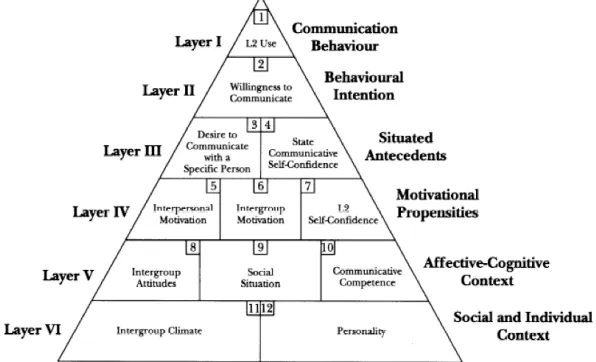
As shown in figure 2, MacDonald, Clement, and Macintyre (2003) note that the construct WTC comprises several layers and subsumes a range of linguistic and psychological variables, including linguistic self-confidence (both state and trait); the desire to affiliate with a person; interpersonal motivation; intergroup attitudes, motivation, and climate; parameters of the social situation; communicative competence and experience; and various personality traits.
Figure 2. Heuristic model of variables influencing WTC
Source: MacIntyre, Clément, Dörnyei, & Noels, 1998, p. 547
As presented in Dornyei (2003), WTC is a fairly stable personality trait, developed over the years, but the situation is more complex with regard to L2 use, because here the level of one’s L2 proficiency, and particularly that of the individual’s L2 communicative competence, is an additional powerful modifying variable. What is important, though, is that WTC and communicative competence are not the same: There are many L2 learners who are very competent L2 speakers, yet tend to avoid L2 communication situations, whereas some other, less proficient learners actively seek opportunities to engage in L2 talk (Dornyei, 2003).
2.3 Willingness to communicate studies within the context of Iran
Alemi and Pakzadian (2011) attempted to investigate how much the WTC model (MacIntyre, 1989) was capable of providing explanation for the relationship among social-psychological and communication variables in the EFL context. The participants in this study were 45 Iranian engineering students who took TOEFL and then filled out a WTC questionnaire (MacIntyre, 1998). The findings showed that university students’ WTC was to function as a trait and they were low in willingness to communicate both in the classroom and outside because, they didn’t need to communicate in English for their basic needs. Also, no relationship was found between any sources of support and any components of orientation. Furthermore, in terms of orientation, the learners showed to be more integratively motivated than instrumentally. Among social support factors, teachers had the main role. Moreover, among all skills, learners were more interested in reading. And the reason they were not willing to communicate inside the classes was that they might be afraid of being evaluated. Based on the results of this study, the researchers suggested that language instructors use more authentic L2 communication and foster more friendly relationship with learners.
In another study, Alemi, Daftarifard, and Pashmforoosh (2011) in an attempt to explore Iranian EFL university students’ WTC and its interaction with their language anxiety and language proficiency, showed that Iranian university students’ WTC was directly related to their language proficiency. In this study higher proficient learners showed to be less communicative than lower proficient ones outside the classroom indicating the state-like nature of WTC in the present sample. Moreover, no significant interaction between WTC and anxiety was found. The researchers argued that anxiety did not affect the learners’ participation in communication (WTC). Finally, it was revealed that anxiety and language proficiency were negatively correlated. That is the association between language learning experience and L2 anxiety was confirmed in the results of this study. Based on the results of the study, linguistic variables seem to be more predictive of Iranian students’ WTC, and language instructors should work on their students' English proficiency.
Ghonsooly, Khajavy, and Asadpour (2012) examined willingness to communicate in the second language (L2WTC) construct and its underlying variables among non–English major students in the context of Iran. They used WTC and socioeducational models for examining L2 communication and L2 learning. The results of this study indicated that L2 self-confidence and attitudes toward international community were two predictors of L2WTC in Iranian context. The paths from motivation to L2WTC and openness to experience to L2 self-confidence were not significant and thus were deleted. Their model indicated the potential use of the L2WTC construct for English as a foreign language context.
Barjesteh, Vaseghi, and Neissi (2012) investigated Iranian EFL learners' perceptions of their willingness to initiate communication across four types of context and three types of receiver. Using a questionnaire consisted of 20 situations in which one might choose to communicate or not to communicate, the researchers came to the conclusion that learners were highly willing to communicate in two context-types (Group Discussion, & Meetings) and one receiver-type (Friend). Based on the results obtained from the questioner, EFL learners were not willing to communicate in other situations. The researchers argued that the main reason that majority of Iranians were not willing to communicate in other situation was that they had the experience of communicating in English only in language classrooms in which they could have some group discussion, meetings, and friendly chat. They didn't have an access to a native speaker or possibility to travel to an English speaking country. The researchers concluded that Generally, Iranian EFL learners are willing to initiate communication in situations experienced before (such as group discussion or communicating with their friends). They don't feel confident enough to initiate communication in unfamiliar situations like public speaking. Therefore, context- and receiver-type familiarity is an effective factor for the situation in which a learner initiates communication.
Baghaei (2012) on the relationship between willingness to communicate and success in learning English as a foreign language, showed that two out of the three subscales of WTC (willingness to communicate in the school context and willingness to communicate with native speakers of English) were moderately correlated with success in learning English as foreign language. Riasati (2012) also studied Iranian EFL learners’ perception of factors that influence their willingness to speak English in language classrooms. The results of semi-structured interviews revealed that a number factors including task type, topic of discussion, interlocutor, teacher, class atmosphere, personality and self-perceived speaking ability contribute to willingness to speak.
Pourjafarian (2012) examined the relationship patterns between socioeconomic factors, i.e. parental occupations, cultural capital, and willingness to communicate in English in Iranian high school context in Shiraz. Individual semi-structured interviews were used to obtain supportive data. The findings revealed noticeable evidence of the existence of a strong relationship between willingness to communicate in English and socio-economic orientations and language achievement. In addition, Zarrinabadi, (2012) investigated Iranian culture values related to self-perceived communication competence, which is reported to be a strong predictor of willingness to communicate (McCroskey& Richmond, 1990). The Self-Perceived Communication Competence (SPCC) (McCroskey, 1995) instrument was used to measure the communication competence self-perceptions of more than 700 Iranian university students regarding various contexts and with various receivers. Results indicated that the participants feel more competent communicating in dyads and group context and with friend and acquaintance receivers, while less competent when talking with strangers or in public.
Tabataba’ian (2012) aimed to investigate the relationships among emotional intelligence (EI), foreign language anxiety, and willingness to communicate (WTC). The results of the study indicated that there was a significant relationship between EQ, WTC, and Foreign Language Anxiety (FLCAS).Significant correlation was found between FLCAS and WTC too. Several subscales of EQ were also related to FLCAS and WTC. Further, regression analysis indicated that FLCAS, EQ, and some of its subscales were predictors of WTC. Also, EQ and several of its subscales could predict FLCAS. Mohammadzadeh and Jafarigohar (2012) studied whether there is any possible relationship between willingness to communicate (WTC) and multiple intelligences (MI) among over 500 EFL learners. The researchers also investigated the effect of gender on the relationship between these two constructs. Findings of the study revealed that the MI profile of learners of English had a significant correlation with their willingness to participate in L2 communication and that the link between MI and WTC was affected by gender.
Mahmoodi and Moazam (2013) investigating willingness to communicate and L2 achievement of Arabic language learners found a significant correlation between WTC and Arabic language achievement. Regarding subscales of WTC, willingness to communicate in the school context was found to have the highest correlation with Arabic language achievement. This is probably because these students were provided with ample opportunities to participate more in classroom activities. And, perhaps they didn’t have an access to a native speaker of Arabic out of their classrooms. While there has been much research exploring EFL students’ willingness to communicate in the second language, EAP learners’ willingness to communicate seems to have been a neglected area in L2 research. Therefore, the present study was mainly designed to explore EAP learners’ WTC and compare it with that of EFL learners. The following research questions were thus formulated for the present study:
1. Is there any significant difference between EFL and EAP learners in terms of willingness to communicate?
2. Is there any significant difference in WTC of Iranian EFL/EAP learners with
A. native speakers,
C. in class context?
3. Is there any significant difference between male and female EFL learners in terms of willingness to communicate?
3. Methodology
3.1 Participants
The participants of the study were 363 Iranian male and female undergraduate students attending Bu -Ali Sina University of Hamedan and Azad University of Mashad. 232 of the participants were EFL learners, and 131 of the participants were EAP learners. The students were of different academic levels and the age range of the two groups was 19-29.The researcher used cluster random sampling to select the participants. That is the researcher randomly selected intact classrooms and gave the questionnaire to all the students in those classrooms.
3.2 Instruments
Willingness to Communicate (WTC) questionnaire - The Willingness to Communicate in a Foreign Language Scale (WTC-FLS) which was developed and validated by Baghaei (2012) was given to the participants. This scale was used as a direct measure of the respondents’ predisposition toward approaching or avoiding the initiation of communication (Appendix A). The scale has 21 items, of which seven items are related to willingness to communicate with native speakers, seven items assess willingness to communicate with nonnative speakers, and seven items are related to willingness to communicate in class context. Participants were asked to indicate on a scale from 1 to 5 (1 = Strongly Disagree 2= Disagree 3 = Neutral 4 = Agree 5 = Strongly Agree) how willing they were to communicate.
3.3 Data Collection procedure
The researcher pursued the following procedures:
In this study cluster random sampling was used to select the participants. First of all, the purposes and the importance of the study were clarified to the participants and full descriptive instructions regarding the procedures of administration was provided. Then, the questionnaire was administered to 363 EAP and EFL students at Bu Ali Sina University and Azad University of Mashad. Students were asked to indicate on a scale from 1 to 5 how willing they were to communicate. It took each student 15 minutes to complete the questionnaire.
3.4 Data Analysis
In this study the following statistical procedures were used:
T-test - For research questions number1 and 3 an independent samples t-test was conducted.
4. Results
4.1 Demographic information of the participants
Table 1 reports participants’ demographic information. As Table 1 indicates, 232 EFL learners (63.9 %) and 131 EAP learners (36.06%) participated in this study. Overall, 363 EFL/EAP learners completed the willingness to communicate questionnaire.
Table 1
Demographic information of the participants in the study
EFL learners EAP learners Total
Participants Percentage Participants Percentage 363
232 63.9 131 36.06
4.2 Reliability
Table 2 shows the results of Cronbach’s Alpha consistency for the questionnaire. As Table 2 indicates, the
reliability coefficient of the WTC questionnaire using Chronbach’s Alpha consistency was estimated to be 0.95. Table 2
Reliability statistics
Cronbach's Alpha N of Items
.95 21
4.3 Validity
Table 3 shows the results of factor analysis for the WTC questionnaire. As Table 3 shows, the Kaiser-Meyer-Olkin (KMO) measure of sampling adequacy was greater than .90 and, the Bartlett's test of sphericity was significant which indicates that the relationship among variables was strong.
Table 3
KMO and Bartlett's test
Kaiser-Meyer-Olkin Measure of Sampling Adequacy. .93
Bartlett's Test of Sphericity Approx. Chi-Square 2.155E3
Df 23
Sig. .00
4.4 T –test for overall WTC between EAP and EFL participants
The first research question of this study was “is there any significant difference between EAP and EFL learners in terms of their WTC?” Table 4 represents descriptive statistics for EAP and EFL participants.
Table 4
Descriptive statistics for EAP and EFL participants
N Mean SD Std. Error Mean
EAP participants’ WTC 131 77.61 14.94 1.30
EFL participants’ WTC 232 86.56 10.51 .69
Table 5
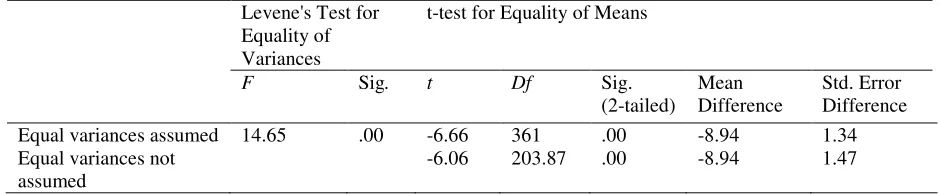
Independent samples t-test for overall willingness to communicate of EAP and EFL participants
Levene's Test for Equality of Variances
t-test for Equality of Means
F Sig. t Df Sig.
(2-tailed) Mean Difference
Std. Error Difference Equal variances assumed 14.65 .00 -6.66 361 .00 -8.94 1.34 Equal variances not
assumed
-6.06 203.87 .00 -8.94 1.47
4.5 One way ANOVA for EFL participants
The second research question of the study was “is there any significant difference in WTC of Iranian EFL/EAP learners’ with 1- native speakers, 2- nonnative speakers and 3- in class context?” The following Tables summarize the results of one way ANOVA. Table 6 provides descriptive statistics for EFL participants.
Table 6
Descriptive statistics for EFL participants
N Mean SD Std.
Error
95% Confidence Interval for Mean
Min Max
Lower Bound
Upper Bound WTC with Native speakers of
English
232 29.21 3.85 .25 28.71 29.70 11 35
WTC with Non Native speakers of English
232 26.84 4.21 .27 26.30 27.39 13 35
In Class context WTC 232 27.18 4.82 .31 26.56 27.81 12 35
Total 696 27.75 4.43 .16 27.42 28.08 11 35
Table 7 represents the results of the Levene’s test for the assumption that the variances of the three subscales are not significantly different.
Table 7
Test of homogeneity of variances
Levene Statistic df1 df2 Sig.
5.71 2 693 .00
As shown in Table 7, the Levene’s test was significant (sig=.00). Thus, the assumption of homogeneity of variance was not met. As the result had been significant, then we could use an adjusted F test. While, Table 8 shows the results of one way ANOVA for EFL participants.
Table 8
One way ANOVA for EFL participants
Sum of Squares df Mean Square F Sig.
Between Groups 756.47 2 378.23 20.30 .00
Within Groups 12908.02 693 18.62
Total 13664.50 695
Table 9
Robust tests of equality of means
df1 df2 Sig.
Welch 23.11 2 458.32 .00
Brown-Forsythe 20.30 2 669.64 .00
Note. Asymptotically F distributed.
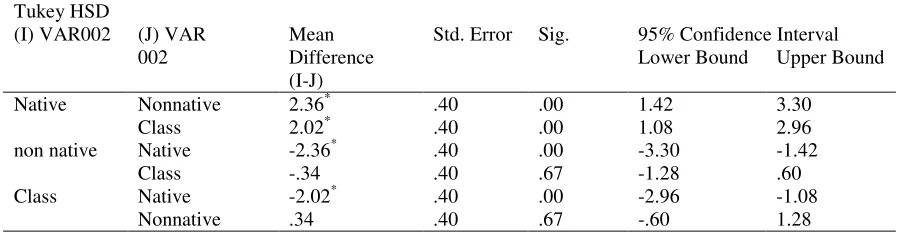
As can be seen in Table 9, the results of the Welch statistics and the Brown-Forsythe statistics show that there is a significant difference in WTC of EFL learners with native speakers, nonnative speakers and in class context (sig=.00). It can be concluded that at least one or two of the subscale means are significantly different from the others (or that at least two of the subscale means are significantly different from each other). However, to determine which WTC subscales are significantly different from each other, a post-hoc test was used. Table 10 reports the results of post-hoc test (Tukey).
Table 10
Post hoc tests for EFL participants
Tukey HSD
(I) VAR002 (J) VAR 002
Mean Difference (I-J)
Std. Error Sig. 95% Confidence Interval Lower Bound Upper Bound
Native Nonnative 2.36* .40 .00 1.42 3.30
Class 2.02* .40 .00 1.08 2.96
non native Native -2.36* .40 .00 -3.30 -1.42
Class -.34 .40 .67 -1.28 .60
Class Native -2.02* .40 .00 -2.96 -1.08
Nonnative .34 .40 .67 -.60 1.28
Note. *The mean difference is significant at the 0.05 level.
Table 10 indicates that the willingness to communicate with native speakers of English (M = 29.21) is significantly different from the willingness to communicate with nonnative speakers of English (M = 26.84), with a mean difference of 2.36and a p value of .00. Also, the willingness to communicate with native speakers of English (M = 29.21) is significantly different from the willingness to communicate in the school context (M = 27.18), with a mean difference of 2.02and a p value of .00.
4.6 One way ANOVA for EAP participants
The second part of the second research question was “is there any significant difference in WTC of Iranian EAP learners with 1- native speakers, 2- nonnative speakers and 3- in class context”. Table 11 represents descriptive statistics for EAP participants.
Table 11
Descriptive statistics for EAP participants
N Mean SD Std.
Error
95% Confidence Interval for Mean
Min Max
Lower Bound
Upper Bound WTC with native
speakers of English
131 25.54 5.38 .47 24.61 26.48 7 35
WTC nonnative speakers of English
131 25.08 5.21 .45 24.18 25.98 7 35
In class context WTC 131 23.48 5.77 .50 22.48 24. 7 35
Total 393 24.70 5.51 .27 24.15 25.25 7 35
Table 12
Test of homogeneity of variances
Levene Statistic df1 df2 Sig.
.45 2 390 .63
As Table 12 indicates, the Levene’s test was not significant (Sig=.63). Thus, the assumption of homogeneity of variance was met for EAP learners.
Table 13 represents the results of one way ANOVA for EAP participants.
Table 13
One way ANOVA for EAP participants
Sum of Squares df Mean Square F Sig.
Between Groups 308.55 2 154.27 5.17 .00
Within Groups 11635.20 390 29.83
Total 11943.76 392
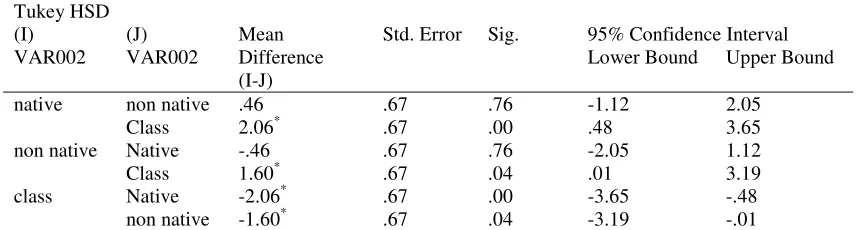
As is evident from Table 13, there is a significant difference in WTC of EAP learners with native speakers, nonnative speakers and in class context, F (5.17) = .00, p < .01. As such, we can conclude that at least one or two of the subscale means are significantly different from the others (or at least two of the subscale means are significantly different from each other). Table 14 represents the results of post-hoc test (Tukey) to determine where exactly the differences lie.
Table 14
Post hoc tests for EAP participants
Tukey HSD (I)
VAR002 (J) VAR002
Mean Difference (I-J)
Std. Error Sig. 95% Confidence Interval Lower Bound Upper Bound
native non native .46 .67 .76 -1.12 2.05
Class 2.06* .67 .00 .48 3.65
non native Native -.46 .67 .76 -2.05 1.12
Class 1.60* .67 .04 .01 3.19
class Native -2.06* .67 .00 -3.65 -.48
non native -1.60* .67 .04 -3.19 -.01
Note. *The mean difference is significant at the 0.05 level.
As Table 14 reveals the willingness to communicate with native speakers of English (M = 25.54) is not significantly different from the willingness to communicate with nonnative speakers of English (M = 25.08), with a mean difference of .46565 and a p value of .76. But, the willingness to communicate with native speakers of English (M = 29.21) is significantly different from the willingness to communicate in the school context (M = 23.48), with a mean difference of 2.06and a p value of .00.
4.7 T-test for male and female EFL participants
Table 15
Descriptive statistics for WTC of male and female EFL participants
N Mean SD Std. Error Mean
WTC of male 27 91.03 10.08 1.94
WTC of female 121 87.04 9.81 .89
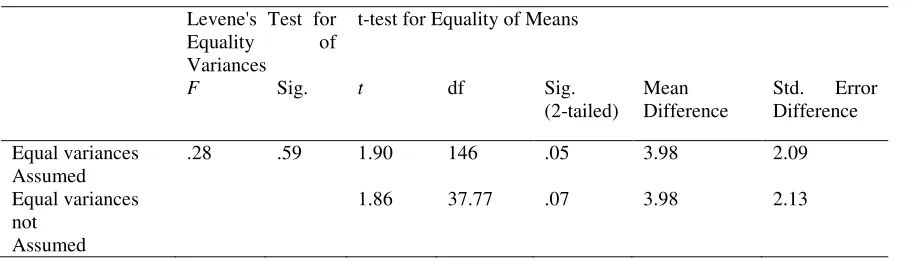
Table 16 represents the results of independent samples t-test for willingness to communicate between male and female EFL participants.
Table 16
Independent samples t-test betweenWTC of male and female EFL participants
Levene's Test for Equality of Variances
t-test for Equality of Means
F Sig. t df Sig.
(2-tailed)
Mean Difference
Std. Error Difference
Equal variances Assumed
.28 .59 1.90 146 .05 3.98 2.09
Equal variances not
Assumed
1.86 37.77 .07 3.98 2.13
As Table 16 shows, there was no significant difference between male and female EFL learners regarding WTC (sig=.05).
5. Discussion
In this study, overall, there was a significant difference between EFL and EAP students in terms of willingness to communicate. That is EFL students were more willing to communicate than EAP students.
One probable reason for this finding is that EFL students are provided with ample opportunities to participate in classroom activities. Therefore, seam found to be more willing to communicate than EAP learners. Another possible reason for the current result could be a lack of English proficiency and self-perceived communication competence which is reported to be a strong predictor of willingness to communicate (McCroskey & Richmond,
1990
) on the part of EAP students. Hence, previous research have found that undergraduate students’ general English proficiency (GEP), in general, is lower than what is required in the EAP courses (Atai & Nazari, 2011). So, it seems that lower English proficiency of EAP learners is the cause of their lower levels of willingness to communicate. In this regard, Hashimoto (2002) argues that perceived competence is the cause of stronger WTC, which leads to more L2 use.This finding is in line with that of Alemi, Daftarifard, and Pashmforoosh (2011) who found that Iranian university students’ WTC is directly related to their language proficiency. Based on the results of the study, the researchers suggested that linguistic variables seem to be stronger predictive of Iranian students’ WTC. Similarly, Riasati (2012) investigating Iranian EFL learners’ perception of factors that influence their willingness to speak English in language classrooms, found that self-perceived speaking ability among a number of other factors such as task type, topic of discussion, interlocutor, teacher, class atmosphere, and personality contributes to willingness to speak.
classrooms, they preferred to avoid communication. Moreover, a lack of competence in language seems to be the cause of communication apprehension in these learners that leads them to decide not to engage in communication.
According to Yu, Li and Gou (2011), an individual with less communication apprehension and high level of perceived communication competence has more willingness to communicate. In other words, both increasing perceived competence and lowering anxiety help students foster a willingness to communicate (Maclntyre, Baker, Clement, & Donovan, 2003).
On the other hand, as the results of the study indicate, significant differences were found between the two groups in terms of the subscales of WTC- FLS in favor of EFL learners. That is EFL learners were also more willing to communicate with native speakers, nonnative speakers, and in class context in contrast to their EAP counterparts. Furthermore, the findings of the study indicate that there was a significant difference in WTC of EFL learners with native speakers, nonnative speakers and in class context. As the findings of the study showed EFL learners were more willing to communicate with native speakers of English and less willing to communicate with nonnative speakers of English. Perhaps EFL learners believe that they can learn more from native speakers of English than from nonnative speakers of English (Baghaei, 2012). So, they may see no point in communicating with nonnative speakers.
According to the findings of this study, EFL learners’ willingness to communicate in the school context had the second highest rate of WTC. In this regard, MacIntyre and Doucette (2010) hold that in foreign language contexts, students rarely have opportunity for exposure to the target language outside of their classrooms. In other words, students in L2 classrooms are frequently faced with the opportunity to speak up and outside the classroom opportunities for L2 communication may arise from time to time. Further, Mady and Arnott (2010) indicated that participants’ willingness to communicate in the second language maybe influenced by situational factors inherent to the volunteer experience such as access to native speakers of the target language and opportunities for authentic community participation. Thus, it seems justifiable to say that because the participants of the present study might not have had access to native speakers of English out of their classrooms, they have no choice other than practicing English in their own classrooms. In addition, Barjesteh, Vaseghi, and Neissi (2012) argue that Iranian EFL learners are not willing to communicate in unfamiliar situations. They mostly communicate in English only in their language classrooms.
According to the findings of the study, EAP students were found to be more willing to communicate with native speakers of English and less willing to communicate in class context. There might be some reasons why EAP students were less willing to communicate in the class context:
Teaching EAP seems to have no clear guidance from the Ministry of Science, Research and Technology (MSRT) (Mazdayasna &Tahririan, 2008; Moslemi, Moinzadeh, & Dabaghi, 2011). As MacIntyre et al. (1998, cited in Kim, 2004) argue, “a proper objective for L2 education is to create WTC.
Several classroom observations conducted by the researcher revealed that GTM method was mostly used by the EAP teachers as they mostly emphasized on translation and reading comprehension. That is, the main objective of English classes at undergraduate level is to help students increase their technical vocabulary, reading, and translation skills. Speaking skill is ignored and there are not good involvement and interaction among students in EAP classes. Furthermore, it was observed that course administrators and departments as well as students did not take EAP classes seriously. Mostly these classes were crowded and held at late times.
classroom activities.
Finally, there was no significant difference between male and female EFL participants in terms of willingness to communicate. In line with this finding, Afghari and Sadeghi (2012) found no significant difference between male and female students in WTC. In the opposition of this finding, Donovan and MacIntyre (2004) found that as males age, they become more willing to communicate. Females, in contrast, become less willing to communicate with age. In general, females were more willing to communicate as compared to males.
6. Conclusion and implications of the study
Since in an EFL context like Iran students mostly learn in the classroom where English teaching and learning mainly occur, EFL teachers and their students need to understand that the best way to enhance WTC is to communicate and interact with one another. Thus, Iranian EFL teachers should devote much effort to encouraging Iranian EFL students to use their L2 in their classrooms and work together to enhance the students’ willingness to communicate as a crucial component of modern L2 pedagogy in English.
As previously discussed, overall, EAP students were less willing to communicate and appeared to have low levels of WTC in English compared to EFL students who were highly willing to communicate in second language. Therefore, EAP teachers are advised to improve their communicative language teaching methods and curriculum design to provide language learners with more communication opportunities. They are suggested to encourage their students to use their L2 when the opportunity arises, inside or outside the classroom, to foster their students’ willingness to communicate. Furthermore, as EAP students were found to have the least willingness to communicate in class context, the researcher of the study suggests that EAP teachers in Iran make efforts to create a positive classroom atmosphere to help students engage in communication activities and carry out investigations in their own classrooms in order to further their knowledge of the conditions and contexts that will be more likely to motivate students to use target language more actively. Finally, EAP and EFL teachers are recommended to reflect upon their teaching practice and classroom management. This may then lead to changes and improvements in their teaching.
7. References:
Afghari, A., & Sadeghi, E. (2012).The effect of EFL learners' gender and second language proficiency on willingness to communicate. Sheikhbahaee University EFL Journal, 1(1), 49-65.
Alemi, M., Daftarifard, P., & Pashmforoosh, R. (2011). The impact of language anxiety and
language proficiency on WTC in EFL context. Cross-Cultural Communication, 7(3), 150-166. Alemi, M., & Pakzadian, S. (2011).Willingness to communicate in English in EFL context. International
Conference on Education, Research and Innovation 2011 Proceedings (pp. 5519-5522.).
Atai, M. R., & Nazari, O. (2011). Exploring reading comprehension needs of Iranian EAP students of health information management (HIM): A triangulated approach. System, 39(1), 30-43.
http://dx.doi.org/10.1016/j.system.2011.01.015
Baghaei, P. (2012).The relationship between willingness to communicate and success in learning English as a foreign language. Modern Journal of Applied Linguistics, 4(2), 53-67.
Barjesteh, H., Vaseghi, R., & Neissi, S. (2012). Iranian EFL learners' willingness to communicate across different context-and receiver-types. International Journal of English Linguistics, 2(1), 47-54. http://dx.doi.org/10.5539/ijel.v2n1p47
Burgoon, J. K. (1976). The unwillingness‐to‐communicate scale: Development and validation. Communications Monographs, 43(1), 60-69. http://dx.doi.org/10.1080/03637757609375916
Donovan, L. A., & MacIntyre, P. D. (2004).Age and sex differences in willingness to communicate,
communication apprehension, and self‐perceived competence. Communication Research Reports, 21(4), 420-427. http://dx.doi.org/10.1080/08824090409360006
and applications. Language Learning, 53, 3-32. http://dx.doi.org/10.1111/1467-9922.53222
Furuta, N. (2011). Willingness to communicate in a second language: The effects of learning contexts. Retrieved May 23, 2013, from http://naotoshifuruta.myefolio.com/pploads/WTC%20.pdf
Ghonsooly, B., Khajavy, G. H., & Asadpour, S. F. (2012).Willingness to communicate in English among Iranian non–English major university students. Journal of Language and Social Psychology, 31(2), 197-211. http://dx.doi.org/10.1177/0261927X12438538
Hashimoto, Y. (2002). Motivation and willingness to communicate as predictors of reported L2 use: the Japanese ESL context. Second Language Studies, 20(2), 29-70.
Kang, S.-J. (2005). Dynamic emergence of situational willingness to communicate in a second language. System,
33, 277–292. http://dx.doi.org/10.1016/j.system.2004.10.004
Khazaei, Z. M., Zadeh, A. M., & Ketabi, S. (2012). Willingness to communicate in Iranian EFL learners: THE effect of class size. English Language Teaching, 5(11), 181-187.
Kim, S. J. (2004). Exploring willingness to communicate (WTC) in English among Korean EFL (English as a foreign language) students in Korea: WTC as a predictor of success in second language acquisition. Unpublished doctoral dissertation, Ohio State University, Ohio.
MacDonald, J. R., Clement, R., & MacIntyre, P. D.(2003).Willingness to Communicate in an L2 in a Bilingual Context: A Qualitative Investigation of Anglophone and Francophone Students. Unpublished manuscript, Cape Breton University, Sydney, Nova Scotia, Canada.
MacIntyre, P. D. (1994). Variables underlying willingness to communicate: A causal analysis. Communication Research Reports, 11, 135-142. http://dx.doi.org/10.1080/08824099409359951
MacIntyre, P. D. (2007). Willingness to communicate in the second language: Understanding the decision to speak as a volitional process. The Modern Language Journal, 91(5), 564–576.
http://dx.doi.org/10.1111/j.1540-4781.2007.00623.x
Maclntyre, P. D., Baker, S. C., Clement, R., & Donovan, L. A. (2003).Talking in order to learn: Willingness to communicate and intensive language programs. The Canadian Modern Language Review, 59(4), 589-607. http://dx.doi.org/10.3138/cmlr.59.4.589
MacIntyre, P. D., & Charos, C. (1996). Personality, attitudes, and affect as predictors of second language communication. Journal of Language and Social Psychology, 15(1), 3-26.
http://dx.doi.org/10.1177/0261927X960151001
MacIntyre, P. D., & Doucette, J. (2010). Willingness to communicate and action control. System, 38, 161-171. http://dx.doi.org/10.1016/j.system.2009.12.013
MacIntyre, P. D., Dornyei, Z., Clement, R., & Noels, K. A. (1998).Conceptualizing willingness to communicate in anL2:Situational model of L2 confidence and Affiliation. The Modern Language Journal, 82(4), 545-562. http://dx.doi.org/10.1111/j.1540-4781.1998.tb05543.x
Mady, C., & Arnott, S. (2010). Exploring the “situation” of situational willingness to communicate: a volunteer youth exchange perspective. Canadian Journal of Applied Linguistics (CJAL)/Revue canadienne de linguistiqueappliquée (RCLA), 13(2), 1-26.
Mahmoodi, M. H., & Moazam, I. (2013, May).The relationship between willingness to communicate and L2 achievement: The Case of Arabic Language Learners. Paper presented at International Conference on Current Trends in ELT Putting the Learner in the Spotlight, Urmia University, Urmia.
Mazdayasna, G., & Tahririan, M. H. (2008).Developing a profile of the ESP needs of Iranian students: The case of students of nursing and midwifery. Journal of English for Academic Purposes, 7(4), 277-289. http://dx.doi.org/10.1016/j.jeap.2008.10.008
McCroskey, J., & Baer, E.(1985). Willingness to communicate: The construct and its measurement. Paper presented at the Annual Convention of the Speech Communication Association, Denver, CO. McCroskey, J. C., & Richmond, V. P. (1990). Willingness to communicate: Differing cultural perspectives.
Southern Journal of Communication, 56(1), 72-77. http://dx.doi.org/10.1080/10417949009372817 Mohammadzadeh, A., & Jafarigohar, M. (2012).The relationship between willingness to communicate and
multiple intelligences among learners of English as a foreign language. English Language Teaching,
Mohseni, A., & Niknejad, S.(2013). Willingness to communicate: A critical overview. International Journal of Educational Research and Development, 2(2), 41-48.
Molberg, H.-K.K. (2010).The consequence of motivation and linguistic self-confidence in relation to pupils’ oral interaction. Unpublished masteral thesis, University of Tromso, Tromso.
Moslemi, F., Moinzadeh, A., & Dabaghi, A. (2011). ESP needs analysis of Iranian MA students: A case study of the University of Isfahan. English Language Teaching, 4(4), 121-129.
http://dx.doi.org/10.5539/elt.v4n4p121
Pourjafarian, N. (2012). Willingness to communicate and socio-economic orientations in foreign language learning context: The case of Iran. Teaching English Language and Literature Society of Iran (TELLSI) 10 Conference Proceedings, (pp. 246-257).
Riasati, M. J. (2012). EFL learners’ perception of factors influencing willingness to speak English in language classrooms: a qualitative study. World Applied Sciences Journal, 17(10), 1287-1297.
Sallinen‐Kuparinen, A., McCroskey, J. C., & Richmond, V. P. (1991). Willingness to communicate,
communication apprehension, introversion, and self‐reported communication competence: Finnish and American comparison. Communication Research Reports, 8(1), 55-64.
http://dx.doi.org/10.1080/08824099109359876
Tabataba’ian, M. S. (2012). The interrelationships among emotional intelligence, foreign language anxiety, and willingness to communicate. Journal of American Science, 8(8), 725-730.
Xie, Q. M. (2011). Willingnessto communicate in English among secondary school students in the rural Chinese English as a Foreign Language (EFL) classroom. Unpublished doctoral dissertation, AUT University, Auckland.
Yu, H., Li, H., & Gou, X. (2011).The personality-based variables and their correlations underlying willingness to communicate. Asian Social Science, 7(3), 253-257. http://dx.doi.org/10.5539/ass.v7n3p253
Yu, M. (2009).Willingness to communicate of foreign language learners in a Chinese setting. Unpublished doctoral dissertation, Florida State University, Florida.