Original Article
I J H S
International Journal of Health Studies
The Effect of Breathing Techniques on Enhancing the Effect of Massage in Reducing the
Pain in the Second Stage of Labour: A Parallel Randomized Clinical Trial
Arezoo Haseli1, Zahra Chenari2, Mona Nami2, Fereshteh Jahdi3, Leila Neisani Samani4, Hamid Haghani5
1 Student Research Committee, School of Nursing and Midwifery, Shahroud University of Medical Sciences, Shahroud, Iran. 2 Student Research Committee, School of Nursing and Midwifery, Ilam University of Medical Sciences, Ilam, Iran. 3 Nursing Care Research Center, School of Nursing and Midwifery, Iran University of Medical Sciences, Tehran, Iran. 4 School of Nursing and Midwifery, Iran University of Medical Sciences, Tehran, Iran.
5 Collage of Management and Medical Information, Iran University of Medical Sciences, Tehran, Iran.
Received: 25 January 2019 Accepted: 17 June 2019
Abstract
Background: massage is commonly used for labor pain relief and has been the subject of research for many years. The present study was conducted to evaluate the effect of abdominal massage on labor pain as well as assessing the effect of breathing techniques in reducing the labor pain by massage.
Methods: In this parallel-randomized clinical trial, 96 nulliparous women from were recruited from July to December 2010 and allocated into two experimental groups (massage only and massage with breathing groups) and one control group. Before allocation, an informed consent form was obtained from all the subjects. Visual Analog Scale (VAS) was used to assess the pain during active and transitional phases of labor 30and 60 min after intervention. The duration of active phase, path of delivery, episiotomy, neonatal Apgar score at 1 and 5 min and neonatal birth weight were considered as secondary outcomes of this study.
Results: After 30 and 60 min of intervention in active phase, the mean VAS scores of both experimental groups significantly decreased compared to the control group (P<0.01).No significant difference was observed in mean VAS scores after intervention on transitional phase (P>0.05). In second stage of labor, the mean VAS scores of massage with breathing group were significantly lower than the massage and control groups (P<0.05). Both experimental groups had significant shorter time used in active phase of labor than the control group (P<0.05).
Conclusions: Breathing techniques only strengthen the pain-relieving effect by the massage in the second stage of labor. Therefore, it is recommended to use breathing techniques, especially in the second stage of labor.
Keywords: Abdominal massage, Breathing technique, Labour pain, Primiparous, Respiratory practice.
*Corresponding to: A Haseli, Email: [email protected]
Please cite this paper as: Haseli A, Chenari Z, Nami M, Jahdi F, Neisani Samani L, Haghani H. The effect of breathing techniques on enhancing the effect of massage in reducing the pain in the second stage of labour: a parallel randomized clinical trial. Int J Health Stud 2018;4(2):25-29.
I
ntroduction
Labor is one of the most unique moments in the lives of women.1 Most women consider labor pain as an unpleasant life experience.2 Labor pain starts acutely and increases rapidly so that, it can be mentioned a distressful experience accompanied by the pain, fatigue, and negative temper during labor.3 In the long- term, it causes serious emotional disturbance and impaired psychological well-being and may have a negative effect on the relations of mother, baby, and family in the first
days after delivery.4 Increased pain intensity leads to an increase in the fear and anxiety during labor and stimulation of the sympathetic nervous system, which in turn, leads to vasoconstriction and increased uterine muscle tone, resulting in the reduced uterine blood flow, increased blood pressure, and loss of uterine contractions, prolonged labor, and oxygen consumption.5 Thus, there are significant consequences caused by the physiological effects of pain during labor such as exhaustion or abnormal uterine action during labor and mental distress, which might lead to the increased medical interventions and obstetric complications.6
Considering these complications followed by labor pain, the goal of all maternity care units is reducing the pain of labor and turning the labor into a pleasant experience. Today, multiple pharmacological and non-pharmacological methods and techniques are used to get rid of labor pain.2 Pharmacological methods of pain relief in labor have a significant effect in reducing or eliminating the pain, but, mainly followed by maternal and fetal complications such as disturbance in uterine contractility, fetal distress ,and increased medical intervention including induction.7
Materials and Methods
Study Design
This parallel-randomized clinical trial was conducted on primiparous women referred to Lolagar hospital in Tehran, Iran with concealed allocation and blinding of some outcome assessors from July to December 2010. Before allocation, an informed consent form was obtained from all the subjects. Nulliparous women under the maternity care were recruited and randomly allocated into two experimental groups and one control group.
After meeting the eligibility criteria for the study, subjects were allocated systematically to two experimental groups and a control group using random method by the researcher according to an opaque bag contained 6 alphabetical balls (2 balls for each group).
During the periods of 4 -cm and 8 -cm of cervical dilation with uterine contractions, subjects in both interventional groups received abdominal effleurage massage for 30 min by the researcher and subjects in the massage with breathing group conducted breathing techniques, along with receiving the massage. Assistant of researcher stayed blinded to group allocations and was never present while the interventional or control procedures were performed by the researcher. Assistant of researcher enrolled the subjects and recorded labor pain before and immediately after the intervention. After labor and before hospital discharge, the assistant of researcher gathered the data regarding obstetric and neonatal outcomes.
The inclusion criteria were: Iranian women inhabiting in Tehran, aged between 18 and 35 years old with gestational age of 37 to 42 weeks, primigrara, a single fetus in cephalic position, low-risk pregnancy, not attending in preparatory childbirth classes during pregnancy, the spontaneous onset of labor and lack of PROM (Prolonged Rupture of Membranes) for more than 12 hours, cervical dilation of 4 cm with appropriate uterine dynamics for this phase, the fetal weight between 2500 and 4000 grams estimated by clinical methods (including palpation method, Symphysis Fundal Height measurement (SFH)), lack of using the medication from admission to hospital until randomization, fetals̓ health confirmation according to ultrasound findings or triple test on pregnancy, no drug addiction, no history of cognitive or psychiatric problems and skin diseases such as eczema, swelling of massage area, high fever, superficial phlebitis, thrombosis and jaundice all of which were diagnosed with physical examination by the researcher and report of physician presented in the history sheet.
The main exclusion criteria were the presence of dermatologic conditions that would contraindicate the use of abdominal massage, the use of drugs stimulating uterine contraction such as oxytocin and performing the breathing techniques incorrectly. Participants were allowed to withdraw from the study if they were endured of the allocated intervention or if they declined more participation at any stage. The statistical population included all the primiparous women aged between18-35years old. The study was designed to detect a reduction in labor pain from the baseline to the final assessment of 20% in the intervention groups compared to the
control group (alpha2-sided=5%; power=80%). Based on this information, as well as considering the previous studies11,14 and using the following formula, the sample size was determined to be 32 in each group, and the final sample size became 96 due to the given loss of 10%.
The flow of subjects through the trial is shown in figure 1. In total, 196 parturient were screened and 79 were excluded due to not meeting the inclusion criteria and 21 were excluded based on exclusion criteria. Finally, 96 subjects were included in the study and were randomly allocated to the experimental group 1 (massage group; M group) (N=32), the experimental group 2 (massage with breathing group; MB group) (N=32), and the control group (N=32).
2 people contributed in the intervention and data collection. The researcher conducted the randomization and applied the study interventions (massage, massage with breathing techniques, and routine care), while the assistant of researcher measured the outcomes.
In the experimental group 1 (M group), the researcher made his hands greasy using olive oil at a rate of 2 cc (manufactured by Pharmaceutical and Food Laboratory, Balak Company) and started abdominal massage at the beginning of the active and transitional phases of labor and during the period of 4 and 8 -cm of cervical dilation, respectively. Effleurage abdominal massage was extended during uterine contractions for 30 minutes from the lower abdomen to the upper sides of the uterus at the foci of the pain by smooth strokes with the finger tips and then, fingers were scrolled down toward the midline of abdomen until both hands reach the starting point of the massage i.e. the lower abdomen simultaneously.15 The experimental group 2 (MB group) received massage by the researcher (as described for the experimental group 1) and were encouraged to perform breathing exercises so that, modified-paced breathing was encouraged in the active phase and pattern-paced breathing was encouraged in the transitional phase. Finally, the pant-blow abdominal breathing technique was applied in the second stage of labor.12 Meanwhile, the women in the current group were trained by the educated researcher to do practical breathing after randomized allocation in the same day.
The control group received a similar routine maternity ward care. Additionally, the same researcher accompanied the subjects in the control group for 30 minutes during the period of 4 and 8 -cm of cervical dilation, as done for the experimental groups, although the researcher was there just for observation and answering the questions.
the intervention and 30 min after the intervention in the active and transitional phases of labor by the same trained midwife.
Obstetric and neonatal outcomes were collected by the assistant of researcher using the collection form. Obstetric outcomes included the severity of labor pain in the active and transitional phases, episiotomy, and the path of delivery. Neonatal outcomes were weight and APGAR score.
All procedures performed in the studies involving human participants were in accordance with the ethical standards of the institutional Tehran University of Medical Sciences No. 1744284 on July 19, 2010 as well as the 1964 Helsinki declaration and its later amendments or comparable ethical standards. This study was registered in the Iranian Registry of Clinical Trials (No.138807192248N4).
Statistics
Content validity method was used to determine scientific validation of instruments and equivalence test was used for testing the reliability of the questionnaire. The data were analyzed using SPSS software 17.0 by the non-blinded researcher; comparisons between the groups were performed by χ 2 test, One-Way ANOVA, LSD and Kruskal-Wallis tests. P.V of <0.05 was considered as statistically significant.
Results
The subjects in three groups were compared with each other using χ 2 and ANOVA tests. No significant differences were observed in terms of maternal age, educational level, Body Mass Index (BMI), gestational age, and bishop score between three groups (table1).
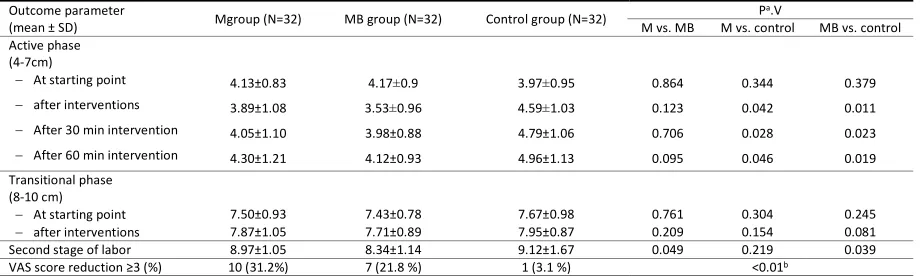
No significant difference was observed in mean VAS scores between three groups at the baseline (P>0.05). After 30
and 60 min of intervention on active phase, the mean VAS scores of both experimental groups significantly decreased compared to the control group (P<0.05); however, Post-Hoc Multiple Comparison (Scheffes̓ test) did not show significant difference between two experimental groups (P>0.05) but there was a significant difference between control group and each of the experimental groups.
No significant difference was observed in mean VAS scores after intervention on transitional phase (P>0.05). The results of Post-Hoc Multiple Comparison (Scheffes̓ test) indicated that, the mean VAS scores of massage with breathing group were significantly lower than the massage group (P<0.05) in second stage of labor, also the mean VAS scores of two experimental groups were significantly lower than the control group (P<0.05). At the last measurement, the proportion of VAS score reduction≥3 was equal to 31.2, 21.8 and 3.1 %, respectively in the massage with breathing, massage, and control groups respectively (P<0.01) (table 2).
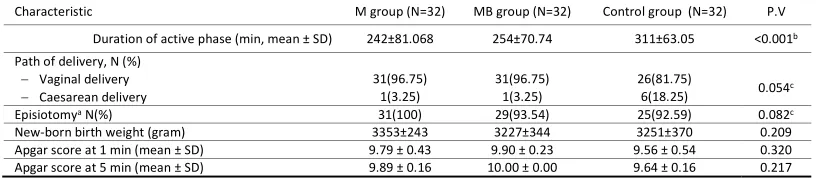
In the massage group, the time used in active phase of labor was shorter than that of the massage with breathing group, but no significant difference was observed between two experimental groups (P>0.05)(Scheffes̓ test). Both the massage and massage with breathing groups had significantly shorter time used in active phase than the control group (P<0.001). Although, the rate of caesarean section was found to be more in the control group compared to both experimental groups, but it was not significant (P>0.05). There was no significant difference regarding the rate of episiotomy, neonatal birth weight, and Apgar score at 1 and 5 min between three groups (P>0.05, table 3).
Table 1. Comparison of individual and obstetrics criteria in the three study groups
Characteristic M group (N=32) MB group (N=32) Control group (N=32) P.V
Maternal age (year) 24.45±4.46 23.96±4.46 24.15±4.22 0.654
Educational level At least diploma (%)
Others (%) 20 (62.5 %) 12 (37.5 %) 23 (71.8 %) 9 (28.2 %) 21 (65.6 %) 11 (34.4 %) 0.831b
Body Mass Index a 26.87±2.80 27.28±3.14 27.18±2.40 0.340
Gestational age (day) 279.2±5.76 276.2±5.16 278.53±6.12 0.467
Bishop score 7.95±1.21 8.01±1.02 8.72±0.92 0.099
M. Massage group, MB. Massage with Breathing group, a. Calculated as weight in kilograms divided by the square of height in meters b. Chi-squared test
Table 2. VAS Scores
Outcome parameter
(mean ± SD) Mgroup (N=32) MB group (N=32) Control group (N=32) P
a.V
M vs. MB M vs. control MB vs. control
Active phase (4-7cm)
At starting point 4.13±0.83 4.17±0.9 3.97±0.95 0.864 0.344 0.379
after interventions 3.89±1.08 3.53±0.96 4.59±1.03 0.123 0.042 0.011
After 30 min intervention 4.05±1.10 3.98±0.88 4.79±1.06 0.706 0.028 0.023
After 60 min intervention 4.30±1.21 4.12±0.93 4.96±1.13 0.095 0.046 0.019
Transitional phase (8-10 cm)
At starting point 7.50±0.93 7.43±0.78 7.67±0.98 0.761 0.304 0.245
after interventions 7.87±1.05 7.71±0.89 7.95±0.87 0.209 0.154 0.081
Second stage of labor 8.97±1.05 8.34±1.14 9.12±1.67 0.049 0.219 0.039
VAS score reduction ≥3 (%) 10 (31.2%) 7 (21.8 %) 1 (3.1 %) <0.01b
Table 3.Main characteristics of labor course and neonatal outcomes
Characteristic M group (N=32) MB group (N=32) Control group (N=32) P.V
Duration of active phase (min, mean ± SD) 242±81.068 254±70.74 311±63.05 <0.001b
Path of delivery, N (%)
Vaginal delivery 31(96.75) 31(96.75) 26(81.75) 0.054c
Caesarean delivery 1(3.25) 1(3.25) 6(18.25)
Episiotomya N(%) 31(100) 29(93.54) 25(92.59) 0.082c
New-born birth weight (gram) 3353±243 3227±344 3251±370 0.209
Apgar score at 1 min (mean ± SD) 9.79 ± 0.43 9.90 ± 0.23 9.56 ± 0.54 0.320
Apgar score at 5 min (mean ± SD) 9.89 ± 0.16 10.00 ± 0.00 9.64 ± 0.16 0.217
١
Discussion
This study was designed to determine the effect of massage alone or with breathing techniques on labor pain and other labor outcomes. There was a significant difference in terms of pain relief during the active phase of labor between the experimental groups and the control group. This result was consistent with the results of the previous studies, indicating that the massage could reduce the pain during labor.9,11,12 Even, the results of a study review demonstrated the effect of massage on labor pain.16 The analgesic effects of massage could be mainly explained either by blocking the pain impulses transmitting to the brain which as accepted as the gate theory17 or by stimulating the local release of endorphins.18
The result of this study was inconsistent with the study by Kimber et al.19 This inconsistency may be attributed to the difference in the instrument, sociocultural status, research setting, and individual differences in terms of pain perception and compliance with labor pain.
In this study, the mean VAS scores were not significantly different between three groups after the intervention in the transitional phase, which was not consistent with the previous studies,11,20 probably resulting from the difference in the location of the massage. In the present study, massage was focused specifically on the foci of pain in the uterine stimulated the uterine contractions which led to more pain in the transitional phase and neutralized the effect of massage in relieving the pain while in the previous studies, the location of massage has been at the back, lumbar, shoulders, and sacrum pressure depending on the desire and choice of the pregnant women.11,20
In this regard, the duration of the active phase was significantly shorter in both experimental groups than the control group. On the other hand, the transitional phase is an intermediate stage between the first and second stages of labor (8-10 cm). In this phase, contractions of the uterus are more intense and the vagina and pelvic floor muscles are more stretched to match with the presented member.21
There was a significant difference in mean VAS scores between the massage with breathing group and other groups in the second stage. Application of breathing techniques has been shown to lead to an increase in the size of the abdominal cavity, the decreased uterus friction with the abdominal wall, consequently reduced pain during the contractions,12 so the effect of techniques is more dominant.
Except for pain relief in the second stage, the application of breathing techniques did not cause any significant change in the results. Although, the results of a valid study on the controlled breathing learned in Lamaze Class showed that, the perception of pain decreased, and the oxygenation increased, resulting in the relaxation and having a shorter labor.22 Probably, learning breathing techniques for pregnant women should be started at 24-26 weeks of gestation until the end of their pregnancy in this way; they have enough time for mastering the breathing techniques during labor leading to the improvement in the effect of massage in all stages of labor.
The massage along with breathing practices used in this study did not change the rate of cesarean section, neither the rate of episiotomy nor the neonatal outcomes. In addition, no notable adverse effect was observed during the study time.
The results of this study should be interpreted with caution, because some gynecologists began augmentation in some subjects regardless of scientific criteria for diagnosis of prolonged labor therefore, the researcher inevitably excluded these subjects from the study (see figure 1). On the other hand, pain is a psychological subject influenced by individual, social, and cultural factors, and matching of all these variables in all groups is beyond the control of the researcher therefore, this also could be considered as another limitation of the present study.
The results of this study revealed that, massage along with breathing techniques was interestingly more effective than the massage alone in terms of pain relief in the second stage of labor. Therefore, it is recommended to use breathing techniques on the childbirth, especially in the second stage of labor. There is a need for replication of the study with larger sample size to confirm the results of the present study.
Acknowledgement
The authors would like to appreciate Tehran University of Medical Sciences for financial support provided for this research (project number: 12372).
Conflict of Interest
The authors declare that they have no conflict of interest.
References
1. Koyyalamudi V, Sidhu G, Cornett EM, Nguyen V, Labrie-Brown C, Fox CJ, et al. New labor pain treatment options. Curr Pain Headache Rep 2016;20:11.
doi:10.1007/s11916-016-0543-2
3. Khaskheli M, Baloch S. Subjective pain perceptions during labour and its management. J Pak Med Assoc 2010;60:473-6.
4. Defrin R, Shramm L, Eli I. Gender role expectations of pain is associated with pain tolerance limit but not with pain threshold. PAIN 2009;145:230-6.
doi:10.1016/j.pain.2009.06.028
5. Macdonald S, Johnson G. Mayes' Midwifery E-Book. 15th ed. Elsevier Health Sciences; 2017.
6. Zhang J, Liu Y, Meikle S, Zheng J, Sun W, Li Z. Cesarean delivery on maternal request in southeast China. Obstet Gynecol 2008;111:1077-82.
doi:10.1097/AOG.0b013e31816e349e
7. Earl D, Hunter M. Keeping birth normal: midwives experiences in a tertiary obstetric setting. New Zealand College of Midwives Journal 2006:21-3. 8. Jones L, Othman M, Dowswell T, Alfirevic Z, Gates S, Newburn M, et al. Pain
management for women in labour: an overview of systematic reviews. Cochrane Database Syst Rev 2012;14: CD009234.
doi:10.1002/14651858.CD009234.pub2
9. Karami NK, Safarzadeh A, Fathizadeh N. Effect of massage therapy on severity of pain and outcome of labor in primipara. Iranian Journal of Nursing and Midwifery Research 200;12:6-9.
10. Taghinejad H, Delpisheh A, Suhrabi Z. Comparison between massage and music therapies to relieve the severity of labor pain. Womens Health 2010;6:377-81.doi:10.2217/whe.10.15
11. Chang MY, Wang SY, Chen CH. Effects of massage on pain and anxiety during labour: a randomized controlled trial in Taiwan. J Adv Nurs 2002;38:68-73.
12. Yildirim G, Sahin NH. The effect of breathing and skin stimulation techniques on labour pain perception of Turkish women. Pain Res Manag 2004;9:183-7.doi:10.1155/2004/686913
13. Haseli A, Akbari M, Neisani Samani L, Haghani H, Jahdi F. The effect of abdominal massage along with breathing techniques during labor on duration
of uterine contractions in primiparous women. The Iranian Journal of Obstetrics, Gynecology and Infertility. 2017;20:1-8.
doi:10.22038/IJOGI.2017.8867
14. Khodakarami N, Safarzadeh A, Fathizadeh N. 822 the effects of massage therapy on labor pain and pregnancy outcome. European Journal of Pain. 2006;10:6-9.doi:10.1016/S1090-3801(06)60825-2
15. Mahlmeister LR. Best practices in perinatal nursing: professional role development for charge nurses. The journal of perinatal and neonatal nursing 2006;20:122-4.
16. Smith CA, Levett KM, Collins CT, Jones L. Massage, reflexology and other manual methods for pain management in labour. Cochrane Database Syst Rev 2012;15:CD009290.doi:10.1002/14651858.CD009290.pub2
17. Melzack R, Wall PD. Pain mechanisms: a new theory: a gate control system modulates sensory input from the skin before it evokes pain perception and response. Pain Forum 1996;5:3-11. doi:10.1016/S1082-3174(96)80062-6
18. Kaada B, Torsteinbø O. Increase of plasma beta-endorphins in connective tissue massage. Gen Pharmacol 1989;20:487-9.
19. Kimber L, McNabb M, Mc Court C, Haines A, Brocklehurst P. Massage or music for pain relief in labour: A pilot randomised placebo controlled trial. Eur J Pain 2008;12:961-9.doi:10.1016/j.ejpain.2008.01.004
20. Khodakarami N, Safarzadeh A, Fathizadeh N. Effect of massage therapy on pain severity and labor of primipara women. Iranian Journal of Nursing and Midwifery Research 2010;10.
21. Haseli A, Eghdampour F, Ghiasi A. Impact of massage therapy and breathing techniques on the sat is faction of primiparous women with childbirth. The Iranian Journal of Obstetrics,Gynecology and Infertility 2018;21:18-26. doi:10.22038/ijogi.2018.11629