This project was funded by the GRF grant 846412, 2013–2014 (UGC, Hong Kong). The earlier version of this paper was initially presented at PME 38, July 2014, Vancouver, Canada.
* Corresponding author
The Correlation between Prospective Teachers’ Knowledge
of Algebraic Inverse Operations and Teaching Competency –
using the square root as an example
Issic Kui Chiu Leung* Lin Ding
The Education University of Hong Kong The Education University of Hong Kong
Allen Yuk Lun Leung Ngai Ying Wong
Hong Kong Baptist University The Education University of Hong Kong
Abstract
This study is part of a larger study investigating the subject matter knowledge and
pedagogical content knowledge of Hong Kong prospective mathematics teachers, the
relationship between the knowledge of algebraic operation and its inverse, and their teaching
competency. In this paper, we address the subject matter knowledge and pedagogical content
knowledge of eight Hong Kong prospective teachers in teaching the mathematical concept of
the square root of a number in junior secondary school. The results suggest that insufficient
understanding of the concept of algebraic operation is a major obstacle for effective teaching
of this topic by prospective teachers. The results corroborate the viewpoint that subject matter
knowledge and pedagogical content knowledge are interrelated constructs and that rich
subject matter knowledge leads to high-quality pedagogical content knowledge. We conclude
it with a suggestion on how teachers can enrich their pedagogical content knowledge by
looking at elementary mathematics from an advanced standpoint (EMFAS), when they
possess a substantial subject knowledge
Keywords: pedagogical content knowledge, subject matter knowledge, teaching competence, algebraic operation, elementary mathematics from an advanced standpoint
Introduction
Results from international comparative studies, such as TIMSS and PISA, have indicated that
students from East Asian countries outperform their Western counterparts (e.g., Mullis et al.
2008; OCED 2014). From the MT21 Report (Schmidt et al. 2007), educational professionals
2
for the performance discrepancies between students from Western and Eastern countries. The
preparation gap— the teachers of well performing countries in international benchmarking exercises have been trained with extensive educational opportunity in mathematics and in
practical training of mathematics teaching. The MT21 project wasa pilot study for TEDS-M
study (Tatto et al. 2008). The finding was later echoed by the results of the International
Association for the Evaluation of Educational Achievement (IEA), Teacher Education and
Development Study in Mathematics (TEDS-M) (Tatto et al. 2012), and became a fundamental
concern. The results from TEDS-M study showed that prospective mathematics teachers from
two participating East Asian countries, Taiwan and Singapore, ranked among the top of
participating countries in terms of achievement in both content knowledge (CK) and
pedagogical content knowledge (PCK) assessments. In particular, in the MT21 Report, it
stated: The difference in achievement between the Asian eight grades and the US eight grades is likely related to not only the “preparation gap” found in TIMSS but also to a “preparation gap” — the fact that teachers in those countries had a very different configuration of
teaching experiences as a part of their teacher preparation (p. 2), in the sense that US teachers are not well prepared in their professional training in comparison with their
counterparts.
It was intuitively believed that the high performance in such international assessments would
result in well-equipped and competent teachers in the two countries. The intuition just echoes
the finding of the exploratory study done by Hill and her colleagues (Hill et al. 2008b). They
claimed that teachers’ mathematical knowledge plays an important role in their teaching.
However, little is known about the reasons for this relationship – how much knowledge they
possess in order to teach effectively; how one kind of knowledge affects the other? More
explorations might elucidate this educational concern.
Theoretical Framework
In his mostly cited article, Shulman (1986) set out the multidimensional nature of teachers’
professional knowledge by identifying, among other dimensions, three aspects of professional
knowledge: pedagogical knowledge, subject knowledge, and PCK. A large body of research has been done to modify and expand Shulman’s PCK by integrating it with other knowledge
domains. For example, Mishra and Koehler (2006) coined the term TPACK (Technological,
Pedagogical and Content Knowledge) by merging a technological knowledge domain with the
pedagogical knowledge domain and content knowledge domain. In mathematics, Hill et al.
(2005) further conceptualized teachers’ professional knowledge by categorizing it into two
domains: mathematical subject matter knowledge (SMK) and PCK. In their Mathematics
Knowledge for Teaching (MKT) model (Hill et al. 2008a, p. 377), PCK and SMK are
3
(KCS), knowledge of content and teaching (KCT) and knowledge of the curriculum. Yet all
three constructs under PCK are connected with SMK (some researchers use the term content
knowledge: CK, the two terms might not be exactly equivalent, but they are generally referred
to in mathematics knowledge as a subject discipline) in various ways. However, the
relationship between PCK and SMK is considerably vague. It is vague because we still do not
know how these two kinds of knowledge affect the teaching effectiveness simultaneously, in
the sense one may be more dominant than the other. Do these dominant phenomenon change
when teaching a more advanced level of mathematics? Or vice versa? Are they both sufficient
conditions? Or are both necessary and sufficient for teaching effectiveness? Does SMK guide
PCK? If strong SMK leads to the proficiency of PCK, what features of SMK will constitute the leading of such proficiency of PCK? In Ball’s construct, there are several subsets in SMK.
Content understanding is a special kind of knowledge that is a key to the profession of
teaching (Shulman 1986). Robust SMK is a prerequisite of teachers’ preparation of
mathematics. That is, the quality of SMK (roughly equivalent to CK at Shulman’s decade) has
an important bearing on the PCK. We summarize our description in a modified construct of
MKT. The original one was introduced by Ball et al. (2005).
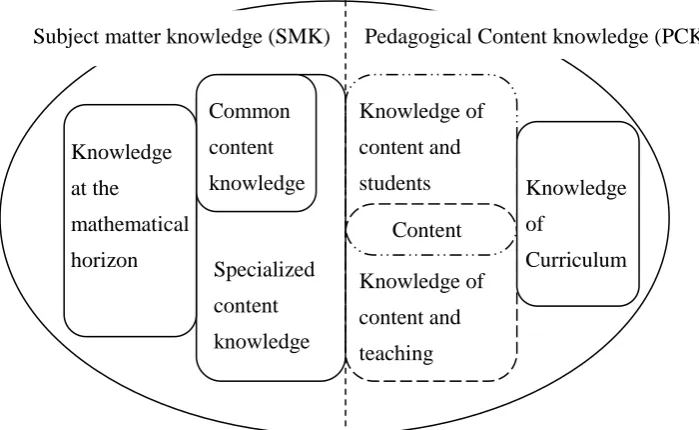
The diagram illustrates the distribution of different domains of knowledge. There are two
observations, firstly, PCK (at the right) is totally disconnected with SMK (at the left). That
was the original construct of Ball’s model. Secondly, content appears in several subdomains indicating that content, assembly the subject content, appears at both sides.
Although some studies have separated the constructs PCK and SMK empirically, a strong
connection between PCK and SMK in the construct was found. For example, Krauss et al. Content
Knowledge of
content and
students
Knowledge of
content and
teaching
Figure 1. Modified domain map for mathematical knowledge for teaching (MKT) Subject matter knowledge (SMK) Pedagogical Content knowledge (PCK)
Common
content
knowledge
Specialized
content
knowledge Knowledge
at the
mathematical
horizon
Knowledge
of
4
(2008) investigated the relationship between PCK and SMK, and revealed that students
majoring in mathematics performed well on SMK and also surprisingly well on PCK. They
asserted that rich SMK can be one route to PCK. Even (1993) investigated the SMK of
pre-service secondary mathematics teachers in U.S. and its relationship with PCK in teaching
the concept of functions (topic specific SMK). Even suggested that good SMK is necessary
for teacher preparation, particularly on focusing on enriching teachers’ knowledge in a
constructivist point of view on teaching and learning.
Schwarz et al. (2008) investigated how pre-service teachers illustrate the knowledge in
proving the proposition: Double the sides of a square will double its diagonal (p. 795). Pre-service teachers generally use Pythagoras theorem to prove it, where skill of mastery of
procedure plays a greater role. Rather, very few of them (4 out of 67 participants) applied the
property of similar triangles where deductive reasoning of geometry is required. The
proficiency of deductive reasoning partially reflects the richness of knowledge of geometry.
Jumping to algebraic and numerical procedures at the early stage of a proof glosses over the
sufficiency of conditions that must be analysed in the process of proving.
These results showed that insufficient SMK might have led pre-service teachers to adopt
teaching approaches that emphasized procedural mastery rather than conceptual
understanding. Bill and her associates also included both common content knowledge (CCK)
and specialized content knowledge (SCK) into their construct of SMK (see Figure 1). In
particular, they distinguished SCK from CCK, noting that the former allows teachers to engage in particular teaching tasks, including how to represent mathematical ideas accurately, explain common rules and procedures, and examine and understand unusual solution methods to problems (Hill et al. 2008, p. 377). In addition, Thompson (2016) questioned the focus on assessing MKT. He stated that MKT would be more profitable when it is shifted from focusing on teachers’ declarative knowledge to teachers’ mathematical
meaning. The teachers’ mathematical meanings for teaching would become important sources
of teachers’ instructional decisions and action and thus it helps by providing useful guidelines
for designing teachers’ professional development. The question is: what constitute teachers’
MKT?
Elementary Mathematics from an Advanced Standpoint (EMFAS).
The idea of teaching elementary mathematics from an advanced standpoint (EMFAS) is
inspired by Felix Klein (1932) who identified the phenomenon of double discontinuities,
which highlighted the common situation fresh mathematics teachers’ experienced. They
encountered difficulty in studying university mathematics that requires a large degree of
5
difficulty in teaching elementary mathematics in school, after they graduated from university,
at where rigour and stringency (Kaiser & Buchholtz 2014) can be skipped. Graduates of
teacher college encounter a kind of knowing-doing gap (Turner 1995) when they come to the
classroom. In which they know the complete idea of certain mathematical concepts, but find it difficult to deliver them for students’ learning. However, transformation builds a bridge
(Deiser et al. 2014) between advanced (university) mathematics and elementary (school)
mathematics. Even though the nature of framework of transformation has yet been explored, teachers’ capability of applying EMFAS is likely one of the ingredients to build such a bridge.
In a recent study, Buchholtz et al. (2013) reemphasized EMFAS as an essential category that
constitutes teachers’ professional knowledge. According to their findings, they suggested that “…prospective teachers should have adaptable mathematical knowledge: a knowledge that
comprises school mathematics, but goes beyond it and relates it to the underlying advanced academic mathematics, which according to Klein (1932) we call the knowledge of elementary mathematics from an advanced standpoint.” (Buchholtz et al. 2013, p. 108). The results
derived from their international comparative study indicated that the future mathematics
teachers from top mathematics-performing countries or regions, including HK, still
demonstrated problems in linking school mathematics and university mathematics
systematically. The construct of EMFAS “aims at the mediation and integration of school mathematics into already acquired canon of knowledge gained by advanced academic mathematical experiences” (Buchholtz et al. 2013, p. 109). Teachers mediate the
mathematical knowledge to their students, and it differs from subject content knowledge, that
it entails knowledge of students and teaching.
Looking at or interpreting a mathematical idea from an advanced standpoint (EMFAS) is not
the synonym of knowing more or understanding deeper about it. It involves how to unpack the abstract mathematical content, mediate and make it comprehensible for students via a
teaching-learning activity. EMFAS and experience of going through the process of abstraction
enables teachers to transform the advanced knowledge, which comprises of a sequential
understanding of axioms, postulates, definitions, notions, results and their proofs, and diverse
applications, to intuitively and authentically accessible knowledge for school students’
learning (Deiser & Reise 2014). In the investigation of mathematical meaning for teaching,
Thompson (2016) also helped us understand what PTs’ meaning would be in mediating advanced knowledge learnt in university for students’ learning.
In this study, we investigate the SMK and PCK of Hong Kong PTs on the concept of the
square root of a number for lower secondary school algebra. And elaborate how EMFAS helps
6
as a reverse process of squaring a number.
Learning Mathematics via abstraction.
Fundamental to the learning of mathematics is the process of learning abstraction.
Mitchelmore and White (2000, 2004, 2007) identified four stages of learning mathematical
abstraction: familiarization, similarity recognition, reification and formalization based on the constructivist’s approach. From observing relevant objects, ideas or operations, a precept or a
prototype of concept would be developed. The contextual understanding to a concept would
be developed in this process - familiarization. For the next stage, students recognize
similarities between relevant and familiar examples from observation. The use of
mathematical representation illustrates the definition of the concept, would be evident in this
stage. It helps to develop linkages among various concepts and facilitate that communication
occurs among concepts. In the reification process, the concept would be embodied, and
renewed in a new conceptual network. The use of concept, special case and generalization
would be evident in this process. In the final stage, critical understanding of the concept
would be developed. Learners could evaluate their new or old method of solving problems
with the help of the understanding of the abstract concept and generalize the techniques used
in the process of problem solving.
Put it into the context of learning square and square root, the identification of more than one
pair-up multiplicative decompositions a, b (𝑎 × 𝑏 = 𝑁) of a given number N is the
familiarization stage. For example, 1 × 16 = 2 × 8 = 4 × 4 = 16 shows three such pairs. From which there is only one pair (4, 4) consists of a duplicate member 4. In the second stage:
similarity recognition, learners may identify that there are only some numbers that consist of only a duplicate pair, these numbers are 9 = 3 × 3 and 25 = 5 × 5. In the third stage:
reification, learners identify that they cannot determine the multiplicative pair for an arbitrary number, but only for some special numbers such as 9, or 25, which can be decomposed to a
duplicate pair. The generalization of this idea to the area of a square that its magnitude equals,
to the multiplication of its own side’s length by itself. Conversely, learners can treat finding
the side from a given area of square, as a reverse process of finding the pair of decomposition
of a given number. In the fourth stage: the formalization, the concept of finding the side of a square with a given area can be interpreted as solving a quadratic equation 𝑥2= 𝑁. Hence the
definition and property of square root and the meaning of radical sign √ will be learnt.
Studies on the topic square roots.
There has been studies of how students find it hard to learn the concept of square and square
roots (see, e.g., Tirosh et al. 1997, Hebert 2003, Gough 2007 & Crisan 2014). The
7
prerequisite of learning quadratic equations. We do not use the term the power 2 of ..., but the word square obviously because there has been a closed geometric connection to the area of the quadrilateral square. When most people take the convenient name square, people might have missed the convention of square and square root notations that are raised from solving a
quadratic equation from which two possible solutions might occur. When mathematicians say
to evaluate √16, we simply refer to an intermediate step of solving a quadratic equation
𝑥2= 16, while the negative solution is negligible. Thus, by convention, √16 means the
positive square root of 16.
However, many curriculums prefer to introduce the notion of square root before the method of
solving quadratic equations. This easily creates confusion for students as they are taught to
treat 16 (or any square number) as the area of a quadrilateral square and find the length of its
side (Gough 2007). Unfortunately it is hard for them to grasp the reason why √16 cannot be
−4 as (−4)2 is also 16. Gouph (2007) pointed out that it would be a challenge for teachers to teach the concept of square and square roots when they introduce the term square root to students. Students felt it was hard to connect the numerical value with the geometric shape,
where it seems absurd to have a figure with an edge of negative length.
Crisan (2014) investigated teachers’ concepts of square roots in terms of the meaning of the
radical sign √ and found out that some teachers had difficulty in distinguishing √25,
±√25, and the value of x in 𝑥2= 25. Tirosh and Even (1997) even argued that we should not insist to define the surd term like (−8)1/3. They explored the definitions of the index rule,
and the radical sign and related operations; and concluded that there were always confusion
and inconsistency by demonstrating the dilemma " − 2 = (−8)
1
3= (−8) 2
6= 2". However, we
counter argue that the generally accepted definition by mathematicians is perfect. The above
example given by Tirosh and Even (1997) will generate an extraneous value when introducing
a power of 2 to (−8)
1
6. For a counter example when one does not know how to solve 𝑥 − 1 =
𝑎 but to write (𝑥 − 1)2 = 𝑎2 and get 𝑥 = 1 + √𝑎2. That would be incomplete as
𝑥 = 1 − √𝑎2 is also a solution of this quadratic equation, but not of the equation 𝑥 − 1 = 𝑎.
Many, if not all of these studies of the knowledge competency of teachers on this special
topic, point towards the suggestion that effective teaching and learning likely requires teachers’ advanced mathematical knowledge (AMK) (Zazkis & Leikin 2010). Teachers
deficient understanding of the concept of square and square root mentioned in the above
studies is based on the elementary algebraic perspectives such as: meaning of the radical sign,
8
forward-reverse process. We are looking at the situation from the set-functional perspective in
which AMK is required. For example, when looking at why
(
a
)
2
a
.
we definesquaring-square-rooting as a composite function of squaring and its inverse, acting on a
variable in a well-defined domain and range as sets respectively. In particular, we are looking
at mathematics from an advanced stand point (EMFAS) (Buchholtz et al. 2013) - a kind of
knowledge about variable, set, and function and its inverse in this case, that enables students’
mediation of mathematical concepts and ideas.
Under Usiskin’s four categories of the concept of algebra (Usiskin 1988), there are various
meaning of variables obtained in each category; (1) Algebra as an arithmetic generalization,
variable becomes a pattern generalized. (2) Algebra as a set of problem solving procedures,
variable becomes an unknown or a constant. (3) Algebra as an illustrator of relationship
between quantities, variable becomes an argument or a parameter. (4) Algebra as a structure
such as fields, rings, groups, etc., variable becomes an arbitrary symbol. The concept of variable is one of the teachers’ subject knowledge we want to examine.
On the other hand, Wilson et al. (2005) identified four characteristics of good mathematics
teaching, namely, it requires prerequisite knowledge, promotes mathematical understanding,
engages and motivates students, and carries out effective management. Accordingly, teachers
believe that good teaching requires richness of knowledge of mathematics and knowledge of
students. The two characteristics identified by Wilson et al. (2005): prerequisite knowledge,
and promotion of mathematical understanding, requires substantial SMK. Possessing quality
SMK and PCK is essential for a good mathematics teacher. We thus attempted to understand
more the quality of PTs’ SMK and PCK regarding their ability to teach an algebraic
abstraction of a particular topic (square and square root in this study) of secondary school
algebra, via a set of well-designed questions. Although one specific topic may not reflect the
whole situation, it may serve as reference for further investigation into teaching mathematical
abstraction for different topics and levels. Specifically, the research questions we aimed to
answer in the current study are as follows:
What are the SMK and PCK that HK PTs exhibit in teaching the abstract concept of the square root of a number?
How does the algebraic thinking of PTs relate to the quality of PCK in teaching this concept?
9
This study is part of a larger project (2013-2014) in
which two groups of prospective secondary mathematics
teachers in HK participated. The participants were in
either their third or fourth year of their studies towards a
Bachelor of Education (BEd) in Mathematics or a
Postgraduate Diploma in Education (PGDE) in
Mathematics. There were three stages in the
investigation in which we identify PTs’
(1) belief and attitude on the nature of mathematics,
the concept of mathematics learning, and the role of mathematics teachers etc. through a
agree-disagree type of questionnaire of 97 item questions. There were around 200 participants
in this stage.
(2) subject knowledge covering almost the full curriculum of secondary mathematics
through a test of multiple choices and short questions of routine mathematics problems. A
score (from 0 to 68) was given to each participant’s test. There were around 70 out of these
200 participants of stage (1), in this stage.
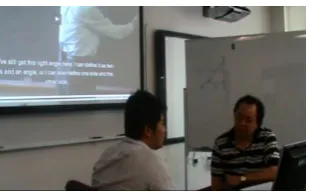
(3) PCK and SMK via interview questions related to the demo lesson while watching a
video lesson (See Figure 2). 24 PTs were selected according to their scores (roughly one-third
of these 24 participants in their low, middle and high scores in stage (2) respectively). From
these 24 PTs, 8 of them were interviewed on watching a demo lesson video on the system of
linear equations, another 8 of them did the same on watching one about square and square root, and the last 8 PT’s watched a lesson video on congruent triangles.
At the end of the study, we shall write a holistic article on how PTs’ beliefs and attitudes, and
subject knowledge affect their teaching practice through a series of real and hypothetical
questions. These hypothetical questions are deliberately, but realistically created during the
interview via watching the demo lesson video. The entire project was comprised of both
quantitative and qualitative data collection. Based on the results of stage (2), 8 participants
were selected for stage (3), which is the focus of this study, consisting of clinical interviews to explore the PTs’ PCK and SMK in teaching three mathematical topics. The PTs were assigned
the pseudonyms Jack, Fanny, Mandy, Gary, Charles, Alvis, Edward and Ray. The interviews
were video-based interviews, involving a 40-minute lesson in a Grade 8 class from the TIMSS
1999 Hong Kong video (TIMSS, 1999). During the interview, both the researcher and
participants sat next to each other (see Figure 1). The researcher controlled the play of the
video, stopped playing it and asked questions when appropriate. The interviewees watched the
video and occasionally wrote responses on the whiteboard. The entire process was
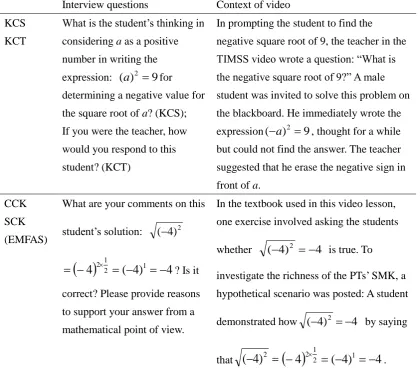
video-taped. Table 1 lists the interview questions based on the MKT framework of Hill et al.
(2008), which was incorporated with EMFAS.
Figure 2. The context of a video-based interview (stage
10 Table 1
Interview questions corresponding to PCK categories
Interview questions Context of video
KCT What are your comments on this teacher’s approach of introducing
the concept of the square root? If
you were the teacher, what would
you do?
In the TIMSS video, the teacher told the
students to find a number that produced a
specified quantity after multiplying the
number by itself. In general, the process of
obtaining a square root as a reverse process
of simple multiplication.
KCT How to teach students to find the
square roots of 9; i.e.
(
a
)
2
9
.The teacher in the TIMSS video focused on
the square roots of 9 being either positive or
negative.
Table 2
Interview questions corresponding to SMK categories
Interview questions Context of video
KCS
KCT
What is the student’s thinking in
considering a as a positive number in writing the
expression:
(
a
)
2
9
for determining a negative value forthe square root of a? (KCS); If you were the teacher, how
would you respond to this
student? (KCT)
In prompting the student to find the
negative square root of 9, the teacher in the TIMSS video wrote a question: “What is the negative square root of 9?” A male
student was invited to solve this problem on
the blackboard. He immediately wrote the
expression
(
a
)
2
9
, thought for a while but could not find the answer. The teachersuggested that he erase the negative sign in
front of a.
CCK
SCK
(EMFAS)
What are your comments on this
student’s solution: 2
) 4 (
4
2(
4
)
14
12
? Is it
correct? Please provide reasons
to support your answer from a
mathematical point of view.
In the textbook used in this video lesson,
one exercise involved asking the students
whether (4)2 4 is true. To
investigate the richness of the PTs’ SMK, a
hypothetical scenario was posted: A student
demonstrated how (4)2 4 by saying
that
(
4
)
2
4
2(
4
)
14
12
11
Figure 4. Fanny’s picture of
explaining why3232. Thefollowing sample item questions are selected from the protocol:
The figure (Figure 3) shows the teacher’s chalkboard explanation of the square root of the square of
-4, how would you evaluate this approach? If you were the teacher, would you like to adopt
this approach?
If not, could you please suggest other alternatives for approaching this question?
Findings
This section presents preliminary findings and analysis based on the Hong Kong PTs’
responses to PCK and SMK as described in Table 1 and Table 2.
KCT: Introducing the concept of square root
All PTs tended to introduce the concept of the square root by connecting it with the concept of
the square of a number. The first approach they used was introducing square numbers such as
4, 9, 16 and 25; for example, Mandy asked students:
“What is the square of 3? What is the square of 4? Let’s think about 12
, 22, 32…” (Mandy)
The second approach is to introduce the relationship between the area and the side of a
square.
“I will draw a square… Because square is [area of] a Square. Square is the self-multiplication
of the length of side of a square. That is the area of a square. Therefore the name of square is
related to a square. Yes…. [therefore I] draw a square as an introduction.” (Alvis)
Some participants emphasized the notation of the square and square root, and illustrated the
concept of notations by using a square image either explicitly or implicitly.
In addition to Fanny, the other two participants, Mandy and
Jack, mentioned explicitly that students might confuse the
concept of the square of 3 with that of 3 multiplied by 2. For
example, Mandy justified adopting the approach of
Figure 3. Chalkboard
explanation of the square root of
12
introducing square numbers to strengthen students’ understanding that the “meaning of square of 3” refers to the term “3” multiplied by itself, not multiplied by 2.
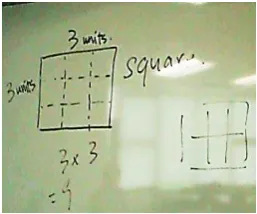
For example, Figure 4 shows how Fanny demonstrated the square with length of side 3 units
and an area of 9 square units. Fanny also tried to help students distinguish the concept of
3
2from
3
2
(Figure 4).Ray also expressed this worry about using some specific numbers as teaching examples e.g.
12, 22, 32, so on, as students failed to develop an abstract meaning of the topic.
“For using a specific example to generalize… is not a very good habit…, that is it… That
means it may make students to habituate this thought. But actually…. Undoubtedly you observe…. The pattern, it’s ok. But if… for a habitual introduction… students will have a
wrong mind over a long period of time: whenever I see… a specific example, generally should be like that.” (Ray)
Ray emphasised that the habitual introduction of a concrete example to generalize a new
concept might not be the best teaching approach. To a certain extent, it is true. Because some
special mathematical structures and features may not be easily illustrated by real examples.
Learners have to get used to thinking and interpreting the meaning in an abstract way. It might
just be Ray’s belief.
KCT: Introducing the notion “𝐚𝟐= 9”
Explaining the equation a2 9 entails introducing students to the concept of positive and negative square roots. They highlighted the term “self-multiplication,” and introduced the
students to the sign rules of multiplication and division of directed numbers. Which is almost
a purely procedural approach. Charles’s approach was typical of the PTs: he wrote
3
3
9
and(3)(3)9. Besides, no visual representations were used by these PTs to explain how
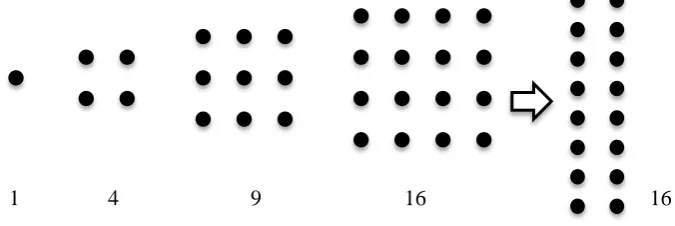
to solve such problems. A picture of an array of dots representing the square numbers might
be a choice of a visual representation (See Figure 5).
1 4 9 16 16
13
non-trivial binary decompositions of multiplication, namely 2 × 8 and 4 × 4.
The above array demonstrates that not all numbers can be represented by dots arranged in a
square shape that indicate a2= 1, 4, 9, or 16. The 16 dots can be arranged into two possible
shapes of numbers of dots in the row, times that in the column, but only one shape
(decomposition) is a square. Which leads to the uniqueness of the positive solution of x2= N. Without any visual representation, Edward and Alvis focused on the relationship between
square and square root. They presented the square roots as a reverse process of squaring.
Edward used an equation of x2 9 and let students guess the value(s) of x. Some PTs suggested using a geometric figure to show the relation between square and square root.
However, finding the area of a rectangle is one of the illustrations of multiplication whereby
the length and area of a plane figure must be non-negative real numbers. Therefore this
demonstration is not sufficient to show the existence of the negative square root of a real
number. Gary and Ray:
“Er… I might think of drawing a square. Three…three [is nine]…but I don’t have ideas on how to draw the square with [the side] as negative 3.” (Gary)
“Actually we can’t visualize negative number, ’but…er… in fact how we explain this? Er…
in directed number system, we can visualize on the xy-plane, but they may not teach in depth, so it may mention later.” (Ray)
Ray tried to link up the concept of square and square root with the concept of multiplication
of directed numbers by a square on a Cartesian coordinate plane with the length of side a units, and provided that the area of it is 9 square units. He wanted to use points lying on the
quadrant III to illustrate the negative square roots of 9. However, he failed to recognize that
the sign of coordinates only illustrates the relative position away from the original or the
reference point, not the length. He employed vector analysis to explain the meaning of the negative square root by taking the signs of coordinates in the process of finding the area of a
square on the Cartesian plane. The dot product of two vectors on the axes certainly gives a
positive area with the magnitudes of the vectors being the length of the sides respectively. However, Ray has insufficient subject knowledge and mixed up the algebraic concept of
solving the equation, with the concept of dot product in vector geometry. It means that we
start with a variable x, imposing the condition that x multiplied by itself will give the value 9, that is x2= 9. And, solving this equation will give both positive and negative solutions of x, that are -3 and 3. While the dot product is a special kind of multiplication of vectors which
involves the manipulation of the direction of a magnitude, it would be hard for students at this
stage to understand the analogue of squaring by a dot product, as students would find it hard
14
The response of Ray to this question reflects that he is relatively weak in PCK. It created
students’ confusion to the existence of negative length, area or so on. Also students from
grade 8 may not have come across the meaning of vector operation. It was not an appropriate
example used in teaching this topic. From the PT’s examples to illustrate the abstract concept,
there is still room to improve.
KCS and KCT: Reacting to a misconception
In attempting to solve a problem, a student wrote the negative sign in front of a as in the expression
(
a
)
2
9
. PTs were asked why the student assumed the negative value for the square root of 9. What was he thinking? The PTs provided two interpretations: Charles, Fannyand Gary inferred that the student did not grasp the idea of “negative value of a” in the teacher’s question. For instance,
“Em…he [the student] might not think that the value of this unknown could be either positive
or negative. He probably thought, taking it for granted, that it must be a positive number… because it is an unknown; so, the unknown could be positive or negative … but he did not think of the possibility that this number could be a negative number.” (Gary)
“He would think of the negative root, and then said, ‘there is a negative sign inside, so I want
to add a bracket.’ like that….” (Ray)
However Ray was not aware that the negative sign should be embedded in a when we wrote
𝑎2 = 9 . Jack and Mandy attributed it to the student’s incapability.
“At that moment he was thinking he thought wrong. I think his mind went blank.” (Jack)
The majority of the PTs also criticized this (demo) teacher’s suggestion to the student to erase
the negative sign. For example,
“The teacher should let him (the student) continue. In fact, he (this student) was able to write this, why don’t we let him finish it? That is … I think the teacher just wanted the student to
write the equation . . . but I think that the student had the whole plan in his mind . . . so we can
talk about what was in his mind and help him to clarify the misconceptions in terms of format.” (Jack)
Jack thought that the video teacher should allow the student to continue solving the problem,
and let the students elaborate on their method. As teachers we had better revise our method
when a student comes across contradiction at the end. In this subroutine, Jack demonstrated a
15
student to consider that a could be either a positive or a negative number. For example, Mandy tried to provide the student with hints:
“What about if a equals –3? How about the square of –3?” (Mandy)
However, it was a bad approach because Mandy just said the answer indirectly.
CK: Mathematical explanations for why
(
4
)
2
4
.All of the PTs correctly stated that
(
4
)
2
4
. The knowledge they applied is CCK; that is,the radicand is non-positive; hence,
(
4
)
2
4
. They also commented that there must bean error in some steps in the expression:
(
4
)
4
2
4
14
12
2
; however, none of
the PTs could provide a mathematical reason to explain why this evaluation did not work. Some
stated that
(
4
)
2 should firstly give16
based on the order of operations: taking squareroot after squaring.
SCK: Explanation of a negative square root
The analysis of the eight Hong Kong PTs’ PCK in teaching the concept of the “square root”
shows how they adopted a procedural and purely computational approach to instruction. As
evidenced in their approaches in explaininga29, most of them adopted an approach of 3
times 3 equals 9, and negative 3 times negative 3 equals 9. However, this overly simplistic
approach cannot facilitate students’ algebraic thinking, because substituting the numbers 3
and –3 is a type of trial and error process and is hard to generalize a pattern. Similarly, in
responding to the students’ questions such as “adding the negative sign in front of a”, these PTs provided the hints that “–3 is also the square root of 9” to emphasize that the sign of a
could be either positive or negative. However, when we say “the square root of 9”, we refer to
the positive square root. When we want to specifically refer to the negative root, we say “the
negative square root of 9”. Notation wise, writing
9
or + 9, does not literally meanthat 9 has two possible values. Their responses to the KCS question demonstrated that the PTs tended to interpret the students’ confusions as superficial understanding; for some of the
PTs, it was even worse, they attributed it to the students’ lack of focus. Some evidence also shows that the PTs embraced the students’ previous knowledge in learning the concept of the
square, that is, how to interpret the operational meaning of superscripted 2 in 32, yet this is not
16
PTs’ responses to the questions about the scenario of TIMSS students’ mistakenly putting a
negative sign in front of a indicating (TIMSS, 1999, video time: 07:01) that PTs might have some misconceptions about variables and unknowns. The meaning of variables closely relates
to contextual understanding. Absence of equations and numbers as a referent, variable
becomes an arbitrary object in a structure related by certain properties (Usiskin 1988, p.12). In our case study, the meaning of variables is related to category (2) of Usiskin’s description
about variable. The misinterpretation of a student in the TIMSS video by putting −a2 = 9 because the negative sign is absorbed (embedded) in the variable a, when we define a as a variable at the beginning, only be treated as an unknown by imposing “= 9”. Putting a minus
sign in front of a is unnecessary. The student mixed up a variable with a constant a. Teachers should explain it along this line. There is also a problem around the context with the question
of finding the length of the side of a quadrilateral square of an area of 9 units. It would be
different to asking to find the length of one side of a quadrilateral with an area of 16 units.
Which leads to two possible combinations, 4×4, and 2×8, if we do not specify it as a square.
By guessing a number whose product of itself is 9, it is different from solving an equation of
x2 = 9, originating from the area of the square and letting the unknown side’s length be x, would provide some context for problem solving.
Furthermore, the minus sign will be extraneous and embedded in the variable a when writing that the value of a2is equal to9. The variable a will become an unknown of the expression
9
2
a . This underline meaning illustrated how PTs’ understood the concept of algebra as an arithmetic generalization, or a set of problem solving procedures. None of our PTs pointed out
that putting a minus sign in front of a was unnecessary when teaching students to solve the problem: what is the negative value of a if a2 = 9? Owning insufficient SMK, they were incapable of facilitating students’ development of structural conceptual understanding to
algebra, but were limited to procedural learning or operational concept (Sfard, 1991; Akgün &
Özdemir, 2006).
Discussion
In the TIMSS video, the demo teacher tried to facilitate students’ abstractive thinking.
Mitchelmore and White (2000, 2007) identified the various learning stages regarding the
intensity of abstraction; namely, familiarization, similarity recognition, reification, and
formalization. Accordingly the teaching for abstraction, familiarization and similarity
17
“the negative value of a if the square of a is 9”, helping students to recognize the similar
concept among different contexts. Unfortunately, the demo teacher in the TIMSS video failed
to reach the reification and formalization stages in teaching this abstraction. The ability of
leading students to reach the abstract understanding at these two levels is vital in fostering the
development of structurally algebraic concepts (Sfard, 1991).
Abstraction, or the use of different representations or interpretations with the same conceptual
meaning, is common in mathematics. Therefore the development of students’ conceptual
understanding would be affected by the teachers’ ability to identify ambiguity (Hersh 2014).
In our case, the ambiguity is: should we write −𝑎2=9 or 𝑎2=9 when looking for the negative square root of 9? For the participating PTs in this study, they neither have sufficient
awareness of recognizing the elements of teaching abstract ingredients, nor the understanding
of the definition of variables.
EMFAS about a composite function in explaining
(
4
)
2
4
.
Analysing the PTs’ SMK showed that they might have had sufficient CCK in making
judgments, yet they were apparently unable to answer a student’s enquiry about why
4 ) 4
( 2 ? This reflected the weakness in their SCK. The PTs did not demonstrate
sufficient understanding of the radical sign , nor application of the Index Law, nor the
properties of composite functions. In the case of ( 4) ( 4) 2 ( 4)1 4
1 2
2
, the PTs
seemed to overlook the fact that the Index Law cannot be applied to the case of
22
number
negative
)
number
negative
(
, because of the restricted property ofcomposite functions. Here, f :xx2, and
f
1:
x
x
. Applying the property of composite functions, we havef
f
1(
x
)
f
[
f
1(
x
)]
x
; but making x,f
f
1(
x
)
and)] ( [f 1 x
f equal is possible only if f1(x) is well defined. However, in this case, the
real-value inverse function
f
1(
x
)
x
is undefined whenx
0
.The lack of adequate SMK, particularly SCK, could explain why their PCK in teaching this
algebraic concept is procedural. Algebraic thinking involves understanding roles and
properties of variables, as well as the relevant operations among those variables. Learning
algebra entails transitioning from a less abstract state to a more abstract state. In this current
case, by knowing computationally that the square of the number 3 or –3 is 9, the level of
abstraction that learners can only reach are familiarization and similarity recognition. The
18
when the square root of a number is determined, because we treat squaring-taking square root as a pair of function and its inverse. Knowing what constraints exist when writing
x x f f x f
f 1( ) [ 1( )] is at the level of formalization. It is because the inverse
function
f
1:
x
x
can be applied only to the domain of non-negative real numbers.When students ask the truth of the following two calculations:
(
4
)
2
4
or4
)
4
(
2
, the PTs’ responses on their incapability to distinguish them reflect theirdifficulty in applying the knowledge of EMFAS. Since t
here is a restriction in applying the
Index Rule:
(𝑥𝑚)1/𝑛= (𝑥1/𝑛)𝑚when
x
< 0 and
n
is odd. Looking at this rule from
the advanced standpoint refers to the interpretation of the set-functional aspect of the
composite of a function and its inverse
when m=n=2, and x < 0.
To a certain extent, this knowledge of EMFAS will be used by teachers to help students to overcome troublesomeknowledge (Meyer & Land, 2003). The term troublesome knowledge is originally defined by
Perkins (1999) and is usually associated with the term threshold concept − the concept constituted by the knowledge that is “alien”, counter-intuitive or even intellectually absurd at
face value (Meyer & Land 2003, p. 2). Interpretation of why 4 is the only correct answer for
the simplification of
(
4
)
2 requires teachers’ proficiency in the knowledge of EMFAS,which contributes to their SMK in terms of concept of functions, their inverses, and
composite functions. This proficiency further helps students to overcome the threshold of why
2
)
4
(
cannot give two values: – 4 and 4, when both seem correct. In contrast, theinsufficiency of this EMFAS knowledge can hardly reach the abstraction levels of reification
and formalization (Mitchelmore & White, 2000, 2004, 2007) in teaching algebra. As a result,
the PTs could hardly achieve a high-quality PCK that assists students in developing algebraic
thinking. It is believed that subject matter knowledge (SMK) is the prerequisite of the
richness of PCK.
Conclusion
A small sample size, due to reluctant participation, because of the lengthy interview in this
investigation, is our limitation. We can only select one common topic in the lower secondary
level as our focus. Square-square root is one of the very few topics that involves the algebraic
property of nonlinearity (the term involves x2). Students at this level find it difficult to manipulate variables expressed in nonlinear status.
19
and plays a significant role in the PCK of HK PTs, as observed according to how they taught
the concept of square root. Consistent with assertion by Buchholtz et al. (2013), the current
study shows that the examined HK PTs could not connect relevant university mathematics
with what they taught. A lack of adequate knowledge of algebraic operations and functions
caused these PTs to teach this algebraic concept procedurally, rather than using algebraic
abstractions. In addition, this study provides a novel perspective for evaluating the quality of
PCK from the perspective of SCK and EMFAS. We can thus reconsider the construct of PCK,
which cannot be separated from CK, particularly it cannot be separated from SCK or EMFAS.
Both of these models are more crucial than CCK in enabling mathematics teachers to help
students develop a more conceptual understanding. Unfortunately the current curriculum has
been trimmed down to a very narrow scope and superficial depth, even though teachers
possess advanced knowledge, they may not easily apply (or deliver the mathematical concepts
by) EMFAS in teaching. Modification would be suggested by introducing the skill of applying
EMFAS in core pedagogy courses in mathematics teacher education.
To us, EMFAS is a kind of tool, or approach, or some kind of proficiency to tackle the challenge of teaching and learning. Teachers’ skilfulness to enhance students in learning the
concept of square root reflects their richness of PCK, where SMK is necessary, but not
sufficient. The interview data shows that our PTs could not lead students to understand the
third or fourth level of abstraction of this particular concept, which reflects their weakness in
PCK. But how does one lift students to reach the fourth level? EMFAS here may play an
important role. Perhaps in many situations of mathematics teaching, knowledge of EMFAS
helps teachers to teach more effectively. Even though the role of EMFAS in the construct of
knowledge of teaching according to Hill et al. (2005) and Ball et al. (2005) has not been
established, we hope to add a little remark to the development of mathematics teachers’
education: proper application, or transforming the subject knowledge to EMFAS, will likely
uplift the effectiveness of mathematics abstraction delivery, particularly in algebra teaching.
This little study aims at stimulating further research on this area of mathematics teacher
education.
References
Akgün, L. & Özdemir, E. M. (2006). Students’ understanding of the variable as general number and unknown: A case study. Teaching of Mathematics. 9, 45-51.
Ball, D. (2005). Effects of teachers’ mathematical knowledge for teaching on student achievement.
American Educational Research Journal. 42(2), 371–406.
20
Buchholtz, N., Leung, F., Ding, L., Kaiser, G., Park, K., & Schwarz, B. (2013). Future mathematics teachers’ professional knowledge of elementary mathematics from an advanced standpoint. ZDM – The International Journal on Mathematics Education, 45(1), 107-120.
Hersh, R. (2014). Experiencing Mathematics – what do we do, when we do mathematics? Providence, Rhode Island: American Mathematical Society.
Crisan, C. (2014). The case of the square root: Ambiguous treatment and pedagogical implications for prospective mathematics teachers. In S. Pope (Ed.), Proceedings of the 8th British Congress of Mathematics Education) (pp. 73-8o).
Deiser, O. & Reiss, K. (2014). Knowledge transformation between secondary school and university mathematics. In S. Rezat et al. (Eds.), Transformation - A fundamental idea of mathematics education (pp. 51-63). New York: Springer Verlag.
Even, R. (1993). Subject-matter knowledge and pedagogical content knowledge: Prospective secondary teachers and the function concept. Journal for Research in Mathematics Education, 24(2), 94-116. Gough, J. (2007). Teaching square roots: Conceptual complexity in mathematics language. Australian
Senior Mathematics Journal, 21(1), 53.
Hill, H. C., Rowan, B., & Ball, D. L. (2005). Effects of teachers’ mathematical knowledge for teaching on student achievement. American Educational Research Journal, 42(2), 371-406.
Hill, H. C., Ball, D. L., & Schilling, S. G. (2008a). Unpacking pedagogical content knowledge: Conceptualizing and measuring teachers’ topic-specific knowledge of students. Journal for Research in Mathematics Education, 39(4), 372-400.
Hill, H. C., Blunk, M. L., Charalambous, C. Y., Lewis, J. M., Phelps, G. C., Sleep, L., & Ball, D. L. (2008b). Mathematical knowledge for teaching and the mathematical quality of instruction: An exploratory study. Cognition and Instruction, 26(4), 430-511.
Kaiser, G. & Buchholtz, N. (2014). The impact of an Innovative Program in mathematics Teacher Education at the Justus-Liebig-university in Giessen. In M. Hattermann, A. Peter-Koop, & S. Rezat (Eds), Transformation - A Fundamental Idea of Mathematics Education (pp. 85-105). New York: Springer Verlag.
Klein, F. (1932). Elementary mathematics from an advanced standpoint - Part 1: Arithmetic, algebra, analysis. New York: Macmillan.
Krauss, S., Baumert, J., & Blum, W. (2008). Secondary mathematics teachers’ pedagogical content knowledge and content knowledge: Validation of the COACTIV constructs. ZDM – The International Journal on Mathematics Education, 40(5), 873-892.
Ma, L. (1999). Knowing and teaching elementary mathematics teachers’ understanding of fundamental mathematics in China and the United States. Mahwah, N.J.: Lawrence Erlbaum Associates. Meyer, J.H.F. and Land, R. (2003) Threshold concepts and troublesome knowledge: linkages to ways of
thinking and practising within the disciplines (1). In: C. Rust (Ed.), Improving Student Learning: Theory and Practice – 10 Years On. Proceedings of the 10th Improving Student Learning
Conference (pp. 412-424). Oxford: OCLSD.
Mitchelmore, M. C., & White, P. (2000). Teaching for abstraction: Reconstructing constructivism. In J. Bana & A. Chapman (Eds.), Proceeding of the 23rd Conference of the Mathematics Education
Research Group of Australasia (pp. 432-439).Perth: MERGA.
Mitchelmore, M., & White, P. (2004). Abstraction in mathematics and mathematics learning. In M.J. Hoines & A.B. Fuglestad (Eds.), Proceedings of the 28th International Conference of the Psychology in Education (Vol. 3, pp. 329-336). Rotterdam, Netherland: Sense.
21
Mishra, P., & Koehler, M. J. (2006). Technological pedagogical content knowledge: A new framework for teacher knowledge. Teachers College Record, 108(6), 1017‐1054.
Mullis, I., Martin, M., & Foy, P. (2008). TIMSS 2007 international mathematics report: Findings form IEA’s trends in international mathematics and science study at the fourth and eighth grades. Boston, Massachusetts: TIMSS & PIRLS International Study Center, Boston College.
Organization for Economic Co-operation and Development. OECD. (2014). PISA 2012 Results: What students Know and can do Student performance in mathematics, reading and science. (Vol. I, Revised edition, February 2014): PISA, OECD Publishing. DOI:10.1787/9789264208780-en
Perkins, D. (2006). Constructivism and troublesome knowledge. In J.H.F. Meyer & R. Land (Eds.),
Overcoming barriers to student understanding: Threshold concepts and troublesome knowledge
(pp. 33-47). UK: Oxon. Routledge.
Schwarz, B., Leung, I. K., Buchholtz, N., Kaiser, G., Stillman, G., Brown, J., & Vale, C. (2008). Future teachers’ professional knowledge on argumentation and proof: a case study from universities in three countries. ZDM – The International Journal on Mathematics Education, 40(5), 791-811. Sfard, A. (1991). On the dual nature of mathematical conceptions: Reflections on processes and objects
as different sides of the same coin. Educational Studies in Mathematics, 22(1), 1-36.
Sfard, A., & Linchevski, L. (1994). The gains and the pitfalls of reification — the case of algebra. Educational Studies in Mathematics, 26, 191-228.
Shulman, L. S. (1986). Those who understand: Knowledge growth in teaching. Educational Researcher,
15(2), 4-14.
Schmidt, W., Tatto, M.T., Bankov, K. Blomeke, S., Cedillo, T., Cogan, L. Han, S.I., Houang, R., Hsieh, F.J., Paine, L., Santillan, M., & Schwille, J. (2007). The preparation gap: Teacher education for middle school mathematics in six countries. East Lansing, MI: Michigan State University.
Tatto, M. T., Schwille, J., Senk, S., Ingvarson, L., Peck, R., & Rowley, G. (2008). Teacher education and
development study in mathematics (TEDS-M): Conceptual framework. East Lansing, MI: Teacher
Education and Development International Study Center, College of Education, Michigan State University.
Tatto, M. T., Schwille, J., Senk, S. L., Ingvarson, L., Rowley, G., Peck, R. (2012). Policy, practice, and readiness to teach primary and secondary mathematics in 17 Countries: Findings from the IEA Teacher Education and Development Study in Mathematics (TEDS-M). Amsterdam, the Netherlands: IEA center.
Tirosh, D., & Even, R. (1997). To define or not to define: the case of (-8)1/3. Educational Studies in Mathematics, 33(3), 321-330.
Thompson, P. W. (2016). Researching Mathematical Meanings for Teaching. L. English & D.
Kirshner (Eds.), The thirdHandbook of International Research in Mathematics Education (pp. 435-461). London: Taylor and Francis.
TIMSS.(1999).HK1SQUARE ROOTS.TIMSSVIDEO.VIDEO RETRIEVED FROM:
http://www.timssvideo.com/43 (RETRIEVED ON 27TH JULY,2013)
Turner, D. (2011). The teaching school as a means for addressing the knowledge-doing gap. Doctor of Education thesis. Central Queensland University, Rockhampton.
http://hdl.cqu.edu.au/10018/916546
Usiskin, Z. (1988). Conceptions of School Algebra and Uses of Variables. In A. Coxford & A.
22
of Mathematics (pp. 8-17). Reston, VA.
Wilson, P. S., Cooney, T. J., & Stinson, D. W. (2005). What constitutes good mathematics
teaching and how it develops: nine high school teachers’ perspectives? Journal of Mathematics Teacher Education,8(2), 83-111.
Zazkis, R., & Leikin, R. (2008). Exemplifying definitions: a case of a square. Educational Studies in Mathematics, 69(2), 131-148.
Zazkis, R., & Leikin, R. (2009). Advanced mathematical knowledge: How is it used in
teaching? InV. Durand-Guerrier, S. Soury-Lavergne & F. Arzarello (Eds.), Proceedings of the Sixth Conference of the European Society for Research in Mathematics Education (CERME-6) (pp. 2366-2375). Lyon, France: INRP
Zazkis, R., & Leikin, R. (2010). Advanced mathematical knowledge in teaching practice: