5
T
Rates and Methods of Rice Straw Application to
Wheat and Rice Crops and the Implications on
Crop Productivity as Well as some Soil Properties
A.M.G. Ewis, M.M. Sobh, M.H. Amer and M. Gouda
Soil and Water Department, Faculty of Technology and Development, Zagazig Univerity, Zagazig, Egypt.
WO FIELD experiments one on wheat and one on rice ………succeeding wheat (2009 / 2010 wheat, 2010 rice) were carried out on a clayey soil at Ghazala El-khis on Efficient Productivity Institute farm, Sharkhia-Governorate to study the effect of rice straw residue applied to wheat on yield and nutrient uptake of wheat and also the residual effect of such residues on rice crop which succeeded the wheat crop. Rates were 4.8, 9.5 and 14.3 Mg (mega grams) ha-1, methods were surface application followed by incorporation in the 30 cm top soil, and application in ditches 40 cm deep (tunnels) spaced at 2,3and 4m between each other. Application of straw caused slight decrease in wheat grains and marked decreases in straw yields. Ditch application recorded greater values over surface application. Uptake of N and P by wheat was lower due to rice residue application but for K, it gave higher values over the non-treated and the highest values were recorded at the 3rd rate with ditches treatment of 2m distance. There was a residual effect on yields of rice as well as NPK uptake and protein percent over treatment not receiving rice straw residue in the preceding wheat crop. The ditch method was superior to the broadcast method; and decreased with increasing the spacing between ditches, as well with the decrease in the rate of application. The results also indicated positive effects on bulk density as well as organic matter and NPK contents in soil. Greater values were obtained at the rate of the 14.3 Mg ha -1 with ditches method of 2m
distances.
Keywords: Wheat plants, Rice plants, Residual effect, Straw residue, Ditches.
Gong et al. (2009) and Liu et al. (2010) showed that, long term addition of organic manure showed beneficial effects on wheat and maize. Application of organic materials to wheat crop gave significant increases in grain and straw yields, crop index, harvest index, and N, P and K uptake. Crop residues convert farm wastes into useful products and provide nutrients for crops, and maintain soil physical and chemical conditions (Powel and Unger, 1997 and Jimenez et al., 2002) Incorporation of rice straw and animal manure in soil increased organic matter, available N, P , K, Zn, Cu, Fe and Mn and improved soil aggregation, porosity and bulk density (Verma and Bhagat, 1992). Sarwar et al. (2008) reported that pH and SAR decreased due to addition of composted organic residues, also available N, P, K, Ca and Mg as well as organic content increased. Burning rice straw causes black clouds in Egypt which would lead to respiratory problems to humans .The current study was conducted to study the effect of rice straw application to the soil on wheat productivity and the residual effect on the succeeding rice crop and soil properties in Sharkhia Governorate.
Material and Methods
A field experiment was carried out with rice and wheat (season 2009-2010) and the succeeding crop of rice (season 2010) at the farm of Faculty of Technology and Development (Ghazala El-Khis) – Sharkia Governorate to study the effect of rice straw application on wheat crop and the residual effect on the succeeding rice crop. Main characteristics of the soil and the rice straw residues are recorded in Table 1. The treatments were replicated thrice in a split plot design. The main plots were assigned to the rate of straw application (4.8, 9.5 and 14.3 Mg ha-1). The sub plots were assigned to the method of application (surface incorporation into the 30 cm top layer and deep application in 40 cm deep at distances of 2-, 3-and 4- m each tunnel treatment). An additional treatment without straw application was done .The area of the experimental plot was 48 m2. The straw residues were cut by a machine to obtain parts with high surface area. Chemical fertilizers were added to the residues at recommended NPK doses. Phosphorus at 17 kg P as super phosphate (6.8% P) and 48 kg K in the form of potassium sulfate (40 % K) ha-1, respectively were added to each crop. For nitrogen, 214 kg N as urea (46.5% N), and 179 kg N as ammonium sulfate (21% N) were applied for wheat and rice, respectively. P and half K rates were added before wheat sowing or rice transplanting, the other K half was given with the second N split. Nitrogen was added in three equal splits at planting, 30 days after sowing and 60 days after sowing for wheat, for rice nitrogen splits were before transplanting, 30 days after transplanting and 45 days after transplanting.
Seeds of wheat (Triticum aestivum L., cv Sakha 93) were seeded on 30th of November, 2009, broadcast at a rate of 143 kg ha-1. seedlings of rice (Oryza
sativa L., cv Sakha 101) were transplanted on 15th July, 2010, 2-3 seedlings hill-1
Chapman and Pratt (1961).Soil particle size distribution and other physical analysis were done according to Piper (1950).
TABLE 1. Physicochemical analysis of tested soil and chemical properties of rice straw residue .
Results and Discussion
Effect of organic residues on wheat production
The data in Table 2 represent the wheat production under different rates of rice straw application. The addition of rice straw within all tested rates resulted in decreases in grains, and straw compared to the no-rice straw (NRO) treatment which received NPK only. On an average, the greatest value of wheat straw yield was 7.9 ton ha-1 with a decrease of 3.54% compared with the NRO treatment. In the case of tunnel treatments, data show significant differences between treatments. The main effect show greatest decrease in yield with increasing the rate of applied rice straw. Decreases were statistically non-significant with grains, but non-significant with straw. The decreases due to applying 1st 2nd and 3rd of straw were 8.2, 9.3 and 12.9 % for grain yield and 3.5, 6.1 and 9.4 %, respectively for straw yield. Such a pattern of decreased yields with increased application of straw occurred with all methods of application. Sidhu and Beri (1989) reported that, incorporation of cereal straws of wide C: N ratio immobilize soil N and adversely affected yield of crops.
Concerning to the main effect of the method of straw application, data show significant greater yields of grains and straw with ditch method compared with the surface incorporation and the greater the distance between the ditches the higher was the yield. Incorporating straw in the soil surface makes the soil plough layer subject to a greater immobilization of available N compared with ditch method. Besides, a straw incorporation in close-distance ditches would be subject to greater N-immobilization. These results agree with Bunt (1988), Van Kessel et al. (2000) and Qian & Schoenau (2002), who stated that immobilization in soil occurs with organic materials of high C: N ratio. Cheshire et al. (1999) stated that, when straw remains in the field after harvest, its rapid decomposition is important to minimize the negative effect due to immobilization of available nutrients. Azam et al. (1991) reported that added mineral N following straw incorporation into the soil in order to overcome yield decrease due to N immobilization.
Analysis of soil of the experimental site
Available K Mgkg-1 Available P Mgkg-1 Available N mgkg-1 Total N (gkg-1)
CaCO3
% OM (gKg-1)
EC (dSm-1)
Textural class Clay % Silt % Coarse sand % Fine sand % 290 19 160 1.23 2.20 18.30 1.10 Clay 62.6 20.4 5.8 11.2
Chemical properties of rice straw residue
total K ( g kg-1)
total P ( g kg-1)
Total N ( g kg-1)
C/N ratio OC (g kg-1)
1.43 0.066
0.49 83
Residual effect of organic residues on the succeeding rice crop
The data in Table 3 show the residual effect of organic residues on rice production under different rates of rice straw residues with two methods of application. Addition of residues within all tested rates for all methods of application (surface as well as ditches) resulted in positive effect on grain and straw of rice. Verma and Baghat (1992), Cassman et al. (1993), Bird et al. (2001) and Kaewpradit et al. (2009) reported that straw and animal manure incorporation increased rice yields and N uptake. Increases obtained in the current study were associated with increases in the rate of application. The values were greater in ditches than in surface incorporation at all rates of application. Incorporation of rice straw into soil reduces N loss (Shindo and Nishio, 2005).
The ditch method gave higher values than the surface incorporation one. Yield of grain and straw decreased with increasing the distance between ditches. Compared with surface application, the 2- 3- and 4-m ditch distance gave average increases of 12.4, 5.3 and 4.7% for grains, respectively, increases for straw were 2.7, 10.1 and 13.0 %, respectively.
Nutrient uptake Wheat crop
The N- uptake in wheat grains and straw are recorded in Tables 4 and 5. All treatments receiving rice straw contained lower N- uptake in wheat grain and straw compared with the treatment not receiving straw. This demonstrates marked immobilization of available N in the soil caused by rice straw residue. These results are in a good agreement with those of Elliot et al. (1981), Verma and Bhagat (1992), Azam et al. (1993), Soon (1999), Varendarpal Singh et al. (2006) and Sharma & Parasad (2008) who stated that applying rice straw residue to the soil reduced N- uptake by wheat grain and straw due to their wide C:N ratio which decreased the availability of N to growing plants through immobilization of mineral N forms into organic N forms. The current results
show that N- uptake decreased with increasing the rate of application.
Regarding P- uptake, results are similar to those of N. Data recorded in Table 4 indicate lower P- uptake in treatments given rice straw compared with the treatment not receiving straw. Such a pattern is in line with that of N- uptake and indicates immobilization and decrease in available nutrients due to rice straw application. These results are in agreement with those obtained by Elliot
et al. (1981), Verma and Bhagat (1992), Azam et al. (1993), Can (1999) and
Varendalpal et al. (2006).
P-uptake decressed as the rate of straw application increased. The ditch method was greater compared with the surface method. P-uptake increased with increasing distance between ditches. These findings are in harmony with those obtained by Elliot et al. (1981) and Sharma & Parasad (2008) who reported that rice straw being of wide C: N ratio reduces the availability of nutrients to growing plants through immobilization. Varinderpal et al. (2006) found that incorporation of crop residues increased P adsorption as well as resistance to P release in soils.
Data of Table 4 indicate that application of rice straw caused pronounced positive effect on wheat K- uptake. The uptake increased when the rate increased. Average increased at 1st, 2nd and 3rd rates of application were 19.1 , 32.0 and 29.2% , respectively for uptake in grains and 12.4 , 14.0 , 15.0 %, respectively for uptake in straw. The ditch method surpassed the surface method by averages of 30.4, 23.5 and 25.3%, respectively for K-uptake in grains and 21.2, 18.9 and 13.6 % for uptake in straw.
These findings are in harmony with those obtained by Kaur and Benipal (2006). Data also reported that K- uptake decreased with increasing the distance between ditches. Increases with the 2- , 3- and 4-m spacing were 37.0, 31.1 and 32.9 %, respectively for K- uptake in grains and 21.6, 19.3 and 14.0 % for K- uptake in straw of wheat.
Rice crop
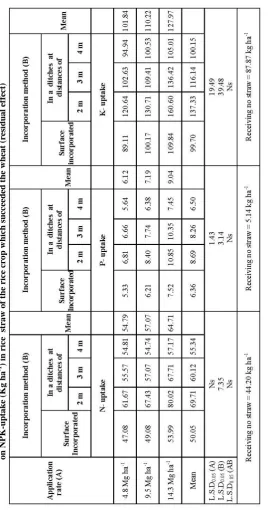
Data presented in Tables 7 and 8 illustrate the effect of applying rice straw residue to wheat on uptake of N, P and K in the rice crop which succeeded the wheat. Data show higher values for all treatments as compared with the no – straw treatment.
For grain protein content, data in Table 6 show higher protein content in treatments of the surface incorporation as well as those of the ditch method, particularly those of the 2 and 3m distance as compared with content in the no-straw application. Contents in the ditch method were greater than in the surface application method. Contents increased with increasing straw –application rate. Average increases for the 1st 2nd and 3rd rates were 12.8, 15.4 and 19.6%, respectively. The ditch method was superior to the surface application method by averages of 17.9, 10.5. and 6.7 for the 2-, 3- and 4- m distance, respectively. The greater the distance between ditches, the less contents of protein.
With respect to P- uptake ,increases due to 1st, 2nd and 3rd rates of application averaged 48.1 , 70.9 and 115.5 %, respectively for uptake in grains, 19.0 , 39.8 and 75.9 %, respectively for uptake in rice straw. The ditch method gave greater p- uptake than the surface method. The increases due to the surface method, averaged 25.0 % for grains P- uptake and 23.6 % for straw P- uptake Increases due to 2 – m 3 – m and 4 –m spacing ditch method were 126.0 %, 96.9 % and 65.1 %, respectively for uptake in grains and 69.0, 60.7 and 26.4%, respectively for uptake in rice straw. These results are similar to those obtained by Sharma and Parasad (2002), who found that incorporation of crop residue resulted in building up organic C and increased P uptake by rice.
Regarding K uptake in rice (grain and straw), data in Table 6 show that all treatments recorded greater values than control. Increases due to 1st, 2nd and 3rd rates of application averaged 79.8, 143.5 and 151.3 %, respectively for uptake in grains; 15.9, 25.4, and 45.6 %, respectively for uptake in rice straw. The ditch method gave greater K- uptake than the surface method. The increases due to the surface method, averaged 24.0 % for grains K- uptake and 13.5 % for straw K- uptake Increases due to 2- m, 3- m and 4- m spacing ditch method were 231.5 % 131.5 % and 94.8 %, respectively for uptake in grains and 56.3, 33.7 and 13.98%, respectively for uptake in rice straw. These results are in agreement with those obtained by Prasad and Sinha (2000) and Saha et al. (2009).
Overall assessment of response to rice straw application
Applying rice straw gave negative response to the crop of wheat to which it was applied. This is an indication of removal of available nutrients to soil micro-organisms which must have been active in removing soluble N for building their bodies (i.e., immobilizing N) due to abundant amounts of energy organic materials (the rice straw of the wide C:N ratio). However, following several months of being in the soil, the rice straw must have undergone intensive decomposition, narrowing its C: N ratio due to consuming energy rich components. This would lead to a net mineralization of organic N- particularly the N in the dead micro-organisms. For this reason, the residual effect of showed positive response and increased yield and NPK uptake of the rice crop which succeeded to wheat crop.
Soil bulk density
Generally, application of rice straw to the soil decreased bulk density in all treatments (Table 9). These results are in agreement to those obtained by Bhagat and Verma (1991), He and Liu (1992), Prasad and Sinha (2000) and Bhagat et al. (2003) who stated that lower soil bulk density and higher porosity were realized after the application of rice straw and organic residues. Bulk density responded significantly to treatments (Table 7). Regarding to the rate of application of rice straw, data show that bulk density decreased when the rate increased. The lowest value (1.26 gm cm-3) was realized at 1st rate of application.
For methods of application, the results indicate that ditch method gave lower bulk density than surface method. Ditches at 2 m distance showed an average of 1.27 Mg m-3 while that of surface treatment gave an average of 1.30 Mg m-3.
NPK and organic matter in soil
Different rice straw treatments showed positive residual effects on soil contents of NPK and organic matter and recorded greater values than the not receiving straw residue treatment (Table 10). Increases obtained occurred with increasing the rate of organic residues in all methods of application. The ditches method gave higher values than the surface incorporation method. Higher values were obtained at 3rd rate which gave average increases of 11.9, 12.1, 26.7 and 40.4% for N, P, K and organic matter contents of soil compared to the no- straw treatment. These findings are in agreement with those obtained by Bhagat and Verma (1991), Sharma Prasad and (2002) and Kaewpradit et al. (2009) who reported that the practice of residue incorporation may be better to sustain arable soils and represents an interesting method of managing soil fertility and the soil organic matter content is related strongly to the amount of residues added and the organic matter is regarded as the ultimate source of nutrients and microbial activity in the soil.
With respect to the effect of methods of application, data show that the ditch method surpassed the surface incorporation method. The 2-, 3- and 4- m distance treatments showed average increases over the surface application as follows: 24.19, 16.93 and 12.1%, respectively for N, 23.78, 15.0 and 9.33% respectively for P, 50.6, 31.5 and 17.9 %, respectively for K and 24.6, 17.3 and 8.2% for organic matter
Conclusion
Recycling rice straw residue in long - term wheat - rice system in ditches of 4m distance between each other at any rate of application will improve soil physical, chemical and biological properties and increase crop productivity particularly following long time after application. Thus would enable the farmers to get rid of rice straw in a safety manner to avoid the problem of burning it which not only lead to loss of huge biomass but also cause environmental pollution. In addition, long - term application of rice straw residue may reduce the use of inorganic fertilizers and then decrease soil pollution.
Acknowledgement:This research was funded by the research contract signed on
15/6/ 2009 with Zagazig University through the Competitive Projects Program funded by the University.
References
Azam, F., Lodhi, A. and Ashraf, M. (1991) Availability of soil and Fertilizer N to wetland rice following wheat straw amendment. Biol.and Fert. of Soils 11:97 – 100.
Azam, F., Ashraf, M. and Lodhi, A. (1993) Relative significance of soil and fertilizer nitrogen to nitrogen nutrition of wheat following rice straw amendment. Pak. J. Sci. 7: 50 – 54.
Bhagat, R.M., Bhardwaj, A.K. and Sharma, P.K. (2003) Long-term effect of residue management on soil physical properties, water use and yield of rice in north – western India. J. Indian Soc. Soil Sci. 51: 111-117.
Bhagat, R.M. and Verma, T.S. (1991) Impact of rice straw management on soil physical propertiesand wheat yield. Soil Sci. 152: 108-115.
Bird, J.A., Horwath, W.R., Eagl, A.J. and Van. Kessel, C. (2001) Immobilization of fertilizer nitrogen in rice : effects of straw management practices. Soil Sci. Soc. Am. J. 65 : 1143-1152.
Bunt, A.C. (1988) Media and mixes for container-grown plants. Unwin Hyman, London.
Can, J. (1999) Crop residue and fertilizer management effects on nutrient use and barley production. Soil Sci. 79: 389-394.
Cassman, K.G., Kroppf, M.J., Gaunt, J. and Peng, S. (1993) Nitrogen use efficiency of rice reconsidered: what are are the key constrains? Plant Soil 155/156: 359-362.
Chapman, H.D and Pratt, P.F. (1961) “Methods of Analysis for Soils, Plant and Water”, Div. of Agric., Sci. Univ. of Calif., USA.
Elliot, L., Cochran, VL. and Papendick, RI. (1981) Wheat residues and nitrogen placement effects on wheat growth in green house. Soil Sci. 131: 48-52.
Gong, W., Yan, X. Wang, J. Hu, T. Gong, Y. (2009) Long-term manure andfertilizer effects on soil organic matter fractions and microbes under a wheat-maize cropping system in northern China. Geoderma 149: 318–324
He, N. and Liu, Z. (1992) Effect of organic and chemical fertilizers on the grain yields and soil properties. Proceeding of International Symposium on Nutrient Management for Sustained Productivity, Vol. II, pp. 130-132, Punjab Agric. Univ., Ludhiana, India.
Jimenes, M.P, Hora, A.M., Pruzzo, L. and Palma, R.M. (2002) Soil quality: a new index based on microbiological and biochemical parameter. Biology and Fertility of Soils 35: 302-306.
Kaewpradit, W., Toomsan, B., Cadisch, G., Vityakon, P., Limpinuntana, V., Saenjan, P., Jogloy, S. and Patanothai, A. (2009) Mixing groundnut residues and rice straw to improve rice yield and N use efficiency. Field Crops Res. 110: 130-138.
Kaur, N. and Benipal, D.S. (2006) Effect of crop residue and farmyard manure on K forms on soils of long term fertility experiment. IndianJ. Crop Sci. 1(1-2): 161-164.
Liu, E., Yan, C., Mei, X., He, W., Bing, S.H., Ding, L., Liu, Q., Liu, S. and Fan, T. (2010). Longterm effect of chemical fertilizer, straw, and manure on soil chemical and biological properties in northwest China . Geoderma 158:173- 180.
Piper, C.S. (1950) “Soil and Plant Analysis”, Academi Press, New York,USA.
Powel, J.M. and Unger, P.W. (1997) Alternatives to crop residues as soil amendments. In: “Crop Resides in Sustainable Mixed Crop/Livestock Farming Systems”, C. Renard, (Ed.), pp. 215-239, ICRISAT, India and ILRI, Kenya.
Prasad, B. and Sinha, S.K. (2000) Long-term effects of fertilizers and oganic manures on crop yields, nutrient balance and soil properties in rice- wheat cropping system in bihar. In: “Long-term Soil Fertility Experiments in Rice- Wheat Cropping Systems”, I.P., Abrol, K.F., Bronson, J.M. Duxbury and R.K. Gupta, (Ed.), Rice-Wheat Consortium Paper Series 6. New Delhi, India: Rice-Rice-Wheat Consortium for the Indo-Gangetic Plains.
Qian, P. and Schoenau, J. (2002) Availability of nitrogen in solid manure amendments with different C: N ratios. Can. J. of Soil Sci. 82: (2) 219-225.
Saha, P.K., Miah, M.A.M., Hossain, A.T.M.S., Rahman, F. and Saleque, M.A. (2009) Contribution of rice straw to potassium supply in rice fallow-rice cropping pattern. Bangladesh J. Agric. Res. 34 (4): 633-643.
Sharma, S.N. and Prasad, R. (2008) Effect of crop-residue management on the production and agronomic nitrogen efficiency in a rice-wheat cropping system.
J. of Pl. Nutr. and Soil Sci. 171 (2): 295-302.
Sharma S.N. and Prasad, R. (2002) Effect of crop residue with and without a culture of cellulolytic fungi on yield, NPK uptake and soil fertility rice -wheat
cropping system. Archives of Agron. and Soil Sci 48 (4): 363-370.
Sidhu, B.S. and Beri, V. (1989) Effect of crop residue management on the yields of different crops and on soil properties. Biological Wastes 27: 15-27.
Soon, Y.K. (1999) Crop residue and fertilizer management effects on nutrient use and barley production. Can. J. Soil Sci. 79: 389-394.
27. Shindo, H. and Nishio, T. (2005) Immobilization and remineralizationof folloing addition wheat straw into soil: determination of gross N transformationrates by 15N- ammonium isotope dilution teqnique. Soil Biol. Biochem. 37: 425-432.
Tawfik, M.M. and Gomaa, A.M. (2005) Effect of organic and biofertilizer on growth and yield of wheat plants. Egypt. J. Agric. Res. 2 (2): 711-725.
Van Kessel, J.S., Reeves, J.B. and Meisinger, J.J. (2000) Nitrogen and carbon mineralization of potential manure components. Journal EnvironmentalQualiyy29: 1669 – 1677.
Varinderpal-Singh, Dhillon, N. and Brar, B. (2006) Effect of incorporation of crop residues and organic manures on adsorption/desorption and bio-availability of phosphate. Nutrient Cycling in Agroecosystems 76 (1) : 95-108 (14).
Verma, T.S. and Bhagat, R.M. (1992) Impact of rice straw management practices on yield, nitrogen uptake and soil properties in a wheat-rice rotation in northern India. Fertilizer Research 33: 97-106.
Yaduvanshi, N.P.S. and Sharma, D.R. (2008) Tillage and residual organic manures/chemical amendment effects on soil organic matter and yield of wheat under sodic water irrigation. Soil & Tillage Research 98: 11–16.
Zeidan, M.S., Hozayn, M. and El- Krammany, M.F. (2005) Effect of different organic fertilizer sources and levels on growth and yield of wheat (Triticum aestivum L.) in sandy soil. Egypt. J. Agric. Res. 2 (2), 643.
زرلأاو حمقلا لوصحم ىلإ زرلأا شق ةفاضإ تلادعمو قرط
ةبرتلا صاوخ ضعبو جاتنلإا ىلع تايعادتلاو
م فرشأ ةدوج دمح سيوع
، حبص دمحم دومحم ،
رماع دماح دمحم و
دمحم
ليلخ دمحم ةدوج
ةايملاو ىضارلأا مسق –
ةيمنتلاو ايجولونكتلا ةيلك – قيزاقزلا ةعماج – قيزاقزلا – رصم . لوصحم ىلع ةيناثلاو حمقلا لوصحم ىلع ةدحاو نيتبرجت تيرجأ
لا زرلأا ذ ي
ةعارزلا مسوم للاخ هبقعي 2119
/ 2101 ةعارزلا مسومو حمقلل 2101
زرلأل
ةظفاحمب سيخلا ةلازغ ةيحانب ةيمنتلاو ايجولونكتلا ةيلك ةعرزمب ةينيط ضرأ ىلع تنإ ىلع زرلأا شق اياقب ةفاضإ ريثأت ةسارد ضرغب ةيقرشلا زرلأاو حمقلا ةيجا
ةبرتلا صاوخ ضعب كلذكو .
تلادعمب زرلأا شق اياقب تفيضأ 8 ‚ 4 ، 5 ‚ 9 ، 3 ‚ 04 مارجاجيم / نيتقيرطب راتكه :
ىلولأا : قمعل اهجمد عم ةيحطس 31 مس ( ثرحلا ةقبط ) ةيناثلا ، : قمعب قافنأ يف 41
تافاسم ىلع مس 2 ، 3 ، 4 نم رتم
يتلآاك جئاتنلا تناكو ضعبلا اهضعب :
لاوأ : يلاحلا لوصحملا ىلع ةبرتلا ىلإ زرلأا شق اياقب ةفاضإ ريثأت (
حمقلا )
حمقلا بوبح يف فيفط ضافخنا ىلإ ىدأ ةبرتلا ىلإ زرلأا شق اياقب ةفاضإ
شقلا لوصحم يف ظوحلم ضافخناو .
لضفأ قافنلأا يف ةفاضلإا تلجس دقو
ةيحطسلا ةفاضلإاب ةنراقملاب شقو بوبح لوصحم .
-دأ اضيأ يرصنع صاصتما يف ضافخنا ىلإ ةبرتلا ىلإ زرلأا شق ةفاضإ ى
نلا ي مويساتوبلا رصنع صاصتما يف ةدايز ثدح امنيب روفسوفلاو نيجورت
لورتنكلا ةلماعمب ةنراقملاب (
زرلأا شق اياقب نودب )
ةلماعملا تطعأ دقو 3
‚ 04
مارجاجيم / قافنلأا تافاسم تاذ راتكه 2
رصنع صاصتما يف ةدايز ىلعأ م
ا مويساتوبل . ايناث : قحلالا لوصحملا ىلع يقبتملا ريثأتلا (
زرلأا )
لوصحملا ىلإ ةفاضملا زرلأا شق اياقبل يقبتم ريثأت دوجو جئاتنلا ترهظأ
قباسلا ( حمقلا ) بوبحلاو شقلا لوصحم ةدايز ىلإ ىدأ و
رصانع صاصتما
نلا ي وفلاو نيجورت ىوتحم كلذكو مويساتوبلاو روفس
نيتوربلا بوبحلا يف
قحلالا لوصحملل (
زرلأا ) لورتنكلا ةلماعمب ةنراقملاب تلاماعملا عيمج يف (
نودب
زرلأا شق اياقب .)
-طسلا ةفاضلإاب ةنراقملاب قافنأ يف ةفاضلإا ةلاح يف اقوفتم ريثأتلا ناك نأو ةيح
لوصحلا مت جئاتن لضفأ قافنلأا ةلماعم يف اهيلع
2 ةفاضإ لدعمو م 3 ‚ 04 مارجاجيم / راتكه . اثلاث : ةبرتلا صاوخ ضعب ىلع يقبتملا ريثأتلا
-ا ىوتحم ، ةبرتلل ةيره-اظل-ا ةف-اثكل-ا ىلع ةيب-اجيإ ت-اريثأت جئ-اتنل-ا ترهظأ نم ةبرتل
كلذكو ةيوضعلا ةداملا نلا رصانع نم ةبرتلا ىوتحم
ي روفسوفلاو نيجورت
قافنلإا ةلماعم تطعأ دقو مويساتوبلاو 2