Surgery for lung cancer as the second primary
malignancy
Arnoldas Krasauskas
1,
Renatas Aškinis
1, 2,
Sigitas Zaremba
1,
Giedrė Smailytė
3,
Saulius Cicėnas
1, 21 Subdivision of Thoracic Surgery and Oncology, I Department of Surgical Oncology, Institute of Oncology, Vilnius University
2 Medical Faculty of Vilnius University
3 Cancer Control and Prevention Center, Institute of Oncology, Vilnius University
Correspondence to: Arnoldas Krasauskas, Subdivision of Tho-racic Surgery and Oncology, I Department of Surgical Onco lo gy, Institute of Oncology, Vilnius University,Santariškių 1,
LT-08660 Vilnius, Lithuania. E-mail: [email protected]
Following a successful treatment of the first oncological disease, the second malignancy can develop. This retrospective study was designed to evaluate the efficacy of surgical treatment results for patients with the second primary lung cancer (2PLC) depending on the site of the first primary tumor (1PT).
Materials and methods. From 2005 to 2009, 88 patients (pts) were treated in the Subdivision of Thoracic Surgery and Oncology, Institute of Oncolo-gy, Vilnius University, with lung cancer as the second primary malignancy. 29 patients (33%) underwent surgery: 17 pts (58.6%) – lobectomies, 2 pts (6.9%) – pneumonectomies, 9 pts (31%) – anatomical segmentectomies and 1 pt (3.5%) – bilobectomy. All lung resections were performed with lymph nodes dissection. We had neither major complications nor mortality 30 days after surgery. Stages of 2PLC were as follows: IA-B stage (st.) – 19 pts (65.5%), IIA-B st. – 7 pts (24.1%), and IIIA-IV st. – 3 pts (10.3%). Lung cancer mor-phology was the following: squamous cell – 11 pts (37.9%), adenocarcino-ma – 13 pts (44.8%), large cell carcinoadenocarcino-ma – 4 pts (13.8%), sadenocarcino-mall cell lung can-cer – 1 pt (3.5%). First primaries of the patients were as follows: larynx – 6 pts (207%), lung – 2 pts (6.9%), stomach – 3 pts (10.3%), colon and rectum – 4 pts (13.8%), kidney – 4 pts (13.8%), prostate – 4 pts (13.8%), breast – 2 pts (6.9%), gynecology – 2 pts (6.9%) and haematologic malignancies – 2 pts (6.9%). Ac-cording to 1PT localization patients were divided into 4 groups: airways, gas-trointestinal, urology and other malignancies.
Results. 1- and 3-year survival was 69% and 27.6% (60.9% and 30.4% for males; 27.6% and 16.7% for females). 3-year survival for the first primary cancer was 37.5% in urological cancers, 14.3% in gastrointestinal, 37.5% in airway cancers and 16.7% in other cancer cases. Survival by stage of 2PLC was as follows: IA-B st. – 33.3%, IIA-B st. – 28.6%, respectively. No patients survived for 3 years with IIIA-IV st. of 2 PLC. By morphology of 2 PLC there were adenocarcinoma cases in 14.3%, squamous cell carcinoma in 50.0%. One patient with small cell 2 PLC has lived so far.
Conclusions. 1. The site of the first primary tumor is not a significant prognostic factor for surgical outcomes of the second primary lung cancer (p > 0.5). 2. Statistically significant survival rates did not differ by gender and histological type of 2PLC. 3. A statistically significant survival differ-ence was obtained only between the patients with IA-IIB st. and IIIA-IV st. of 2PLC (p = 0.0013).
INTRODUCTION
Following a successful treatment of the first
onco-logical disease, the second malignancy can develop.
4.2% of gastric cancer patients had a second
ma-lignancy and lung cancer was detected in 28.4%
cases (1). Lung cancers account for 5% of second
primary cancers after breast cancer (7) and 7.2%
after oral cavity cancers (9). For the highest-risk
subgroups of head and neck cancers, second
pri-mary cancers occur in 4% of patients per year (2).
There are evidences that the second primary lung
cancer worsens treatment results of cancer patients
(10, 12). This retrospective study was designed to
evaluate the efficacy of surgical treatment results
for patients with the second primary lung cancer
(2PLC) depending on the site of the first primary
tumor (1PT).
MATERIALS AND METHODS
From 2005 to 2009, 88 patients (pts) were treated
in the Subdivision of Thoracic Surgery and
Onco-lo gy, Institute of OncoOnco-logy, Vilnius University, with
lung cancer as the second primary malignancy.
59 pts (67%) were not treated surgically and were
excluded. 29 pts (23 males (79.3%) and 6 females
(20.7%)) underwent surgery. For 17 pts (58.6%)
we performed lobectomies, for 2 pts (6.9%)
pneu-monectomies, for 9 pts (31%) anatomical
segmen-tectomies and for 1 pt (3.5%) bilobectomy. Each
lung resection followed mediastinal lymph nodes
dissection. We had neither major complications
nor mortality 30 days after surgery.
Distribu-tion of patients by 2PLC stages was as follows: IA
stage (st.) – 11 pts (37.9%), IB st. – 8 pts (27.6%),
IIA st. – 2 pts (6.9%), IIB – 5 pts (17.2%), IIIA-IV
st. – 3 pts (10.3%). Histological types of the lung
cancer were squamous cell carcinoma – 11 pts
(37.9%), adenocarcinoma – 13 pts (44.8%), large
cell carcinoma – 4 pts (13.8%), small cell lung
can-cer – 1 pt (3.5%). First primaries of the patients were
in the larynx – 6 pts (20.7%), lung – 2 pts (6.9%),
stomach – 3 pts (10.3%), colon and rectum – 4 pts
(13.8%), kidneys – 4 pts (13.8%), prostate – 4 pts
(13.8%), breast – 2 pts (6.9%) and gynecological
organs – 2 pts (6.9%). For 2 pts (6.9%) 1PT were
haematologic malignancies. All of these patients
had metachronous 2PLC (identified later than one
year). Patients were divided into 4 groups according
to 1PT localization due to a small number of cases:
airways – 8 pts (27.6%), gastrointestinal – 7 pts
(24.1%), urology – 8 pts (27.6%) and 6 pts (20.7%)
of other malignancies.
RESULTS
The average age of patients was 65.86 years
(SD ± 8.81). 1- and 3-year survival of patients were
69% and 27.6%. A statistically significant difference
in survival between the genders has not been
es-tablished (p = 0.7492) and is presented in Table 1.
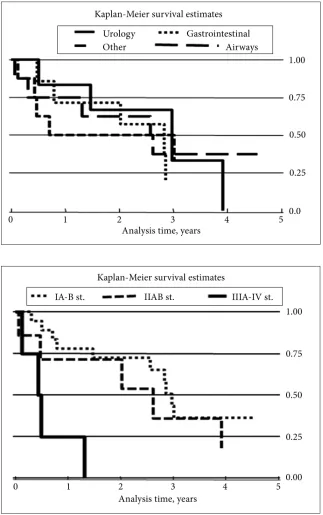
3-year survival by the first primary cancer was the
following: urological cancers – 37.5%,
gastrointes-tinal – 14.3%, airways – 37.5% and other – 16.7%
(Table 2). There was no statistically significant
difference by the first primary site (p = 0.9992)
(Fig. 1). Survival by stage of 2PLC was as follows:
Table 1. Patient survival from secondary lung cancer by gender (p = 0.7492)
Gender Patient No. Average age (±SD) Survival years (±SD) 1-year survival, % 3-year survival, %
Males 23 66.39 (±8.60) 2.53 (±2.35) 60.87 30.43
Females 6 63.83 (±10.15) 2.61 (±0.86) 100.00 16.67
All pts 29 65.86 (±8.81) 2.55 (±2.11) 68.97 27.59
Table 2. Patient survival from secondary lung cancer by the first primary tumor Primary
tumor group Patient No. Average age (±SD) Survival years (±SD) 1-year survival, % 3-year survival, %
Urology 8 72.13 (±5.54) 2.65 (±3.04) 50.00 37.50
Gastro-intestinal 7 67.57 (±10.20) 2.44 (±1.74) 71.43 14.29
Airways 8 60.63 (±4.84) 2.80 (±2.18) 75.00 37.50
Table 3. Patient survival from secondary lung cancer by stages of lung cancer
Stage Pts Average age (±SD) Survived years (±SD) 1-year survival, % 3-year survival, %
IA-B 19 65.44 (±8.95) 3.05 (±2.17) 77.78 33.33
IIA-B 7 69.29 (±8.81) 2.38 (±1.98) 71.43 28.57
IIIA-IV 3 61.75 (±8.02) 0.59 (±0.51) 0.00 0.00
IA-B st. – 33.3%, IIA-B st. – 28.6% (Fig. 2 and
Table 3). No patients survived for 3 years with
II-IA-IV st. of 2 PLC. By morphology of 2 PLC there
were adenocarcinoma cases in 14.3%, squamous
cell carcinoma in 50.0%, large cell carcinoma in
0% (Fig. 3 and Table 4). One patient with small
cell 2 PLC has lived so far.
Fig. 1. Patient survival from se-condary lung cancer by the first primary tumor (p = 0.9992)
DISCUSSION
We found more males (79.3%) than females (20.7%)
with 2PLC in our study, like it was presented by
Ikeda Y., Quadrelli S., Liu Y., Rea F. and Furaka J.
(70–80% and 20–30%, respectively) (1, 3–6).
Sur-vival rates by gender in our study did not differ. It
may be due to a small number of female patients
because survivals of females were significantly
bet-ter than males in Josef Furaka’s study (6).
Our data show that patient survival rates were
not statistically different according to the
prima-ry tumor site (p > 0.5). They correspond to
com-mon statistical data of the surgically treated lung
cancer patients: we found a statistically significant
survival difference between the patients with
IA-IIB st. and IIIA-IV st. of 2PLC (p = 0.0013). The
same conclusion cites Quadrelli S. (5-year survival
65.3% vs. 58.6%, log-rank P = 0.416) and Bae M. K.
(3, 8). For patients with localized NSCLC, a history
of mixed cellularity Hodgkon’s lymphoma was
as-sociated with a 3-fold improved overall survival
(P = 0.006) (13). We cannot disprove or approve
these data due to a very small number of such
pa-tients in our study. Only further studies with more
samples could confirm or disprove literature claims
that poorer lung cancer survival prognosis
wor-sens other primary cancer treatment outcomes (9,
10, 12). Surgery for localized pulmonary lesions is
necessary because it helps to differentiate primary
from metastatic tumors. The same is recommended
by Nakamura T. after follow-up study of the
ope-rated stomach cancer patients (11). We had no
ma-jor complications after 2PLC surgery and survival
rates were not different according to the primary
tumor site, therefore we offer surgical treatment of
2LPC such as the first primary (alone) lung cancer.
CONCLUSIONS
1. The site of the first primary tumor is not a
signifi-cant prognostic factor for surgical outcomes of the
second primary lung cancer (p > 0.5). 2.
Statisti-cally significant survival rates did not differ by
gen-Table 4. Patient survival from secondary lung cancer by histology type of lung cancer Histology type of second
primary lung cancer Patient No. Average age (±SD) Survival years (±SD) 1-year survival, % 3-year survival, %
Adenocarcinoma 13 66.29 (±8.64) 2.21 (±1.99) 64.29 14.29
Squamous cell carcinoma 11 66.90 (±6.97) 2.59 (±2.28) 60.00 50.00
Small cell carcinoma 1 74.00 (–) 7.36 (–) 100.00 100.00
Large cell carcinoma 4 59.75 (±13.38) 2.44 (±0.77) 100.00 0.00
der and histological type of 2PLC. 3. A statistically
significant survival difference was obtained only
between the patients with IA-IIB st. and IIIA-IV st.
of 2PLC (p = 0.0013).
Received 27 October 2012 Accepted 23 November 2012
References
1. Ikeda Y, Saku M, Kawanaka H, Nonaka M, Yo-shida K. Features of second primary cancer in pa-tients with gastric cancer. Oncology. 2003; 65(2): 113–7.
2. Licciardello JT, Spitz MR, Hong WK. Multiple pri-mary cancer in patients with cancer of the head and neck: second cancer of the head and neck, eso phagus, and lung. Int J Radiat Oncol Biol Phys. 1989; 17(3): 467–76.
3. Quadrelli S, Lyons G, Colt H, Chimondeguy D, Silva C. Lung cancer as a second primary malig-nancy: increasing prevalence and its influence on survival. Ann Surg Oncol. 2009; 16(4): 1033–8. 4. Liu Y, Chen Y, Yen S, Tsai Ch, Perng R.
Mul-tiple primary malignancies involving lung can-cer – clinical characteristics and prognosis. Lung Cancer. 2002; 35: 189–94.
5. Rea F, Zuin A, Callegaro D, Bortolotti L, Guanel-la G, Sartori F. Surgical results for multiple prima-ry lung cancers. Eur J Cardiothorac Surg. 2001; 20: 489–95.
6. Furaka J, Trojana I, Szokea T, Wolfarda A, Nagya E, Nemethb I, et al. Lung cancer as a second primary malignant tumor: prognostic values after surgical resection. Interact Cardiovasc Thorac Surg. 2008; 7(1): 50–3.
7. Schonfeld SJ, Curtis RE, Anderson WF, Ber-rington de González A. The risk of a second pri-mary lung cancer after a first invasive breast can-cer according to estrogen receptor status. Cancan-cer Causes Control. 2012; 23(10): 1721–8. Epub 2012 Aug 24.
8. Bae MK, Byun CS, Lee CY, Lee JG, Park IK, Kim DJ, Chung KY. The role of surgical treatment in second primary lung cancer. Ann Thorac Surg. 2011; 92(1): 256–62.
9. Chen PT, Kuan FC, Huang CE, Chen MF, Huang SH, Chen MC, Lee KD. Incidence and pat-terns of second primary malignancies following
oral cavity cancers in a prevalent area of betel-nut chewing: a population-based cohort of 26,166 pa-tients in Taiwan. Jpn J Clin Oncol. 2011; 41(12): 1336–43.
10. Milano MT, Li H, Constine LS, Travis LB. Survival after second primary lung cancer: a population-based study of 187 Hodgkin lymphoma patients. Cancer. 2011; 117(24): 5538–47.
11. Nakamura T, Homma Y, Miyata N, Ushida S, Su-zuki K, Otsuki Y, et al. Only surgical resection can identify the second primary lung cancer out of the metastasis after gastric cancer surgery. Jpn J Clin Oncol. 2012; 42(7): 609–11.
12. Jayaprakash V, Cheng Ch, Reid M, Dexter EU, Chukwumere E. Nwogu, et al. Previous head and neck cancers portend poor prognoses in lung cancer patients. Ann Thorac Surg. 2011; 92: 1056–61.
13. Milano MT, Li H, Constine LS, Travis LB. Va-riables affecting survival after second prima-ry lung cancer: A population-based study of 187 Hodgkin’s lymphoma patients. J Thorac Dis. 2012; 4(1): 22–9.
Arnoldas Krasauskas, Renatas Aškinis,
Sigitas Zaremba, Giedrė Smailytė, Saulius Cicėnas PLAUČIŲ VĖŽIO KAIP ANTROS PIRMINĖS ONKOLOGINĖS LIGOS CHIRURGINIO GYDYMO REZULTATAI
Įvadas. Po sėkmingo vienos onkologinės ligos gydymo gali vystytis antra pirminė onkologinė liga. Šios retros-pektyvios analizės tikslas yra įvertinti chirurginio plau-čių vėžio kaip antros pirminės onkologinės ligos gydy-mo rezultatus ir palyginti juos pagal pirminio naviko lokalizaciją.
Vienuolikai pacientų (37,9 %) buvo nustatytas plokščia-ląstelinis 2PPV, 13 (44,8 %) – liaukinis, 4 (13,8 %) – dide-lių ląstedide-lių ir 1 (3,5 %) – smulkialąstelinis vėžys. Šešiems pacientams (20,7 %) buvo nustatyta gerklų pirma onko-loginė liga (1OS), 2 (6,9 %) – plaučių, 3 (10,3 %) – skran-džio, 4 (13,8 %) – storžarnės, 4 (13,8 %) – inks-tų, 4 (13,8 %) – priešinės liaukos, 2 (6,9 %) – krūinks-tų, 2 (6,9 %) – moteriškų lytinių organų ir 2 (6,9 %) – krau-jodaros organų. Pagal pirmos onkologinės ligos lokaliza-ciją pacientai buvo suskirstyti į 4 grupes: kvėpavimo takų, virškinimo organų, šlapimo sistemos ir kitų organų.
Rezultatai. Vienus metus po operacijos išgyveno 69 % pacientų (60,9 % vyrų ir 27,6 % moterų), tre-jus metus – 27,6 % (30,4 % vyrų ir 16,7 % moterų). Pagal 1OS trejų metų išgyvenamumas urologinių pacientų buvo 37,5 %, žarnyno – 14,3 %, kvėpavimo takų – 37,5 % ir kitų lokalizacijų – 16,7 %. Pagal 2PPV stadijas: trejus metus išgyveno 33,3 % IA-B st. sirgusių
pacientų ir 28,6 % IIA-B st. Nė vienas IIIA-IV st. 2PPV sirgusių ligonių neišgyveno trejus metus. Pagal 2PPV histologiją: trejus metus išgyveno 14,3 % pacientų, sirgusių liaukiniu vėžiu, ir 50,0 % – plokščialąsteliniu. Visi 4 pacientai, sirgę didelių ląstelių 2PPV, neišgyveno trejų metų. Smulkialąsteliniu 2PPV sirgęs ligonis gy-vena iki šiol.
Išvados. 1. Pirmos onkologinės ligos lokalizacija nėra reikšmingas prognostinis veiksnys antro pirminio plaučių vėžio chiruginio gydymo rezultatams (p > 0,5). 2. Pacientų, sirgusių antra pirmine onkologine liga, iš-gyvenamumo rodikliai statistiškai patikimai nesiskyrė ir pagal lytį, ir pagal histologiją. 3. Statistiškai patikimas išgyvenamumo skirtumas buvo nustatytas tik tarp IA-IIB st. ir IIIA-IV st. pacientų, sirgusių antru pirminiu plaučių vėžiu (p = 0,0013).