A COMPARATIVE STUDY OF ROUTING PROTOCOLS IN
WIRELESS MESH NETWORKS
Er.Pushpender Sarao1 Prof. (Dr.) Sohan Garg2 Prof. (Dr.) YashPal Singh3
1Asstt. Professor in SITM, Rewari, ([email protected]) 2Professor, C.C.S. University, Meerut, [email protected]
3 Professor, S.(P.G.)I,T.M., Rewari, [email protected]
SHIV SHAKTI
International Journal in Multidisciplinary and Academic Research (SSIJMAR)
Vol. 2, No. 5, August – September 2013 (ISSN 2278 – 5973)
Abstract
Wireless Mesh Networks (WMNs) typically aim to provide cost-effective Internet access with minimal infrastructure expenditure, which makes it particularly attractive. This paper reflects the routing protocols used in WMNs. Also, this paper presents the categorization of a variety of routing protocols which are used in WMNs. At last of this paper, we represent the comparative study of the routing protocols in WMNs.
1.Introduction
Wireless Mesh Networks (WMNs) consists of a number of stationary wireless routers inter-connected by wireless links. These wireless routers serve as access point (APs) for wireless mobile devices. Some of them also act as gateways to the Internet via high speed wired links. Wireless mobile devices first, transfer data to the associated wireless router, and these data are then transferred to the Internet (or other networks) via the intermediate wireless routers in a multi-hop manner. Stationary wireless routers are assumed to have multiple network interface cards (NICs). Each network interface is assigned to a distinct frequency channel. A router can communicate with a neighboring router when each router has one of its interfaces using the same channel. The number of available channels depends as the frequency band. Wireless Mesh Networks typically aim to provide cost-efficient Internet access with minimal infrastructure expenditure, which makes it particularly attractive for sub-urban areas with little or no broad band.
2. Routing in WMNs
WMN is multi-hop network consisting of routers, gateways and mobile nodes. Routing in such a heterogeneous environment has put enormous challenges to participating nodes and routers to deliver packet from one corner to another. A variety of routing metrics has been proposed for Wireless Mesh Networks providing routing algorithms with high flexibility in the selection of best path and offering compromise between throughput, end-to-end delay, and energy consumption.
3. Categories of Routing Protocols
I)
Proactive, Reactive and Hybrid Routing:A Reactive Routing starts to setup a routing path for two nodes only after traffic is generated between these two nodes. Reactive Routing protocols calculate optimal route on demand. When a route is calculated, it is stored and used until the destination is available. DSR and AODV are the reactive protocols which are mostly used.
Hybrid Routing combines the best features of proactive and reactive routing by overcoming their demerits and find efficient routes, without much control overhead. If employs diverse routing protocols in different part of the infrastructure WMNs i.e. reactive protocols for the ad-hoc network area while proactive protocols are employed in wireless backbone.
II) Static and Dynamic Routing
In static and dynamic routing, a host or a router has a routing table with an entry for each destination, or a combination, to route IP packets. In Static Routing, routing table contains information entered mate manually. The administrator enters the route for each destination into the table. When a table is created, it can’t update automatically when there is a change in the Internet. The table must be manually altered by the administrator. In Dynamic Routing, routing table is updated periodically by using one of the dynamic routing protocols such as RIP, or BGP. Whenever there is a change in the Internet, such as a shutdown of a router or breaking of a link, the dynamic routing protocols update all the tables in the routers (and eventually in the host) automatically. Routers in a big internet such as the Internet need to be updated dynamically for efficient delivery of the IP packets.
III) The existing routing protocols for WMNs can be categorized according to their objectives of performance optimization:
(A.)Hop-Count Based Routing: Many of the routing protocols in WMNs use hop-count as the routing metric. Minimizing the hop-counts numbers, is not directly related to performance optimization for WMNs. In order to achieve the goal of optimized performance, all these routing protocols are have to be enhanced.
(B.)Link-Level QoS Routing: In some routing protocols, the routing performance is optimized by minimizing the accumulative or the routing path.
(C.)End-to-End QoS Routing: In some routing protocols, end-end QoS parameters are considered as the performance optimized objective. Thus, these protocols are expected to achieve better QoS performance then the routing protocols based on link-level QoS.
(E.)Stability-Aware Routing: Routing protocols in this category utilize the special system architecture to improve stability. Thus, a routing protocol can select some wired links or more stationary nodes in a routing path to improve stability.
(F.)Scalable Routing: For a large scale WMNs, it is needed to develop a scalable routing protocol. There can be several schemes to enhance the scalability a routing protocol.
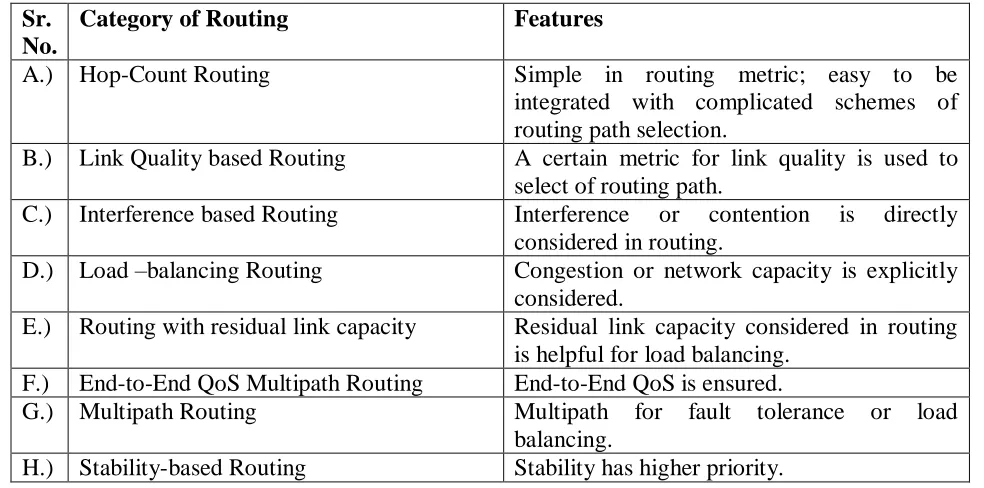
A summary of different categories of routing schemes is given in Table 1:
Table 1: Categories of routing schemes
Sr. No.
Category of Routing Features
A.) Hop-Count Routing Simple in routing metric; easy to be integrated with complicated schemes of routing path selection.
B.) Link Quality based Routing A certain metric for link quality is used to select of routing path.
C.) Interference based Routing Interference or contention is directly considered in routing.
D.) Load –balancing Routing Congestion or network capacity is explicitly considered.
E.) Routing with residual link capacity Residual link capacity considered in routing is helpful for load balancing.
F.) End-to-End QoS Multipath Routing End-to-End QoS is ensured.
G.) Multipath Routing Multipath for fault tolerance or load balancing.
H.) Stability-based Routing Stability has higher priority.
4. Proactive Routing Protocols
OLSR is another example of controlled flooding (RFC 3626). OLSR is an optimization over a pure link state protocol as it compacts the size of information sent in the messages, and furthermore, reduces the number of retransmissions to flood these messages in entire network. For this purpose, the protocol uses multipoint relaying technique to efficiently and economically flood its control messages.
4.2 DSDV: Destination Sequenced Distance Vector (DSDV)
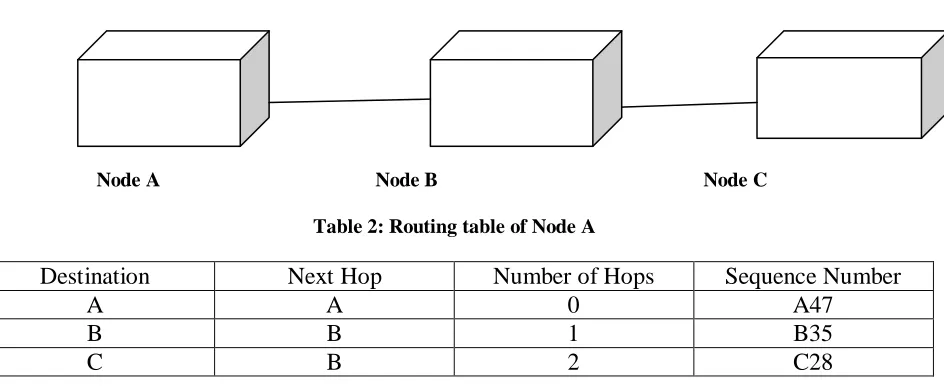
DSDV is a proactive routing protocol (table- driven) enhancement over Bellman-Ford algorithm. A sequence number is assigned to each entry in the routing table, the sequence number is mostly even when a link is present, and otherwise an odd number is used. The destination generates the number. Routing information is distributed among the nodes by sending updates.
Node A Node B Node C
Table 2: Routing table of Node A
Destination Next Hop Number of Hops Sequence Number
A A 0 A47
B B 1 B35
C B 2 C28
The table contains the details of all the possible paths reachable by node A. Also table contains the destination, next hop, number of hops and sequence number fields. In DSDV routing protocol, a regular updating of routing tables is needed. A new sequence number is required when the topology of the network is changed.
Some drawbacks of DSDV
To find out the maximum setting time, is difficult. Multi-path routing is not supported by DSDV routing protocol. Due to the periodic and triggered updating, DSDV routing protocol has excessive communication overhead. A complete routing table is needed by every node.
DSDV Routing is used by CGSR as the basis of routing. The mobile nodes are arranged into clusters. A cluster head is elected among the clusters. A cluster-head can communicate all the nodes that come into its cluster. If a node comes into the communication range of two or more cluster-heads, then we can consider that node as a gateway node. A LCC (Least Cluster Change) algorithm is used by the CGSR algorithm. In LCC, cluster-head is changed in only two conditions: first when due to network changes, two cluster-heads to come into one cluster and second one of the nodes moves out of the range of all the cluster-heads.
The CGSR algorithm works in the following sequence of steps: First packet is transmitted by the source of the packet to its cluster-head. In the next step, the packet is sent to the gateway node that connects this cluster-head. And in the next step, next cluster-head connects along the route to the destination. The gateway sends it to next cluster-head and so on until the destination cluster-head is achieved. At last, the packet is transmitted by the destination cluster-head to the destination. A cluster member table and routing table is maintained by the each node. To broadcast the cluster member table periodically and updating the table after receiving other node, it is the responsibility of the each node. When a packet is received, the nearest cluster-head along the route to the destination is found out with the help of cluster table and routing table. After this, node contacts its routing table to achieve the next hop in order to reach the cluster-head selected in initial step and transmits the packet to that node.
Fig.1: Routing in CGSR from node 1 to node 12
(node 5) to the cluster-head node (node 8). The cluster-head node (node 8) sends the packet to gateway-head node (node 11). The gateway node (node 10) transfers the packet to cluster-head node (node 11). The gateway node (node 10) connecting the cluster-head node (node 8) along the route to the cluster-head (node 11) i.e. destination cluster-head. The cluster-head node (node 11) then transmits the packet to the destination (node 12).
4.4 HEAT: Scalable Routing Protocol
HEAT, routing protocol is suited well for WMNs, as in mesh networks, mesh traffic flows between a large number of mobile nodes and a few APs (Access Points) with Networks Connectivity. HEAT is an anycast routing protocol. To scale to the network size and to be robust to node mobility, HEAT is designed. In HEAT, a temperature field is used to route data packets towards the gateways networks. A temperature specific value is assigned to each node. In HEAT, a route is followed by the packets along increasing temperature values until they reach any of the Internet gateways. Internet gateways works as heat sources. Heat has a specific feature i.e. it does not require flooding of control messages. HEAT is more suitable routing protocol as compared to AODV (unicast routing protocol) in Wireless Mesh Networks.
Length and robustness of paths, both are considered by HEAT in the routing decision. To improve the scalability feature, HEAT used the special construction and maintenance mechanism. HEAT is a proactive routing protocol and algorithm used by it, is fully distributed. HEAT protocol is inspired by the characteristics of temperature fields. A specific temperature value is assigned to each node in the mesh network. If new nodes exist, zero value is assigned to them. Maximum value is given to the gateway nodes. Node’s distances to available gateways and robustness of the paths towards these gateways, a temperature value of a specific node is determined.
5. Reactive Routing Protocols
5.1 Dynamic Source Routing (DSR):
DSR is an on-demand routing protocol for Wireless Mesh Networks. Dynamic Source Routing is based on source routing, as at every mobile node, routing information is updated continually. DSR works in only two phases:
Fig.2: Route Discovery: Node A is the initiator, and node E is the Target
Route Maintenance (RM): In Route Maintenance, node P is able to detect, while using route to Q, if the network topology has changed such that it can no longer uses its route to Q because a link along the route no longer works. When RM indicates a source route is broken, P can attempt to use any other route it happens to know to Q, or can invoke RD again to find a new route. RM is used only when P is actually packets to Q. RD and RM, each phase operate entirely on demand.
Dynamic Source Routing algorithm is beaconless routing algorithm and therefore does not need periodic hello packet (beacon) transmissions. A node uses the hello packets to inform about its presence, to its neighbours. DSR is a reactive routing protocol, hence, no need to find routes to all other nodes in the network. The setup of a route is done only when it is required.
The main feature of WMNs i.e. self-organizing and self configuring is supported by the DSR protocol. DSR protocol supports to discover dynamically a route across multiple-hops to any destination in the WMNs.
Limitations: DSR works well only in static and low-mobility environment. But, we use this protocol in the increasing mobility, performance may be degraded. Considerable routing overhead is another limitation of this protocol.
5.2 Ad hoc On Demand Distance Vector Routing (AODV)
AODV is a reactive routing protocol used for routing purpose in WMNs. Both unicast and multicast routing are supported by AODV.
continuously used by the needy node. That route has the least number of hops through other node.
A transmitting node receives a routing error if a link failure condition is comes out. After this, process is repeated.
AODV is on-demand, reactive routing protocol. To identify the most recent path, it uses sequence numbers. The special feature of AODV routing protocol is that it uses destination sequence number (DestSeqNum) to find out the latest path to the desired destination. As broadcast route discovery mechanism is used by the DSR (Dynamic Source Routing), AODV also uses that mechanism for this purpose of discovery a route on the network. Route request have a TTL (Time-To-Live) number.
The main advantage of AODV is that extra traffic is not created by this routing protocol. No much data storage space is needed by this protocol.
But it has some limitations like more time needed for establishing a connection, unusual bandwidth consumption is taken by this protocol.
5.3 Link quality source routing (LQSR)
LQSR was developed by Microsoft Company. It is a reactive routing protocol used in Wireless Mesh Networks. LQSR protocol is developed on the basis of DSR.
In WMNs, all the nodes are identified by the LQSR protocol. After identification of all the nodes in a mesh network, relative weight is assigned to the links between the nodes. Information regarding channel, bandwidth, loss for every links, is provided to each node on the network to define a best path, LQSR uses a metric called Weighted Cumulative Expected Transmission Time.
LQSR protocol has many features and characteristics such as Route Discovery (Route Request and Route – Reply Messages) and Route Maintenance (Route Error Messages). LQSR differentiate from DSR in the way that LQSR is implemented as layer 2.5 protocols instead of as a network layer protocol and also link quality metrics as supported by LQSR.
6. Hybrid Routing Protocols
6.1 Zone Routing Protocol (ZRP)
ZRP may be used. ZRP is well suited protocol for Wireless Mesh Networks. By changing the zone radius, the performance of the ZRP may be enhanced.
ZRP has mainly four components: IARP (Intra-Zone Routing Protocol), IZRP (Inter-Zone Routing Protocol), BRP (Border Resolution Protocol) and NDP (Neighbor Discovery Protocol).
ZRP uses the border casting technique. The border casting process is performed by using the Border Cast Resolution Protocol (BRP). BRP gives us the border cast packet delivery service. A query control mechanism is used to direct the route requests. Neighbor Discovery Protocol (NDP) is used to detect the new neighbor nodes. Also link failure information is provided by the NDP protocol. A “HELLO” beacon is transmitted at a fixed interval by the NDP protocol. When a beacon is received, the table of neighbor is modified.
7. Comparison of Routing Protocols
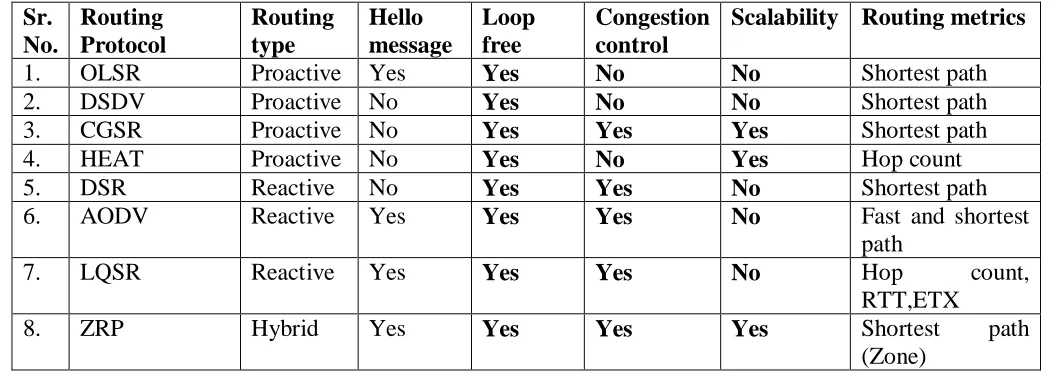
Table 1 describe the comparison of the routing protocols in WMNs. Table also specifies which routing protocol provides us a loop free routing, greater scalability, congestion control. Here, routing metrics are used mainly for comparison purposes.
Table:3 Comparison of Routing Protocols in WMNs
Sr. No.
Routing Protocol
Routing type
Hello message
Loop free
Congestion control
Scalability Routing metrics
1. OLSR Proactive Yes Yes No No Shortest path 2. DSDV Proactive No Yes No No Shortest path 3. CGSR Proactive No Yes Yes Yes Shortest path
4. HEAT Proactive No Yes No Yes Hop count
5. DSR Reactive No Yes Yes No Shortest path
6. AODV Reactive Yes Yes Yes No Fast and shortest path
7. LQSR Reactive Yes Yes Yes No Hop count,
RTT,ETX
8. ZRP Hybrid Yes Yes Yes Yes Shortest path
8. Conclusion
WMNs having low cost and ease of deployment is a popular technology as compared to the competitive technologies. Routing in WMNs has put enormous challenges to participating nodes and routers to deliver packet from one end to another end of a network. In this paper, categorization of routing schemes in WMNs has been discussed. Existing routing protocols also categorized according to the routing schemes. We have presented the reactive protocols, proactive protocols, and hybrid routing protocols. A comparison of routing protocols for WMNs also has been discussed. So we can select a suitable and efficient routing protocol depending upon the network conditions and environment.
9. References:
[1] Mobile communication system by T. S. Rapaport edition publisher,2010
[2] Ian F. Akyildiz, Xudong Wang, Kiyon, Inc.” A Survey On Wireless Mesh Networks”, IEEE Radio Communication, Sep 2005.
[3] Ian F.Akyildiz,Xudong Wang and Weilin Wang, “wireless mesh networks: a survey,” Computer Networks, vol. 47, pp. 445- 487, Jan. 2005.