ISSN 1392-2785 ENGINEERING ECONOMICS. 2008. No 5 (60) THE ECONOMIC CONDITIONS OF ENTERPRISE FUNCTIONING
Writing and Using Learning Outcomes in Economic Programmes
Pranas Žiliukas, Egl÷ Katiliūt÷
Kauno technologijos universitetas K. Donelaičio g. 73, LT-44029 Kaunas
With changes of conditions for the activity when state institutions and enterprises are forced to react to changes of the environment, conditioned by processes of globalization and integration, the entire system of economics evolves as well. Due to the increasing demands of economy, due to the development of globalization processes and international economic relationship related with them, the need for qualified specialists of economics will increase. Thus, while training high qualification specialists of economics, it becomes necessary to provide the latest knowledge of economics, to develop skills and abilities necessary to adapt the models of economics as well as analytic and interdisciplinary methods of research while seeking to achieve effective activity of enterprises and state institutions. The Bologna process and the need for ensuring a highly skilled workforce, particularly in economics, requires all institutions in Europe to rethink and improve the delivery and quality of teaching in higher education. Staff needs to move from teacher-centred transmission style teaching to one that focus on student involvement. The redesign of the curricula based on the development of specific and transversal competences, according to the different courses, and learning outcomes requires a deeper reflection from universities.
Keywords: learning outcomes, competences, economic programmes, teaching, assessment.
Introduction
In the 21st century, learning outcomes are arguably best viewed as a fundamental building block of the Bologna educational reforms. This is because they are a practical device and represent a methodological approach that has been adopted to improve the competiveness, transparency, recognition and mobility of European education (Adam, 2006).
Shortly after the beginning of the Bologna process, various experts began to explore the usefulness of the learning outcomes concept for the European Higher Education Area: first the Joint Quality Initiative proposed the Dublin descriptors, i.e. generic descriptors of the learning outcomes to be expected as Bachelor, Master and doctoral level, then the “Tuning Educational Structures in Europe“ project began to define a common core of learning outcomes in a variety of disciplines (Tauch, 2006). The Bologna process spells out a number of “action lines” in which learning outcomes should play an important role (Adam, 2004, 2006). One of the logical consequences is that, by 2010, all programmes and significant constituent
elements of programmes in third level institutions throughout the European Higher Education Area should be based on the concept of learning outcomes, and that curriculum should be redesigned to reflect this (Kennedy, Hyland, Ryan, 2006).
It is worth noting that defining courses in terms of learning outcomes is not unique to Europe. Gosling and Moon (2001) have indicated that the outcomes-based approach to teaching is becoming increasingly popular at an international level. The outcome-based approach has been increasingly adopted within credit frameworks and by national quality and qualifications authorities such as the QAA (Quality Assurance Agency for Higher Education) in the UK, the Australian, New Zealand and South African Qualification Authorities (Gosling and Moon, 2001; Kennedy, Hyland, Ryan, 2006).
Learning outcomes have applications at three distinct levels: the local level of the individual higher education institution (for course units/modules, programmes of study and qualifications); the national level (for qualifications frameworks and quality assurance regimes); and interna-tionally (for wider recognition and transparency purposes) (Adam, 2006).
How much change is allowed, and how changes work their way through the profession is a complicated process that Colander (2004) has explored in the book “The Changing Face of Economics“ (Colander et al., 2004). In that book, authors interview individuals on the cutting edge of change in the profession, and argue that, currently, significant change is taking place in economics because (1) technological changes in analytic and computing methods are opening up new avenues of study, and (2) the ‘low hanging fruit’ from previous approaches and methods have already been picked. These changes have not been widely noticed because they are evolutionary, not revolutionary; they occur as older university teachers, using older approaches, leave the profession and are replaced by younger teachers using newer approaches (Colander, 2005).
higher education institutions is supportive of moves towards an emphasis on institutional responsibility for standards and quality.
This article presents some answers to the following questions: What is the difference between aims, objectives and learning outcomes? How can one write learning outcomes in economic programmes? The article aim is to analyze practical issues in writing and using learning outcomes in economic programmes and modules. The research methods were the literature review and document analysis.
Towards a Definition of Learning Outcomes
In terms of curriculum design and development, learning outcomes are at the forefront of educational change. They represent a change in emphasis from ‘teaching’ to ‘learning’ typified by what is known as the adoption of a student-centred approach in contrast to traditional teacher-centred viewpoint. Student-centred learning produces a focus on the teaching – learning – assessment relationship and the fundamental links between the design, delivery and measurement of learning (Adam, 2004; Tauch, 2006).
Learning outcomes are statements of what a learner is expected to know, understand and/or be able to demonstrate at the end of a period of learning. They are explicit statements about the outcomes of learning – the results of learning. They are usually defined in terms of a mixture of knowledge, skills, abilities, attitudes and understanding that an individual will attain as a result of his or her successful engagement in a particular set of higher education experiences. In reality, they represent much more than this. They exemplify a particular methodological approach for the expression and description of the curriculum (modules, units and qualifications) and levels, cycles, subject benchmark statements and the ‘new style’ Bologna qualifications frameworks (Adam, 2007).
Various definitions of learning outcomes do not differ significantly from each other. Kennedy, Hyland, Ryan (2006) have indicated that: learning outcomes focus on what the learner has achieved rather than the intentions of the teacher; learning outcomes focus on what the learner can demonstrate at the end of a learning activity.
The following definition (ECTS Users’ Guide, 2005) of a learning outcome may be considered a good working definition: Learning outcomes are statements of what a learner is expected to know, understand and/or be able to demonstrate after completion of a process of learning.
The process of learning could be, for example, a lecture, a module or an entire programme.
The Difference between Aims and Learning
Outcomes
There is often some confusion between learning outcomes and aims and objectives and certainly many regard learning outcomes and objectives as the same thing and use the terms synonymously. Aims are concerned with teaching and the teacher’s intentions whilst learning outcomes are concerned with learning. One way to distinguish aims from learning outcomes is that aims
indicate the general content, direction and intentions behind the module from the designer/teacher viewpoint. Learning outcomes and objectives are more difficult to distinguish as objectives can be written in terms of learning outcomes (Moon, 2002, Adam, 2006).
Learning outcomes are more precise, easier to compose and far clearer than objectives. From one perspective, learning outcomes can be considered as a sort of “common currency” that assists modules and programmes to be more transparent at both local level and at an international level (Kennedy, Hyland, Ryan, 2006).
Learning outcomes can (Adam, 2007): contribute to student-centred learning (focus on the learner not the teacher); overcome some problems associated with traditional input-focused ways of expressing the curriculum; have a positive impact on the teaching-learning-assessment relationship and thus benefit the curriculum design (module + course); aid quality assurance and standards (way to express external reference points); benefit learners and employers – focus on progression, skills and knowledge; can (with credits) provide a ‘common currency’ that links vocational education, training and academic education that facilitates integrated lifelong learning educational frameworks; helps national and international progression, transparency and recognition; are intimately linked to all Bologna Action Lines.
Relationship between Learning Outcomes and
Competences
Adam (2006) proposes that the relationship between learning outcomes and competences is a complex area – the subject of some debate and considerable confusion. ‘Competence’ and ‘competences’ are used in association with learning outcomes in different countries in a number of ways – hence the problem. ‘Competence’ can broadly refer to aptitude, proficiency, capability, skills and understanding, etc. A competent person is someone with sufficient skills, knowledge and capabilities. Some take a narrow view and equate competence just with skills acquired by training. It should be recognised that there is no precise common understanding or use of the term.
In Tuning project, the term competence is used to represent a combination of attributes in terms of knowledge and its application, skills, responsibilities and attitudes and an attempt is made to describe the extent to which a person is capable of performing them. ECTS Users’ Guide describes competences as “a dynamic combination of attributes, abilities and attitudes. Fostering these competences is the object of educational programmes. Competences are formed in various course units and assessed at different stages. They may be divided in subject area related competences (specific to a field of study) and generic competences (common to any degree course)” (ECTS, 2005, Kennedy, 2008). A competence or a set of competences means that a person can demonstrate a certain capacity or skill and perform a task in a way that allows evaluation of the level of achievement. Competences can be demonstrated and therefore assessed (Adam, 2006).
learning outcomes have become more commonly used than competences when describing what students are expected to know, understand and/or be able to demonstrate at the end of a module or programme (Kennedy, Hyland, Ryan, 2006).
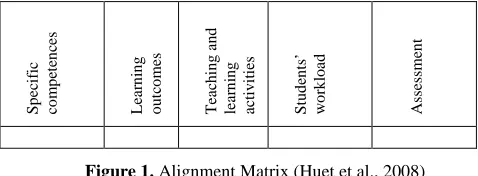
The redesign of the curricula based in the development of specific and transversal competences, according to the different courses and learning outcomes, requires a deeper reflection. In Portugal, the challenge lies on designing a curriculum that aligns the content, the process of learning and assessment. The intended learning outcomes should conduct the design of the curricula and the ECTS but, in practice, this objective is not so easy to achieve. This communication addresses the importance to align the curriculum and its intended outcomes, the teaching and learning methods, and the assessment of the curricular units (see Figure 1).
S p ec if ic co m p et en ce s L ea rn in g o u tc o m es T ea ch in g a n d le ar n in g ac ti v it ie s S tu d en ts ’ w o rk lo ad A ss es sm en t
Figure 1. Alignment Matrix (Huet et al., 2008)
This work was supported by the theory of constructive alignment (Biggs, 1999; 2002). The authors took into consideration 6 steps in the alignment process (Huet et al., 2008):
1. defining the specific competences and intended learning outcomes. The transversal competences were thought at a bottom-level analysis;
2. choosing teaching/learning activities likely to lead, help and encourage students to attain these learning outcomes;
3. engaging students in these learning activities through the teaching process;
4. giving feedback to help students improve their learning;
5. defining the students’ workload (time spent in classes and outside classes) in order to calculate the ECTS;
6. assessing students’ learning outcomes using methods that enable students to demonstrate the intended learning and evaluating how well they match what was intended.
Writing Learning Outcomes in the Cognitive
Domain: Practical Advice for Writing Learning
Outcomes in Economic Programmes
Six categories of learning were identified by Bloom as: knowledge, comprehension, application, analysis, synthesis and evaluation (Adam, 2006). Bloom’s taxonomy is frequently used for writing learning outcomes, since it provides a ready-made structure and list of verbs. It can be argued that the use of the correct verbs is the key to the successful writing of learning outcomes. Bloom’s original list of verbs was limited and has been extended by various authors over the years. The list of verbs given in this article has been compiled by Kennedy (2008).
Knowledge may be defined as the ability to recall or remember facts without necessarily understanding them.
Some of the action verbs used to assess knowledge are as follows: arrange, collect, define, describe, duplicate, enumerate, examine, find, identify, label, list, memorise, name, order, outline, present, quote, recall, recognise, recollect, record, recount, relate, repeat, reproduce, show, state, tabulate, tell.
Some examples of learning outcomes for courses in various disciplines in economic that demonstrate evidence of knowledge include the following:
• Describe economic concepts and principles.
• Define how to apply economic reasoning to policy issues.
Comprehension may be defined as the ability to understand and interpret learned information. Some of the action verbs used to assess comprehension are as follows: associate, change, clarify, classify, construct, contrast, convert, decode, defend, describe, differentiate, discriminate, discuss, distinguish, estimate, explain, express, extend, generalise, identify, illustrate, indicate, infer, interpret, locate, paraphrase, predict, recognise, report, restate, rewrite, review, select, solve, translate.
Some examples of learning outcomes that demonstrate evidence of comprehension are:
• Explain economic theory and modelling approaches. • Recognise mathematical and statistical techniques and information technologies, necessary for an economist.
Application may be defined as the ability to use learned material in new situations, e.g. put ideas and concepts to work in solving problems. Some of the action verbs used to assess application are shown as follows: apply, assess, calculate, change, choose, complete, compute, construct, demonstrate, develop, discover, dramatise, employ, examine, experiment, find, illustrate, interpret, manipulate, modify, operate, organise, practice, predict, prepare, produce, relate, schedule, select, show, sketch, solve, transfer, use.
Some examples of learning outcomes that demonstrate evidence of application are:
• Apply the concepts of balance, disbalance and stability.
• Demonstrate strategic thinking on the basis of possibility and outcome evaluation.
Analysis may be defined as the ability to break down information into its components, e.g. look for inter-relationships and ideas (understanding of organisational structure). Some of the action verbs used to assess analysis are as follows: analyse, appraise, arrange, break down, calculate, categorise, classify, compare, connect, contrast, criticise, debate, deduce, determine, differentiate, discriminate, distinguish, divide, examine, experiment, identify, illustrate, infer, inspect, investigate, order, outline, point out, question, relate, separate, sub-divide, test.
Some examples of learning outcomes that demonstrate evidence of analysis are:
• Analyse how economic ideas evolved and the variety of methods for economic analysis.
• Calculate alternative economic costs.
generalise, generate, integrate, invent, make, manage, modify, organise, originate, plan, prepare, propose, rearrange, reconstruct, relate, reorganise, revise, rewrite, set up, summarise.
Some examples of learning outcomes that demonstrate evidence of synthesis are:
• Recognise stimuli and inadequacies in a concrete economic context.
• Propose solutions to economic problems both verbally and in writing.
Evaluation may be defined as the ability to judge the value of material for a given purpose. Some of the action verbs used to assess evaluation are: appraise, ascertain, argue, assess, attach, choose, compare, conclude, contrast, convince, criticise, decide, defend, discriminate, explain, evaluate, grade, interpret, judge, justify, measure, predict, rate, recommend, relate, resolve.
The following are some examples of learning outcomes that demonstrate evidence of evaluation are:
• Relate differences in economic policy recommendations to differences in the theoretical and empirical features of the economic analysis, which underlie such recommendations.
• Evaluate expectations and unexpected things while planning economic actions.
Linking Learning Outcomes to Teaching and
Assessment
The challenge for teachers is to ensure that there is alignment between teaching methods, assessment techniques, assessment criteria and learning outcomes. This connection between teaching, assessment and learning outcomes helps to make the overall learning experience more transparent. Student course evaluations show that clear expectations are a vitally important part of effective learning. Lack of clarity in this area is almost always associated with negative evaluations, learning difficulties, and poor student performance. Toohey (1999) recommends that the best way to help students understand how they must achieve learning outcomes is by clearly setting out the assessment techniques and the assessment criteria (Kennedy, Hyland, Ryan, 2006).
Learning outcomes imply the assessment criteria. Assessment criteria may be developed from the learning outcome or from the assessment task – but in either case they should relate to the learning outcome. There are many reasons for developing assessment tasks – such as to provide feedback and these will affect the manner in which an assessment task is designed. However, the purpose of the task with which we are concerned here is to test that the learning outcomes have been achieved. A teaching strategy, on this model, is seen as being designed in relation to assessment processes, providing the support necessary to enable the students to be successful in attaining the threshold indicated in assessment criteria (Moon, 2002).
In economic instruction, the evidence on the effectiveness of group learning has been promising but far from conclusive. Johnston (1997) found that introductory microeconomic students tutored in a group setting performed better on examinations. Similarly, Moore (1998) showed that students who participated in cooperative learning labs outside of the classroom reported the labs worthwhile and enjoyable. In more recent articles, Johnston
et al. (2000) and Brooks and Khandker (2002) incorporated a cooperative-learning approach in weekly recitations (labs). Johnston et al. (2000) found that students in cooperative-learning recitations spent more time preparing for the tutorials and were more interested but did not perform any better on the examinations. However, Brooks and Khandker, found that students in small cooperative-learning labs scored higher on the final exam. In a survey of 34 liberal arts colleges, Jensen and Owen (2001) reported that less lecture and more group learning in the classroom encouraged students to take more economic courses and become economics majors (Yamarik, 2007).
Conclusions
The traditional input-related curriculum has placed too strong emphasis on the teacher instead of the learner. Consequently there is a shift of paradigms from teaching to learning and oriented towards student-centred learning. This change has been associated with a need for reconstruction of curriculum design, and an acknow-ledgement that a greater and diversity of learning styles can be suggested to the learner. This has strengthened the need to express, through the medium of learning outcomes, knowledge, understanding, competences and other attributes within courses and their components.
Learning outcomes play an important role in ensuring the transparency of qualifications and of qualification frameworks. They are also essential for the implementation of the various action lines of the Bologna process throughout the European Higher Education Area.
The requirement to make teaching and learning process more transparent and more explicit presents a challenge to all involved in education. This involves preparing for the immediate challenge of expressing modules and programmes in terms of learning outcomes. In the longer term, the adoption of the learning outcomes approach has the potential to help embrace a more systematic approach to the design of programmes and modules (Kennedy, Hyland, Ryan, 2006).
Learning outcomes are not the universal panacea for all educational problems facing higher education and they certainly are related to some distinct problems that should be evaluated and researched.
References
1. Adam, S. An introduction to learning outcomes, in EUA Bologna Handbook, Froment E., Kohler J., Purser L., Wilson L. (eds), article B. 2. 3–1. Berlin, Raabe. 2006.
2. Adam, S. Learning outcomes, credits and qualifications
frameworks. Forum on Qualification Frameworks, Strasbourg, 11–
12th October, 2007. Available online at www.coe.int/ t/dg4 highereducation/Source/Stephen%20Adam%20-%20CREDITS% 20+%20LO%20+%20QF.ppt
3. Adam, S. Using Learning Outcomes: A consideration of the
nature, role, application and implications for European education of employing learning outcomes at the local, national and international levels. Report on United Kingdom Bologna Seminar,
July 2004, Herriot-Watt University. 2004.
4. Biggs, J. Teaching for Quality Learning at University. Open University Press, Milton Keynes, 1999.
6. Brooks, T. B., and Khandker, A. W. A cooperative learning lab:
Does the form matter? Contemporary Economic Policy, 2002, 20
(3): 330–38.
7. Colander, D. The future of economics: the appropriately educated
in pursuit of the knowable. Cambridge Journal of Economics,
2005, 29, p. 927–941.
8. Colander, D., Holt, R. and Rosser, B. The Changing Face of
Economics, Lansing, MI, University of Michigan Press, 2004.
9. ECTS Users’ Guide, 2005. Brussels: Directorate-General for
Education and Culture. Available online at http://ec.europa. eu/education/programmes/socrates/ects/doc/guide_en.pdf 10. Gosling, D. and Moon, J. How to use Learning Outcomes and
Assessment Criteria. London: SEEC Office, 2001.
11. Huet, I., Oliveira, J. M., Nilza, C., Estima de Oliveira, J. The effectiveness of alingnment matrices in curriculum design. Bologna Seminar on ‘Development of a common understanding of Learning Outcomes and ECTS’ Porto, Portugal, 19–20 June 2008.
12. Jenkins, A. & Unwin, D. How to write learning outcomes, 2001. Available online at http://www.ncgia.ucsb.edu /education/ curricula/giscc/units/format/outcomes.html
13. Jensen, E. J., and Owen, A. L. Pedagogy, gender, and interest in
economics. Journal of Economic Education, 2001, 34 (Fall): 323–43.
14. Johnston, C. G. Cooperative learning of economics in a peer
tutoring context at the University of Melbourne. Australian
Economic Papers 1997, 0 (special edition): 56–68.
15. Johnston, C. G., James, R. H., Lye, J. N., and McDonald, I. M. An
evaluation of collaborative problem solving for learning economics. Journal of Economic Education, 2000, 31 (Winter):
13–29.
16. Kenedy, D. Everything you need to know about Learning
Outcomes, 2008. Available online at http://portobologna.
up.pt/documents/BS_Porto_KL1_Declan_20080619.pdf 17. Kennedy, D., Hyland, A., Ryan, N. Writing and Using Learning
Outcomes: a Practical Guide, in EUA Bologna Handbook,
Froment E., Kohler J., Purser L., Wilson L. (eds.), article C. 3. 4–1. Berlin, Raabe, 2006.
18. Moon, J. The Module and Programme Development Handbook, Kogan Page, London, 2002.
19. Moore, R. L. Teaching introductory economics with a cooperative
learning lab. Journal of Economic Education, 1998, 29 (Fall): 321–
29.
20. Subject benchmark statements Economics. The Quality Assurance
Agency for Higher Education, 2007. Available online at http://www.qaa.ac.uk/academicinfrastructure/benchmark/statement s/Economics.pdf
21. Tauch, Ch. Understanding the Characteristics of European Degree
Structures, in EUA Bologna Handbook, Froment E., Kohler J.,
Purser L., Wilson L. (eds.), article B. 2. 1–1. Berlin, Raabe, 2006. 22. Toohey, S. Designing Courses for Higher Education. Buckingham:
SRHE and OU Press, 1999.
23. Yamarik, S. Does Cooperative Learning Improve Student Learning
Outcomes? Journal of Economic Education, 2007, 31 (Summer):
259–277.
Pranas Žiliukas, Egl÷ Katiliūt÷
Studijų rezultatų aprašai ir jų naudojimas ekonomikos programose
Santrauka
Vienas iš svarbių veiksnių, darančiųįtaką pokyčiams aukštojo mokslo sektoriuje, yra dinamiška išorin÷ aplinka. Valstybin÷s institucijos ir įmon÷s yra priverstos reaguoti į aplinkos pokyčius, kuriuos sąlygoja globalizacijos ir integracijos procesai. Galima pasteb÷ti pokyčius ir visoje ekonomikos sistemoje. Tiek d÷l augančiųūkio reikmių, tiek ir d÷l globalizacijos procesų
bei su jais susijusių tarptautinių ekonominių ryšių pl÷tros prognozuojama, jog prireiks daugiau kvalifikuotų ekonomikos specialistų. Tod÷l aukštosioms mokykloms rengiant aukštos kvalifikacijos ekonomikos specialistus, galinčius prisid÷ti prie efektyvios įmonių bei valstyb÷s institucijų veiklos, būtina suteikti jiems naujausių ekonomikos žinių, ugdyti geb÷jimus adaptuoti ekonomikos modelius ir analitinius ir tarp disciplininių
tyrimų metodus. Naujai parengtų specialistų ekonomin÷ kompetencija ir
geb÷jimas efektyviai ja naudotis yra būtina Lietuvos ūkio konkurencingumo didinimo sąlyga.
Tarptautin÷s iniciatyvos (Bolonijos procesas, Lisabonos deklaracija ir kt.) turi įtakos aukštojo mokslo sistemų raidai tiek Europos, tiek nacionaliniuose lygmenyse. Europos Komisijos ar kitų Europos Sąjungos institucijų priimti teis÷s aktai ar rekomendacijos tampa gair÷mis Bolonijos proceso šalių narių aukštojo mokslo sistemos pokyčiams. Berlyno (2003) ir Bergeno (2005) komunikatuose akcentuojama tiesiogin÷ studijų rezultatų įtaka Bolonijos proceso s÷kmei ir skatinama kurti palyginamų ir suderinamų
kvalifikacijų sistemas, kurios apibūdintų kvalifikacijas per studijų krūvį, lygį, studijų rezultatus, kompetencijas ir profilį (Berlyno komunikatas, 2005).
Šiame straipsnyje siekiama atsakyti į klausimus: Koks yra skirtumas tarp tikslų, uždavinių ir studijų rezultatų? Kaip galima aprašyti studijų
rezultatus ekonomikos programose? Straipsnio tikslas – atskleisti studijų
rezultatų sampratą ir jų naudojimą ekonomikos programose. Tyrimo metodai – mokslin÷s literatūros apžvalga ir dokumentų analiz÷.
Iki 2010 metų visos programos ir reikšmingi programų sudedamieji elementai Europos aukštojo mokslo institucijose turi būti pagrįsti studijų
rezultatais ir tai turi atspind÷ti mokymo programų turinys (Kennedy, Hyland, Ryan, 2006).
Studijų rezultatai yra teiginiai apie tai, ką studentas tur÷tų žinoti, suvokti ir geb÷ti pademonstruoti baigęs savo studijas. Teiginiai gali apimti atskirą kursą, dalyką ar modulį arba visą studijų laikotarpį, pavyzdžiui, pirmąjį ar antrąjį studijų programos ciklą. Studijų rezultatuose tiksliai apibr÷žiami iškelti reikalavimai, kuriuos įvykdžius gaunami kreditai (ECTS Users’ Guide, 2005). Studijų rezultatai apibr÷žiami nurodant, ką privalo išmokti studentai, o ne atsižvelgiant į tai, ko siekia išmokyti d÷stytojai.
Studijų rezultatai atspindi studijų ir darbo rinkos poreikių sąryšį, akademin÷s bendruomen÷s atstovų bendradarbiavimą su socialiniais partneriais, lemia vidinę studijų programos sąrangą ir rengimo logiką bei jos kokybę. Apibr÷žti studijų rezultatai palengvina studijų programos suvokimą, jos vidinį ir išorinį įvertinimą ir kvalifikacijų pripažinimą, yra naudinga standartų ir kokyb÷s sistemai palaikyti ir tobulinti. Studijų rezultatų
pagrindu yra formuluojami ir svarbiausi studentų pasiekimų vertinimo kriterijai.
Patys studijų rezultatai, remiantis Bloomo taksonomija, paprastai nusakomi veikiamosios rūšies veiksmažodžių formomis, nurodančiomis išmokimo lygius: žinias, supratimą, pritaikymą, analizę, sintezę ir vertinimą. Tinkamai apibr÷žti studijų rezultatai tur÷tų būti nusakomi žodžiais, kurie nurodo, ką studijuojantysis geb÷s atlikti s÷kmingai užbaigęs studijas; apibūdina konkrečias priemones, su kuriomis studentas geb÷s veikti, ir situacijas, kurioms esant jis dirbs; apibr÷žia reikalaujamą veiklos būdą, kuriuo galima pademonstruoti, ką studentas pasiek÷ per studijas (Moon, 2002). Studijų rezultatų aprašymo pavyzdžiai ekonomikos pagrindinių
studijų programos įvairiuose studijų moduliuose: žinių lygio studijų
rezultatai (geb÷s apibr÷žti ekonomikos sąvokas ir principus; geb÷s apibū -dinti ekonomin÷s argumentacijos taikymą svarstant politikos problemas),
supratimo lygio studijų rezultatai (geb÷s paaiškinti pagrindines ekonomines teorijas bei ekonomin÷s analiz÷s metodų įvairovę; supras ekonomistui būtinus matematinius ir statistinius metodus ir informacines technologijas),
pritaikymo lygio studijų rezultatai (geb÷s taikyti pusiausvyros, disbalanso ir stabilumo koncepcijas, geb÷s taikyti strateginį mąstymą galimybių ir pasekmių vertinimo pagrindu), analiz÷s lygio studijų rezultatai (geb÷s analizuoti ekonominių id÷jų pl÷tojimąsi, geb÷s analizuoti vartotojų lūkesčius ir jų tenkinimo būdus, geb÷s apskaičiuoti alternatyvius ekonominių
sprendimų kaštus), sintez÷s lygio studijų rezultatai (geb÷s atpažinti stimulus ir neatitikimus konkrečiame ekonominiame kontekste, geb÷s pateikti ekonominių problemų sprendimus raštu ir žodžiu), vertinimo lygio studijų
rezultatai (geb÷s susieti ekonomin÷s politikos rekomendacijų skirtumus su ekonomin÷s analiz÷s, kuria pagrindžiamos šios rekomen-dacijos, teoriniais ir empiriniais bruožais; geb÷s įvertinti lūkesčius ir netik÷tumus planuojant ekonominius veiksmus).
Studijų rezultatai svarbūs studijų programos studijų turiniui rengti, studentų pasiekimams vertinti, studijų kokybei užtikrinti ir standartams bei nacionalinei ir tarptautinei švietimo sistemai pl÷sti. Aiškus ir tikslus studijų
rezultatų apibr÷žimas, rengiant studijų programą, užtikrina studijų programą
sudarančių studijų dalykų ar modulių darną, padeda atskleisti persidengimus tarp geb÷jimų, įgyjamų studijuojant skirtingus studijų dalykus, ir palengvina studijų turinio projektavimą ir įgyvendinimą. Remiantis studijų rezultatais, apibr÷žiami studijų tikslai, derinami skirtingi tos pačios studijų programos studijų dalykai ir prognozuojama studijų pažangos įžvalga.
Studijų rezultatai atsispindi esminį d÷stymo, studijavimo ir vertinimo ryšį. D÷stytojams studijų rezultatai nurodo, kokias žinias, supratimą ir
Studijų kokyb÷s užtikrinimo ir standartų lygmenyje studijų rezultatai didina skaidrumą ir kvalifikacijų standartų palyginimo galimybes. Studijų
rezultatai, išreikšti įgyjamomis kompetencijomis, sąlygoja profesijų
standartų, kvalifikacijų apibr÷žimą ir vertinimą, atskirų kvalifikacijų
standartų palyginimo galimybes ir jų pripažinimą. Studijų rezultatai tampa svarbiausiu kriterijumi kuriant ir vertinant standartus nacionaliniu ir tarptautiniu lygmenimis.
Raktažodžiai: studijų rezultatai, kompetencijos, ekonomikos programos, mokymas, vertinimas.