ISSN 1392-2785 Inzinerine Ekonomika-Engineering Economics(4). 2009 THE ECONOMIC CONDITIONS OF ENTERPRISE FUNCTIONING
Environmental Management Systems and Tools Analysis
Juozas Ruzevicius
Vilnius University, International Business School
Sauletekio av. 22, LT-10225 Vilnius, Lithuania [email protected]
This article presents an analysis of changes in the development and expansion of implementation of organizations’’ environmental protection measures, as influenced by globalization and internationalization processes on the world’s economy and various fields of activity, and their impact on competitiveness. The study describes the system of international environmental certification and other sustainable development protection measures, encompassing the eco-labeling of products, accommodation and recreation services, forest and timber supply chains, the energy certification of buildings, the ISO ecological and ergonomic certification of computer equipment and mobile phones, identification of packaging materials, environmental management systems (EMS) certification, etc. The article also presents the international benchmarking of the ecological footprint – an integral indicator reflecting sustainable development. It should be noted that the current level of human consumption already exceeds the Earth‘s ecological potential, i.e., the ecological footprint of all the countries in the world exceeds nature‘s capacity for regeneration. Lithuania has a positive ecological balance, meanwhile, the ecological footprint of the Ukraine and Belarus exceeds the country’s biological potential respectively by 0.3 and 0.4 global hectares per person.
The features and problem areas of EMS (namely, ISO 14001 and EMAS), and the process of implementation of other measures in Lithuania and in an international context are also presented. For a more objective comparison of sustainable development in individual countries and regions, the author suggests the use of a new indicator – the number of certificates (ISO 14001, EMAS, ecological products, etc.) per 1 million inhabitants of a country’s total population. Although there was a marked increase in the implementation of ISO 14001 systems in recent years, according to the number of implemented environmental management systems per 1 million inhabitants, Lithuania lags considerably behind not only the most developed nations, but also some of the new EU countries. To date, there are no EMAS environmental systems in place in Lithuania, yet they are being successfully implemented in other EU countries and in the neighbouring Baltic countries. The main reason why this type of system of environmental measures has not been implemented in Lithuania is an inadequate understanding on the part of the leaders of organizations of the essential differences between EMAS and ISO 14001 (this was noted by 89% of respondents). It is recommended that the government institutions responsible for formulating Lithuania’s environmental policies boost their environmental certification infrastructure, carry out the realistic development of “green purchases”, and encourage
Lithuanian organizations to create and certify EMAS environmental systems, while secondary schools should be drawn into the globally acknowledged and effective Kids’ ISO 14000 programs. The implementation of such a program in our country is very important and deserves to receive government funding as well as funding from business organizations declaring their social responsibility. The education of children in environmental awareness is one of the most important ways to solve environmental concerns in Lithuania and throughout the world, and to develop the way towards creating an ecological balance. Effective environmental education should also involve tertiary students from all disciplines, business enterprises, and public sector and government administration institutions.
Keywords: environmental management system, sustainable development, ISO 14001, EMAS, eco-labeling, certification, environmental footprint, benchmarking.
Introduction
The growing demand, on a global scale, to protect the environment – air, water, the life of humanity, the animal and plant world, natural resources and ecosystems – will be determined by essential policy changes of organizations covering all fields of activity, such as manufacture, services, marketing, consumer and state leadership, international economic and political organizations. It is no longer sufficient to solve ecological problems through the environmental activities of only some countries – the combined and coordinated efforts of all countries and international organizations are necessary.
In the 1970s, there was an intensive move towards the preparation of environmental legislation, technical regulations, and normative documents. At the same time, concepts such as eco-business, environmentally-orientated activities, continuous development, balanced development, cohesive development, and sustainable development started to appear in academic articles and documents (Burinskiene, 2009; Ciegis et al., 2009; Grybaite & Tvaronaviciene, 2009; Grundey (2009); Hillary, 2000; Karlavicius, 2009; Mahlman, 1998; Marijano, 2001; Relano. 2008; Ruzevicius, 2009; Zutshi & Sohal, 2004 et al.). According to the principle of sustainable development, a country’s economic and social development should be orientated in such a way that the satisfaction of today’s needs would not impinge on the opportunities for satisfying the needs of future generations. The Gro Brundtland Commission’s* report Our Common Future (1987) highlights
that the government, public organizations, and enterprises are not only able to, but must combine and direct their efforts towards solving environmental concerns, as they pose a risk to the existence of society itself. Later, in 1992, the International Chamber of Commerce Business Charter for Sustainable Development formulated 16 principles enterprises were advised to follow in the field of environmental protection. Almost at the same time, the European Union Common Social Responsibility Policy was formulated and passed, where most attention was directed to the main sectors of economy and society. It foresaw new market methods that would aim to minimize and regulate negative impacts on the environment, and the broad distribution of information. At the crux of the Common Social Responsibility Policy are the principle of social responsibility and the support of voluntary activities in environmental protection. International organizations and governments are starting to realize that traditional environmental control measures and state regulation based on strict administrational methods and coercion can no longer ensure a stable ecological situation. It is important that individual enterprises continuously improve their activities in the field of environmental protection. For this to take place, in addition to the mandatory environmental requirements that are defined in laws and other legal acts, new measures are being created that encourage enterprises of different sectors (industry, services, banking, logistic, agriculture, etc.) to willingly strive towards achieving better ecological results (Burinskiene, 2009; Grybaite & Tvaronaviciene, 2009; Grundey (2009); Karlavicius, 2009; Relano. 2008; Ruzevicius, 2009) .
The media event of 1992 was undoubtedly the United Nations Conference in Rio de Janeiro for environment and development, better known as the “Earth Summit”. The declaration in which this provision was consolidated on a global scale, at the Earth Summit, was signed by many countries, including Lithuania. Every nation should have an environmental policy uniting all sectors of the economy and territorial development strategies.
This event changed outlooks in several ways of sustainable development and social responsibility. The key change – it became received wisdom that sustainable development should address not only environmental issues, but should seek equilibrium between the aspects of environment, social activity and the economy (Rennings et al., 2006; Ruzevicius & Waginger, 2007; Scot, 2003; Ubius & Alas, 2009). Lithuania signed the declaration containing this point together with other countries in Rio de Janeiro in 1992. Every state must have an environmental policy, which links all development strategies of economy branches and territories.
Seeking for the highest international competitiveness and unexceptionable quality level of products and services, companies must manage their work by following the principles of sustainable development. Developing according to the principles of sustainable development, it has become increasingly clear that sustainability means long-term and far-reaching changes of technologies (Burinskiene, 2009; Ciegis & Ciegis, 2008; Rennings et al., 2006; Snieska, 2008). Because of the rising stakeholders’ pressure, successful companies are engaged to share their success with others and to benefit people, business and
environment. Organizations are about to form informal social-economic contract between an organization and its stakeholders. Today such a situation may be called “corporate life”. The organizations are being motivated to improve both social and environmental practices and the cooperation with the stakeholders voluntary by the attempts of various international initiatives. In order to guarantee the durable partnership between the companies all around the world and the stakeholders concerned about the transparency of the businesses results, organizations consolidate into the global corporate social responsibility (CSR) networks, use various means to implement the concept of corporate social responsibility and sustainability into the business practice: from abstractly declared to standardized worldwide (Juscius & Snieska, 2008; Relano, 2008; Ruzevicius, 2009; Zutshi & Sohal, 2004). Direct and tight links between CRS and sustainable development are clearly visible. On the other hand, organizations’ public reports have shown a marked change from the purely environmental to the current wave of sustainable development and corporate responsibility reporting.
The aim of the research: to examine and identify the typology of international environmental management systems, tools and their elements, to analyze the development of their expansion in Lithuania and in an worldwide business context, and to formulate insight on how they might be implemented more effectively.
The research object: environmental management systems, tools and their elements used in the Lithuanian, European and global businesses.
The research methods: systematic analysis of scientific, normative, and statistical literature, logical analysis, benchmarking and summary of organizations’ environmental activities, author’s research conducted on Lithuanian organizations.
Ecological footprint as an integral indicator of sustainable development
Ecological footprint (EF) is an integral indicator reflecting national and global sustainable development. It shows the effect inhabitants of a particular region or country have on the environment they live in and on natural resources (Wackernagel et al., 2004). EF is the area of land and water (in global hectares – gha) required to sustain one individual’s current level of consumption (food, housing, transport, energy, waste disposal, etc.). This unit of measurement allows the evaluation of the relationship between people‘s consumer needs and the existing natural resources. A global hectare is a measurement of the average biocapacity of the Earth, based on resource manufacture and waste assimilation, that is, the Earth‘s biologically productive area of land and marine zones expressed in hectares. The EF reflects humanity’s anthropogenic impact on global ecosystems.
biological potential) was only 13.6 billion gha (2.1 gha per person). In other words, according to the current rate of global consumption, humanity needs 1.3 planet Earths.
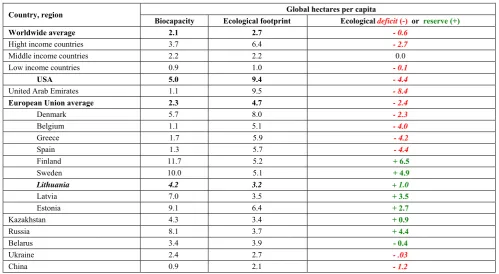
Traditionally wasteful countries like the USA, the United Arab Emirates, and high income countries in the EU leave the greatest EF. The EF of one US citizen is 9.4 gha. Seven percent of the world’s population live in the territory of the European Union, yet they use 17 % of the world’s natural resources. The EF of EU citizens exceeds the biological ecosystem potential 2.2 times. From 1961 until 2005, the ecological footprint of the EU grew by 70
% (Europe…, 2006) If people all over the world followed the same model of consumption as US citizens, we would need 4.5 planet Earths, and if everyone consumed the same as citizens of the developed EU countries, at least 3 planet Earths would be needed. Finland and Sweden have the biggest ecological reserve, and Spain and Greece have the biggest ecological deficit among EU countries. It should be
noted that so far, Lithuania has a positive ecological balance, meanwhile, the ecological footprint of the Ukraine and the Belarus exceeds the country‘s biological potential respectively by 0.3 and 0.4 gha (Table 1).
Table 1
Ecological footprint and biocapacity of the countries and regions
Global hectares per capita Country, region
Biocapacity Ecological footprint Ecological deficit (-) or reserve (+)
Worldwide average 2.1 2.7 - 0.6
Hight income countries 3.7 6.4 - 2.7
Middle income countries 2.2 2.2 0.0
Low income countries 0.9 1.0 - 0.1
USA 5.0 9.4 - 4.4
United Arab Emirates 1.1 9.5 - 8.4
European Union average 2.3 4.7 - 2.4
Denmark 5.7 8.0 - 2.3
Belgium 1.1 5.1 - 4.0
Greece 1.7 5.9 - 4.2
Spain 1.3 5.7 - 4.4
Finland 11.7 5.2 + 6.5
Sweden 10.0 5.1 + 4.9
Lithuania 4.2 3.2 + 1.0
Latvia 7.0 3.5 + 3.5
Estonia 9.1 6.4 + 2.7
Kazakhstan 4.3 3.4 + 0.9
Russia 8.1 3.7 + 4.4
Belarus 3.4 3.9 - 0.4
Ukraine 2.4 2.7 - .03
China 0.9 2.1 - 1.2
(Source: designed by the author, using Ecological..., 2008)
Today we can say that the Earth‘s ecological footprint has doubled since the 1950s. The planet‘s degradation is encouraged by globalization and the scale of international trade growth. In 1961, the ecological footprint of international trade objects made up 8% of the global EF, while in 2005 this value had grown to over 40% of the global EF. If there are no cardinal environmental and sustainable development measures applied in the near future on a global scale, then by 2040, the maintenance of the current, irresponsible levels of consumption and lifestyles will demand two planet Earths (Ecological…, 2008; Living…, 2009). This is why, both the EU, and all other economically-developed countries throughout the world should prepare a new sustainable development strategy that involves both the marked development of the production of renewable natural resources, and the implementation of various environmental measures (the typology and features of which will be discussed later in this article). Sustainable development can encourage the wider application of sustainable trade and fair trade
principles and standards on a world-wide scale. Compliance with these standards is validated by a suitable certification and labeling system which encompasses the use of natural
resources and energy, the formation of hazardous waste, and social responsibility and justice.
Environmental management tools system
yet single, obvious examples of initiative were not unheard of. Special measures were created to support these activities, such as eco-labeling and environmental management standards, whose requirements supplemented the mandatory environmental requirements regulated by government institutions.
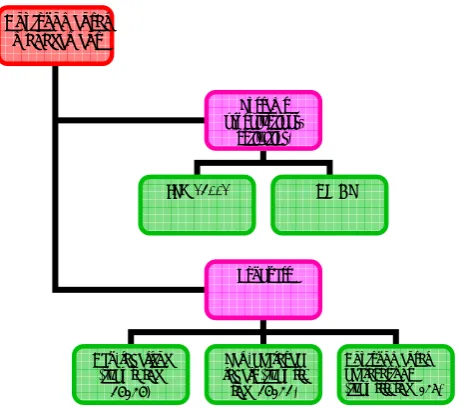
The environmental management systems ISO 14001 and EMAS (Eco-management and audit scheme), and eco-labeling, are identified as voluntary measures. Of these two types of environmental management systems (EMS), only ISO 14001 standards are being implemented in Lithuanian organizations thus far. The European system of standardized ecological management tools is presented in Figure 1.
Figure 1. Standardized tools of ecological management (designed by the author)
Organizations in the European Union implement two types of EMS – ISO 14001 and EMAS as well as implementing ecological certification programmes and the eco-labeling of products and services
Changes in the development and expansion of implementation of organizations’’ environmental protection measures are being influenced by globalization and internationalization processes on the world’s economy and various fields of activity, and their impact on competitiveness (Scot, 2003; Ruzevicius, 2008a; Zutshi & Sohal, 2004). The current system for international environmental certification and other sustainable development measures encompasses the following sub-systems:
1. Environmental management systems (ISO 14001 and EMAS);
2. Environmental certification and labeling of products (Calabro, 2007; D’Sauza, 2004; Evaluation…, 2005; Grundey, 2009; Kollmann, 2006; Ruzevicius & Waginger, 2007; Vossenaar, 1996);
3. Environmental certification of accommodation and recreation services (hotels, farmsteads, jetties, beaches) (Herbig, 1997; Jayawardena, 2003; Kirk, 1995; Sinclair, 2003; Ruzevicius & Waginger, 2007); 4. FSC (Forest Stewardship Council) or PEFC
(Programme for the Endorsement of Forest Certification Council) certification of forests and the timber supply chain (Ruzevicius, 2008b);
5. Energy certification of buildings;
6. Ecological and ergonomic TCO (Swed.
Tjänstemännens Centralorganiation) certification of computer equipment, mobile phones, and office furniture;
7. Ecological certification of automobiles;
8. Mandatory labeling of the efficiency and other characteristics of household appliances (refrigerators, washing machines, dishwashers, electrical light bulbs, etc.).
The ecological labeling system ensures that consumers have access to ecological products and services and they might adjust their preferences towards environmentally friendly business practices. For business worldwide, ecological marketing and its applications in practice have become a competitive prerogative for modern business performance (Grundey, 2009; Ruzevicius & Waginger, 2007). In the beginning of 2009, approximately ten non-food products manufactured by Lithuanian enterprises had environmental certification. In other words, the variety of objects with eco-labeling in Lithuania is growing – in the middle of the last year, seven beaches, four hotels, and several rural tourism farmsteads had been certified, and all state forests had FSC certification. In 2009, an energy certification system for buildings is due to be implemented in Lithuania.
Environmental management
Systems
organizations‘ activities)
Products
ISO 14001 EMAS
Eco-labelling
(type I, ISO 14024)
Self-declared labels (type II, ISO 14021)
Environmental declarations (type III, ISO025)
Environmental management system ISO 14001
One of the most important expressions of environmental management and internationalization is the standardized creation of environmental management systems (EMS) and their systematic improvement and application in organizations in business and public sectors. The purpose of ISO 14001 is to bring order to the environmental concerns of an enterprise. It is an international standard that can be applied to any type and size of organization, under various geographical, social, and cultural conditions. ISO 14001 is designed for the enterprise that wishes to implement, maintain, and improve its environmental management system; ensure that it will comply with the organization’s own self-declared environmental policy; strive to conform to the requirements and publicly demonstrate its compliance; ensure that it abides by environmental legal requirements and norms; and seek to have its environmental management system certified by an external organization (Hillary, 2000; Scot, 2003). Compared to other environmental management systems, the advantage of ISO 14001 is its world-wide acceptance, clearly defined certification criteria, and performance of independent, standardized audits.
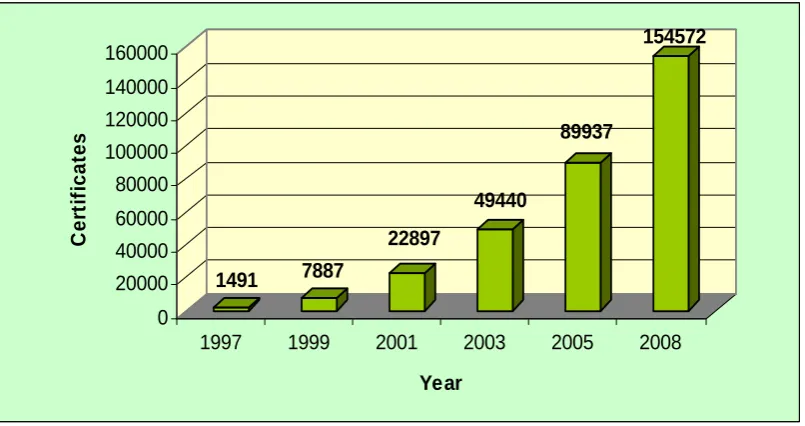
As of September 1, 2009, 451 Lithuanian enterprises had implemented the ISO 14001 EMS (Figure 2). The number of certified EMS in Lithuania increased in the period 2001– 2008 more that thirty folds. The growth of this indicator in Lithuania is much faster than the world average (see Fig. 2 and Fig. 3). The creation of EMS helps ascertain, define and activate the technological, technical, and organizational opportunities existing in a great deal of enterprises – opportunities which can be used to resolve environmental problems.
1 10 34
72
155 208
252 312
391 451
0 50 100 150 200 250 300 350 400 450 500
N
u
m
b
er
o
f cer
ti
fi
cat
ed
c
o
m
p
an
ies
1998 2001 2003 2004 2005 2006 2007 2008 2009 2009.09.01
Year
Figure 2. Development of environmental management systems ISO 14001 in Lithuania by the number of certified enterprises, start of period
(Source: designed by the author using data of the Lithuanian Standard Board)
been implemented by Switzerland‘s UBS Bank, Sweden‘s Malardalen University, Riga’s hospital, France‘s Auchan retail chain, to name but a few (Peglou, 2006; Ruzevicius & Waginger, 2007). Global practice has shown that EMS allows enterprises to reduce their negative impact on the environment by 20-30 % (Hillary, 2000; Uyar, 2008). China, Japan, Spain, and Italy have the greatest number of enterprises certified according to the ISO 14001 model (see Fig. 4).
However, the comparison and evaluation of countries according to the total number of certified organizations, as is commonplace in the official statistical publications of the ISO, is not informative enough. That is why, the author of this article suggests using a relative indicator to attain a more objective comparison – the number of ISO 14001 certificates per 1 million of a given country’s population.
According to this relative environmental activity indicator,
the ranking of countries is totally different – Brunei, Lichtenstein, and Sweden are front runners in the world, while Lithuania is overtaken not only by CIS countries such as Kazakhstan, Ukraine, and Russia (see Fig. 5), but also Germany, France, China, and the US. This indicator can enable the comparison of different countries’ and regions’ sustainable development efforts and their effectiveness.
Even though the total number of enterprises that had certified their environmental activities in Lithuania grew approximately 31 times in the 2001-2008 period (Figure 2), while on a world-wide scale this indicator grew only both the leading countries (Figure 5), and the new EU countries (Czech Republic, Slovenia, Estonia, and Hungary) in terms of the number of EMS per 1 million inhabitants. Thus, this issue should be of concern to both business organizations and government institutions.
1491 7887
22897
49440
89937
154572
0 20000 40000 60000 80000 100000 120000 140000 160000
C
e
rt
if
ic
a
te
s
1997 1999 2001 2003 2005 2008
Year
Figure 3. Evolution of environmental management systems (ISO 14001 in the world by the number of certified enterprises, start of period
30489 27955 13852
12057 7323
6392 5462 4877 3800 3476 312
267 90 73
0 5000 10000 15000 20000 25000 30000 35000
China Japan Spain Italy United Kingdom South Korea USA Germany Sw eden France Lithuania Russia Ukraine Kazakhstan
C
oun
tr
y
Num be r of ce r tificate s
Figure 4. Worldwide top 10 countries (and Romania, Lithuania, Russia, Ukraine and Kazakhstan) by the number of ISO 14001 certificated enterprises, start of 2008
(Source: designed by the author using data of The ISO Survey, 2008 )
991,33 870,25
417,23 307,80
267,49 249,23 223,14 217,30 202,48 180,56 91,66
4,98 1,96 1,86
0,00 200,00 400,00 600,00 800,00 1000,00 1200,00
Brunei Liechtenstein Sw eden Spain Czech Republic Sw itzeland Slovenia Japan Italy Denmark Lithuania Kazakhstan Ukraine Russia
C
oun
tr
y
Ce rtificate s pe r 1 m illion of population
Figure 5. Worldwide top 10 countries (and Lithuania, Kazakhstan, Ukraine, Russia) by the number of ISO 14001 certificated companies per 1 million of population ( start of 2008)
(Source: designed by the author using The ISO Survey, 2008 )
EMAS – the European Community’s Eco-management and Audit Scheme
This is a voluntary system for organizations that want to evaluate, manage, and improve their environmental performance. This system is open to all public and private organizations operating in the European Union and in the European Economic Area (Iceland, Lichtenstein, and Norway). EMAS was created in 1993 and started being implemented in April 1995, with a review in 2001.
At the beginning, EMAS systems were applied only to enterprises in the industrial sector. Currently, they have been adapted for organizations from all sectors. By participating in EMAS projects, a company is obliged to evaluate and improve its environmental performance and present all the relevant information to the public. Generally speaking, EMAS has the same environmental system
61,8 43,2
42,8 34,6
31,0 22,8
22,5 9,4
8,3 7,7
0,0 10,0 20,0 30,0 40,0 50,0 60,0 70,0
Austria
Greece
Denmark
Belgium
Spain
Italy
Germany
Finland
Sweden
Portugal
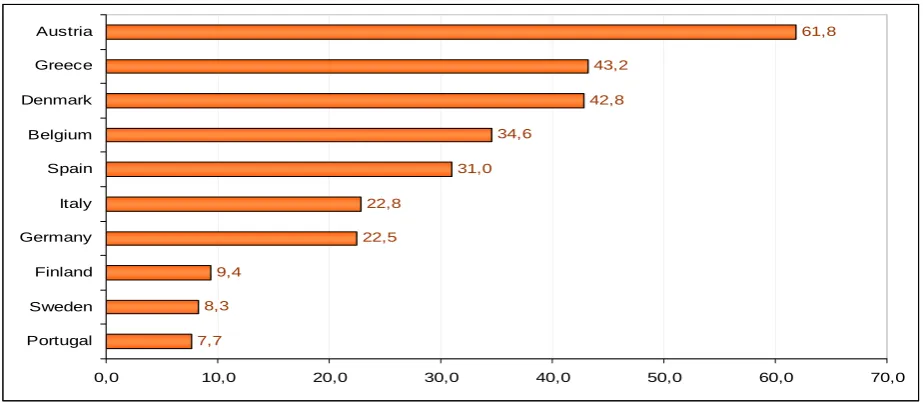
Figure 6. EU top 10 countries by the number of EMAS systems per 1 million of population, start of 2009
(Source: designed by the author using data EMAS..., 2009 )
EN ISO 14001 (2004) requirements
+Public reporting
+Legal compliance +Employees
participation
+ Performance improvement
EMAS require-ments
Figure 7. EMAS and ISO 14001 requirements’ comparison (Source: EMAS…, 2009)
According to the number of EMAS per 1 million inhabitants, Austria is the European leader (see Fig. 6). It is regretful that Lithuania and Bulgaria are the only EU countries that have no EMAS registered systems. Meanwhile, our neighbour Latvia is in 12th position among EU countries according to the total number of EMAS systems.
In order to ascertain the reason behind Lithuania‘s lag in this respect, 250 Lithuanian organizations were surveyed at the end of 2008; among them, 50 had certified ISO 14001 environmental management systems in place. The main reason for not implementing this type of EMS was the inadequate understanding of the essential differences between EMAS and ISO 14001 (as noted by 89 % of respondents). On the whole, the requirements of EMAS systems are higher, compared to ISO 14001 (Figure 7). The EMAS regulations specify the following additional requirements for organizations:
• Mandatory review of the existing environmental performance.
• Evaluation criteria must be available to the public.
• Employee participation in defining the organization’s environmental goals.
• Suppliers and contractors must also satisfy the
environmental policy requirements.
• Environmental audit completed at least every three years.
• Recommended use of environmental protection
effectiveness indicators.
• The organization must issue a public environmental statement.
important motivating factors for the implementation of environmental management systems in Lithuania is the goal to reduce their ecological risk, increase their competitiveness, and maintain and broaden their position in foreign markets where there are strict environmental protection requirements, among others. These implementation motivators also improve the image of an enterprise. It is important to note that most of the surveyed enterprises export their production. Thus, concern for their image is related to the goal of establishing themselves in foreign markets (Hillary, 2000; Rios et al., 2006; Uyar, 2008).
The government institutions responsible for forming Lithuania’s environmental policies should encourage organizations to implement EMAS systems as they ensure a higher level of environmental protection, compared to the ISO 14001 EMS. The EMAS requires a mandatory environmental status review, publicly available evaluation criteria, that suppliers and contractors also meet the set environmental requirements, a Public Environmental Statement revealing the effectiveness of the organization’s environmental protection activities, beside other requirements. In other words, the experiences of the leading European countries indicate, that EMAS systems are being implemented not only by industrial enterprises, but also services and public sector organizations, such as hotels, restaurants, governmental and public sector institutions, education offices, hospitals, etc. (EMAS, 2009). This is an example that should be followed by both industrial and public sector organizations in Lithuania.
EMS and fostering environmental awareness among children
When tackling ecological problems, environmental education and fostering ecological awareness among our country‘s children is of utmost importance. The United Nations, UNESCO and ISO support a new and very promising international initiative – the Kids’ ISO 14000 program. This environmental program for kids was created in 2000 by the Japanese non-profit organization Artech (Kids’…, 2009). The program‘s exceptional significance was acknowledged by the International Standards Organization (ISO), giving the exclusive rights to use their ISO acronym in the program‘s title – Kids’ ISO 14000. The main goal of the program is to create an environmentally aware global network of children. It is widely known that environmental problems are not bound by state borders, and that no single country can put an end to global warming alone. In addition, it is an ideal opportunity for children to understand the necessity of cooperation in solving global environmental problems.
Currently, over 1 million children world-wide are participating in the Kids’ ISO 14000 program (Kids’…, 2009). Fostering environmental awareness from childhood is important because it will shape the extent of their impact on the environment when they reach adulthood and start a business themselves or undertake other activities. It is the way to educate environmentally aware children. It should be noted, that 20% of the global population is aged between 10 and 19. What children and young people think and how they act in terms of the environment today will
undoubtedly affect the environment in which they will live tomorrow. The development of environmental awareness from a young age will shape our future adults’ conservation efforts. The environmental education of children is one of the key ways of solving global environmental problems and aiming for an ecological balance. The implementation of such programme in Lithuania is very important and should be funded by the government as well as organizations declaring their social responsibility status. Fostering environmental awareness among children is one of the most important measures for tackling environmental problems in the country and the world, and for striving towards the establishment of an ecological balance.
Conclusions
The organizations are being motivated to improve both social and environmental practices and the cooperation with the stakeholders voluntary by the attempts of various international initiatives. Direct and tight links between CRS and sustainable development are clearly visible. CSR tends to focus less on the company itself and more on its activities – its community and social engagement, as well as environmental aspects. If CSR is to become widely accepted, if there is less threatening alternative to corporate sustainability, CSR become simply
corporate responsibility.
Lithuanian organizations use various activity and product environmental certification systems and measures which improve the competitiveness and image of enterprises, as well as encourage and facilitate international trade. Although the implementation of the ISO 14001 EMS has markedly increased in recent years, according to the number of implemented systems per 1,000 of the country’s population, Lithuania lags quite far behind not just the leading countries in the world, but also some of the new EU countries. Many Western countries are becoming more and more involved in making “green purchases”. The absence of environmental quality identification on Lithuanian products is already a serious obstacle in the export of certain products and the development of tourism. In this sense, the problems encountered with the implementation of EMS and other environmental measures in Lithuania that were mentioned earlier can reduce the international competitiveness of Lithuanian enterprises.
The government institutions responsible for formulating Lithuania‘s environmental policies should improve the certification infrastructure, carry out a realistic development of “green purchases”, encourage Lithuanian organizations to create and certify EMAS environmental management systems, and involve schools in the globally acknowledged and effective Kids’ ISO 14000 program. The implementation of such program in our country is very important and should be funded by the government as well as organizations declaring their social responsibility status. The environmental education of children is one the most important measures for solving environmental problems in our country and in the world, and helps to strive towards achieving an ecological balance. Effective environmental awareness should also involve tertiary students from all disciplines, business enterprises, as well as public sector and government administration institutions.
accountability systems (SA 8000), occupational health and safety management systems (OHSAS), and of products with environmental quality certification.
In order to achieve a more objective comparison of different countries’ and regions’ sustainable development efforts and their effectiveness, the author of this article suggests the introduction of a relative indicator – the number of implemented environmental measures (ISO 14001, EMAS, and others) per 1 million of the population of a given country.
In order to broaden the use of safe, non-hazardous, environmentally-safe products, it is recommended that nation-wide consumer education and information programs were organized, thereby increasing consumer competency in this field and developing the public‘s ecological culture. Only an ecologically-sophisticated consumer can become a competent and demanding shopper, thereby forcing businesses and government institutions to act with purpose in this field.
At present, the world is battling the financial crisis which eventuated due to the over-evaluation of the potentials of financial resources and their relatively excessive use. However, humanity may one day face another fundamental global crisis as a result of its “ecological debt”, the inadequate understanding of the importance of sustainable development, and the out of control consumption of natural resources. The global community is using natural resources too intensively – at rates exceeding nature’s ability to regenerate their productivity potential. Humanity’s total ecological footprint is already 30 % greater than the Earth’s biological capacity. That is why both EU countries and economically developed countries throughout the whole world should prepare a new sustainable development strategy encompassing the marked development of renewable natural resource production, as well as the effective implementation of various environmental protection measures. Sustainable development can also encourage the broader application of sustainable trade and fair trade principles and standards on a global scale.
References
1. Burinskiene, M. (2009) Technological and economic development of econew methodology for sustainable development towards sustainable transportation system. Technological and economic development of economy 15(1), 5–9.
2. Calabro, G. (2007). The EU-policy of promoting green purchases: the role of ecological labelling. Forum Ware International (1), 1-7.
3. Ciegis, R. & Ciegis, R. (2008). Laws of thermo-dynamics and sustainability of the economy. Inzinerine Ekonomika-Engineering Economics (2), 15-22.
4. Ciegis, R., Ramanauskiene, J., & Martinkus, B. (2009). The concept of Sustainable Development. Inzinerine Ekonomika-Engineering Economics(2), 28-37.
5. D’Sauza, C. (2004). Ecolabel programmes: a
stakeholder (consumer) perspective. Corporate Communications: an International Journal (9/3), 179-188.
6. Ecological footprint and biocapacity (2008). Global Footprint Network.
7. EMAS presentation (2009). Available at: http://ec.europa.eu/ environment/emas/documents/presentation_en.htm
8. Europe 2005. The Ecological Footprint (2006). Global Footprint Network.
9. Evaluation of EMAS and Ecolabel for their Revision. Report 1: Options and Recommendations for the Revision Process
(2005). Roma: IEFE – Universita Bocconi.
10. Grybaite, V., Tvaronaviciene, M. (2008). Estimation of sustainable development: germination on institutional level.
Journal of business economics and management 9(4), 327-334.
11. Grundey. D. (2009). Eco-marketing and eco-labelling: does it ensure customer loyalty for eco-products in lithuania?
Transformations in Business & Economics,8, 152-175. 12. Herbig, P. (1997). Ecotourism: a guide for marketers.
European Business Review (97/5), 231-236.
13. Hillary, R. (2000). ISO 14001: Case Studies and Practical Experiences. London: Network for Environmental Management.
14. Jayawardena, Ch. (2003). Sustainable tourism development in Canada: practical challenges. International Journal of Contemporary Hospitality Management (15/7), 408-412. 15. Juscius, V. & Snieska, V. (2008). Influence of Corporate
Social Responsibility on Competitive Abilities of Corporations. Inzinerine Ekonomika-Engineering Economics
(3), 34-44.
16. Kids' ISO 14000 Program. Environmental education program system (2009). ArTech International Art & Technology Cooperation Organization.
17. Kirk, D. (1995). Environmental management in hotels.
International Journal of Contemporary Hospitality Management (7/6), 3-8.
18. Kollmann, K. (2006). Konsument und Umwelt:
Veränderungen in der Umweltorientierung österreichischer Konsumenten seit 1985 (Changes in the eco awareness of Austrian consumers since 1985). Materialien Konsumen-tenpolitik (1), 28-39.
19. Kurlavicius, A. (2009). Sustainable agricultural development: knowledge-based decision support. Technological and economic development of economy 15(2), 294–309.
20. Living Planet Report 2008 (2009). Gland: WWF International. 21. Mahlman, I. (1998). Erfolgskontrolle Umweltzeichen.
Hannover: Institut fur Markt-Umwelt-Gesellschaft.
22. Marijano, E. (2001). Environment and company. Milano: Guerini Scientifica.
23. Relano, F. (2008). From sustainable finance to ethical banking. Transformations in Business & Economics
7(3-15), 123-131.
24. Rennings, K., Ziegler, A., Ankele, K. & Hoffmann, E. (2006). The influence of different characteristics of EU environmental management and auditing scheme on technical environmental innovations and economic performance. Ecological Economics (57), 45-59.
associations: an experimental approach. Journal of customer marketing (23/1), 26-33.
26. Ruzevicius, J. (2009). The development of sustainable and socially responsible business in Lithuania. Update International. Special Edition (1), 50-55.
27. Ruzevicius, J. (2008a). The study of Lithuanian forest certification system. Economics and Management
(13), 843-841.
28. Ruzevicius, J. (2008b). The study of quality certification system of Lithuania. Inzinerine Ekonomika-Engineering Economic, (2),78-84. 29. Ruzevicius, J. & Waginger, E. (2007). Eco-labelling in
Austria and Lithuania: a comparative study. Inzinerine Ekonomika-Engineering Economics (4), 96-102. 30. Scot, P. (2003). Management systems and sustainable
development. ISO Management Systems
(September/October), 27-32.
31. Sinclair, D. (2003). Developing indigenous tourism: challenges for Guianas. International Journal of Contemporary Hospitality Management (15/3), 140-146.
32. Snieska, V. (2008). Research into International Competitiveness in 2000–2008. Inzinerine Ekonomika-Engineering Economics (4), 29-41.
33. Steen, B. (2005). Environmental costs and benefits in life cycle costing. Management of Environmental Quality (16/2), 107-118.
34. The ISO Survey of Certifications – 2003, 2004, 2005, 2006, 2007, 2008. Geneva: ISO Central Secretariat. 35. Ubius, U. & Alas, R. (2009). Organizational Culture
Types as Predictors of Corporate Social Responsibility. Inzinerine Ekonomika-Engineering Economics (1), 90-99.
36. Uyar, A. (2008). An Empirical Investigation of the Relationship between Quality Initiatives and Financial Performance. Eurasian Journal of Business and Economics (1), 25-36.
37. Vossenaar, R. (1996). Eco-labelling and international trade: possible effects on developing countries. Geneva: ITC.
38. Wackernagel, M., White, K. & Moran, D. (2004). Using Ecological Footprint accounts: from analysis to applications. International Journal of Environment and Sustainable Development (3/4), 293-315.
39. Zutshi, A. & Sohal, A. (2004). Adoption and maintenance of environmental management systems.
Management environmental quality (15/4), 399-419. Juozas Ruževičius
Aplinkosaugos vadybos priemonių sistemos analizė
Santrauka
Didėjantis poreikis pasauliniu mastu išsaugoti aplinką – orą, vandenį, žmonijos gyvenimą, gyvūnų ir augalų pasaulį, gamtos išteklius ir ekosistemas – lemia esminius visų veiklos sričių – gamybos, paslaugų, rinkodaros, vartojimo, valstybės valdymo bei tarptautinių ekonominių ir politinių organizacijų – politikos pokyčius. Ekologinėms problemoms spręsti reikalingos tiek suvienytos ir koordinuotos visų šalių ir tarptautinių
organizacijų pastangos, tiek ir sisteminiai moksliniai tyrinėjimai. Šio straipsnio tikslas– nustatytitarptautinęaplinkosaugos vadybos priemonių
sistemą ir jos elementų tipologiją, išanalizuoti jų diegimo raidą mūsų šalyje bei tarptautiniame kontekste ir suformuluoti veiksmingesnio jų taikymo įžvalgas. Straipsnis parengtas naudojant mokslinės, normatyvinės, statistinės literatūros ir organizacijų aplinkosauginės veiklos logine analize bei apibendrinimus ir remiantis autoriaus atliktų Lietuvos organizacijų tyrimo rezultatais.
Ekologinis pėdsakas (EP) yra integralus nacionalinę ir globaliąją tausojamąją plėtrą atspindintis rodiklis. Jis parodo, kokį poveikį gyvenamajai aplinkai ir gamtos ištekliams daro tam tikro regiono ar konkrečios šalies gyventojai. EP – tai žemės ir akvatorijos plotas (globaliais hektarais – gha), reikalingas vieno žmogaus dabartiniam vartojimo lygiui palaikyti (maistas, butas, transportas, energija, atliekų sutvarkymas ir kt.). Šis matavimo vienetas leidžia įvertinti gyventojų vartojimo poreikių ir turimų ekologinių resursų
santykį. Būtina pažymėti, kad dabartinis žmonijos vartojimo lygis jau pralenkia Žemės ekologinį potencialą, t. y. visų pasaulio šalių ekologinis pėdsakas viršija gamtos regeneracines galimybes. Nuo 1961 iki 2005 metų ES ekologinis pėdsakas padidėjo 70 proc. Jeigu visų pasaulio gyventojų vartojimo lygio modelis būtų toks pat, kaip JAV gyventojų, mums reikėtų 4,5 Žemės planetų, o jeigu jis būtų toks, kaip išvystytų ES šalių gyventojų, reikėtų bent 3 planetų. Reikia pabrėžti, kad Lietuva kol kas turi teigiamą ekologinį balansą, o Baltarusijos ir Ukrainos ekologinis pėdsakas atitinkamai 0,4 ir 0,3 gha viršija šių šalies biologinį potencialą. Nuo praėjusio šimtmečio 6-ojo dešimtmečio iki šių dienų Žemės ekologinis pėdsakas padvigubėjo. Planetos degradaciją skatina ir globalizacija bei tarptautinės prekybos augimo mastai. Antai 1961 m. tarptautinės prekybos objektų ekologinis pėdsakas sudarė 8 proc. viso pasaulio EP, o 2005 m. jų dalis sudarė daugiau kaip 40 proc. viso EP. jeigu artimiausiu metu pasaulio mastu nebus priimta kardinalių aplinkosaugos ir tausojamojo vystymo priemonių, tai 2040 m. Dabartiniam neatsakingam vartojimo lygiui ir gyvenimo būdui palaikyti jau prireiks dviejų Žemės planetų išteklių.
Aplinkai tausoti yra taikomos direktyvinės (privalomosios) ir savanoriškosios organizacijų iniciatyva taikomos aplinkosaugos priemonės. Prie savanoriškųjų priemonių priskiriamos aplinkosaugos vadybos sistemos ISO 14001 ir EMAS (angl. Eco-management and audit scheme) bei produktų ir paslaugų aplinkosauginis sertifikavimas ir ženklinimas (angl. Eco-labelling). Iš minėtų dviejų aplinkosaugos vadybos sistemų (AVS) tipų Lietuvos organizacijose kol kas diegiami tik ISO 14001 standartai. Pasaulio ekonomikos ir įvairių veiklos sričių globalizacijos bei internacionalizacijos procesų veikiami organizacijų aplinkosaugos užtikrinimo priemonių plėtrą ir raidos pokyčiai bei jų įtaka konkurencingumui. Dabartinė tarptautinė aplinkosauginio sertifikavimo ir kitų tausojamosios plėtros užtikrinimo priemonių sistema jungia tokius posistemius:
– aplinkosaugos vadybos sistemas (ISO 14001 ir EMAS); – gaminių aplinkosauginį sertifikavimą ir ženklinimą;
– apgyvendinimo ir poilsio paslaugų (viešbučių, kaimo sodybų, prieplaukų, paplūdimių) aplinkosauginį sertifikavimą;
– miškų ir medienos tiekimo grandinės aplinkosauginįFSC (angl. Forest Stewardship Council) arba PEFC (angl. Programme for the Endorsement of Forest Certification Council) sertifikavimą;
– pastatų energinį sertifikavimą;
– kompiuterinės įrangos, mobiliųjų telefonų ir biuro baldų TCO (šved. Tjänstemännens Centralorganisation) ekologinį bei ergonominį sertifikavimą;
– automobilių ekologinį sertifikavimą;
– buitinės technikos (šaldytuvų, skalbimo mašinų, indaplovių, elektros lempučių ir kt.) ekonomiškumo ir kitų savybių privalomąjį ženklinimą.
2009 m. pradžioje tik apie 10 Lietuvos įmonių, kurios gamino ne maisto produktus, turėjo aplinkosaugos sertifikatus. Kita vertus, mūsų šalyje plečiasi aplinkosauginio ženklinimo objektų įvairovė – 2009 m. viduryje jau buvo sertifikuoti 7 paplūdimiai, 4 viešbučiai, keletas kaimo turizmo sodybų, o FSC sertifikatus turėjo visi valstybiniai miškai. 2009 m. mūsų šalyje pradedama diegti pastatų energinio sertifikavimo sistema.
2009 m. rugsėjo 1 d. ISO 14001 aplinkosaugos vadybos sistemas (AVS) buvo įdiegusios 451 Lietuvos įmonė. Ši savanoriška aplinkosaugos priemonė yra prieinama daugeliui tiek gamybos, tiek ne gamybos įmonių. Pavyzdžiui, šias AVS yra įdiegę Šveicarijos UBS bankas, Švedijos Malardaleno universitetas, Prancūzijos „Auchan“ prekybos tinklas ir kt. Pasaulinė praktika įrodė, kad AVS leidžia 20–30 proc. sumažinti neigiamą įmonės poveikį aplinkai. Daugiausia sertifikuotų pagal ISO 14001 modelįįmonių yra Kinijoje, Japonijoje, Ispanijoje ir Italijoje. Tačiau šalių sugretinimas ir vertinimas pagal bendrą sertifikuotų
organizacijų kiekį, kaip tai daroma oficialiuose ISO organizacijos statistikos leidiniuose, nėra pakankamai informatyvus. Todėl objektyvesniam palyginimui šio straipsnio autorius siūlo naudoti santykinį rodiklį – ISO 14001 sertifikatų
skaičių, tenkantį 1 milijonui atitinkamos šalies gyventojų. Pagal šį santykinį
aplinkosauginės veiklos rodiklį šalys išsidėsčiusios visai kitaip – pasaulyje pirmauja Brunėjus, Lichtenšteinas, Švedija, o Lietuva yra pranašesnė ne tik už Nepriklausomų valstybių sandraugos šalis Kazachstaną, Ukrainą ir Rusiją, bet ir Vokietiją, Prancūziją, Kiniją ir JAV. Šis rodiklis gali padėti sugretinti skirtingų
Lietuvoje padidėjo apie 31 kartą, o pasaulio mastu šis rodiklis padidėjo tik apie 7 kartus, mūsų šalis pagal AVS kiekį, skaičiuojant 1 mln. gyventojų, gerokai atsilieka tiek nuo pirmaujančių pasaulio šalių, tiek ir nuo kai kurių naujųjų ES šalių (Čekijos, Slovėnijos, Estijos, Vengrijos). Taigi šiuo klausimu turėtų susirūpinti tiek verslo organizacijos, tiek ir valdžios institucijos.
Europos Bendrijos aplinkosaugos vadybos ir audito sistema EMAS yra savanoriškai taikoma priemonė organizacijoms, siekiančioms
įvertinti, valdyti ir pagerinti savo aplinkosaugos programą. Apskritai EMAS sistemų reikalavimai yra didesni, palygti su ISO 14001 reikalavimais. Remiantis EMAS reglamentu organizacijoms keliami tokie papildomi reikalavimai:
• privaloma atlikti aplinkos apsaugos būklės analizę; • vertinimo kriterijai turi būti prieinami visuomenei; • darbuotojų turi dalyvauti nustatant aplinkosaugos tikslus; • tiekėjai ir subrangovai taip pat turi atitikti aplinkosaugos
politikos reikalavimus;
• aplinkosaugos auditas turi būti atliekamas ne rečiau nei kas treji metai;
• siūloma naudoti aplinkos apsaugos veiksmingumo indikatorius; • turi būti pateikta vieša organizacijos aplinkosaugos
veiksmingumo ataskaita.
2009 m. balandžio 1 d. pradžioje EMAS sistemas buvo įdiegusios 4 356 ES ir Europos ekonominės erdvės šalių organizacijos. Pagal EMAS kiekį, tenkantį 1 mln. gyventojų, Europoje pirmauja Austrija. Tenka apgailestauti, kad mūsų šalis ir Bulgarija yra vienintelės ES šalys, neturinčios registruotų EMAS sistemų. Mūsų kaimynė Latvija užima 12 vietą tarp ES šalių pagal bendrą šių AVS kiekį. Siekdami išsiaiškinti mūsų šalies šio atsilikimo priežastį, 2008 m. pabaigoje buvo apklausta 250 Lietuvos organizacijų, iš jų 50, kuriose įdiegtos sertifikuotas ISO 14001 aplinkosaugos vadybos sistemos.
Pagrindinė šio tipo AVS nediegimo priežastis – organizacijų
vadovai nepakankamai suvokia EMAS ir ISO 14001 esminius skirtumus (tai pažymėjo net 89 proc. respondentų). Lietuvos aplinkosaugos politiką
formuojančioms valdžios institucijoms reikėtų paskatinti organizacijas diegti EMAS sistemas, kadangi jos užtikrina aukštesnio lygmens gamtosaugą, palyginti su ISO 14001 AVS.
Kita vertus, pirmaujančių Europos šalių patirtis rodo, kad EMAS sistemas diegia ne tik pramonės įmonės, bet ir paslaugų ir viešojo sektoriaus organizacijos: viešbučiai, restoranai, valstybės valdymo ir viešojo sektoriaus institucijos, švietimo įstaigos, ligoninės ir kt. Tai yra sektinas pavyzdys mūsų
šalies tiek pramonės, tiek ir viešojo sektoriaus organizacijoms.
Lietuvos aplinkosaugos politiką formuojančioms valdžios institucijoms siūloma stiprinti sertifikavimo infrastruktūrą, realiai plėtoti „žaliuosius pirkimus“ plėtotę, skatinti mūsų šalies organizacijas kurti ir sertifikuoti EMAS aplinkosaugos sistemas, o mokyklas įtraukti į pasaulyje itin pasiteisinusias ir veiksmingas „ISO 14000 vaikams“ programas. Vaikų aplinkosauginis ugdymas – viena iš svarbių priemonių spręsti šalies ir pasaulinėms aplinkosaugos problemas ir siekti ekologinės pusiausvyros. Veiksmingo ekologinio ugdymo procesas turėtų vykti ir tarp visų specialybių studentijos, verslo įmonių, viešojo sektoriaus bei valstybės administravimo institucijų. Lietuvos viešųjų pirkimų įstatyme tikslinga padaryti pataisą, kaip konkurencinį pranašumąįteisinančią tai, kad minėtuose pirkimuose dalyvaujančios įmonės privalo turėti AVS (ISO 14001 ir/arba EMAS), kokybės vadybos sistemos (ISO 9001, ISO 22000), socialinės atsakomybės sistemos (SA 8000), darbuotojų saugos ir sveikatos vadybos sistemos (OHSAS), produktų aplinkosauginės kokybės sertifikatus. Siekiant plėsti saugių, nekenksmingų ir tausojančių aplinką produktų vartojimą, siūloma valstybės mastu rengti vartotojų švietimo ir informavimo programas, taip kelti vartotojų šios srities kompetenciją ir visuomenės ekologinę kultūrą. Tik ekologiškai išprusęs vartotojas taps kompetentingas ir reiklus pirkėjas, tuo versdamas verslo atstovus ir valstybės institucijas veikti kryptingai šioje srityje.
Dabar pasaulis kovoja su finansinės krizės, kilusios dėl finansinių išteklių
galimybių pervertinimo ir jų sąlygoto perteklinio vartojimo. Tačiau žmoniją gali ištikti ir kita fundamentali pasaulinė krizė, sąlygota „ekologinio įsiskolinimo“, tvarios plėtros svarbos nepakankamo suvokimo ir gamtinių išteklių nepamatuoto vartojimo. Pasaulio bendruomenė naudoja gamtinius išteklius per daug intensyviai – greičiau, negu gali atsikurti gamtinis jų gamybos potencialas. Jau dabar žmonijos visuminis ekologinis pėdsakas 30 proc. viršija biosferos galimybes. Todėl tiek ES, tiek ir viso pasaulio ekonomiškai išvystytos šalys turėtų parengti naują tausojamosios plėtros strategiją, apimančią tiek atsinaujinančių gamtinių išteklių gamybos didelę plėtrą, tiek ir įvairių
aplinkosaugos priemonių veiksmingą diegimą. Tausojamąją plėtrą gali skatinti atsakingos ir tvarios prekybos (angl. Sustainable trade, Fair trade) principų ir standartų platesnis taikymas viso pasaulio mastu.
Raktažodžiai: aplinkosaugos vadybos sistema, tausojamoji plėtra, ISO 14001, EMAS, aplinkosauginis ženklinimas, sertifikavimas, ekologinis pėdsakas, sugretinimas.