18
BIO-BASED POLYURETHANE PREPARED FROM RENEWABLE FEEDSTOCKS
Ganiyu K. Latinwo
Department of Chemical Engineering, Ladoke Akintola University of Technology, P.M.B. 4000, Ogbomoso, Nigeria.
ABSTRACT
Non-isocyanate polyurethane (NIPU)s were prepared by reacting carbonated soybean oil with kraft lignin using two pot reactions. In the first stage, epoxidized soybean oil (ESBO) reacted with carbon dioxide to form carbonated soybean oil (CSBO) with tetra-butylammonium bromide (TBAB) as the catalyst. In the second stage, urethane monomer was formed from the reaction of CSBO with 3-aminopropyltriethoxylsilane (APES) and was reacted with the kraft lignin. The reaction was catalyzed by lithium chloride and the NIPU was cured both at room temperature and at 70 oC. Effects of lignin composition (20 – 50 wt%) on the NIPU mechanical properties were studied. Fourier transform infrared spectroscopy (FTIR) analysis was used to determine the structure of the lignin, CSBO, and lignin polyurethane. Tensile strength of the NIPU was much more improved when the polymer was cured at elevated temperature compared to when cured at room temperature. On the other hand, room temperature curing favoured high elongation at break.
Keywords: Bio-based polyurethane foam, Non-isocyanate, Carbonated soybean-oil, Tensile strength Elongation-at-break.
INTRODUCTION
Polyurethanes (PU)s are versatile, elastic, and segmented phase-separated polymer that consist of a chain of organic units joined together by urethane linkage (-NHCOO-). They have been used in wide array of applications such as insulation, upholstery furniture and beddings, elastomers, packagings, vehicle parts, coatings, and constructions. PU is synthesized through the step-growth polymerization reaction between a diisocyanate and a polyol, with the most widely-used diisocyanates, being diphenylmethane diisocyanate (MDI) and toluene diisocyanate (TDI) among the many alternatives that exist. These isocyanates are very toxic and are made from even more toxic substance, phosgene, which causes environmental hazards. Further, exposure to isocyanate can cause damaging health complications such as skin irritation and chronic asthma (David and Stanley, 1969). PU from petrochemical starting materials is susceptible to environmental degradation. They have poor chemical resistance and are hydrolytically unstable.
When used as coating, it is important to remove moisture in the PU before the coating is applied to surfaces, because the unstable carbamic acid formed from the reaction of isocyanate and water can decompose irreversibly, forming urea and carbon dioxide. Due to these drawbacks from conventional PU, several alternative environmentally friendly methods have been reported for PUs from
green resources. Some of these methods include (i) epoxidation of vegetable oils followed by carbonization to form cyclic carbonate and subsequent reaction with petrochemical isocyanate (Tanaka et al, 2008; Tu et al, 2008; Latinwo and Agarry, 2014), petrochemical diamine (Hatakeyama
et al, 2005), or with AgNCO-based isocyanate (Çaylı and Küsefoğlu, 2008), (ii) reaction of bis(chloroformate) with diamines (Hoff and Wicker, 1945), (iii) adiponitrile carbonate with diols or polyols (Dieter et al, 1975), (iv) reaction of urethane diphenol with phosgene (Foti et al, 1983). PUs from these approaches are environmentally friendly than those from conventional method. Nevertheless, they are less preferable commercial alternatives because of low degree of polymerization.
19
byproduct of the kraft pulping process can be converted to polyamine by reacting with organosilane, particularly 3-aminopropyltriethoxysilane (APES) in the presence of lithium chloride catalyst to create the functional group for reaction with cyclic carbonate, thereby forming polyurethane. This approach was followed in this study.MATERIALS AND METHOD
Materials
Epoxidized soybean oil (ESBO) with epoxy oxygen content (EOC) of 6.8 g /100g corresponding to 4.0 epoxy groups per triglyceride was purchased from Spectrum Chemicals. Carbon dioxide was supplied by Air gas. 3-aminopropyltriethoxysilane, Tetrabutylammoniumbromide (TBAB), and lithium chloride were supplied by Sigma-Aldrich and used as received. Kraft lignin was purchased from Cognis Ltd.
Method
Synthesis of carbonated soybean oil
Carbonated soybean oil (CSBO) was prepared by weighing 100 g of ESBO and placed in a 500 mL three necked reactor. 6.5 g/100g ESBO of the catalyst TBAB and carbon dioxide at a rate of 0.2 mL/s were added. The reactor was then heated in a oil bath to 140 oC at atmospheric pressure with continuous stirring at the speed of 700 rpm for 72 h. The reaction was monitored by means of IR and was terminated when there was complete conversion.
50 wt %) in powder form dissolved in THF/water solution in 60/40 v/v was added to the reaction mixture and stirred for 12 h. The resulting mixture was poured into a cup mold and dried for 2 h. It was then cured at 70 oC for 6 h.
Characterization
FTIR spectroscopy was performed on a Perkin-Elmer FTIR spectrometer using attenuated total reflectance (ATR) technique for recording. The total number of scans was 32 and the resolution 4 cm -1
.
Tensile properties were determined according to ASTM D 882-97 using an Instron testing machine (Hampden Co., UK) with a load cell of 5 kN with self-tightening grip. The test specimens were 45 x 12 x 12 mm3 in dimension. The tests were carried out at the speed of 5 mm/min.
Results and Discussion
Preparation of Carbonated soybean oil (CSBO) and functionalization with organosilane
20
Figure 1: The scheme for the Formation of Cyclic Carbonate from Reaction of ESBO and CO2
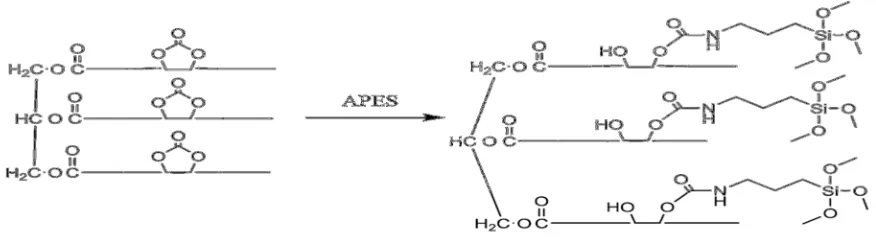
Figure 2: The scheme for the Formation of Urethane Monomer from Reaction of Cyclic Carbonate and APES
Figure 3: The Scheme for the Formation of Polyurethane The conversion of epoxide to cyclic
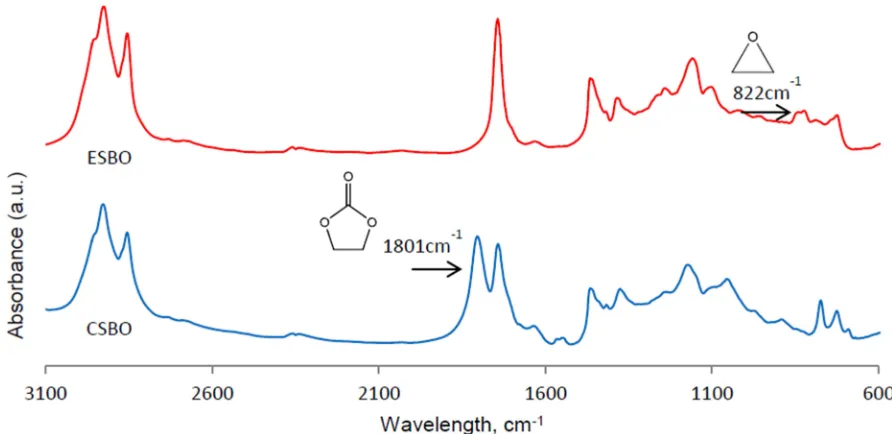
carbonate occurred at 140 oC and was monitored by IR. Figure 4 shows the FTIR spectroscopy of the conversion with TBAB as catalyst. It can be seen in the FTIR spectra of ESBO and CSBO, that the peak at 833 cm-1 indicating presence of epoxy group in the ESBO has disappeared in the spectrum for CSBO and replaced with a new peak at 1803 cm-1 corresponding to absorption for cyclic carbonate carbonyl. This shows that the ESBO has been converted to CSBO.
Preparation and Characterization of non-isocyanate polyurethane (NIPU)
21
Figure 5. By the peak at 1801 cm , the carbonyl carbon of the cyclic carbonate of CSBO disappeared.22
Wavelength, cm-1Figure 5: FTIR Spectra of Lignin Polyurethane (NIPU), Lignin, and Carbonated Soybean Oil
23
temperature, the formation of three dimensional space networks as a result of the rigid aromatic structure of the lignin and its crosslinking characteristics resulted in the high tensile strength. This observation is similar to those reported by other studies on the relation of lignin content and tensile strength of polyurethane (Chung and Washburn, 2012; Bähr and Mülhaupt, 2012). Further, Bähr and Mülhaupt reported that hydrogen bonds formed between hydroxyl groups and carbonyl group of the urethanes accounted for higher water absorption, improved resistance to organic solvents, increased Young’s modulus, and higher tensile strength in NIPUs compared to conventional polyurethane (PU) and that NIPUs exhibit improved thermal stability because of the absence of labile biurets and allophantes (Figovsky and Shapovalov, 2002) which are common occurrence in conventional PU.Figure 8 shows the elongation at break of the NIPUs, where it can be seen that the property increased with the lignin contents when the NIPUs
study, the cross linked polymer contain more siloxane bonds than lignin contributing to the increased higher flexibility. This is contrary to established phenomenon of how lignin affects the elongation at break of polymer which is to reduce the property and act as hard segment as lignin content is increased. It is surprising to note that the opposite is what results from this work. As the lignin content is increased, less and less space is available in the polyurethane at high lignin content for free silanols to react with each other and form three dimensional siloxane but would rather form linear –Si-O-Si- bridges, which would form high flexiblility polymer as a result of low cross link density. Though, much space will be available for free silanols to react at low lignin content, the NIPU polymer also exhibit high flexibility at low lignin content. This is because the free silanols are very likely to react with each other with higher probability, forming complex three dimensional siloxane networks and ultimately forming higher cross link density.
Figure 7: Tensile Strength of NIPUs with Different Lignin Contents 0
0.2 0.4 0.6 0.8 1 1.2 1.4 1.6
10 20 30 40 50 60
Ten
si
le
Stre
ngth
(M
Pa)
Lignin Content (wt%)
curing at 70 degree
24
Figure 8: Elongation at Break of NIPUs with Different Lignin Contents
CONCLUSION
The use of purely renewable resourced materials- CSBO and lignin as the starting materials for non-isocyanate polyurethane has been studied. CSBO was reacted with APES in the presence of TBAB catalyst to produce the urethane monomer. The urethane monomer was then reacted with kraft lignin with lithium chloride as catalyst. The kraft lignin content was varied from 20 – 50 wt%. The essence was to produce polyurethane that is hydrolytically stable and resistant to organic solvents with resultant immobilization of carbon dioxide by the green process employed. Effect of lignin content on tensile strength and elongation at break of NIPUs were studied. The following observations were made:
i. This study confirmed the technical feasibility of synthesizing non isocyanate polyurethane from renewable agricultural resources as replacement for conventional polyurethanes.
ii. The lignin content and curing temperature strongly affect the tensile strength and elongation at break of the NIPUs.
iii. The NIPU properties can be altered from highly rigid to highly elastic by controlling the temperature and lignin content. For example, if desired product is a rigid lignin thermoplastic, then high contents of lignin should be used and cured at higher
temperature in order to achieve high tensile strength.
iv. Sustainable implementation of the green process can contribute to the avoidance of the use of toxic and environmentally hazardous materials and can be performed in wide range of applications such as coatings, adhesives, sealants, paintings, and elastomers.
REFERENCES
Bähr M. and Mülhaupt R. (2012). Linseed and soybean oil-based polyurethanes prepared via the non-isocyanate
route and catalytic carbon dioxide conversion, Green Chemistry, 14: 483
Çaylı G. and Küsefoğlu S. (2008). Biobased Polyisocyanates from Plant Oil Triglycerides: Synthesis,
Polymerization, and Characterization, Journal of Applied Polymer Science, 109: 2948–2955 Chung H. and Washburn N. R (2012). Improved Lignin Polyurethane Properties with Lewis Acid Treatment,
Applied Materials & Interfaces 4: 2840-2846 0 2 4 6 8 10 12 14 16
10 20 30 40 50 60
Elong
ation
at b
reak (%)
Lignin content (wt%)
curing at room temperature
25
nonisocyanate polyurethane coatings.Macromol. Symp., 187(1): 325-332.
Foti S., Giuffrida M., Maravigna P. and Montaudo G. (1983). Direct mass spectrometry of polymers.IX.
Copoly(carbonate-urethanes) prepared by reorganization of polycarbonates with piperazine, Journal of
Polymer Sci. Polymer Chemistry Edition,
21(6): 1599 - 1615
https://doi.org/10.1002/pol.1983.170210604
Hatakeyema H., Tanamachi N., Matsumura H., Hirose S., Hatakeyama T. (2005). Bio-based polyurethane composite
foams with inorganic fillers studied by thermogravimetry, Thermochimica Acta, 351: 155 – 160.
Hoff G. P. and Wicker D. B. (1945). In Perlon U Polyurethanes, at IG Farben, Boringen, Augsburg, P. B. Report
1122.
Javni I., Hong D. P, Petrovic Z.S. (2008). Soy-Based Polyurethanes by Nonisocyanate Route, Journal of Applied
between
coupling agents and wood by FTIR spectroscopy and pull strength tests, De Gruyter, Holzforschung, 68(7):
799–805. DOI 10.1515/hf-2013-0121 Tamami B., Sohn S. and Wilkes G. L. (2004). Incorporation of carbon dioxide into soybean oil and subsequent
preparation and studies of nonisocyanate polyurethane networks, J. Appl. Polym. Sci., 92(2): 883 - 891.
Tanaka R., Hirose S., Hatakeyama H. (2008). Preparation and characterization of polyurethane foams using a palm
oil-based polyol Bioresource Technology, 99: 3810 - 3816
Tu Y., Suppes G.J. and Hsieh F. (2008). Water-Blown Rigid and Flexible Polyurethane Foams Containing