December 2016, Vol. 4, No. 2, pp. 59-69
ISSN: 2374-2380 (Print), 2374-2399 (Online)
Copyright © The Author(s). 2015. All Rights Reserved.
Published by American Research Institute for Policy Development
DOI: 10.15640/jpbs.v4n2a5
URL: https://doi.org/10.15640/jpbs.v4n2a5
Testing the Criterion Validity of the CAAPE for Screening Co-Occurring Disorders
among Jail Inmates
Paul E. Tracy, Ph.D.
1& Danielle Marie Carkin, Ph.D.
2Abstract
A growing body of research indicates that the reentry of prisoners back into society is among the most pressing issues facing the criminal justice system. Likewise, research indicates that significant proportions of justice-involved individuals are characterized by a much higher prevalence of substance abuse, mental health disorders, and more importantly, the co-occurrence of these phenomena. Individuals with co-occurring disorders have long criminal histories and may even be under the influence of the disorders as criminogenic factors at the time of the commission of a crime. Thus, the effective screening of co-occurring disorders is a necessary prerequisite for both treatments while incarcerated and the development of community-based treatment as part of the reentry process. The present study uses 170 inmates from a county jail that are participating in a focused reentry program to test the criterion validity of the Comprehensive Addictions and Psychological Evaluation (CAAPE) instrument. The results of this study show that there are particular drugs of abuse and specific mental health disorders that are associated with criminal history. More importantly, the results suggest that the subscales of the CAAPE establish a strong connection between the co-occurring disorders and criminal behavior.
Keywords
: Substance abuse, mental health disorders, Co-occurring disorders, Criminal behavior1.0 Introduction
Over the past sixteen years there has been considerable public policy concern and research interest with respect to the phenomenon of offender reentry. Petersilia was among the first to call attention to the issue of reentry when she noted that there had been virtually no systematic, comprehensive attention being paid by policy makers to deal with offenders after they are released from custody (1999, 2001). Petersilia’s observation mostly pertained to the many thousands of offenders who were being released on parole. But, the issue becomes even more manifold when one considers that many jurisdictions had abolished parole in favor of determinate sentences, and these offenders are released without community supervision. Jeremy Travis, the Director of the National Institute of Justice, raised this point specifically when he noted that concerns about offender reentry came at a time when traditional mechanisms for managing reentry had been significantly weakened because 14 states had abolished discretionary parole and the parole boards that historically had overseen the processes of reentry (2000).
Indeed, Ditton and Wilson (1999) have indicated that approximately 20 percent of state prisoners leave prison with no post-release supervision. Even Janet Reno, the Attorney General at the time referred to reentry as “one of the most present problems we face as a nation, the reentry of offenders from prison back to the communities where the problem started in the first place” (2000). The concerns raised by Petersilia and Travis take on even greater significance when more recent data are examined. The sheer size of the reentry population warrants increased attention.
1 Professor of Criminology, School of Criminology and Justice Studies, College of Fine Arts, Humanities, and Social Sciences,
University of Massachusetts Lowell 2
In 2010, 708,677 inmates were released back to their communities (Guerino, Harrison, & Sabol, 2010), and in 2011, 688,384 offenders, approximately 1,885 individuals per day, were released from state or federal custody (Carson & Sobel, 2012). However, Hughes and Wilson (2002) have indicated that at least 95 percent of state inmates will ultimately be released. When we include the approximately nine million offenders released from jails annually (Beck, 2006), we realize that offender reentry actually involves orders of magnitude beyond the prison releases. Simply, policymakers, and the general public alike, now expect corrections to “do a better job" by developing evidenced-based practices and programs to facilitate reentry and prevent recidivism. The task will be daunting as evidenced by studies on recidivism.
Research indicates that two-thirds of released prisoners are rearrested within three years of release (Durose, Cooper,& Syder, 2014; Langan & Levin, 2002) and approximately 76 percent will recidivate within five years (Langan& Levin, 2002). Whatever may be the original criminogenic factors, reentry only exacerbates the problem. For example, offenders enter prisons with limited marketable work experience, low levels of educational or vocational skills, and many health-related issues, ranging from mental health needs to substance abuse histories and high rates of communicable diseases. Upon release from prison, these challenges persist and affect neighborhoods, families, and society at large (Urban Institute, 2006). The revolving door of prison:, then release, then recidivism, then back to prison is increasingly concentrated in communities that are often already deprived of resources and ill equipped to meet the challenges the reentry population presents (Vigne & Kachnowski, 2003).
2.0 Risk Factors
In addition to the usual deficits in areas like education, employment, vocational skills, etc. that affect crime, successful reentry is further compromised by the fact that substantial proportions of offenders have substance abuse histories, mental health issues, and even co-occurring disorders. There is substantial evidence, which continues to grow, that these risk factors affect sizable proportions of returning offenders.
2.1 Substance Abuse
The National Center on Addiction and Substance Abuse (CASA) has published two studies that provide the following results. CASA reported that four out of five of America’s 1.7 million prison and jail inmates were substance involved in 1996 (CASA, 1998). In 2006, of the 2.3 million adults behind bars, 1.9 million were substance involved and almost two-thirds (64.5 percent) met the medical criteria for an alcohol or other drug use disorder. Another 20 percent (458,000 cases) did not meet the DSM-IV medical criteria for alcohol and other drug abuse and addiction, but nevertheless were substance involved–that is, they were under the influence of alcohol or other drugs at the time of their offense, stole money to buy drugs, are substance abusers, violated the alcohol or drug laws, or share some combination of these characteristics. (CASA, 2010). Moreover, CASA (2010) has also indicated that the substance abuse problems among inmate’s cuts across are corrections venues: 84.8 percent of all inmates (1.9 million) were substance involved 86.2 percent of federal inmates (0.2 million), 84.6 percent of state inmates (1.1 million) and 84.7 percent of local jail inmates (0.6 million).
Research has also shown that substance abuse was proximate to the offense for which offenders were incarcerated. Karberg and James (2005) found that half of all convicted jail inmates were under the influence of drugs or alcohol at the time of offense. Similarly, Mumola and Karberg (2006) found almost one-third of state and one-quarter of federal prisoners committed their offense under the influence of drugs. Begum, Early, and Hodge (2016) have found that significant percentages of state and federal prisoners committed the act for which they were incarcerated while under the influence of drugs. At the time of arrest, 63 to 83 percent had drugs in their system, with marijuana and cocaine being the most common. They also reported that between 2000 and 2013, the percentage of arrestees with opiates in their system increased. Studies have also addressed the drugs that were present. The Substance Abuse and Mental Health Services Administration (2011) compared cases admitted to probation or parole admissions that had no prior substance abuse treatment episodes with those who had three or more prior treatment episodes.
Further, data from a national study in five major American cities shows that at the time of arrest, 63% to 83% of arrestees had drugs in their system, with marijuana and cocaine being the most common and that between 2000 and 2013, the percentage of arrestees with opiates in their system increased, with a couple of cities seeing significant increases in opiate presence, as well as methamphetamine (Center for Prisoner Health and Human Rights).
2.2 Mental Health
Research has also addressed the mental health deficits of offenders that affect reentry and can lead to increased risk of recidivism. Over time, these studies have provided strong evidence about mental illness among offenders. In one Bureau of Justice Statistics (BJS) study, Ditton (1999) has reported several findings of interest. First, 16 percent of state prison inmates, 7percent of Federal inmates, and 16 percent of those in local jails reported either a mental condition or an overnight stay in a mental hospital and another 16 percent of probationers were found to have had a mental condition or stayed overnight in a mental hospital at some point in their lifetime. Second, state prison inmates with a mental condition were different than the general population of inmates: (1) more likely than other inmates to be incarcerated for a violent offense (53% compared to 46%); (2) more likely than other inmates to be under the influence of alcohol or drugs at the time of the current offense (59% compared to 51%); and (3) more than twice as likely as other inmates to have been homeless in the 12 months prior to their arrest (20% compared to 9%). Third, the mental illness and crime connection appeared to be longstanding– over three-quarters of mentally ill inmates had been sentenced to time in prison or jail or on probation at least once prior to the current sentence.
In a second BJS study, James and Glaze (2006) have found that more than half of all prison and jail inmates had a mental health problem, including 705,600 inmates in state prisons, 78,800 in Federal prisons, and 479,900 in local jails. These counts of mental illness cases represented 56 percent of state prisoners, 45 percent of federal prisoners, and 64 percent of jail inmates. More recently, Steadman, Osher, Robbins, Case, and Samuels, (2009) have reported that 16.9 percent of people admitted to jail have serious mental illnesses and these rates are three times higher for men and six times higher for women than those found in the general population. Likewise, the National Center on Addiction and Substance Abuse (2010) has reported a much higher percentage of mental illness–one-third (32.9 percent) of the 2.3 million prison and jail inmates. Other research has provided lower estimates of mental illness among offenders when precise diagnostic measures of mental health symptomalogy are used. These estimates of the prevalence of offenders with mental illness in jails and prisons range from 10 to 15 percent of criminal justice populations (Lamb, Weinberger, & Gross, 2004; Teplin, 1990; Teplin, 1994; Teplin, Abram, & McClelland, 1996).
2.3 Co-Occurring Disorders
It is even more problematic when published studies provide a so-called estimate of co-morbidity– the percent of substance abuse among offenders with mental health disorders– but fails to provide the underlying percentage of the latter. For example, Peters, Bartoi, and Sherman observed that, “Other studies indicate that 72–87 percent of justice-involved individuals with severe mental disorders have co-occurring substance use disorders” (2008: 2). The so-called 72-87 percent co-morbidity statistic is not at all helpful because we are not given the underlying percentage of these mental health disorders. If these mental disorder inmates constitute only 10 percent of involved people, then co-morbidity represents only from 7.2 to 8.7 percent. If however, 40 percent of the justice-involved individuals have diagnosed mental health disorders, then co-morbidity affects from 28.8 to 34.8 of the individuals. Simply, much prior research has failed to provide meaningful data concerning co-morbidity prevalence (Abram &Teplin, 1991; Abram, Teplin, & McClelland, 2003; Chiles, Cleve, Jemelka, & Trupin,
1990).Fortunately, there are a few studies that have provided estimates of the co-morbidity of mental disorders
and substance abuse among criminal offenders. Cote and Hodgins (1990) investigated co-occurring disorders in a random sample of 650 inmates in the penitentiaries in Quebec, Canada. The sample constituted 21.9 percent of the male penitentiary population in April 1988. Disorders were based on results from the Diagnostic Interview Schedule which is uses DSM-III criteria but can be administered by lay interviewers. A variety of statistical results are reported for co-morbidity based on mental illness disorders and then drug abuse concurrence, or drug abuse diagnosis and then the co-occurrence of various mental health disorders. For our purposes, we will focus on the latter. Among the inmates determined to have a substance abuse diagnosis, the co-morbidity results for mental disorders were as follows: (1) schizophrenic disorders, 10.8%; (2) bipolar disorder, 5.4%; (3) atypical bipolar disorder, 5.4%; (4) major depression, 17.4%; (5) antisocial personality, 74.7%; and (5) alcohol abuse, 74.7%. For each co-morbidity category, the prevalence is far greater than in the general population.
James and Glaze (2006) analyzed the data from two Bureau of Justice Statistics (BJS) surveys: (1) Inmates in State and Federal Correctional Facilities, 2004; and (2) Inmates in Local Jails, 2002. BJS has conducted the surveys every 5 to 6 years since 1972 and these inmate surveys are the only national source of detailed information on criminal offenders, particularly special populations such as drug and alcohol users and offenders who have mental health problems (James & Glaze, 2006: 11). Among the many descriptive tables, the results of co-morbidity are relevant here. James and Glaze compared drug-involved inmates with and without mental health issues for state and federal prison inmates and local jail prisoners. They found that mental disorders affected 56.2 percent of state inmates, 44.8 percent of federal inmates, and 64.2 percent of jail prisoners. They also found that these impaired inmates also had abused drugs, 18 percent state, and 16.1 percent federal, and 17.3 percent jails. When we combine these percentages to reflect co-morbidity, we see that mental health disorders occur with substance abuse issues for 10 percent of all state inmates, 7 percent of all federal inmates, and 11 percent of all prisoners in local jails. These data are far in excess of the general population situation.
Blandford and Osher (2013) have provided the most recent co-morbidity data. They have estimated mental illness and drug abuse co-morbidity from a variety of sources. The sources cited came from different years, used different methodologies and definitions, and combined different data sets. According to Blandford and Osher, “the table is intended to give the reader a general sense of the prevalence rates of behavioral disorders in corrections populations and is not intended to be the definitive epidemiologic dataset” (2013: endnote 3, p.33). With the caveat duly noted, Table 1 nonetheless provides highly valuable information. The estimated prevalence of serious mental disorders is as follows: 5.4 percent for the general public, 16 percent for state prisons, 17 percent for jails, and 7–9 percent for probation and parole cases.
2.4 Risk Factors Summary
Prior research on criminogenic risk factors has established the following. First, substantial proportions of offenders have diagnosed substance abuse issues. Further, many criminals used drugs proximal to the time of their offenses, or were under the influence of drugs at the time they were arrested. Second, prisoners show a much greater percentage of mental conditions than does the general public. Third, the co-morbidity of substance abuse and mental health disorders far exceeds that in the general public. These co-occurring disorders may have influenced the onset of criminality, and more important, these justice-involved persons represent serious risks for continued criminality when they are returned to society.
2.5 Screening Instruments
Given the strength of the relationship between co-occurring disorders and crime, it is obvious that effective screening should be a routine practice in correctional settings. There are numerous screening instruments available (Peters, Bartoi, & Sherman, 2008; Braude and Miller, 2011). However, there are numerous barriers to effective screening and assessment of co-occurring disorders. In a comprehensive monograph on screening and assessment, Peters, Bartoi, & Sherman, (2008) have identified major barriers to effective screening. The first barrier concerns the screening process itself. There may be a failure to examine one or more components of the co-occurring disorders. Sometimes this is due to ineffective screening instruments, or inadequate staff training or, because there is a bifurcated mental health and substance abuse service systems that feature separate screening and assessment processes (Peters, Bartoi, & Sherman, 2008: v). A second factor concerns the difficulty in determining whether psychiatric symptoms are caused by recent substance abuse or reflect the presence of a mental disorder (Peters, Bartoi, & Sherman, 2008: v).
Regardless of the basis for ineffective screening, there is a pervasive failure to screen effectively persons with co-occurring disorders in the justice system (Chandler, Peters, Field, & Juliano-Bult, 2004). A major consequence of this failure is that offenders with co-occurring disorders are not accorded treatment or they are placed in inappropriate treatment (e.g., in less intensive services than are needed), resulting in high rates of criminal recidivism following release (Peters, Bartoi, & Sherman, 2008). Peters, et al., have concluded, therefore, the justice system is generally ill equipped to address the multiple needs of this population, and few specialized treatment programs exist in jails, prisons, or court or community corrections settings that provide integrated mental health and substance abuse services (2004: v).
Braude and Miller (2011) have also raised important issues about cross-discipline screening. They noted the historic territorial issues and disagreements among disciplines about which disorder is primary, or more serious, or whether one precipitated the other. When clients are caught in the middle of different or incomplete systems of care, they do not get effective help for their full range of needs (2011: 4). Moreover, the failure to resolve disciplinary differences precludes the implementation of integrated treatment– specialized interventions that work concurrently for both substance use and mental health recovery Braude and Miller (2011:5).
3.0 Present Study
3.1 Measurement of Co-Occurring Disorders
Clinicians made the diagnosis of co-occurring disorders by using the Comprehensive Addictions and Psychological Evaluation (CAAPE). The Comprehensive Addictions and Psychological Evaluation (CAAPE) is screening instrument specifically designed to assess persons with co-occurring disorders (Hoffmann, 2000). The CAAPE provides detailed indications for abuse or dependence for nine substance categories (alcohol, marijuana, cocaine, heroin, stimulants, sedatives, hallucinogens, inhalants, and a category for mixed substance abuse). The CAAPE also covers six Axis I and six Axis II DSM-IV conditions– the more prevalent mental health conditions likely to impact recovery from substance use disorders. The CAAPE has been applied to adjudicated adolescents in secure facilities (Abrantes, Hoffmann, & Anton, 2005) and in a comparative analysis of the relative prevalence of substance use disorders among prison inmates in the United Kingdom and the United States (Jones & Hoffman, 2006). In the context of an evaluation of an integrated day treatment program for co-occurring disorders, research participants were interviewed using the structured clinical interview for DSM-IV (SCID) and the CAAPE (Gallagher, Penn, Brooks, & Feldman, 2006). We are not aware that there have been any peer-reviewed validation studies of the CAAPE. Thus, the present study is a first effort to examine the CAAPE’s validity among a large sample of jail inmates.
3.2 CAAPE Variables.
3.2.1 Drug Abuse
The CAAPE employs a clinician scored drug abuse scale that reflects four abuse levels: None, Mild, Moderate,
And Severe which are scored from 0 to 3 for Nine Drugs Scales (Alcohol, Marijuana, Cocaine, Stimulants,
Sedatives, Heroin, Hallucinogens, Inhalants, and Mixed). In addition to these nine drug scales, we also calculated
the following: (1) Total Drug Abuse Score = 1-27; (2) Number of Drugs Abused (any of the nine scale scores
greater or equal to 1); and (3) Number of Drugs Severely Abused (any of the nine scale scores equal to 3).
3.2.2 Mental Health
The CAAPE provides two mental health variables. First, Nine Disorders are scored dichotomously (Major
Depressive, Manic, Panic, Post Traumatic Stress, Anxiety, Obsessive/Compulsive, Psychosis, Anti-Social
Personality, and Personality Disorder). Second, the nine items are then evaluated to produce an overall Mental
Health Score which ranges from 1 to 3 (Mild, Moderate, and Severe). We added a third measure, Number of Disorder Types (a count of the presence of the nine disorders; range 1 to 9).
3.3 Dependent Variable
The dependent variable in this study is the total number of times the subject has been arrested as an adult prior to the offense for which they committed to the jail to serve the sentence. Because this is a count variable, the appropriate statistical procedure is Poisson regression.
3.4 Research Question
The research question is this study concerns the criterion validity of the CAAPE. Criterion validity represents the association between measures that are purportedly related. In psychometrics, criterion (or concrete validity) is the extent to which a measure is related to an outcome of interest. In the present case, if co-occurring disorders are related to criminal conduct, and if the CAAPE provides sufficient diagnosis of co-occurring disorders through the various scales and summary variables, then the following necessary result would arise–the CAAPE measures should serve as significant predictors of prior criminal history of the subjects in this study. Criterion validity is often divided into concurrent and predictive validity. Concurrent validity refers to a comparison between the measure in question and an outcome assessed at the same time, which here would be prior criminal history. Subsequently, the CAAPE scores should also have predictive validity– the extent to which the CAAPE explains post-release recidivism. We only deal with concurrent validity here.
4.0 Results
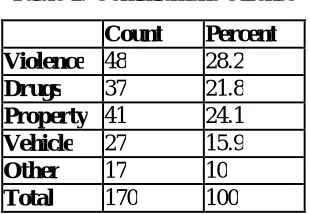
Given this distribution of offenses types, the inmates with co-occurring disorders in this study have not specialized in any particular crime type, but rather, have been convicted of a range of criminal offenses. This heterogeneity enhances the predictive environment for the statistical models since the cases are so heterogeneous.
Table 1: Commitment Offense
Count Percent Violence 48 28.2
Drugs 37 21.8
Property 41 24.1
Vehicle 27 15.9
Other 17 10
Total 170 100
In Table 2 we observe the descriptive data for all the variables in this study. These data suggest that there is sufficient variation across the various measures so that the multivariate analysis to test the validity of the CAAPE will not be hindered by a situation in which the cases are largely homogenous. For example, the dependent variable, number of prior arrests ranges from no prior crimes to a maximum of 65, with an average of 15.26 and standard deviation of 13.519. This indicates that there is sufficient variation in prior criminal history to make the prediction model worthwhile. Likewise, the data for the two prime CAAPE measures of interest here, the substance abuse and mental health scores, shows that the subjects vary in the extent of their co-occurring disorders. The subjects range from a low of one to a maximum of 21 on the substance abuse scale with a mean of 7.44, which indicates moderate abuse on average. The mental health scores range from a low of one (low disorders) to a maximum of 3 (severe disorders) and on average have a score of 2.01, which signifies moderate mental health problems.
The multivariate Poisson regression models are given in Tables 3, 4, and 5. The analyses proceeded as follows. First, we investigated separately the specific drugs of abuse (Table 3) and then the mental health disorders (Table 4). In Table 5 we provide the results of the ultimate criterion validity test concerning the predictive value of the substance abuse score and the mental health scores for explaining the variation in prior criminal history.
Table 2: Descriptive Statistics
Variable N Min. Max. Mean Std. Dev
Prior Arrests 170 0 65 15.26 13.519
Substance Abuse Score 170 1 21 7.44 4.847
Number of Drugs Abused 170 1 7 2.91 1.77
Number of Drugs Severely Abused 170 0 7 2.07 1.655
Mental Health Score 170 1 3 2.01 0.754
Number of Disorder Types 170 2 9 4.53 1.636
Table 3: Poisson Regression: Number of Prior Arrests by Drugs Abused
Std. Wald
Parameter B Error Chi-Square Sig. Intercept 2.612 0.0504 2685.915 0.000
Alcohol -0.005 0.0181 0.077 0.781
Marijuana 0.024 0.016 2.226 0.136
Cocaine 0.103 0.0163 40.115 0.000
Stimulants -0.105 0.0334 9.911 0.002
Sedatives -0.143 0.0245 33.869 0.000
Heroin 0.017 0.0165 1.066 0.302
Hallucinogens 0.085 0.0383 4.968 0.026
Inhalants -0.845 0.2915 8.396 0.004
Mixed -0.818 0.2127 14.791 0.000
Model Chi-Square 140.239; p= 0.0001
Table 4 provides the regression results for the nine metal health disorders. Even though the CAAPE only scores the presence/absence of these disorders, rather than the extent, there are four types of disorders that are significantly predictive of the number of prior arrests. Obsessive/compulsive, psychosis, anti-social personality, and personality disorders all have significant positive effects on the number of prior arrests.
Table 4: Poisson Regression: Number of Prior Arrests by Disorders
Std. Wald
Parameter B Error Chi-Square Sig. Intercept 2.237 0.0825 734.923 0.000 Major Depressive -0.023 0.0471 0.241 0.623 Manic Disorder -0.053 0.0641 0.693 0.405 Panic Disorder 0.031 0.0506 0.382 0.536
PTSD -0.063 0.0432 2.139 0.144
Anxiety Disorder -0.076 0.0744 1.048 0.306 Obsessive / Compulsive 0.303 0.052 33.999 0.000 Psychosis 0.128 0.0584 4.83 0.028 Anti -Social Personality 0.383 0.0506 57.316 0.000 Personality Disorder 0.595 0.0694 73.489 0.000 Model Chi-Square 156.929; p=.0001
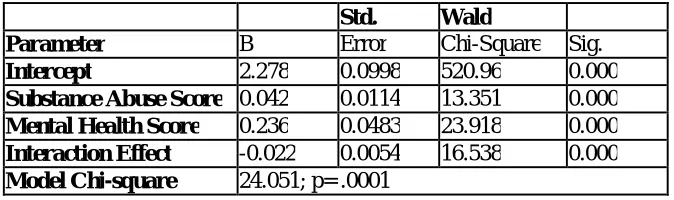
Tables 3 and 4 establish that the specific drug abuse and mental health disorder items in the CAAPE constitute significant individual predictors of prior criminal history. However, the prime question of interest concerns whether the summary measures in the CAAPE are valid scales of co-occurring disorders such that the CAAPE can be determined to have criterion validity for the prediction of an outcome of significant relevance for justice-involved individuals– prior criminal history. These results are shown in Table 5. It should be noted that we analyzed the data using the two CAAPE summary scales, and the additional count variables that we created (Number of Drugs Abused, Number of Drugs Severely Abused, and Number of Disorder Types).We found that these three variables were collinear to the two summary scales, and thus, they are unnecessary. Table 5 provides definitive results concerning the validity of the CAAPE in two major respects.
Second, therefore, Table 5 indicates that not only are the two main effects of substance abuse and mental health disorders significant, but it also shows, perhaps more importantly, that the interaction effect is also significant, but has a negative coefficient. Since these two measures are quantitative variables, the interpretation of a significant but negative interaction coefficient is quite straightforward. Specifically, when the mental disorder score increases, it remains powerful even at lower levels of the substance abuse score. Thus, substance abuse does not moderate the effect of a severe mental health disorder score. Moreover, the interaction effect conforms the primacy of the mental health disorder effect observed for the main effect. The results in Table 5 can be represented, therefore, to have established the criterion validity of the CAAPE 5 as a predictor of the extent of criminal history of these subjects.
Table 5: Poisson Regression: Number of Prior Arrests by Drug Abuse, Mental Health, and Interaction Effects
Std. Wald
Parameter B Error Chi-Square Sig.
Intercept 2.278 0.0998 520.96 0.000
Substance Abuse Score 0.042 0.0114 13.351 0.000
Mental Health Score 0.236 0.0483 23.918 0.000
Interaction Effect -0.022 0.0054 16.538 0.000
Model Chi-square 24.051; p= .0001
5.0 Conclusion
The goal of this study was to add to a growing body of research that focuses on the issue of prisoner reentry. The return of offenders back into society is among the most pressing issues facing the criminal justice system. Although there are upwards of 700,000 such individuals being released from prisons, there are over 12 times as many returning from county jails. Within the reentry literature, research indicates that significant proportions of justice-involved individuals are characterized by a much higher prevalence of substance abuse, mental health disorders, and more importantly, the co-occurrence of these phenomena than is the case among the general public. These disabilities pose significant criminogenic risk factors. Individuals with co-occurring disorders have long criminal histories and may even be under the influence of the disorders as criminogenic factors at the time of the commission of a crime.
Thus, the effective screening of co-occurring disorders is a necessary prerequisite for both treatments while incarcerated and the development of community-based treatment as part of the reentry process. It is clear however, that there are a range of barriers, which affect the screening, and assessment of co-occurring disorders including the technical expertise needed to administer and score the instruments as well as the fact that instruments themselves may have strength in screening for substance abuse or mental health issues but not both. In this context, the present study sought to examine the validity of a screening instrument, the Comprehensive Addictions and Psychological Evaluation (CAAPE) that purports to target the assessment of co-occurring disorders. This research used 170 inmates from a county jail that are participating in a focused reentry program to test the criterion validity of the CAAPE instrument. The results of this study showed that the CAAPE does identify particular drugs of abuse and specific mental health disorders that are associated with criminal history. More importantly, the results from multivariate models using the subscales of the CAAPE indicated there was a significant connection between the two major dimensions of the CAAPE: substance abuse score and mental health score and criminal behavior. It was also discovered that there was a significant interaction effect between mental health issues and substance abuse such that when an offender suffers from a higher mental disorder score, he only needs a minimal substance abuse problem to have an extensive criminal history.
References
Abram K. M., & Teplin L. A. (1991). Co-occurring disorders among mentally ill jail detainees: Implications for
public policy. American Psychologist, 46, 1036-1045.
Abram, K. M., Teplin, L. A., & McClelland, G. M. (2003). Co morbidity of severe psychiatric disorders and
substance use disorders among women in jail. American Journal of Psychiatry, 160, 1007-1010.
Abrantes A, Hoffmann N.G., & Anton R (2005).“ Prevalence of Co-occurring disorders among juveniles
committed to detention centers.” International Journal of Offender Therapy and Comparative
Criminology, 49, 79-193.
Baillargeon, J., Binswanger, I.A., Penn, J.V., Williams, B.A., & Murray, O.J., (2009a). “Psychiatric disorders and
repeat incarcerations; the revolving door.” American Journal of Psychiatry, 166, 103-109.
Baillargeon, J., Williams, B.A., Mellow, J., Harzke, A.J., Hoge, S.K., Baillargeon, G., & Greifinger, R.B. (2009b). “Parole revocation among prison inmates with psychiatric and substance use disorders.”
Psychiatric Services, 60, 1516-1521.
Balyakina, E., Mann, C., Ellison, M., Sivernell, R., Fulda, K.G., Sarai, S.K, & Cardarelli, R. (2013). Risk of future offense among probationers with co-occurring substance use and mental health disorders.
Community Mental Health Journal, 50, 288-295.
Beck, A.J. (2006).The Importance of Successful Reentry to Jail Population Growth. Presented at the Urban Institute's Jail Reentry Roundtable, June 27, 2006.
www.urban.org/projects/reentry-roundtable/upload/beck.PPT.
Begun, A.L., Early, T.J. & Hodge, A. (2016).“Mental Health and Substance Abuse Service Engagement by Men
and Women During Community Reentry Following Incarceration.” Administration Policy and Mental
Health, 43, 207-218.
Blandford, A.M. &Osher, F.C. (2013). Guidelines for the Successful Transition of Individuals with Behavioral Health Disorders from Jail and Prison. Delmar, NY: SAMHSA’s GAINS Center for Behavioral Health and Justice Transformation.
Braude, L. & Miller, N. (2011). RSAT Training Tool: Understanding Co-occurring Disorders & Applying Integrated Treatment Strategies for Adult Correctional Populations. Sudbury, MA: Advocates for Human Potential, Inc. Carson, E. A. and Sobel, W.J. (2012).“Prisoners in 2011,” BJS Bulletin, December 2012, NCJ 239808.
Chandler, R., Peters, R., Field, G., & Juliano-Bult, D. (2004). “Challenges in implementing evidence-based
treatment practices for co-occurring disorders in the criminal justice system.” Behavioral Sciences and the
Law, 22, 431-448.
Chiles, J. A., Cleve, E. V., Jemelka, R. P., & Trupin, E. W. (1990). Substance abuse and psychiatric disorders in
prison inmates. Hospital & Community Psychiatry, 41, 1132-1134.Center for Prisoner Health and Human
Rights. (2016). http://www.prisonerhealth.org/educational-resources/factsheets-2/incarceration-substance-abuse-and-addiction/
Ditton, P. (1999). “Mental Health and Treatment of Inmates and Probationers.” Washington, D.C.: U.S. Department of Justice, Office of Justice Programs, Bureau of Justice Statistics.
Ditton, P.M. and Wilson, D.J. (1999).Truth in Sentencing in State Prisons, Special Report, Washington, DC: U.S. Department of Justice, Bureau of Justice Statistics, NCJ 170032.
Durose, M.R., Cooper, A.D., & Snyder, H.N. (2014).“Recidivism of Prisoners Released in 30 States in 2005: Patterns from 2005 to 2010,” U.S. Department of Justice, Office of Justice Programs, Bureau of Justice Statistics. http://www.bjs.gov/index.cfm?ty=pbdetail&iid=4986 (accessed September 29, 2015).
Fellner, J., & Maurer, M. (1998). "Losing the Right to Vote: The Impact of Felony Disenfranchisement Laws in the United States," The Sentencing Project, Washington, DC. Gallagher, S.M., Penn, P.E., Brooks, A.J., & Feldman, J. (2006). "Comparing the CAAPE, A New Assessment Tool for Co-occurring Disorders,
with the SCID." Psychiatric Rehabilitation Journal, 30, 63-65,
Guerino, P.M., P.M. Harrison, & W. Sabol. (2011).Prisoners in 2010. NCJ 236096. Washington, D.C.: U.S. Department of Justice, Bureau of Justice Statistics, http://www.bjs.gov/content/pub/pdf/p10.pdf.
Hoffmann, N.G. (2000). CAAPE (Comprehensive Addictions and Psychological Evaluation) Manual. Smithfield, R.I.: Evince Clinical Assessments.
James, D.J. and Glaze, L.E. (2006). "Mental Health Problems of Prison and Jail Inmates." Washington, D.C.: U.S. Department of Justice, Office of Justice Programs, Bureau of Justice Statistics. Jones, G.Y. & Hoffman,
N.G. (2006). "Alcohol dependence: international policy implications for prison populations." Substance
Abuse Treatment, Prevention, and Policy, 1, 33-38.
Karberg, J.C. & James, D.J. (2005). Substance Dependence, Abuse, and Treatment of Jail Inmates, 2002. NCJ
209588. Washington, D.C.: U.S. Department of Justice, Bureau of Justice Statistics.
bjs.ojp.usdoj.gov/content/pub/pdf/sdatji02.pdf. Lamb, H. R., Weinberger, L. E., & Gross, B. H. (2004).
“Mentally ill persons in the criminal justice system: Some perspectives.” Psychiatric Quarterly, 75, 107-126.
La Vigne, N.G. and Kachnowski, V. (2003). A Portrait of Prisoner Reentry in Maryland (Washington, DC: The Urban
Institute, 2003); Nancy G. La Vigne and Cynthia A. Mamalian, A Portrait of Prisoner Reentry in Illinois (Washington, DC: The Urban Institute, 2003); Nancy G. La Vigne and Gillian L. Thompson, A Portrait of Reentry in Ohio (Washington, DC: The Urban Institute, 2003).
Langan, P.A. and Levin, D. (2002). Recidivism of Prisoners Released in 1994, Bureau of Justice Statistics Special Report NCJ 193427. Washington, DC: U.S. Department of Justice, 2002.
Mumola, C.J. (2000). Incarcerated Parents and Their Children, Bureau of Justice Statistics Special Report NCJ 182335. Washington, DC: U.S. Department of Justice.
Mumola, C.J. & J.C. Karberg, J,C. 2006). Drug Use and Dependence, State and Federal Prisoners, 2004. NCJ 213530.
Washington, D.C.: U.S. Department of Justice, Bureau of Justice Statistics.
bjs.ojp.usdoj.gov/content/pub/pdf/dudsfp04.pdf. The National Center on Addiction and Substance Abuse. (2010). “Behind Bars II: Substance Abuse and America’s Prison Population.” New York: Columbia University. The National Center on Addiction and Substance Abuse. (1998) .“Behind bars: Substance Abuse and America's Prison Population. New York: Columbia University.
Osher, F. (2013). Integrating Mental Health and Substance Abuse Services for Justice-Involved Persons with Co-Occurring Disorders. Substance Abuse and Mental Health Services Administration. Gains Center.
Osher, F., Steadman, H.J., & Barr, H. (2003).
“A Best Practice Approach to Community Reentry From Jails for Inmates With Co-Occurring Disorders: The
APIC Model.” Crime & Delinquency, 49, 79-96.
Peters, R.H., Wexler, H.K. & Lurigio, A.J. (2015). “Co-Occurring Substance Use and Mental Disorders in the
Criminal Justice System: A New Frontier of Clinical Practice and Research.” Psychiatric Rehabilitation
Journal, 38, 1–6.
Peters, R.H., Bartoi, M.G., & Sherman, P.B. (2008). Screening and assessment of co-occurring disorders in the justice system. Delmar, NY: CMHS National GAINS Center.
Peters, R. H., LeVasseur, M. E., & Chandler, R. K. (2004). “Correctional treatment for co-occurring disorders:
Results of a national survey.” Behavioral Sciences and the Law, 22(4), 563-584.
Petersilia, J. (2001). “Prisoner Reentry: Public Safety and Reintegration Challenges.” The Prison Journal, 81,
360-375.
Petersilia, J. (1999).“Parole and prisoner reentry in the United States.” In M. Tonry & J. Petersilia (Eds.), Prisons
(pp. 479-529). Chicago: University of Chicago Press.
Reno, J. (2000, February). “Remarks of the Honorable Janet Reno on reentry court initiative.” Presented at John Jay College of Criminal Justice, New York. https://www.justice.gov/archive/ag/speeches/2000/doc2.htm
Steadman, H.J., Osher, F. C., Robbins, P. C., Case, B., and Samuels, S. (2009). “Prevalence of Serious Mental Illness
Among Jail Inmates,” Psychiatric Services, 60, 761-765. Substance Abuse and Mental Health Services Administration. (2015). “Screening and Assessment of Co-occurring Disorders in the Justice System.” HHS Publication No. (SMA)-15-4930. Rockville, MD: Substance Abuse and Mental Health Services Administration. Substance Abuse and Mental Health Services Administration. (2011).The TEDS Report: Characteristics of Probation and Parole Admissions Aged 18 or Older. Rockville, MD.: Center for Behavioral Health Statistics and Quality. The Second Chance Act of 2007.
https://apa.org/about/gr/science/advocacy/2008/second-chance-act-2007.pdf
Teplin, L. A. (1990). “Detecting disorder: The treatment of mental illness among jail detainees.” Journal of
Consulting and Clinical Psychology, 58, 233-236.
Teplin, L. A. (1994). “Psychiatric and substance abuse disorders among male urban detainees.” American Journal
of Public Health, 84, 290-293.
Teplin, L. A., Abram, K. M., & McClelland, G. M. (1996). “Prevalence of psychiatric disorders among
incarcerated women: Pretrial jail detainees.” Archives of General Psychiatry, 53, 505-512. Urban Institute