V
OLUMEN
O.
9
(2019),
I
SSUEN
O.
09
(S
EPTEMBER)
ISSN
2231-5756
A Monthly Double-Blind Peer Reviewed (Refereed/Juried) Open Access International e-Journal - Included in the International Serial Directories
Indexed & Listed at:
Ulrich's Periodicals Directory ©, ProQuest, U.S.A., Cabell’s Directories of Publishing Opportunities, U.S.A., Google Scholar, Indian Citation Index (ICI), J-Gage, India [link of the same is duly available at Inflibnet of University Grants Commission (U.G.C.)],
Index Copernicus Publishers Panel, Poland with IC Value of 5.09 (2012) & number of libraries all around the world.
V
OLUMEN
O.
9
(2019),
I
SSUEN
O.
09
(S
EPTEMBER)
ISSN
2231-5756
CONTENTS
Sr.
No.
TITLE & NAME OF THE AUTHOR (S)
Page
No.
1
.
AN EMPIRICAL ANALYSIS OF VOLUNTARY INITIATIVES OF SELECTED
COMPANIES IN IMPROVING CORPORATE GOVERNANCE PRACTICES
ARPIT RASTOGI & Dr. O. P. VERMA
1
2
.
A STUDY ON ABOLISHMENT OF DIRECT TAX IN INDIAN ECONOMY
Dr. NAMRATA PANDEY
6
3
.
A STUDY ON EMPLOYEES BEHAVIOUR AT WORKPLACE
VIDYA HULKUND
9
V
OLUMEN
O.
9
(2019),
I
SSUEN
O.
09
(S
EPTEMBER)
ISSN
2231-5756
FOUNDER PATRON
Late Sh. RAM BHAJAN AGGARWAL
Former State Minister for Home & Tourism, Government of Haryana
Former Vice-President, Dadri Education Society, Charkhi Dadri
Former President, Chinar Syntex Ltd. (Textile Mills), Bhiwani
CO-ORDINATOR
Dr. BHAVET
Former Faculty, Shree Ram Institute of Engineering & Technology, Urjani
ADVISOR
Prof. S. L. MAHANDRU
Principal (Retd.), Maharaja Agrasen College, Jagadhri
EDITOR
Dr. PARVEEN KUMAR
Professor, Department of Computer Science, NIMS University, Jaipur
CO-EDITOR
Dr. A. SASI KUMAR
Professor, Vels Institute of Science, Technology & Advanced Studies (Deemed to be University), Pallavaram
EDITORIAL ADVISORY BOARD
Dr. S. P. TIWARI
Head, Department of Economics & Rural Development, Dr. Ram Manohar Lohia Avadh University, Faizabad
Dr. CHRISTIAN EHIOBUCHE
Professor of Global Business/Management, Larry L Luing School of Business, Berkeley College, USA
Dr. SIKANDER KUMAR
Vice Chancellor, Himachal Pradesh University, Shimla, Himachal Pradesh
Dr. JOSÉ G. VARGAS-HERNÁNDEZ
Research Professor, University Center for Economic & Managerial Sciences, University of Guadalajara,
Guadala-jara, Mexico
Dr. TEGUH WIDODO
Dean, Faculty of Applied Science, Telkom University, Bandung Technoplex, Jl. Telekomunikasi, Indonesia
Dr. M. S. SENAM RAJU
Professor, School of Management Studies, I.G.N.O.U., New Delhi
Dr. A SAJEEVAN RAO
Professor & Director, Accurate Institute of Advanced Management, Greater Noida
Dr. D. S. CHAUBEY
Professor & Dean (Research & Studies), Uttaranchal University, Dehradun
Dr. CLIFFORD OBIYO OFURUM
Professor of Accounting & Finance, Faculty of Management Sciences, University of Port Harcourt, Nigeria
Dr. KAUP MOHAMED
Dean & Managing Director, London American City College/ICBEST, United Arab Emirates
Dr. VIRENDRA KUMAR SHRIVASTAVA
Director, Asia Pacific Institute of Information Technology, Panipat
Dr. MIKE AMUHAYA IRAVO
Principal, Jomo Kenyatta University of Agriculture & Tech., Westlands Campus, Nairobi-Kenya
Dr. SYED TABASSUM SULTANA
Principal, Matrusri Institute of Post Graduate Studies, Hyderabad
Dr. BOYINA RUPINI
Director, School of ITS, Indira Gandhi National Open University, New Delhi
Dr. NEPOMUCENO TIU
V
OLUMEN
O.
9
(2019),
I
SSUEN
O.
09
(S
EPTEMBER)
ISSN
2231-5756
Dr. SANJIV MITTAL
Professor & Dean, University School of Management Studies, GGS Indraprastha University, Delhi
Dr. RAJENDER GUPTA
Convener, Board of Studies in Economics, University of Jammu, Jammu
Dr. SHIB SHANKAR ROY
Professor, Department of Marketing, University of Rajshahi, Rajshahi, Bangladesh
Dr. SRINIVAS MADISHETTI
Professor, School of Business, Mzumbe University, Tanzania
Dr. NAWAB ALI KHAN
Professor & Dean, Faculty of Commerce, Aligarh Muslim University, Aligarh, U.P.
MUDENDA COLLINS
Head, Operations & Supply Chain, School of Business, The Copperbelt University, Zambia
Dr. EGWAKHE A. JOHNSON
Professor & Director, Babcock Centre for Executive Development, Babcock University, Nigeria
Dr. A. SURYANARAYANA
Professor, Department of Business Management, Osmania University, Hyderabad
P. SARVAHARANA
Asst. Registrar, Indian Institute of Technology (IIT), Madras
Dr. MURAT DARÇIN
Associate Dean, Gendarmerie and Coast Guard Academy, Ankara, Turkey
Dr. ABHAY BANSAL
Head, Department of Information Technology, Amity School of Engg. & Tech., Amity University, Noida
Dr. YOUNOS VAKIL ALROAIA
Head of International Center, DOS in Management, Semnan Branch, Islamic Azad University, Semnan, Iran
WILLIAM NKOMO
Asst. Head of the Department, Faculty of Computing, Botho University, Francistown, Botswana
Dr. JAYASHREE SHANTARAM PATIL (DAKE)
Faculty in Economics, KPB Hinduja College of Commerce, Mumbai
SHASHI KHURANA
Associate Professor, S. M. S. Khalsa Lubana Girls College, Barara, Ambala
Dr. SEOW TA WEEA
Associate Professor, Universiti Tun Hussein Onn Malaysia, Parit Raja, Malaysia
Dr. OKAN VELI ŞAFAKLI
Professor & Dean, European University of Lefke, Lefke, Cyprus
Dr. MOHENDER KUMAR GUPTA
Associate Professor, Government College, Hodal
Dr. BORIS MILOVIC
Associate Professor, Faculty of Sport, Union Nikola Tesla University, Belgrade, Serbia
Dr. LALIT KUMAR
Course Director, Faculty of Financial Management, Haryana Institute of Public Administration, Gurugram
Dr. MOHAMMAD TALHA
Associate Professor, Department of Accounting & MIS, College of Industrial Management, King Fahd University
of Petroleum & Minerals, Dhahran, Saudi Arabia
Dr. V. SELVAM
Associate Professor, SSL, VIT University, Vellore
Dr. IQBAL THONSE HAWALDAR
Associate Professor, College of Business Administration, Kingdom University, Bahrain
Dr. PARDEEP AHLAWAT
Associate Professor, Institute of Management Studies & Research, Maharshi Dayanand University, Rohtak
Dr. ALEXANDER MOSESOV
V
OLUMEN
O.
9
(2019),
I
SSUEN
O.
09
(S
EPTEMBER)
ISSN
2231-5756
Dr. ASHOK KUMAR CHAUHAN
Reader, Department of Economics, Kurukshetra University, Kurukshetra
Dr. BHAVET
Former Faculty, Shree Ram Institute of Engineering & Technology, Urjani
YU-BING WANG
Faculty, department of Marketing, Feng Chia University, Taichung, Taiwan
SURJEET SINGH
Faculty, Department of Computer Science, G. M. N. (P.G.) College, Ambala Cantt.
Dr. TITUS AMODU UMORU
Professor, Kwara State University, Kwara State, Nigeria
Dr. RAJESH MODI
Faculty, Yanbu Industrial College, Kingdom of Saudi Arabia
Dr. SAMBHAVNA
Faculty, I.I.T.M., Delhi
Dr. THAMPOE MANAGALESWARAN
Faculty, Vavuniya Campus, University of Jaffna, Sri Lanka
Dr. SHIVAKUMAR DEENE
Faculty, Dept. of Commerce, School of Business Studies, Central University of Karnataka, Gulbarga
SURAJ GAUDEL
BBA Program Coordinator, LA GRANDEE International College, Simalchaur - 8, Pokhara, Nepal
FORMER TECHNICAL ADVISOR
AMITA
FINANCIAL ADVISORS
DICKEN GOYAL
Advocate & Tax Adviser, Panchkula
NEENA
Investment Consultant, Chambaghat, Solan, Himachal Pradesh
LEGAL ADVISORS
JITENDER S. CHAHAL
Advocate, Punjab & Haryana High Court, Chandigarh U.T.
CHANDER BHUSHAN SHARMA
Advocate & Consultant, District Courts, Yamunanagar at Jagadhri
SUPERINTENDENT
V
OLUMEN
O.
9
(2019),
I
SSUEN
O.
09
(S
EPTEMBER)
ISSN
2231-5756
CALL FOR MANUSCRIPTS
We invite unpublished novel, original, empirical and high quality research work pertaining to the recent developments & practices in the areas of Com-puter Science & Applications; Commerce; Business; Finance; Marketing; Human Resource Management; General Management; Banking; Economics; Tourism Administration & Management; Education; Law; Library & Information Science; Defence & Strategic Studies; Electronic Science; Corporate Gov-ernance; Industrial Relations; and emerging paradigms in allied subjects like Accounting; Accounting Information Systems; Accounting Theory & Practice; Auditing; Behavioral Accounting; Behavioral Economics; Corporate Finance; Cost Accounting; Econometrics; Economic Development; Economic History; Financial Institutions & Markets; Financial Services; Fiscal Policy; Government & Non Profit Accounting; Industrial Organization; International Economics & Trade; International Finance; Macro Economics; Micro Economics; Rural Economics; Co-operation; Demography: Development Planning; Development Studies; Applied Economics; Development Economics; Business Economics; Monetary Policy; Public Policy Economics; Real Estate; Regional Economics; Political Science; Continuing Education; Labour Welfare; Philosophy; Psychology; Sociology; Tax Accounting; Advertising & Promotion Management; Management Information Systems (MIS); Business Law; Public Responsibility & Ethics; Communication; Direct Marketing; E-Commerce; Global Business; Health Care Administration; Labour Relations & Human Resource Management; Marketing Research; Marketing Theory & Applications; Non-Profit Or-ganizations; Office Administration/Management; Operations Research/Statistics; Organizational Behavior & Theory; Organizational Development; Pro-duction/Operations; International Relations; Human Rights & Duties; Public Administration; Population Studies; Purchasing/Materials Management; Re-tailing; Sales/Selling; Services; Small Business Entrepreneurship; Strategic Management Policy; Technology/Innovation; Tourism & Hospitality; Transpor-tation Distribution; Algorithms; Artificial Intelligence; Compilers & Translation; Computer Aided Design (CAD); Computer Aided Manufacturing; Computer Graphics; Computer Organization & Architecture; Database Structures & Systems; Discrete Structures; Internet; Management Information Systems; Mod-eling & Simulation; Neural Systems/Neural Networks; Numerical Analysis/Scientific Computing; Object Oriented Programming; Operating Systems; Pro-gramming Languages; Robotics; Symbolic & Formal Logic; Web Design and emerging paradigms in allied subjects.
Anybody can submit the soft copy of unpublished novel; original; empirical and high quality research work/manuscriptanytime in M.S. Word format
after preparing the same as per our GUIDELINES FOR SUBMISSION; at our email address i.e. [email protected] or online by clicking the link online submission as given on our website (FOR ONLINE SUBMISSION, CLICK HERE).
GUIDELINES FOR SUBMISSION OF MANUSCRIPT
1. COVERING LETTER FOR SUBMISSION:
DATED: _____________
THE EDITOR
IJRCM
Subject: SUBMISSION OF MANUSCRIPT IN THE AREA OF______________________________________________________________.
(e.g. Finance/Mkt./HRM/General Mgt./Engineering/Economics/Computer/IT/ Education/Psychology/Law/Math/other, please specify)
DEAR SIR/MADAM
Please find my submission of manuscript titled ‘___________________________________________’ for likely publication in one of your journals.
I hereby affirm that the contents of this manuscript are original. Furthermore, it has neither been published anywhere in any language fully or partly, nor it is under review for publication elsewhere.
I affirm that all the co-authors of this manuscript have seen the submitted version of the manuscript and have agreed to inclusion of their names as co-authors.
Also, if my/our manuscript is accepted, I agree to comply with the formalities as given on the website of the journal. The Journal has discretion to publish our contribution in any of its journals.
NAME OF CORRESPONDING AUTHOR :
Designation/Post* :
Institution/College/University with full address & Pin Code :
Residential address with Pin Code :
Mobile Number (s) with country ISD code :
Is WhatsApp or Viber active on your above noted Mobile Number (Yes/No) :
Landline Number (s) with country ISD code :
E-mail Address :
Alternate E-mail Address :
Nationality :
* i.e. Alumnus (Male Alumni), Alumna (Female Alumni), Student, Research Scholar (M. Phil), Research Scholar (Ph. D.), JRF, Research Assistant, Assistant Lecturer, Lecturer, Senior Lecturer, Junior Assistant Professor, Assistant Professor, Senior Assistant Professor, Co-ordinator, Reader, Associate Profes-sor, ProfesProfes-sor, Head, Vice-Principal, Dy. Director, Principal, Director, Dean, President, Vice Chancellor, Industry Designation etc. The qualification of
V
OLUMEN
O.
9
(2019),
I
SSUEN
O.
09
(S
EPTEMBER)
ISSN
2231-5756
NOTES:
a) The whole manuscript has to be in ONE MS WORD FILE only, which will start from the covering letter, inside the manuscript. pdf. version is liable to be rejected without any consideration.
b) The sender is required to mention the following in the SUBJECT COLUMNof the mail:
New Manuscript for Review in the area of (e.g. Finance/Marketing/HRM/General Mgt./Engineering/Economics/Computer/IT/ Education/Psychology/Law/Math/other, please specify)
c) There is no need to give any text in the body of the mail, except the cases where the author wishes to give any specific message
w.r.t. to the manuscript.
d) The total size of the file containing the manuscript is expected to be below 1000 KB.
e) Only the Abstract will not be considered for review and the author is required to submit the complete manuscript in the first instance.
f) The journal gives acknowledgement w.r.t. the receipt of every email within twenty-four hours and in case of non-receipt of acknowledgment from the journal, w.r.t. the submission of the manuscript, within two days of its submission, the corresponding author is required to demand for the same by sending a separate mail to the journal.
g) The author (s) name or details should not appear anywhere on the body of the manuscript, except on the covering letter and the cover page of the manuscript, in the manner as mentioned in the guidelines.
2. MANUSCRIPT TITLE: The title of the paper should be typed in bold letters, centeredand fully capitalised.
3. AUTHOR NAME (S) & AFFILIATIONS: Author (s) name, designation, affiliation (s), address, mobile/landline number (s), and email/al-ternate email address should be given underneath the title.
4. ACKNOWLEDGMENTS: Acknowledgements can be given to reviewers, guides, funding institutions, etc., if any.
5. ABSTRACT: Abstract should be in fully Italic printing, ranging between 150 to 300 words. The abstract must be informative and eluci-dating the background, aims, methods, results & conclusion in a SINGLE PARA. Abbreviations must be mentioned in full.
6. KEYWORDS: Abstract must be followed by a list of keywords, subject to the maximum of five. These should be arranged in alphabetic order separated by commas and full stop at the end. All words of the keywords, including the first one should be in small letters, except special words e.g. name of the Countries, abbreviations etc.
7. JEL CODE: Provide the appropriate Journal of Economic Literature Classification System code (s). JEL codes are available at www.aea-web.org/econlit/jelCodes.php. However, mentioning of JEL Code is not mandatory.
8. MANUSCRIPT: Manuscript must be in BRITISH ENGLISH prepared on a standard A4 size PORTRAIT SETTING PAPER. It should be free
from any errors i.e. grammatical, spelling or punctuation. It must be thoroughly edited at your end.
9. HEADINGS: All the headings must be bold-faced, aligned left and fully capitalised. Leave a blank line before each heading. 10. SUB-HEADINGS: All the sub-headings must be bold-faced, aligned left and fully capitalised.
11. MAIN TEXT:
THE MAIN TEXT SHOULD FOLLOW THE FOLLOWING SEQUENCE:
INTRODUCTION REVIEW OF LITERATURE
NEED/IMPORTANCE OF THE STUDY STATEMENT OF THE PROBLEM OBJECTIVES
HYPOTHESIS (ES)
RESEARCH METHODOLOGY RESULTS & DISCUSSION FINDINGS
RECOMMENDATIONS/SUGGESTIONS CONCLUSIONS
LIMITATIONS
SCOPE FOR FURTHER RESEARCH REFERENCES
APPENDIX/ANNEXURE
V
OLUMEN
O.
9
(2019),
I
SSUEN
O.
09
(S
EPTEMBER)
ISSN
2231-5756
12. FIGURES & TABLES: These should be simple, crystal CLEAR, centered, separately numbered & self-explained, and the titles must be above the table/figure. Sources of data should be mentioned below the table/figure. It should be ensured that the tables/figures are
referred to from the main text.
13. EQUATIONS/FORMULAE: These should be consecutively numbered in parenthesis, left aligned with equation/formulae number placed at the right. The equation editor provided with standard versions of Microsoft Word may be utilised. If any other equation editor is utilised, author must confirm that these equations may be viewed and edited in versions of Microsoft Office that does not have the editor.
14. ACRONYMS: These should not be used in the abstract. The use of acronyms is elsewhere is acceptable. Acronyms should be defined on its first use in each section e.g. Reserve Bank of India (RBI). Acronyms should be redefined on first use in subsequent sections.
15. REFERENCES: The list of all references should be alphabetically arranged. The author (s) should mention only the actually utilised references in the preparation of manuscript and they may follow Harvard Style of Referencing. Also check to ensure that everything that you are including in the reference section is duly cited in the paper. The author (s) are supposed to follow the references as per the following:
All works cited in the text (including sources for tables and figures) should be listed alphabetically.
Use (ed.) for one editor, and (ed.s) for multiple editors.
When listing two or more works by one author, use --- (20xx), such as after Kohl (1997), use --- (2001), etc., in chronologically ascending order.
Indicate (opening and closing) page numbers for articles in journals and for chapters in books.
The title of books and journals should be in italic printing. Double quotation marks are used for titles of journal articles, book chapters, dissertations, reports, working papers, unpublished material, etc.
For titles in a language other than English, provide an English translation in parenthesis.
Headers, footers, endnotes and footnotes should not be used in the document. However, you can mention short notes to elucidate some specific point, which may be placed in number orders before the references.
PLEASE USE THE FOLLOWING FOR STYLE AND PUNCTUATION IN REFERENCES: BOOKS
Bowersox, Donald J., Closs, David J., (1996), "Logistical Management." Tata McGraw, Hill, New Delhi.
Hunker, H.L. and A.J. Wright (1963), "Factors of Industrial Location in Ohio" Ohio State University, Nigeria.
CONTRIBUTIONS TO BOOKS
Sharma T., Kwatra, G. (2008) Effectiveness of Social Advertising: A Study of Selected Campaigns, Corporate Social Responsibility, Edited by David Crowther & Nicholas Capaldi, Ashgate Research Companion to Corporate Social Responsibility, Chapter 15, pp 287-303.
JOURNAL AND OTHER ARTICLES
Schemenner, R.W., Huber, J.C. and Cook, R.L. (1987), "Geographic Differences and the Location of New Manufacturing Facilities," Jour-nal of Urban Economics, Vol. 21, No. 1, pp. 83-104.
CONFERENCE PAPERS
Garg, Sambhav (2011): "Business Ethics" Paper presented at the Annual International Conference for the All India Management Asso-ciation, New Delhi, India, 19–23
UNPUBLISHED DISSERTATIONS
Kumar S. (2011): "Customer Value: A Comparative Study of Rural and Urban Customers," Thesis, Kurukshetra University, Kurukshetra.
ONLINE RESOURCES
Always indicate the date that the source was accessed, as online resources are frequently updated or removed.
WEBSITES
V
OLUMEN
O.
9
(2019),
I
SSUEN
O.
09
(S
EPTEMBER)
ISSN
2231-5756
AN EMPIRICAL ANALYSIS OF VOLUNTARY INITIATIVES OF SELECTED COMPANIES IN IMPROVING
CORPORATE GOVERNANCE PRACTICES
ARPIT RASTOGI
Ph. D. RESEARCH SCHOLAR
DEPARTMENT OF COMMERCE
HIMACHAL PRADESH UNIVERSITY
SHIMLA
Dr. O. P. VERMA
PROFESSOR
DEPARTMENT OF COMMERCE
HIMACHAL PRADESH UNIVERSITY
SHIMLA
ABSTRACT
Corporate Governance is the way how a corporation is governed. It is the process by which companies are directed and managed. It signifies carrying the business as per the stakeholders’ desires. Corporate are actually conducted by the board of Directors and the concerned committees for the company’s stakeholder’s benefit. It stands for balancing individual and societal goals, along with, economic and social goals. Voluntary initiatives are necessary for corporations in order to comply with the applicable laws of respective countries to which they belong and the globally adopted best practices which work as benchmark for the corporate. Such practices are called voluntary because they have their genesis in providing tailor-made and customized resolutions to problems and promote greater transparency and accountability. The aim of this paper is to reflect onto the voluntary initiatives of selected companies in improving corporate governance practices.
KEYWORDS
accountability, corporate governance, transparency.
JEL CODE
G34
INTRODUCTION
he Voluntary initiatives of the corporate are critical for their brand value, better compliance with applicable corporate and other applicable laws, satisfac-tion level of the investors and other stakeholders. Voluntary initiatives include diligent adherence to principles that remove the twin percepsatisfac-tions of agency problems and asymmetric information, disclosure, especially when the news is bad and when it concerns the management or the board, regular training of directors especially independent directors and PSUs following Good Practices of Private sector voluntarily and vice versa (if any); apart from these voluntary actions, other set of activities can also be followed which are in addition to the applicable laws, rules and regulations which are required to be mandatorily followed by the corporate.
MEANING OF CORPORATE GOVERNANCE
Corporate governance is the combination of mechanisms, processes and relations by which corporations are controlled and operated. Governance structures and principles leads to the distribution of rights and responsibilities among different participants in the corporation such as the board of directors, managers, share-holders, creditors, auditors, regulators, and other stakeholders and include the rules and procedures for making decisions in corporate affairs. Corporate govern-ance is necessary because of the possibility of conflicts of interests between stakeholders, primarily between shareholders and upper management or among shareholders. Corporate governance includes the processes through which corporations' objectives are set and pursued in the context of the social, regulatory and market environment. These include monitoring the actions, policies, practices, and decisions of corporations, their agents, and affected stakeholders. Corpo-rate governance practices can be seen as attempts to align the interests of stakeholders
PRINCIPLES OF CORPORATE GOVERNANCE
The national committee on corporate governance has formulated eight principles of corporate governance which are concerned with governance structure, struc-ture of the Board and its committees, directors’ appointment procedures, directors’ duties, remuneration and performance, risk governance and internal control, reporting with integrity, audit and relations with shareholders and other key stakeholders. Fairness, Accountability, Responsibility and Transparency are also the key principles of corporate governance which could guide the entity into the future. The OECD has also suggested some guiding principles for corporate govern-ance, they are: ensuring the basis for an effective corporate governance framework, the rights and equitable treatment of shareholders and key ownership func-tions, institutional investors, stock markets and other intermediaries, the role of stakeholders in corporate governance, disclosure and transparency, responsibili-ties of the Board.
BENEFITS OF GOOD CORPORATE GOVERNANCE
Good Corporate Governance leads to several advantages to the Corporate in the form of higher shareholder satisfaction, increased transparency, accountability and responsibility among management. Following benefits accrue to corporations due to better corporate governance:
1. Encouraging positive behavior. 2. Reducing the cost of capital. 3. Improving top level decision making. 4. Assuring internal controls. 5. Ensuring better strategic planning. 6. Attracting talented directors.
REVIEW OF LITERATURE
Review of literature is an important dimension which helps a researcher to evaluate the work done by researchers and find out the research gap in relation to study undertaken by them. In this paper extensive literature is reviewed and the summary of the same is presented below:
V
OLUMEN
O.
9
(2019),
I
SSUEN
O.
09
(S
EPTEMBER)
ISSN
2231-5756
Armstrong, Christopher S., Blouin, Jennifer L., Jagolinzer, Alan D., Larcker, David F. (2015)1 focused on the relation between corporate tax avoidance and
corporate governance characteristics and managers׳ equity incentives in their research on the topic of "Corporate governance, incentives, and tax avoidance ". Consistent with the hypothesis that managers expect greater personal benefits from increased tax avoidance, it has been observed that, risk-taking equity incen-tives are positively related to tax avoidance. It has also been observed that board financial sophistication and independence exhibit a positive (negative) relation with tax avoidance. The results are consistent with the notion that; the optimal level of tax avoidance is unlikely to be at the “corner.” Also, the optimal level of tax avoidance is more likely to occur at an interior point at which the marginal costs and benefits (to managers) equate.
Dwivedi, N. & Jain, A. K. (2005)2 during their research on " Corporate Governance and Performance of Indian Firms: The Effect of Board Size and Ownership",
went through the relationship between corporate governance and firm performance in the Indian context. A simultaneous equation regression model for Tobin’s Q, as a measure of firm performance, was used, while controlling for industry effects and other non-governance variables. Their study provided evidence that a higher proportion of foreign shareholding was related with increase in market value of the firm, while the Indian institutional shareholders’ association was not statistically significant. A weak positive association was found between board size and firm value. Overall, directors’ shareholding had a non-linear negative rela-tionship with firm value, while the public shareholding had a linear negative association.
Khuntia, Rajanikanta. (2014)3 suggested in her research on "Companies Act, 2013 – A New Wave of Effective Regulation and Corporate Governance in India", that
Great performances, higher profits, expanded reach; nothing would act as safeguards for a company when governance and ethics take a back seat. The efficiency and accountability of the corporate is currently a matter of both private and public interest and governance has thereby come to the top of the international agenda. Corporations should ensure that they follow the law not just in letter but in spirit.
Lim, Yong. & Min, Geeyoung. (2016)4discovered in their work titled "Competition and Corporate Governance: Teaming Up to Police Tunneling", that the Undue
Support Clause is a unique feature of Korean law. As Korea’s competition law continues its journey into the field of corporate governance, there will be more opportunities to re-evaluate the relationship between the competition and corporate governance. For now, the Undue Support Clause has managed to prove that competition law is not irrelevant to corporate governance and can indeed play a role in simplifying some of its chronic ailments.
Zuraidah, Mohd-Sanusi., Shayan, Motjaba-Nia., Nurul, A. Roosle., Ria, N. Sari. and Agus, Harjitok. (2017)5, during the research titled "Effects of Corporate
Gov-ernance Structures on Enterprise Risk Management Practices in Malaysia", derived eight components framework, in measuring the relevant control and risk man-agement practices of PLCs. The study aims to find the extent of firms’ ERM practices which are derived from the eight components of COSO-ERM framework. Firms that established a RMC, who acts like a representative on the board of directors, will provide better overview on ERM. Firms with higher quality of board, measured through board independence are more likely to provide greater support and encouragement to ERM effectiveness. A new function of internal audit with respect to risk management is added, which requires the internal auditors to assume primary responsibility for monitoring enterprise risk exposures. Thus, risk manage-ment should not be led by the internal audit division as this would contradict their independent roles.
NEED/IMPORTANCE OF THE STUDY
It has been considered essential to take up the study of empirical analysis of voluntary initiatives of selected companies in improving corporate governance prac-tices, as it plays an important role in knowing the prevalent voluntary activities of corporate, in order to compare and select the best practices.
OBJECTIVE OF THE STUDY
To analyze the voluntary initiatives of selected companies in improving corporate governance practices.
RESEARCH METHODOLOGY
The study is based on the Primary data, Published and unpublished articles, ongoing academic working papers and internet are used extensively as a source of information.
EMPIRICAL ANALYSIS OF VOLUNTARY INITIATIVES OF SELECTED COMPANIES IN IMPROVING CORPORATE GOVERNANCE
PRACTICES
Corporate Governance Voluntary Guidelines 2009 have been brought by the MCA to develop an enriched and deepen sound Corporate Culture among Indian Corporate. These guidelines have been primarily classified into six broad parameters, namely-Board of Directors, Responsibilities of the Board, Audit Committee of the Board, Auditors, Secretarial Audit and Institution of mechanism for Whistle Blowing. Thereafter a new Companies Act 2013 came into the fore. It touches the corporate governance framework by touching to the key concerns regarding Board functioning-Appointment of the Board, Disqualifications of Directors, Number of Directorships, Independent Directors, Code of conduct for Independent Directors, Liabilities of Independent Directors; Committees of the Board-Audit Committee, Nomination and Remuneration Committee, CSR Committee, Stakeholders’ Relationship Committee; provisions regarding classification of related party transactions, prohibition of insider trading among other provisions contained in the new Companies Act 2013 regarding Companies commencement to its winding up.
The analysis of voluntary initiatives of fourteen selected companies have been done based on the primary data of Bharat Petroleum Corporation Limited (BPCL), Gas Autjority of India Limited (GAIL), Gujarat Gas Limited (GGL), Hindustan Petroleum Corporation Limited (HPCL), Indian Oil Corporation Limited (IOCL), Mangalore Refinery and Petrochemicals Limited (MRPL), Oil and Natural Gas Corporation Limited (ONGC), Oil India Limited (OIL), Cairn India Limited (CIL), Essar Oil Limited (EOL), Indraprastha Gas Limited (IGL), Mahanagar Gas Limited (MGL), Petronet LNG Limited (PLNGL) and Reliance Industries Limited (RIL) which could lead to improvement in Corporate Governance Practices. This analysis involves four variables namely- (a) Diligent adherence to principles that remove the twin percep-tions of agency problems and asymmetric information, (b) Disclosure, especially when the news is bad and when it concerns the management or the board, (c) Regular Training of Directors especially Independent Directors and (d) PSUs following Good Practices of Private sector voluntarily and vice versa.
The average of the responses of 280 respondents of 14 companies across all four variables have been analyzed with respect to five demographic components Viz. Company, Age, Educational Qualification, Designation and Experience.
1.1 Company-wise Analysis of responses regarding voluntary initiatives taken by the companies to Improve Corporate Governance Practices
V
OLUMEN
O.
9
(2019),
I
SSUEN
O.
09
(S
EPTEMBER)
ISSN
2231-5756
TABLE 1.1: DESCRIPTIVE ANALYSIS OF VOLUNTARY INITIATIVES TAKEN BY THE COMPANIES TO IMPROVE CORPORATE GOVERNANCE PRACTICES: COMPANY- WISE DISTRIBUTION
Company Name Number of Respondents Mean Standard Deviation Standard Error Minimum Maximum BPCL 20 2.5500 0.37767 0.08445 2.00 3.20 GAIL 20 3.2700 0.58138 0.13000 2.20 4.20 GGL 20 3.2000 0.56569 0.12649 2.40 4.40 HPCL 20 2.9600 0.52556 0.11752 2.00 4.20 IOCL 20 3.3300 0.52022 0.11633 2.00 4.40 MRPL 20 3.5300 0.89977 0.20119 2.00 4.60 ONGC 20 2.9800 0.51463 0.11507 2.00 4.00 OIL 20 2.8800 0.95675 0.21394 1.00 4.20 CIL 20 2.8800 0.75505 0.16884 1.00 3.60 EOL 20 2.7600 0.39789 0.08897 2.20 3.80 IGL 20 3.1600 0.31523 0.07049 2.60 3.80 MGL 20 3.4900 0.74685 0.16700 2.00 4.60 PLNGL 20 2.5400 0.32509 0.07269 2.00 3.20 RIL 20 2.8200 0.60140 0.13448 2.20 3.80 TOTAL 280 3.0250 0.66802 0.03992 1.00 4.60
Three companies whose mean score is higher in descending order are MRPL (3.5300), MGL (3.4900) and IOCL (3.3300); on the other hand, three companies securing lowest mean score in ascending order are PLNGL (2.5400), BPCL (2.5500) and EOL (2.7600). The highest difference in the opinion have been seen in the responses of OIL (0.95675), MRPL (0.89977) and CIL/VEDANTA (0.75505); whereas the lowest difference in the opinion of the responses have been seen in IGL (0.31523), PLNGL (0.32509) and BPCL (0.37767). The minimum score (i.e. 1) have been given by the respondents of OIL and CIL/VEDANTA; on the other hand, the maximum score (i.e. 4.60) have been given by the respondents of MRPL and MGL.
After having discussed the Company wise responses of the respondents, now it is proposed to highlight the views of respondents on the basis of their Age wise distribution.
1.2 Age-wise Analysis of responses regarding voluntary initiatives taken by the companies to Improve Corporate Governance Practices
Age-wise respondents have been classified into age groups viz. 21-30 years, 31-40 years, 41-50 years and 51-60 years & above, they have 37, 102, 75, 66 respond-ents respectively. The below mentioned Table 1.2 shows the Age-wise response of respondrespond-ents of fourteen companies on the voluntary initiatives taken by se-lected companies to Improve Corporate Governance Practices.
TABLE 1.2: DESCRIPTIVE ANALYSIS OF VOLUNTARY INITIATIVES TAKEN BY THE COMPANIES TO IMPROVE CORPORATE GOVERNANCE PRACTICES: AGE-WISE DISTRIBUTION
Age (in years) Number of Respondents Mean Standard Deviation Standard Error Minimum Maximum 21-30 37 3.0649 0.57165 0.09398 1.40 4.60 31-40 102 2.9471 0.66238 0.06559 1.00 4.60 41-50 75 3.1013 0.71914 0.08304 1.00 4.60 51-60 & above 66 3.0364 0.66832 0.08227 1.00 4.60 Total 280 3.0250 0.66802 0.03992 1.00 4.60
The respondents in the age group of 41-50 years & 21-30 years have got higher mean scores viz. 3.1013 & 3.0649 respectively; whereas respondents in the age group of 31-40 years & 51-60 years & above have got lower mean scores viz. 2.9471 & 3.0364 respectively. The greater difference of opinion has been shown by the respondents of age groups 41-50 years (0.71914) & 51-60 years and above (0.66832); on the other hand the lower difference of opinion have been shown by the respondents of age group 21-30 years (0.57165) and 31-40 years (0.66238) respectively. The minimum score (i.e. 1) have been selected by the respondents in age groups of 31-40 years, 41-50 years & 51-60 years and above; whereas the maximum scores (i.e. 4.60) have been selected by the respondents in the age group of 21-30 years, 31-40 years, 41-50 years & 51-60 years and above respectively.
After having discussed the Age wise responses of the respondents, now it is proposed to highlight the views of respondents on the basis of their Educational Qualification wise distribution.
1.3 Educational Qualification-wise Analysis of responses regarding voluntary initiatives taken by the companies to Improve Corporate Governance Practices
Respondents have been classified on the basis of their education viz. Professional Degree, Masters’ Degree, Bachelors’ Degree and Other degree & Diploma and they are quantified as 100, 42, 62 and 76 respectively. Under mentioned Table 1.3 shows the Educational Qualification-wise response of respondents of fourteen companies on the voluntary initiatives taken by selected companies to Improve Corporate Governance Practices.
TABLE 1.3: DESCRIPTIVE ANALYSIS OF VOLUNTARY INITIATIVES TAKEN BY THE COMPANIES TO IMPROVE CORPORATE GOVERNANCE PRACTICES: EDUCATIONAL QUALIFICATION-WISE DISTRIBUTION
Educational Qualification Number of Respondents Mean Standard Deviation Standard Error Minimum Maximum Professional Degree 100 3.0320 0.66710 0.06671 1.00 4.60 Masters’ Degree 42 2.9286 0.75975 0.11723 1.00 4.60 Bachelors’ Degree 62 3.0613 0.68290 0.08673 1.80 4.60 Other Degrees’ & Diploma 76 3.0395 0.60928 0.06989 1.40 4.60 Total 280 3.0250 0.66802 0.03992 1.00 4.60
The higher man scores have been obtained by the respondents lying in Bachelors’ Degree (3.0613) & Other Degree and Diploma (3.0395); whereas lower mean scores have been got by the respondents belonging to Masters’ Degree (2.9286) and Professional Degree (3.0320) respectively. The greater difference of opinion have been shown by the respondents having Masters’ Degree (0.75975) and Bachelors’ Degree (0.68290); on the other hand the lowest difference of opinion have been shown by the respondents having Other Degree and Diploma (0.60928) and Professional Degree (0.66710) respectively. The minimum score (i.e. 1) has been achieved by the respondents having Professional Degree & Masters’ Degree; whereas the maximum score (i.e. 4.60) has been got by the respondents having Professional Degree, Masters’ Degree, Bachelors’ Degree & Other Degree and Diploma Holders respectively.
V
OLUMEN
O.
9
(2019),
I
SSUEN
O.
09
(S
EPTEMBER)
ISSN
2231-5756
1.4 Designation-wise Analysis of responses regarding voluntary initiatives taken by the companies to Improve Corporate Governance Practices
This analysis is based on the designation based classification. Respondents have been classified on the basis of positions held by them in their respective companies namely- Company Secretary, Executive Director, Non-Executive Director, Independent Director and Management Staff having 14, 14, 28, 14, 210 respondents respectively. Below Table 1.4 shows the Designation-wise response of respondents of fourteen companies on the voluntary initiatives taken by selected companies to Improve Corporate Governance Practices.
TABLE 1.4: DESCRIPTIVE ANALYSIS OF VOLUNTARY INITIATIVES TAKEN BY THE COMPANIES TO IMPROVE CORPORATE GOVERNANCE PRACTICES: DESIGNATION-WISE DISTRIBUTION
Designation Number of Respondents Mean Standard Deviation Standard Error Minimum Maximum Company Secretary 14 3.5571 0.56120 0.14999 2.80 4.60 Executive Director 14 2.9286 0.44103 0.11787 2.20 3.80 Non-Executive Director 28 2.2857 0.61687 0.11658 1.00 3.00 Independent Director 14 3.5286 0.38115 0.10187 2.60 4.00 Management Staff 210 3.0610 0.62828 0.04336 1.40 4.60 Total 280 3.0250 0.66802 0.03992 1.00 4.60
The higher mean scores have been got by the respondents working in the positions of Company secretary (3.5571) & Independent Director (3.5286); whereas the lower mean scores have been got by the respondents working in the positions of Non-Executive Director (2.2857) & Executive Director (2.9286) respectively. The higher difference of opinion has been shown by the respondents working in the positions of Management Staff (0.62828) & Non-Executive Director (0.61687); whereas the lower difference of opinion has been shown by the respondents working in the positions of Independent Director (0.38115) & Executive Director (0.44103) respectively. The minimum score (i.e. 1) has been got by the respondents working in the position of Non-Executive Director; and the maximum score (i.e. 4.60) has been got by the respondents working in the positions of Company Secretary & Management Staff respectively.
After having discussed the Designation wise responses of the respondents, now it is proposed to highlight the views of respondents on the basis of their Experience wise distribution.
1.5 Experience-wise Analysis of responses regarding voluntary initiatives taken by the companies to Improve Corporate Governance Practices
Under this analysis the respondents have been classified on the basis of experience held by them in years ranging from: 0-5, 6-10, 11-15 and 16 & above; these range of experience in years have 43, 108, 100 & 29 respondents respectively. Table 1.5 shows the Experience-wise response of respondents of fourteen companies on the voluntary initiatives taken by selected companies to Improve Corporate Governance Practices.
TABLE 1.5: DESCRIPTIVE ANALYSIS OF VOLUNTARY INITIATIVES TAKEN BY THE COMPANIES TO IMPROVE CORPORATE GOVERNANCE PRACTICES: EXPERIENCE-WISE DISTRIBUTION
Experience (in years) Number of Respondents Mean Standard Deviation Standard Error Minimum Maximum 0-5 43 2.9953 0.51730 0.07889 1.40 4.20 6-10 108 2.9278 0.70324 0.06767 1.00 4.60 11-15 100 3.1080 0.64349 0.06435 2.00 4.60 16 & above 29 3.1448 0.78358 0.14551 1.00 4.60 Total 280 3.0250 0.66802 0.03992 1.00 4.60
The higher mean score has been got by the respondents having experience in the range of 16 & above years (3.1448) & 11-15 years (3.1080); the lower mean score has been got by the respondents having experience in the range of 6-10 years (2.9278) & 0-5 years (2.9953) respectively. The higher difference of opinion has been shown by the respondents in the age group of 16 years & above (0.78358) and 6-10 years (0.70324); whereas the lower difference of opinion has been shown by the respondents in the age group of 0-5 years (0.51730) and 11-15 years (0.64349) respectively. The minimum score (i.e. 1) has been got by the respond-ents having experience in the range of 6-10 years and 16 years and above; whereas the maximum score (i.e. 4.60) has been got by the respondrespond-ents having experience in the range of 6-10 years, 11-15 years and 16 years & above respectively.
SUGGESTIONS
1. Understanding that corporate governance is not limited to compliance. 2. Board’s role to be specifically defined in every strategy.
3. Review and monitoring the performance of the company. 4. The CEO is the responsibility of the Board.
5. Do not ignore the element of Risk.
6. Board should not be deprived of the necessary information. 7. Effective governance infrastructure should be in place. 8. Regular training of Board members to upgrade their skills.
9. Best practices of peers should be analyzed and incorporated (if feasible).
LIMITATIONS
The present study suffers from the inherent limitations of the bias of respondents, and the secondary data which includes the representative nature of the data, authenticity in disclosing true and correct information and bias of the people working for the corporate sometimes tend to hide crucial piece of information.
SCOPE FOR FURTHER RESEARCH
While going through the literature review, it has been observed that no specific study has been conducted so far with regard to the voluntary initiatives in improving corporate governance practices of the corporate.
CONCLUSIONS
V
OLUMEN
O.
9
(2019),
I
SSUEN
O.
09
(S
EPTEMBER)
ISSN
2231-5756
REFERENCES
1. Armstrong, Christopher S., Blouin, Jennifer L., Jagolinzer, Alan D., and Larcker, David F., "Corporate governance, incentives, and tax avoidance ", Journal of Accounting and Economics (2015), Vol. 60, No. 1, ISSN: 0165-4101, pp-1-17.
2. Dwivedi, N. & Jain, A. K.," Corporate Governance and Performance of Indian Firms: The Effect of Board Size and Ownership ", Employee Responsibilities and Rights Journal (2005), Vol. 17, No. 3, ISSN: 1573-3378, pp-161–172.
3. Khuntia, Rajanikanta.,"Companies Act, 2013 – A New Wave of Effective Regulation and Corporate Governance in India", International Journal of Advance-ments in Research & Technology (2014), Vol. 3, No. 7, ISSN: 2278-7763, pp-148-158.
4. Lim, Yong. & Min, Geeyoung.(2016).," Competition and Corporate Governance: Teaming Up to Police Tunneling", Northwestern Journal of International Law & Business (2016), Vol. 36, Issue 2, and Virginia Law and Economics Research Paper No. 21, ISSN: 0196-3228, pp-267-301.
V
OLUMEN
O.
9
(2019),
I
SSUEN
O.
09
(S
EPTEMBER)
ISSN
2231-5756
A STUDY ON ABOLISHMENT OF DIRECT TAX IN INDIAN ECONOMY
Dr. NAMRATA PANDEY
ASST. PROFESSOR
XAVIER SCHOOL OF TRIBAL EDUCATION
GAMHARIA
ABSTRACT
The Indian Government raises revenue from two different types of taxation. A government levy on the income, property, or wealth of people or companies. A direct tax is borne entirely by the entity that pays it, and cannot be passed on to another entity. Examples include corporation tax, income tax, and social security contri-butions. An indirect tax is collected by one entity in the supply chain (usually a producer or retailer) and paid to the government, but it is passed on to the consumer as part of the purchase price of a good or service. The consumer is ultimately paying the tax by paying more for the product. The examples of indirect taxes include CGST, SGST, IGST and the custom charges that are imposed on imported goods. There is a debate going on if the direct taxes should be abolished. Various arguments have been given again and in favor of the Abolition of direct taxes. In this paper benefits and demerits of direct tax abolishment is discussed and highlighted.
KEYWORDS
direct tax, indirect tax, Abolition of direct tax.
JEL CODE
H21
INTRODUCTION
s per experts of economy, abolishment of direct tax in Indian Economy and replacing them with other levies and some other suitable form of revenue is both feasible and desirable. It will give great incentive to work as quite a portion of service class incomes goes into income tax. It shall certainly lead to an increase in personal savings rate and help economic growth. Tax experts and industrialists also believe that it will reduce corruption. Taxpayers will also not indulge into practices like falsification of accounts, money laundering and other illegal ways of tax evasion. However, there also exists other school of thought, it says Abolition of income tax will lead to higher Indirect taxes which are regressive in nature, i.e., you pay tax as you buy. This act will also increase the gap between rich and poor.
OBJECTIVES OF THE STUDY
1. Study the features of direct and indirect taxes 2. Study the advantages and disadvantages of direct tax 3. To evaluate the situation when direct tax is abolished
LITERATURE REVIEW
1. Dr. P.K Pani, Dr. P.K Jain & R.K Tyagi (2018) have mentioned the provisions of Income Tax in a simple way. They presented the definitions of terms related to income tax like direct taxes and indirect taxes. Provisions of the Income Tax Act have been explained with tables, illustrations and clarifications. Have explained the burden of direct taxes on an individual.
2. Dr. H.C Mehrotra & Prof. V.P Agarwal (2018) have mentioned the heads of charging indirect taxes like GST, VAT, Excise and custom. They have explained about the procedure of assessment of individual under various heads. Have mentioned about deductions, rebates and exemptions that an individual can avail. They have also mentioned the method of investment as per their income.
3. Tim Worstall (2017) concluded that abolishing income tax in India is a very bad idea. He mentions the problems in current system but he concludes that abolishing income tax will lead to great loss of fixed income of Government hence should not be abolished.
RESEARCH METHODOLOGY
Research methodology is the method of solving a research problem systematically. Data is collection from secondary sources such as books, periodicals and websites. This is an exploratory research based solely on insights drawn from the analysis of existing literatures of different studies, reports, periodicals and books related to the topic of study in order to investigate the idea of abolishment of direct taxes in Indian economy. This research work will serve as a means to help acquire useful information or knowledge about the subject area.
DISCUSSION
One of the important ways to put Indian economy on a double digit expansion mode would be ‘to raise savings and abolish the Income Tax’. Government needs tax revenues to meet demands of different stakeholders in the economy, and also to meet its larger socio-economic development agenda like infrastructure development, healthcare, education etc.
In India, out of 7.6 million individuals who declare incomes above Rs 5 lakh, 5.6 million are in the salaried class, for whom the taxes are deducted at source and only two million businessmen and self-employed people who earn incomes above Rs 5 lakh???
But social media gives a different picture. Most of the people are going abroad for vacations, many of them are changing their four wheeler vehicles in every 5 year. Can a person having income less than 10 lakhs per annum will be able to do such things.
Is this the true picture? Certainly not.
The data shows the failure of current taxation system of our country. To analyze, let’s begin with some basics.
What is a Tax?
A tax is a mandatory financial charge or some other type of levy imposed upon a taxpayer (an individual or other legal entity) by a governmental organization in order to fund various public expenditures.
V
OLUMEN
O.
9
(2019),
I
SSUEN
O.
09
(S
EPTEMBER)
ISSN
2231-5756
TYPES OF TAXES
In India, there are two types of Tax: Direct and indirect.
DIRECT TAX
Income Tax is a direct tax which is charged by income tax department of the central govt. on the income earned by the assesse in the previous year weather in the form of salary, or income from house property or capital gain or other source income or is it a gain from business or profession. Examples include corpora-tion tax, income tax, and social security contribucorpora-tions.
TYPES OF DIRECT TAX
1. Income tax- It is based on one’s income. A certain percentage is taken from a worker’s salary, depending on how much he earns. It is also charged on income from business and profession The good thing is that the government is also keen on listing credits and deductions that help lower one’s tax liabilities and helps in forming capital.
2. Transfer taxes- The most common form of transfer taxes is the estate tax. Such tax is levied on the taxable portion of the property of a deceased individual, including trusts and financial accounts. A gift tax is also another form wherein a certain amount is collected from people who are transferring properties to another individual.
3. Entitlement tax- Such type of direct tax is the reason why people enjoy social programs like Medicare, Medicaid, and Social Security. The entitlement tax is collected through payroll deductions and is collectively grouped as Federal Insurance Contributions Act.
4. Tax on Income from Property- Property tax is charged on properties like land and buildings and is used for maintaining public services like the police and fire departments, schools, and libraries, as well as roads.
5. Tax on Income from Capital gains - Such type of tax is charged when an individual sells assets such as stocks, real estate, or business. The tax is computed by determining the difference between the acquisition amount and the selling amount.
FEATURES OF DIRECT TAXES
1. It is imposed upon either an individual (which can include a person, or even an individual organization or company) or else upon some sort of property (this can include land, or even income such as wages).
2. These taxes are paid to the government directly by the person who is bearing their burden. For example, property tax is paid by the owner of the property. 3. The burden of direct taxes cannot be shifted. This is an important feature of all direct taxes, because it means that the taxpayer cannot shift the burden onto
anyone else. Hence if a person is to pay income tax on the income they have earned, then they must pay this amount out of their own pocket. There is no way of shifting the burden onto anyone else. No third person can be asked to pay the tax or bear the burden of the tax. The person earning the income is the only person who can be asked to bear the burden of the income tax. Hence a direct tax is often defined as one whose burden cannot be shifted to anyone other than the taxpayer.
4. Direct taxation applies to all individuals. There is no way in which one can actively avoid direct taxes, or consciously make decisions so as not to pay such taxes. Direct taxes are mostly unconditional.
5. Direct taxes are mostly progressive, meaning that they are levied according to the financial status of a person. In Income tax, people with higher incomes are charged higher percentages of tax while those with extremely low incomes are often exempted from tax altogether.
NOW WHAT IS INDIRECT TAX?
Indirect tax is a type of tax collected by govt. from an intermediary such as manufacturer or retailer. The eventual burden of tax falls on to consumer who buys that goods or services. When we are going to buy tickets of movie, or we are going restaurants to celebrate birthday or anything else, at that time we are paying tax. Even when we are buying a pen or a packet of chips or cold drink, every time we are paying tax without any pain of paying tax. The ultimate tax burden lies on the consumer who consumes it.
So idea is that why shouldn’t we abolish direct taxes in which we are feeling pain to submit. We must charge indirect taxes on each and every goods depending on its utility.
Necessity will be taxed at a lower rate and comforts will be taxed at a higher rate and luxury at highest rate of indirect tax. There is only one indirect tax levied by the government currently. This is called GST or the Goods and Services Tax.
GST: This is a consumption tax that is levied on the supply of services and goods in India. Every step of the production process of any goods or value-added services is subject to imposition of GST. It is supposed to be refunded to the parties that are involved in the production process (and not the final consumer).
GST resulted in the elimination of other kinds of taxes and charges such as Value Added Tax (VAT), octroi, customs duty, Central Value Added Tax (CENVAT), as well as customs and excise taxes. The products or services that are not taxed under GST are electricity, alcoholic drinks, and petroleum products. These are taxed as per the previous tax regime by the individual state governments.
FEATURES OF INDIRECT TAXES
1. Payment and Tax Load - The service provider makes payment of indirect taxes and this is transferred to a final consumer. 2. Liability of Tax –tax liability is on ultimate consumer without having knowledge of paying tax.
3. Nature – Initially, indirect taxes was regressive in nature.but, now with GST, they have become quite progressive. 4. Evasion - Indirect taxes are hard to evade due to direct implementation through goods and services.
5. Investment and Saving - Most indirect taxes are largely growth-oriented since they de-motivate the consumer and encourage savings. Like alcohols and cigarettes.
6. Social Coverage - The indirect tax has a much larger coverage since their charge falls upon each individual buying products or services. Having looked in to the definitions and features of direct and indirect taxes, let’s see the dis-advantages associated with direct taxes.
1. Inconvenient: The great disadvantage of a direct tax is that it pinches the payer. He ‘squeaks’ when a lump sum amount is taken out of his pocket. The direct- taxes are thus very inconvenient to pay. Nobody can help feeling the pinch.
2. Evadable: The assesse can submit a false return of income and thus evade the tax. That is why a direct-tax is “a tax on honesty.” There is a lot of evasion. Many of those who should be paying taxes go scot-free by concealing their incomes.
3. Arbitrary: If taxes are progressive, the late of progression has to be fixed arbitrarily; and if proportional, they fall more heavily on the poor. Thus, both are bad. The rate of taxes depends upon the whim of the Finance Minister. This is arbitrary.
4. Disincentive: If the taxes are too heavy, they discourage savings and investment. In that case the country will suffer economically. A high level of taxation discourages investment and enterprise in the country. It inflicts a lot of damage, on business and industry.
Also, we have mentioned here the advantages of indirect taxes over direct taxes.
V
OLUMEN
O.
9
(2019),
I
SSUEN
O.
09
(S
EPTEMBER)
ISSN
2231-5756
2. Convenient for all -Taxpayers are saved from indirect taxes since they are paid while buying things. Also, it is easy for state authorities to gather this tax since they are direct upon collection from the factories / ports, saving effort and time.
3. Easy collection process- Gathering these taxes is an automatic function performed when purchasing and selling goods and services. In above we have said all advantages of indirect taxes over direct and we advocate the abolishment of direct taxes.
Let’s now look in to the situation of Indian economy where direct taxes are completely abolished.
The arguments are:
1. Indirect tax is regressive. Abolishment would lead to rise in prices of some basic goods which will in turn have great effect on poor people. Also, it may lead to decrease in price of luxury items which is used by rich. This will increase the gap between rich and poor.
2. There are many people who believe that it is the right of the government to demand money from the citizens as the governments provide a lot of services to the citizens like defense, welfare and education. Therefore, direct taxes should not be abolished outrightly even though it appears that a lot of people don’t like the present methods of taxation. There can be several different ways in which the direct tax methods can be changed with a view to help the people. As a result, there is no real reason why taxation system should be changed thing for the elusive public approbation.
3. It is also believed by many that abolishing direct taxes and going for the system of indirect taxes may not work because it will need a value judgment on various types of goods. For example, it needs to be decided if a car is a luxury item or not. Similarly, can a distinction be made between a Ferrari and a multi-utility van. If this is the case, the next question that arises is where the boundary can be drawn. This type of problems will be present in case of all the goods and therefore, there is a danger that the system may become arbitrary and at the same time, very difficult or even impossible to administrate.
4. Similarly, it can also be said that although this may take place, people may decide to go to other parts of the world, which are attractive in terms of the taxation system. For example, significant problems may be caused if people decide to go abroad for doing their shopping and in this way, deprive their own country from valuable revenue.
5. At the same time, it also needs to be noted that it is not true that the evasion of text is easy in case of direct taxes. As against this popular belief, perhaps the evasion of tax is much easier in case of indirect taxes. The reasons include smuggling, car boot sales, unlicensed trading and similar other causes. An example in this regard can be given of the situation according to which half of the cigarettes that are being sold in Britain were sold illegally. Therefore, indirect taxes can prove to be disastrous for the revenue of the country and at the same time much more difficult to trace as compared to detecting the evasion of direct tax.
CONCLUSION
It is found that the direct and indirect taxes are both necessary for a country. The system has evolved over the ages and is not faulty. However, government needs to ensure that it does not lead to unnecessary burden to the common man. There should also not be any double taxation. The government should also take measures to increase compliance, especially by businessmen in small towns and cities.
REFERENCES
BOOKS
1. Dr. H.C Mehrotra and Prof. V.P Agarwal,2018,” Indirect Taxes”, SBPD Publishing House, Agra
2. Dr. P.K Pani, Dr. P.K Jain and R.K Tyagi,2018,”Income Tax-Law and accounts” SBPD Publishing House, Agra
WEBSITES
3. Tim Worstall (2017): An Extremely bad idea to abolish India’s Income Tax, viewed on March 30, 2019, https://www.forbes.com
4. https://www.thehindubusinessline.com/news/national/subramanian-swamy-pitches-for-abolition-of-income-tax/article23853559.ece, viewed on March 30, 2019.
V
OLUMEN
O.
9
(2019),
I
SSUEN
O.
09
(S
EPTEMBER)
ISSN
2231-5756
A STUDY ON EMPLOYEES BEHAVIOUR AT WORKPLACE
VIDYA HULKUND
ASST. PROFESSOR
OXBRIDGE BUSINESS SCHOOL
BANGALORE
ABSTRACT
Today we as a whole need to get by in condition technology, employee perception, behavior, competition, internal rivals, culture and political environment at workplace. we are facing so many challenges and behavior pattern at work place. Employee behavior, can be seen when the employees respond to specific condi-tions or situacondi-tions in the workplace. The present study is focused on Employees behavior. Data has been collected by using questionnaire. The finding of the study highlights that facing various behavior in workplace.
KEYWORDS
behavior, workplace, employees, environment.
JEL CODES
M50, M54.
INTRODUCTION
mployees conduct, alludes to the manner by which Employees react to explicit conditions or circumstances in the working environment. Employees conduct is simply the manner in which that a worker conducts at work. Individual and corporate culture influences the manner in which workers convey and com-municate with each other and with the executives. Furthermore, a worker's convictions influence his or her morals and feeling of moral duty. Each work environment has an alternate air, an alternate domain, an alternate ethos. A productive and amicable work space is made, to a great extent, by the manner in which individuals carry on in the work environment.
Employee behavior, refers to the way in which employees respond to specific circumstances or situations in the workplace. Employee behavior is the way that an employee conducts themselves at work.
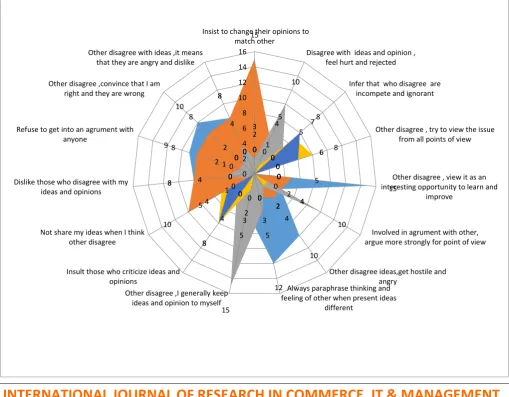
The situation one encounters in one’s working life. People behave differently to the various situations. Some of behavior at work place as follows. The people disagree with groups in organization insist of changing their opinion.
Sometimes they disagree with ideas and opinions from which they feel hurt and rejection. Some employees infer and disagree with the people who are incompetent and ignorant.
Some employees see positive aspects in the behavior of other employees. They see opportunity to learn and improve the ideas.
Some employees get involved in an argument with other and become more and more certain that they are correct and argue more strong for their own point of view.
Employees disagree with others ideas and get hostile and angry at them.
Employees careful always interpret thinking and feelings of others when they present ideas and opinions that are different from them. When other employees disagree with individual they keep their ideas and opinions to them.
Employees often insult those who criticize their ideas and opinions.
Employees careful not to share their ideas and opinions when they think other may disagree with them. Employees tend to dislike other employees who disagree with their ideas and opinions.
Employee refuse to get into some arguments with others.
Employees disagree with others ideas and opinions; it means that they are angry with others.
OBJECTIVES
1. To know the employees behavior at work place.
2. To know the situation one encounters in one’s working life.
DATA COLLECTION
For efficient data collection for this paper, survey with questionnaire is preferred, since methods have been used since a long to get relevant information and help coming to proper conclusion through analysis.
Data Source
The present study is based on primary and secondary data.
Primary data: The required primary data has been collected with help of questionnaire.
Secondary data: The relevant secondary data has been collected from articles.