7
Civil service reforms in Nigeria: The journey so far in service delivery
Rosemary O. Anazodo, Ph.D
Lecturer, Department of Public Administration
Nnamdi Azikiwe University, Awka, Nigeria
Joseph C. Okoye, Ph.D
Professor, Department of Public Administration
Faculty of Management Sciences
Nnamdi Azikiwe University, Awka, Nigeria.
Emma E.O. Chukwuemeka, Ph.D
Senior Lecturer, Department of Public Administration,
Nnamdi Azikiwe University, Awka, Nigeria
ABSTRACT
Nations all over the world are currently in the struggle to better their existence through the process of good governance, and responsible civil service for effective and efficient service delivery. Nigeria is one of such countries. However the kind of civil service bequeathed to Nigeria by her colonial master was alien and narrow in scope, and so not development oriented. At Nigeria independence in 1960, the federal civil service had a staff strength of only 30,000, this increased steadily to the level of 200,000 in the late 1990s due to political patronage. Many unqualified personnel joined the Civil Service which resulted to over sized workforce that absorbed about 87% of the total government revenue. The paper examined the civil service reforms in Nigeria from independence to the present and how they affected efficient and effective service delivery in the country. It is the position of paper that the kind of civil service reform that would tackle these problems should be evolutionary and pragmatic in nature to meet Nigeria developmental needs and the challenges of the modern world.
Keywords: Service delivery, Bureaucracy, government revenue.
Introduction
The Civil Service is the administrative bureaucracy which occupies an essential position
in the political system of nations. Throughout the world, the contributions of Civil
Service in promoting sustainable and equitable economic growth are receiving increasing
attention. Efficient and effective management of the Civil Service are critical to
sustainable socio-economic development of a nation. Thomas (1995), stated that the East
Asian experience has underscored the critical contributions of the Civil Service in
fostering rapid development.
8
judicial. Bezzina (1994) opined that Civil Service refers to employees selected and
promoted on the basis of a merit and seniority system, which may include examination.
The World Book Encyclopedia (2004), noted that the Civil Service consists of people
employed by the state to run the public service of a country.
Abba and Anazodo (2006), argue that civil service in Nigeria comprises workers
in the various ministries or departments apart from those who hold political
appointments. Civil Service reform on the other hand refers to the purposeful
modification of governmental human resource management system with the goal of
maximizing important administrative values (Anazodo 2009).
The Civil Service in Nigeria is of a colonial creation. The model of Civil Service
bequeathed to Nigeria by her colonial master (Britain) was narrow in structure and
objectives. It was basically structured in such a manner that enabled colonial masters to
successfully extract the much coveted financial and material resources needed by their
controlling metropolitan powers. Colonialism was therefore marked by a lack of
accountability and absence of transparency.
At independence in 1960 when Nigerian nationals took over the administrative
leadership, no attempt was made by them to restructure the Civil Service to suit our own
developmental needs. The Nigeria bureaucrats who occupied the leadership position in
the Civil Service imbibed the colonial mentality of wealth acquisition for
self-aggrandizement and self-superiority. Instead of working to improve the lot of the
country, they became colonial masters in a, “black man’s skin”. This aggravated the
abysmal performance of the Civil Service and consequently the under development of the
country. These and other factors necessitated the clamour for reforms in the Nigeria
Civil Service. The colonial masters carried out some reforms, among which are the
Harragin commission of 1945 which was the first commission set up to look into the
Nigeria Civil Service, and the Gorsuch commission of 1954-55. According to Anazodo
(2009), the Harragin commission was the first commission set up to look into the
man-power problem in the service and the discontent among the European members of what
was described as poor financial reward, while the Gorsuch Commission was the first to
attempt giving the regional administrative bureaucracies indigenous structure.
After independence, Nigerian government carried out series of reforms among
which are the Adebo Commission (1971), Udoji Public Service Review Commission of
1974, Dotun Philips Civil Service Reform of 1988, Allison Ayida Committee on Civil
Service of 1995. However, Nigeria is not alone in this quest for Civil Service reform.
This is because according to World Bank (2002), there is a strong consensus in the
international development community on the need for Civil Service reform in developing
nations. It is therefore a topical issue of the moment as developing nations all over the
world engage in the struggle to better their existence through the process of reforms for
efficient and effective service delivery.
9
Managerialism”. In countries like Ghana and Uganda incrementalist approach to their
Civil Service reforms was adopted to accommodate their socio-cultural needs and it has
been working well for them. It is against this back drop that the researcher sought to
examine some of the past reforms in the Nigerian Civil Service to find out if they actually
solved our developmental needs and if not what should we do to make our civil service
responsive and efficient?
Statement of the problem
It is sometimes claimed that corruption is part of African culture, but this has been
strongly denounced by the former Nigerian president Olusegun Obasanjo in 1999.
Colonialism was marked by lack of accountability and transparency. The courts existed,
not to administer justice but to sustain the imposition of colonialism. Judges were simply
Civil Servants wearing wigs and the style of governance was characterized by
government being “done” to people, rather than a people being governed by consent
(Ademolekun 1994:41). The above statement was the case in Nigeria. At Independence
in 1960, when Nigerians took over the leadership of the country, the Civil Service
structure was left the way the colonial master kept it. Much was not changed in the
activities and roles of the Civil Service.
10
started with the “purge” in the public service which was undertaken by Murtala
Mohammed’s regime in 1975/76. The Buhari and Babangida regimes took more drastic
measures in massive retrenchment of Civil Servants by way of retirements, terminations
of appointment and dismissals. This state of affairs generated fears of insecurity,
administrative culture of dehumanization and frustration in the Civil Service. The Civil
Servants lacked working tools and equipment coupled with the galloping inflation which
kept an average civil servant in perpetual misery, and apathy. There were low morale,
embezzlement, and corruption which ultimately resulted in ineffectiveness and low
productivity in the service.
The higher civil servants assumed great political powers without responsibility to
the people. They exhibited selfishness and sectional interests within the system which
consequently impaired discipline and achievement of goals. The individuals were
pre-occupied with feathering their own nests in total neglect of their individual and collective
roles toward satisfying societal needs. However Riggs (1974) opined that in the absence
of strong political institutions during the military regimes, the Civil Service tended to
become powerful, corrupt and inefficient and ultimately lost its neutrality.
The present state of affairs in the Civil Service appears that the variables
responsible for poor performance in the Nigerian Civil Service have not been dealt with
and so the problem still lingers. It is against this background that the researcher sought to
examine some of the past Civil Service reforms, to find out to what extent they were able
to solve problems of inefficiency and ineffectiveness in the Nigerian Civil Service and
proffer the way forward
.
Factors that necessitated various reforms in the Nigerian Civil Service (1960-2005).
A number of factors necessitated various reforms in Nigeria. The situation of
grand corruption among the Civil Servants was facilitated by the long rule of the Military
and its attendant practices of impunity, lack of probity and accountability.
Gowon’s regime was unashamedly corrupt to the macro level. It was not hidden
from the public gaze. According to the Nigerian Tribune (1975), his pledge to enact an
anti-corruption decree like other promises was never fulfilled. The level of corruption
under Gowon’s regime came under public scrutiny when Murtala Mohammed became
the head of state and set up Assets Investigation Panel to probe the governors and other
public officers that served under Gowon. The panel indicted ten (10) out of twelve (12)
military governors and so their assets were confiscated. The anticorruption crusade
spread to the entire public service, thus, the purge of the public service that led to the
retirement and dismissal of over 10,000 public servants nation-wide. The Murtala’s
anti-corrupt crusade did not in any way deterred the politicians of the second republic from
corrupt practices, rather they engaged in different shades of corrupt practices.
The Babangida administration came into power via coup d’état of August 27, 1985 and
lunched Nigeria into eight (8) years of kleptocratic rule.
11
$200 million siphoned from the Aluminum and Smelter project.
N400 million wasted on Better Life project
Huge extra budgeting spending of N186.9 billion naira between 1989 and 1993.
Babangida regime is said to be the apogee of corruption in the history of Nigeria.
Abdusalam Abubakar administration made mockery of any sense of discipline and
probity. Christopher Kayode panel report revealed that the contracts awarded by the
Abdulsalam administration cost Nigeria N635.62 billion. The panel also revealed that the
depletion of the foreign reserve which as at the end of 1988, stood at $7.6 billion had
shrank to $3.8 billion by May 1999.
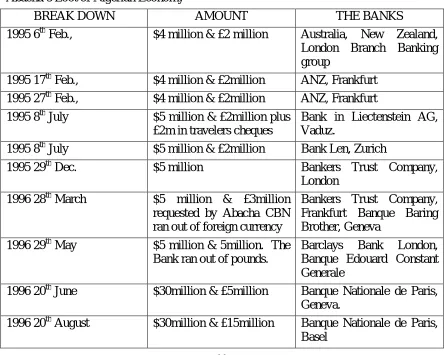
The Abacha’s loot tops the list of grand corruption in the history of Nigeria.
Although it was glaring that Abacha’s regime was corrupt, the extent of it became
manifest only after Abacha’s demise in 1998. Evidence showed that he, his children and
their cronies had looted about $3 billion dollars hidden in foreign accounts scattered
across Europe and the Persian Gulf. Abacha was described as the “biggest thief” of the
1990s, and was alleged to have sent between $12 to $16 dollars out of Nigeria during his
five-year reign. The African Network for Environmental and Economic Justice (ANEEJ)
a non-governmental organization illustrated the level of Abacha’s loot, as highlighted in
the table below.
Table 1
Abacha’s Loot of Nigerian Economy
BREAK DOWN
AMOUNT
THE BANKS
1995 6
thFeb.,
$4 million & £2 million
Australia, New Zealand,
London Branch Banking
group
1995 17
thFeb.,
$4 million & £2million
ANZ, Frankfurt
1995 27
thFeb.,
$4 million & £2million
ANZ, Frankfurt
1995 8
thJuly
$5 million & £2million plus
£2m in travelers cheques
Bank in Liectenstein AG,
Vaduz.
1995 8
thJuly
$5 million & £2million
Bank Len, Zurich
1995 29
thDec.
$5 million
Bankers Trust Company,
London
1996 28
thMarch
$5 million & £3million
requested by Abacha CBN
ran out of foreign currency
Bankers Trust Company,
Frankfurt Banque Baring
Brother, Geneva
1996 29
thMay
$5 million & 5million. The
Bank ran out of pounds.
Barclays
Bank
London,
Banque Edouard Constant
Generale
1996 20
thJune
$30million & £5million
Banque Nationale de Paris,
Geneva.
12
1996 24
thSeptember
$50million
Citibank N.A London
1996 30
thSeptember
$50million & £3million
Citibank Newyork & N.A
Luxembourg
1997 26
thNovember
$24million
M.M
Warburg
and
Company, Hamburg
1997 10
thDecember
$24 million
Merrill
Lynch
Bank,
Geneva
1997 18
thDecember
£6:15million
Midland
Bank
London,
National West Minister’s
Bank, London
Source:
ANEEJ Briefing paper on the Abacha loot, October 2002.
However wide spread corruption under the military rule and deteriorating economy have
raised a number of concerns, both for the country’s and from the International
community. These corruption include international financial scams, criminal gangerism,
drug trafficking and currency trafficking.
As the Military juntas were corrupt, so also were other public servants during the
period under review.
There are several allegations against some public servants on grand corruption.
However when the civilians took over power from the military, the problem of
inefficiency and ineffectiveness in the service still persisted.
The Civil Service Crises in this dispensation
Due to the absolute power wielded by the military during its rule, it bloated the
work of the Nigerian federal civil service from less than 30,000 in 1960 to 45, 104 in
1970, it rose to 98, 877 in 1974, 213, 802 in 1988 and reached its peak of 273, 392 in
1988 during Babangida’s administration. At this dispensation of civilian leadership, the
political leaders also inflated the Civil Service due to political patronage. Many
unqualified personnel joined the Civil Service and this resulted in over-sized workforce,
and absenteeism engulf about 87% of total government revenue. All sorts of vices are
associated with the civil service among which are; inefficiency, laziness, absenteeism,
wastefulness and corruption. There are many allegations against some civil servants on
grand corruption. In 2001, a permanent secretary of the ministry of defence was accused
of embezzling funds amounting to N450 million. The chairperson of the Educational Tax
Fund (ETF), and the Accountant General of the Federation, the former chairman of the
Inland Revenue Services were alleged to have embezzled funds of the ETF to the tune of
N40 billion between 1993 and 2000. However in 2003, Chief Vincent Azie was
appointed in Acting Auditor General of the Federation for six months, he audited the
annual accounts of government bodies.
13
money without the approving authorities involvement etc. The report indicted all federal
ministries for gross financial indiscipline and lack of regards for laid down financial
regulations (Azie 2003) see table II below.
Table 2.
Ministries Indicted by Vincent Azie (2003) Panel During his Audit
1
Ministry of Works
9
Ministry of Agriculture and rural development
2
Ministry of Transport
10
Federal Civil Service Commission
3
Ministry of Defence
11
Ministry of water resources
4
Ministry of Education
12
Ministry of Information and National Orientation
5
Fed., Min., of Finance
13
Ministry of Environment
6
Ministry of Internal Affairs
14
Federal Ministry of works and housing
7
Ministry of Police Affairs
15
Federal Ministry of water resources
8
Ministry of Power and Steel
Source: Report of the Auditor General for the Federation to the National Assembly for
the year ended 31
stDec. 2001.
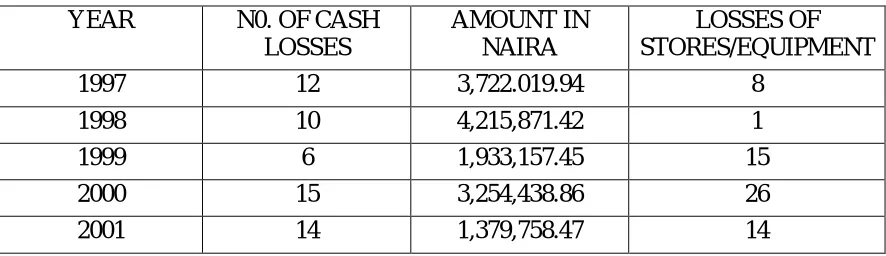
The comparative losses in the federal ministries from 1997 to 2001 is shown on table 3
below.
Table 3: Comparative Losses in the Federal Ministries 1997-2001
YEAR
N0. OF CASH
LOSSES
AMOUNT IN
NAIRA
LOSSES OF
STORES/EQUIPMENT
1997
12
3,722.019.94
8
1998
10
4,215,871.42
1
1999
6
1,933,157.45
15
2000
15
3,254,438.86
26
2001
14
1,379,758.47
14
Source: Report of the Auditor General for the Federation to the National Assembly for
the year ended 31
stDec. 2001.
14
Based on the afore-mentioned maladies in the Nigeria civil service, various
reforms have been introduced by different military regimes and civilian administrations
in Nigeria to ensure better management, effective service delivery and accountability of
public service.
The ultimate goal is to raise the quality of services delivered to the population,
support economic and social development, enhance the capacity to carryout core
government
functions-revenue
generation,
financial
management,
personnel
management, policy formulation etc. To achieve the above, Nigeria had embarked on
many post independence civil service reforms. Among the most important ones are the
Adebo Commission (1971), Udoji Public Service review commission (1974) Dotun
Philips Civil Service Reforms (1988) and Allison Ayida Commission (1995).
PUBLIC SERVICE REFORMS (1963-1999)
Morgan salaries and wages commission (1963): This Public Service Reforms
(1963-1999) was directed towards the review of salaries and wages of workers because of an
unbearable high cost of living in the country. The commission recommended a review of
grading of officers and corresponding salary structure to take care of the discrepancies in
various parts of the country on an ununiform salary grade level, conditions of service and
uniform remuneration for officers performing the same duty in different parts of the
country. It also recommended the award of a minimum living wage although; this was
turned down by the government. Because some of the commission’s recommendations
were turned down, and the implementation of the accepted ones did not achieve the
intended goal the Civil Service continued to perform poorly.
The Adebo Commission (1971)
The commission studied and reformed the Civil Service. It made a number of
recommendations on the structure and organization of the Civil Service. It reviewed the
salaries and wages of workers and recommended that a public service commission should
be put in place to take up the responsibility of effectively reviewing the salaries and
wages.
Udoji Public Service Review Commission Of 1974
15
in the Civil Service, salary to depend on job content and performance, promotion to be
based on merit, public sector composition to be in line with that of the private sector,
finance and personnel management to be modernized, introduction of code of ethics,
motivation of workers, man power development, the term administration to be changed to
management etc. The Udoji Public Service Review Commission attempted to achieve a
“New Style Public Service based on result oriented management which would be capable
of meeting the challenges of development”. However institutional and cultural problems
combined to weaken the effectiveness and efficiency of the Civil Service reform and this
led to a drastic reduction of the workforce in which about 12,000 public servants lost
their jobs in 1975, culminating to low morale of the workers which adversely affected
productivity in the service.
Dotun Philips Civil Service Reform Commission 1988
Still trying hard to re-engineer the Nigeria Civil Service for effective service
delivery, the Dotun Philips Civil Service Reform Commission of 1988 was set up by the
Babangida regime, under the chairmanship of Dotun Philips. The Commission was set to
study the structure, staffing and operations of the federal Civil Service. This reform did
more harm than good as it encouraged corrupt practices in the state bureaucracy. The
highlights of the reform were that, the minister was made both the chief executive and the
accounting officer of his ministry. But before the reform the permanent secretary was the
accounting officer of the ministry. The permanent secretary’s appointment was made
political as its duration/tenure was left for the pleasure of the president or governor by
making their position non-permanent any longer. They were meant to retire with the
president or governor. The permanent secretary had a choice whether or not to accept the
post. The review commission professionalized the Civil Service, because every officer
whether a specialist or generalist made his career entirely in the ministry or department of
his choice. Each ministry was made to undertake the appointment, discipline and
promotions of its staff and the ministries of finance and national planning were merged
etc.
Allison Ayida Civil Service Reform (1995)
16
and that the minister should continue to be head of the ministry only and the permanent
secretary the accounting officer so as to re-introduce checks and balances.
Present State of the Civil Service
The Nigerian Civil Service has undergone several organizational and structural reforms,
both before and after independence as we have X-rayed above, yet there is no tremendous
improvement in the quality of service provided to the citizenry. Corruption still rears its
ugly head again after many years of military exit in governance. There is weak national
consciousness due to earlier introduction of the Nigerianization and regionalization
policies that encouraged ethnicity and sectionalism in the rank and file of staffers in the
service. There is multiplicity of classes and grades which brought about over bloating of
the number of Civil Servants resulting to high re-current expenditure to the peril of
infrastructural development. There is still a uniform centralized control of the Civil
Service as was put in place by the colonial masters. In this twenty-first century, there is
disillusionment with the uniform centralized control of the Civil Service management.
Such ‘controls according to experts was to assure impartial application of personnel
policies to professionalize the Civil Service cadres and to route out corruption and
patronage. But it is obviously clear today that these variables have not been dealt with,
therefore a decentralize civil service will to some extent provide a panacea to the problem
of development in Nigeria.
Critical Analysis of the Impact of the reforms
These reforms starting from the Morgan Commission of 1963 to the Allision
Ayida Panel of 1994, tried quiet a lot at improving the Civil Service in Nigeria. But by
2005, it was obvious that a result oriented Civil Service had not emerged in Nigeria. The
quality of the Civil Service was severely hampered by cultural, structural, institutional
and other management defects.
The Way Forward
17
Nigeria therefore should decentralize her Civil Service to a reasonable extent from the
center to the out-post offices so as to give them power to attend to emergencies as they
arise. This will go a long way in strengthening the system. Nigeria should borrow a leaf
from some advanced countries like Asian countries, France, US, Germany, Netherlands,
and Canada who have tremendously improved their Civil Service by making it more
Client public-oriented. They achieved this by using a model of centralized control
allowing a reasonable degree of decentralization, flexibility and delegation of Civil
Service Management system. Nigeria should emulate the above mentioned industrialized
countries by embarking on a search for ways to reduce Civil Service expenditures and at
the same time improve performance standards in government by adopting the “New
public management (NPM) style” or the “New Managerialism”. It could do this by way
of adopting different phases in her reform process. Hood (1991), opined that major New
Public Management (NPM) doctrines are that (a) direct public sector costs must be cut,
(b) Private sector style management practices must be applied to increase flexibility in
decision making (c) competition in the public sector must be increased to help lower
costs and better standards (d) the public sector must be decentralized to make units more
manageable and productive (e) results should be stressed rather than procedure (f)
explicit standards and performance measure must be established because accountability
requires clearly stated aims and efficiency requires attention to goals (g) managers must
be given powers for professional management, because accountability requires clear
assignment of responsibility not diffusion of power. According to Jann (1997:96), the
NPM inspired measures include reduction and refocusing of public sector functions
through staff reductions and changes in budgetary allocations, restructuring of public
organizations through reorganization of ministries, decentralization, delinking or
hiring-off of central government functions to local governments or other bodies or private
sector, etc.
To reduce and refocus Civil Service activities in Nigeria, Civil Service workforce
must be reduced. Lienert and Mordi, (1997) agree that measures are to be taken along
this line and they must come in phases. The first approach could be called “cut back
management” which will help in curbing public spending and Civil Service staffing in
response to the fiscal constraints of the country. This could be done through further
down-sizing exercise of the Civil Service staff which would be achieved through the
removal of “Ghost” workers, elimination of vacant posts, retrenchment of redundant staff
or recruitment slow downs, freezing of hiring, compulsory retirement at a legal age,
transparent privatization of government functions / activities, establishment of guaranteed
jobs for graduates, voluntary retirement and lay off of non-permanent staff.
The second approach is to (a) reduce direct role of government in managing the
economy and in producing services so as to enable the private sector, local governments
and communities provide such services, (b) policy formulation, co-ordination, regulations
and monitoring functions of government should be strengthened (c) to change the way
Civil Service is managed by establishing performance incentives and (d) to re-organize
ministerial functions including decentralization, corporatization, out sourcing and
privatization.
18
The Nigeria government is advised that in applying the above approaches, it
should do it in line with the level of the social and economic needs of the country. Some
examples of the countries that adopted cut back management according to Nunberg
(1995) included the United States of America in the early 1980s. Dutch government’s
downsizing exercises reduced the Civil Service personnel by two percent per annum, in
the mid 1980s, a Japanese programme to reduce Civil Service staff by five percent took
place between 1986 and 1992, and the U.K’s reduction of Civil Service staff by 22
percent was between 1979 and 1989 (see figures 1, 2 and 3).
Figure 1
Civil Service Employment In Selected Oecd Countries, 1979-1990
180 750 3200 6% 6% 6% 4% 4% 4% 2% 2% 2% 0% 0% 0% -2% -2% -2% -4% -4% -4% 170 700 3100 160 650 3200 150 600 2900 140 550 2800 * 130 500 2700 120 450 2600 400 2500 1979 1979 1979 1980 1980 1980 1981 1981 1981 1982 1982 1982 1983 1983 1983 1984 1984 1984 1985 1985 1985 1986 1986 1986 1987 1987 1987 1988 1988 1988 1989 1989 1989 1990 1990 1990 (t h o u s a n d ) (t h o u s a n d ) (t h o u s a n d ) Australia
United Kingdom United Kingdom
Japan 520 6% 4% 510 (t h o u s a n d ) 2% 500 0% -2% 480 -4% * * * * * * * * 400
1979 1980 1981 1982 1983 1984 1985 1986 1987 1988 1989 1990
Note: data unavailable for years marked with an asterisk (xx).
Source: World Bank Discussion Papers managing the Civil Service (1995)
19
Figure 2
Percentage Changes In Civil Service Employment For Selected Oecd Countries, 1984-89
0 .1% 0.3%
1.4 %
6.8%
-1.8% -9.1%
-1.1% -5.70%
-0.7% -3.3%
-0.5% -2.7%
-0.5% -2.5%
-0.2% -0.6%
Note: Changes in Germany are based on 1985-89 time period Source: CECPS
20
Figure 3
Civil Servants Per 100 In The Population In Selected Oecd Countries
3.76 3.69
3.08 2.90
1.30 0.99
1.28 1.24 1.04
0.93 1.02 0.88
0.51 0.50
0.43 0.40 Earliest period
1989
84
France Sweden United Kingdom
United States
Australia Canada Germany Japan
89 79 89 79 89 79 89 79 89 79 89 85 89 84 89
Source: CECPS
21
among a policy guidance body, and oversight agency which would help to ensure fair and
meritorious practices, financial control cum monitoring organ, under which a regulatory
body to take charge of the workers’ salary should be established. This measure will go a
long way in curbing the frequent struggles between the government and the workers on
the matters of remuneration. Workers often struggle with the government before they are
paid their minimum wage or living wage. Sometimes some states will agree to pay,
while some other states disagree to pay the minimum living wage to the workers. If a
salary regulatory body is established, workers salaries would be adjusted based on the
state of the country’s economy and this will drastically reduce the frequency of strikes,
embezzlement, other corrupt practices, and low morale by the Civil Servants. In
Malaysia, for example, a New Remuneration System has been established which ensures
that incentive packages are regularly given to the workers. Still and, in particular
personal achievements are recognized and rewarded. In countries like, USA, Australia
and Germany, salary regulatory bodies are established. In Botswana public service, a
salary regulatory body known as “Presidential Salary Review Commission” has been
instituted to regulate the salary of workers in line with the state of the country’s economy.
Following the increased revenues from diamonds and the annual rate of inflation, the
body made automatic annual adjustments in 1982 and 1990 the annual adjustments were
followed by the award of salary increase based on the recommendations of the
presidential salary review commission (Mogolori Modisi 1996:70). In those years
salaries were thus increased twice as shown in the table below.
Table 4
Grade 1983/84
1993/94
Folds of Increase
P
P
F0
21,768
124,728
5.7
F1
21,012
108,456
F2
18,984
94,320
E1
17,460
82,008
4.6
E2
16,428
71,316
D1
15,408
62,004
D3
14,388
48,456
C1
13,476
37,872
2.8
C2
9,948
30,792
C3
6,984
25,056
B1
6,996
16,080
2.3
B2
4,920
13,464
B3
3,972
10,992
22
The re-structuring and re-organization of the Civil Service should not be only in
the area of nomenclature but also in personnel utilization. This will help to ensure that
manpower is optimally deployed and that there is effective monitoring system of the
productivity of individual workers to ensure high productivity of the whole work-force.
The initial recruitment and placement of workers should be on the bases of skills and
competence. Appraisal and promotion of workers should be more objective based on
skills and, in particular, personal achievements just as it is obtained in the Malaysian New
Remuneration System. There is need to identify workers training needs to find out where
they are deficient so as to train them accordingly. Anybody who fails or does not
perform after the training should be asked to voluntarily retire. There should be a
substantial freeing-up of centrally imposed rules on budgetary and staffing matters, so as
to enable managers be both efficient and effective. The fact that excessive rule and
regulations create inefficiencies, while devolution and freeing-up the rules give managers
flexibility in improving public sector performance should not be ignored while
considering the various options in this paper vis-à-vis the Nigeria socio-cultural
environments. The research also recommends that other African Countries especially in
the West African sub-region that were once colonized should consider the above options
recommended for Nigerian civil service for the improvement of their own civil service in
consonance with their socio-cultural values and circumstances.
Conclusion
Having identified the problem in the Nigerian Civil Service from independence
till date and proffered suggestions on how to improve the service, what Nigeria needs
now is to adopt a “new style management” bearing in mind her social and economic
environment. Again the implementation strategy and monitoring systems of the Civil
Service are to be taken seriously so that the Nigerian Civil Service would be
service-and-result-oriented geared towards the achievement of the nation’s socio-economic
development.
23
References
Adebayo, A. (1994),
Principles and Practice of Public Administration in Nigeria,
Ibadan
: John Wiley & Sons Ltd.
Alli, Chris (2001) the Siege of a Nation:
The Federal Republic of Nigerian Army
,
Malthouse and Heinemann
Anazodo, R.O (2009)
Civil Service In Nigeria, An Analysis of Its Bureaucratic
Effectiveness
, Onitsha: Abbot Books, Ltd.
ANEEJ. (2002) Briefing paper on the Abacha loot, October 2002.
Aucoin, Peter (1990) “Administrative Reform in Public Management Paradigms,
Principles, Paradoxes and Pendulums”.
Governance: An International Journal of Policy
and Administration
115-137.
Ayida, Allison (2001), Reflections on
Nigeria’s Development
: Malthous and Heinemann.
Ayoade, A. A (1988),
States without Citizens
:
An emerging problem
in D. Rothchild and
N. Chazain (1986) (eds),
The Precarious Balance: State and Society in Africa
, West
View Press, Boulder.
Barbara, Nunberg (1995),
Managing the Civil Service: Reform Lessons from Advanced
Industrialized Countries
, USA. The World Bank.
Daley, Dennis M. (1990).
The Civil Service Reform Act and Performance Appraisal, A
Research Note on Federal Employee Perceptions
, 245-251.
Ejeviome Otobo (2000), “Nigeria” in Ladipo Ademolekun (ed) Public
Administration in
Africa
, Spectrume Books Ltd.
For Details of Abacha’s rule see: “Chris Alli” (2001), The Federal Republic of Nigeria’s
Army:
The Siege of a Nation
, Lagos: Malthouse.
Harry C. Reld ILL. (1990), The State of the Merit System:
Perceptions of Abuse in the
Federal Civil Service
New York: Longman.
Hood, (1986) “Exploring Variations in Public Management Reform of the 1980’s in
Bekke 1996.
Jann, W. (1997)
Public Management Reform in Germany: A Revolution without a Theory
inkikert, 1997.
Kayode (1990),
Social Cultural Values and Bureaucracy In Adebayo (1994) (ed)
Bureaucracy and Social Change: Studies in Bureaucracy And Under Development
Lagos: Pumark Nig. Ltd.
24