Technical Tools for Studying Structure and Dynamics
of Water Masses
V.Z. Dykman
Marine Hydrophysical Institute, Russian Academy of Sciences, Sevastopol, Russian Federation
e-mail: [email protected]
The article gives a review of the technical tools designed to study structure and dynamics of water masses in the surface, bottom and deep-water sea layers, where the acting processes are not connected with wind waves. The process of adapting the measuring equipment to the requirements resulting from the expanding notions on physics of the marine environment phenomena is shown. Almost all the major designs are patented in the USSR, Ukraine and Russia. The experience in the development of different instruments enable adequately respond to the need for new methods and technical means intended for the organization of operational observations of the marine environment and land and sea interface zone. CTD-system experimental samples having a high degree of miniaturization and extremely low power consumption have already been created. They possess the necessary metrological characteristics and are intended for use in the drifters and lost (disposable) probes. According to its metrological and operating characteristics, the autonomous electromagnetic current meter is able to provide reliable data in a variety of conditions (including collapse area of wind waves) both being installed on a fixed base and hung on buoy stations. For wide manufacture of the new measurement tools it is necessary to create a complete set of design documentation on the basis of existing sketches, as well as to find the production base, equipped with machine tools of the corresponding class.
Keywords: measuring instruments, turbulence, fine structure, current, bed load.
DOI: 10.22449/1573-160X-2016-6-43-55
© 2016, V.Z. Dykman © 2016, Physical Oceanography
Immediately after Marine Hydrophysical Institute (MHI) was relocated from Moscow to Sevastopol the widespread implementation of up-to-date technical tools of its own design in the hydrophysical research began. To implement this program the head of MHI Arkady G. Kolesnikov put his hope in the newly recruited engineers and technicians, as the number of researchers, including the instrument operators who arrived from Moscow was not enough. Probably it was an unprecedented case of such a broad involvement of the young staff mainly of technical orientation by the Institute. The author of the present work was enrolled in the Turbulence Department being a 3rd year student of Sevastopol instrument-making institute. On N. Panteleyev (the associate of A. Kolesnikov) instruction, together with G. Aretinskiy he started to develop electronic units of the deep-water autonomous turbulence meter (GAT-3) [1] on a modern element base (at that time it was a transistor). Fig. 1 shows the research process applying GAT-3 in the summer of 1964, when the first deep-sea small-scale turbulence measurements were carried out in the Black Sea.
а b
scientists, for example, V. Vodyanitsky [2] and A. Kolesnikov, had a different opinion.
Fig. 1. R/V Mikhail Lomomosov 16th cruise, the Black Sea. GАТ-3 deep-water submersion, depth
~2000 m (а); GАТ-3 electronics check, from L to R: G. Aretinskiy, V. Dykman, N. Panteleyev, V. Pisarev (b)
Fig. 2. R/V Akademik Vernadsky 5th cruise, the Indian Ocean. automated deep-water autonomous turbulence meter, preparation for putting on submerged buoyancy (1)
Fig. 3. Autonomous current velocity meter
In 1964 – 1977 a large number of new instruments was created in the Turbulence Department with direct participation of the author of the present paper as the head of a group. Following GAT-3, more complex automated systems were developed for marine turbulence investigation, such as automated deep-water autonomous turbulence meter (Fig. 2). These instruments were equipped with a device recording information on a magnetic carrier of a large capacity. At that time the magnetic recording was not applied in oceanographic instruments in the USSR. Mechanical assemblies of magnetic recording devices, being type tested, were borrowed from the space sector and improved for the use in the sea. To eliminate the harmful effects of surface waves on the results of measurements of small
amplitude current velocity pulsations, peculiar to the natural small-scale turbulence, several types of so-called submerged buoys were developed. In operational mode, they were not on the sea surface. They were situated at a certain depth the surface wave did not penetrate to. Moreover, to eliminate the influence of large-scale currents on the rope with the instruments hanging, the buoy was often located near the measuring tools, sometimes almost at the very bottom. Under these operating conditions, it had to withstand a heavy pressure of hundreds of atmospheres. For such buoys Research Institute ‘Yarsintez’ (Yaroslavl) by MHI order manufactured the buoyancies of different sizes and shapes from a mixture of epoxy resin and glass microspheres (Fig. 2, item 1). Such material with a specific gravity of ~ 0.6 g/cm3 withstood the pressure of hundreds of atmospheres and was not subject to corrosion. At shallow depths of about several hundred meters, we applied the write-off all-metal cases of mines and hydroacoustic stations.
Current is an important hydrological characteristics that determines the movement of ocean waters and behavior of the salinity fields, temperature and density of different suspended and dissolved elements of natural and anthropogenic origin, and has a significant influence on the weather and climate of the Earth. Research of mesoscale variability of the current velocity field has been an urgent task of all times. But there were no domestic technical tools to carry out such research in 1960s, except for the mechanical direct-printing recorders of currents BPV-2 and BPV-r, which made a large number of methodological and instrumental errors [3]. Their key errors were the following: overstatement of current velocity module (due to the velocity converter irreversibility) under the influence of waves on the meter itself and the buoy – a carrier of the devices; large inertia of the current direction meter finned body of the instrument); averaging of the velocity module over the entire range of discrete nature; instant (at the time of printing of the measurement result) current direction.
Several models of electronic current meters, e.g. Autonomous current velocity meter (ACVM), were developed in the Turbulenсe Department (Fig. 3). Its main feature is a magnetic information recorder, as well as a small interval of measurement resolution – 10 seconds. The shades of time averaging of the current velocity vector module (10 s) and the reaction time (~ 1 s) of the current direction sensor (vane) shortened the number of the known methodology measurement errors [3].
spent stages. Applying the latter was only necessary to reduce the power consumption of the electronics unit, performing the function of the analog averaging vector as the micro-consuming operational amplifiers and microprocessors did not exist at the time. The temperature measurement channel in the long-term component current recorder was designed on the basis of quartz thermal frequency converter.
Running time of the long-term component current recorder depended on the sampling frequency. The power supply with voltage of 10 V and capacity of 11 A/h at the interval between 5 min samples provided the operation duration of 90 days. At larger sampling intervals the running time period increased. The magnetic storage capacity was 25,000 36-bit words.
The practical application of the first electronic
CTD-probes in hydrological research revealed the presence of quite thin irregularities of the studied fields of temperature, salinity and density, initially accepted for instrument errors. But in the course of summarizing of the probing results it turned out to be an almost universal phenomenon. Also, the range of the vertical dimension of the inhomogeneity of various fields stretching towards the small scale (of a meter – centimeters) was revealed. In order to study this phenomenon, in the Turbulence Department several models of the probes were developed. These probes were falling along the cable rope providing a stable probing velocity unlike those sinking on the cable rope.
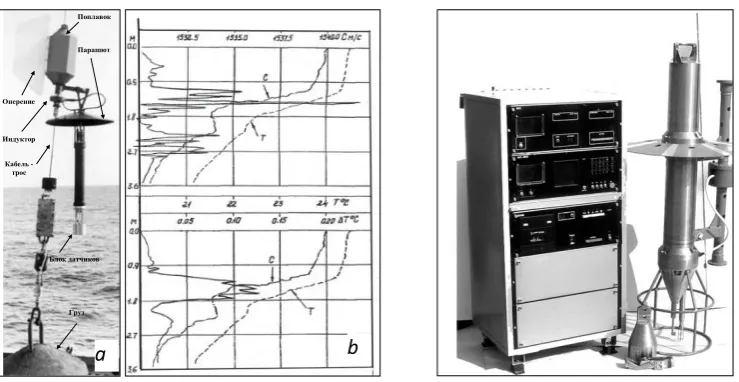
Design features of Zond-ST meter are as follows: instrument container; inductor; float and parachute slowing the fall of the probe; fins diverting the meter container from the inclined cable rope. Instead of time sampling measurement, spatial sampling by the impeller was applied. The impeller started a measuring cycle every 3.6 cm moving along the cable rope. The data transfer to the vessel was carried out using a frequency-modulated signal through the inductor–cable rope –receiver system.
Zond-ST meter was widely used in the expeditions (Fig. 5, a). It was a well established and reliable instrument, convenient in carrying out probing to 1.500 m depth [6]. Its application in the POLYMODE project permitted to obtain unique data on the fine structure of the fields of temperature and sound velocity in large eddy formations and rings of the Gulf Stream (the obtained materials formed the basis for the author's Ph.D. thesis). Fig. 5, b shows graphs of the same fields for the Black Sea according to the results of thermocline probing in summer. Depth scale reflects only the thickness of the transient layer fragment shown in the Figure.
Fig. 5.Zond-ST falling along the cable rope– а; temperature and sound velocity profiles, their vertical gradients and the transient layer in the Black Sea in summer – b
Fig. 6. Fine-structural high resolution CTD-probe Kompkleks-1М
In January 1977, the author of the present paper was transferred to MHI Special Design and Technological Bureau. At that time the Bureau was fulfilling the order of the Hydrographic Service of the USSR Navy. It included development of several measurement systems that were to register parameters of fields of temperature and conductivity with high accuracy and high spatial resolution. In the Special Design and Technological Bureau, which had experience in development of high-speed high-precision CTD-systems, the probes Kompkleks-1 and
Kompkleks-1M were created. These instruments permitted to explore the fine structure of field temperature, salinity and density and to obtain their mean profiles and T, S-curves with high accuracy.
Last of the Bureau developments – Kompkleks-1M probe (Fig. 6) has a larger spatial resolution of conductivity measurement channel due to the application of small-sized four-electrode conductivity sensor cell, unlike the Kompkleks-1 probe transformer sensor. According to their spatial resolution and sensitivity the aforementioned probes can cover a range of vertical scales L> (2 – 7) cm.
As assigned by the Automation Department, the Bureau started the improvement of the current meter created in the Department. The work was fulfilled using completely different, more sophisticated components and other principles of conversion of the measured parameters in the digital form and their recording on a magnetic carrier. The problem of the magnetic case influence on the compass was eliminated with the help of Special Design and Technological Bureau of the Institute for Problems of Strength, Ukrainian Academy of Sciences, which developed and manufactured the batch of cases of glass and ceramics.
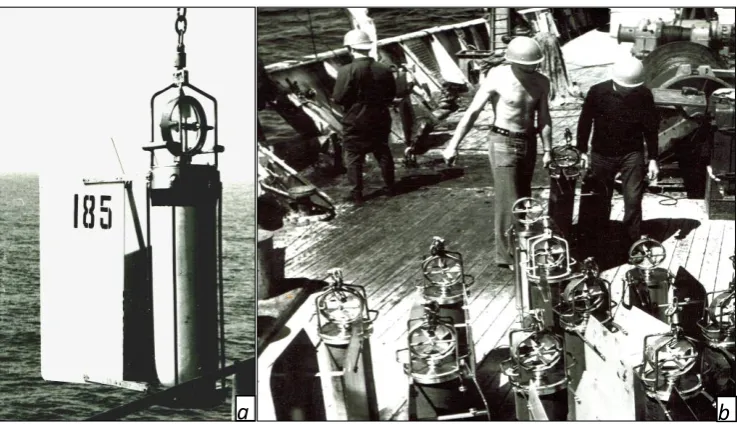
In 1983 the responsible executive M. Kolomoitsev prepared and carried out the state acceptance tests with the recommendation for serial production (Fig. 7, a). The Bureau produced more than 300 such meters to provide the MHI expeditionary activities and supply of the instruments by the Hydrographic Service (Fig. 7, b).
Поплавок
Парашют
Оперение
Индуктор
Блок датчиков
Груз Кабель -
трос
Fig. 7. MGI-1301 autonomous current and temperature meter designed in Special Design and Technological Bureau – а; complete supply of the Marine Hydrophysical Institute research vessels by the self-developed current meters – b
By the time of MGI-1301 design was complete, it was clear that there was no alternative to the vector averaging principle in measurement of the current velocity vector parameters. So the Bureau, without any additional third-party financing, organized work on development of the standard-fit current meter MGI-1308
implementing the aforementioned principle. The team of developers consisting of V. Dykman (team leader), S. Lavrov, G. Dudnikov, A. Tolstosheev, E. Timofeev, M. Ivanenko created fundamentally new important elements of the meter, such as digital magnetic compass, reversing current converter velocity impeller, system controller and memory device, mechanical units, in particular the instrument suspension ball system. In the hydro-canal of the Baltic branch of Research Institute of Fisheries and Oceanography (Kaliningrad) the tests of the instrument suspension system of a cable break, which provides high accuracy flow reversal, were performed.
The results of the MGI-1308 field tests in the 41st cruise of R/V Akademik Vernadsky (Fig. 8) and statistical processing of the data obtained showed that the vector averaging significantly improved the quality of the current velocity field research.
In 1990 MHI Special Design and Technological Bureau obtained an order (Riga) for 120 MGI-1308 meters from Scientific Development and Production Center "Soyuzmorinzhgeologiya". But when the instruments were produced, the customer had to cancel his order. Currently, some part of the manufactured equipment is still in the institute and is used for its intended purpose.
Fig. 8. The MGI-1308 field tests in the 41st cruise of R/V Akademik Vernadsky, the Atlantic Ocean
Fig. 9. Triaxial electromagnetic sensor of the current velocity vector component pulsations
Fig. 10. Measurement complex “Donnaya Stantsiya” (Bottom Station): 1 – sensor of the current velocity, temperature and electrical conductivity vector component pulsations; 2 – meters of accelerations in three axes, azimuth and hydrostatic pressure; 3, 4, 5 – suspension traps; 6 – electronics of the traps; 7 – directional attenuation coefficient meter; 8 – central module (power, communications)
After the break-up of the Soviet Union (1991) the orders from the Russian authorities for the production of various hydrophysical devices stopped. Consequently, the staff of MHI Special Design and Technological Bureau was sharply reduced. However, by virtue of MHI Deputy Director Vilaliy Ivanov, the leading developers of CTD-probes and instruments for the study of the dynamics of water masses were able to continue their elaboration.
Dynamic processes in the coastal zone at depths of up to 15 – 20 m are among the least studied and the most relevant for practical applications. Insufficient
1 2
3 4
5
6 7
knowledge is associated with a significant shortage of experimental studies of dynamics in this area, and with intensification of erosion processes, bottom material transport and redeposition.
To obtain the direct instrumental research data in the coastal bottom area, which are necessary to determine the bed load suspended matter flows, the team of the Shelf Hydrophysics and Turbulence Departments (consisting of V. Dykman, O. Efremov and V. Barabash) developed a unique triaxial electromagnetic sensor of the current velocity vector component pulsations (Fig. 9). This instrument was capable of operating in any direction of the streaming flow [7, 8]. The basic element of the measurement complex “Donnaya Stantsiya” (Bottom Station) [9] (Fig. 10) designed for the study of bed load suspended matter transport is the meter of current velocity vector component pulsations with triaxial electromagnetic sensor of spherical direction diagram (Fig. 11). The sensing element of this instrument has the form of a ball 3 cm in diameter. According to the type of its spatial hardware function it can measure minimum wavelength inhomogeneity [3]
λmin = 1.8 a =5.4 сm.
Fig.11. Meter of the current velocity vector component pulsations
All three structural components of the current field velocity are involved in bed load transport processes. These are wave motions, small-scale turbulence and middle currents, which include all the fluctuations in the coastal zone with periods of more than one minute. A typical feature of shallow water is predominance of wave motions over the middle currents, so the direction of the instantaneous velocity vector varies in a very wide angular range. In this situation, the meters of turbulent fluctuations with a narrow direction diagram are unsuitable, as they can normally operate only in the probing mode, when towing in a steady streams.
The vertical component of current velocity turbulent fluctuations has the leading role in particle weighing mechanisms [10]. However, this does not mean that we can neglect the dimensions of the horizontal component of velocity fluctuations. First of all, horizontal components of the wave fluctuations are important for calculating the stress involved in the processes of bottom soil erosion. In addition, the instrument platform can be inclined at an angle to the horizon, and for converting from one coordinate system to another, it is necessary to measure all three components of the current velocity fluctuations.
The frequency range detected by the meter of the current velocity vector component pulsations is 0.1 – 20 Hz and the level resolution is about 1 mm/s. This means that it can be used to measure the characteristics of wave motion and small-scale turbulence simultaneously.
3
1
2
turbidimeter) (Fig. 12), for determining the parameters of suspended matter, particularly, concentration and average particle size of the suspension. Another module (applied for direct determination of instrumental parameters of the suspension) the complex is equipped with is suspension collection modules (traps) (Fig. 13) with a remote readout of the amount of accumulated suspension [11].
Fig. 12. Directional attenuation coefficient meter (transparency meter)
Fig.13. A suspension collection module (trap) consists of: 1 – storage glass; 2 – signal processing unit; 3 – glass fitting
Mounting of the complex “Donnaya Stantsiya” (Bottom Station) at the sea bed in the coastal area is not a simple task, especially in heavy sea. It is carried out manually in the area of wave breaking at the depths of about 1.5 m (Fig. 14, a). There is a specially designed watercraft on the basis of the inflatable catamaran "Neris" (Fig. 14, b) for the mounting at the greater depths up to 10 – 20 m.
Fig. 14. Ways of “Donnaya Stantsiya” mounting: manually (the beach of Chersonesos Reserve) – а; by means of a specially designed watercraft on the basis of the inflatable catamaran "Neris" Tuzla Spit – b
а
b
Fig. 15. Works with the complex “Sigma” probing variant in the international expedition on the Bulgarian R/V Akademik – а; co-complex “Sigma-P” (stationary variant) on the oceanographic platform in Katsiveli – bFig.16. Autonomous electromagnetic current meter: 1 – two of the four electrodes; 2 – false case with the load; 3 – sensor compartment; 4 – electronics and battery compartment; 5 – cover; 6 – suspension handle
For the study of hydrophysical fields in the upper 100 m sea layer a multifunctional measuring complex "Sigma" was created through joint efforts of the Turbulence and Shelf Hydrophysics Departments shelf of MHI (Fig. 15). This complex meets modern requirements in terms of accuracy and sensitivity. Its basic module is also a meter of the current velocity vector component pulsations. It can be used both in the stationary mode for the surface layer study and in the probing mode – for the deeper sea layers. Probing version of the instrument is designed to research the fine structure of the upper ocean layer, transferring the data both by cable to the onboard computer and by storing the obtained data to the flash memory when working autonomously.
Complex "Sigma" performs measuring of the three components of current velocity vector pulsations – U', V' and
associate the measured values of the current velocity vector component with a fixed coordinate system. Furthermore, these data are used to exclude those components which are caused by the instrument's own vibrations from the channel readings of fluctuations.
The practice of long-term application of current meters with mechanical velocity and direction converters in the shelf sea areas and at shallow depths has shown that they have a short term reliable operation due to significant fouling by biological objects. Development of new current meters was aimed at elimination of the main drawbacks of such meters with the principle of vector averaging maintained.
The developed autonomous electromagnetic current meter (Fig. 16) provides measuring of the two horizontal components of the current velocity vector averaged over a relatively large time interval (10 min or more). During the processing on their basis the averaged current velocity module vector and its direction are calculated relative to the magnetic meridian. The meter is capable of operation under specific conditions: in the sea surface layer, where the wave nature of the velocity fluctuations can approach and exceed the average velocity of water mass transfer; in the area where high waves enter shallow water, the pulsations can hugely exceed it. The coastal water is saturated with solid mineral particles capable, of damaging the movable mechanical elements velocity transducers in a short time, like biological fouling. The velocity and direction converters of autonomous electromagnetic current meter has no moving mechanical elements.
To ensure high resistance of the instrument to the impact of the environment we chose the conversion principle of magnetic induction transformation of the conducting fluid motion in difference of the potentials appearing in the electrodes placed in a magnetic field. Application of an alternative acoustic method to measure the current parameters is difficult at a high suspended matter concentration, and also under a large number of air bubbles at the zone of wind waves breaking.
In the aquatic environment, when the wave and turbulent components of the current velocity fluctuations reach several meters per second, and the average transfer rate is no more than several tens of centimeters per second, characteristic aspects of the autonomous electromagnetic current meter operation force to apply the vector averaging process for significant time intervals, for example, 10 min, or 1,500 instantaneous samples. Additionally, the averaging procedure permits to reduce significantly the effect of electrochemical noise of the electrodes and hydrodynamic nature noise in the electrode region.
electrochemical nature of the noise has always been a serious problem in terms of electricity consumption. We have provided a device which can excite an alternating magnetic field by rotating a cylindrical drum with built-in magnets of rare earth materials [12].
High speed operation of magnetic induction transmitters of current velocity components, according to the type classification of converters [3], provides minimal methodical measurement errors.
Conclusion. More than 50 years of experience in the development of
instruments for studying the structure and dynamics of water masses can adequately respond to the need for new methods and technical means intended for organization of operational observations of the marine environment and land and sea interaction zone.
CTD-system operating samples with a high degree of miniaturization and extremely low power consumption have already been created. They possess the necessary metrological characteristics and are intended for use in the drifters and disposable probes.
According to its metrological and operating characteristics, the autonomous electromagnetic current meter is able to provide reliable data in a variety of conditions (including collapse area of wind waves) both being installed on a fixed base and hung on buoy stations.
For wide manufacture of the new measurement tools it is necessary to create a complete set of design documentation on the basis of existing sketches, as well as the production base equipped with machine tools of the corresponding class.
Two recent developments have been performed within the framework of the Project No. 0827-2014-0010 (code "Fundamental Oceanology").
REFERENCES
1. Kolesnikov, A.G., Panteleev, N.A., Aretinskiy, G.Yu. & Dykman, V.Z., 1966, “Apparatura dlya izmereniy turbulentnykh pul'satsiy skorosti techeniya i temperatury na bol'shikh
glubinakh okeana [The equipment for measuring of the current velocity and temperature
turbulent fluctuations at great depths of the ocean]”, Metody i pribory dlya issledovaniya
fizicheskikh protsessov v okeane, vol. 36, pp. 15-25 (in Russian).
2. Vodyanitskiy, V.A., 1975, “Zapiski naturalista [Notes of a naturalist]”, Moskva, Nauka, 193 p. (in Russian).
3. Kushnir, V.M., 1978, “Nekotorye voprosy izmereniya vektorov fluktuiruyushchikh okeanicheskikh
techeniy [Some issues on the measurement of the ocean current fluctuating vectors]”,
Eksperimental'nye metody issledovaniya okeana, pp. 5-17 (in Russian).
4. Dykman, V.Z., Efremov, O.I. & Naumchuk, V.V., 1978, “Vektorno-osrednyayushchiy izmeritel'
skorosti techeniya [Vector averaging current velocity meter]”, Eksperimental'nye metody
issledovaniya okeana,pp. 112-116 (in Russian).
5. Dykman, V.Z. & Kropinov, V.A., 30.10.81, A. s. No. 877569 (SSSR), “Sinusno-kosinusnyy
preobrazovatel' [Sine-cosine transformer]”, Bul. No. 89.40.
6. Dykman, V.Z., Efremov, O.I. & Panteleev, N.A., 1978, “Zondiruyushchiy kompleks dlya
issledovaniya tonkoy vertikal'noy struktury okeana [The probe complex for studying the fine
7. Dykman, V.Z., Efremov, O.I., 2000, “Elektromagnitnyy datchik dlya izmereniya fluktuatsiy
vektora skorosti techeniya [Electromagnetic sensor of the changes of current velocity vector
fluctuations]”, Ekologicheskaya bezopasnost' pribrezhnoy i shel'fovoy zon i kompleksnoe
ispol'zovanie resursov shel'fa, pp. 318-324 (in Russian).
8. Efremov, O.I., Dykman, V.Z. & Barabash, V.A., “Ustroystvo dlya izmereniya pul'satsiy
skorosti potoka elektroprovodnoy zhidkosti [Measuring instrument for current velocity vector
fluctuations]”, Patent RF No. 2548126, 2015 (in Russian).
9. Dykman, V.Z., Ivanov, V.A., 2001, “Izmeritel'nyy kompleks dlya issledovaniya transporta donnykh
nanosov [Measuring complex for bed load transport research]”, Ekologicheskaya bezopasnost'
pribrezhnoy i shel'fovoy zon i kompleksnoe ispol'zovanie resursov shel'fa, iss. 2, pp. 276-287 (in
Russian).
10. Dykman, V.Z., Ivanov, V.A. & Efremov, O.I., 2005, “Funktsiya raspredeleniya chastits vzvesi v
pribrezhnoy oblasti morya [Suspended matter propagation function in the coastal area]”, Dop. NAN
Ukrainy, no. 1, pp. 11-17 (in Russian).
11. Dykman, V.Z., “Sposob nepreryvnogo opredeleniya kontsentratsii mineral'noy vzvesi v
pridonnom sloe morya v zone intensivnogo volneniya [A continuous process for determining
the concentration of mineral suspension in the bottom layer of the sea in an intense excitement area]”, Patent RF No.2598397, 2016 (in Russian).
12. Barabash, V.A., Volikov, M.S. & Dykman, V.Z., “Elektromagnitnyy izmeritel' komponent
vektora skorosti techeniya elektroprovodnoy zhidkosti [Electromagnetic meter component of