Dynamic Recharge Systems with Efficient
Bandwidth Utilization for Mobile Network Using
Agent Technology
Olusegun Ayodeji OJESANMI
Abstract
The advent of wireless communication technology has brought a new dimension to telecommunication. Consequently, handheld devices can now be used to perform basic operations like wired counterparts if not more. Wireless communication technology like the Global System for Mobile Telecommunication (GSM) has been a celebrated saga the world over, and has thus become expedient that services provided by them should be readily available to the end-users without limitations like highways, remote locations as long as there exist signal coverage in the area.
This paper proposes a mobile agent based recharging system for the GSM networks. The aim is to provide a dynamic and flexible way of recharging the system (device) even where recharge cards are not physically available. It is also meant to conserve power and bandwidth utilization by taking the confirmation processes off the mobile clients using the intermittent connectivity method of query processing and sending the feedback.
Keywords:Mobile agent, wireless cellular network, client/server, mobile phone, Location update, SNMP.
1. Introduction
The need for information anywhere, anytime has been a driving force for the increasing growth and adoption of wireless communication. The advances in technology both in computing and communication have again contributed in no small measure to facilitate this. Mobile computing thus appeared as the merger of the two technological drives stated above with the aim of provision of ubiquitous computing environment for the mobile users [19,31].
Networks today are growing continuously complex, with the addition of new kind of services being introduced and heterogeneous networks collaborating as a whole entity [7]. Telecommunication networks in particular have become truly global networks encompassing variety of national and regional networks, both wired and wireless [7,9,13]. Mobile phone networks are increasingly used for much more than voice calls. This is sequel to the improved capabilities of different handsets coupled with the networks increased data transfer rate [39].
With no gain saying handsets can offer access to e-mail, short message service (SMS), global positioning system (GPS), instant messaging (IM), multimedia services (MMS) and wireless application protocol (WAP) based on increasing technological advancement in their operations. The sporadic growth in the acceptability or usage of the GSM services has however led to the need to address the ever-growing complexity in management of GSM telecommunication networks, which is sequel to expansion in size cum complexity in the delivery of services to the users. Consequently, decentralized approaches to network/GSM services management is critically becoming evident due to the fact that centralized solutions has failed to successfully cope with the scalability issues [9]. In a bid to avoid information overload and epileptic service rendition to the users, distributed intelligence approach to telecommunication management is currently being considered [1], [2], with mobile agent technology [4,5,6] providing extremely crucial role in many of these approaches [7,8], which in turn will be applied in this study.
discussion of the new system was presented while section 5 concludes the paper.
2. Mobile Agent
Software agent can be defined as a computational entity, which acts on behalf of others: it is autonomous, asynchronous and optionally intelligent with possible attributes of migration [17]. The word agent referred to software components that “reside” in computer environments. The field of Artificial Intelligence (AI) was known to have developed the first agent, whose operation was constrained to a single computing environment. However, networks today are growing continuously complex, with new kinds of services being included and heterogeneous networks interworking as a whole. To this end, agent's development technology concentrates not only on how agents can negotiate, coordinate and work together, but also on the architecture of agents and the language of creating them. Consequently, we define mobile agent as a program that allow users to remotely perform some task (or set of tasks), possibly through maintaining persistent state and communicating with its owner, other agents and/or its environment as a whole [3,15].
Similarly, agents are sometimes tagged by the kind of applications they are employed to perform. Thus, we can distinguish collaborative agents, interface agents, and smart agents. Others include information agents, reactive agents, mobile agents and hybrid agents. The concept of agenthood was proposed by [38]. In their submission, a weak agent is autonomous, has social ability and it is proactive. To be reactive and responsive, it behoves that agents must perceive its environment and respond appropriately to the changes therein. In the proactive sense, agents are suppose to display opportunistic, goal-directed behaviour intrinsically as opposed to simple act in response to their environment, thus whenever reactivity (responsiveness) is combined with proactiveness and social features, a flexible agent ensues. On the other hand, a stronger notion for agenthood involves assembling humanistic concepts/features such as belief-desired-intention (BDI) model [29,30] and human characteristics such as trash and competence [24] and/or emotions to agents [5].
information agents was by [19,27]. Others identified are infrastructure agents [10], softbots [11,12], knowbots [16], infobots, autobots, webbots, and others.
An agent is therefore expected to have the following characteristics amongst others [25]:
Autonomy
Mobility
Response method
Learning
Cooperation
Agent autonomy refers to the ability of an agent to operate on behalf of the user without guidance. An agent only needs information on what to search for, not where to search for it. Mobility is the attribute of an agent that enables it move from one point to another in different environments, transporting its states of operation into the new environment without alerting the mode of operation. The ability to react to request depicts the response method. It is determined by the knowledge of the working environment. The understanding of an environment where an agent exit allows for optimum performance on that site. The attribute however increases the size of an agent. Learning is an agent's ability to afford itself with information about the environment in which it is deployed, which can be subsequently used to modify its own behaviour [20]. Cooperation denotes the ability to avoid redundant efforts and conduct high-level communication amongst other existing agents in the environment, which are performing other tasks. From the above mentioned, we submit that intelligent agents are presented with a spectrum of various degrees of intelligence (and complexity) which is synonymous to a real life ranging from single cell life forms (lower animals) to extremely complex life forms (like humans).
agents [28]. A lieu is regarded as a static program that checks the security, a u t h e n t i c a t e s t h e s u i t a b i l i t y f o r e x e c u t i o n , a n d a l l o w s intra/intercommunication with other agents, making provisions for residence an also monitor (tracking) its agents. In the above management architecture, lieus are static agents capable of spawning and servicing mobile agents traversing across the network [32]. [16] presented hierarchical simplified graphs as an abstraction approach to represent a network. The nodes of the graph abstract a portion of the network inside of which routing demand for stipulated bandwidth allocation is possible. The management of the virtual architecture and the routing of demands are thereafter distributed to intelligent agents [28].
Another distinguishing category of agent classification is the negotiating agents. This category is gaining ground based on the theories of distributed artificial intelligence (DAI). Here, cooperative and self-interested agents within a community communicate with each other with a view to achieving mutually acceptable agreement towards desired goals via negotiations. The above is facilitated by negotiation protocols that allow components to conduct intelligent communication to either selfishly increase the performance of individual component or altruistically improve overall effectiveness and efficiency of the network [49]. The process can thus be viewed as a distributed search through a space of potential agreements [14, 37]. Going down the memory lane, negotiating agents usually employ one of the four techniques: game theory [26,26], operation research [27], probabilistic/Bayesian techniques [49], and Heuristic models [25].
As would be pointed out later, negotiation is an important concept in multiagent systems leading to cost reduction, performance optimisation, cost budgeting and autonomy. This concept has been employed to detect and resolve certain kinds of feature interactions present in telecommunication systems [19]. This single notion of cooperating intelligent agents promised greater potential for future research in telecommunication networks.
2.1Advantages of Mobile Agents
derived from using agent technology.
(a) Asynchronous autonomous interaction – This attribute implies that mobile agent can be delegated to perform tasks in the absence of the delegating entity.
(b) Support for heterogeneous environment – Agents can be successfully applied in heterogeneous environment for management and/or other operational functions as long as the mobility framework is in place.
(c) Reduction in network traffic – Because mobile agents is basically a moving code and not necessarily the data, transportation of code is usually smaller when compared to the size of the data thus allowing for efficient utilization of the network channel.
(d)Space saving – This factor is best described when the operation of mobile agent is compared to that of the static server, requiring duplication of its operations in all the available nodes. Mobile agent moves along with its code, its operation is similar to that of the remote object, however, cost of the middleware might be high for the latter.
(e) Efficiency – Resulting from the above, since unnecessary duplication is not a common place in agent technology, the CPU is saved from continuous utilization as in the case of the static server.
(f)Real-time system interaction – Network congestion resulting from multiple accesses in a real-time operation can be alleviated using mobile agent. This is sequel to the fact that agents normally reside close to the hardware, a factor which is absent in other management techniques.
(g)Robustness and Fault tolerance – Mobile agent provides more fault tolerance in distributed systems for service availability in the advent of one or two nodes malfunctioning.
(h) Convenience development paradigm – Agent based distributed systems creation is becoming much easier. The most important part being the creation of the mobility framework, once this is in place, deployment and further operation is much simpler.
in maintaining quality of service (QoS).
(j) Online extensibility of service – Application capabilities are easily extended with mobile agent providing ubiquitous access at ease.
2.2 Intelligent Agent Structure
There are numerous designs of agent structure. This is not unconnected with the diverse functions performed by agent' technology as seen in telecommunication networks. However, a general structure of a typical intelligent agent is as shown in Figure 1
Figure 1:Design of an intelligent agent structure for telecommunication
There exist six integral modules within the agent:
Event monitor
House keeping
Adaptive learning mechanism
Message interface
Task interface
Manager
The network management module is responsible for creation and
COBRA/KQLM LAYER
EVENT
EVENT DATABASE
HOUSEKEEPING
MANAGER
TASK DIRECTIVES
AGENT PROFILE
NEIGHBOUR MODEL
ADAPTIVE LEARNING MECHANISM
NETWORK MANAGEMENT
TASK INTERFACE
TASK INTERFACE HISTORY
KNOWLEDGE BASE
DATABASE SERVERS
of the inherent knowledge gathered from past behavioural pattern and occurrences used in tackling new challenges.
Using a typical naming convention, this research features deployment of agent to collect, process and transmits data on the activities and health of a mobile phone network and could be terminated once the report of its findings were utilized and documented. This type of agent is more of a network housekeeper.
3. Operational Framework
Figure 2: Location area for the Model
A generalized design for a typical intelligent agent structure for telecommunication network is presented in figure 1. However this research work will only adapt some of the features therein presented. In retrospect, we mentioned that poor power management, ineffective bandwidth utilization and a newly identified problem of network access recharging method was presented as the motivation for this work. Thus this section features the adapted framework/architecture for the mobile agents and also discusses the modes of operation.
Mobile switching Controller
Highway Controller
Remote Location
GATEWAY Location A
Highway B
Remote C
Public Network
In figure 2, we presented a typical representation of a mobile phone network. Therein a mobile unit (MU) is located in an identifiable cell of a distinct location area (LA) under the control of a controller. The essence of this is to facilitate easy location of mobile units via the cellular structure representing their LA. A controller usually have more than one of such LA under its coverage, thus the controller serves to link/connect each MU located in its territory with the gateway to provide global access to services provided by the mobile phone networks and the internet. Distinct clusters depicting three (3) different scenes possible in a mobile phone network illustrated. The first cluster, city A, guarantees that almost all the services provided by the particular network is easily accessible due to the nature of the environment (i.e easy access to power recharge, access recharge (loading) and other queries that would be performed on the phone network). The second cluster, highway B, represents the major highway where it is still expected that there exists network coverage. In this environment opportunity like power recharging or access recharge is not readily available or even if available at all, will be presented at a very high cost. This problem of power in most cases limit the amount of query/request and its subsequent processes that could be performed in such areas. The third cluster represent another environment (possibly a remote location) where the operation is not as costly as that of B, but more expensive than that of A.
The research work thus presents a novel method of query/request processing that is mobile agent based: (i) all queries are composed and managed by mobile agents who thus act independently (though on behalf) of the client/mobile user to process their request and deliver whatever information is needed without the need to continuously maintain a permanent connection to the network during the period of processing and delivering a request (ii) access proposed corporate organization database to load credit base on the status of individual. The above operation aimed at reducing congestion in the available limited wireless bandwidth, reduce the rate of power consumption and facilitate flexible recharging mode for mobile users.
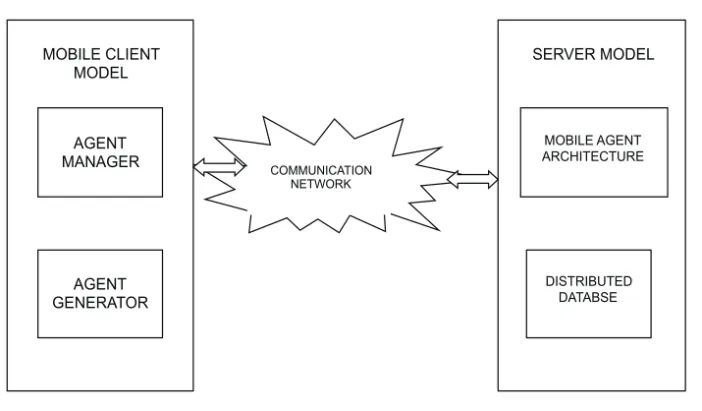
Figure 3: System Model
The simulation model presented in figure 3 consists of three basic components: Mobile client/unit model, communication network and the server model. The model can therefore be viewed as a composition of the following infrastructures: Agents, Mobility, Communication, server and security, which are further discussed in turn.
Agents – A mobile agent in this regard is a composed object with ability to visit agent-enabled environment (servers) in a telecommunication network. Generally, a mobile agent consists of its code (completely or partially) and its persistent state. The code is said to be complete if all the instruction and materials needed for its operation is provided at the point of composition/generation. However, due to the task of some agents involving several activities as it traverse a network, large volume of code usually slow down the operation and migration potentials of such agent. To this end, such agents are provided with minimal amount of code necessary for the commencement of its operation while other codes are downloaded in the course of the operation. This special compiled version of mobile agent is necessitated by the fact that cellular phones now operate by their own operating system. The rapid growth of Java-based mobile units/devices and subsequent portability on mobile phones provide execution environment with no additional software but for the mobile agent's code that is expected
MOBILE CLIENT MODEL
AGENT MANAGER
AGENT GENERATOR
SERVER MODEL
MOBILE AGENT ARCHITECTURE
DISTRIBUTED DATABSE COMMUNICATION
to be transferred once alongside the agent's state.
Mobility – A clear distinguishing factor in this research is the migration ability incorporated into its agents. Not all agents are mobile, thus it behoves to say that mobility is an important feature in this research in other to allow utilization of other attributes of an agent. Ability of an agent to move from one location to the other embedded with the list of expected operation and places (servers) to be visited cum flexible query issuance and processing is a major advantage employed in this research.
Communication – The notion of communication becomes
important as the need arise of an agent to request (communicate) with other agents in its environment or even the database (server). After their operation in the migrated environment, it is also expected that the same mode is employed by the agent to communicate with their owner and vice-versa by either a status mail or SMS message back to their originator. This research work employs message through the SMS, which is not costly to process and compose.
Servers – Server in this regard refers to any network environment supporting agent operation for query issuance and processing. The agent server is responsible for service provision to the mobile agents based on their requests. Each server has a network communicator employed for transferring and receiving agents on one hand, and processing of agents'
requests to/from the owner or other collaborating agents. The network communicator also monitors agents' attributes like resources requirements, security issues etc. All these are authenticated prior to the admittance of an agent to transfer to its place of execution. It is expected that each server have more than one transversal portion depending on the requirements of the agents and its roaming license.
3.2Model Interaction
High number of the mobile agents will have their originating point from the mobile client model (MCM). This not been unconnected with the fact that most request with query issuance usually emanate from the mobile unit. This is transported in form of SMS having 5 tuples. A typical example is thus:
The tuple above depicts 5 different values. The passcode consists of the user account number in the database upon which this mobile agent architecture is ported. The PIN (Personal Identification Number) is the actual value that authenticates the owner of the account so that even if somebody else now owns the account number, the PIN is still expected to be a private (personal) value. The admittance or non-admittance thus rests solely on the validity of both the PASSCODE and the PIN. On confirmation of the above, the mobile agent checks for the operation required in the RCHG (recharge) value, in the case, if the holder/user intend to recharge its account, then it informs it of how much (monetary value) the user is intending to recharge with (purchase). The NETWORKNAME informs the MA of the type of network the user operates (e.g MTN, GLO, etc). The VALUE now confirms the presentation of the RCHG and then the MA completes other required operation leading to account recharge or denial or other query processing as the case may be.
Message passing between the mobile clients and the server must pass through the cloud of communication network, each tuple is assumed to take insignificant time in passing through the network. It is also expected that once the massage composition and onward transmission is completed, bandwidth can be released for other users until the response to the request is ready before another connection is ensured. Once the message has successfully got to the server, the event monitor of the intelligent agent structure diagram picks the packet (SMS) and logs it in the event database. The housekeeping module gets hold of all event packets and passed it to the manager's module. The manager module after proper understanding of the request of the agent's packet thus pass it down to the task interface that interconnects the database where the mobile agent actually complete its operation. The following sequence of operation is performed to facilitate the agent admittance and performing any operation on the database.
1.Pass the SMS for conformity
2. Pick the passcode and pin to authenticate (verify) the user.
3.Collect the user information from the database (compare with the SMS)
7. Update database accordingly.
ALGORITHM: Query confirmation and request processing
Pass the SMS for conformity If passcode and pin is valid then Obtain user information
Confirm type of recharge required and value
If client's account balances > RCHG and Minbal required then Process voucher type and forward voucher number to client Update database accordingly
Else
Generate an insufficient balance message End
Else
Generate an invalid passcode or pin message End
4.Discussion
We assume that proper location update and management is in place thus facilitating continuous signal access to all the mobile clients in the geographical coverage of a particular network. Each query generated from/by the mobile client is also assumed to be in form of SMS, thereby allowing intermittent connectivity when the need arise. The contribution of our work comes in three fold:
Enabling location independent recharging system from the user via mobile agents
Enabling maximum bandwidth utilization through “use/release”
intermittent connectivity method of operation
Facilitating minimum power consumption through mobile agent implementation.
location, where the activity rate is not as high in the first location. It also has cell cluster under the control of a controller and the MSC. Usually, mobile client roaming will fall within the specified location above.
In location A, it is expected that the network access is steady and reliable, proximity to power recharge is also possible. More importantly, user can recharge/renew their access to any network operation at case. The case is not the same in the other two locations. Suppose along the highway is the second location, there is an automobile breakdown and the need to contact help via a mobile network arise, if in such location the credit facility of the mobile client is not sufficient for the operation, then problem of insecurity among others may arise. However, the use of mobile MA in traversing connected database on the network, locating, processing and subsequently updating necessary information will be of great advantage in this regard. In which case the mobile client just wire a query in form of SMS using the earlier stated tuple i.e
PASSCODE#PIN#RCHG#NETWORKNAME#VALUE to send a request which will be processed by the network server and the result is updated on the user's account and granting of right to communicate again on the network.
Another accruable benefit of this operation is the fact that user can now spread out their days of reloading of any type of network and value without the fear of unavailability of any type and value, thus ensuring specific/dynamic patter of spending.
affecting the result of the first query.
The work is based on a typical GSM network employing the Time Division Multiple Access (TDMA) signalling method for its interconnectivity. GSM network/signalling is composed mainly of several E1 lines, which are multiplexed for the use of the subscribers. A typical E1 line operating at 2.408 MB/s is divisible into 32 channels out of which 30 is used for subscribers while the remaining 2 channels are used for in-house operation, network performance monitoring, etc. The 30 functional channels are composed of divisible 64 KB/s bandwidth each. Because the signalling method is time dependent, each completed call/call-session utilizes 16KB/s of the bandwidth. From the above, we can infer that:
One E1 lines – 32 channels (30 functional)
Each channel has 64KB/s available bandwidth
Each call utilizes 16KB/s for a session.
Every channel can thus accommodate four different calls simultaneously (i.e using 16 KB/s bandwidth)
Each E1 line is therefore assumed to be servicing only 120 users.
Our research showed that a typical query at off peak period takes an average of 4 seconds for the results to be processed and sent to the mobile client while at peak period, it can be as high as 8-10 seconds. Using an off peak period for our work, the result following the simulation is depicted in the figures below:
bandwidth.
Figure 4: Performance of MA and TDMA based on time utilization
Figure 5: Performance of MA and TDMA based on bandwidth utilization
delivered, the call session is terminated. During this period, the MA is activated at the server end to perform every required operation, either to recharge via the tuple or to enable some in-house operations like account balance, validity expiration etc. Sequel to the above, assuming sending the query takes 1 second after which the session is terminated. Upon successful completion of its task, the session is re-enacted and sent down in another 1 second making a total of 2 seconds for such intermittent interconnectivity operations. It therefore behoves that the MA call employs less time in its operation, making it a perfect choice for such operation, therefore increasing the throughput of the TDMA operation.
Figure 5 compares the bandwidth utilization of the network vis-à-vis the number of users. It was found out that there exists a direct relationship in terms of variation between time taken to complete a particular operation and the bandwidth consumed by such operation. Again we see that the amount of bandwidth utilization is minimal for the MA calls making it possible to scale part of the calculated number of users at which critical point is attained for the normal signalling method.
5. Conclusion
This paper has presented two main contributions. Firstly, we argued the need to imbibe mobile agent technology in the process of access recharging system for the mobile unit. The shortfall of the present scratch card system, which is scarcity and in affordability, will be well solved if the agent technology is employed. A simulation model was presented comprising of the client-side; the communication link and the server model can be located anywhere outside that of the service provider as long as there exists such agreement between them. Secondly, the interrelationship or interdependency between the time based and the bandwidth consumption was present via the use of MA technology. This is with a bid to depict the effectiveness of MA for intermittent connectivity based queries. It was shown that such operation becomes very costly if they are employing continuous connection mode of transmission. The MA mode thus showed a drastic improvement in time management and bandwidth utilization for such intermittent operations.
References
Improve Performance of Network management Operations “, Proceedings of 4th Annual Symposium of postgraduate Networking Conference (PGNET).
[2] Adhicandra I and Pattinson C. (2002), “ Performance Evaluation of Network
Management Operations”, in proceedings of 3rd Annual Symposium of Postgraduate Neworking Conference (PGNET), Liverpool, UK, pp. 210-214.
[3] Baldi M., Gai S. and Picco G.P. (1997), “Exploiting Code Mobility in
Decentralized and Flexible Network Management”, Proceedings of First International Workshop on Mobile Agents (MA'97), April, Berlin, Germany, pp. 13-26.
[4] Baldi M., Gai S. and Picco G.P. (1998), “Evaluating the Tradeoffs of Mobile
Code paradigms in Network Management Applications”, Proceedings of the 20th international Conference on Software (ICSE'98), April, Kyoto, Japan, pp. 146-155
[5] Bates J. (1994), “The Role of Emotion in Believable Characters”,
Communication of ACM, 37(7), pp. 122-125.
[6] Bieszczad A. and Pagurek B (1998), “Network Management
Application-Oriented Taxonomy of Mobile Code” in proceedings of the EEE/IFIP Network Operations and Management Symposium (NOMS'98), February 15-20, New Orleans, Louisiana, pp. 659-669.
[7] Bieszczad A., Raza S.K, Pagurek B. and White T. (1998), “Mobile Agent for
Network Management”, IEEE Communications Survey, 1(1), pp. 2-9.
[8] Busuoic M. and Griffiths D. (1993), “Cooperating Intelligent Agents for Service
Management in Communication Networks”, Proceedings of the 1993 Workshop on Cooperating Knowledge based Systems (CKBS'93), September, University of Keel, UK, pp. 213-226.
[9] Chess D., Grosof B., Harrison C., Levine D., and Parris C. (1995), “Itinerant
Agents for Mobile Computing”, IEEE Personal Communications, 2(5), pp.34-49.
[10] Eaton P.S, Freuder E.C, and Wallace R.J (1998), “Constraints and Agents:
Confronting Ignorance”, AI Magazine, 19(2), pp.51-65.
[11] Etzioni O., Levy H.M, Segal R.B, and Thekkath C.A (1995), “The Softbot
Approach to OS Interfaces”, IEEE Software, 12(4), pp.42-51
[12] Etzioni O., and Weld D. (1994), “A Softbot-Based Interface to the Internet”,
Communication of ACM, 37(7), pp.72-76.
[13] Frei C. and Fatlings B. (1998), “A Dynamic Hierarchy of Intelligent Agents for
Network Management”, Proceedings of the Second International Workshop on Intelligent Agents for Telecom Applications (IATA'98), July 4-7, Paris, France, pp. 9-16.
They Promised? Are they here to Stay?(PANEL)”, Proceedings of IEEE International Conference on Mobile Data Management (MDM'04).
[15] Griffeth N.D and Velthuijsen H. (1993), “Win/Win Negotiation among
Autonomous Agents” in proceedings of the 12th International Workshop on Distributed Artificial Intelligence”, Hidden Valley, PA, pp. 187-202.
[16] Hylton J. and Rossum G (1997), “Using the Knowbot Operating Environment
in a Wide-Area Network” in the 3rd ECOOP Workshop on Mobile Object Systems (MOS'97), June, pp. 9-10.
[17] Igor B., Hassler V. and Lugmayr W. (2000), “Deployment of Mobile Agents in
the Mobile Telephone Network Management”, Proceedings of the 3rd Hawaii International Conference on System Sciences
[18] Jenning N.R, Sycara K. and Wooldridge (1998), “A Roadmap of Agent
Research and Development, Autonomous Agents and Multi-Agent System, pp. 275-306.
[19] King J.A (1995), 2Intelligent Agents Bring Good Things to Life”, AI
Expert,10(2), pp. 17-19.
[20] Kraus S., Epharati E. and Lehmann D. (1991), “Negotiation in a
Non-Cooperative Environment”, Journal of Experimental and Theortical Artificial Intelligence, 3(4), pp. 255-282.
[21] Kraus S., Wiilkenfeld J. and Zlotkin G. (1995), “Multiagent Negotiation under
Time Constraints”, Artificial Intelligence, 75(2), pp.297-345.
[22] Laasri B., Laasri H., Lander S. and Lesser V. (1992), “A Generic Model for
Intelligent Negotiating Agents”, International Journal on intelligent Cooperative Information Systems, 1(2), pp. 291-317.
[23] Lashkari Y., Metral M. and Maes P. (1994), “Collaborative Interface Agents” in
Proceedings of the 12th National Conference on Artificial Intelligent August 1-4, Seattle, Washington, pp. 444-449.
[24] Maes P. (1994), “Agents that Reduces Work Information Overload”,
Communication of ACM, 37(7), pp. 31-40.
[25] Morreale P. (1998), “Agents on the Move”, IEEE Spectrum, pp.34-41.
[26] Osborne M.J and Rubinstein (1994), “A Course in Game Theory”, Boston, MIT
Press
[27] Papazoglou M.P., Laufman S.C and Sellis T.K (1992), “An organizational
[28] Plu M. (1998), “Software Technology for Building Agent Based Systems in
Telecommunications Networks” in Agent Technology Foundation, Application and Markets, N.R Jennings and M.J Wooldridge (eds), Berlin, Germany, Springer-Verlag, pp. 241-266.
[29] Rao A.S and Georgeff M.P (1995), “BDI Agents: From Theory to Practice”
Proceedings of the First International Conference on Multi-Agent Systems (ICMAS'95), June 12-14, San Francisco, California, pp. 312-319.
[30] Rosenschein J.S and Genesereth M.R (1995), “Deals among Rational Agents”
Proceedings of the Ninth International Joint Conference on Artificial Intelligence, Los Angeles, CA, pp. 91-99.
[31] Rubinstein M. and Daurte O.C (1999), “Evaluating Tradeoffs in Mobile Agents
in Network Management”, Journal of Networking and Information Systems, pp. 237-252.
[32] Sahai A., Morin C. and Brilliart S (1997), “Intelligent Agents for a Mobile
Network Manager (MNM)”, Proceedings of the IFIP/IEEE International Conference on intelligent networks and Intelligence in Networks, September 2-5, Paris, France, pp. 449-463.
[33] Sahai A. and Morion C. (1998), “ Enabling a Mobile network manager through
Mobile Agents”, Proceedings of the 2nd International Workshop on Mobile Agent (MA'98), September, Stuttgart, Germany, pp. 662-669.
[34] Sandholm T. and Lesser V. (1995), “Coalition Formation among Bounded
Rational Agents” Proceedings of the 14th International Joint Conference on Artificial Intelligence (IJCAI-95), Montreal, Canada, pp. 662-669.
[35] Sycara K. (1999a), “Persuasive Argumentation in Negotiation, Theory and
Decision”, 28(3), pp. 203-242.
[36] Sycara K. (1999b), “Negotiation Planning: An AI Approach”, European Journal
of Operation Research, 46(2), pp.216-234.
[37] Tsatsoulis C. and Soh L. (2000), “Intelligent Agents in Telecommunication
Networks” computational Intelligence in Telecommunication Networks, W. Pedrycz and A. V. Vasilakos (Eds) CRS Press.
[38] Wooldrige M. and Jennings N. (1995), “Intelligent Agents: Theory and
Practices”, The Knowledge Engineering Review, 10(2), pp. 114-152.
[39] Zeng D. and Sycara K. (1996), “Bayesian Learning in Negotiation, in Working