390
Norito Tri Bayu, DlisFirmansyah, Hanif Achmad Sofyan, Iqbal Muhammad. Implementing cooperative learning in physical education and sport to improve children fundamental movement skill. Journal of Education, Health and Sport. 2019;9(7):390-403. eISNN 2391-8306. DOI http://dx.doi.org/10.5281/zenodo.3346970
http://ojs.ukw.edu.pl/index.php/johs/article/view/7153
The journal has had 7 points in Ministry of Science and Higher Education parametric evaluation. Part B item 1223 (26/01/2017). 1223 Journal of Education, Health and Sport eISSN 2391-8306 7
© The Authors 2019;
This article is published with open access at Licensee Open Journal Systems of Kazimierz Wielki University in Bydgoszcz, Poland
Open Access. This article is distributed under the terms of the Creative Commons Attribution Noncommercial License which permits any noncommercial use, distribution, and reproduction in any medium, provided the original author (s) and source are credited. This is an open access article licensed under the terms of the Creative Commons Attribution Non commercial license Share alike.
(http://creativecommons.org/licenses/by-nc-sa/4.0/) which permits unrestricted, non commercial use, distribution and reproduction in any medium, provided the work is properly cited.
The authors declare that there is no conflict of interests regarding the publication of this paper.
Received: 05.06.2019. Revised: 25.06.2019. Accepted: 23.07.2019.
IMPLEMENTING COOPERATIVE LEARNING IN PHYSICAL
EDUCATION AND SPORT TO IMPROVE CHILDREN
FUNDAMENTAL MOVEMENT SKILL
Tri Bayu Norito
(a)*, Firmansyah Dlis
(b), Achmad Sofyan Hanif
(b),
Muhammad Iqbal
(c)(a) State University Of Jakarta, Department of Physical Education, St. Rawamangun Muka,
Pulo Gadung, East Jakarta City, 13220, Indonesia.
(b) State University Of Jakarta, Department of Physical Education, St. Rawamangun Muka,
Pulo Gadung, East Jakarta City, 13220, Indonesia.
(c) STKIP Kusumanegara, Jl. Raya Bogor KM. 24, Cijantung, Jakarta Timur, 13770 Indonesia
Abstract:
This study discusses Physical education and sport (PES) focusing on fundamental movement skill
(FMS) learning. This FMS include locomotor , nonlocomotory dan manipulative for students of
elementary school. The fact that students had not shown their development in FMS has been a concern
for PES teachers. To overcome this problem, this study proposed cooperative learning (CL) method to
improve students’ FMS in locomotor, non-locomotor and manipulative movement. This study applied
quasi-experimental method. There were 120 students who involved in this study and they were divided
into two groups namely: the experimental and control group. The instrument used to collect data is a
battery test of FMS. Based on the results of the t-test, the mean of pre-test FMS for the experimental
391
46.14. and in post-test is 50.74. The results of this study shows that the application FMS learning based
on CL improves students’ achievement in FMS learning. To put this into practice, this study designed
implementation to show practitioners FMS learning based on CL that can be used in learning locomotor,
non-locomotor and manipulative movements.
Key Words: battery test, cooperative learning , Fundamental Movement Skill, Physical
education and Sport
Introduction
Physical education and sport (PES) has been a concern in education to ensure children growth and development in the future. In addition to knowledge and literacy practice, PES serves as a foundation for students in elementary school to grow and develop. To meet this need, PES learning include foundational movement skill (FMS) for students. Students learn FMS to experience a form of change physically, psychologically and behavior (Tangkudung & Puspitorini, 2012). Their physical changes and behavior in elementary school age are needed in their educational process to prepare them for future life. One of the skill in PES to master by children is FMS.
Learning FMS provides a variety of movement by students in carrying out physical activities. This contributes to children physical growth which is essential for their development in the following stages of life. Without meeting this physical growth need, children have no proper foundation to undergo the next stage (Lumintuarso, 2013). To achieve this, students need to experience good coordination when they are taking part in any movement, play, sports. These activities require children skill in performing FMS (Cools, Martelaer, Vandaele, Samaey, & Andries, 2010). For children, mastering FMS equip them to play and participate in any activities of their life both in school and family.
392
something to do with an object that children perform in physical activities. This includes children using bat to hit the ball (Mahendra, 2017).
In elementary school, students are expected to learn FMS since this physical movement are important for their future growth and development. Several studies report that in many cases students have not performed well to learn FMS. This may happen because PES teachers have not improved their quality, quantity and the relevance of learning methof to deliver FMS for students. In line with this, PES teachers face challenges to deliver FMS learning because they put priority in achieving the competence and meeting the demand of curriculum and pay less attention to apply proper approach, method and strategy to teach FMS.
There are several options to answer the problem of FMS learning for students in elementary school. To achieve this, PES teachers need to explore and seize learning approaches and method to deliver FMS learning. One of the possible method is to propose cooperative learning (CL) method to deliver FMS learning for children in elementary school. This method is expected to develop their enthusiasm and competence in FMS learning. It is expected that the method will trigger them to link between information (new knowledge) and their experience that they get from study group.
CL has been an interesting method to explore by teachers and researchers in education. It has been applied in various subject to assist students learning process. Several studies have reported the successful implementation of CL in their research. CL refers to learning model that emphasizes group learning activities and not focusing on individual pattern (Griffin & Butler, 2004). Using this method, students are required to work together to accomplish tasks. In group, they work to complete certain tasks and each student is expected to contribute to the process of learning and outcomes that they obtain.
Cooperative learning for FMS
CL can be used by teachers in PES learning activities including FMS learning. This method can assist students to work together to learn FMS and it optimizes their competencies to achieve FMS in elementary school curriculum. Students need to learn FMS using an approach that trigger them to be more active, innovative, creative in learning to achieve effective learning outcome. When it comes to learning FMS, students have various options for example learning through games so that they are expected to be able to optimize their FMS learning.
393
knowledge. Their new knowledge can be combined with their experiences to achieve FMS learning in particular and PES learning in general.
In elementary school, FMS learning aims to develop children physical and psychological potential through overall body movement skills. CL can assist students to develop their learning process on the FMS to the maximum to contribute well for their future physical growth. This method with its characteristics is expected to facilitate students to learn FMS. CL offers many benefits compared to conventional method in learning many subjects including PES.
Several studies have reported the results of using CL in elementary schools for PES. Their findings show that PES teachers believed in the possibility of successful learning by applying CL (Tastan & Markic, 2012). Teaching FMS using CL may offer fun and joy on the part of students who like to play game to explore the world around. Children enthusiasm to learn FMS will have an impact on the success of the learning itself. Their enthusiasm should be coupled with the beliefs to make their goals to learn FMS in elementary schools can be achieved. FMS learning based on CL has been investigated in several studies. It seeks to explore the possibility of students’ high involvement or participation in learning activities by offering properly modified games (Farias, Valério, & Mesquita, 2018). To date, the study on FMS learning based on CL in Indonesian elementary school context is under research. This study investigates the use of CL to learn FMS. It sought to explore whether the use of CL in learning FMS can improve students achievement or not. The use of CL focused on game groups to produce understanding and experience in learning FMS.
Material & Methods
This study examined FMS learning models based on CL. It is quantitative in nature and it applied quasi-experimental. The design of this study deployed before and after treatment with control group design. The subjects in this study were children aged 6-7 years or grade 2 in elementary school. The population of this study were 120 subjects taken from 3 elementary schools in Jakarta. They were divided into two groups: 60 children in the experimental group and 60 children in the control group. This grouping technique was not done randomly. The study compared the effect of treatment given to the experimental group on their gains compared to the control group using pretest and posttest.
394
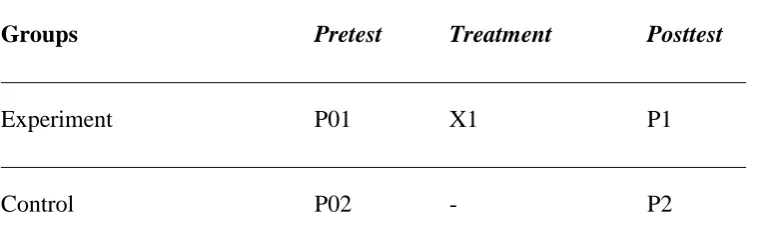
[image:5.595.71.462.155.278.2]for the influence of a variable on other variables (Snelbecker, 1984). The technique used is the average difference test between groups using the t-test. Here's the research design:
Table 1. Research design using before and after with control design
Groups Pretest Treatment Posttest
Experiment P01 X1 P1
Control P02 - P2
Note: P01 = Pre-test for experiment 1; P02 =Pre-test for control group; X1 = Treatment FMS learning based on CL; (-) = :no Treatment or conventional learning; P1= Post-test for experimental group 1; P2 = Post-test for control group
The design of the research above can be explained as follows: 1) The research subjects were plotted into 2 groups.
2) Each group was given pre-test. The experimental group which received FMS learning based on CL is given a symbol (P01) and the control group was given a symbol (P02).
3) The experimental group one received treatment, namely FMS learning based on CL and was coded with a symbol (XI). In contrast, the control group received no treatment. It used conventional learning and was given a symbol (-).
4) After the treatment, a post-test was conducted for the two groups. The experimental group was given a symbol (P1) and the control group was given a symbol (P2).
To implement FMS learning based on CL, this study designs the form of final product that can be used to improve students’ FMS learning in elementary school. There are several stages that this study carried out to implement the final product. First, assigning students from elementary schools in East Jakarta as research subjects. There were three elementary schools and 20 students were taken from each school. They had the same characteristics. 60 students were placed in the experimental group. On the other hand, this study selected 60 students from 3 different elementary schools to be placed in the control group.
395
locomotor, non-locomotor and manipulative FMS for both groups. Fifth stage is analyzing the results of the pre-test and post-test using the statistical method (t-test) to compare the two groups.
In the implementation phase of this product, this study used 120 primary school subjects consisting of 60 students from the experimental group and 60 students from the control group. To investigate FMS achievement, this study measured FMS consisting of locomotor, non-locomotor and manipulative movement using test instrument (battery test). This study used the battery test proposed by Kirkendall, Gruber and Johnson (1987).
1. Agility Run
The test was used to measure students' locomotor movement skills. To conduct this test, materials and equipment include; cone, rope (1.5 meters), duct tape and stopwatch. The testee stands behind the cone and the position was straight on the rope. The testee stands behind the cone, when the teacher instructed testee to begin, the students run following the pattern from the first cone to the final cone. The point was calculated by looking at the results of the fastest time (seconds). Every testee has the chance to perform 3 times.
2. Standing Long Jump
This test aimed to measure students’ FMS through their ability to jump forward. If the teacher instructs to begin, the testee must jump forward without preparatory steps. As testee jumping both his hands swinging forward to produce as far as possible movement. Each testee had three opportunities to perform. Calculations start from the repulsion line to the heel of the foot using the meter.
3. Face Down to Standing
This test was conducted to measure students FMS by asking their body to lay down facing the mat and then they stood up. The procedure was to ask students to get ready with their body lying on the mat and their front of the stomach touch the mattress and their face facing down. When the teacher instructed them to begin, the students must stand (wake up) using their knee as an aid to support or like to crawl. Students performed this movement continuously for 25 seconds. They were given the opportunity 3 times. Their best results was taken for the record. Their score were calculated based on how many times they were able to perform a face down movement and then stand for 25 seconds.
4. Static Balance
396
once before the test began. When the teacher commanded them "yes" they raised the ankle heel (tiptoe). They moved their hand from their waist or the other leg shifted from the knee of the foot. The test ended if the students’ feet touched the floor. Their scores starts when students start lifting one leg until they lose balance. Each testee was given 3 times the longest time (seconds) calculated as the final score.
5. Chair Push Up
This test was directed to measure students’ FMS by doing push with the help of chairs. Students prepared to position their body to do push up with both hands in the chair and the position of the body straight forward. When the teacher instructed them to begin, students must stand (straighten the arm) by lifting their body up and then going down again. They performed this movement continuously for 25 seconds. Each testee was given 3 times the opportunity. The best results were taken. The score was calculated based on how many times the testee was able to do a push up chair for 25 seconds.
6. Back and Hamstring Stretch
This test aimed to measure students’ FMS through the flexibility of the thigh muscles and back muscles. Students sat against the wall and hands above knees. As the teacher instructed them to begin, students grabbed the ruler in front with their hands straight forward as far as possible without swinging. Each testee was given the opportunity to take the test for 3 times. The calculated score was based on how far students could get with both hands straight forward. To measure the distance, the teacher observed at the fingertips of students’ hand that were able to reach the ruler.
7. Target Throwing
Unlike locomotor and nonlocomotor movement test, this test belongs to manipulative movement skill test. This test was done by throwing the target. To do this, students performed the eye's coordination on the target and their hand throwing the ball. They stood behind the cone with a score of 3.1 meters. The teacher demonstrated the example and gave students the opportunity to ask. Students performed the test by throwing the target as many as 15 times the repetition and mentioned the score from the result of their performance. Score 1 was for the biggest target, the score 2 was for smaller target and the score 3 was from the smallest square target.
Result
397
[image:8.595.69.531.553.643.2]control groups. Given the result of the test, this study is investigating at the effect of FMS learning based on CL to improve students’ FMS. To administer the t-test, this study had grouped students into experimental group of 60 subjects and a control group of 60 subjects. Pre-test was administered to both groups to measure their FMS. Experimental group received the treatment on FMS based on CL. On the other hand, control group received no treatment or they learned using conventional way. After conducting treatment for 4, this study administered a post-test. It was performed using a battery test of FMS. Description of the data from the pretest and posttest can be seen in the following table.
Tabel 2. Data description on Pre-test and Post-test FMS of Experimental group
N Minimum Maximum Mean Std.
Deviation Variance
Pre-test 60 40.16 52.92 46.7215 2.88359 8.315
Post-test 60 48.51 64.98 56.3882 3.52923 12.455
Valid N 60
Referring to table 2 above, it can be concluded that the average/ mean for experimental group on pre-test FMS is 46.72 and on post-test is 56.38. The average difference in FMS skills is 9.66. In addition, FMS pre-test data for experimental group shows variant 8.31 and for post-test FMS showed a variant of 23.33. The highest value of the pre-test data on average rough value is 51.30 and the lowest value is 12,455. From the results of the post-test basic motion skills the highest value of the average rough value is 64.98 and the lowest value is 48.51.
Tabel 3. Data description for Pre-test dan Post-test FMS for control group
N Minimum Maximum Mean Std.
Deviation Variance
Pre-test 60 41.64 53.69 46.1478 2.79593 7.817
Post-test 60 45.83 59.37 50.7420 2.79681 7.822
Valid N 60
398
[image:9.595.68.535.150.224.2]59.37 and the lowest value is 45.83. Thus the description of the data between the control group and the experimental group is as follows:
Tabel 4. Data Recapitulation between experimental and control group
Groups Mean
Experiment
Pre-test Post-test Difference
46.73 56.39 9,66
Control 46.14 50.74 4,61
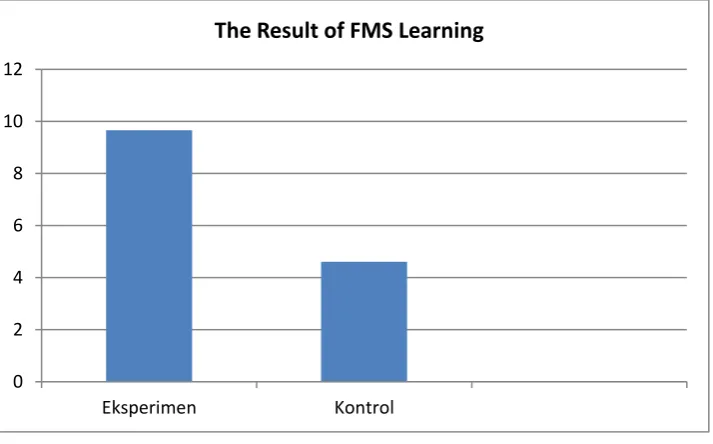
[image:9.595.76.433.430.652.2]Referring to table 4, it can be seen that in the experimental group, the average FMS for pre-test is 46.73 and for the post-test is 56.39. There is an improvement for their achievement after they received treatment FMS learning based on CL and the difference is 9.66. Whereas in the control group, their average for FMS in the pre-test is 46.14 and in the post-test is 50.74. There is an improvement or changes in FMS and the difference is 4.61. From this description, it can be seen that experimental group performed better in their achievement. It is clear that FMS learning based on CL can improve their FMS in PES activities. To get a bigger picture, the following comparison on the improvement of FMS can be seen in the following chart:
Figure 1. The Result Difference of FMS between Experiment and Control Group
Figure 1 above shows that the experimental group who received FMS learning based on CL treatment had improved their achievement greater than the control group using conventional
0 2 4 6 8 10 12
Eksperimen Kontrol
399
learning. Effectiveness testing is based on data tabulation taken from FMS battery test. The results of the data tabulation are processed and analyzed statistically to test the effectiveness of FMS learning based on CL.
[image:10.595.75.522.252.383.2]Effectiveness test is done for the experimental group. To determine the effect of FMS learning based on CL to improve students’ FMS achievement, an average difference test is conducted in the experimental group. The average test of the experimental group is taken from the result of the t-test. The results of the average difference test in the experimental group are as follows:
Table 5. Difference test result (Paired Sampel t-Test) for Experimental group Paired Differences
t df
Sig. (2-tailed) Mean Std. Devia tion Std. Error Mean
95% Confidence
Interval of the
Difference
Lower Upper
Pair 1 PostTestExp -PreTestExp 9.6666 7 1.814
77 .23429 10.13547 9.19786 41.260 59 .000
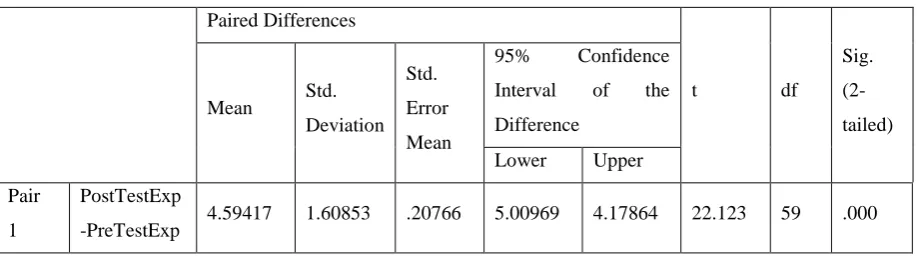
[image:10.595.70.529.522.651.2]Effectiveness test for the control group. To find out the effect of conventional FMS learning, it is necessary to conduct an average difference test in the control group. The average test of the control group is performed using the t-test. The results of the average difference test in the control group are as follows:
Table 6. Difference test result (Paired Sampel t-Test) for control group Paired Differences
t df
Sig.
(2-tailed)
Mean Std.
Deviation Std.
Error
Mean
95% Confidence
Interval of the
Difference
Lower Upper
Pair
1
PostTestExp
-PreTestExp 4.59417 1.60853 .20766 5.00969 4.17864 22.123 59 .000
400
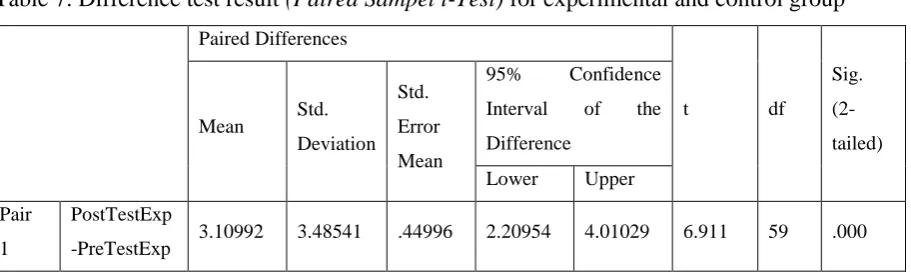
Table 7. Difference test result (Paired Sampel t-Test) for experimental and control group Paired Differences
t df
Sig.
(2-tailed)
Mean Std.
Deviation Std.
Error
Mean
95% Confidence
Interval of the
Difference
Lower Upper
Pair
1
PostTestExp
-PreTestExp 3.10992 3.48541 .44996 2.20954 4.01029 6.911 59 .000
In this section, test criteria is discussed. In table 7, there is a comparison between t-count and t-table values and it can be concluded that Ho is rejected and Ha is accepted because the value of t-count = 6.911> t-table = 1.65776. In other words there are significant differences from FMS learning based on CL to improve students’ FMS. It can be concluded that FMS learning based on CL is more effective to improve students’ FMS compared to conventional FMS learning.
Dicussion
Based on the result and analysis of the data in the previous section, it can be understood that FMS learning based on CL can be used to teach and learn FMS in PES for elementary school students. It is clear that FMS learning based on CL is effective for improving students’ FMS. The learning model in this study is a product that aims to help practitioners (teachers) in an effort to improve students’ FMS. This model is also developed based on students’ need to learn FMS learning.
FMS learning is a learning model that combines fundamental movement and physical supporting learning in a series of movements. Thus the FMS learning based on CL is more efficient in an effort to improve students’ FMS. Basically FMS are divided into three, namely locomotor, non-locomotor and manipulative movement. Learning FMS will be optimal if supported by the right learning method. Therefore FMS learning based on CL combines every fundamental movement in the game group.
401 and heat is strongly suggested.
Another supporting factors in FMS learning based on CL is that the students had already their previous fundamental movement skill. Basically students already have fundamental and physical movement skills that support their FMS learning based on CL. In this study, previous FMS and physical conditions that students possess become supporting factors to improve their FMS. In addition, the media and tools used in this learning model become an attraction for students to try it.
The learning model of FMS learning based on CL has some advantages. This learning model improved students’ FMS and their physical conditions to support FMS activities at the same time. A variety of learning models and learning in the groups that encourage each other are the hallmarks of this learning.
FMS learning based on CL has served as the solution to problems of learning FMS for students in elementary school. This learning model has met the expectations of teachers and students to learn FMS efficiently. It is more effective and it has a variety option in for teachers and students to improve FMS learning.
This is in line with the research conducted by Darmawan (2017) with the title of developing an interactive multimedia learning model for elementary students. The study stated that FMS learning can be applied with a variety of variations tailored to the students' FMS needs so that it helps the teacher to streamline time for teaching and learning. Furthermore the model developed is more effective and efficient (Darmawan, 2017).
Angga (2011) conducted research on developing FMS learning models for elementary school students. The study concludes that that the product in the form of a running basic learning model is more effectively carried out by physical education teachers in FMS learning in elementary school students ( Angga, 2011). Another study by Johnstones (2017) reports that FMS need to be improved because they are related to children's physical activity. The use of active games is proven to be effective in improving students FMS. The combination of FMS and active play can create an environment that fosters students' curiosity to learn FMS in a fun way (Johnstone et al., 2017)
402 Conclusion
FMS Learning based on CL had been applied in this study. This treatment was given to the experimental group. Comparison of the effect between experiment and the control group has been carried out. The process and result show that FMS learning based on CL can be applied to elementary school children learning PES.
403 References
Angga P D. 2011. Pengembangan Model Pembelajaran Gerak Dasar Lari Siswa Sekolah Dasar. TESIS. PPs UNJ.
Cagno, A., Battaglia, C., Fiorilli, G., Piazza, M., Giombini, A., Fagnani, F.,Pigozzi, F. (2014).
Motor Learning as Young Gymnast ’ s Talent Indicator, (December), 767–773.
Cools, W., Martelaer, K. De, Vandaele, B., Samaey, C., & Andries, C. (2010). Assessment of movement skill performance in preschool children : Convergent validity between MOT 4-6 and M-ABC, Journal of Sports Science & Medicine. 9(4), 597–604.
Darmawan, A. (2017). Pengembangan Model Pembelajaran Gerak Dasar Berbasis Multimedia Interaktif pada Siswa Sekolah Dasar. DISERTASI. PPs UNJ.
Farias, C., Valério, C., & Mesquita, I. (2018). Sport Education as a Curriculum Approach to Student Learning of Invasion Games : Effects on Game Performance and Game Involvement,
J Sports Sci Med. 17(1), 56-65.
Griffin, Linda L. & Butler, J. I. (2004). Teaching Games for Understanding: Theory, Research, and Practice. United States: Human Kinetics.
Johnstone A., Hughes A R., Janssen X., Reilly J J. 2017. Pragmatic Evaluation of the Go2Play Active Play Intervention on Physical Activity and Fundamental Movement Skills in Children. Preventive Medicine Reports 7. 62 halaman.
Kirkendall, Don R. Gruber, Joseph J. Johnson, R. E. (1987). Measurement and Evaluation for Physical Educators. United States: Human Kinetics.
Lumintuarso, R. (2013). Pembinaan Multilateral Bagi Atlet Pemula. Yogyakarta: UNY Press. Mahendra. (2017). Teori Belajar Motorik. Bandung: Universitas Pendidikan Indonesia. Maksum A. (2012). Metodologi Penelitian dalam Olahraga. Unessa University Press.
Syarifudin. 2002. Kemampuan Gerak dan Program Pembelajaran Pendidikan Jasmani. Jurnal IPTEK Olahraga. 4(3), 180.
Tangkudung, James & Puspitorini, W. (2012). Kepelatihan Olahraga. Pembinaan Prestasi Olahraga. Jakarta: Cerdas Jaya.