Microelectromechanical Systems
(MEMS)
Outline
• Introduction
• Applications
– Passive structures
– Sensors
– Actuators
• Future Applications
• MEMS micromachining technology
– Bulk micromachining
– Surface micromachining
– LIGA
– Wafer bonding
• Thin film MEMS
– Motivation
– Microresonators
• MEMS resources
What are MEMS?
(Micro-electromechanical Systems)
• Fabricated using
micromachining technology
• Used for
sensing
,
actuation
or are
passive
micro-structures
3-D Micromachined Structures
Linear Rack Gear Reduction Drive Triple-Piston Microsteam Engine
3-D Micromachined Structures
Movies from Sandia National Lab. Website: http://mems.sandia.gov
2 dust mites on an optical shutter
Some future applications
• Biological applications:
– Microfluidics
– Lab-on-a-Chip
– Micropumps
– Resonant microbalances
– Micro Total Analysis systems
• Mobile communications:
– Micromechanical resonator for resonant circuits and filters
• Optical communications:
Microfluidics / DNA Analysis
In the future, a complete DNA sequencing systems should include:
•Amplification (PCR)
•Detection (electrophoresis)
•Fluid preparation and handling (pumps, valves, filters, mixing and rinsing)
Basic microfabrication technologies
• Deposition
– Chemical vapor deposition (CVD/PECVD/LPCVD) – Epitaxy
– Oxidation – Evaporation – Sputtering
– Spin-on methods
• Etching
– Wet chemical etching • Istropic
• Anisotropic – Dry etching
• Plasma etch
• Reactive Ion etch (RIE, DRIE)
• Patterning
Bulk micromachining
Anisotropic etching of silicon
Etchant
111 100
etch etch r
r Selectivity to p+- Si
Disadvantages
Potassium Hydroxide
(KOH) 100 Yes -H-Nigot ChlyM cOorroS csoivmepatible Tetramethyl ammonium
hydroxide (TMAH)
30-50 yes -formation of pyramidal hillocks at bottom of cavity
Ethylenediamine pyrochatechol
(EDP)
Bulk micromachining
Anisotropic etch of {100} Si
54.74º
111
aBulk micromachining: Pressure sensors
Piezoresistive elements
SiO
2p
+Si
Surface Micromachining
substrate
Important issues:
•
selectivity of structural, sacrificial and substrate materials
• stress of structural material
Surface Micromachining
Most commonly used materials for surface micromachining:
•
substrate:
silicon
• sacrificial material:
SiO
2or phosphosilicate glass (PSG)
• structural material:
polysilicon
Substrates Sacrificial Structural
Glass Plastic metals Polymer Metals silicon nitride
Surface Micromachining
• Polysilicon deposited by LPCVD (T~600 ºC) usually has large stress • High T anneal (600-1000 ºC) for more than 2 hours relaxes the strain
Photo from R.T. Howe, Univ. of Calif, Berkeley, 1988
Low temperature, thin film materials has much less intrinsic stress
Surface Micromachining
Surface tension of liquid during evaporation results in capillary forces that causes the structures to stick to the substrate if the structures are not stiff enough.
Stiction
F
To avoid this problem
• make the structures stiffer (ie, shorter, thicker or higher Young’s modulus) • use super-critical drying in CO2 (liquid supercritical fluid gas)
LIGA
– X-ray
Li
thography,
Electroplating (
G
alvanoformung), Molding (
A
bformung)
Deposit plating base Deposit photoresist
Expose and develop photoresist Immerse in chemical bath and electroplate the metal
LIGA
Wafer bonding- Anodic
• bring sodium contating glass (Pyrex) and silicon together
• heat to high temperature (200-500 ºC) in vacuum, air or inert ambient
• apply high electric field between the 2 materials (V~1000V) causing mobile + ions to migrate to the cathode leaving behind fixed negative charge at glass/silicon interface • bonding is complete when current vanishes
• glass and silicon held together by electrostatic attraction between – charge in glass and + charges in silicon
SiO
2p
+Si
<100> Si
glass
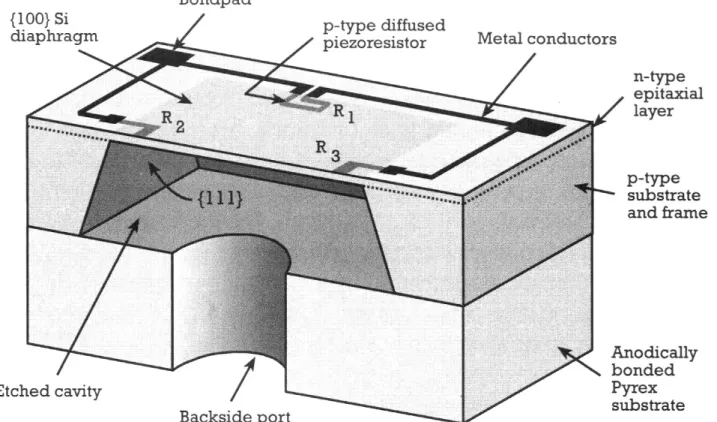
Piezoresistive pressure sensor
Summary: MEMS fabrication
• MEMS technology is based on silicon
microelectronics technology
• Main MEMS techniques
– Bulk micromachining
– Surface micromachining
– LIGA and variations
Thin-film MEMS
Thin films allows:
•
Low-temperature processing
• Large area, low cost, flexible or biocompatible
substrates
• Possibility to integrate with a CMOS or thin film
electronics based back plane
Sacrificial Layer Deposition and Patterning
Structural Layer Deposition and Patterning
Sacrificial Layer Removal
d=1
m; h=500 nm; b=10
m
L
max(bridge) ~ 60
m ; L
max(cantilever) ~ 30
m
•
Electrostatic force between gate and counter-electrode
•
Electrostatic force is always attractive
•A laser beam is focused on the structure and the reflected
light is collected with an intensity (or quadrant) detector.
•The deviation of the beam is proportional to the
deflection
0 5 10 15 20 25 0.0
0.5 1.0
decreasing length
45m 30m 25m 20m 18m 15m 12m 10m
300 nm a-Si:H / 100 nm Al 10m-wide bridges
D
e
fle
ct
io
n
(
no
rm
a
liz
ed
)
Frequency (MHz)
•
Optical detection of electrical actuation• Resonance is inversely proportional to square of the length
• 20 MHz resonances measured with 10 m-long a-Si:H bridges (Q~100 in air; Q up to 5000 in vacuum)
Applications
: Passive S
tructures
Applications: Sensors
Pressure sensor:
• Piezoresistive sensing
• Capacitive sensing
• Resonant sensing
Application examples:
• Manifold absolute pressure (MAP) sensor
Piezoresistive Pressure Sensors
Pressure
Piezoresistive elements
SiO
2p
+Si
Piezoresistive Pressure Sensors
Wheatstone Bridge configuration
Applications: Sensors
• Acceleration
– Air bag crash sensing – Seat belt tension
– Automobile suspension control
– Human activity for pacemaker control
• Vibration
– Engine management – Security devices
– Monitoring of seismic activity
• Angle of inclination
– Vehicle stability and roll
Accelerometers
M
Inertial massF=Ma Spring F=kx Damping F=Dv
Static deformation:
k
Ma
k
F
d
static
Dynamic behavior
Ma
F
kx
dt
dx
D
dt
x
d
M
2
ext
2
M
k
r
D
M
Q
rResonance frequency
Accelerometers
Accelerometer parameters
• acceleration range (G) (1G=9.81 m/s
2)
• sensitivity (V/G)
• resolution (G)
• bandwidth (Hz)
• cross axis sensitivity
Application Range Bandwidth Comment
Air Bag Deployment ± 50 G ~ 1 kHz
Capacitive Accelerometers
Stationary Polysilicon fingers
Based on ADXL accelerometers, Analog Devices, Inc.
Spring
Inertial Mass
Anchor to substrate
Applications: Actuators
Texas Instruments Digital Micromirror Device
TM• Array of up to 1.3 million mirrors • Invented by Texas Instruments in 1986
For an animated demo of this device, go to http://www.dlp.com/dlp_technology/ • Each mirror is 16 mm on a side with a pitch of 17 mm
Digital Micromirror Device
Digital Micromirror Device
From “An Introduction to Microelectromechanical Systems Engineering” by Nadim Maluf
=> Acheive grey scale by adjusting the duration of pulse
• Switching time: 16 µs (about 1000 times faster than the response time of the eye) • Mirror is moved by electrostatic actuation (24 V applied to bias electrode)
• Projection system consists of the DMD, electronics, light source and projection optics
• Placing a filter wheel with the primary colors between light source and the micromirrors
MEMS Resources
Reference Books
• Nadim Maluf, An Introduction to Microelectromechanical Engineering (Artech House, Boston,2000)
• M. Elewenspoek and R. Wiegerink, Mechanical Microsensors (Springer-Verlag, 2001) • Héctor J. De Los Santos, Introduction to Microelectromechanical (MEM) Microwave Systems (Artech House, Boston, 1999)
Websites
• Sandia National Lab: http://mems.sandia.gov
• Berkeley Sensors and Actuators Center: http://www-bsac.eecs.berkeley.edu • MEMS Clearinghouse: http://www.memsnet.org/
Some companies with MEMS products
• Accelerometers – Analog Devices:
http://www.analog.com/technology/mems/index.html