Analysis of Relationships between Organizational Learning
Capacity and Organizational Performance:
A Case Study of Banking Sector in Nigeria
Aminu Ahmed
Mehmet Fatih Yasar
Abdurrahim Emhan
Nigerian Turkish Nile University Department of Business Administration
Abuja FCT,Nigeria
Doi:10.5901/ajis.2013.v2n6p191
Abstract
This study aims to analyze the relationships between organizational learning and organizational performance within the banking sector in Nigeria. A survey research method with statistical treatment was conducted in this study. To test the model, except demographic variables, a 21-items questionnaire was conducted using random sampling method to the employees of various banks in Nigeria. A total of 203 completed questionnaires were evaluated for analysis. The data analysis revealed that there is a positive relationship between organizational learning and organizational performance. The findings of the study indicated that, there was a relationship between organizational learning and organizational performance. In terms of demographic variables, bank managers have higher learning perception than other employees. The paper offers practical suggestions of how management can improve organizational performance by improving the organizational learning of the organization. Survey was not all-inclusive to contain all potential bank employees in Nigeria. For that reason, this research is limited to the banks and the results can take a wide-ranging outlook to banking sector.
Keywords: Organizational Learning Capacity, Organizational Performance, Banking Sector, Managers, Nigeria.
1. Introduction
Managerial functions are essentially the same, to obtain results by establishing an enabling environment for effective and efficient performance of the work force. And creating situations where employees are highly productive and motivated. Even though there are considerable variations in environment, task to be done, nature of problems and scope of responsibility and authority.
Effective organizations are being characterized by a deep sense of purposefulness and a vision of its future. Banking industry must be well equipped to compete in any market with highly motivated and committed employees with distinctive competence.
the banks to promote growth and development depends on the extent to which financial transactions are carried out with trust, confidence and less risk.
The banking system is being threatened every day with adverse operational and marketing consequences. Changes in banking sector in Nigeria are too rapid with a lot of implication to personnel. This may be due to technical requirements of the job, upgrading of facilities, and lack of human and material support or improper assessment of employee at the point of entry.
The banking system is quite concentrated in urban areas; it is equally regulated and protected from foreign competition. The structure of Nigerian banks is characterized by relatively high density of branch offices. Against this background and face with greater internal competition and the recent consolidation policy by the Central Bank of Nigeria, many banks have sought to preserve their market space. The impact of personnel performance is more likely to affect their operation and survival.
The implication depends to a large extent on the behavior of the personnel. And in order to remain competitive bank must train their old employees. Any organization that fails to shift their mission in response to changing market conditions will likely failed miserably. This is where training and learning comes in to enhance individual ability. According to W and Cameron performance is the product of ability multiplied by motivation. A person’s lack of ability might inhibit good performance for several reasons.
The worrisome problem facing all managements is how to correctly identify the underlying causes of a specific employee’s poort performance and the consequences associated with the stress and staff development through learning. This implication can be assessing through the use of Plato model …
Management of all organizations entails carrying out basic functions of playing organizational motivation and control. Management of people takes up very important dimension in banking services. Although it is known that culture has a strong effect on people behavior. Management’s interest is less likely to be prompted by curiosity about why this happens (Rollinson, 2008). Management have a tendency to look for “off the shelf” solutions to organizational problems.
2. Literature Review
Effective research is based upon past knowledge, the existence of the present always rest on the foundation of the past. A summary of writings of recognized authorities provides an insight into what is already known and what is still unknown or untested.
Attention is a critical factor in many life processes, but paying attention is not all that is involved in management in fact, motivation is a major source, that reinforce behavior.
Human mind is a complex cognitive system. The system manipulates or processes information coming in from environment or already being stored within the system .The actions will result in greater worker’s self esteem and performance. Staff will demonstrate progressive development of the knowledge, abilities and values needed to function effectively in an increasing complex setting of banking institutions.
3. Organizational Learning Capacity
Learning can be deliberate and formal process or an unintentional outcome of natural progression. It provides an overview of the learning as key aspects to talent development and organization performance. Learning implies a different internal state which may result in new behavior and action. The general understanding of learning has been limited to formal teaching and training; it is often not related to daily life and work. Learning is the most powerful, engaging rewarding and enjoyable aspect of our personal and collective experience.
All learning requires an engagement of and a transformation of the mind to learn anything well. Personnel practices reflect the desire to infuse thinking on the job specification description and design.
Organizations are beginning to identify and formalize the significance of knowledge to performance. Staff members retain their impulsivity during emotional crises, they listen to each other with empathy ,understanding, precision constantly reflect on and evaluate their behaviors and strive to make them more consistent with the core value and belief that thoughtful behavior is a valid goal of learning.
Costa (1991) outlines list of intelligent behavior, persistence, decreased impulsivity, empathic listening, cooperative thinking, flexible thinking, meta cognition, checking for accuracy, drawing on past knowledge and applying it to new situations, questions and problem posing, risk taking, a sense of humor, precision of language, use of all senses, ingenuity and, a sense of efficacy as a thinker. This notion suggests that workers reflect on what they learn and apply it to the work environment.
Learning means change of a relatively permanent kind (Mullins, 2008). Learning occurs in many different ways, information or skills may be implicitly communicated or learning incidentally, it implies that an individual has experience something. Both change and learning are natural processes that continue throughout life, sometime behavior and knowledge coincide, at other times people will learn to act in certain ways without an underlying understanding of the reasons why.
Intelligent people are in continuous learning mode, their confidence in combination of their intuitiveness, allows them to constantly search for new and better ways of doing their jobs. They seize problems, situations, tensions, conflicts and circumstances as valuable opportunities to learn. This shared vision is evident in seven ways that include inherent faith that the organization will continue to improve on their intellectual capacities through learning as a valid goal. With learning workers can achieve their goals build fruitful and satisfying relationship with others and experience the challenges that make life meaningful (Costa, 1991). It is important to note that in the banking systems model of operational management learning becomes always an input. Organizations can be viewed as a system that includes human action that facilitates production of useful outcomes; we could not improve without learning.
4. Organizational Performance
Organizational performance has been subject matter of all organizational activities. Moreover, Dess and Robinson (1984) states that, organizational performance has become a significant aspect of empirical research in the business policy. However, goal ambiguity and measurement deficiencies are the major challenges of organizational performance (March and Sutton, 1997; Chun and Rainey, 2005). These issues led to a diversity of explanations for organizational performance and complexity of developing standard for measuring it.
Performance measurement can help businesses and organizations in establishing organizational efficiency. Nevertheless, there is no consensus on the performance measurement indicators because of the goal differences of the organizations, firms and corporations.
1997; Wang, 2000; Robbins and Judge, 2012) to measure organizational performance. Whetten and Cameron (2008) describes five principal tools available for overcoming poor performance problems due to lack of ability, these are resupply, retrain, refit, reassign and release. Performance = ability multiplied by motivation (effort). The most important deficiency of the organizational performance is its openness to manipulations and dependence of performance measurement to organizational political environment.
5. Theoretical Model
This study has two variables, organizational learning capacity and organizational performance. The conceptual model of this study is presented in Figure 1.
Figure 1: Hypothesized Model
6. Methodology
6.1 Study Design and Sample
The research was conducted on different banks in Abuja. Approximately 315 questionnaires were delivered randomly to the bank employees. Management of banks allowed different divisions to distribute the questionnaires randomly to their employees. Subsequently, all the participants were revisited, so that the questionnaires could be collected. A total of 247 survey forms were collected and 44 surveys were excluded from the analysis due to missing data. Thus, exactly 203 (82%) complete questionnaire forms were evaluated for further analysis. All data was collected in 2013.
6.2 The survey instrument
The survey instrument consisted of questions derived from the literature. There were 9 questions in organizational learning and 12 questions in organizational performance. There was also a demographic information part in the instrument.
a) Demographic Information: Information about the demographic characteristics of the participants was collected, covering their age, gender, marital status, education level, occupational rank and total working year.
b) Organizational Learning Scale: The scale developed by Alegre and Chiva (2008) has been used in numerous studies and these have confirmed its validity and reliability as a measure of organizational learning. Organizational learning was measured using 9 questions. A five-point Likert scale was used for each of the 9 questions, scored from 1 to 5 where the number (1) means Strongly disagree, (2) Disagree, (3) Undecided, (4) Agree, and (5) Strongly Agree. The five-point Likert scale was again used for all these questions. The Cronbach’s alpha score for Justice is 0.73.
To high relaebilty one item (4th item) was deleted. This concept was measured with 4 items.
c) Organizational Performance Scale: The scale was adapted by Bakiev (2011) from Nyhan (2000) and Sahin (2010). A five-point Likert scale was used for each of the 5 questions, scored from 1 to 5 where the number (1) means Strongly disagree, (2) Disagree, (3) Undecided, (4) Agree, (5) Strongly Agree. The five-point Likert scale was again used for all these questions. The Cronbach’s alpha score is 0.81. Skewness and Kurtosis scores are between -1 and +2 which indicate that it has a normal distribution.
SPSS 18.0 software was used to analyze the data using parametric test (ANOVA), correlation and regression. The significance level for acceptance was set as p<0.05.
7. Findings
7.1 Demographic Variables
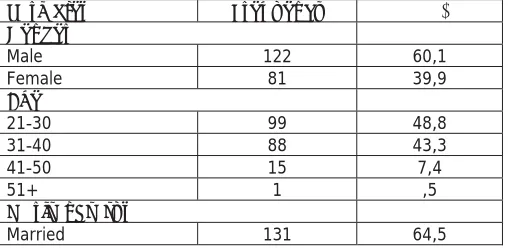
The distribution of the respondents over the demographic variables is presented in Table 1. 247 employees participated to the survey. As displayed in Table 1, It is not surprising that the majority of the study participants were male (122; 60.1%). On the other hand, 81 female respondents constitute 39.9% of the total employees. For the distribution of the respondents in terms of age, 99 employees were relatively young with, 21-30 years old, and the next largest group, 88, was 31-40 years old. These two groups account for 48.8% and 43.3% respectively of study participants. 15 respondents (7.4 %) were ages 41-50. The age group 51 years or older was the smallest, with 1 respondents (0.5 %). Of the 203 respondents, 131 (64.5%) is married, while 72 (35.5%) is single. In terms of education level of respondents, 132 people had bachelor degree, 52 of them had masters and 4 of them had PhD degrees. Cumulatively, these three groups of people account for approximately 93 % of the study participants (65.0 % and 25.6 %, and 2.0% respectively). Those respondents with secondary school degrees are 15 (7.4 %). In terms of respondents’ rank, 20 of the total 203 respondents (9.9 %) were top level manager, 48 of the total respondents (23.6%) were middle level manager, and 44 of the total respondents (21.7%) were low level managers. Remaining 44.8 % of the respondents, of whom 77 were employees, and 14 others, respectively 37.9 %, and 6.9 % of the respondents. As to how long the participants had worked in the bank. Of the total 203 respondents, the largest group, 82 respondents, with five years or less of service, followed by 62 respondents with six and ten years of service, and 22 respondents with between eleven and fifteen years of service. The percentage distributions of these three groups by years of service were 40.4 %, 30.5 %, and 10.8 %, respectively. 20 respondents (9.9 %) reported between sixteen and twenty years of service, and 17 respondents (8.4 %) reported twenty or more years of service. This last was the smallest.
Table 1: Demographic variables
Variables Frequency (%)
Gender
Male 122 60,1
Female 81 39,9
Age
21-30 99 48,8
31-40 88 43,3
41-50 15 7,4
51+ 1 ,5
Marital Status
Single 72 35,5
Education Level
Secondary School 15 7,4
Bachelor 132 65,0
Master 52 25,6
Phd 4 2,0
Rank
Top Level Manager 20 9,9
Middle Level Manager 48 23,6
Low Level Manager 44 21,7
Employee 77 37,9
Other 14 6,9
Tenure
0-5 82 40,4
6-10 62 30,5
11-15 22 10,8
16-20 20 9,9
20 + 17 8,4
n=203
As displayed in Table 2, there is a positive correlation between organizational learning capacity and organizational performance (p<0.001), As a result, researchs hypothes was supported.
Tablo 2: Relationship between Performance, Organziational Learning
Variable 1 2
1. Performance Correlation
Coefficient 1 ,467
**
2. Organziational Learning 1
**Correlation is significant at the 0.01 level (2-tailed).
The Table 3 illustrates that (in organizational performance) organizational learning variable explains 34% of total variance.
Tablo 3: Regression Analysis of Performance, Organziational and Learning Capacity
Depent
variable R2 Independent variables B ǃ t p VIF
Performance 0.34 Organziational Learning .895 .589 10,04 0.000 1.04
According to demographic variables, some results are presented below;
Learning perception of bank managers is higher than bank employees (p<0.05 F: 3.93).
8. Discussion and Conclusion
The results of this investigation provide support for the concept that organizational learning impact upon organizational performance. According to correlation results there is a positive linear relationship between organizational learning capacity and organizational performance. This result was supported by highly significant correlations between organizational learning capacity and organizational performance.
According to regression analysis, organizational learning capacity explains 34% percent of variation in overall performance.
Organizational learning perception of bank managers in the present study was higher than bank employees. The reason behind this could be that employee’s low level education. Learning is the most powerful, engaging rewarding and enjoyable aspect of our personal and collective experience. Organizations are beginning to identify and formalize the significance of knowledge to performance. The bank managers can increase learning perception, for instance collecting data on all facets of performance, extensive use of electronic storage, highly specialized or knowledgeable personnel, maintains a certain mix of skills among its pool of employees, expediting to react to technological change, developing experts from within.
It is recommended that more research on the subject of organizational performance be expanded. It is also recommended that more research on individual and organizational performance be conducted in Nigeria. The lack of unambiguous research on these areas creates blankness in the knowledge foundation of top management related to the performance.
9. Research Limitations/Implications
The survey was not comprehensive to include all possible bank employees in Nigeria. Therefore, this research is limited to the banks and the results can take a broad view to banking sectors. This study inspects the relationship between organizational learning, career, and organizational commitment in Nigeria, a sub-Saharan African country in a sub-continent that has been disregarded and under-researched. This study draws management practitioners’ attention to the fact that they should adopt behavior that can help to improve employees’ performance. From an academic perspective, this study offer insight into the relationship between learning and performance, which should contribute to the future development of this line of research, particularly in developing countries like Nigeria.
References
Alegre, J., & Chiva, R. (2008). Assessing The Impact Of Organizational Learning Capability On Product Innovation Performance: An Empirical Test. Technovation, 28(6), 315-326.
Bakiev, E. (2011). Determinants of Interpersonal Trust, Organizational Commitment for Performance within Kyrgyz National Police, University of Central Florida, Orlando (unpublished dissertation). Chun, Y. H. and Rainey, H. G. (2005). Goal ambiguity and organizational performance in US federal
agencies. Journal of Public Administration Research and Theory, 15(4): 529-557. Costa, A.L. (1991). The School as a Home for the Mind, Skylight, TPI, Illinois.
Dess, G. G. and Robinson, R. B. (1984). Measuring Organizational Performance in The Absence of Objective Measures: The Case of The Privately Held Firm and Conglomerate Business Unit. Strategic Management Journal, 5(3): 265-273.
Duffy, J. A. (2000). “The Application of Chaos Theory to the Career-Plateaued Worker”, Journal of Employment Counseling, 37: 229-237.
Ettington, D. R. (1997). “How Human Resource Practices Can Help Plateaued Managers Succeed”, Human Resource Management, 36(2): 221-234.
Koontz, H. and Weinhrich, H. (2009) Essential of Management; an International Perspective Tata McGraw Hill New Delhi
March, J. G. and Sutton, R. I. (1997). Crossroads—organizational performance as a dependent variable, Organization science, 8(6): 698-706.
Mullins, L.J. (2007). Management and Organisational Behavior, Prentice Hall. Mullins, L.J. (2008). Essentials of Organisational Behavior, Prentice Hall, London
Niehoff, B. P. and Moorman, R. H. (1993). Justice as a mediator of the relationship between methods of monitoring and organizational citizenship behavior. Academy of Management journal, 36(3): 527-556.
Nyhan, R. C. (2000).Changing the Paradigm-Trust and Its Role in Public Sector Organizations, American Review of Public Administration, 30(1): 87-109.
Peterson, Robin T. (1993) Beyond the Plateau, Sales and Marketing Management, 145(8): 78-82. Robbins, S. P. and Judge, T.A., (2012). Essentials of Organizational Behavior, 11th Ed. Pearson, Harlow,
UK
Rollinson, D. (2008). Organisational Behaviour and Analysis an Integrated Approach, Prentice Hall, London.
Sahin, I. (2010). Organizational Social Capital and Perceived Performance of Drug Law Enforcement Departments: A Case Study in Turkey. University of Central Florida, Orlando, FL (unpublished dissertation).
Sausa, Gita De (2002). A Study of the Influence of Promotions on Promotion Satisfaction and Expectations of Future Promotions Among Managers, Human Resource Developement Quarterly, 13(3): 325-340.
Tongur, A. (2011). Organizational Support, Organizational Citizenship Behavior, and Perceived Performance in Crime Scene Investigation Units of Turkish National Police, (1 ed.). Orlando: Unpublished Dissertation.
Whetten, D.A. and Cameron, K.S., (2008). Developing Management Skills, Pearson, Prentice Hall, London.
Williams, L.J. and Anderson, S.E., (1991). Job Satisfaction and Organizational Commitment as Predictors of Organizational Citizenship and In-Role Behaviors, Journal of Management, 17(3): 601-617.