Determination of some constant parameters during
cutting of canola stem
Mohsen Azadbakht
*, Mohammad Vahedi Torshizi, Ehsan Ghajarjazi,
Armin Ziaratban
(Department of Bio-System Mechanical Engineering, Gorgan University of Agricultural Sciences and Natural Resources, Gorgan, Iran)
Abstract: In this study, the canola stalk cutting parameters including modulus of mass density of stalk, special work of useful cutting, coefficient of cutting useful work and crush resistance coefficient were examined. For the tests, testing machine Instron (Model Santam STM-5) with 50 N load cell was used. Cutting was performed with a saw-serrated cutting blade that was attached to the Instron movable jaw. Stems were cut at three diameter levels (1 to 3, 3 to 5 and more than 5 mm), three cutting speed levels (75, 115 and 150 mm/minute), three cutting angles (0°, 30° and 60°) and three replicates. Cutting parameters including modulus of mass density of stalk, special work of useful cutting, coefficient of cutting useful work and crush resistance coefficient were examined. Tests lasted for each stem until the full cut. Data requirements were obtained from Force-Deformation curve. The results showed that the modulus of mass density, special work of useful cutting and crush resistance coefficient were enhanced by increasing the diameter and cutting angle. As well as modulus of mass density, special work of useful cutting and crush resistance coefficient were decreased by increasing the cutting speed. Also, the coefficient of cutting useful work was enhanced by increasing diameter, but the changes in the diameter and cutting speed had no significant effect on it.
Keywords: canola, cutting, stem, modulus, special work, coefficient, useful work, crush resistance
Citation: Azadbakht, M., M. V. Torshizi, E. Ghajarjazi, and Armin Ziaratban. 2016.
Determination of some constant parameters during cutting of canola stem . Agricultural Engineering International: CIGR Journal, 18 (2):351-359.
1 Introduction
1The scientific name of Canola is Brassica napus (L.)
and it is considered as one of the crop plants of the cabbage family found in both autumn and spring types. It can be grown in different soil and climatic zones (Eslam, 2009; Hazbavi and Minaei, 2008). These characteristics have turned Canola to one of the most important agricultural products, in the field of industrial and food uses in the world, both its seed and oil can be used (Imanmehr et al., 2007). In addition to the above-mentioned cases, Canola is the world's largest source of biodiesel production and the products such as
Received date: 2016-01-01 Accepted date: 2016-03-21
*Corresponding author: Mohsen Azadbakht, Department of Bio-System Mechanical Engineering, Gorgan University of Agricultural Sciences and Natural Resources, Gorgan, Iran. Email: [email protected].
and Shirneshan, 2012). There are several studies in this area some of which are pointed out:
Researchers noted on designing a machine to harvest wheat that the type of machine and the blades and their speed is very important and they proposed a 30° angle to cut the stems of 2-5 cm (Ghahrae et al., 2008).
Other researchers studied on cutting and bending properties of the Canola stalk and reported that with the increase in stem diameter, the bending stress and Young's Modulus reduce and shear strength increases (Hoseinzadeh and Shirneshan, 2012).
Other scholars studied the energy used for Canola stalk cutting, and reported that with increasing humidity, cutting energy increased and with increasing altitude, cutting energy decreased (Azadbakht et al., 2015a). Vale Ghozhedi et al. (2010) conducted an experiment on the properties of saffron stem and reported that cutting force of the stem is affected by factors such as variety, speed and the type of blade and observed that with increasing cutting speed from 20 to 200 mm/min, shear strength and energy consumption for cutting per unit area of stem declined, while with a further increase in speed, shear strength, and energy consumption did not decline. According to researchers’ experiments on the ultimate
shear strength of Alfalfa, it was announced that the shear strength has been variable between 0.6-17.95 MPa (Halyk and Hurlburt, 1968). A researcher showed that the cutting speed has a significant impact on cutting energy, and by increasing the moisture content throughout the stalk, its shear strength is reduced and the higher moisture content must lead to higher cutting force and the increased stem diameter must lead to increased cutting force. But the cutting force is inversely related to jump height and whatever stem cutting reduces, cutting energy increases (Persson, 1987). Other researchers studied the effect of the number of stems and blades type on the cutting force of rice straw. The maximum cutting force was measured for 6, 12 and 24-category of stems in two types of serrated and non-serrated blade. Increasing the
number of stems and cutting force were not increased proportionally, the average maximum force in smooth type blade was 139 N and in serrated type blade was 135 N (Chancellor, 1965).
Azadbakht et al. (2015b) in effect of irrigation regimes and the plant density on shear strength and physical properties of Azivash stem, determined cutting force, shear strength and energy per unit area of stem. Researchers determined the effect of knife velocity on cutting energy and efficiency during the impact cutting of sorghum stalk. And cutting energy requirement showed negative linear correlation with knife weight and stalk moisture content with cutting efficiency showing positive linear correlation with the parameters (Yiljep and Mohammed, 2005). Johnson et al. (2012) determined the cutting energy of Miscanthus x giganteus stems at three oblique angles and three cutting speeds and observed that the specific cutting energy was directly proportional to the cutting speed and cutting energy was proportional to the stem diameter. Other researchers investigated soybean stems cutting energy and the effects of blade parameters in four different blade velocities, five different blade bevel angles, five oblique angles and five tilt angles. They observed that the optimum value of specific cutting energy was obtained at blade bevel angle of 23˚, oblique angle of 30˚, tilt angle of 25˚ and blade
stem diameter in order to design harvesting machines with high efficiency and the lowest energy consumption as well as reducing damage to plants during harvest.
Given that the need for comprehensive information about the mechanical properties of agricultural crops and forage plants are necessary, the aim of this study was to determine the parameters of the Canola stalk cutting influenced by various factors such as cutting speed, cutting angle and stem diameter in order to design harvesting machines with high efficiency and the lowest energy consumption as well as reducing damage to plants during harvest.
2 Materials and methods
2.1 Sample Preparation
Canola stalk variety of the "GSM-R" harvested from the farm was used in this study. After collecting, to determine the moisture content, the Canola stalks were taken to Gorgan University of Agricultural Sciences and
Natural Resources laboratory and put in the oven. Stalk samples were held in the oven at 103°C for 17 hours and then their moisture was measured in this experiment according to the standards (Chandio et al., 2013).
2.2 Mechanical properties of the stalk
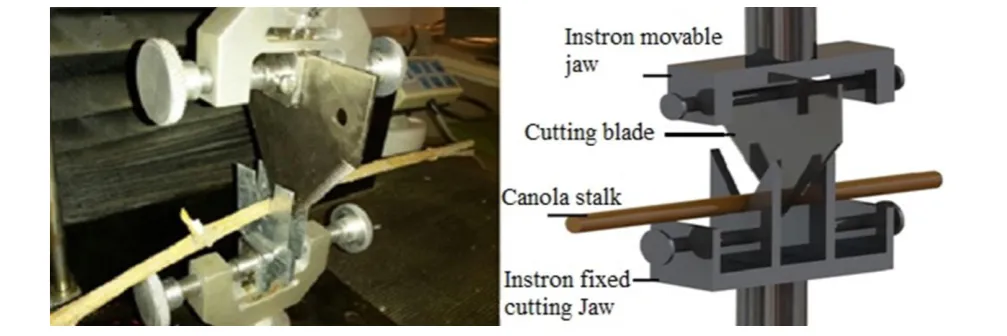
For mechanical testing, Instron machine (Model Santam-STM5) was used with a 50 N load cell. A saw-serrated cutting blade was attached to Instron
Movable Cutting Jaw according to Figure 1. Stalks were cut at three diameter levels of (1 to 3, 3 to 5 and more than 5 mm), three positioning angles on the Instron fixed cutting Jaw (0˚, 30˚ and 60˚) and three levels of
cutting speed (75, 115, 150 mm/min) in three replications. Tests for each stalk lasted until the full cut. Data requirements were obtained from Force-Deformation curve. And data analysis was conducted using a factorial experiment in a Completely Randomized Design with the help of SAS software and LSD test.
2.3 Principles of theory
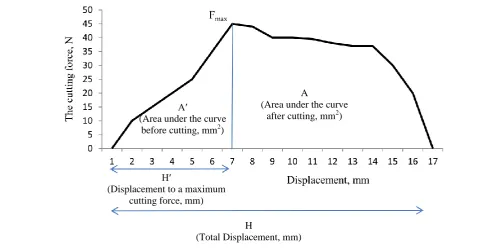
By moving the movable jaw, cutting operation was performed and Force-Deformation curve was plotted by Instron (Figure 2). Modulus of mass density of stalk,
special work of useful cutting, coefficient of cutting useful work and crush resistance coefficient as well as related relations were calculated by the information of force-deformation curve.
2.3.1 Modulus of mass density
Modulus of mass density was calculated by Equation (1) (Bernacki, 1972):
Where, =Modulus of mass density; = The
maximum force, N; H =Total displacement, mm.
2.3.2 Special work of useful cutting
To calculate the special work of useful cutting, Equation (2) was used (Bernacki, 1972):
a =
Where, = The maximum force, N; Dstem= The
diameter of stalk, mm.
2.3.3 Coefficient of cutting useful work
The Coefficient of cutting useful work was calculated by Equation (3) (Bernacki, 1972):
Where, = Coefficient of cutting useful work; =The area under the curve after cutting , mm2; A' = The area under the curve before cutting, mm2
2.3.4 Crush resistance coefficient
To calculate the crush resistance coefficient, Equation (4) was used (Bernacki, 1972):
Where, = Displacement to a maximum cutting force, mm; = The maximum force , N.
3 Results and discussion
3.1 Modulus of mass density
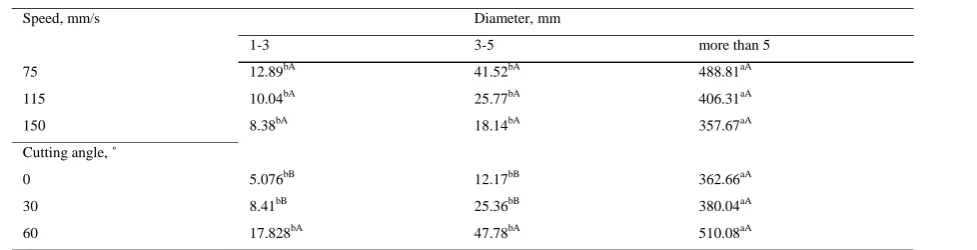
According to Table 1, diameter and angle changes at the probability level of 1% and the changes of speed at the probability level of 5% were effective on modulus of mass density of object. Also the interaction of diameter with speed and angle is significant at the probability level of 5%. Therefore, the comparison of means was performed by LSD test and the results were shown in Table 2.
Figure 2 Force-deformation diagram at canola stalk cutting Hʹ
(Displacement to a maximum cutting force, mm)
H (Total Displacement, mm)
Aʹ (Area under the curve
before cutting, mm2)
A (Area under the curve
3.1.1 Interaction between diameter and the cutting speed The findings in Table 2 showed that the highest and the lowest modulus of mass density of stalk in stem were equal to 488.81 and 8.38 respectively at the speeds of 75 mm/min and 115 mm/min and in diameters more than 5 mm and between 1-3 mm. Also, by increasing the diameter and decreasing the speed, modulus of mass density of stalk was increased. Given to Equation (1), the modulus of mass density has a direct relationship with cutting force and cutting relocation. Because by increasing the diameter, the value of cutting force and the relocation of the blade for cutting are increased, the modulus of mass density is also increased. As well as increased cutting speed reducing cutting forces, it reduces the module of mass density. It seems that the difference between the modulus of density in different diameters has been due to the relocation to stem full cutting. More than 5 mm in diameter, because relocation to full cut is
more, so more difference can be seen with other diameters.
3.1.2 Interaction of diameter and cutting angle
The effect of angle changes in various diameters on modulus of mass density of stalk has been shown in Table 2. The most and the least modulus of mass density of stalk in stem were 510.08 and 5.07 in angles of 60˚ and 0˚ and in diameters more than 5 mm and between 1-3 mm, respectively. Modulus of mass density of stalk was increased with increasing the angle and diameter. Modulus of mass density has direct relationship with cutting force and relocation. Cutting force was increased with increasing the cutting angle, since the ratio of relocation of moving blade for full cutting was enhanced by rising oblique angle and that is why modulus of mass density was increased. More difference among diameters can be observed due to the difference of relocation to stem full cutting.
Table 1 Analysis of variance of the diameter, cutting angle and loading speed effects on the mechanical
properties of the Canola stalk
Crush resistance coefficient
Coefficient of cutting useful work
Special work of useful cutting
Modulus of mass density Source of Variance
207.85** 0.20** 340.86** 1428800.763** Diameter 19.23** 0.01ns 35.45** 19433.752* Speed 12.14** 0.02ns 55.60** 32882.623** cutting angle 5.33** 0.03ns 5.41ns 10723.61*
Diameter × speed
3.82** 0.0.025ns
3.96ns 14431.66*
Diameter × angle
2.23ns 0.008ns
11.17ns 2103.97ns
Speed × angle
0.700 0.017
2.48 3980.81
Error
Note: ** and *Significant difference at 1% level (p <0.01) and at 5% level (p <0.05) respectively, ns not significant difference.
Table 2 Interactions between diameter with cutting angle and speed for modulus of mass density
Diameter, mm Speed, mm/s
more than 5 3-5 1-3 488.81aA 41.52bA 12.89bA 75 406.31aA 25.77bA 10.04bA 115 357.67aA 18.14bA 8.38bA 150
Cutting angle, ˚
362.66aA 12.17bB 5.076bB 0 380.04aA 25.36bB 8.41bB 30 510.08aA 47.78bA 17.828bA 60
3.2 Special work of useful cutting
According to Table 1, the effects of changes in speed, diameters and angle at the probability level of 1% on special work of useful cutting is significant. Considering Figure 3, special work of useful cutting decreases with increasing cutting speed; the highest ratio was 4.901 at a speed of 75 mm/min and the lowest ratio was observed at 150 mm/min equal to 2.61. As shown
in Equation (2), special work of useful cutting is directly related to cutting force. The cutting force was declined with increasing the speed, because at low speeds, the stem is firstly pressed in front of the blade and then cut. Whereas, at high speeds stems density is reduced due to the viscoelastic properties of the plant matters; thus special work of useful cutting has been also declined.
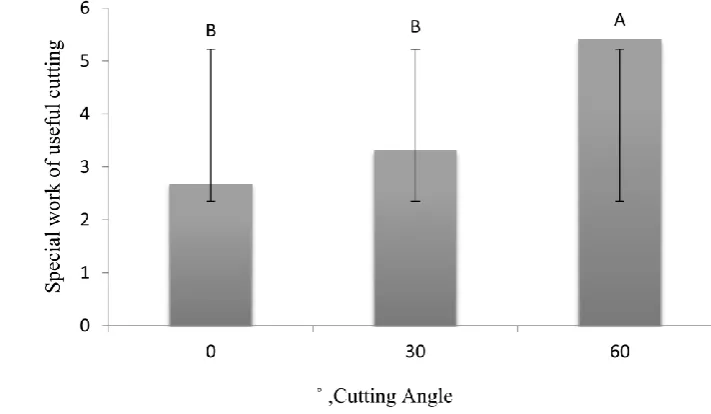
Given to Figure 4, the cutting angle increases the amount of special work of useful cutting and the highest ratio (5.4) was at an angle of 60° and the lowest ratio (2.66) was at 0°. Maximum cutting force was enhanced
by the increasing angle. Since special work of useful cutting has a direct relationship with maximum cutting force, hence, special work of useful cutting was increased by rising cutting angle.
Figure 3 Effect of loading speed on special work of useful cutting
Figure 5 illustrates that special work of useful cutting was increased by rising diameter; the average five special work of useful cutting in diameter more than 5 mm was 7.89 and the lowest mean was 1.601 in diameter of 1-3 mm. By increasing the diameter, the cutting force
increased because larger cross section leads to more contact area and as a result, friction increases between the stems and the blade as well as special work of useful cutting is increased by rising cutting force.
3.3 Coefficient of cutting useful work
According to Table 1, only the diameter changes at the level of 1% had significant effect on coefficient of cutting useful work. Given to Figure 6, the coefficient of cutting useful work was increased by rising the diameter; average coefficient of cutting useful work in diameter more than 5 mm was 0.186 and the lowest ratio
was 0.354 in diameters of 1-3 mm. Increased diameter leads to an increase in cutting energy because cutting energy is equal to the area under the force-relocation curve; therefore, increased diameter causes enhancing the cutting force, relocation and cutting energy and resulting in increased coefficient of cutting useful work.
Figure 5 Effect of diameter on special work of useful cutting
3.4 Crush resistance coefficient
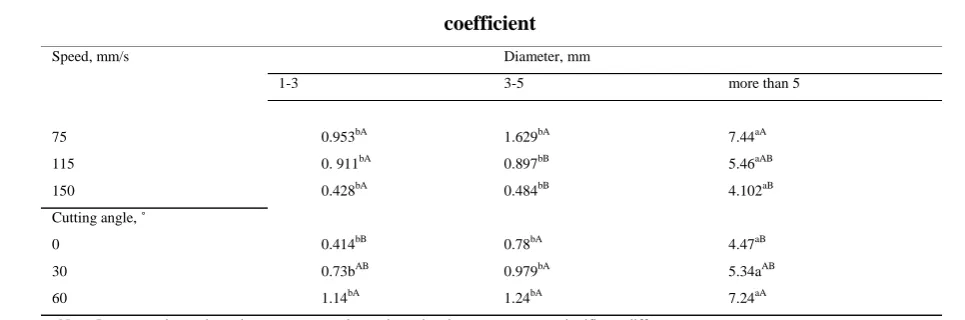
Given to the results of Table 1, the effects of changes in diameter and speed and angle at the level of 1% on crush resistance coefficient are significant. As well as the interaction of crush resistance coefficient with diameter and speed and angle at the level of 1% and cutting angle and speed at the level of 1% are significant. Comparison of means was performed using LSD test and the results have been shown in Table 3.
3.4.1 Interaction of diameter and speed
As is shown in Table 3, the highest and the lowest crush resistance coefficient in stem were 7.44 and 0.428 respectively at the speeds of 75 mm/min and 150 mm/min and in diameters more than 5 mm and between 1-3 mm. Crush resistance coefficient was reduced by increasing the speed, and was increased by rising diameter.
According to Equation (4), crush resistance coefficient has a direct relationship with cutting force. Given to obtained data, the cutting force was decreased by increasing the speed so resulting in a decrease in crush resistance coefficient. Also cutting force was enhanced with increasing the diameter so resulting in an increase in crush resistance coefficient.
3.4.2 Interaction of diameter and cutting angle
The results of Table 3 indicated that the most and the least crush resistance coefficient in stem were found 7.24 and 0.414 in angles of 60˚ and 0˚ and in diameters more than 5 mm and between 1-3 mm. Crush resistance coefficient was decreased by rising cutting angle and diameter. Cutting force and relocation were enhanced by increasing diameter and resulting in increased crush resistance coefficient.
4 Conclusions
The investigation of constant cutting parameters of canola stem including coefficient of cutting useful work, modulus of mass density of stalk, crush resistance coefficient, special work of useful cutting indicated the following results:
(1). Coefficient of cutting useful work was enhanced by increasing diameter, but the changes in the diameter and cutting speed had no significant effect on it.
(2). Modulus of mass density, special work of useful cutting and crush resistance coefficient were enhanced by increasing the diameter and cutting angle.
(3). Modulus of mass density, special work of useful cutting and crush resistance coefficient were decreased by increasing the cutting speed.
References
Azadbakht, M., E. Esmaeilzadeh, and M. Esmaeili-Shayan. 2015a. Energy consumption during impact cutting of canola stalk as a function of moisture content and cutting height. Journal of the Saudi Society of Agricultural Sciences, 14(2): 147-152.
Azadbakht, M., E. Ghajarjazi, E. Barzanooni, R. Pourbagher, and N. Tajari. 2015b. Effect of irrigation regimes and the plant density on shear strength and physical properties of Azivash (Corchorus Olitorius) stem. Agricultural Engineering
Table 3 Interaction of diameter and cutting angle and diameter and cutting speed on crush resistance
coefficient
Diameter, mm Speed, mm/s
more than 5 3-5
1-3
7.44aA 1.629bA
0.953bA 75
5.46aAB
0.897bB
0. 911bA
115
4.102aB
0.484bB
0.428bA
150
Cutting angle, ˚
4.47aB 0.78bA
0.414bB 0
5.34aAB 0.979bA
0.73bAB 30
7.24aA 1.24bA
1.14bA 60
Bernacki, H., J. Haman, and C. Z. Kanafojski. 1972. Agricultural machine theory and construction, Vol 1. U. S. Department of commerce spring field, USA.
Chancellor, W. J. 1965. An experiment on force and energy requirements for cutting paddy stalks. The Malaysian Agricultural Journal, 45(2): 200-205.
Chandio, F. A., C. Yi, A. A. Tagar, I. A. Mari, C. Arslan, D. M. Cuong, and H. Fang. 2013. Effect of loading rate on mechanical characteristics of wheat and rice Straw. Bulgarian Journal of Agricultural Science, 19(6): 1452-1458.
Ghahrae, O., M. H. Khoshtaghaza, and D. Bin Ahmad. 2008. Design and development of special cutting system for sweet sorghum harvester. Journal of Central European Agriculture, 9(3): 469-474.
Halyk, R. M., and L. W. Hurlburt. 1968. Tensile and shear strength characteristics of alfalfa stems. Transaction of the ASAE, 11(1): 256-257.
Hazbavi, E., and S. Minaei. 2008. Determination and investigation of some physical properties of seven variety rapeseed. Iranian Journal of Food Science and Technology, 5(4): 21-28.
Hoseinzadeh, B., and A. Shirneshan. 2012. Bending and shearing characteristics of canola stem. American-Eurasian J. Agric. & Environ. Sci, 12 (3): 275-281.
Hosseinzadeh, B., A. Eshaghbeigi, and N. Raghami. 2009. Effect of moisture content, bevel angle and cutting speed on shearing energy of three wheat varieties. World Applied Sciences Journal, 7(9): 1120-1123.
Imanmehr, A., B. Ghobadian, S. Minaei, and J. Faradmal. 2007. Determination of some physical properties of canola seed
(licord cultivar). Journal of Agricultural Engineering Research, 7(29): 119-128.
Johnson, P. C., C. L. Clementson, S. K. Mathanker, T. E. Grift, and A. C. Hansen. 2012. Cutting energy characteristics of Miscanthus x giganteus stems with varying oblique angle and cutting speed. Biosystems Engineering, 112(1): 42-48.
Pasban Eslam, B. 2009. Study of yield in winter oilseed rape cultivars during different sowing dates. Quarterly Journal of Crop Ecophysiology (Agriculture Science), 3(10): 1-10.
Persson, S. 1987. Mechanics of cutting plant material. Michigan: ASAE Publications.
Prasad, J., and C. B. Gupta. 1975. Mechanical properties of maize stalks as related to harvesting. Journal of Agricultural Engineering Research, 20(1): 79-87.
Tabatabae Koloor, R., and G. Kiani. 2007. Soybean stems cutting energy and the effects of blade parameters on it. Pakistan Journal of Biological Sciences: PJBS, 10(9): 1532-1535.
Vale Ghozhedi, H., S. R. Hassan Beygi Bidgoli, M. H. Saeidirad, and M. H. Kianmehr. 2010. Shear strength of stem and picking force for saffron flowers. Journal of Agricultural Engineering Research, 11(3): 41-54.