Complete genome sequence of Atopobium parvulum type
strain (IPP 1246
T)
Alex Copeland1, Johannes Sikorski2, Alla Lapidus1, Matt Nolan1, Tijana Glavina Del Rio1, Su-san Lucas1, Feng Chen1, Hope Tice1, Sam Pitluck1, Jan-Fang Cheng1, Rüdiger Pukall2, Olga Chertkov1,3, Thomas Brettin1,3, Cliff Han1,3, John C. Detter1,3, Cheryl Kuske1,3, David Bruce1,3, Lynne Goodwin1,3, Natalia Ivanova1, Konstantinos Mavromatis1, Natalia Mikhailova1, Amy Chen4, Krishna Palaniappan4, Patrick Chain1,5, Manfred Rohde6, Markus Göker2, Jim Bris-tow1, Jonathan A. Eisen1,7, Victor Markowitz4, Philip Hugenholtz1, Nikos C. Kyrpides1, Hans-Peter Klenk2*, and John C. Detter1,3
1 DOE Joint Genome Institute, Walnut Creek, California, USA
2 DSMZ - German Collection of Microorganisms and Cell Cultures GmbH, Braunschweig, Germany
3 Los Alamos National Laboratory, Bioscience Division, Los Alamos, New Mexico, USA 4 Biological Data Management and Technology Center, Lawrence Berkeley National
Labora-tory, Berkeley, California, USA
5 Lawrence Livermore National Laboratory, Livermore, California, USA 6 HZI - Helmholtz Centre for Infection Research, Braunschweig, Germany 7 University of California Davis Genome Center, Davis, California, USA
*Corresponding author: Hans-Peter Klenk
Keywords: halitosis, obligately anaerobic, human respiratory tract, risk group 2, malodor, Co-riobacteriaceae
Atopobium parvulum (Weinberg et al. 1937) Collins and Wallbanks 1993 comb. nov. is the type strain of the species and belongs to the genomically yet unstudied Atopobium/Olsenella branch of the family Coriobacteriaceae. The species A. parvulum is of interest because its members are frequently isolated from the human oral cavity and are found to be associated with halitosis (oral malodor) but not with periodontitis. Here we describe the features of this organism, together with the complete genome sequence, and annotation. This is the first complete genome sequence of the genus Atopobium, and the 1,543,805 bp long single repli-con genome with its 1369 protein-coding and 49 RNA genes is part of the Genomic E ncyclo-pedia of Bacteria and Archaea project.
Introduction
Strain IPP 1246
T(= DSM 20469 = ATCC 33793 =
JCM 10300) is the type strain of the species
Atopo-bium parvulum
and was first described by
Wein-berg
et al.
1937 as ‘
Streptococcus parvulus
’
(ba-sonym) [
1]. In 1992 it was reclassified as
A.
parvu-lum
[
2].
A. parvulum
is of high interest because it
has frequently been isolated from the human oral
cavity, especially from the tongue dorsum, where
it has been associated with patients suffering from
halitosis (oral malodor) [
3,4]. In general, the
malo-dorous compounds are volatile sulfur compounds,
with the most frequent ones being hydrogen
sul-fide, methyl mercaptan, and dimethyl sulsul-fide,
which are produced by bacterial metabolism of
the sulfur containing amino acids cysteine and
methionine [
3,4]. However, for
A. parvulum
itself,
the production of these substances has not yet
been studied.
A. parvulum
has not been found to
be significantly associated with chronic
periodon-titis, though a participation in periodontitis can
not be fully excluded [
5]. Nevertheless,
A.
parvu-lum
has been associated with odontogenic
infec-tions,
e.g
. dental implants, but also with the saliva
of healthy subjects [
6]. Here we present a
sum-mary classification and a set of features for
A.
par-vulum
IPP 1246
Ttogether with the description of
Classification
and features
Phylotypes with significant 16S sequence
similari-ty to strain IPP 1246
Twere observed from
intu-bated patients (EF510777) and from
metagenom-ic human skin surveys (GQ081350) [
7]. No
signifi-cant similarities were found in human gut
meta-genomes (highest similarity is 92%,
BABE01011651) [
8], or in marine metagenomes
(87%, AACY020304192) [
9] (status June 2009).
Figure 1
shows the phylogenetic neighborhood of
A.
parvulum
strain IPP P1246
Tin a 16S rRNA based
tree. The sequence of the sole copy of the 16S
rRNA gene in the genome is identical with the
previously published sequence generated from
ATCC 22793 (AF292372), but differs by four
nuc-leotides from the sequence used for the last
tax-onomic emendation (X67150) [
2].
Figure 1.
Phylogenetic tree of
A. parvulum
strain IPP 1246
T, all other type strains of the genus
Ato-pobium
and the type strains of all other genera within the
Coriobacteriaceae
, inferred from 1345
aligned characters [
10,11] of the 16S rRNA gene sequence under the maximum likelihood criterion
[
12]. The tree was rooted with the type strains of the genera within the subclass
Rubrobacteridae
.
The branches are scaled in terms of the expected number of substitutions per site. Numbers above
branches are support values from 1000 bootstrap replicates if larger than 60%. Lineages with type
strain genome sequencing projects registered in GOLD [
13] are shown in blue, published genomes
in bold, including two of which are reported in this issue of
SIGS
[
14,15]
The cells are cocci (approximately 0.3 to 0.6 µm in
diameter) that occur singly, in pairs, in clumps,
and in short chains, occasionally with central
swelling [
16,17] (
Table 1and
Figure 2). The strains
are non-motile and obligate anaerobic.
Interes-tingly, growth is substantially stimulated by
0.02% (vol/vol) Tween 80 and by 10% (vol/vol)
rabbit serum added to culture media [
16]. Strain
IPP 1246
Tis susceptible to chloramphenicol (12
µg/ml), clindamycin (1.6 µg/ml), erythromycin (3
µg/ml), penicillin G (2 U/ml), and tetracycline (6
µg/ml) [
17].
Strain IPP 1126
Tproduces acid (final pH < 4.7)
from cellobiose, esculin, fructose, galactose,
glu-cose, inulin, lactose, maltose, mannose, salicin,
sucrose, and trehalose; erythritol and xylose were
weakly fermented; no acid was produced from
amygdalin, arabinose, glycerol, glycogen, inositol,
mannitol, melezitose, melibiose, pectin, raffinose,
rhamnose, ribose, sorbitol, or starch. Esculin was
hydrolyzed; neither starch nor hippurate was
hy-drolyzed. Nitrate was not reduced. Indole was not
formed. A solid acid curd formed in milk; neither
milk, gelatin, nor meat was digested. Neither
cata-lase, urease, deoxyribonuclease, lecithinase, nor
lipase was detected [
17]. Other enzyme activities
are positive for acid phosphatase, alanine
but negative for arginine dihydrolase, histidine
arylamidase, proline arylamidase, serine
arylami-dase, as determined using the API system [
24].
Chemotaxonomy
The chemotaxonomy of
A. parvulum
IPP 1246
Tis
unfortunately hardly studied. There are no data
known on the polar lipids. The strain possesses
cell-
wall peptidoglycan of type A4α, L
-
Lys
-D-Asp
(type A11.31 according to the DSMZ catalogue of
strains) [
25]. The major cellular fatty acids (FAME:
fatty acid methyl ester; DMA: dimethylacetyl) are
C
18:1cis
-9 (38.2%, FAME), C
18:1cis
-9 (24.1%, DMA),
C
16:1cis
-9 (5.0%, FAME), C
17:1cis
-8 (5.0%, FAME),
C
18:1c11/t9/t6 (5.0%, FAME), C
18:1cis
-11 (3.9%,
DMA), C
14:0(3.4%, FAME), C
10:0(3.0%, FAME) [
16].
Table 1. Classification and general features of A. parvulum IPP 1146T according to the MIGS recommendations [18].
MIGS ID Property Term Evidence
code
Current classification
Domain Bacteria TAS [19]
Phylum Actinobacteria TAS [20]
Class Actinobacteria TAS [20]
Subclass Coriobacteridae TAS [21]
Order Coriobacteriales TAS [21] Suborder “Coriobacterineae” TAS [21] Family Coriobacteriaceae TAS [21]
Genus Atopobium TAS [2]
Species Atopobium parvulum TAS [2] Type strain IPP 1246
Gram stain positive TAS [16]
Cell shape small cocci that occasionally appear to be elliptical TAS [16]
Motility nonmotile TAS [17]
Sporulation nonsporulating TAS [16]
Temperature range 25°C–45°C TAS [17]
Optimum temperature 37°C–45°C TAS [17]
Salinity less than 6.5% NaCl TAS [17]
MIGS-22 Oxygen requirement obligate anaerobic TAS [17]
Carbon source acid production from cellobiose, esculin, fructose, galactose, glucose, inulin, lactose, maltose, man-nose, salicin, sucrose, and trehalose
TAS [17]
Energy source carbohydrates TAS [17]
MIGS-6 Habitat human respiratory tract. TAS [1,17]
MIGS-15 Biotic relationship free living NAS
MIGS-14 Pathogenicity associated with halitosis and human oral infections TAS [3,4,6]
Biosafety level 2 TAS [22]
Isolation unknown for this specific strain, but Weinberg et al reported that the principal habitat was the
respirato-ry tract. TAS [1,17]
MIGS-4 Geographic location unknown, probably France TAS [1,17]
MIGS-5 Sample collection time before 1937 TAS [1,17]
MIGS-4.1
MIGS-4.2 Latitude – Longitude unknown
MIGS-4.3 Depth not reported
MIGS-4.4 Altitude not reported
Figure 2.
Scanning electron micrograph of
A. parvulum
IPP 1246
TGenome
sequencing
and annotation
Genome project history
This organism was selected for sequencing on the
basis of each phylogenetic position, and is part of
the
G
enomic
E
ncyclopedia of
B
acteria and
A
rchaea
project. The genome project is deposited in the
Genome OnLine Database [
13] and the complete
genome sequence is deposited in GenBank
Se-quencing, finishing and annotation were
per-formed by the DOE Joint Genome Institute (JGI). A
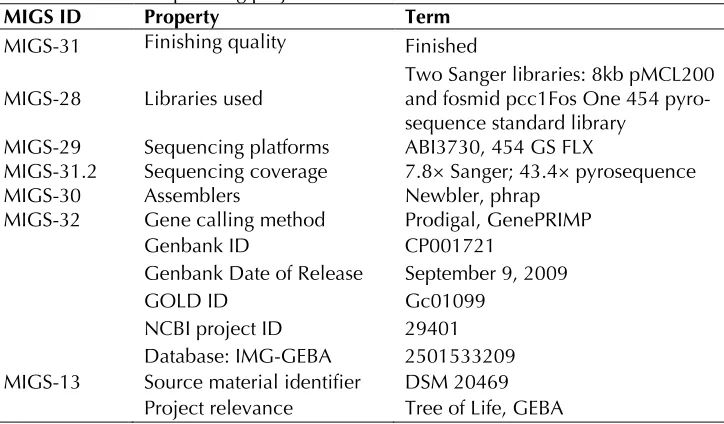
summary of the project information is shown in
Table 2.
Growth conditions and DNA isolation
A. parvulum
strain IPP 1246
T, DSM 20469, was
grown anaerobically in DSMZ medium 104
(mod-ified PYG; Medium [
26]) at 37°C. DNA was isolated
from 0.5-1 g of cell paste using the JGI CTAP
pro-cedure with a modified protocol for cell lysis as
described in Wu
et al
. [
27].
Table 2. Genome sequencing project information
MIGS ID Property Term
MIGS-31 Finishing quality Finished MIGS-28 Libraries used
Two Sanger libraries: 8kb pMCL200 and fosmid pcc1Fos One 454 pyro-sequence standard library
MIGS-29 Sequencing platforms ABI3730, 454 GS FLX
MIGS-31.2 Sequencing coverage 7.8× Sanger; 43.4× pyrosequence
MIGS-30 Assemblers Newbler, phrap
MIGS-32 Gene calling method Prodigal, GenePRIMP
Genbank ID CP001721
Genbank Date of Release September 9, 2009
GOLD ID Gc01099
NCBI project ID 29401
Database: IMG-GEBA 2501533209 MIGS-13 Source material identifier DSM 20469
Genome sequencing and assembly
The genome was sequenced using a combination
of Sanger and 454 sequencing platforms. All
gen-eral aspects of library construction and
sequenc-ing performed at the JGI can be found on the JGI
website. 454 Pyrosequencing reads were
assem-bled using the Newbler assembler version
1.1.02.15 (Roche). Large Newbler contigs were
broken into 1,716 overlapping fragments of
1000bp and entered into assembly as
pseudo-reads. The sequences were assigned quality scores
based on Newbler consensus q-scores with
mod-ifications to account for overlap redundancy and
to adjust inflated q-scores. A hybrid 454/Sanger
assembly was made using the parallel phrap
as-sembler (High Performance Software, LLC). Poss
i-ble mis-assemblies were corrected with
Dupfi-nisher [
28] or transposon bombing of bridging
clones (Epicentre Biotechnologies, Madison, WI).
Gaps between contigs were closed by editing in
Consed, custom primer walk or PCR amplification.
A total of 125 Sanger finishing reads were
pro-duced to close gaps, to resolve repetitive regions,
and to raise the quality of the finished sequence.
The error rate of the completed genome sequence
is less than 1 in 100,000. Together all sequence
types provided 51.2 x coverage of the genome. The
final assembly contains 12,842 Sanger and
359,479 pyrosequence reads.
Genome annotation
Genes were identified using Prodigal [
29] as part
of the Oak Ridge National Laboratory genome a
n-notation pipeline, followed by a round of manual
curation using the JGI GenePRIMP pipeline [
30].
The predicted CDSs were translated and used to
search the National Center for Biotechnology
In-formation (NCBI) nonredundant database, UniProt,
TIGRFam, Pfam, PRIAM, KEGG, COG, and InterPro
databases. Additional gene prediction analysis and
functional annotation were performed within the
Integrated Microbial Genomes Expert Review
(IMG-ER) platform [
31].
Genome properties
The genome is 1,543,805 bp long and comprises
one main circular chromosome with a 45.7% GC
content (
Table 3and
Figure 3). Of the 1419 genes
predicted, 1369 were protein coding genes, and 50
RNAs. Sixteen pseudogenes were also identified.
The majority of the genes (74.5%) were assigned
with a putative function while the remaining ones
were annotated as hypothetical proteins. The
dis-tribution of genes into COGs functional categories
is presented in
Table 4.Table 3. Genome Statistics
Attribute Value % of Total
Genome size (bp) 1,543,805 100.00%
DNA Coding region (bp) 1,396,223 90.44%
DNA G+C content (bp) 705,312 45.69%
Number of replicons 1
Extrachromosomal elements 0
Total genes 1419 100.00%
RNA genes 49 3.52%
rRNA operons 1
Protein-coding genes 1369 96.48%
Pseudo genes 16 1.13%
Genes with function prediction 1059 74.63%
Genes in paralog clusters 69 4.86%
Genes assigned to COGs 1096 77.24%
Genes assigned Pfam domains 1084 76.39%
Genes with signal peptides 240 16.91%
Genes with transmembrane helices 339 23.89%
Figure 3.
Graphical circular map of the genome. From outside to the center: Genes on forward
strand (color by COG categories), Genes on reverse strand (color by COG categories), RNA genes
(tRNAs green, rRNAs red, other RNAs black), GC content, GC skew.
Table 4. Number of genes associated with the general COG functional categories Code Value % age Description
J 128 9.3 Translation, ribosomal structure and biogenesis
A 0 0.0 RNA processing and modification
K 85 6.2 Transcription
L 72 5.3 Replication, recombination and repair
B 1 0.1 Chromatin structure and dynamics
D 18 1.3 Cell cycle control, mitosis and meiosis
Y 0 0.0 Nuclear structure
V 42 3.1 Defense mechanisms
T 46 3.4 Signal transduction mechanisms
M 70 5.1 Cell wall/membrane biogenesis
N 1 0.1 Cell motility
Z 0 0.0 Cytoskeleton
W 0 0.0 Extracellular structures
U 20 1.5 Intracellular trafficking and secretion
O 44 3.2 Posttranslational modification, protein turnover, chaperones C 44 3.2 Energy production and conversion
Table 4. Number of genes associated with the general COG functional categories (cont.) Code Value % age Description
E 105 7.7 Amino acid transport and metabolism F 53 3.9 Nucleotide transport and metabolism
H 37 2.7 Coenzyme transport and metabolism
I 23 1.7 Lipid transport and metabolism
P 59 4.3 Inorganic ion transport and metabolism
Q 11 0.8 Secondary metabolites biosynthesis, transport and catabolism R 125 9.1 General function prediction only
S 90 6.6 Function unknown
- 273 19.9 Not in COGs
Acknowledgements
We would like to gratefully acknowledge the help of Katja Steenblock for growing A. parvulum cultures and
Susanne Schneider for DNA extraction and quality analysis (both at DSMZ). This work was performed under the auspices of the US Department of Energy Office of Science, Biological and Environmental Re-search Program, and by the University of California,
Lawrence Berkeley National Laboratory under contract
No. DE-AC02-05CH11231, Lawrence Livermore N
a-tional Laboratory under Contract No. DE-AC52-07NA27344, and Los Alamos National Laboratory u n-der contract No. DE-AC02-06NA25396, as well as Ger-man Research Foundation (DFG) INST 599/1-1.
References
1. Weinberg M, Nativelle R, Prévot AR. Les microbes anaeobies. Masson and Co., Paris. 1937.
2. Collins MD, Wallbanks S. Comparative sequence analyses of the 16S rRNA genes of Lactobacillus minutus, Lactobacillus rimae and Streptococcus parvulus: proposal for the creation of a new genus Atopobium. FEMS Microbiol Lett 1992; 74:
235-240
3. Kazor CE, Mitchell PM, Lee AM, Stokes LN, Loesche WJ, Dewhirst FE, Paster BJ. Diversity of bacterial populations on the tongue dorsa of pa-tients with halitosis and healthy papa-tients. J Clin Microbiol 2003; 41:558-563.
4. Riggio MP, Lennon A, Rolph HJ, Hodge PJ, Do-naldson A, Maxwell AJ, Bargg J. Molecular identi-fication of bacteria on the tongue dorsum of sub-jects with and without halitosis. Oral Dis 2008; 14:
251-258
5. Kumar PS, Griffen AL, Barton JA, Paster BJ, Moeschberger ML, Leys EJ. New bacterial species associated with chronic periodontitis. J Dent Res 2003; 82: 338-344
6. Downes J, Munson MA, Spratt DA, Konen E, Tark-ka E, Jousimies-Somer H, Wade WG. Characteri-sation of Eubacterium-like strains isolated from
oral infections. J Med Microbiol 2001; 50:
947-951
7. Grice EA, Kong HH, Conlan S, Deming CB, Davis J, Young AC, NISC Comparative Sequencing Pro-gram, Bouffard GG, Blakesley RW, Murray RR, et al. Topographical and temporal diversity of the human skin microbiome. Science 2009; 324:
1190-1192
8. Kurokawa K, Itoh T, Kuwahara T, Oshima K, Toh H, Toyoda A, Takami H, Morita H, Sharma VK, Srivastava TP, et al. Comparative metagenomics revealed commonly enriched gene sets in human gut microbiomes. DNA Res 2007; 14: 169-181
9. Venter JC, Remington K, Heidelberg JF, Halpern AL, Rusch D, Eisen JA, Wu D, Paulsen J, Nelson KE, Nelson W, et al. Environmental genome shot-gun sequencing of the Sargasso Sea. Science 2004; 304: 66-74
10. Castresana J. Selection of conserved blocks from multiple alignments for their use in phylogenetic analysis. Mol Biol Evol 2000; 17: 540-552
11. Lee C, Grasso C, Sharlow MF. Multiple sequence alignment using partial order graphs. Bioinformat-ics 2002; 18: 452-464
12. Stamatakis A, Hoover P, Rougemont J. A Rapid Bootstrap Algorithm for the RAxML Web Servers. Syst Biol 2008; 57: 758-771
13. Liolios K, Mavromatis K, Tavernarakis N, Kyrpides NC. The Genomes On Line Database (GOLD) in 2007: status of genomic and metagenomic projects and their associated metadata. Nucleic Acids Res 2008; 36: D475-D479
14. Mavrommatis K, Pukall R, Rohde C, Chen F, Sims D, Brettin T, Kuske C, Detter JC, Han C, Lapidus A, et al. Complete genome sequence of Cryptobacte-rium curtum type strain (12-3T). Stand Genomic
Sci 2009; 1: 93-101
15. Saunders E, Pukall R, Abt B, Lapidus A, Galvina Del Rio T, Copeland A, Tice H, Cheng JF, Lucas S, Chen F, et al. Complete genome sequence of Eg-gerthella lenta type strain (IPP VPI 0255T). Stand Genomic Sci 2009; 1:
174-182
16. Olsen I, Johnson JL, Moore LVM, Moore WEC. Lactobacillus uli sp. nov. and Lactobacillus rimae sp. nov. from the human gingival crevice and emended descriptions of Lactobacillus minutus and Streptococcus parvulus. Int J Syst Bacteriol 1991; 41: 261-266
17. Cato EP. Transfer of Peptostreptococcus parvulus (Weinberg, Nativelle, and Prévot 1937) Smith 1957 to the Genus Streptococcus: Streptococcus parvulus (Weinberg, Nativelle, and Prévot 1937) comb, nov., nom. rev., emend. Int J Syst Bacteriol 1983; 33: 82-84.
18. Field D, Garrity G, Gray T, Morrison N, Selengut J, Sterk P, Tatusova T, Thomson N, Allen MJ, Angiu-oli SV, et al. The minimum information about a genome sequence (MIGS) specification. Nat Bio-technol 2008; 26: 541-547
19. Woese CR, Kandler O, Wheelis ML. Towards a natural system of organisms: proposal for the do-mains Archaea, Bacteria, and Eucarya. Proc Natl Acad Sci USA 1990; 87: 4576-4579
20. Garrity GM, Holt J. In: Garrity GM, Boone DR, Castenholz RW, eds. Taxonomic Outline of the Archaea and Bacteria. Bergey's Manual of Syste-matic Bacteriology, 2nd Ed. Vol 1 The Archaea,
Deeply Branching and Phototrophic Bacteria. 2001 pp. 155-166
21. Stackebrandt E, Rainey FA, Ward-Rainey NL. Pro-posal for a New Hierarchic Classification System, Actinobacteria classis nov. Int J Syst Bacteriol 1997; 47: 479-491.
22. Anonymous. Biological Agents. Technical rules for biological agents www.baua.de TRBA 466. 23. Ashburner M, Ball CA, Blake JA, Botstein D, Butler
H, Cherry JM, Davis AP, Dolinski K, Dwight SS, Eppig JT, et al. Gene ontology: tool for the unifica-tion of biology. The Gene Ontology Consortium. Nat Genet 2000; 25: 25-29
24. Rodriguez Jovita MR, Collins MD, Sjoden B, Falsen E. Characterization of a novel Atopobium isolate from the human vagina: description of Atopobium vaginae sp. nov. Int J Syst Bacteriol 1999; 49:
1573-1576
25. Weiss N. Cell wall structure of anaerobic cocci. Rev Inst Pasteur Lyon 1981; 14: 53-59.
26. List of media used at DSMZ for cell growth: http://www.dsmz.de/microorganisms/media_list.p hp
27. Wu M, Hugenholtz P, Mavromatis K, Pukall R, Dalin E, Ivanova N, Kunin V, Goodwin L, Wu M, Tindall BJ, et al.. A phylogeny-driven genomic en-cyclopedia of Bacteria and Archaea. Nature 2009;(In press}
28. Sims D, Brettin T, Detter JC, Han C, Lapidus A, Copeland A, Glavina Del Rio T, Nolan M, Chen F, Lucas S, et al. Complete genome of Kytococcus sedentarius type strain (541T). Stand Genomic Sci
2009; 1: 12-20
29. Anonymous. Prodigal Prokaryotic Dynamic Pro-gramming Genefinding Algorithm. Oak Ridge Na-tional Laboratory and University of Tennessee 2009 http://compbio.ornl.gov/prodigal
30. Pati A, Ivanova N, Mikhailova N, Ovchinikova G, Hooper SD, Lykidis A, Kyrpides NC. GenePRIMP: A Gene Prediction Improvement Pipeline for mi-crobial genomes. (Submitted) 2009.
31. Markowitz VM, Mavromatis K, Ivanova NN, Chen IMA, Chu K, Kyrpides NC. Expert Review of Func-tional Annotations for Microbial Genomes. Bioin-formatics 2009; 25: 2271-2278

![Table 1. Classification and general features of A. parvulum IPP 1146T according to the MIGS recommendations [18]](https://thumb-us.123doks.com/thumbv2/123dok_us/663562.2065495/3.612.62.546.193.671/table-classification-general-features-parvulum-according-migs-recommendations.webp)