The Effect of Mental Rotation Training on the Balance and Falling of the Elderly Women with Physical Training Method
Mohammad Taghi Aghdasi1
Professor of Motor Behaviour, Faculty of Physical Education and Sport Sciences, University of Tabriz, Tabriz, Iran
Seyed Hojjat Zamani Sani
Assistant Professor of Motor Behaviour, Faculty of Physical Education and Sport Sciences, University of Tabriz, Tabriz, Iran
Saba Mohammad Alinezhad*
M. Sc. Student of Motor Behaviour, Faculty of Physical Education and Sport Sciences, University of Tabriz, Tabriz, Iran Sahand Eslami
M. Sc. Student of Sport Psychology, Faculty of Physical Education and Sport Sciences, University of Tabriz, Tabriz, Iran Fatemeh Farrokhzad
M. Sc. of Motor Behaviour, Faculty of Physical Education and Sport Sciences, University of Tabriz, Tabriz, Iran
Received: February 10, 2020; Accepted: March 03,2020 doi:10.22054/nass.2019.10769
Abstract
Purpose: The aim of this study was to compare the effect of eight weeks physical and mental rotation training on the balance and falling of elderly women. Method: The present study is a quasi-experimental study with a pre-test, post-test and two-way ANOVA, which is also t-test designed. Tools included: mental rotation questionnaire and functional reach test. The participants included: 36 patients (12 subjects in three groups of physical training, mental rotation and control group) have been randomly selected among the elderly women of an elderly Centre in Tabriz. The training program was administered in two groups of physical training and mental rotation for eight weeks, at three sessions in a week and a group of control with no intervention. For data analysis, the SPSS software, version 21 was used. Results: One-way ANOVA showed, the mean balance among the elderly women was significantly different from the physical training group. The relationship between post-test mental rotation and pre-test physical training was significant at the 0.01 level. Also, the relationship between the post-test mental rotation group and the pre-test mental rotation group was significant at the level of 0.05 and the relationship between mental rotation and balance among elderly women is significant at the 0.01 level, at the end the relationship between mental rotations and falling in the elderly was significant at 0.05 level. Conclusions: The results of this research indicates that the physical training and mental rotation training had a positive effect on the balance of the elderly women and it also showed that the elderly women of the physical training group had more improvement on balance than mental rotation groups. So, this research indicates that, cognitive abilities and movements could be facilitating and effective in this way.
Keywords: Mental rotation, Physical training, Balance, Falling, Elderly
1 * Author’s e-mail: [email protected] (Corresponding Author);
INTRODUCTION
Physical training improves balance and by improving coordination
and balance, decreased muscle weakness (Liu‐Ambrose et al., 2004),
increased resistance to muscle fatigue and hypertrophy, especially in fibers Muscle type (II), reduces the risk of falls in the elderly (Bloch et al., 2010). The most common fear among the elderly (Todd & Skelton, 2004) is fear of falling (Tinetti, Richman & Powell, 1990).that means the lack of confidence in performing normal activities without losing balance related to trust in the balance (Hatch, Gill-Body & Portney, 2003) in both people with a history of falling (Cumming, Salkeld, Thomas & Szonyi, 2000) and in people without a history of falling (Arfken, Lach, Birge & Miller, 1994) about 22% to 59% have been reported (Wijlhuizen, Jong & Hopman-Rock, 2007; Cumming, Salkeld, Thomas & Szonyi, 2000) have a high prevalence in the elderly (Todd & Skelton, 2004), with fear of the elderly leading to over-care and over-restriction of their mobility and independence (Shumway-Cook and Woollacott, 2007). Elderly people who are afraid of falling also have limited ability to balance and trust in balance (Binda, Culham & Brouwer, 2003). balance it is a predictor of balance (Nemmers & Miller, 2008; Hatch, Gill-Body & Portney, 2003) and has a significant relationship with balance (Simpson, Worsfold, Fisher & Valentine, 2009; Kulmala et al., 2007 and Hatch, Gill-Body & Portney, 2003). Although there has been a large amount of researches on mental rotation and non-evaluation of mental rotation in the elderly, but comparing the effect of mental and physical exercises on the balance of the elderly doesn’t seem as an interesting area for the researches which may provide useful information. Therefore, the present study aims to answer the question "Is the mental rotation or physical training effective on the balance and falling of elderly women?"
METHOD
Participants and procedure
(n = 12), mental rotation training (n = 12) and control group (n = 12) Have been investigated.
Instruments
Initially information was collected through demographic questionnaire (including age, sex, education, type of residence, history of falls, neurological problems, vision, mental and specific illness, training history and preservation balance). All the samples were collected and
investigated for all three groups. Mental rotation test (MRT): This test
is provided by Shepard and Metzler (1971), originally from the Auto CAD mapping version and the Vandenberg and Kuse (1978) rotation test. Mental rotation test in two ways: V, 20 Questions & K, is 24 the question. The mental rotation test used is a set of 24 questions. Each problem consists of a target shape on the right and four stimulus forms on the left. Two shapes of the four stimulus shapes are rotated versions of the target shape and the other two forms cannot be identical to the target shape (Peters et al., 1995). Reliability of the test was calculated 0.82 using the re-test method.
Figure 1: An example of a mental rotation test (Peters et al. 1995)
The main test has 24 questions, which were taken as two 12-question tests. The time for solving each test was 4 minutes with a 2-minute rest period between the tests. There are two ways to score this test. The first method is to record a score for each correct answer and deduct a score for each incorrect answer. In this case the maximum score would be 48 points. However, the most common scoring method is used in this study which is to record a sore for every two correct answers and not to record any sores for one correct answer. (one score for only two correct answer was considered.) This means that the maximum score in this test was 24. Appropriate descriptions of mental spin function and its processes can be found in Weaver's work (Voyer & Bryden, 1990), and the specific information for the revised V and K tests described here can be found in the work of Peters, Chisholm & Laeng (1995), and Peters et al. (1995)
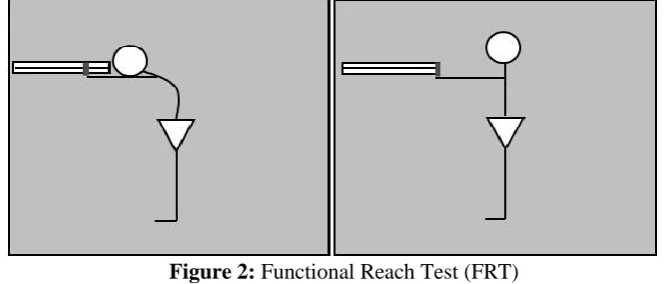
to assess the static balance of the elderly and according to definition, the distance a person can bend and reach beyond the length of his or her arms while maintaining a stable level of standing. Duncan, Studenski, Chandler & Prescott in 1992 have shown that the Functional Reach Test has concurrent validity in assessing elderly balance (Bennie et al., 2003).
Figure 2: Functional Reach Test (FRT)
focused on endurance and strength and in the second two weeks on the components of balance and flexibility. Control group: There was no intervention for control group subjects. First, a pre-test of mental rotation was performed, then after training, the post-test was performed as a pre-test procedure for the physical training and post-pre-test mental of rotation groups.
Data analysis
In this research for statistical analysis, mean and standard deviation were used as descriptive statistics and classify the data. Before examining the data, the Shapiro Wilk test was used to examine the normal distribution, one-way analysis of variance (ANOVA) and t-test analyses was performed, at the significant level of 0.05 (p value ≤ 0.05 was considered statistically significant). Statistical analysis was executed using SPSS 21 version software.
RESULTS
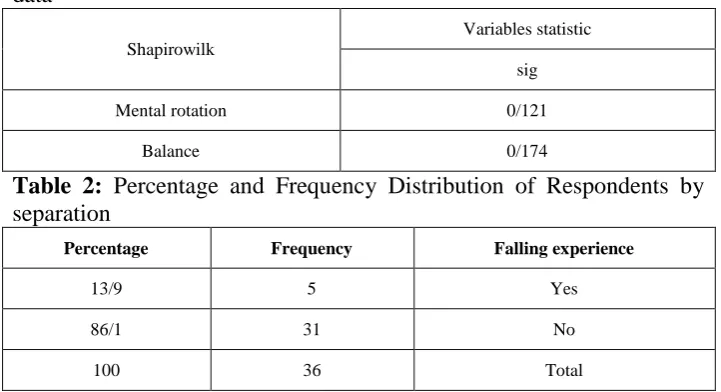
Shapiro Wilk test was used to verify the normal distribution of data in small volume to ensure data is normal. Considering the table and the significant level values for the variables of balance and mental rotation, it can be said that the distribution of variables was normal with good probability.
Table 1: Shapiro Wilk test was used to verify the normal distribution of data
Shapirowilk
Variables statistic
sig
Mental rotation 0/121
Balance 0/174
Table 2: Percentage and Frequency Distribution of Respondents by separation
Percentage Frequency Falling experience
13/9 5 Yes
86/1 31 No
According to datas in table 2, the mean age of the respondents was 67.47 years. The highest score was 79 and 60 was the lowest age. Falling
recordof the 36 respondents, indicates that 5 had history of falling and
31 had no history of falling. Among them, nearly 13.9 have a history of falling. Table below shows the frequency of the distribution and percentages of respondents by breakdown history.
Table 3: Statistics on the balance of elderly women
Mean SE Variance SD Number of
observation
29/11 1/714 105/81 10/28 36
Minimum Maximum Range of
changes Elongation skewed
14 61 47 1/489 1/137
According to table 3, the mean balance variable among female elderly is 29/11. A score of 61 indicates the highest balance and a score of 14 indicates the lowest level of balance.
Table 4: Statistics on the mental rotation variable
Mean SE Variance SD Number of
observation
8/69 0/738 19/46 4/43 36
Minimum Maximum Range of
changes Elongation Skewed
3 21 18 0/928 1/149
The mean of mental rotation variable is 8/69. A score of 21 indicates the highest level of mental rotation and a score of 3 indicates the lowest level of mental rotation (table 4).
Table 5: One-way ANOVA test analysis among the elderly
F sig F 𝑠2𝑚𝑒𝑎𝑛 df 𝑆2 Source of Changes
The dependent variable
0/004 259/03 129/51 0/5
9 2 11
1165/66 1 1166/66
Among group Intergroup
Total
Balance among elderly women
According to Table below, the mean balance among the elderly women was significantly different from the physical training group.
Table 6: Difference between two groups
Difference of mean balance by separation of physical training
group among the elderly
Sig
Difference of mean balance by separation of physical training
group among the elderly
Sig
Pre-test of mental rotation Pre-test of balance Post-test of balance
0/048 0/009
Post-test of mental rotation
Post-test of balance 0/038
Table 6 shows the difference between the two groups of mental rotation and inter-group physical training: In this study, LSD method was used to determine the significant differences between the means. Which the results of the LSD test show significant differences in the mean balances between the elderly women and the exercise group. LSD test obtained the most significant difference in binary averages. This test shows the most significant difference in physical training group is related to pre-test and post-test in mental rotation test.
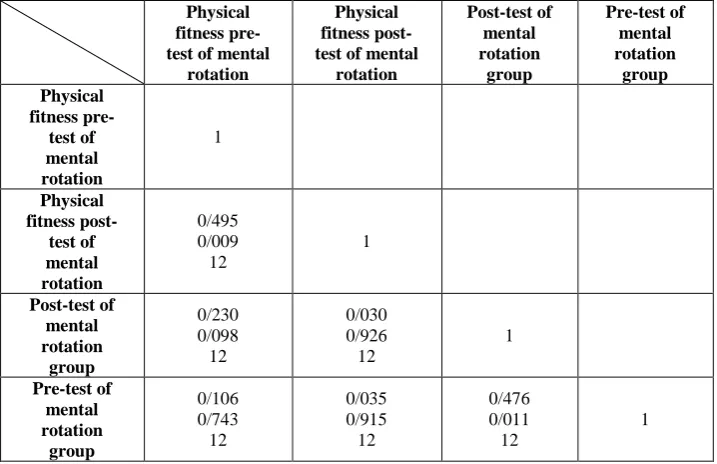
Table 7: The relationship between post-test mental rotation and pre-test physical training
Pearson correlation coefficient was used to test the relationship between mental rotation group and physical training group. According to
Physical fitness pre-test of mental
rotation
Physical fitness post-test of mental
the table (Table 7), the relationship between post-test mental rotation and pre-test physical training was significant at the 0.01 level. Also, the relationship between the post-test mental rotation group and the pre-test mental rotation group was significant at the level of 0.05 and because the level is less than 0.05, so the correlation between post-test mental rotation and pre-test physical training was significant. Mental rotation and post-test mental rotation group with pre-test mental rotation group were significant.
Table 8: Relationship between mental rotation and balance among elderly women
Pearson correlation coefficient Sig Number of respondents
-0/301 0/000 36
Pearson correlation coefficient was used to test of relationship
between mental rotation and balance among elderly women in table 8. According to the information in the table below, the relationship between mental rotation and balance among elderly women is significant at the 0.01 level because of the level is less than 0.05, so the result of the correlation between the relationship of mental rotation and balance among elderly women is significant. The relationship is positive and moderate.
Table 9: Mean balance among the elderly
Balance among elderly women
Levine test sig Levine test
T Df Sig F Sig
0/536 34 0/596 0/141 0/710
The results of mean balance test among female elderly by history of falling have shown in table 9.
Table 10: Relationship between mental rotation and falling of elderly women
Number of respondents Sig Pearson's correlation coefficient
36 0/047 0/131
relationship between mental rotation and falling in the elderly was significant. Positive and moderate reported.
DISCUSSION
of research, some of them are mentioned below. Some Elderly people got tired earlier than other ages due to physical limitations due to age, so research work can sometimes be done in several stages which might have affected the outcome. Another limitation of the study was the lack of patience of some seniors and the belief that they were unable to perform mental games and activities. Elderly who lacked literacy and vision due to old age found it difficult to understand the mental rotation test. Motivational and behavioral problems made it difficult to perform physical and mental exercises that required more practice and repetition, which required more time outside of the research timeframe. It takes a long time to follow the ethics of doing research with the elderly. Failure to cooperate with older staff is one of the limitations of the study, because there was no research on comparing the mental rotation in internal and external sources and there were very few resources, it was not possible to compare the results with similar ones. The results would be comparable in different provinces. According to the results of this study, it is suggested that: Comparison of mental rotation of elderly women with men The Elderly Center in which this study was conducted was for the elderly with disabilities, and it is recommended that the Elderly Center get included in this study. In this study, we compared the motor and mental activities of female elderly, suggesting different mental activities in relation with mental rotation.
CONCLUSIONS
The results showed that physical training and mental rotation training had a positive effect on the balance and falling of elderly women and the effect of physical training group was more on balance improvement in elderly women than mental rotation groups. So cognitive abilities and movements could be facilitating and effective in this way.
Acknowledgements
We would like to express our sincere thanks to all the participants, for their participation in this study.
REFERENCES
Adams, D. M., Stull, A. T., & Hegarty, M. (2014). Effects of mental and manual rotation training on mental and manual rotation performance. Spatial
Cognition & Computation, 14(3), 169-198.
doi:10.1080/13875868.2014.913050
Arfken, C. L., Lach, H. W., Birge, S. J., & Miller, J. P. (1994). The prevalence and correlates of fear of falling in elderly persons living in the community.
American journal of public health, 84(4), 565-570.
doi:10.2105/AJPH.84.4.565
Aslankhani, M. A., Farsi, A., Abdoli, B., Zamani Sani, S., & Fathi Rezaie, Z. (2009). [Identification of elderly falling risk by balance tests under dual tasks conditions]. Iranian Journal of Ageing, 4(12), 7-15. Retrieved from http://salmandj.uswr.ac.ir/article-1-316-en.html [In Persian]
Azimzadeh, E., Hosseini, M. A., Nourozi, K., & Davidson, P. M. (2015). Effect of Tai Chi Chuan on balance in women with multiple sclerosis. Complementary therapies in clinical practice, 21(1), 57-60. doi:10.1016/j.ctcp.2014.09.002
Baghbanporshokohi, A., Alipur, A. (2007). [Investigating the Effect of Computer's Games on Children's Mental Rotation Ability]. Educational Psychology, 2(6), 1-35. doi:10.22054/jep.2007.5993 [In Persian]
Bennie, S., Bruner, K., Dizon, A., Fritz, H., Goodman, B., & Peterson, S. (2003). Measurements of balance: comparison of the Timed" Up and Go" test and Functional Reach test with the Berg Balance Scale. Journal of Physical Therapy Science, 15(2), 93-97. doi:10.1589/jpts.15.93
Bento, P. C. B., Pereira, G., Ugrinowitsch, C., & Rodacki, A. L. F. (2010). Peak torque and rate of torque development in elderly with and without fall history. Clinical Biomechanics, 25(5), 450-454. doi:10.1016/j.clinbiomech.2010.02.002
Binda, S. M., Culham, E. G., & Brouwer, B. (2003). Balance, muscle strength, and fear of falling in older adults. Experimental aging research, 29(2), 205-219. doi:10.1080/03610730303711
Bloch, F., Thibaud, M., Dugué, B., Brèque, C., Rigaud, A. S., & Kemoun, G. (2010). Episodes of falling among elderly people: a systematic review and meta-analysis of social and demographic pre-disposing characteristics. Clinics, 65(9), 895-903. doi:10.1590/S1807-59322010000900013
Cooper, L. A. (1976). Demonstration of a mental analog of an external rotation. Perception & Psychophysics, 19(4), 296-302. doi:10.3758/BF03204234 Cumming, R. G., Salkeld, G., Thomas, M., & Szonyi, G. (2000). Prospective
Dehghanizadeh, J. Mohammadzadeh, H. Hosseini, F. S. (2013). [Effects of Gymnastics Training on Mental Rotation]. Journal of Cognitive Psychology, 1(1), 16-24. Retrieved from http://jcp.khu.ac.ir/article-1-1703-en.html [In Persian]
Duncan, P. W., Studenski, S., Chandler, J., & Prescott, B. (1992). Functional reach: predictive validity in a sample of elderly male veterans. Journal of gerontology, 47(3), M93-M98. doi:10.1093/geronj/47.3.M93
Fathi Rezaei, Zahra; Aslankhani, Mohammad Ali; Farsi, Ali Reza; Abdoli, Behrouz; & Zamani Sani, Seyyed Hojjat. (2010). [A comparison of three functional tests of balance in identifying fallers from non-fallers in elderly people]. Knowledge and Health, 4(4), 22-27. Retrieved from https://www.sid.ir/fa/journal/ViewPaper.aspx?ID=110976 [In Persian] Hatch, J., Gill-Body, K. M., & Portney, L. G. (2003). Determinants of balance
confidence in community-dwelling elderly people. Physical therapy, 83(12), 1072-1079. doi:10.1093/ptj/83.12.1072
Kulmala, J., Sihvonen, S., Kallinen, M., Alen, M., Kiviranta, I., & Sipilä, S. (2007). Balance confidence and functional balance in relation to falls in older persons with hip fracture history. Journal of geriatric physical therapy, 30(3), 114-120.
Liu‐Ambrose, T., Khan, K. M., Eng, J. J., Janssen, P. A., Lord, S. R., & Mckay, H. A. (2004). Resistance and agility training reduce fall risk in women aged 75 to 85 with low bone mass: A 6‐month randomized, controlled trial. Journal of the American Geriatrics Society, 52(5), 657-665. doi:10.1111/j.1532-5415.2004.52200.x
Nemmers, T. M., & Miller, J. W. (2008). Factors influencing balance in healthy community-dwelling women age 60 and older. Journal of Geriatric Physical Therapy, 31(3), 93-100.
Peters, M., Chisholm, P., & Laeng, B. (1995). Spatial ability, student gender, and academic performance. Journal of Engineering Education, 84(1), 69-73. doi:10.1002/j.2168-9830.1995.tb00148.x
Peters, M., Laeng, B., Latham, K., Jackson, M., Zaiyouna, R., & Richardson, C. (1995). A redrawn Vandenberg and Kuse mental rotations test-different versions and factors that affect performance. Brain and cognition, 28(1), 39-58. doi:10.1006/brcg.1995.1032
Shepard, R. N., & Metzler, J. (1971). Mental rotation of three-dimensional objects. Science, 171(3972), 701-703. doi:10.1126/science.171.3972.701 Shumway-Cook, A., & Woollacott, M. H. (2007). Motor control: translating
Simpson, J. M., Worsfold, C., Fisher, K. D., & Valentine, J. D. (2009). The CONFbal scale: a measure of balance confidence—a key outcome of
rehabilitation. Physiotherapy, 95(2), 103-109.
doi:10.1016/j.physio.2008.12.004
Tinetti, M. E., Richman, D., & Powell, L. (1990). Falls efficacy as a measure of fear of falling. Journal of gerontology, 45(6), P239-P243. doi:10.1093/geronj/45.6.P239
Todd, C., Skelton, D. (2004). What are the main risk factors for falls among older people and what are the most effective interventions to prevent these falls? Copenhagen, WHO Regional Office for Europe (Health Evidence
Network report; Retrieved from
http://www.euro.who.int/document/E82552.pdf, accessed 5 January 2020).
Vandenberg, S. G., & Kuse, A. R. (1978). Mental rotations, a group test of three-dimensional spatial visualization. Perceptual and motor skills, 47(2), 599-604.
Vaupel, J. W. (2010). Biodemography of human ageing. Nature, 464(7288), 536-542. doi:10.1038/nature08984
Voyer, D., & Bryden, M. P. (1990). Gender, level of spatial ability, and lateralization of mental rotation. Brain and Cognition, 13(1), 18-29. doi:10.1016/0278-2626(90)90037-O