Trans. Phenom. Nano Micro Scales, 1(1): 45-52, Winter - Spring 2013 DOI: 10.7508/tpnms.2013.01.005
45
ORIGINAL RESEARCH PAPER .Preparation of γ-Al
2O
3and Prioritization of Affecting Factors on the
Crystallite Size Using Taguchi Method
M. Shayesteh1*, M. Shafiee Afarani2,A. Samimi1, M. Khorram1
1 Deparetment of Chemical Engineering, University of Sistan and Bluchestan, Zahedan, Iran 2 Department of Materials Engineering, University of Sistan and Bluchestan, Zahedan, Iran
Abstract
In this work, boehmite sol was prepared by a previously applied and validated method; hydrolysis of aluminum chloride hexa-hydrate. In order to obtain precise results, the effect of pH after adding precipitating agent, aging time, peptizing temperature and ultrasonic vibration time on the crystallite size of final precipitate were investigated in a narrow range. The preparation conditions applied in the production step of nanocrystalline boehmite affected on the desired alumina phase. Experiments were set based on the statistical design of experiments (Taguchi method). Furthermore the influence of calcination on crystallization and phase transformation of the precipitate was investigated using X-ray diffractometry (XRD) and simultaneous thermal analysis (STA) techniques. To evaluate the results, the obtained data were statistically analyzed. Considering the statistical analysis of experiments, the pH after adding precipitating agent is the major parameter affecting crystallite size. In contrast, aging time has the smallest effect on the crystallite size. In addition, Transmission electron microscopy (TEM) of the samples revealed that the particle size of the powders was well distributed in the nano-size range. Taguchi prediction on the crystallite size was 2.096±0.139 nm (with confidence interval of 95%) which confirmed by a verification experiment (2.064 nm).
Keywords:Boehmite; γ-alumina;precipitation; aging time; ultrasonic vibration; Experimental design
1. Introduction
Gamma alumina is one of technological important materials in industrial applications. It is widely used as absorbent, catalyst supports and catalysts in form of nanopowder or thin-film coatings due to high specific surface area [1-4]. Common methods to prepare γ-alumina nanopowders are mechanical synthesis [5], vapor phase reaction [6], precipitation [7], combustion [8], and sol-gel [9] methods. Precipitation is a simple and fast chemical route which is used for synthesis of γ-alumina __________
*
Corresponding author
Email Address: [email protected]
46
common raw materials for synthesis of boehmite are aluminum alkoxide, aluminum nitrate and aluminum chloride [11, 12]. The last precursor has some advantages such as low cost, non-flammability, and non-toxicity [13]. In preparation of the γ-alumina
nanopowders by precipitation method using
AlCl3.6H2O as precursor, the most important
preparation parameters are AlCl3/H2O ratio, pH of
the solution after adding precipitating agent
(ammonia or NaOH), HNO3 to solution volume ratio,
peptizing temperature, and aging time. Many studies
have been made on preparation of γ-alumina
nanopowders by precipitation method [14]. However, most of these studies have not investigated the effects of some parameters such as pH, peptizing temperature and aging time simultaneously on the crystalline size and mean size of the prepared γ -alumina nanopowders.
In this work, the precipitation method was used to prepare γ-alumina nanopowder using AlCl3.6H2O in
water with possibility to obtain precipitate [15]. The main objectives of this research were to investigate the effect of pH after adding precipitating agent, peptizing temperature, and aging time on the
crystallite size of the prepared γ-alumina.
Furthermore, the ultrasonic vibration of boehmite sol was employed in the preparation procedure, and the effects of ultrasonic vibration time on the crystallite size of the prepared γ-alumina were investigated. To study the effects of these parameters on the crystallite size of the obtained γ-alumina, experiments were set based on the statistical design of experiments (DOE). The data obtained from the experiments were then statistically analyzed. X-ray diffractometry (XRD) technique with CuKα radiation was used to determine formations of γ-boehmite, γ-alumina and crystalline size. The desired calcination temperature was selected according to simultaneous thermal analysis (STA). Finally, the nanostructure of the obtained nanopowder was studied by transmission electron
microscopy (TEM). To the best of authors’
knowledge the effects of aforementioned parameters have not been studied systematically and precisely on the crystallite size by the other researchers. This study deals with the application of experimental design method to investigate the effect of process parameters on the crystallite size distribution in a narrow range.
2. Materials and methods 2.1.Nanopowder synthesis
Aluminum chloride hexa-hydrate (Merck) was used as starting material. Ammonia solution (25% wt) as a precipitating agent and nitric acid (65% wt) as a peptizing agent were used from Merck Chemical Co.
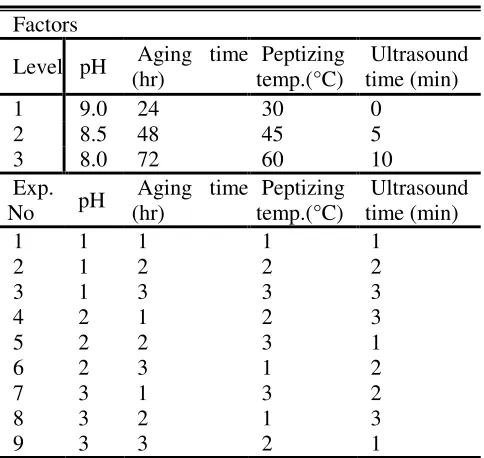
Table 1
Controlling factors and their levels including L9 (3 4
)
standard octagonal array
The precipitate was filtered and washed with distilled water to remove the chloride ions. The obtained precipitate was dispersed in distilled water. To study the effects of aging time, the suspension was kept at room temperature for given time in Table 1. Then it was heated at 80oC for 3 h. After reaching the temperature of suspension to the ambient temperature; the precipitate was peptized at mentioned temperature in Table 1 and pH of about 3.0 by addition of diluted nitric acid solution (0.3% wt) to obtain a boehmite stable sol in the end of peptizing. To study the effect of ultrasonic vibration on the crystallite size of the prepared nanopowder, the boehmite sol was placed in ultrasonic bath (Power Sonic 405, Korea) for the given time in Table 1. After aging, solution was dried at 100°C for 24 h. The prepared powder was calcined at 550 °C for 2 h.
Factors
Level pH Aging time
(hr)
Peptizing temp.(°C)
Ultrasound time (min)
1 9.0 24 30 0
2 8.5 48 45 5
3 8.0 72 60 10
Exp.
No pH
Aging time (hr)
Peptizing temp.(°C)
Ultrasound time (min)
1 1 1 1 1
2 1 2 2 2
3 1 3 3 3
4 2 1 2 3
5 2 2 3 1
6 2 3 1 2
7 3 1 3 2
8 3 2 1 3
M. Shayesteh et al./ TPNMS 1 (2013)
2.2 Experiment design
Influence of different process parameters on the crystallite size were investigated using design of experiment method. As the time and financial constraints play important role in experimental work, before conducting the experiments, appropriate levels for the input factors are needed. In this study, the input factors and corresponded levels are shown in Table 1. According to previous studies [16, 17] the appropriate levels were chosen. According to full factorial design, for a set of four factors with three levels, normally, 34=81 experiments needed to be conducted. A robust experimental design (here Taguchi method) was applied due to the large number of experiments resulting from
parameters which needed to be optimized. According to the Taguchi method an orthogonal array of L9 (Table 1) was used. Resulting only nine experiments can be replaced with 81 experiments. The Taguchi method is a combination of statistical and mathematical techniques that can be used to determine the conditions of experiment and obtain an optimum condition. In addition, the variability of conditions can be introduced using the signal to noise (S/N) ratio. In this way, the experimental condition having the minimum S/N ratio is considered as the optimal condition. Moreover, in order to decide whether the effect of the input factors is significant the statistical analysis of variance (ANOVA) was used.
2.3. Sample characterization
X-ray diffractometry technique with CuK
(Siemens, D-500, Germany) was performed for structure analysis. Line broadening of XRD peaks is also used for crystalline size determination.
Differential thermal analysis (DTA) and
thermogravimetry analysis (TGA) were used wi rate of 10°C/min with the STA PL-1640 equipment. The experiments were conducted under air atmosphere up to 1200 oC for both DTA and TGA. The mean particle size and size distribution of the boehmite sols were determined by particle size
analyzer, using a nanosizer (SYMPATEC,
NANOPHOX, Germany). The morphology of prepared γ-alumina nanopowder was observed using TEM (Philips, CM-120). In this regard, the prepared nanopowders were dispersed in about 3mL ethanol. One droplet of the dispersed nanopowder solu
M. Shayesteh et al./ TPNMS 1 (2013) 45-52
47
Influence of different process parameters on the crystallite size were investigated using design of experiment method. As the time and financial experimental work, before conducting the experiments, appropriate levels for the input factors are needed. In this study, the input factors and corresponded levels are shown in Table 1. According to previous studies [16, 17] the osen. According to full factorial design, for a set of four factors with three =81 experiments needed to be conducted. A robust experimental design (here Taguchi method) was applied due to the large number of experiments resulting from many parameters which needed to be optimized. According to the Taguchi method an orthogonal array of L9 (Table 1) was used. Resulting only nine experiments can be replaced with 81 experiments. The Taguchi method is a combination of statistical and ical techniques that can be used to determine the conditions of experiment and obtain an optimum condition. In addition, the variability of conditions can be introduced using the signal to noise (S/N) ratio. In this way, the experimental condition he minimum S/N ratio is considered as the optimal condition. Moreover, in order to decide whether the effect of the input factors is significant the statistical analysis of variance (ANOVA) was
technique with CuKα radiation 500, Germany) was performed for structure analysis. Line broadening of XRD peaks is also used for crystalline size determination.
Differential thermal analysis (DTA) and
thermogravimetry analysis (TGA) were used with a 1640 equipment. The experiments were conducted under air C for both DTA and TGA. The mean particle size and size distribution of the boehmite sols were determined by particle size
a nanosizer (SYMPATEC,
NANOPHOX, Germany). The morphology of alumina nanopowder was observed using 120). In this regard, the prepared nanopowders were dispersed in about 3mL ethanol. One droplet of the dispersed nanopowder solution
was then dripped onto copper grid where the sample was dried at room temperature before TEM analysis.
3. Results and discussion
Alumina has been attributed to the following phenomena: (a) precipitation reaction in which AlCl reacts with ammonia and produces aluminum hydroxide, (b) aging step in which Al(OH)
to γ-boehmite, (c) calcination in which transformed to γ-alumina [13].
3.1. TGA and DTA analysis
Figure 1 presents TG and DTA curves of the dried boehmite powder. TG curve illustrates three main areas within the measured temperature range.
Fig. 1. DTA and TG curves of the
In the first area from 25 to 180
loss is observed that has been attributed to desorption of adsorbed water. The second area is from 180 to 550oC where the weight loss is 24% is due to transition the boehmite to γ-
significant weight loss in the third area from 550 to 1200oC. The total weight loss of 33% in the precipitant after calcinations is in
reported data by hassanzadeh
Nassaj [13]. DTA curve in Figure 1 shows small
endothermic peak at about 301o
endothermic heat transition γ- boehmite to It can be also seen from DTA curve t transformation begins at about 252
was then dripped onto copper grid where the sample was dried at room temperature before TEM analysis.
Alumina has been attributed to the following phenomena: (a) precipitation reaction in which AlCl3
d produces aluminum hydroxide, (b) aging step in which Al(OH)3 converts
boehmite, (c) calcination in which γ-boehmite
Figure 1 presents TG and DTA curves of the dried γ -curve illustrates three main areas within the measured temperature range.
DTA and TG curves of the γ-boehmite
In the first area from 25 to 180oC about 9% weight loss is observed that has been attributed to desorption cond area is from 180 to C where the weight loss is 24% is due to alumina. There is no significant weight loss in the third area from 550 to C. The total weight loss of 33% in the precipitant after calcinations is in agreement with the reported data by hassanzadeh-Tabrizi and Taheri-Nassaj [13]. DTA curve in Figure 1 shows small
o
3.2. XRD analysis
The XRD pattern of the precipitate sample (Boehmite) and calcinated precipitate samples of Table 1 are shown in Figure 2.
Comparison of XRD pattern of the precipitate and calcinated samples to JCPDS Card 21
JCPDS Card 10-0425 revealed that precipitate was boehmite which after calcinations transformed to alumina. The average crystallite size was estimated from the corresponded peak (020) (by Debye Scherrer equation) [18] and presented in Table 2.
Fig. 2. The XRD patterns of boehmite and alumina samples
As it is seen, the average crystallite size of boehmite and γ-alumina samples are less than 3 nm and 4 nm, respectively. Furtheremore, The (440) peak of alumina has a stronger intensity than the (400) peak, indicating that the (440) planes may be the preferential growth direction. On the other hand, boehmite has provided more intense peaks compared to γ-alumina samples. In the following, the results of statistical analysis of the given experimental data in Table 2 are presented.
3.3 Effect of process parameters on the crystallite size
Table 2 presents the mean measured crystallite size of samples. In this section, the S/N ratio type S (the smaller, the better) was chosen for minimizing the crystallite size of samples:
10 1/∑
48
The XRD pattern of the precipitate sample (Boehmite) and calcinated precipitate samples of
Comparison of XRD pattern of the precipitate and samples to JCPDS Card 21-1307 and 0425 revealed that precipitate was boehmite which after calcinations transformed to γ -alumina. The average crystallite size was estimated from the corresponded peak (020) (by
Debye-presented in Table 2.
The XRD patterns of boehmite and γ -
As it is seen, the average crystallite size of boehmite alumina samples are less than 3 nm and 4 nm, respectively. Furtheremore, The (440) peak of γ
-a stronger intensity th-an the (400) pe-ak, indicating that the (440) planes may be the preferential growth direction. On the other hand, boehmite has provided more intense peaks compared alumina samples. In the following, the results of alysis of the given experimental data in
3.3 Effect of process parameters on the
Table 2 presents the mean measured crystallite size In this section, the S/N ratio type S (the was chosen for minimizing the
(1)
Where, S/N is defined as the signal/noise ratio, y the characteristic property, and n is the number of repetition in each experiment.
Table 2
Experimental data (responses) and sample statistics for the crystallite size
Effects of different process parameters on the crystallite size of samples are also illustrated in Figure 3 which is explained in detail as following.
3.3.1. Effect of pH after adding the precipitating agent
The behavior of crystallite size of samples is complex in different levels of pH. The data reported in Table 2 was statically analyzed leading to the minimum size correspond to the largest surface of γ-alumina nanopowders. Figure 3 shows mean of S/N ratios for the crystallite size of
nanopowders versus levels of input parameters using Taguchi method. As it is seen, increasing pH from 8 to 8.5 leads to the decrease of the crystallite s
alumina, while increasing pH from 8.5 to 9 Ex p. No. Readin g 1 Readin g 2
1 2.89 2.73
2 2.34 2.45
3 2.97 2.77
4 2.73 2.63
5 2.03 2.23
6 2.51 2.75
7 2.72 2.80
8 3.46 3.49
9 2.98 2.90
Where, S/N is defined as the signal/noise ratio, yi is
the characteristic property, and n is the number of
Experimental data (responses) and sample statistics
Effects of different process parameters on the crystallite size of samples are also illustrated in Figure 3 which is explained in detail as following.
3.3.1. Effect of pH after adding the precipitating
The behavior of crystallite size of samples is complex in different levels of pH. The data reported in Table 2 was statically analyzed leading to the minimum size correspond to the largest surface area alumina nanopowders. Figure 3 shows mean of S/N ratios for the crystallite size of γ-alumina nanopowders versus levels of input parameters using Taguchi method. As it is seen, increasing pH from 8 to 8.5 leads to the decrease of the crystallite size of γ -alumina, while increasing pH from 8.5 to 9 increases
Mean ±
SD S/Ns
2.810 ±
0.113
-8.978
2.395 ±
0.078
-7.589
2.870 ±
0.141
-9.163
2.680 ±
0.071
-8.565
2.130 ±
0.141
-6.576
2.630 ±
0.170
-8.409
2.760 ±
0.057
-8.820
3.475 ±
0.021
-10.82
2.940 ±
0.057
M. Shayesteh et al./ TPNMS 1 (2013)
the crystallite size. Okado et al [19] have that the crystallite size of the boehmite
Fig. 3. Mean of S/N ratios for the crystallite size of samples versus levels of input parameters using Taguchi method.
This permanent increase is caused by enhancement of grain growth by a dissolution–
mechanism during aging due to
solubility of boehmite with increasing solution pH. However, with increasing pH from 8 to 9, specific
Table 3
Analysis of ANOVA for the crystallite size
3.3.2. Effect of aging time
The effect of aging time of the precipitate on the crystallite size of γ-alumina is shown in Figure 3. These results were obtained according to statistical analysis performed on the presented data in Table 2. The results show that increasing aging time from 24 to 48 h leads to the decrease of the crystallite size of
γ-alumina, while further increasing in the aging from 48 to 72 h increases of the crystallite size. The results of ANOVA for the crystallite size of samples (Table 3) show that aging time has least influence on the crystallite size of samples (1.85%). According to Table 4, the optimal condition on the crystallite size is obtained at aging time = 48h. Some researchers [19, 20] have reported that the crystallite si
Factors
pH Aging time (hr) Peptizing temp.(°C) Ultrasound time (min)
Error Total
M. Shayesteh et al./ TPNMS 1 (2013) 45-52
49
[19] have reported that the crystallite size of the boehmite increased
almost linearly with increasing pH.
N ratios for the crystallite size of samples versus levels of input
This permanent increase is caused by enhancement of grain growth by a dissolution–reprecipitation the increased solubility of boehmite with increasing solution pH. However, with increasing pH from 8 to 9, specific
surface area decreases due to the agglomeration of boehmite particles. The results of ANOVA for the crystallite size of samples (Table 3) s
crystallite size of samples is highly affected by pH after adding precipitating agent (43.367%).
Analysis of ANOVA for the crystallite size
The effect of aging time of the precipitate on the alumina is shown in Figure 3. These results were obtained according to statistical analysis performed on the presented data in Table 2. hat increasing aging time from 24 to 48 h leads to the decrease of the crystallite size of alumina, while further increasing in the aging time from 48 to 72 h increases of the crystallite size. The results of ANOVA for the crystallite size of samples ble 3) show that aging time has least influence on the crystallite size of samples (1.85%). According to Table 4, the optimal condition on the crystallite size is obtained at aging time = 48h. Some researchers crystallite size of the
boehmite always increases with increasing aging time.
3.3.3 Effect of peptizing temperature
Figure 3 demonstrates the effect of peptizing temperature on the crystallite size of
is seen, the crystallite size decreases with incre peptizing temperature. No results about this parameter have been observed in open literatures. It seems that peptizing temperature increases causes partly dissolution of bohemite precipitant. The results of ANOVA for the crystallite size of samples ( 3) show that peptizing temperature (20.223%) is other important factor affecting on the crystallite size.
DOF Sum of Sqrs. Variance
F-2 1.027 0.513 46.385
2 0.065 0.032 2.937
2 0.491 0.245 22.164
2 0.635 0.317 28.665
9 0.099 0.011
17 2.319 --
almost linearly with increasing pH.
surface area decreases due to the agglomeration of boehmite particles. The results of ANOVA for the crystallite size of samples (Table 3) show that the crystallite size of samples is highly affected by pH after adding precipitating agent (43.367%).
boehmite always increases with increasing aging
3.3.3 Effect of peptizing temperature
Figure 3 demonstrates the effect of peptizing temperature on the crystallite size of γ-alumina. As it is seen, the crystallite size decreases with increasing peptizing temperature. No results about this parameter have been observed in open literatures. It seems that peptizing temperature increases causes partly dissolution of bohemite precipitant. The results of ANOVA for the crystallite size of samples (Table 3) show that peptizing temperature (20.223%) is other important factor affecting on the crystallite size.
-Ratio P (%)
46.385 43.367
2.937 1.85
22.164 20.223
28.665 26.435
-- 8.125
50 3.3.4. Effect of ultrasonic vibration time
The effect of ultrasonic vibration time of boehmite sol on the crystallite size of γ-alumina is shown in Figure 3. The results represent that the crystallite size of γ-alumina overlay increases with increasing time of ultrasonic time. The similar results were not found in this issue but it has been confirmed for synthesized ZnO nanoparticles by [21].
Analyzing the experimental results illustrated in Table 3 reveals the most effective parameters on the crystallite size of γ-alumina. The results show that
pH affects the crystallite size more than any other studied parameters.
According to analysis of ANOVA it is expected that optimum conditions of the four aforementioned factors with corresponding levels presented in Table 4 cause to decrease the crystallite size to 2.096 nm. In addition, one confirmation experiment is conducted and the crystallite size of samples of 2.064 nm is obtained for this sample (Table 4).
Table 4
Optimal setting and corresponding verification experiment for the crystallite size
Owing to the confidence interval (95%) achieved, the verification experiment is in good agreement with Taguchi predictions (2.096±0.139). Figure 4 shows the average size and size distribution of a Boehmite sol, obtained by nanosizer. The average size of the particles in sol was found 80 nm with a narrow size distribution.
Fig. 4. The particle size distribution of prepared boehmite sol
This represents that boehmite nanoparticles in sol aggregate while the average crystallite size of boehmite at 100 oC (as crystalline phase in the dried
precipitate) was estimated about 2.74 nm based on Figure 2.
TEM micrograph of calcined sample 1 at 550oC (γ -alumina) has been presented in Figure 5.
Fig. 5. TEM images of the γ- Alumina nanoparticles
The Figure clearly shows that the shape of nanopowder does not look precisely spherical. The size of nanopowder based on TEM analysis was smaller than 5 nm. Furthermore, uncontrolled aggregation of nanoparticles during precipitation and calcinations caused the formation of agglomerates.
Optimal setting Prediction of
Taguchi
Confidence interval (95%)
Verification Exp. (mean)
Factors Level
pH 8.5
Aging time (hr) 48 2.096 ± 0.139 2.064
Peptizing temp.(°C) 60
M. Shayesteh et al./ TPNMS 1 (2013) 45-52
51
4. Conclusions
Aluminum hydrate was synthesized by the precipitationmethod from inexpensive materials such as an inorganic aluminum salts. The absorbed water
was evaporated at 100oC and powder was dehydrated
(conversion of boehmite into gamma alumina) at
550oC. The calculated Boehmite and gamma alumina
crystallite sizes were found to be less than 4 nm. The Nano-sized Al2O3 particles were prepared with an
average size of 2.74 nm from low cost AlCl3.6H2O
via an economical precipitation method. In addition, the total weight loss of 33% was obtained in the precipitate after heat treatment due to removal of water. To evaluate the results, the obtained data were statistically analyzed. Considering the statistical analysis of experiments, the pH after adding precipitating agent is the major parameter affecting crystallite size. In contrast, aging time has the smallest effect on the crystallite size. In preparing boehmite, pH after adding precipitating agent and ultrasonic vibration time contribute to compose of smaller γ- alumina nanoparticles.
References
[1] R.R. Bhave, Inorganic Membranes:Characterization and application, New York, van Nostrand Reinhold (1991) 1- 24.
[2] K.A. DeFriend, M.R. Wiesner, A.R. Barron,
Alumina and aluminate ultrafiltration membranes derived from alumina nanoparticles, J. Membr Sci. vol. 224 (2003) 11-28.
[3] Y. Cho, K. Han, K. Lee, separation of CO2 by modified γ-Al2O3 membranes at high temperature, J. Membr Sci. 104 (1995) 219.
[4] X. Changrong, W. Feng, M. Zhaojing, L. Fanqing , P. Dingkun, M. Guangyao, Boehmite sol properties and preparation of two-layer alumina membrane by a sol-gel process, J. Membr Sci. 116 (1996) 9-16.
[5] M.L. Panchula, J.Y. Ying , Mechanical Synthesis of Nanocrystalline α-Al2O3 Seeds for Enhanced
Transformation Kinetics, Nanostruct Mater. 9
(1997) 161.
[6] K. Kamata, T. Mochizuki, S. Matsumoto, A.
Yamada, K. Miyokawa, Preparation of
submicrometer Al2O3 powder by gas-phase
oxidation of tris(acetylacetonato) alumina (III), J. Am Ceram Soc. 68 (8) (1985) C-193–C-194.
[7] J.G. Li, X.D. Sun. Synthesis and sintering behavior of a nanocrystalline α-Al2O3 powder, Acta Mater. 48 (2000) 3103-3112.
[8] J.J. Kingsley, K.C. Patil, A novel combustion process for the synthesis of fine particle α- alumina and related oxide materials, Mater Lett. 6 (1988) 427–432.
[9] S.A. Hassanzadeh-Tabrizi, E. Taheri-Nassaj,
H. Sarpoolaky, Synthesis of an alumina–YAG
nanopowder via Sol-Gel method, J Alloy Compd.
456 (2008) 282-285.
[10] R. Tipakontitikul, A. Niyompan, K. Srisurat, N. Kanchanarat, T. Tunkasiri, Effect of pH on
Phase Formation and Morpholo of the
Nanocrystalline Boehmite Powder Prepared by a Precipitation Method, Journal of Micros copy Society of Thailand 22 (2008) 20-22.
[11] W. Tsunenori, M. Yoshihisa, M. Takeo, K. Hiroyoshi, H. Saburo, W. Kenji, I. Masashi, Pore structure of c-Ga2O3–Al2O3 particles
prepared by spray pyrolysis, Micropor Mesopor
Mat. 145 (2011) 131-140.
[12] R. Brace, E. Matijevic, Aluminium hydrous oxide sols: I, J. Inorg Nucl Chem. 35 (1973)
3691–3705.
[13] S.A. Hassanzadeh-Tabrizi, E. Taheri-Nassaj,
Economical synthesis of Al2O3 nanopowder
using a precipitation method”, Mater Lett.
63 (2009) 2274-2276.
[14] H. Kwang-Taek, L. Hee-Soo, L. Shi-Hee, C. Koo-Chun, P. Shin-Seo, L. Jae-Hoon, Synthesis of aluminum hydrates by a precipitation method and their use in coatings for ceramic membranes, J Eur Ceram Soc. 21 (2001) 375-380.
[15] V. Francetic, P. Bukovec, Peptization and Al-
Keggin Species in Alumina Sol, Acta Chim
Slov. 55 (2008) 904- 908.
[16] H. Beygi, M. Zare, S.A. Sajjadi, Fabrication of
FeNi–Al2O3, nanocomposites and optimization
of mechanical properties using Taguchi method,
Powder Technology 232 (2012) 49–57.
[17] S. H. Sadeghi, V. Moosavi, A. Karami, N. Behnia, Soil erosion assessment and prioritization of affecting factors at plot scale using the Taguchi method, Journal of Hydrology, 448–449 (2012) 174– 180.
[18] X. Bokhimi, J.A. Toledo-Antonio, M.L.
Guzman-Castillo, B. Mar-Mar, F. Hernandez-Beltran, J. Navarette, Dependence of Boehmite Thermal Evolution on Its Atom Bond Lengths and Crystallite Size, J. Solid State Chem. 161 (2001) 319-326.
52 [20] J.M. Rousseaux, P. Weisbecker, H. Muhr, E.
Plasari, Aging of Precipitated Amorphous Alumina Gel, Ind Eng Chem Res. 41 (2002) 6059-6069.
[21] Y. Raghvendra, M. Priya, P. Avinash, Growth
mechanism and optical property of ZnO